


The 21st Century Road to Housing Act, passed on 13 March 2026, has fundamentally altered the sequence of property transactions in England — and with that shift comes a new wave of valuation disputes that expert witnesses must be equipped to handle. Expert Witness Preparation for 2026 Homebuying Reform Disputes: Valuation Impacts of Upfront Survey Mandates is no longer a niche specialism; it sits at the intersection of legislative compliance, RICS professional standards, and contested property valuations that courts and tribunals are increasingly being asked to resolve.
The central change is straightforward: sellers must now commission condition assessments before listing a property, rather than buyers arranging surveys after an offer is accepted. That single procedural inversion has cascading effects on how valuations are formed, challenged, and defended in dispute proceedings [1].
Key Takeaways
- The 21st Century Road to Housing Act (March 2026) mandates seller-commissioned upfront condition surveys, reshaping transaction workflows and generating new categories of valuation dispute.
- Expert witnesses must align their evidence with the updated RICS Professional Standard for Surveyors Acting as Expert Witnesses, which now reflects 2026 market conditions.
- Upfront survey data is expected to improve valuation accuracy, but disputed interpretations of condition findings are already driving litigation.
- Data-driven methodologies — including statistical comparables analysis and cost-to-cure modelling — are now essential components of defensible expert evidence.
- Early neutral evaluation is growing as a pre-litigation mechanism, requiring experts to produce rigorous preliminary assessments efficiently.
How the 2026 Reforms Have Changed the Valuation Landscape
The Shift from Buyer to Seller-Commissioned Surveys
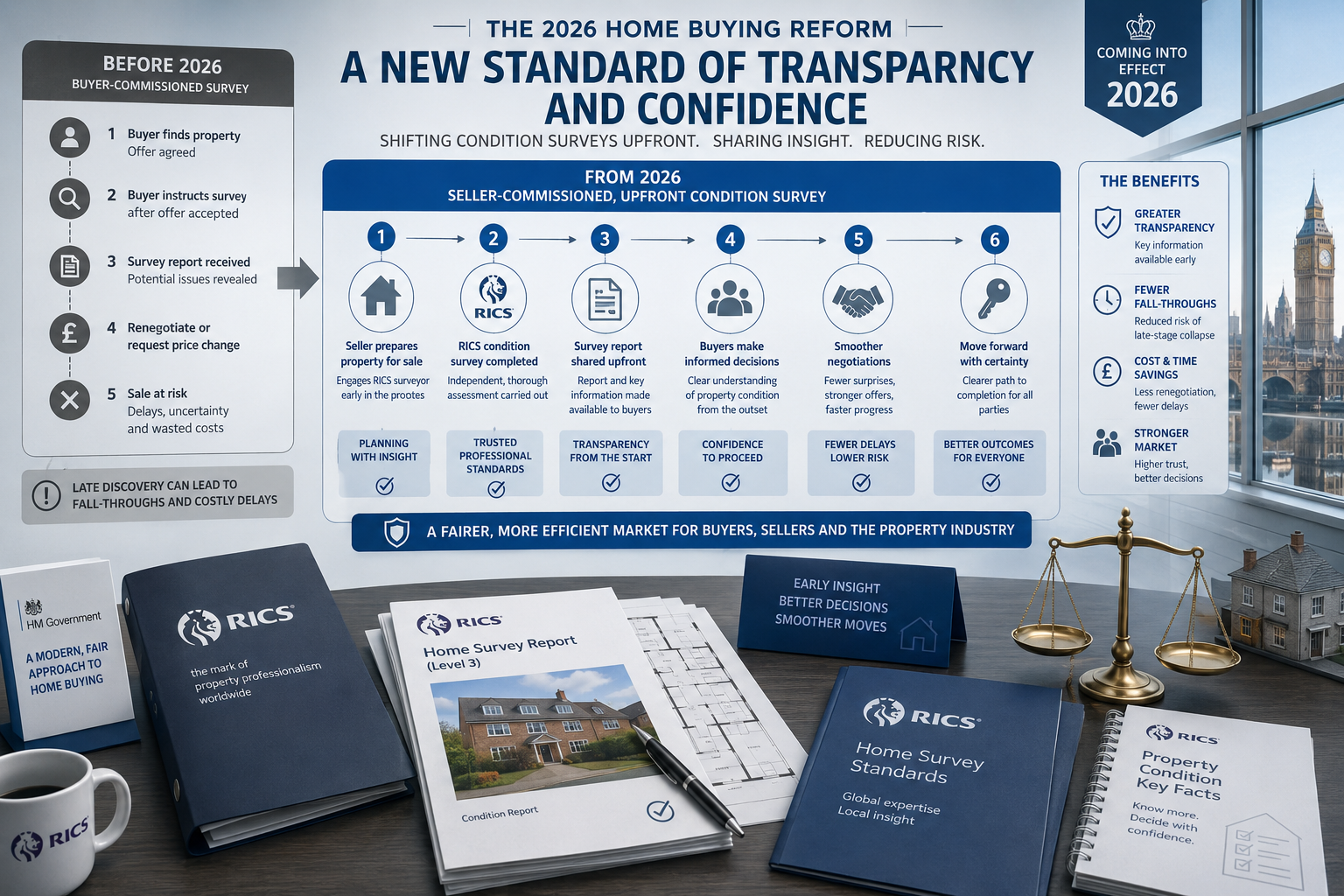
Before 2026, the standard sequence was offer first, survey second. A buyer would agree a price based on limited visible information, then commission a homebuyers survey or full structural assessment that could reveal defects and trigger renegotiations — or collapse the deal entirely. This late-stage discovery was a primary driver of transaction delays and fall-throughs.
Under the new framework, sellers bear the cost of an upfront condition assessment — averaging approximately £380 — before the property is listed [2]. This report is then made available to all prospective buyers, meaning condition data enters the negotiation at the outset rather than after an offer is locked in.
The practical consequences for valuation are significant:
| Pre-2026 Workflow | Post-2026 Workflow |
|---|---|
| Offer made on limited information | Offer made with full condition data available |
| Survey reveals defects post-offer | Defects disclosed before any offer is made |
| Renegotiation common after survey | Price already reflects known condition |
| Deal failures from late surprises | Reduced fall-throughs expected |
| Buyer commissions survey | Seller commissions upfront assessment |
The availability of comprehensive condition data before offers are made is projected to reduce post-inspection price renegotiations and minimise deal failures caused by late-stage surprises [1]. However, it also creates a new problem: disputes about whether the upfront survey accurately reflected the property's condition, and whether the agreed price properly accounted for disclosed defects.
New Categories of Valuation Dispute
The reforms have introduced dispute categories that did not exist at scale before 2026. These include:
- Disputed defect severity: A buyer argues the upfront survey understated the seriousness of a structural issue, meaning the agreed price was too high relative to actual condition.
- Market impact disagreement: Parties contest how much a disclosed defect should have reduced the asking price in the prevailing market.
- Survey scope adequacy: Questions arise about whether the seller-commissioned report met the required standard of investigation.
- Lender valuation conflicts: A mortgage lender's valuation diverges from the agreed price after reviewing the upfront condition report, triggering a dispute between buyer, seller, and lender.
Each of these scenarios requires an expert witness who can provide credible, court-ready valuation evidence that accounts for both the condition findings and the reformed transaction process.
Expert Witness Preparation for 2026 Homebuying Reform Disputes: Building a Defensible Evidence Base
Aligning with Updated RICS Standards
The Royal Institution of Chartered Surveyors has updated its Professional Standard for Surveyors Acting as Expert Witnesses to reflect the conditions created by the 2026 reforms. The standard now places greater emphasis on documented, rigorous processes for forming valuation opinions, with objectivity and regulatory compliance as non-negotiable requirements [3].
For any expert witness operating in this environment, the starting point is a thorough understanding of what the updated standard demands. Key obligations include:
- Maintaining a clear audit trail from condition evidence to valuation conclusion
- Demonstrating that comparable market evidence was selected and weighted systematically
- Disclosing any limitations in the upfront survey data that affected the valuation opinion
- Confirming that the expert's duty is to the court, not to the instructing party
Professionals seeking chartered surveyor accreditation and expert witness recognition must now demonstrate familiarity with the reformed transaction framework as part of their competency evidence.
Integrating Building Survey Evidence into Valuation Reports
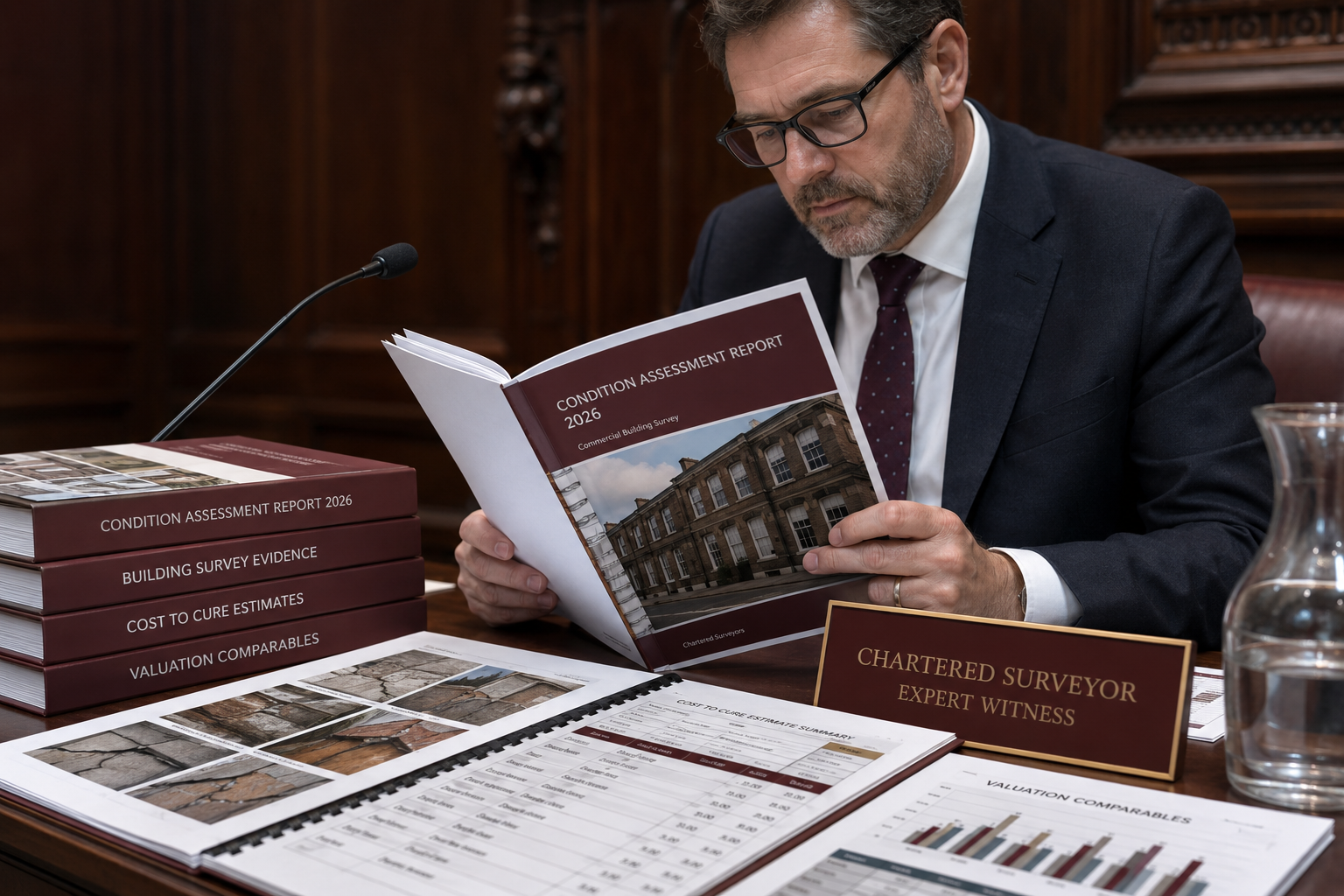
One of the most significant practical shifts in expert witness preparation is the expectation that valuation opinions will be directly anchored to detailed building survey evidence [5]. In the pre-2026 model, a valuation expert might reference a buyer's survey in passing. Under the new framework, the upfront condition report is a primary document in any dispute, and the expert witness must engage with it systematically.
A robust expert report in 2026 disputes should include:
- Structural defect documentation — A clear account of each defect identified in the upfront survey, with reference to the relevant section of the report and any photographic evidence.
- Cost-to-cure estimates — Quantified remediation costs sourced from current contractor pricing, used to establish the financial impact of each defect on market value.
- Market impact assessment — Evidence of how comparable properties with similar disclosed defects have transacted in the same market, demonstrating the price adjustment a willing buyer and seller would have agreed.
- Condition rating analysis — An assessment of whether the survey's condition ratings (typically RICS Condition Ratings 1, 2, or 3) were appropriately applied, and what valuation adjustment each rating warrants.
For disputes involving specific defect types — such as damp and timber issues or subsidence — the expert witness must be prepared to challenge or defend the technical findings of the upfront survey, not merely accept them as given.
Reviewing a condition survey report produced under the new seller-commissioned model requires a different analytical lens than reviewing a traditional buyer-instructed report. The audience for the upfront report is broader — it must serve multiple prospective buyers — and its scope may differ from a bespoke buyer's survey in ways that are material to a valuation dispute.
Data-Driven Methodologies: The New Standard for Expert Evidence
The current dispute environment places a strong emphasis on data-driven analysis [6]. Courts and tribunals expect expert witnesses to move beyond subjective professional opinion and demonstrate that their valuation conclusions are grounded in statistical evidence and replicable methodology.
Core data-driven tools now expected in expert witness preparation include:
- Regression analysis of comparable sales — Isolating the price impact of specific condition factors across a dataset of comparable transactions, rather than relying on a small number of manually selected comparables.
- Cost-to-cure modelling — Using current market data for remediation costs to produce defensible estimates of how much a given defect reduces market value.
- Predictive market modelling — Where a dispute involves a property that was valued at a point of market uncertainty, statistical modelling can demonstrate the range of values that a reasonable expert would have arrived at.
- Sensitivity analysis — Showing how the valuation conclusion changes under different assumptions about defect severity or remediation cost, which demonstrates intellectual rigour and helps the court understand the range of reasonable outcomes.
"The expectation is no longer that an expert will simply state a figure and defend it on the basis of experience. The evidence must show the methodology, the data, and the reasoning — step by step."
This shift rewards surveyors who invest in data literacy and analytical tools, and it disadvantages those who rely solely on traditional comparable selection methods.
Procedural Preparation: From Instruction to Tribunal
Early Neutral Evaluation and Pre-Litigation Strategy
A notable trend in 2026 is the growth of early neutral evaluation (ENE) as a mechanism for resolving upfront survey disputes before they reach formal litigation [6]. In ENE, a neutral expert — often a senior chartered surveyor — provides a preliminary assessment of the likely outcome if the dispute proceeded to a hearing. This assessment is non-binding but frequently leads to settlement.
For expert witnesses, ENE creates a dual challenge: producing a thorough, defensible assessment quickly, and doing so in a way that is genuinely objective rather than partisan. The skills required for ENE overlap with those for formal expert witness work, but the time pressure is greater and the emphasis on practical settlement is more explicit.
Surveyors involved in legal disputes arising from the 2026 reforms should be prepared to operate in both ENE and formal tribunal contexts, and to adapt their reporting style accordingly.
Managing the Expert Witness File
Procedural discipline is as important as technical expertise. A well-managed expert witness file should contain:
- The letter of instruction and any subsequent amendments
- The upfront condition survey report in its original form
- All comparable transaction evidence, with source documentation
- Notes of any site inspection carried out by the expert
- Correspondence with the instructing solicitor, clearly marked to distinguish factual instructions from opinion-forming discussions
- Draft reports and revision notes, retained to demonstrate the evolution of the expert's thinking
Courts have increasingly scrutinised the process by which expert opinions are formed, not just the conclusions reached. A clean, well-documented file is a practical defence against challenges to the expert's independence.
Understanding the Impact of Survey Report Findings on Agreed Prices
A recurring issue in 2026 disputes is the question of causation: did the upfront survey finding actually cause the agreed price to be higher or lower than it should have been, or was the price determined by other market factors? Establishing this causal link is one of the most technically demanding aspects of expert witness preparation.
The impact of survey reports on property transactions has always been significant, but the new framework makes it explicit and documented. Because the upfront survey is provided to buyers before any offer is made, there is a clear evidentiary record of what was known and when. This transparency is valuable for expert witnesses, because it removes the ambiguity that previously existed about whether a buyer had factored a known defect into their offer.
For disputes involving boundary issues or party wall matters that appear in upfront condition reports, the expert witness must also be familiar with the relevant legal framework — including the Party Wall Act 1996 — to assess whether disclosed issues were correctly characterised and priced.

Expert Witness Preparation for 2026 Homebuying Reform Disputes: Technology and Professional Development
Technology Integration in Survey Evidence
Emerging technologies are beginning to reshape how condition assessments are conducted and how the resulting evidence is used in disputes [4]. Two developments are particularly relevant for expert witnesses:
Artificial intelligence for defect detection — AI-assisted inspection tools can identify patterns of deterioration — such as early-stage damp penetration or micro-cracking in render — that may not be visible to the naked eye. Where an upfront survey was conducted using AI-assisted tools, the expert witness must understand the technology's capabilities and limitations in order to assess whether the findings were reliable.
Blockchain for survey record integrity — Some providers are beginning to record survey data on blockchain-based systems, creating an immutable audit trail that cannot be altered after the fact. In disputes where the integrity of the original survey record is contested, this technology provides a verifiable chain of evidence.
Expert witnesses who understand these technologies will be better placed to assess the reliability of upfront survey evidence and to challenge or defend specific findings in tribunal proceedings.
Professional Development Priorities for 2026
The combination of legislative change, updated RICS standards, and technological innovation means that professional development is not optional for surveyors who wish to operate as expert witnesses in 2026 reform disputes [3].
Priority areas for development include:
- RICS Expert Witness accreditation and the updated CPD requirements associated with it
- Training in statistical analysis and data visualisation tools relevant to valuation evidence
- Familiarity with the 21st Century Road to Housing Act and its implementing regulations
- Understanding of AI-assisted inspection methodologies and their evidentiary implications
- Experience with ENE processes and the reporting standards they require
Surveyors who are new to expert witness work should also consider reviewing what a surveyor does across different roles and responsibilities to ensure their foundational competencies are aligned with the demands of dispute work.
Conclusion
Expert Witness Preparation for 2026 Homebuying Reform Disputes: Valuation Impacts of Upfront Survey Mandates demands a disciplined, multi-layered approach that combines technical valuation expertise, procedural rigour, and an understanding of the reformed legislative framework.
Actionable next steps for surveyors and legal professionals:
- Review the updated RICS Professional Standard for Expert Witnesses and map your current practice against its requirements, identifying any gaps in documentation or methodology.
- Build a data-driven evidence toolkit — invest in statistical analysis capabilities and establish a systematic approach to comparable selection and cost-to-cure modelling.
- Familiarise yourself with the 21st Century Road to Housing Act and its specific requirements for upfront condition assessments, so you can assess whether any survey in dispute met the required standard.
- Develop ENE competency — practise producing preliminary neutral assessments that are both thorough and efficiently structured, as this format is increasingly requested before formal proceedings.
- Engage with technology — understand AI-assisted inspection tools and blockchain record systems well enough to assess their reliability as evidence sources.
- Maintain meticulous file management — document every step of your opinion-forming process from instruction through to final report, anticipating that the process itself may be scrutinised.
The reforms of 2026 have created a more transparent property transaction system, but transparency does not eliminate disagreement. Where condition data, valuation methodology, and market interpretation intersect, disputes will arise. Expert witnesses who prepare thoroughly — technically, procedurally, and professionally — will be indispensable to resolving them.
References
[1] Valuation Impacts Of Government Homebuying Reforms Upfront Condition Survey Mandates And Their Effect On 2026 Transaction Workflows – https://nottinghillsurveyors.com/blog/valuation-impacts-of-government-homebuying-reforms-upfront-condition-survey-mandates-and-their-effect-on-2026-transaction-workflows?utm_source=openai
[2] Homebuying Reform Impacts On Building Surveys Preparing For Mandatory Upfront Condition Assessments In 2026 – https://nottinghillsurveyors.com/blog/homebuying-reform-impacts-on-building-surveys-preparing-for-mandatory-upfront-condition-assessments-in-2026?utm_source=openai
[3] Expert Witness Valuations In Stabilising Markets Rics Evidence Standards For 2026 Price Recovery Disputes – https://www.canterburysurveyors.com/blog/expert-witness-valuations-in-stabilising-markets-rics-evidence-standards-for-2026-price-recovery-disputes/?utm_source=openai
[4] Expert Witness Roles In 2026 Upfront Condition Assessment Disputes Preparing Evidence For Homebuying Reform Consultations – https://wimbledonsurveyors.com/expert-witness-roles-in-2026-upfront-condition-assessment-disputes-preparing-evidence-for-homebuying-reform-consultations/?utm_source=openai
[5] Expert Witness Roles In 2026 Lender Valuation Disputes Evidence Standards Amid Rising Transactions – https://wimbledonsurveyors.com/expert-witness-roles-in-2026-lender-valuation-disputes-evidence-standards-amid-rising-transactions/?utm_source=openai
[6] Expert Witness Preparation For 2026 Transaction Delay Disputes Evidence From Data Driven Certainty Solutions – https://wimbledonsurveyors.com/expert-witness-preparation-for-2026-transaction-delay-disputes-evidence-from-data-driven-certainty-solutions/?utm_source=openai