

Institutional landlords now control an estimated 5% of the UK's private rented sector, and that share is growing fast as smaller landlords exit under tax and regulatory pressure. This structural shift has fundamentally changed what a building survey must deliver. Where a standard homebuyer report once sufficed for a single-property purchase, the demands of portfolio-scale acquisition require something far more rigorous. Building Surveys for 2026 Institutional Buy-to-Let Expansion: RICS Checklists Beyond Residential Recovery represents a new discipline — one that merges traditional RICS inspection methodology with data-driven portfolio risk management, regulatory compliance auditing, and long-term asset forecasting.
This article examines how institutional investors are reshaping survey practice in 2026, what RICS frameworks now underpin large-scale buy-to-let due diligence, and why the checklists used in recovering residential markets are no longer sufficient for professional landlords operating at scale.
Key Takeaways
- Institutional buy-to-let portfolios in 2026 require a three-tiered survey strategy that goes well beyond standard RICS Level 2 HomeBuyer Reports.
- RICS released a draft code of practice for residential stock condition surveys in early 2026, standardizing methodology for large-scale portfolio assessments.
- Standardized checklists must be tailored by property type — Victorian terraces carry different risk profiles than post-2000 apartments.
- Energy performance, ESG compliance, and EPC ratings have become core survey criteria, not optional add-ons.
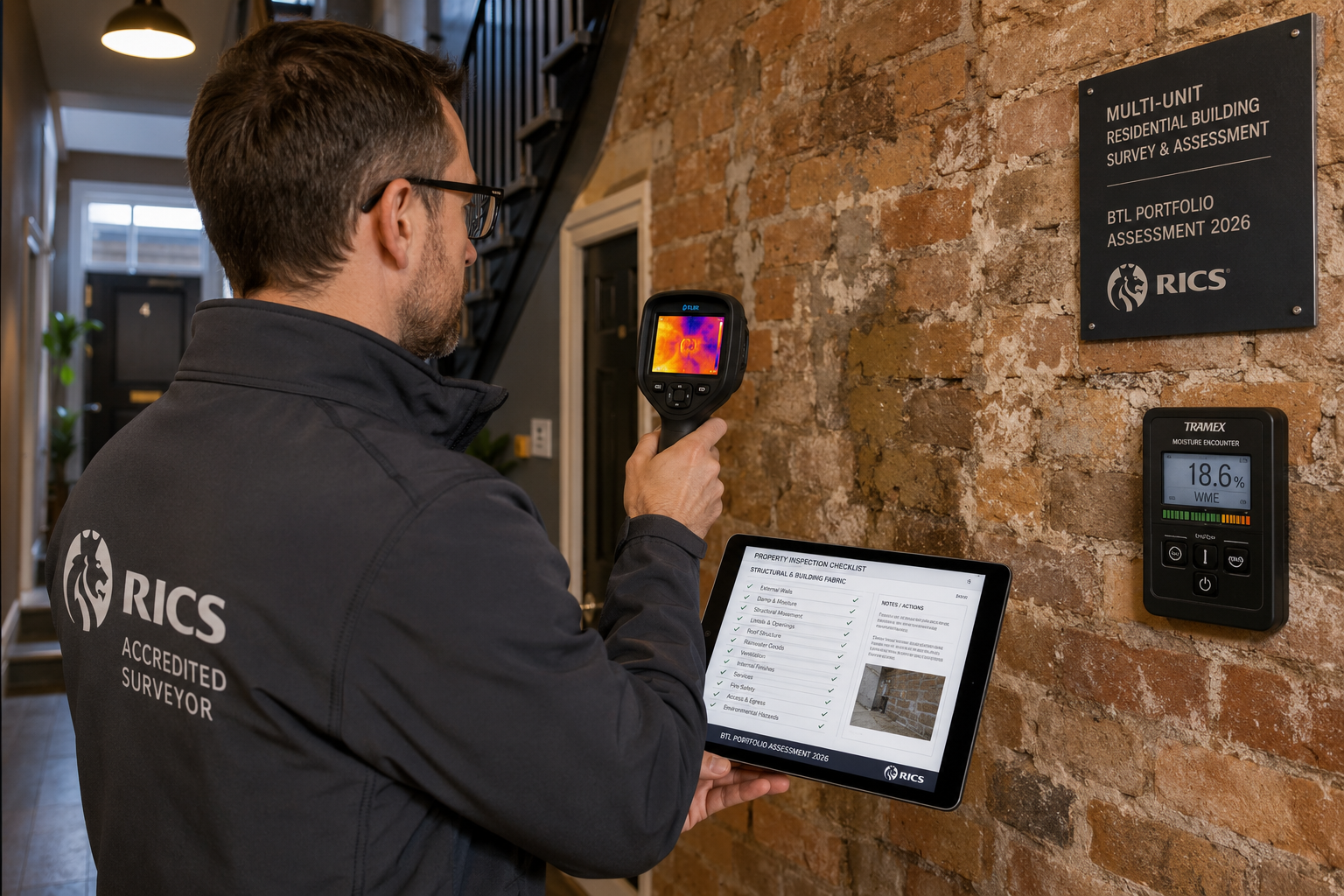
- Advanced inspection technologies, including thermal imaging and drainage cameras, are now standard tools in institutional survey workflows.
Why Residential Survey Models Fall Short for Institutional Portfolios
A standard RICS Level 2 HomeBuyer Report was designed for a single buyer assessing a single property. It provides a condition rating, flags visible defects, and offers a market valuation. For an individual purchasing a two-bedroom flat, that level of detail is appropriate. For an institutional investor acquiring 50 units across three London boroughs, it is structurally inadequate.
The core problem is comparability. When survey reports are generated by different surveyors using different methodologies and presented in different formats, aggregating risk data across a portfolio becomes unreliable. Institutional investors need consistent, standardized outputs that can be fed into asset management systems, maintenance forecasting models, and investment committee reports.
The residential recovery narrative also creates a false sense of security. Rising house prices and improving transaction volumes do not mean that the underlying stock is in good condition. Many properties entering the institutional BTL market have been held by private landlords who deferred maintenance during the cost-of-living squeeze. Structural issues, failing building envelopes, and non-compliant electrical or fire safety systems may be hidden beneath cosmetically acceptable interiors.
For those new to the survey landscape, it is worth reviewing common myths about a property survey before assuming that a basic inspection will surface all material risks.
The RICS 2026 Code of Practice: What Has Changed
In early 2026, RICS released a draft code of practice specifically for residential stock condition surveys. The consultation period closed on 9 February 2026, and the code is designed to standardize survey methodologies across the housing sector, ensuring consistent and high-quality data collection at scale [1].
This is significant for institutional investors for two reasons. First, it creates a common language for condition data — surveyors working across different firms and geographies will use the same element classifications, condition grades, and reporting formats. Second, it establishes a formal framework for the kind of stock condition surveys that institutional landlords have been commissioning informally for years.
Key elements of the new code include:
- Standardized element classification for all building components
- Consistent condition grading scales (typically 1 to 5)
- Minimum inspection requirements per property type
- Guidance on estimating remaining useful life for major components
- Requirements for maintenance cost forecasting
The code also reinforces the importance of understanding home survey levels 2 vs level 3 — a distinction that becomes critical when triaging a large acquisition pipeline.
RICS has also published professional standards for valuing buy-to-let and House in Multiple Occupation (HMO) properties, providing detailed guidance on how rental income, property condition, and market trends interact to determine asset value [4]. Institutional investors using these standards alongside the new stock condition code now have a more complete framework for both physical assessment and financial modelling.
Building Surveys for 2026 Institutional Buy-to-Let Expansion: The Three-Tier Survey Strategy
The most significant operational development in institutional survey practice is the adoption of a structured, three-tiered approach to property inspection [2]. This model allows investors to allocate survey resources efficiently across large acquisition pipelines without sacrificing due diligence quality.
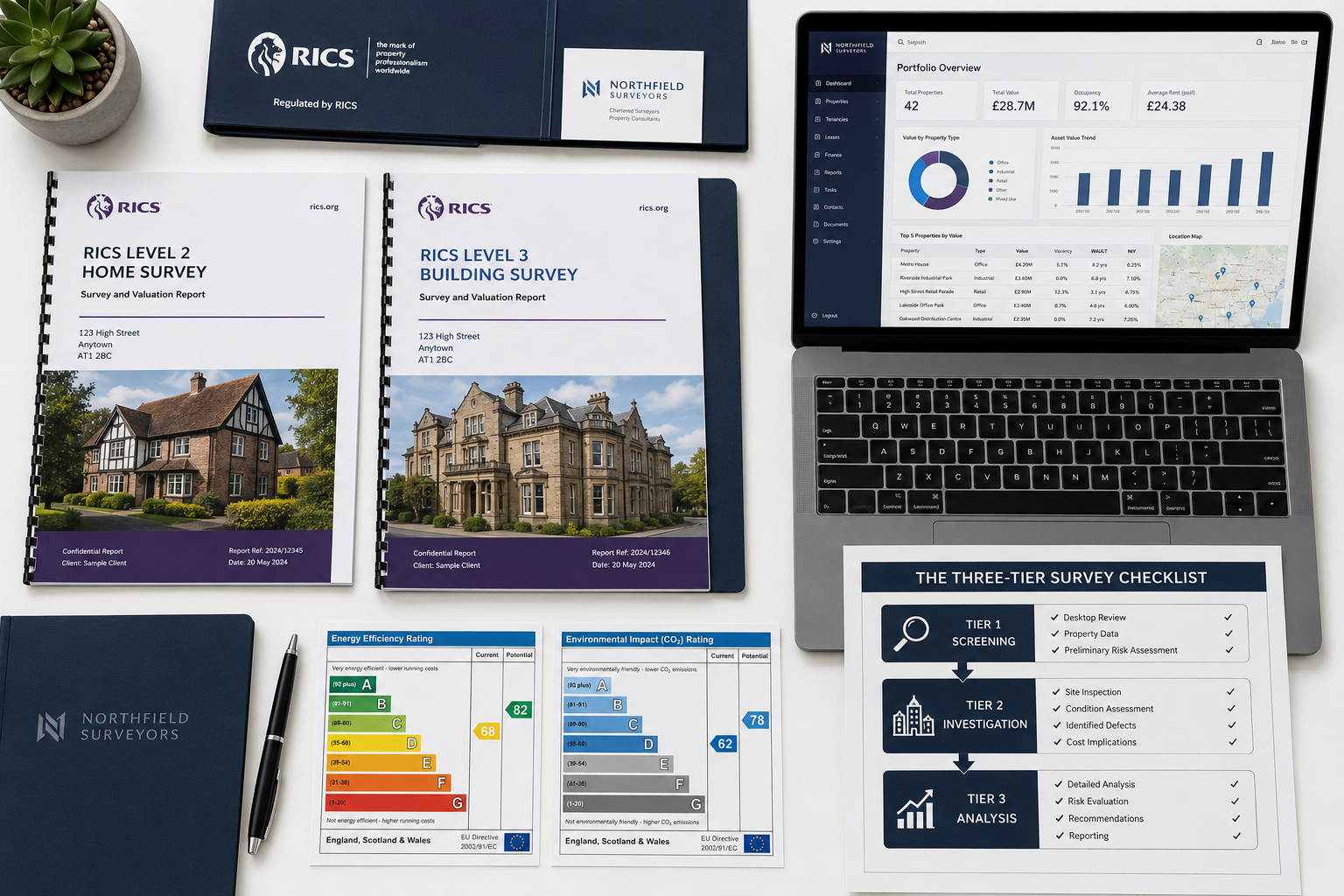
Tier 1: Desktop Analysis and Pre-Visit Screening
Before a surveyor sets foot on a property, a desktop review screens for red flags using publicly available data. This includes:
- Land Registry title and ownership history
- Planning portal records for unauthorized works
- Environmental risk data (flood zones, contamination, subsidence risk)
- EPC ratings and energy efficiency scores
- Building regulations completion certificates
Properties that pass Tier 1 screening proceed to physical inspection. Those that fail — due to, for example, a history of subsidence claims or missing building regulations sign-off — are either deprioritized or flagged for specialist investigation before any offer is made.
Tier 2: RICS Level 2 HomeBuyer Reports for Lower-Risk Assets
For newer, lower-risk properties — typically post-2000 construction in good condition — a RICS Level 2 HomeBuyer Report provides a cost-effective baseline assessment [2]. These reports confirm visible condition, flag urgent issues, and provide a market valuation. They are appropriate where Tier 1 screening has already eliminated the most serious structural risks.
It is worth noting that even at Tier 2, institutional buyers should ensure surveyors are briefed on portfolio-specific concerns. A standard HomeBuyer Report does not automatically assess HMO compliance, fire compartmentation, or landlord licensing requirements.
Tier 3: RICS Level 3 Building Surveys for Higher-Risk Properties
Older properties — Victorian terraces, Edwardian conversions, inter-war semis — and any asset flagged during Tier 1 screening should receive a full RICS Level 3 Building Survey [2]. This is the most comprehensive inspection available, covering:
- Structural integrity and movement
- Roof structure and coverings
- Building envelope (walls, windows, external doors)
- Internal finishes and floors
- Drainage and external works
- Damp and timber condition
For a deeper understanding of what triggers a Level 3 instruction, the building surveys tag archive provides extensive case-study material on defect types and their implications.
Standardized Checklists by Property Type
One of the most practical advances in institutional survey practice is the development of property-type-specific inspection checklists [2]. A single generic checklist cannot adequately serve both a 1890s terraced house and a 2015 purpose-built apartment block. The risk profiles are fundamentally different.
| Property Type | Primary Checklist Focus Areas |
|---|---|
| Victorian / Edwardian terraces | Damp penetration, subsidence, chimney stacks, original timber floors, lead pipework |
| Inter-war semis (1920s-1940s) | Cavity wall insulation condition, steel lintels, flat roof sections, asbestos (textured coatings) |
| Post-war (1945-1980) | Non-traditional construction identification, concrete frame condition, flat roof condition |
| Post-2000 apartments | EPC compliance, cladding systems, fire door specification, service charge history |
| HMO conversions | Fire compartmentation, means of escape, room sizes, licensing compliance |
Victorian terraces, for instance, require specific attention to damp, subsidence, and roof conditions [2]. Understanding whether garden trees could be causing subsidence is a genuine concern for terraced properties with mature street trees — a risk that a generic checklist may not adequately weight.
For post-2000 apartments, the checklist pivots toward EPC ratings, cladding compliance (particularly relevant post-Grenfell), and the condition of communal systems. Leasehold-specific risks also require attention; the guide to buying a flat on a short lease outlines the additional due diligence required when lease length affects both financing and long-term value.
Comprehensive Building Condition Assessments: What Institutional Surveys Must Cover
Beyond the tiered approach and property-type checklists, institutional surveys in 2026 are expected to deliver a holistic building condition assessment that goes well beyond defect identification [3]. The four core assessment domains are:
1. Structural Integrity
Full assessment of foundations, load-bearing walls, roof structure, and floor systems. This includes identifying signs of movement, settlement, or historic repair. Crack mapping — documenting the location, width, and pattern of wall cracks — is standard practice. For guidance on interpreting structural movement, the guide to subsidence provides a useful reference for understanding when cracks indicate serious risk.
2. Building Envelope
The external skin of a building — walls, roof coverings, windows, and external doors — determines both weathertightness and thermal performance. Institutional surveys assess the remaining useful life of each envelope component, not just its current condition. A roof covering with 5 years of life remaining on a 20-year hold asset is a capital expenditure liability that must be quantified at acquisition.
3. Internal Systems
Mechanical and electrical systems — heating, hot water, ventilation, electrical distribution — are assessed for condition, compliance, and remaining useful life. Gas safety, electrical installation condition reports (EICRs), and legionella risk assessments are all part of the compliance audit layer.
4. External Elements
Drainage, boundary structures, external paving, and outbuildings all contribute to the overall condition picture. Blocked or failing drainage can cause significant damage to foundations and internal finishes. Boundary disputes can affect both value and development potential.
Integration of Stock Condition Surveys for Portfolio Management
Stock condition surveys are the backbone of institutional portfolio management [3]. Unlike a one-off building survey conducted at acquisition, a stock condition survey is designed to be repeatable, comparable, and integrated into ongoing asset management systems.
A well-structured stock condition survey delivers:
- A complete element-by-element inventory of each building
- Condition grades for every major component
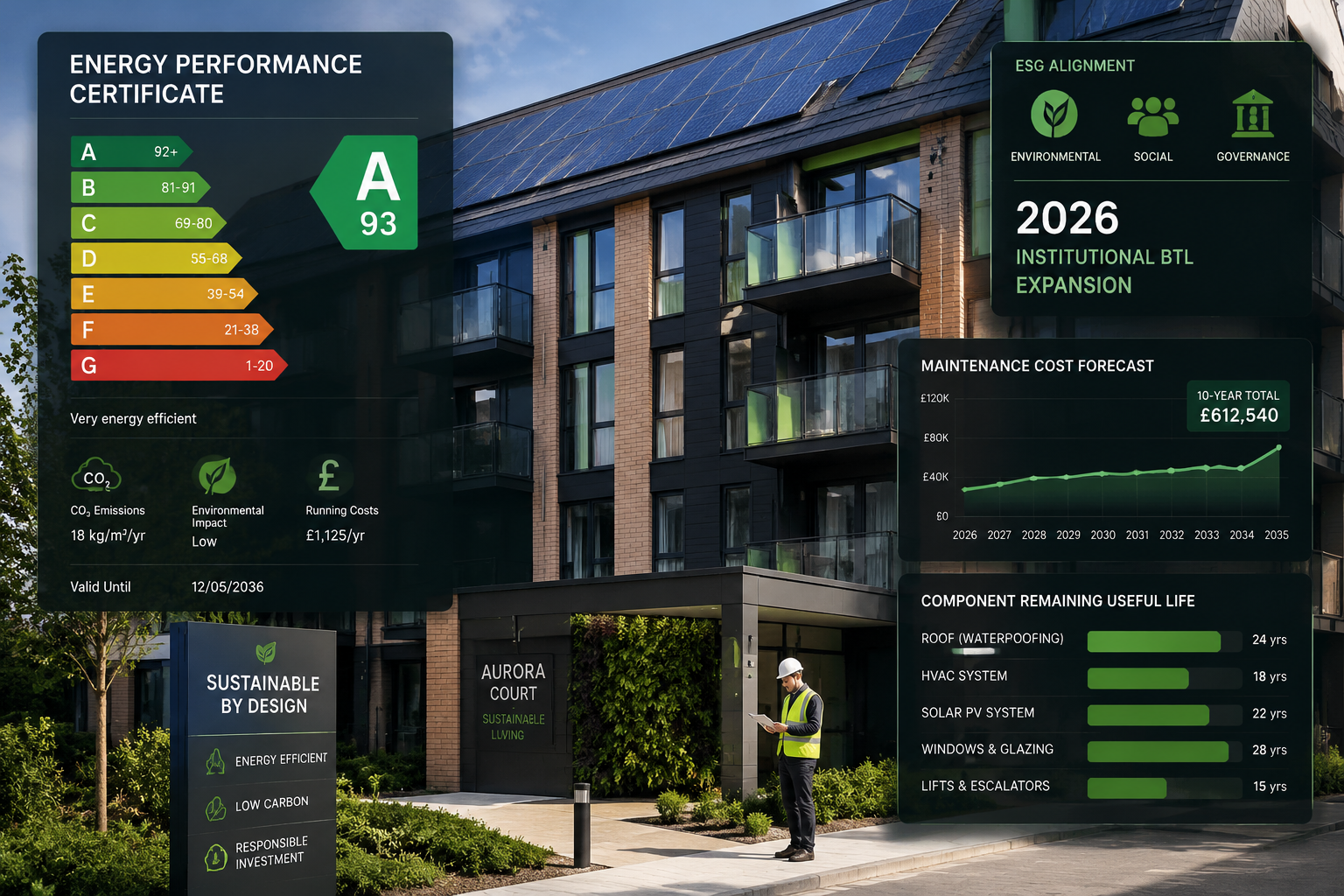
- Estimated remaining useful life for roofs, heating systems, windows, kitchens, and bathrooms
- A 10-30 year maintenance cost forecast
- A prioritized works programme ranked by urgency and cost
This data enables institutional investors to build accurate capital expenditure models, stress-test returns under different maintenance scenarios, and make informed decisions about which assets to hold, refurbish, or dispose of.
The integration of stock condition data with financial modelling is also where RICS valuation standards for buy-to-let and HMO properties become directly relevant [4]. Condition-adjusted valuations — which discount for known defects and forecast capital expenditure — give institutional buyers a more accurate picture of net asset value than a standard market valuation alone.
Regulatory Compliance and Safety Audits
Ensuring compliance with current regulations is not optional for institutional landlords — it is a legal and reputational imperative [3]. Survey-integrated compliance audits now cover:
- Fire safety: Compartmentation, means of escape, fire door specification, alarm systems
- Electrical safety: EICR compliance (mandatory for all rented properties)
- Gas safety: Annual certification and appliance condition
- Energy performance: EPC ratings, with the proposed minimum EPC C standard for new tenancies creating an urgent upgrade pipeline
- Damp and disrepair: Awaab's Law obligations requiring landlords to address damp and mould within defined timeframes
- HMO licensing: Room sizes, amenity ratios, and management standards
For portfolios that include leasehold properties, compliance extends to service charge obligations and the terms of the head lease. The checklist for buying a leasehold property covers many of the due diligence points that institutional buyers must verify before acquisition.
Advanced Survey Technologies in 2026
The adoption of specialist inspection technologies has materially improved the accuracy and reliability of institutional building surveys [5]. Key tools now in standard use include:
- Thermal imaging cameras: Detect heat loss, cold bridges, moisture ingress, and missing insulation without invasive opening up works
- Endoscope cameras: Allow inspection of wall cavities, roof voids, and pipe runs without destructive investigation
- Drainage inspection cameras: Identify blockages, root ingress, pipe collapse, and misaligned joints
- Moisture meters and hygrometers: Quantify damp conditions and map moisture distribution across building elements
- Drone surveys: Provide high-resolution imagery of roofs, parapets, and upper-level facades that are inaccessible from ground level
These technologies reduce the risk of hidden defects being missed during inspection, which is particularly important in large portfolio acquisitions where post-completion defect discoveries can have significant financial consequences.
Understanding damp survey costs and what they involve is useful context when budgeting for specialist investigations that go beyond a standard RICS inspection.
Energy Performance and ESG Integration
Sustainability has moved from a marketing consideration to a core investment criterion for institutional landlords [3]. The reasons are partly regulatory — proposed minimum EPC standards will require significant capital investment in poorly performing stock — and partly financial, as energy-efficient properties command higher rents and lower void rates.
Institutional surveys in 2026 now assess:
- Current EPC rating and the measures required to reach EPC C or above
- Insulation quality in walls, roofs, and floors
- Heating system efficiency and compatibility with heat pump retrofits
- Window specification and glazing performance
- Potential for solar PV installation
- Smart meter and sub-metering infrastructure
ESG reporting requirements are also driving demand for more granular energy data. Institutional investors with sustainability commitments need property-level carbon intensity data, not just a single EPC letter grade. Survey reports are increasingly expected to include estimated annual CO2 emissions per unit and a roadmap for reaching net-zero operational carbon.
Building Surveys for 2026 Institutional Buy-to-Let Expansion: Negotiation and Post-Survey Action
A comprehensive survey is only valuable if its findings are acted upon. Institutional buyers have more leverage than individual purchasers to negotiate price reductions or remediation works based on survey findings [2].
The standard approach is to quantify all identified defects and deferred maintenance items, produce a Schedule of Condition, and use this as the basis for price renegotiation. For guidance on this process, renegotiating after a poor building survey result and understanding average price reductions after a survey are both directly relevant to institutional buyers managing acquisition costs.
Where defects are significant but the asset remains strategically attractive, institutional buyers may negotiate a deferred works allowance — a price reduction that reflects the cost of remediation — rather than requiring the seller to carry out works before completion.
Conclusion
The market conditions of 2026 have created both the opportunity and the obligation for institutional buy-to-let investors to raise their survey standards. As smaller landlords exit and professional portfolios grow, the quality of building condition data at acquisition directly determines the accuracy of financial modelling, the reliability of maintenance budgets, and the long-term performance of assets.
Actionable next steps for institutional investors and their advisors:
- Adopt the three-tier survey strategy for all new acquisitions, matching survey depth to property risk profile.
- Commission surveyors who are familiar with the 2026 RICS stock condition survey code of practice and can deliver standardized, portfolio-compatible reports.
- Build property-type-specific checklists into procurement briefs — do not rely on generic survey formats.
- Integrate energy performance and ESG assessment into every survey instruction, not as an optional extra.
- Use stock condition survey data to build 10-30 year capital expenditure models before finalizing acquisition pricing.
- Ensure compliance audit layers cover fire safety, electrical, damp, and HMO licensing as standard.
The shift from residential recovery to institutional dominance in the BTL market is not a temporary trend. The survey frameworks, checklists, and technologies described here are the foundation of professional-grade due diligence for 2026 and beyond.
References
[1] RICS Stock Condition Survey Consultation Response 2026 – https://sava.co.uk/rics-stock-condition-survey-consultation-response-2026/?utm_source=openai
[2] Building Survey Protocols For Institutional Buy To Let Acquisitions Risk Mitigation In 2026 Landlord Shifts – https://manchestersurveyors.com/building-survey-protocols-for-institutional-buy-to-let-acquisitions-risk-mitigation-in-2026-landlord-shifts/?utm_source=openai
[3] Building Surveys For Institutional Buy To Let Portfolios Assessing Quality Standards When Professional Landlords Dominate 2026 Market – https://www.canterburysurveyors.com/blog/building-surveys-for-institutional-buy-to-let-portfolios-assessing-quality-standards-when-professional-landlords-dominate-2026-market/?utm_source=openai
[4] Valuation of Buy-to-Let and HMO Properties 2nd Edition – https://www.rics.org/content/dam/ricsglobal/documents/standards/Valuation%20of%20buy-to-let%20and%20HMO%20properties_2nd%20edition.pdf?utm_source=openai
[5] Building Survey Checklists For Bungalow Purchases 2026 RICS Guidance On Structural Risks And Costs – https://nottinghillsurveyors.com/blog/building-survey-checklists-for-bungalow-purchases-2026-rics-guidance-on-structural-risks-and-costs?utm_source=openai