
Nearly nine years after the Grenfell Tower fire claimed 72 lives, thousands of leaseholders across England remain trapped in flats they cannot sell, remortgage, or insure at a fair price. Cladding-related valuation disputes have surged through tribunals and courts, placing RICS-accredited surveyors at the centre of complex, high-stakes litigation. Expert Witness Preparation for Fire Safety Remediation Valuations: Post-Grenfell RICS Protocols in 2026 Cladding Disputes has never demanded more rigorous evidence standards, more precise methodology, or a deeper command of evolving professional guidance than it does today.
Key Takeaways
- RICS published the second edition of its cladding valuation standard in May 2026, effective 1 November 2026, setting new benchmarks for expert witness reports in fire safety disputes.
- The updated standard refines when an EWS1 form must be requested, aiming for proportionate and consistent valuations that reduce unnecessary transaction delays.
- Expert witnesses must align every opinion with the Building Safety Act 2022, the updated RICS professional standard, and current case law to withstand tribunal scrutiny.
- Robust documentation of methodology, comparable evidence, and remediation cost data is the foundation of a credible expert witness report in 2026 cladding disputes.
- Ongoing professional development and cross-disciplinary collaboration with fire engineers and legal teams are non-negotiable for valuers operating in this space.
The Scale of the Cladding Valuation Crisis in 2026
More than 3,000 residential buildings in England still await remediation of dangerous cladding systems, according to government data. The financial consequences are vast. Remediation costs for a single block can run into tens of millions of pounds, and the uncertainty surrounding those costs has a direct, measurable impact on market value. Lenders have refused mortgages, insurers have imposed punishing premiums, and leaseholders have found themselves locked into properties that are effectively unsaleable.
This environment has generated a significant volume of legal disputes. Freeholders, developers, managing agents, and leaseholders are all contesting liability, quantum, and the valuation impact of fire safety defects. Tribunals and courts increasingly rely on expert witnesses to translate technical fire safety findings into reliable financial opinions. The quality of that expert evidence can determine whether a leaseholder receives compensation, whether a developer faces a multi-million-pound liability, or whether a lender recovers its security.
For surveyors working across London property markets, understanding the precise requirements of expert witness work in this context is now a core professional competency rather than a niche specialism.
The 2026 RICS Standard: What Has Changed and Why It Matters
RICS published the second edition of its UK professional standard, "Secured Lending Valuation of Properties in Multi-Storey, Multi-Occupancy Residential Buildings with Cladding," on 12 May 2026. The standard becomes mandatory on 1 November 2026 [1]. This is the most significant update to cladding valuation guidance since the original standard was introduced in the aftermath of the Grenfell Tower fire.
Core Changes in the Updated Standard
The revised standard was developed through consultation with fire safety professionals, valuers, insurers, and lenders [2]. Its principal aims are:
- Proportionality: Valuers are directed to apply a more calibrated approach, avoiding blanket deductions or automatic requests for EWS1 forms where the risk profile of a building does not justify them.
- Consistency: The standard provides clearer criteria for when an EWS1 form should be requested during secured lending valuations of domestic residential properties, including mixed-use blocks [1].
- Market stability: By reducing unnecessary delays for buyers, sellers, and those seeking to remortgage, the guidance is designed to restore confidence in affected markets [2].
- Proportionate remediation cost reflection: Valuers must now demonstrate that any adjustment for remediation costs is grounded in verifiable evidence rather than general market sentiment.
The updated standard specifically addresses multi-storey, multi-occupancy residential buildings, reflecting the ongoing complexity of post-Grenfell valuation work [1]. For expert witnesses, this creates both an obligation and an opportunity: reports that align precisely with the new framework will carry significantly greater weight before a tribunal than those relying on superseded guidance.
EWS1 Forms: Refined Criteria for 2026
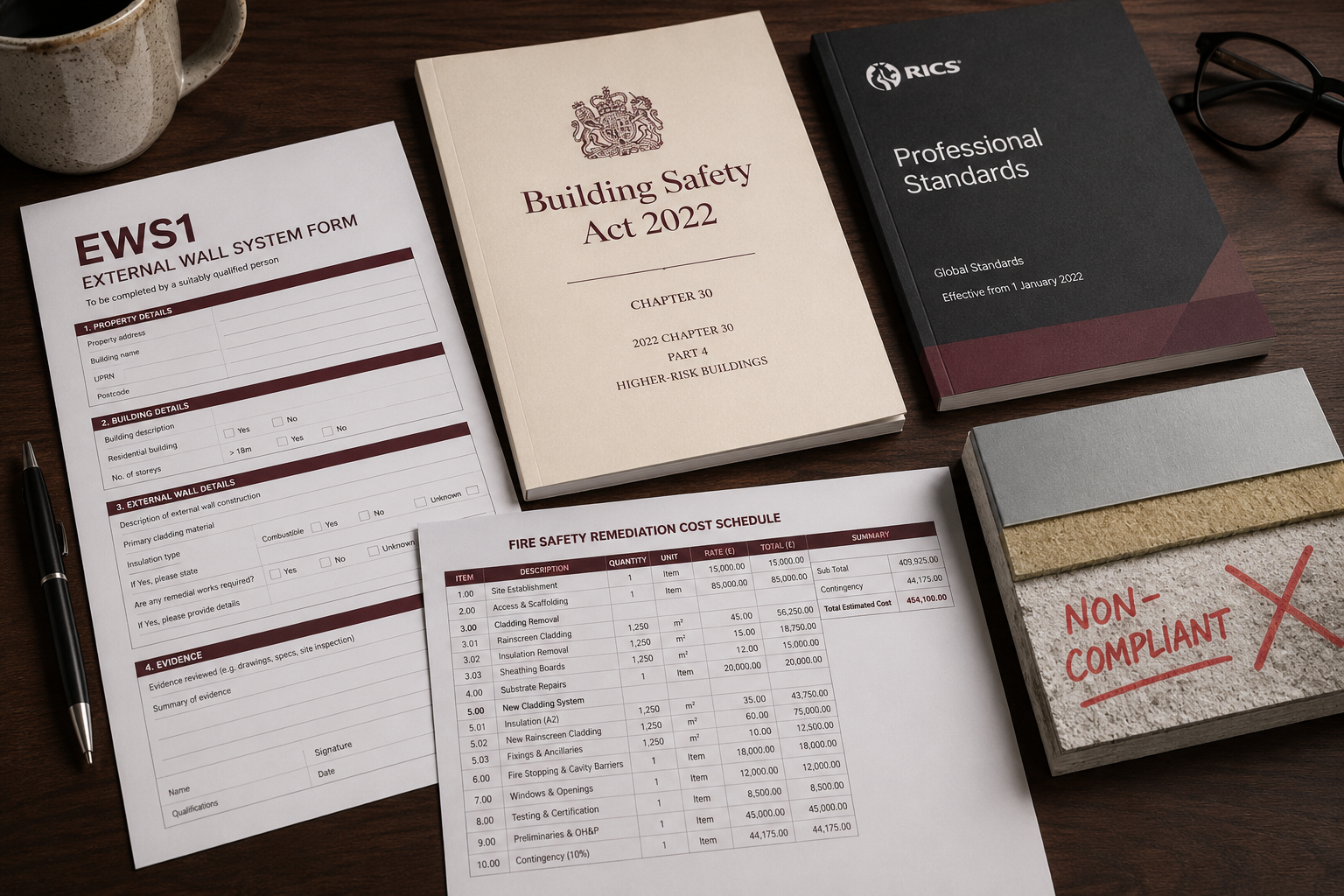
The External Wall System 1 (EWS1) form has been a source of considerable controversy since its introduction. Blanket application led to market paralysis in many sectors. The 2026 standard sets out refined criteria for when the form is genuinely required, helping valuers and their lender clients adopt a proportionate approach [3]. Expert witnesses must now be able to articulate, with precision, why an EWS1 assessment was or was not appropriate for a specific building, and how the presence or absence of that assessment influenced their valuation opinion.
Expert Witness Preparation for Fire Safety Remediation Valuations: Post-Grenfell RICS Protocols in 2026 Cladding Disputes – Building the Evidence Base
The credibility of an expert witness in a cladding valuation dispute rests almost entirely on the quality of the evidence base underpinning the report. Tribunals and courts are sophisticated consumers of expert evidence. Vague assertions, unsupported comparables, and methodology that cannot withstand cross-examination will be challenged aggressively by opposing counsel.
Methodology Documentation
Every expert witness report must set out the valuation methodology in clear, step-by-step terms. In fire safety remediation valuations, this typically involves:
- Establishing the unaffected value: What would the property be worth if no cladding defect existed? This requires robust comparable evidence from genuinely comparable transactions.
- Quantifying the remediation liability: What is the estimated cost of remediation, and how is that cost allocated? Expert witnesses must engage with contractor estimates, building safety fund eligibility, and developer remediation commitments under the Building Safety Act 2022.
- Assessing market perception: Beyond the direct cost, how does the market discount properties with outstanding fire safety issues? This requires analysis of actual sales data, not assumptions.
- Applying the EWS1 framework: Does the building require an EWS1 form under the updated RICS standard? If so, what does the form reveal, and how does that affect value? [5]
Surveyors preparing expert witness reports should also consider how building survey findings interact with fire safety assessments, particularly where structural or material defects compound cladding risks.
Comparable Evidence in Cladding Disputes
The selection and analysis of comparable transactions is one of the most contested areas in cladding valuation disputes. The following principles apply:
| Comparable Criterion | Requirement |
|---|---|
| Building height and type | Must match or be adjusted for differences |
| Cladding system | Like-for-like or clearly adjusted |
| Remediation status | Disclosed and weighted appropriately |
| Transaction date | Recent enough to reflect current market conditions |
| Tenure | Leasehold terms must be comparable |
Adjustments must be explicitly reasoned and defensible. An expert who cannot explain why a 15% adjustment was applied rather than 10% or 20% will face serious difficulty under cross-examination.
For properties in areas such as Southwark or Newham, where high-density residential development is concentrated, the pool of comparables may be larger but the variation in cladding remediation status between buildings adds complexity to the analysis.
Engaging with Fire Safety Engineering Evidence
Expert witnesses in cladding valuation disputes rarely operate in isolation. Fire safety engineers, building surveyors, and legal teams all contribute evidence that the valuation expert must understand and engage with. A valuer who cannot explain the difference between ACM (aluminium composite material) cladding and HPL (high-pressure laminate) panels, or who cannot interpret a fire risk assessment, will lack credibility before a tribunal.
The updated RICS standard was developed in consultation with fire safety industry professionals precisely because the interface between technical fire safety findings and valuation opinion is where disputes most often arise [2]. Expert witnesses should seek to obtain and review all available fire safety documentation before finalising their reports.
Legal and Regulatory Framework for Expert Witnesses in 2026
Expert Witness Preparation for Fire Safety Remediation Valuations: Post-Grenfell RICS Protocols in 2026 Cladding Disputes cannot be understood without reference to the legal and regulatory environment in which that work takes place.
The Building Safety Act 2022 and Its Continuing Impact
The Building Safety Act 2022 fundamentally restructured liability for fire safety defects in residential buildings. Key provisions relevant to expert witnesses include:
- Extended limitation periods: Leaseholders can pursue claims for historical fire safety defects for up to 30 years, significantly expanding the potential scope of litigation.
- Leaseholder protections: Qualifying leaseholders are protected from certain remediation costs, which directly affects the valuation of their interests.
- Developer obligations: Developers who built or refurbished buildings with fire safety defects face statutory obligations to fund remediation, affecting the residual liability that markets must price.
Expert witnesses must stay current with how courts and tribunals are interpreting these provisions, as the case law is still developing [5]. An opinion that does not account for the leaseholder protections afforded by the Act, or that mischaracterises a developer's remediation obligation, will be vulnerable to challenge.
Duties to the Tribunal
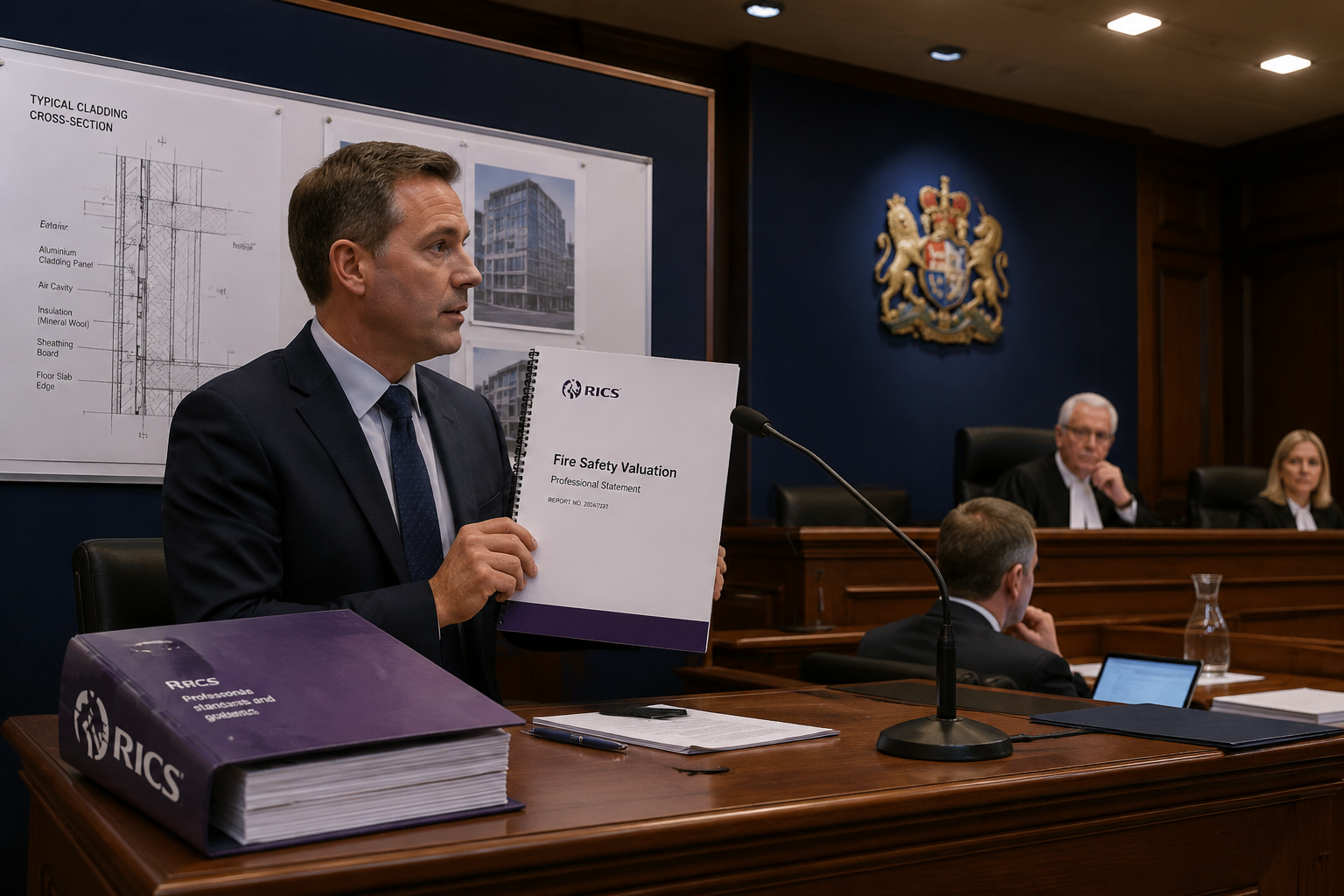
Expert witnesses in England and Wales owe their primary duty to the court or tribunal, not to the instructing party. This is a fundamental principle that applies with equal force in cladding valuation disputes. The RICS Red Book and the Civil Procedure Rules both impose obligations of independence, objectivity, and transparency.
In practice, this means:
- Disclosing limitations: If the evidence base is incomplete, the report must say so and explain why.
- Addressing contrary evidence: The report must engage with evidence that supports a different conclusion, not simply ignore it.
- Avoiding advocacy: The expert's role is to assist the tribunal, not to win the case for the instructing party.
Surveyors who are unfamiliar with legal requirements governing expert evidence should seek specialist training before accepting instructions in contested proceedings.
Interaction with Leasehold Law
Many cladding disputes involve leasehold properties, and the valuation of a leasehold interest affected by fire safety defects requires an understanding of lease terms, service charge obligations, and the interaction between the lease and the Building Safety Act 2022. Surveyors advising on leasehold property purchases should be alert to the additional complexity that cladding issues introduce.
Preparing the Expert Witness Report: Practical Standards for 2026
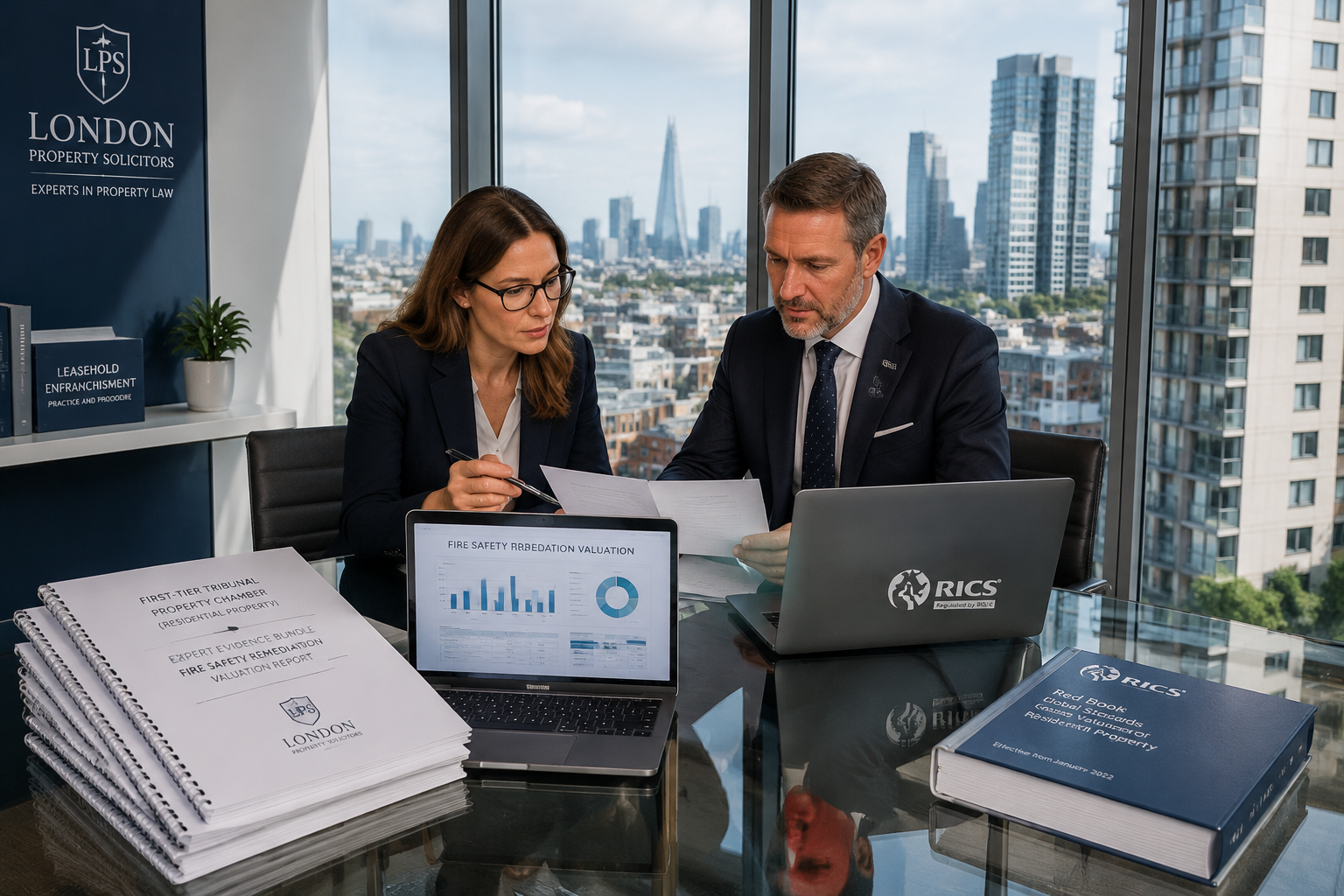
A well-prepared expert witness report in a fire safety remediation valuation dispute will typically contain the following sections:
- Instructions and scope: A clear statement of what the expert has been asked to do and any limitations on the scope of the opinion.
- Qualifications and experience: Evidence that the expert has the specific competence required for this type of work, including familiarity with the 2026 RICS standard.
- Facts and assumptions: A clear distinction between facts established by evidence and assumptions the expert has been asked to make.
- Methodology: A step-by-step explanation of the valuation approach, with reference to the updated RICS standard [1].
- Evidence base: Comparable transactions, remediation cost data, fire safety assessments, and any other material relied upon.
- Opinion: A clear, unambiguous statement of the expert's valuation opinion, with sensitivity analysis where appropriate.
- Declaration: The standard declaration of independence required under the Civil Procedure Rules.
Common Weaknesses That Undermine Expert Evidence
Tribunals and courts have identified recurring weaknesses in expert witness reports in cladding valuation disputes:
- Failure to apply the current RICS standard, or reliance on superseded guidance
- Comparable evidence that is not genuinely comparable without adequate adjustment
- Remediation cost estimates that are not supported by contractor evidence or quantity surveyor input
- Failure to engage with the leaseholder protections under the Building Safety Act 2022
- Opinions expressed with false precision, without acknowledging the range of possible outcomes
Surveyors who regularly undertake full structural inspections will recognise the importance of thorough documentation in avoiding these pitfalls.
Continuing Professional Development
The 2026 RICS standard represents a significant shift in the regulatory landscape. Expert witnesses who have not updated their knowledge since the previous edition of the standard risk producing reports that are out of step with current professional expectations [4]. RICS and other professional bodies offer CPD programmes specifically addressing cladding valuation and fire safety remediation. Attendance at these programmes, and documentation of that attendance, strengthens the credibility of an expert witness.
The development of the updated standard itself involved extensive consultation with valuers, fire safety professionals, insurers, and lenders [2]. Expert witnesses who can demonstrate engagement with that consultation process, or with the professional bodies involved, will be better placed to explain and defend their methodology.
Market Dynamics and the Outlook for Cladding Valuation Disputes
The updated RICS standard is expected to have a measurable effect on property market dynamics in the second half of 2026 and beyond [6]. By providing clearer criteria for EWS1 form requests, the standard should reduce the number of transactions stalled by unnecessary assessments. This may gradually restore liquidity to affected markets, particularly in high-density urban areas.
However, the volume of live disputes is unlikely to decrease significantly in the near term. The extended limitation periods under the Building Safety Act 2022 mean that historical claims will continue to emerge. Developer insolvencies, disputed remediation fund allocations, and ongoing disagreements about the scope of leaseholder protections will all generate new valuation disputes requiring expert evidence.
For surveyors working across London's diverse property markets, from Battersea to Ealing, the ability to produce credible, tribunal-ready expert witness reports in fire safety remediation valuations is increasingly a differentiating professional capability.
Conclusion
The intersection of fire safety regulation, leasehold law, and property valuation has created one of the most technically demanding areas of expert witness work in the UK property sector. Expert Witness Preparation for Fire Safety Remediation Valuations: Post-Grenfell RICS Protocols in 2026 Cladding Disputes demands a command of the updated RICS standard effective from 1 November 2026, a rigorous approach to evidence gathering, and an unwavering commitment to the expert's overriding duty to the tribunal.
Actionable next steps for surveyors and expert witnesses:
- Review the second edition of the RICS cladding valuation standard published in May 2026 and ensure all report templates and methodologies are updated before the 1 November 2026 effective date.
- Audit existing expert witness reports in live disputes to identify any reliance on superseded guidance that may need to be addressed.
- Build working relationships with fire safety engineers and quantity surveyors to ensure remediation cost evidence is robust and defensible.
- Complete relevant CPD on the Building Safety Act 2022 and its interaction with leasehold valuation.
- Seek specialist legal advice on expert witness duties under the Civil Procedure Rules if this type of instruction is new territory.
The cladding crisis is far from resolved. For surveyors who invest in the right preparation, the demand for credible, authoritative expert witness evidence in fire safety remediation valuations will remain substantial throughout 2026 and well beyond.
References
[1] Valuation Of Properties In Multi Storey Multi Occupancy Residential Buildings With Cladding – https://www.rics.org/profession-standards/rics-standards-and-guidance/sector-standards/valuation-standards/valuation-of-properties-in-multi-storey-multi-occupancy-residential-buildings-with-cladding?utm_source=openai
[2] Rics Publishes Updated Standard For Multi Storey Residential Buildings With Cladding – https://www.rics.org/news-insights/rics-publishes-updated-standard-for-multi-storey-residential-buildings-with-cladding?utm_source=openai
[3] Rics Developing Guidance To Support Valuers On Properties With Cladding – https://www.rics.org/news-insights/rics-developing-guidance-to-support-valuers-on-properties-with-cladding?utm_source=openai
[4] Expert Witness Preparation For 2026 Uk Valuation Disputes Rics Standards In A Recovering Market – https://www.canterburysurveyors.com/blog/expert-witness-preparation-for-2026-uk-valuation-disputes-rics-standards-in-a-recovering-market/?utm_source=openai
[5] Building Safety Act 2022 Updates Expert Witness Protocols For Fire Safety And Retrofit Valuations In 2026 – https://princesurveyors.co.uk/blog/building-safety-act-2022-updates-expert-witness-protocols-for-fire-safety-and-retrofit-valuations-in-2026/?utm_source=openai
[6] Secured Lending Valuations For Flats With Cladding In 2026 What Rics Updated Guidance Means In Practice – https://www.canterburysurveyors.com/blog/secured-lending-valuations-for-flats-with-cladding-in-2026-what-rics-updated-guidance-means-in-practice/?utm_source=openai