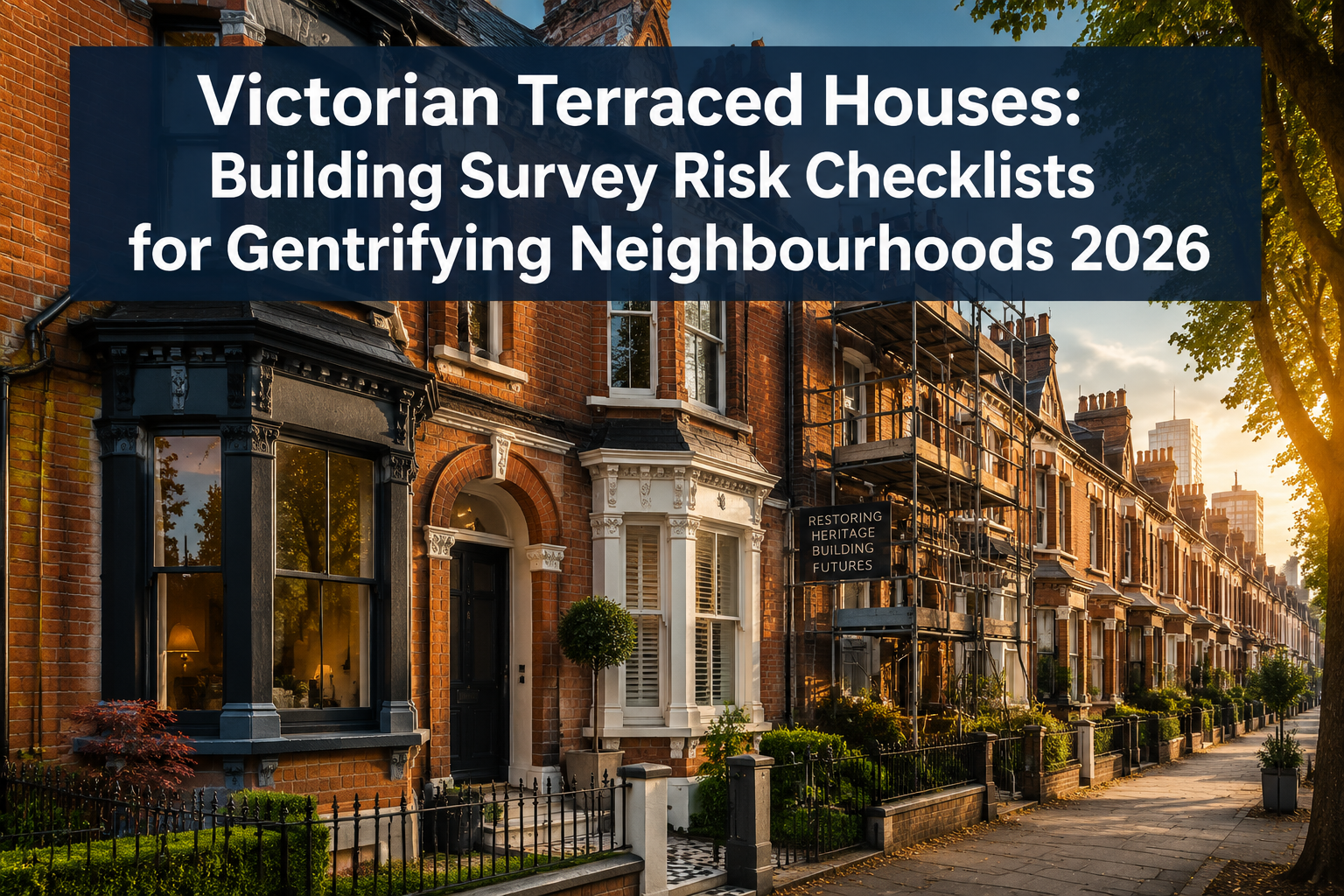
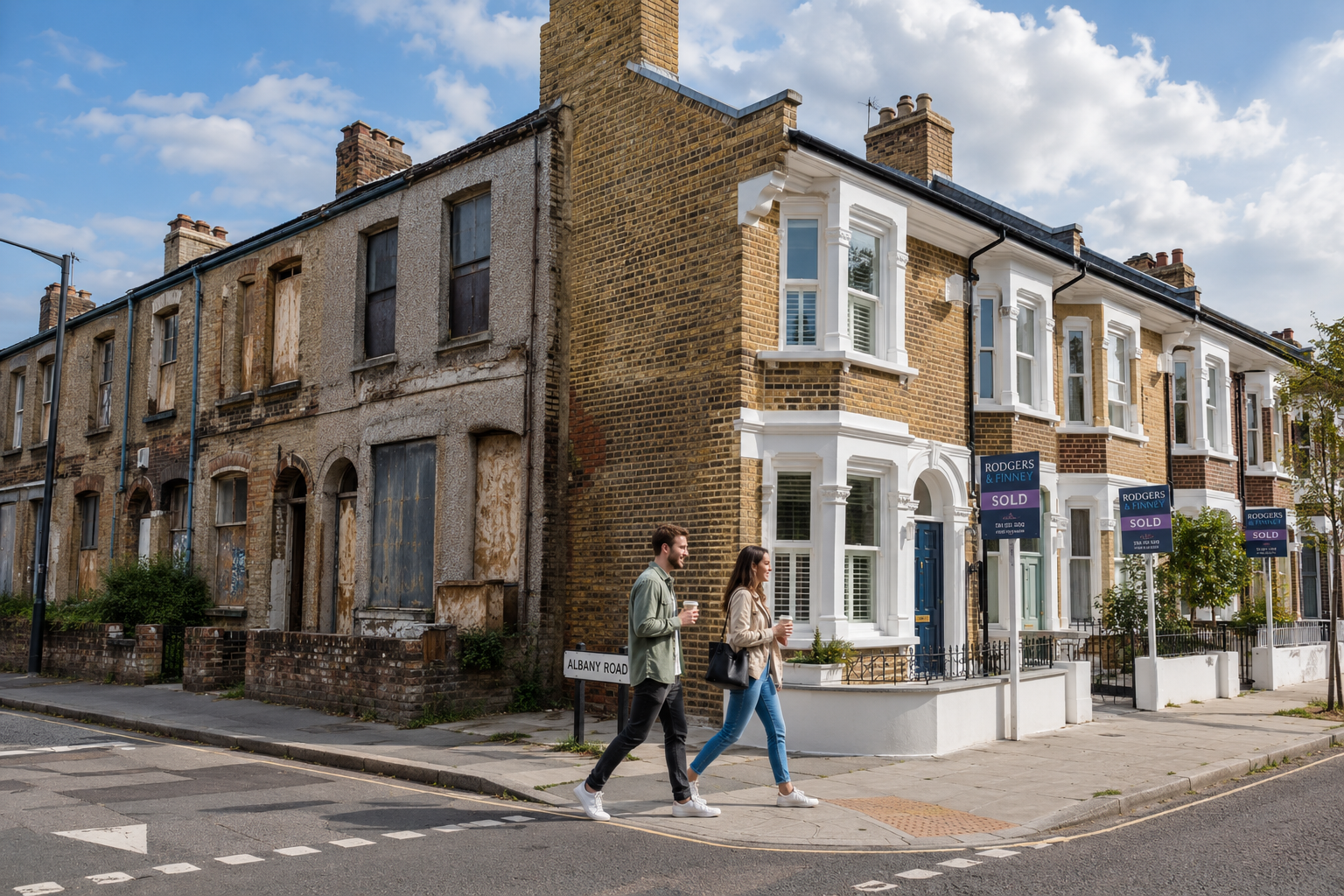
Terraced houses in Camberwell's SE5 postcode now range between £880,000 and £950,000 on average, with prime Georgian stock exceeding £1.5 million [5] — yet the same streets contain unrenovated Victorian properties still priced well below those thresholds. That gap is precisely where informed buyers and investors find their edge in 2026. Using robust Building Survey Risk Checklists for Victorian Terraced Houses in Gentrifying Neighbourhoods: Capturing 2026 Value Opportunities is the systematic way to separate genuine bargains from costly liabilities before exchange of contracts.
Key Takeaways
- Victorian terraced houses in gentrifying neighbourhoods carry predictable, recurring defects that a structured checklist can identify before purchase.
- Structural movement, timber decay, damp, brickwork deterioration, and poor energy performance are the five highest-risk categories for this property type.
- Energy Performance Certificate (EPC) ratings now materially affect resale value and mortgage availability, making retrofit viability a core survey consideration in 2026.
- A Level 3 Building Survey (full structural survey) is the appropriate product for Victorian terraced stock — not a basic Level 2 Homebuyer Report.
- Survey findings can be used as a direct negotiation tool to reduce the agreed purchase price or require remedial works before completion.
Why Victorian Terraced Stock in Gentrifying Areas Demands a Specialist Approach
The appeal of Victorian terraced houses in regenerating northern and inner-city neighbourhoods is straightforward: relatively low entry prices, strong rental demand, and the prospect of capital growth as infrastructure investment and demographic change lift surrounding values. Terraced house prices in Tamworth, for example, rose 5.4% in the year to December 2025, with average rents reaching £948 per calendar month by January 2026 [3]. In Wednesbury, rents on two- and three-bed terraced houses grew 5.8% in the first quarter of 2026 alone, outpacing the local apartment market [4].
These figures attract investors — but they can also encourage rushed due diligence. Victorian terraced houses, typically built between 1837 and 1901, share a set of structural and material characteristics that create predictable defect patterns. Understanding those patterns, and building them into a formal survey checklist, is the foundation of sound acquisition strategy.
A Level 3 Building Survey — sometimes called a full structural survey — is the correct product for this property type. A basic Level 2 Homebuyer Report will not probe concealed voids, investigate roof structures in detail, or assess the extent of timber decay. For a 120-year-old terrace in a neighbourhood where neighbouring properties are being converted, extended, or heavily renovated, only a comprehensive inspection gives the buyer the information they need.
Gentrifying neighbourhoods introduce an additional layer of risk. When surrounding properties undergo basement excavations, loft conversions, or rear extensions, the shared party walls and foundations of a Victorian terrace are subjected to new stresses. A party wall surveyor in London can advise on existing or potential disputes, but the building surveyor must also flag evidence of recent or ongoing movement caused by neighbouring works.
The Core Building Survey Risk Checklist: Defect Categories for Victorian Terraces
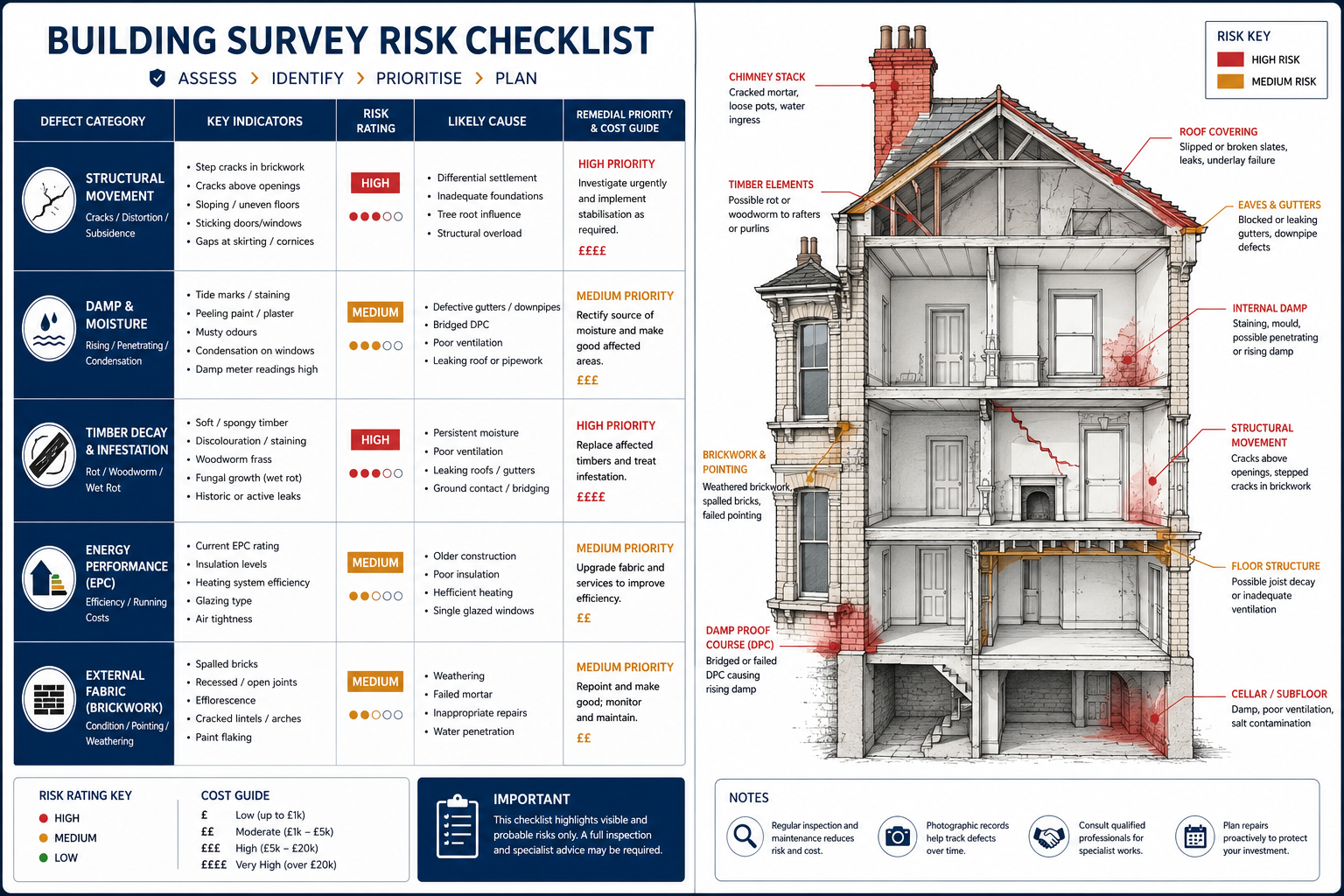
A well-structured checklist organises inspection findings by risk severity and remediation cost. The following categories represent the highest-frequency defects found in Victorian terraced houses and should form the backbone of any pre-purchase survey assessment.
1. Structural Movement and Cracking
Victorian houses frequently experience structural movement as a result of foundation settling, changes in ground conditions, tree root intrusion, drainage defects, or alterations from previous refurbishments [1]. Not all cracking is serious — minor shrinkage cracks in plaster are cosmetic — but diagonal cracking at window and door reveals, stepped cracking in external brickwork, or cracking that is wide, tapered, or recurrent can indicate active movement requiring engineering investigation.
Checklist items:
- Map all visible cracks by location, width, and pattern (horizontal, vertical, diagonal, stepped)
- Identify proximity of mature trees and assess root influence on foundations
- Inspect drainage runs for fractures that could be softening subsoil
- Check for evidence of previous underpinning (often disclosed in legal searches but sometimes concealed)
- Note any recent extensions or alterations that may have altered load paths
2. Roof Structure and Coverings
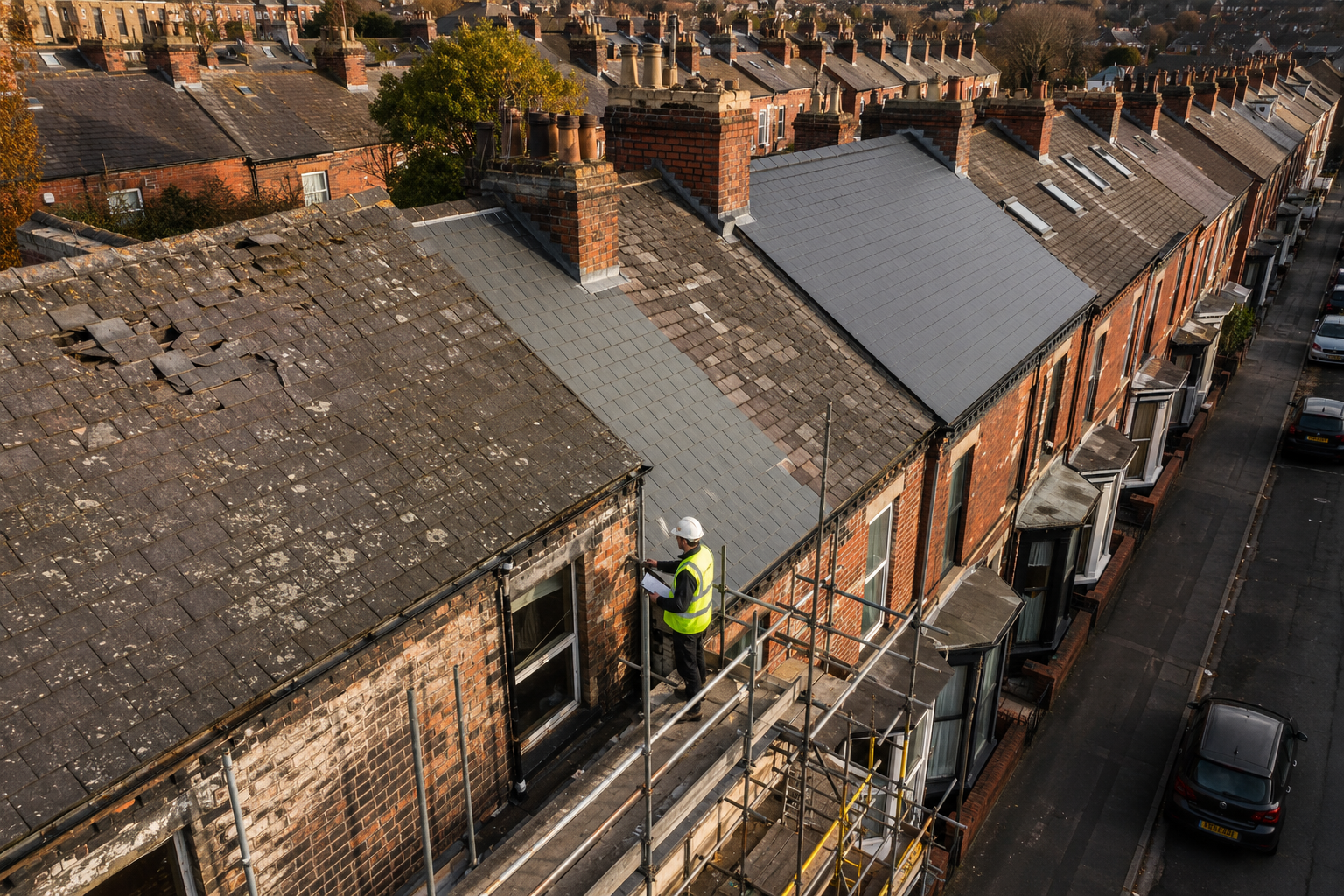
Common Victorian roof defects include slipped or missing slates, damaged lead flashings at chimney stacks and abutments, and timber decay within the roof structure itself [1]. In gentrifying areas, many properties have had flat roof rear extensions added over the decades, introducing additional flat roof failure points.
Checklist items:
- Inspect slate or tile condition from ground level and, where accessible, from within the roof void
- Check lead flashings at all chimney stacks, parapet walls, and valley gutters
- Probe roof timbers for wet rot and dry rot, particularly at wall plate level
- Assess condition of any flat roof coverings (felt, GRP, asphalt) on rear additions
- Note blocked or defective gutters and downpipes that may be causing water ingress
Drone technology is increasingly used by surveyors to safely inspect rooflines on terraced properties where ladder access is restricted [1]. When commissioning a survey, confirm whether the surveyor uses drone inspection as standard or as an optional add-on.
For a detailed look at what roof inspections cover, see this guide to checking the roof when buying a house in London.
3. Damp, Drainage, and Moisture Ingress
Damp is one of the most common findings in Victorian terraced houses and one of the most misdiagnosed. Rising damp, penetrating damp, and condensation each have different causes and remediation costs. Incorrect diagnosis — often from a commercially motivated damp-proofing contractor rather than an independent surveyor — can lead to unnecessary chemical injection works that do not address the root cause.
Checklist items:
- Use a calibrated moisture meter on all ground floor walls, particularly at skirting board level
- Inspect subfloor void ventilation (airbricks) for blockage
- Check external ground levels relative to internal floor levels — raised external paving is a common cause of damp
- Inspect cellar or basement areas for hydrostatic pressure and drainage
- Assess condition of original solid brick walls, which are inherently more permeable than modern cavity construction
A specialist damp survey report may be recommended as a follow-up to the building survey where significant moisture readings are found.
4. Timber Defects: Floors, Joists, and Joinery
Victorian houses contain substantial amounts of timber in floor structures, roof structures, staircases, and window frames [1]. Timber deteriorates through moisture exposure, poor ventilation, and insect attack. Woodworm (common furniture beetle) is widespread in properties of this age and, while often historic and inactive, requires confirmation before dismissal.
Checklist items:
- Lift accessible floorboards to inspect joist condition and subfloor void
- Check for deflection or springiness in floors, which may indicate joist decay
- Inspect window frames for wet rot, particularly at cill and bottom rail
- Examine staircase strings and treads for structural integrity
- Identify any evidence of dry rot (Serpula lacrymans) — a significantly more serious and costly problem than wet rot
5. Brickwork, Mortar, and External Envelope
External brickwork in Victorian properties deteriorates through weathering, freeze-thaw cycles, and the use of inappropriate modern cement mortars in previous repointing works [1]. Hard cement pointing traps moisture within the brick, accelerating spalling. In cavity wall additions from the mid-twentieth century, wall tie corrosion is an additional risk.
Checklist items:
- Assess mortar joint condition across all elevations — look for erosion, cracking, or hard cement repointing
- Check for spalling brickwork (face of brick breaking away)
- Inspect chimney stacks for leaning, cracking, or deteriorated pointing
- Where cavity wall sections exist (later additions), consider wall tie inspection
- Note condition of external render where applied, checking for delamination or cracking
Energy Performance, Retrofit Viability, and the 2026 Value Equation
No Building Survey Risk Checklists for Victorian Terraced Houses in Gentrifying Neighbourhoods: Capturing 2026 Value Opportunities is complete without a serious assessment of energy performance. This is no longer a peripheral concern — it is a core value driver.
In Harrogate, the price gap between an EPC-C and an EPC-E rated terraced house has widened to an average of £18,000 in 2026 [2]. Buyers are factoring in the cost, disruption, and uncertainty of future energy upgrades. Mortgage lenders are increasingly applying stricter criteria to low-rated stock. For investors targeting the rental market, proposed minimum EPC requirements for new tenancies add regulatory risk to properties that cannot be cost-effectively upgraded.
Victorian solid-wall terraced houses present particular retrofit challenges. Solid wall insulation — whether internal or external — is expensive, disruptive, and in conservation areas may require planning consent. A survey checklist for gentrifying neighbourhoods must therefore assess:
| Retrofit Element | Typical Challenge in Victorian Terrace | Cost Indicator |
|---|---|---|
| Solid wall insulation | Disruption, loss of floor area (internal), planning risk (external) | High |
| Roof insulation | Usually achievable if roof void accessible | Low-Medium |
| Double glazing | May conflict with conservation area or Article 4 Direction controls | Medium |
| Air source heat pump | Requires adequate insulation first; garden space needed for unit | Medium-High |
| Solar PV | South-facing roof pitch required; party wall considerations | Medium |
The retrofit viability question should be asked before purchase, not after. A surveyor experienced in Victorian stock can assess whether the property's construction and setting make meaningful EPC improvement realistic within a sensible budget. This directly informs the offer price and the investment return model.
Buyers should also consider whether the property sits within a conservation area or is subject to an Article 4 Direction, both of which restrict permitted development rights and can significantly limit retrofit options. Local authority planning portals and the legal search pack will confirm this, but the surveyor should flag the implications in the context of the property's current condition.
For properties where the survey reveals significant defects, understanding whether you can renegotiate after a poor building survey result is an important next step — survey findings are a legitimate basis for price reduction or conditional exchange.
Neighbourhood-Level Risk Factors in Gentrifying Areas
The physical condition of the property itself is only one dimension of risk. In gentrifying neighbourhoods, the surrounding environment introduces additional variables that a comprehensive survey and due diligence process must address.
Infrastructure and Connectivity
Infrastructure projects materially affect buyer sentiment and short-term value. In Oxford, the prolonged closure of Botley Road — with reopening delayed to August 2026 — reshaped buyer behaviour across several characterful neighbourhoods, creating both risk and opportunity depending on timing [6]. Similar dynamics apply wherever road schemes, HS2 works, or tram extensions are underway near Victorian terraced stock.
Checklist items for neighbourhood risk:
- Confirm planned infrastructure projects within 500 metres (consult local authority planning portal)
- Check for proposed CPO (Compulsory Purchase Order) notices in the legal search
- Assess flood risk zone designation (Environment Agency flood map)
- Identify proximity to industrial or commercial uses that may affect amenity or future value
- Review local authority regeneration plans and housing zone designations
Japanese Knotweed and Invasive Species
Japanese knotweed is a material consideration in many urban regeneration areas, particularly on brownfield land adjacent to Victorian residential streets. Its presence can affect mortgage availability and must be disclosed. A surveyor should flag any visible evidence and recommend a specialist report where knotweed is suspected. For background on this issue, see the detailed guide to Japanese knotweed.
Party Wall Considerations
In a Victorian terrace, every property shares at least two party walls. When neighbouring properties are being extended or converted — as is common in gentrifying areas — the Party Wall etc. Act 1996 is engaged. Buyers should check whether any party wall notices have been served or are anticipated, and factor potential disruption and legal costs into their acquisition model. A party wall surveyor can advise on existing awards and obligations.
Commissioning the Right Survey: Practical Guidance for 2026 Buyers
Choosing the Correct Survey Level
For Victorian terraced houses in gentrifying neighbourhoods, a Level 3 Building Survey is the appropriate choice. It provides a detailed assessment of construction, condition, and defects, with advice on remediation options and cost implications. A Level 2 Homebuyer Report is suitable for modern, well-maintained properties — not for 120-year-old stock with complex defect histories.
What to Ask the Surveyor Before Instruction
- Does the surveyor have specific experience with Victorian terraced properties in the relevant area?
- Will the inspection include roof void access, subfloor inspection, and drone roof survey if required?
- Will the report include indicative remediation costs or refer to a separate specialist?
- Can the surveyor provide a sample survey report to demonstrate report quality and depth?
Using Survey Findings Commercially
A detailed survey report is not just a risk document — it is a commercial tool. Significant findings can support a price renegotiation, a request for remedial works before completion, or a decision to withdraw from the purchase. Buyers who treat the survey as a box-ticking exercise rather than an investment decision support tool consistently leave money on the table.
For investors building a portfolio in gentrifying areas, a specific defect survey may be appropriate for properties where one particular issue — structural movement, damp, or roof condition — requires focused investigation beyond the scope of a standard building survey.
Building Survey Risk Checklists for Victorian Terraced Houses in Gentrifying Neighbourhoods: A Summary Reference Table
| Risk Category | Key Indicators | Survey Action | Risk Level |
|---|---|---|---|
| Structural movement | Diagonal cracking, door binding, sloping floors | Map cracks, check drains, consider engineer | High |
| Roof deterioration | Slipped slates, damaged flashings, damp patches | Roof void access, drone inspection | High |
| Damp and drainage | High moisture readings, staining, efflorescence | Moisture meter survey, drain CCTV | High |
| Timber decay | Springy floors, rot in frames, woodworm holes | Lift boards, probe timbers, specialist report | High |
| Brickwork condition | Spalling, eroded pointing, cracked stacks | Visual survey all elevations, repointing costs | Medium-High |
| Energy performance | Low EPC rating, no insulation, old boiler | Retrofit viability assessment | Medium-High |
| Party wall issues | Neighbouring works, cracking at party wall | Check Party Wall Act notices, legal search | Medium |
| Japanese knotweed | Bamboo-like growth, hollow stems, red shoots | Specialist survey if suspected | Medium |
| Infrastructure risk | Road schemes, CPO, flood zone | Legal search, planning portal, flood map | Variable |
Conclusion
The intersection of Victorian building stock and neighbourhood gentrification creates genuine value opportunities in 2026 — but only for buyers who approach acquisition with rigour. Building Survey Risk Checklists for Victorian Terraced Houses in Gentrifying Neighbourhoods: Capturing 2026 Value Opportunities are not a bureaucratic formality; they are the mechanism by which informed buyers separate properties with manageable, priceable defects from those carrying hidden liabilities that will erode returns.
Actionable next steps for buyers and investors:
- Commission a Level 3 Building Survey from a RICS-accredited surveyor with demonstrable experience in Victorian terraced stock.
- Use the five core defect categories — structural movement, roof, damp, timber, and brickwork — as the minimum framework for any pre-purchase assessment.
- Add an EPC and retrofit viability review to every survey brief; the energy performance gap is now a measurable price variable.
- Check neighbourhood-level risks — infrastructure projects, flood zones, CPO notices, and conservation area designations — through legal searches and local authority portals.
- Treat survey findings as a negotiation tool: significant defects identified before exchange are a legitimate basis for price reduction.
- Where specific defects require deeper investigation, commission targeted specialist reports on damp, structural movement, or Japanese knotweed before committing.
The Victorian terrace in a gentrifying street is one of the most rewarding property investments available in the UK market — when bought with eyes open and a thorough checklist in hand.
References
[1] Victorian House Defects In London Complete Surveyors Guide – https://www.res-prop.com/victorian-house-defects-in-london-complete-surveyors-guide/?utm_source=openai
[2] The Green Dividend Protecting Your Harrogate Property Value In 2026 – https://www.hunters.com/guides/branch/harrogate/the-green-dividend-protecting-your-harrogate-property-value-in-2026/?utm_source=openai
[3] Investing In Tamworth 2026 Why Terraced Houses Are The Top Yield Play – https://www.hunters.com/guides/tamworth/investing-in-tamworth-2026-why-terraced-houses-are-the-top-yield-play/?utm_source=openai
[4] The 5 8 Surge Why Wednesbury Houses Are Outperforming Flats In 2026 – https://www.belvoir.co.uk/guides/wednesbury/the-5-8-surge-why-wednesbury-houses-are-outperforming-flats-in-2026/?utm_source=openai
[5] Camberwell House Prices 2026 Se5 Areas To Watch – https://www.hunters.com/guides/camberwell/camberwell-house-prices-2026-se5-areas-to-watch/?utm_source=openai
[6] Oxford House Prices 2026 Botley Roads Comeback Areas – https://www.martinco.com/guides/oxford/oxford-house-prices-2026-botley-roads-comeback-areas/?utm_source=openai