


Modular housing completions in the UK rose by over 40% between 2022 and 2025, and 2026 is on track to surpass every previous record. That speed of delivery is exactly the problem when it comes to party wall compliance. Traditional construction timelines gave adjoining owners weeks to absorb a party wall notice before a single spade broke ground. Modular and prefab projects compress that window dramatically, because factory fabrication and on-site assembly can overlap in ways that catch neighbours — and even experienced surveyors — off guard. Understanding the Party Wall Essentials for 2026 Prefab and Modular Housing Booms: RICS Schedules of Condition in Offsite Projects is no longer optional for developers, surveyors, or property owners who want certainty in their transactions.
Key Takeaways
- Party wall notices for modular projects must be served during the offsite manufacturing phase, not at the point of on-site assembly.
- RICS Schedules of Condition are the primary evidentiary tool for resolving post-construction damage disputes in prefab developments.
- The RICS 8th Edition consultation (launched April 2026) introduces digital schedules, five-tier condition ratings, and mandatory GPS-tagged photography.
- Boundary precision is uniquely critical in modular builds because factory-engineered tolerances leave almost no room for encroachment error.
- Proactive pre-work documentation protects all parties and is increasingly expected by lenders, insurers, and local planning authorities.
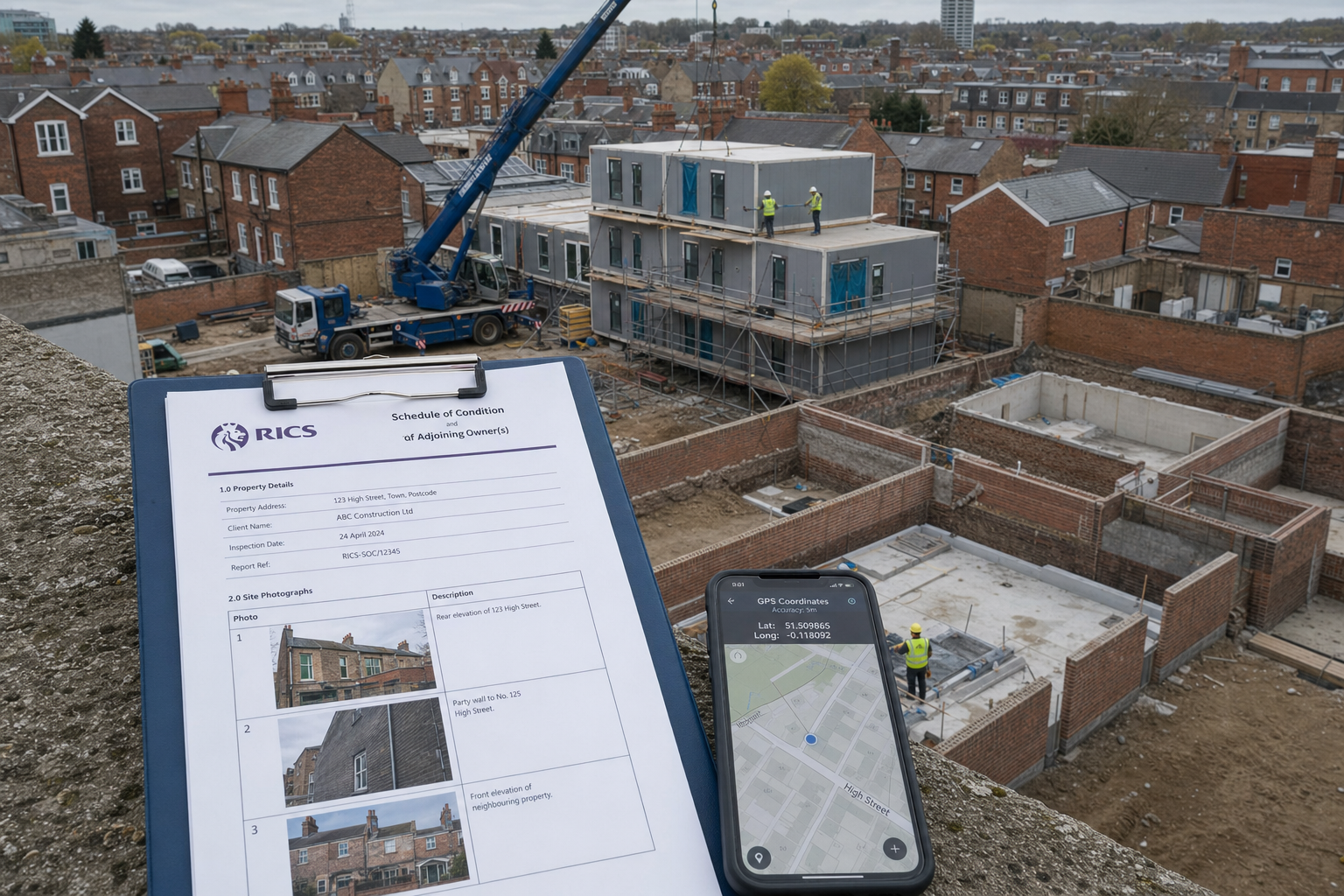
Why the Modular Housing Surge Creates Unique Party Wall Risks
The appeal of offsite construction is obvious: faster delivery, reduced waste, and more predictable costs. But the same factory-to-site pipeline that makes modular housing attractive also creates a compressed regulatory timeline that the Party Wall etc. Act 1996 was not specifically written to address.
In a conventional build, a developer serves notice, waits the statutory period, and then begins excavation or wall work. In a modular project, the structural modules — including panels that may form or abut a party wall — are already being manufactured while the notice period is still running. If the adjoining owner dissents and appoints a surveyor, the developer may face a situation where fabricated components need redesigning at significant cost.
The core risks in modular and prefab projects include:
- Modules delivered to site before a party wall award is in place
- Factory tolerances that assume boundary positions not yet verified by survey
- Crane lifts and heavy plant movements that affect adjoining structures before any baseline condition record exists
- Compressed timelines that leave surveyors insufficient time to produce thorough Schedules of Condition
For a deeper look at how party wall agreements interact with complex construction projects, chartered surveyors with specialist experience in boundary and party wall matters are the right starting point.
The Statutory Framework: What the Act Requires
The Party Wall etc. Act 1996 applies to three categories of work:
| Notice Type | Trigger | Minimum Notice Period |
|---|---|---|
| Party Structure Notice | Works to a shared wall or floor | 2 months |
| Line of Junction Notice | New wall on or near boundary | 1 month |
| Three Metre / Six Metre Notice | Excavation near adjoining foundations | 1 month |
In modular projects, the Line of Junction Notice and Party Structure Notice are most commonly relevant. The critical insight for 2026 is that notice must be served based on the intended works, not the on-site start date. This means developers should be serving notices during the design and manufacturing phase, ensuring adjoining owners have adequate time to respond before assembly begins on site [1].
Failure to serve notice correctly does not make the works unlawful in themselves, but it removes the statutory protection the Act provides and exposes the building owner to common law claims for any damage caused.
RICS Schedules of Condition: The Evidentiary Backbone of Offsite Projects
A Schedule of Condition is a detailed, independently prepared record of the existing state of an adjoining property before notifiable works begin. In conventional construction, it is a best-practice document. In modular and prefab projects, it is closer to a necessity.
The reason is straightforward: modular construction involves heavy crane operations, vibration from large vehicle movements, and the rapid imposition of new loads near existing boundaries. Any one of these activities can cause cracking, settlement, or damage to neighbouring structures. Without a pre-work baseline record, disputes about whether damage pre-existed the works or was caused by them become very difficult — and very expensive — to resolve.
A well-prepared Schedule of Condition typically covers:
- External walls and facades — cracking, spalling, pointing condition, damp staining
- Internal walls and ceilings — existing cracks mapped with width and orientation
- Floors — settlement, unevenness, existing damage
- Roof and chimney stacks — condition of coverings, flashings, and any existing movement
- Outbuildings and boundary structures — garden walls, garages, and ancillary structures
Best practice in 2026 extends coverage beyond immediately adjacent properties to include all structures that could plausibly be affected by the proposed works [3]. For large modular developments with multiple crane positions, this can mean scheduling properties two or three plots away.
For a comprehensive overview of what a professional condition report covers, the condition survey report guidance from London chartered surveyors provides useful context on scope and methodology.
What Makes a Schedule Legally Robust
A Schedule of Condition is only as useful as its evidential quality. Courts and dispute resolution panels consistently distinguish between thorough, independently prepared schedules and cursory documents that fail to capture meaningful baseline data.
Key elements of a legally robust schedule:
- Independence — Prepared by an agreed surveyor or the adjoining owner's appointed surveyor, not the building owner's project team
- Photographic evidence — High-resolution images with scale references and location context
- Written narrative — Precise descriptions of each defect, including dimensions where measurable
- Date and time stamping — Unambiguous confirmation that the record predates the works
- Signed agreement — Acknowledged by both parties or their representatives
The RICS 8th Edition consultation, launched in April 2026, has moved to formalise these requirements significantly [2]. The draft guidance introduces structured data fields for digital schedules, ensuring that critical information is captured consistently rather than left to individual surveyor discretion.
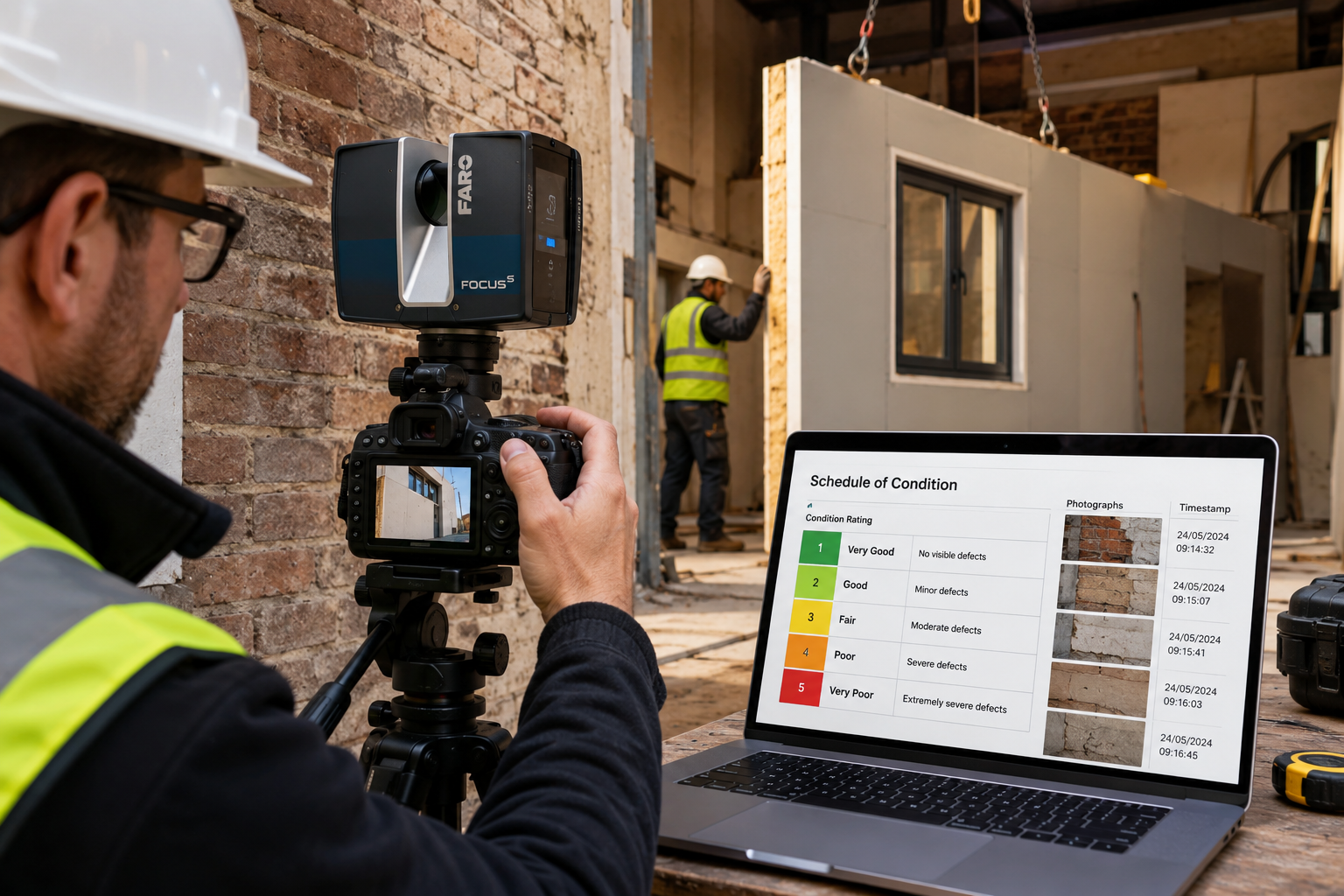
The RICS 8th Edition: What Changes for Prefab and Modular Schedules of Condition
The Party Wall Essentials for 2026 Prefab and Modular Housing Booms: RICS Schedules of Condition in Offsite Projects landscape is being reshaped by the RICS 8th Edition consultation, which represents the most significant update to party wall guidance in over a decade. Several of its proposed changes are directly relevant to offsite construction.
Digital Schedules and Enhanced Appendices
The 8th Edition introduces templates for fully digital Schedules of Condition [2]. These are not simply PDF versions of paper documents. They incorporate:
- Structured data fields that ensure consistent capture of condition information
- High-resolution photographic appendices with minimum 12-megapixel resolution
- GPS coordinates embedded in image metadata to confirm location
- Automatic timestamps that cannot be manually altered
- Scale references in every photograph to allow accurate measurement from the record
This level of documentation is particularly valuable in modular projects where the pace of on-site activity can mean that conditions change within hours. A digital schedule with GPS-tagged, timestamped photography is far more resistant to challenge than a traditional paper document.
The Five-Tier Condition Rating System
One of the most practically significant proposals in the 8th Edition is the introduction of a standardised five-tier, colour-coded condition rating scale [2]. This replaces the inconsistent narrative descriptions that have historically made it difficult to compare pre- and post-work condition records.
| Rating | Colour | Description |
|---|---|---|
| 1 | Green | No defects noted |
| 2 | Yellow | Minor defects, no immediate action required |
| 3 | Amber | Moderate defects, monitoring recommended |
| 4 | Orange | Significant defects, remedial works advised |
| 5 | Red | Serious defects, urgent action required |
In a modular housing context, this system allows a surveyor to record, for example, that a party wall was rated 2 (minor defects) before works began and 3 (moderate defects) after completion. That objective comparison is far more persuasive in a dispute than competing narrative accounts.
Digital Signatures and Chain of Custody
The 8th Edition also addresses document integrity directly. Digital schedules must include verifiable digital signatures to prevent post-inspection alterations [2]. In practice, this means using platforms that create an immutable audit trail — every edit is logged, every version is preserved, and the original inspection record cannot be quietly amended.
For construction projects involving multiple parties — developers, main contractors, subcontractors, and adjoining owners — this chain of custody protection is essential. It ensures that the schedule presented in a dispute is demonstrably the same document prepared at the time of inspection.
Advanced Survey Techniques
The 8th Edition also reflects the growing use of drone photography and 3D laser scanning in party wall surveying [5]. These technologies are becoming standard for:
- Properties with restricted access (e.g., narrow alleyways, elevated party walls)
- Complex rooflines and chimney stacks that are difficult to photograph from ground level
- Large modular developments where multiple structures need baseline records simultaneously
Laser scanning, in particular, creates a point-cloud model of the existing structure that can be compared directly with a post-works scan to identify any movement or deformation. This level of precision is well-matched to the engineering tolerances of modular construction.
Boundary Precision and Pre-Fab Risk Mapping in 2026
Modular housing units are precision-engineered to tight tolerances. A module that is 50mm out of position can create an encroachment on an adjoining owner's land, trigger a boundary dispute, or prevent the correct formation of a party wall junction. This makes proactive boundary surveying a critical component of the pre-construction phase.
The best practice approach for 2026 involves using GPS and laser measurement technology to establish boundary positions with sub-centimetre accuracy before modules are manufactured [1]. Any discrepancy between the legal boundary and the assumed construction line needs to be resolved — through agreement, a party wall award, or if necessary a formal boundary determination — before fabrication is finalised.
For guidance on the legal framework governing boundary walls and their relationship to party wall procedures, the UK boundary wall rules explained resource covers the key distinctions between boundary walls, party walls, and garden walls.
Pre-Fab Risk Mapping: A Practical Framework
Risk mapping for modular projects should be completed before notice is served. A structured risk map typically covers:
Structural risks:
- Foundation type and depth of adjoining properties
- Proximity of existing party walls to proposed module positions
- Presence of basements or cellars that could be affected by crane outrigger loads
Boundary risks:
- Accuracy of title plan boundaries versus physical features on site
- Existence of any informal boundary agreements or historic encroachments
- Potential for property boundary disputes arising from assumed versus legal boundary positions
Procedural risks:
- Number of adjoining owners requiring notification
- Likelihood of dissent and appointment of separate surveyors
- Timeline implications if an agreed surveyor cannot be appointed
Sustainability considerations:
- Emerging best practice recommends incorporating carbon scoping exercises into party wall procedures, aligning with RICS standards for sustainable construction [4]. This is particularly relevant for modular projects, which often carry a lower embodied carbon footprint than traditional builds — a fact worth documenting in the party wall award.
Early Notification: The Single Most Important Step
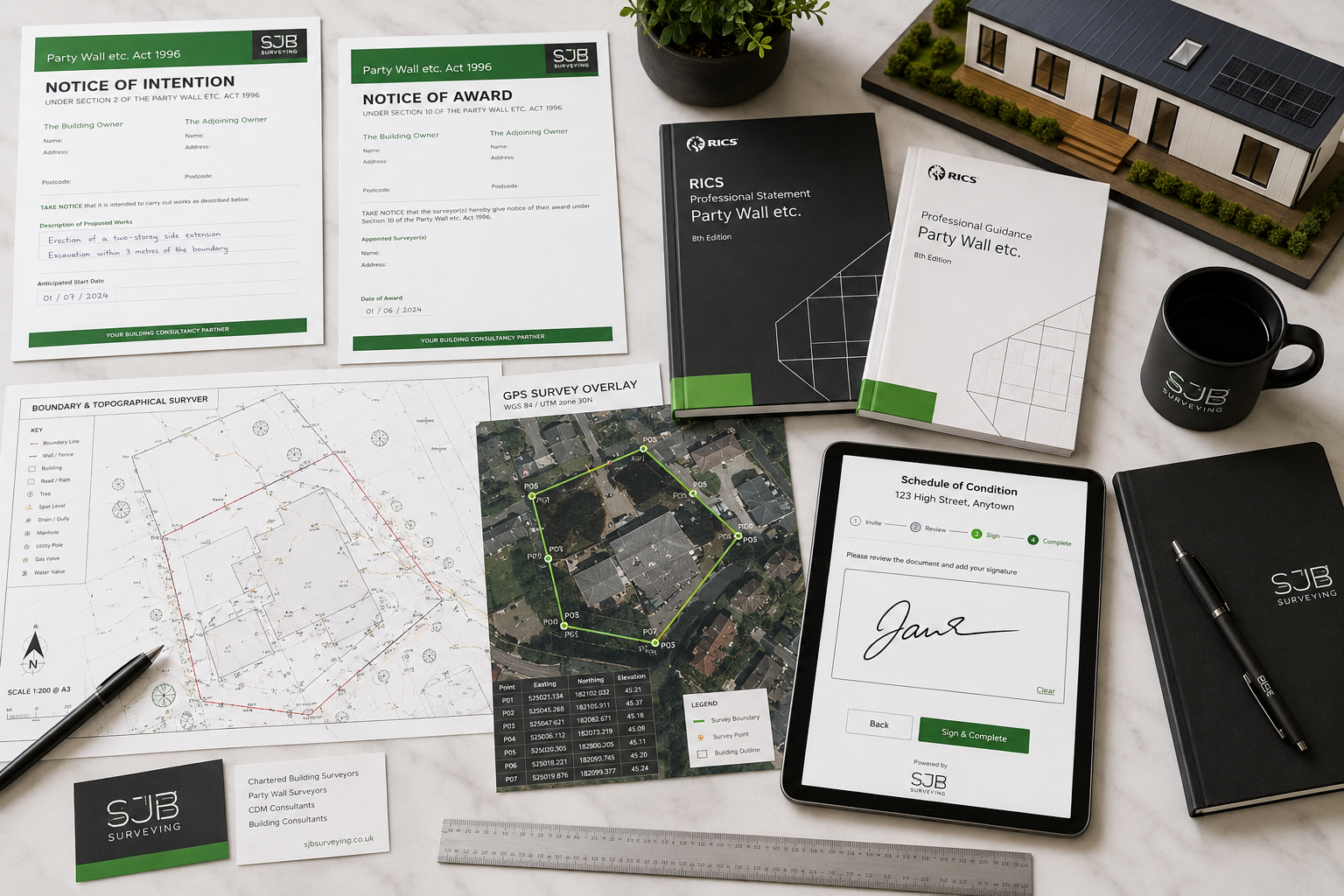
The most consistent finding from modular housing projects that encounter party wall difficulties is that notice was served too late. Serving notice during the offsite manufacturing phase — rather than at the point of site mobilisation — gives all parties the time they need to appoint surveyors, agree the scope of Schedules of Condition, and produce a party wall award before any works affect adjoining properties [1].
Developers who treat early notification as a project management discipline, rather than a legal formality, consistently report fewer disputes, lower legal costs, and smoother programme delivery.
For those working on building works in London and the South East, engaging a chartered surveyor with specific experience in modular and offsite projects is strongly advisable. The combination of compressed timelines and complex boundary conditions in urban areas makes specialist knowledge particularly valuable.
Practical Steps for Developers, Surveyors, and Adjoining Owners
The Party Wall Essentials for 2026 Prefab and Modular Housing Booms: RICS Schedules of Condition in Offsite Projects framework can be distilled into a clear action sequence for each party involved.
For Developers and Building Owners
- Commission a boundary survey using GPS and laser technology before finalising module dimensions
- Serve all required party wall notices during the design and manufacturing phase
- Appoint an experienced party wall surveyor to manage the award process proactively
- Budget for comprehensive digital Schedules of Condition covering all potentially affected properties
- Incorporate whole-life carbon documentation into the party wall award where relevant
For Party Wall Surveyors
- Use the RICS 8th Edition digital schedule templates and five-tier rating system
- Ensure all photographs meet the minimum 12-megapixel standard with GPS metadata and timestamps
- Extend the scope of Schedules of Condition beyond immediately adjacent properties where crane operations or vibration risk warrants it
- Apply digital signature protocols to all schedule documents
- Consider drone and laser scanning for properties with restricted access or complex features
For Adjoining Owners
- Respond to party wall notices promptly — dissenting and appointing a surveyor is a legitimate and protective step, not an adversarial one
- Request a copy of the Schedule of Condition prepared for your property and review it carefully
- Keep records of any changes to your property's condition during the construction period
- If damage occurs, report it promptly to the building owner's surveyor and document it photographically
For those seeking professional surveying support across London, building surveyor services from RICS-regulated firms offer the combination of technical expertise and legal knowledge that modular and prefab party wall matters demand.
Conclusion
The modular housing boom of 2026 is not slowing down, and the party wall framework must keep pace with it. The core message is clear: the speed advantages of offsite construction are only realised without legal disruption when party wall procedures are treated as a front-loaded project management discipline rather than a last-minute compliance exercise.
Actionable next steps for 2026:
- Serve notice early — During the manufacturing phase, not at site mobilisation. This single step prevents the majority of modular party wall disputes.
- Commission digital Schedules of Condition — Using the RICS 8th Edition templates, five-tier rating system, and GPS-tagged photography to create an unassailable baseline record.
- Map boundaries before fabrication — GPS and laser surveys should confirm boundary positions before module dimensions are finalised.
- Engage specialist surveyors — Party wall surveyors with specific experience in offsite construction understand the compressed timelines and precision requirements of modular projects.
- Document sustainability credentials — Incorporate whole-life carbon data into party wall awards where relevant, aligning with emerging RICS standards.
The combination of proactive notice, rigorous documentation, and specialist expertise transforms party wall compliance from a risk into a competitive advantage — giving developers, lenders, and adjoining owners the certainty they need to move forward with confidence.
References
[1] Party Wall Surveys For Modular Housing Projects Rics Protocols In 2026s Offsite Construction Surge – https://wimbledonsurveyors.com/party-wall-surveys-for-modular-housing-projects-rics-protocols-in-2026s-offsite-construction-surge/?utm_source=openai
[2] Viewcompounddoc – https://consultations.rics.org/party_walls_8th_edition_guidance/viewCompoundDoc?docid=16799988&partId=16802804&sessionid=&voteid=&utm_source=openai
[3] Schedules Of Condition In Party Wall Agreements Best Practices For 2026 Pre Work Documentation – https://partywallsurveyorlondon.uk/blogs/schedules-of-condition-in-party-wall-agreements-best-practices-for-2026-pre-work-documentation/?utm_source=openai
[4] Integrating Rics Whole Life Carbon Assessments Into 2026 Party Wall Awards Survey Protocols For Sustainable Boundary Works – https://wimbledonsurveyors.com/integrating-rics-whole-life-carbon-assessments-into-2026-party-wall-awards-survey-protocols-for-sustainable-boundary-works/?utm_source=openai
[5] Underpinning Works And Party Wall Agreements 2026 Surveyor Protocols For Foundation Stability Disputes – https://wimbledonsurveyors.com/underpinning-works-and-party-wall-agreements-2026-surveyor-protocols-for-foundation-stability-disputes/?utm_source=openai