
Around 3.7 million UK households, roughly 15% of all homes, currently fail to meet the Decent Homes Standard, with the average cost to bring a non-decent dwelling up to scratch sitting at £11,162 [31]. Yet most homeowners who receive a building survey report have no clear system for turning that document into a workable repair schedule. The gap between a surveyor's findings and a properly sequenced improvement plan is where money is wasted, defects worsen, and compliance risks grow.
This guide covers Property Improvement Plans After a Building Survey: From Defect List to Phased Works in UK Homes, showing precisely how RICS condition ratings translate into prioritised works, how to build a phased schedule, and how to budget sensibly for everything from urgent structural repairs to long-term energy upgrades.
Key Takeaways
- A building survey report is the starting point, not the end point, converting its findings into a phased works plan is the critical next step.
- RICS Condition Ratings 1, 2 and 3 provide a ready-made prioritisation framework that maps directly onto short, medium and long-term works.
- Urgent (Rating 3) items, structural defects, damp, failed electrics, should be addressed within 12 months; Rating 2 items within 24 months.
- Industry guidance recommends reserving 1-2% of property value annually to fund phased improvements, with more for older or listed homes.
- New legislation including the Renters' Rights Act 2025 and Awaab's Law means survey-identified defects increasingly carry direct legal implications for landlords.
Understanding What a Building Survey Report Actually Tells You
Before any improvement plan can be built, homeowners need to understand what a survey report is designed to communicate. Whether the document is a Level 2 HomeBuyer Report or a Level 3 Building Survey, the RICS Home Survey Standard, currently operating under its 1st edition while a 2nd edition undergoes finalisation following public consultation held between August and October 2025, requires surveyors to use a standardised condition rating system [1][2].
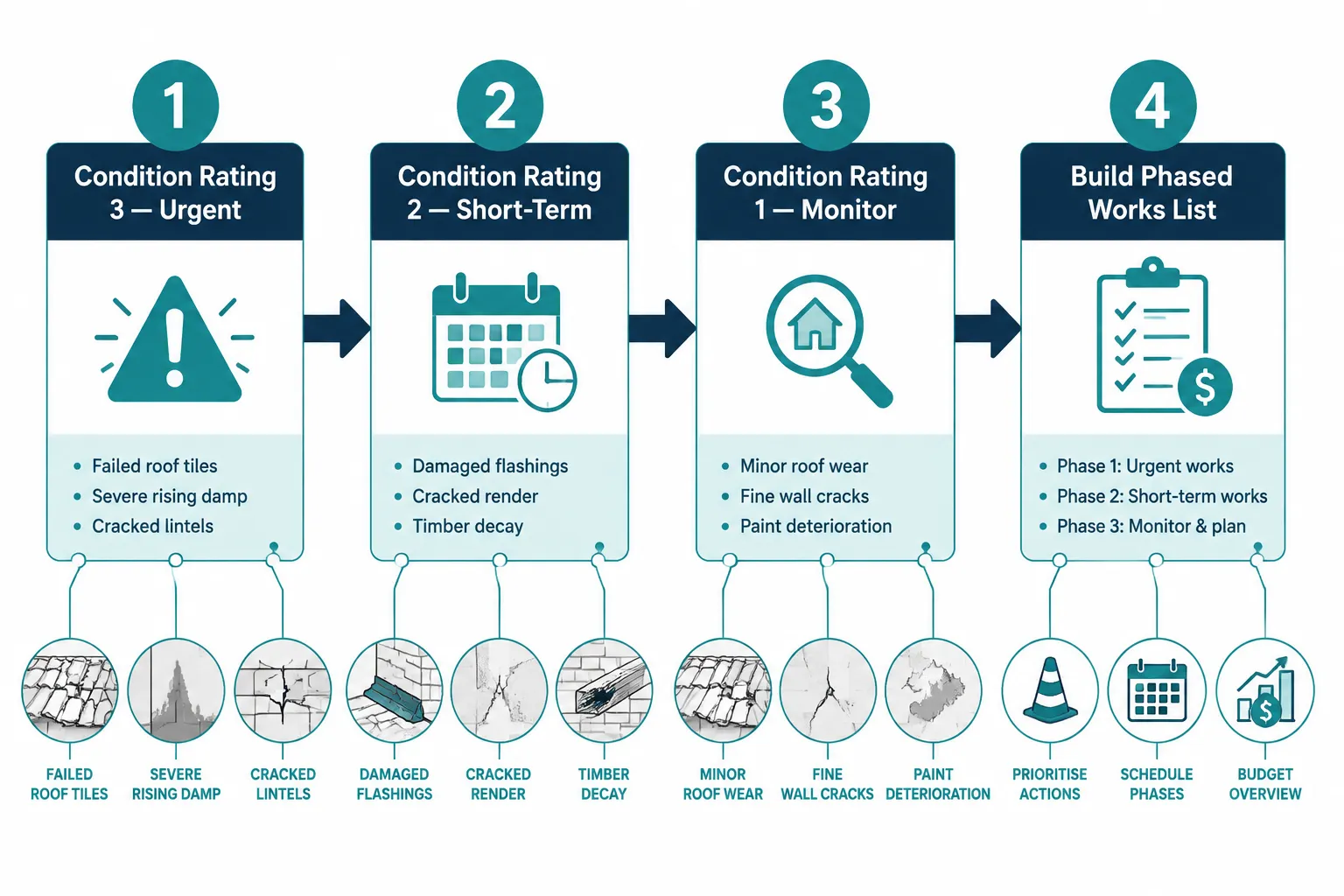
The three ratings work as follows:
| Condition Rating | Meaning | Typical Action |
|---|---|---|
| Rating 3 | Serious or urgent defect requiring prompt repair or investigation | Act within 12 months |
| Rating 2 | Defect needing repair or replacement soon but not immediately | Plan within 24 months |
| Rating 1 | No repair needed; monitor through routine maintenance | Review at next survey |
An April 2026 update from RICS confirms that surveyors must continue working to the 1st edition standard until the 2nd edition is fully approved and implemented, expected around 2027, meaning the condition rating framework above remains the current authoritative basis for all reports [2]. Industry commentary suggests the forthcoming 2nd edition will strengthen requirements around consumer-friendly defect explanations and technology integration, but the fundamental prioritisation logic will remain [5][8].
Before preparing for an RICS home survey, it helps to understand that the report you receive is structured to make exactly this kind of prioritisation possible. Many homeowners, however, treat the report as a pass/fail document rather than a planning tool.
It is also worth understanding the difference between a HomeBuyer Report and a structural survey, a Level 3 Building Survey provides significantly more detail on defect causes and remediation options, making it the stronger foundation for a comprehensive improvement plan on older or complex properties.
Building Your Property Improvement Plan: From Defect List to Phased Works
The core task in Property Improvement Plans After a Building Survey: From Defect List to Phased Works in UK Homes is translating a surveyor's findings into a sequenced, costed action list. This is not complicated, but it does require a disciplined approach.
Step 1, Extract and Categorise All Defects
Start by going through the report and pulling every defect into a simple spreadsheet with the following columns:
- Defect description (as stated in the report)
- Condition rating (1, 2 or 3)
- Location in the property
- Surveyor's recommended action
- Estimated cost range (to be added after obtaining quotes)
- Target completion date
Rating 3 items go straight to the top of the list. These typically include structural movement, active roof leaks, significant damp penetration, outdated electrical systems and unsafe heating installations. If a report has flagged any of these, reading what to do after a bad building survey report is a sensible first step before contacting contractors.
Step 2, Apply Time-Based Priority Bands
Government guidance on condition surveys for public buildings defines time-based priority bands that are increasingly mirrored in private-sector practice: urgent remedial action within one year, essential works within one to two years, and longer-term maintenance thereafter [21]. Apply the same logic to your defect list:
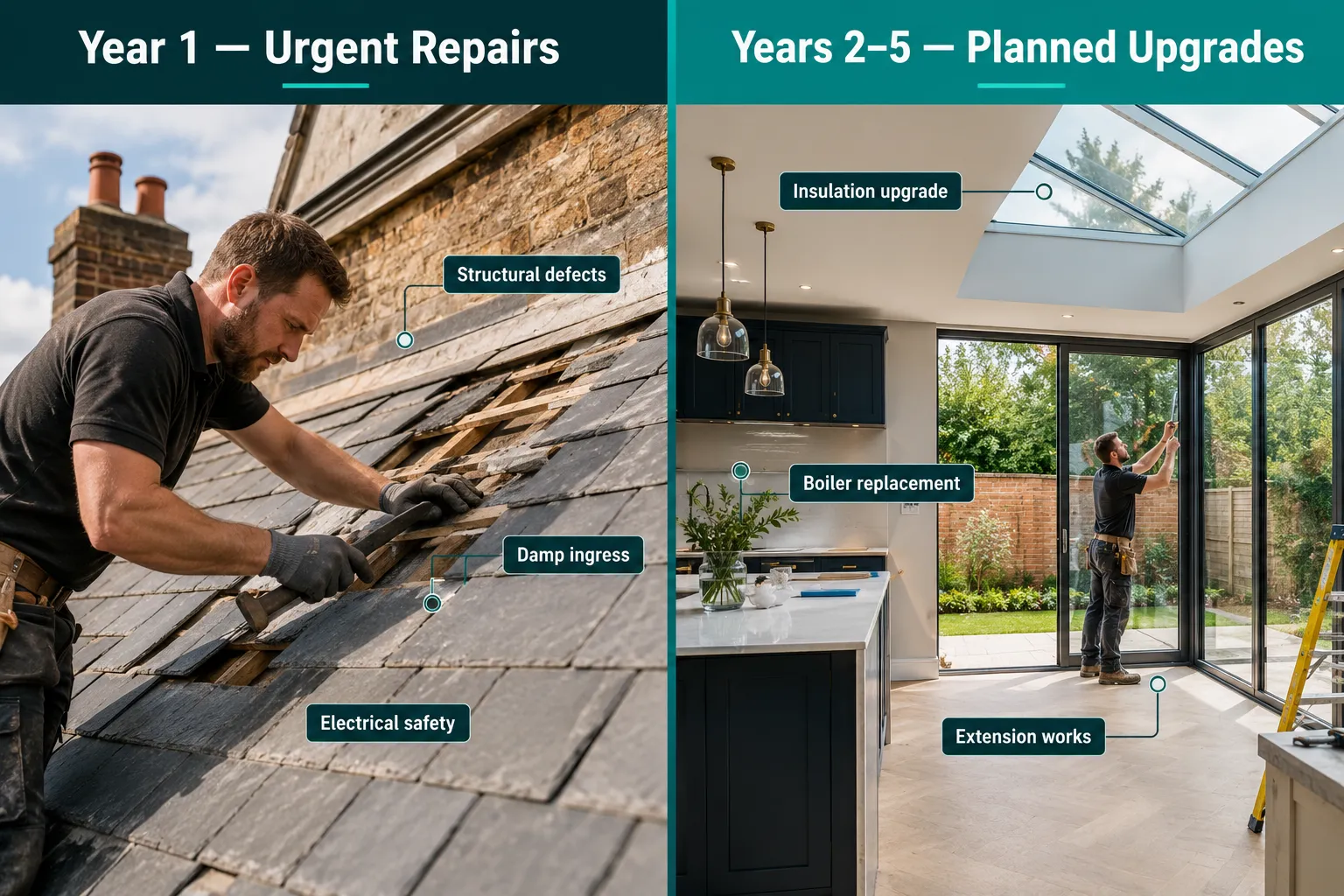
- Year 1 (Urgent): All Rating 3 items plus any safety-critical systems, roof integrity, drainage, structure, electrics, gas/heating.
- Years 1-2 (Essential): Rating 2 items that could deteriorate into Rating 3 if left unaddressed.
- Years 2-5 (Planned): Remaining Rating 2 items, energy efficiency upgrades, cosmetic improvements and any planned extensions.
- Ongoing: Rating 1 items monitored through annual maintenance checks.
Step 3, Sequence Works to Avoid Rework
Sequencing matters enormously. Carrying out internal decoration before fixing a roof leak, or installing new flooring before resolving rising damp, wastes money. A sound sequencing principle is:
- Fix the building envelope first (roof, walls, windows, drainage)
- Address structural issues
- Upgrade services (electrics, heating, plumbing)
- Improve thermal performance and energy efficiency
- Carry out internal fit-out and cosmetic works
- Plan extensions or conversions last
This logic prevents expensive rework and ensures that energy-efficiency measures, such as insulation or heat pump installation, are installed into a building that is already weathertight and structurally sound.
Costing and Budgeting Phased Works in UK Homes
Turning a defect list into a financially realistic plan requires honest cost estimation. Surveying and building maintenance firms now commonly recommend setting an annual maintenance reserve of approximately 1-2% of property value to fund phased improvements derived from the survey [20][22][23]. For a property valued at £400,000, that means budgeting £4,000,£8,000 per year for maintenance and improvement works, more for older, listed or larger homes.
The national picture reinforces why this reserve matters. The English Housing Survey for 2024-25 estimates the mean cost to bring a non-decent dwelling up to standard at £11,162, with a median of £4,598 at 2024 prices [31][32]. These figures suggest that for many homes, a single year's maintenance reserve will not cover the full cost of bringing the property up to standard, phasing works over three to five years is therefore both practical and financially necessary.
Typical Cost Ranges for Common Survey Defects
The following ranges are indicative and will vary by region, property type and contractor:
- Roof re-covering (average terraced house): £5,000,£12,000
- Damp-proof course installation or repair: £500,£2,500 per affected area
- Chimney repointing and flashing: £500,£1,500
- Full rewire (3-bed house): £3,500,£6,000
- Boiler replacement: £2,000,£4,500
- Structural crack investigation and repair: £1,000,£10,000+ depending on cause
- Window replacement (double glazing, full house): £6,000,£15,000
For damp-related defects specifically, which affect around 1.4 million UK dwellings [31], understanding the full scope of investigation before committing to remediation is important. A damp survey provides a detailed diagnosis that prevents homeowners from spending money on the wrong treatment.
Obtaining and Comparing Quotes
- Get at least three quotes for any work above £1,000.
- Ask contractors to quote against the surveyor's specific recommendations, not their own scope.
- Request itemised quotes so individual elements can be deferred if budget is tight.
- Check that contractors carry appropriate insurance and, for structural or specialist work, relevant qualifications.
Legal and Compliance Dimensions of Post-Survey Improvement Plans
Property Improvement Plans After a Building Survey: From Defect List to Phased Works in UK Homes are no longer purely a matter of personal choice for landlords. Two significant legislative developments in 2026 mean that survey-identified defects carry direct legal weight.
Awaab's Law, implemented in phases from 2026, sets strict time limits for dealing with damp and mould hazards in social housing, establishing a benchmark that is already influencing expectations for timely, risk-based remedial works across all tenures [4]. Social landlords are now spending a record £8.8-9 billion annually on repairs and maintenance, approximately 60% more than in 2019, yet an estimated 431,000 non-decent social rented homes remain [35][38].
The Renters' Rights Act 2025, with its first phase effective from 1 May 2026, removes no-fault section 21 evictions and begins extending the Decent Homes Standard into the private rented sector [7]. For private landlords, this means that survey-identified Category 1 hazards, particularly those relating to damp, mould, structural instability and inadequate heating, can now feed directly into enforcement action.
"Survey-identified defects (especially Category 1 hazards, disrepair and inadequate facilities) increasingly have direct legal implications for landlords and feed into enforcement-driven improvement plans." [7]
For landlords managing properties in areas with active enforcement, understanding housing disrepair claims under the Renters' Rights Act is essential reading before finalising any phased works schedule.
The data on vulnerable occupants reinforces the urgency. Between 2022 and 2024, the number of dependent children living in non-decent homes rose from 1.5 million to 1.7 million, and children in damp homes from 0.8 million to 1.0 million [39][45]. Around 1.5 million people over 65 and 2.6 million people with long-term illness or disability also live in non-decent homes [39][45].
Energy Efficiency and Planned Extensions: Integrating Upgrades Into the Phased Plan
A building survey rarely covers energy performance in detail, that requires a separate Energy Performance Certificate (EPC) assessment, but it does identify defects that directly affect thermal comfort. With 13% of UK households unable to keep warm in winter and 7.7 million households reporting condensation, damp or mould [39][45], energy efficiency improvements are increasingly treated as a core component of any phased works plan rather than an optional extra.

Integrating Energy Upgrades
Energy upgrades should be sequenced after the building envelope is made weathertight and before internal finishes are applied. Key upgrades to consider within a five-year phased plan include:
- Loft and cavity wall insulation, typically the highest return on investment for older UK homes
- Solid wall insulation (internal or external), relevant for pre-1920 properties without cavity walls
- Double or triple glazing, particularly where the survey has flagged failed seals or single glazing
- Heat pump or high-efficiency boiler installation, best planned after insulation is in place
- Mechanical ventilation with heat recovery (MVHR), increasingly relevant where airtightness improvements risk condensation
Planning Extensions and Conversions
Extensions and loft conversions should sit at the end of the phased plan, after structural defects are resolved and services are upgraded. Attempting to extend a building with an unresolved subsidence issue, for example, can invalidate insurance and create significant structural risk. Where extensions involve shared walls, party wall surveyor costs and obligations will need to be factored into the budget and timeline.
Choosing the Right Survey Level to Support Your Improvement Plan
The quality of an improvement plan depends directly on the quality of the survey that underpins it. Homeowners and buyers who commission a Level 2 HomeBuyer Report on a property that genuinely warrants a Level 3 Building Survey will receive less detail on defect causes, remediation options and cost implications, making it harder to build an accurate phased works plan.
Understanding the difference between Home Survey Level 2 and Level 3 is therefore a foundational decision. As a general rule:
- Level 2 is appropriate for conventionally built properties in reasonable condition, typically post-1930.
- Level 3 is recommended for properties built before 1900, those with significant visible defects, unusual construction, or where major works are planned.
A qualified building surveyor can advise on the appropriate level before commissioning the survey, potentially saving significant money by avoiding an under-specified report that requires a follow-up inspection.
Maintaining the Plan: Reviews, Records and Ongoing Monitoring
A phased works plan is a living document, not a one-time exercise. Best practice involves:
- Annual review of the plan against completed works, updated cost estimates and any new defects identified
- Photographic records of all completed works, including before-and-after images
- Retention of all contractor invoices, guarantees and building control certificates, these are essential for future sales and insurance claims
- Periodic re-survey for older properties, a full Level 3 survey every 10 years is a reasonable benchmark, with a Level 2 check every five years for newer homes
Where a survey has identified potential subsidence or structural movement, understanding whether building insurance covers subsidence and notifying the insurer promptly is a critical early step that should appear on the plan before any remediation work begins.
Conclusion
A building survey report is one of the most valuable documents a homeowner or buyer can commission, but only if its findings are acted upon systematically. The path from a defect list to a properly sequenced, costed and legally compliant improvement plan follows a clear logic: extract and categorise defects by condition rating, apply time-based priority bands, sequence works to prevent rework, budget realistically using the 1-2% annual reserve principle, and integrate energy efficiency and planned extensions at the appropriate stage.
Actionable next steps:
- Download or request your full survey report and create a defect spreadsheet within one week of receipt.
- Identify all Condition Rating 3 items and obtain contractor quotes within 30 days.
- Set up a dedicated savings pot for your annual maintenance reserve, calculated at 1-2% of your property's current value.
- Consult a qualified chartered surveyor if the report has flagged structural movement, significant damp or any item requiring specialist investigation before works begin.
- If you are a landlord, review your phased plan against the Decent Homes Standard and Awaab's Law timelines to ensure compliance with obligations effective from 2026.
- Schedule a plan review every 12 months and update cost estimates and target dates as works progress.
The scale of the UK's housing condition challenge, millions of non-decent homes, rising numbers of children in damp properties, and new legislative pressure, makes systematic post-survey planning not just good practice but an increasingly urgent responsibility.
References
[1] Home Survey Standards – rics.org
[2] Home Survey Standard 2nd Edition April 2026 Update – rics.org
[4] Awaab's Law – housing-ombudsman.org.uk
[5] RICS Home Survey Standards Updates 2026 Enhancements For Consumer Insights And Tech Integration – princesurveyors.co.uk
[6] RICS Launches Consultation Updated Home Survey Standard – rics.org
[7] Housing Disrepair Claims Renters Rights Act – atalawsolicitors.com
[8] RICS 2nd Edition Home Survey Standard 2025 Key Updates And Implementation Roadmap For Building Surveyors In 2026 – princesurveyors.co.uk