
Fewer than one in five property valuation disputes that reach litigation are resolved without an expert surveyor giving formal evidence, yet many property owners, lenders, and solicitors instruct experts too late, or instruct the wrong type of surveyor entirely. Understanding Valuation Disputes: When to Instruct a Surveyor as Expert Witness Under RICS Red Book Standards is not a procedural nicety; it is a strategic decision that can determine whether a case succeeds or collapses under cross-examination.
This guide explains the difference between a standard Red Book valuation and an expert witness valuation, identifies the precise trigger points that justify formal instruction, and sets out the documentation, methodology, and standards that expert evidence must meet in 2026.
Key Takeaways
- A standard RICS Red Book valuation and an expert witness valuation serve fundamentally different purposes and are governed by different RICS standards.
- The RICS "Surveyors acting as expert witnesses" 5th edition (updated August 2026) is the primary standard governing expert witness instructions, not the Red Book itself, which applies as technical reference.
- Experts must identify which edition of the Red Book was in force at the original valuation date, as the 2025 Red Book replaced the 2021/2022 edition for valuation dates on or after 31 January 2025.
- An expert surveyor's overriding duty is to the tribunal, not to the instructing party, blurring this with an advisory or advocacy role is prohibited.
- ESG factors, AI-assisted valuation tools, and data governance are now mandatory considerations under the 2025 Red Book, and expert witnesses will increasingly be required to address these in their reports.
Standard Valuation vs Expert Witness Valuation: A Critical Distinction
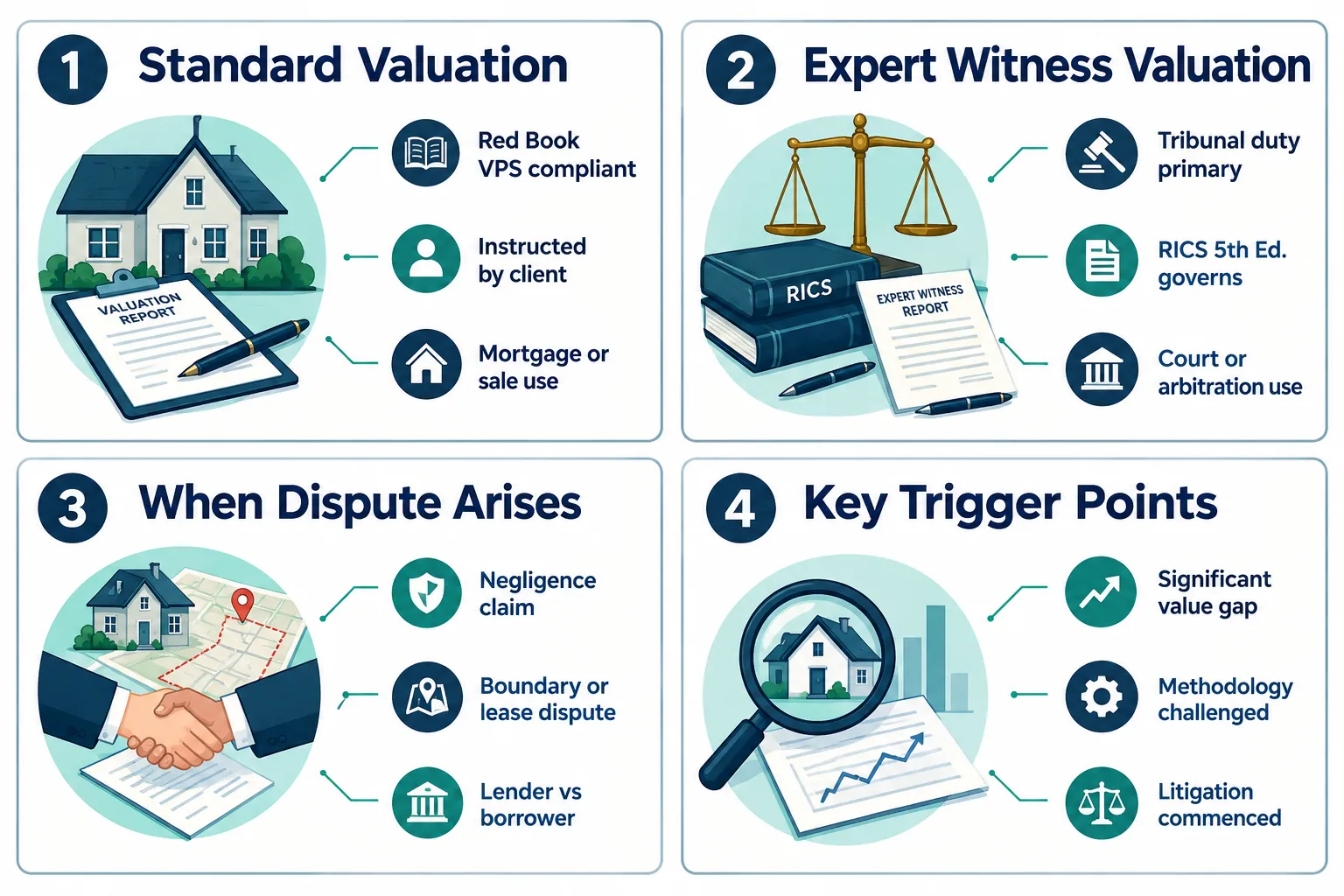
Most property professionals are familiar with a Red Book valuation, a formal, RICS-compliant assessment of market value prepared for mortgage lending, sale, or financial reporting. What is less widely understood is that the Red Book expressly carves out an exception for surveyors acting or preparing to act as expert witnesses [2]. This means the standard procedural requirements of the Red Book, its valuation practice statements (VPS), terms of engagement format, and reporting obligations, are not automatically mandated when a surveyor is instructed purely in an expert witness capacity.
Instead, two separate frameworks apply simultaneously:
| Purpose | Governing Standard | Primary Duty |
|---|---|---|
| Standard Red Book valuation | RICS Red Book Global Standards (VPS 1-5) | To the instructing client |
| Expert witness valuation opinion | RICS "Surveyors acting as expert witnesses" 5th edition | To the tribunal |
This distinction matters enormously in valuation disputes. A surveyor who treats an expert witness instruction as though it were a standard commission, prioritising the client's preferred outcome, risks producing evidence that is inadmissible, professionally sanctioned, or destroyed in cross-examination.
What the Red Book Still Does in Dispute Contexts
Even when the expert witness standard governs the engagement, the Red Book remains the technical benchmark against which the original valuation is assessed [2][3]. An expert reconstructing or critiquing a valuation must:
- Identify which edition of the Red Book applied at the original valuation date
- Apply the bases of value (now reorganised under VPS 2 in the 2025 edition) that were operative at that date [3]
- Consider the UK National Supplement where the property is in the UK, effective from 1 May 2024 and reissued in January 2025 to align with the new Global Standards [14][15]
For valuations dated before 31 January 2025, the previous 2021/2022 Red Book edition applies. For those dated on or after 31 January 2025, the current Red Book Global Standards govern [2][5]. Experts who apply the wrong edition undermine the credibility of their entire analysis.
Key principle: The Red Book tells the expert what good valuation practice looked like at the relevant date. The expert witness standard tells the expert how to give evidence about it.
When Valuation Disputes Require a Formal Expert Witness Instruction
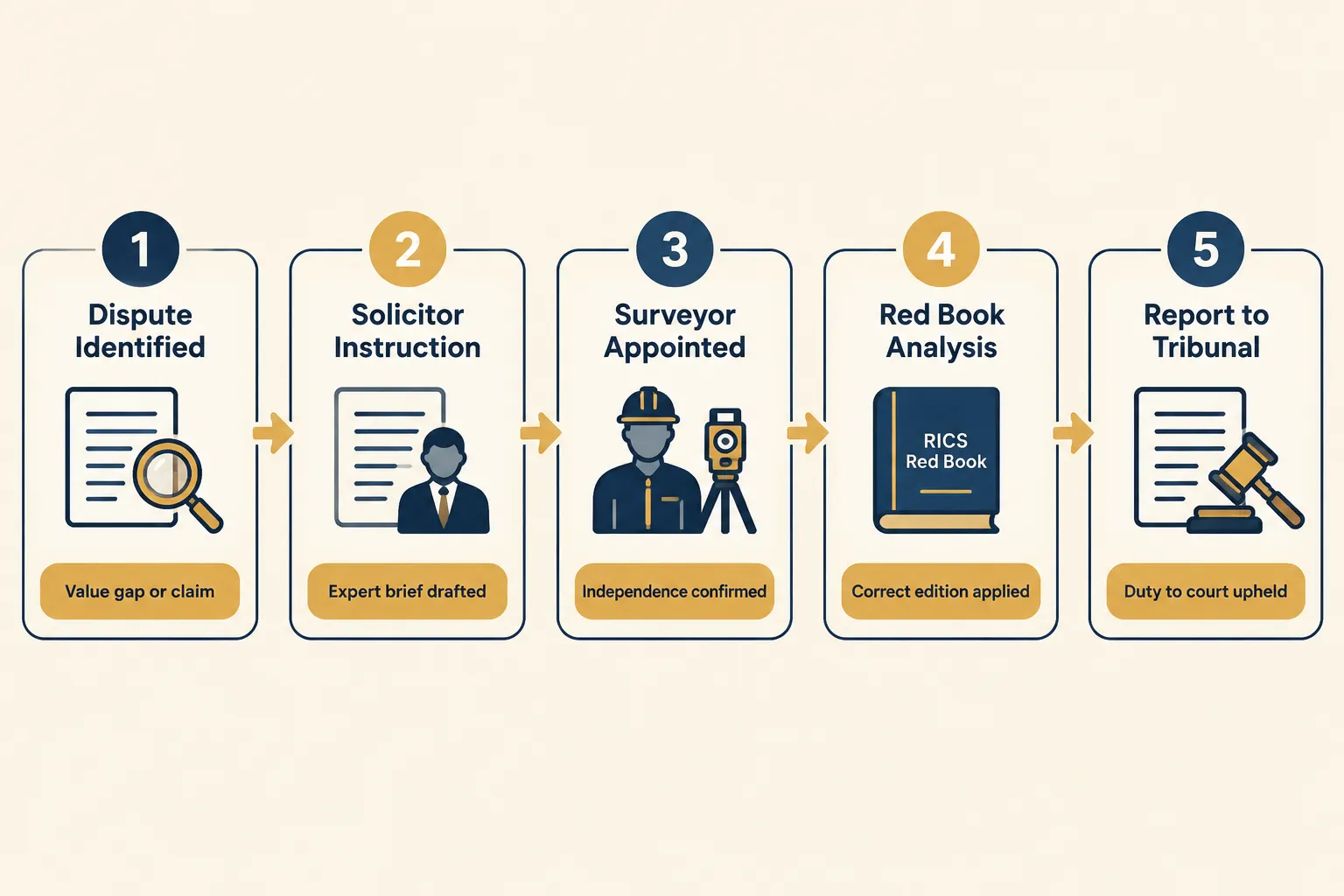
Not every disagreement about property value warrants the instruction of a formal expert witness. RICS guidance is clear that surveyors should be instructed as expert witnesses only where genuine subject-matter expertise is needed to assist the tribunal on complex or contested valuation issues [9][11]. The following scenarios typically cross that threshold.
Negligence Claims Against Valuers
When a lender, buyer, or borrower alleges that a valuation was negligently prepared, for example, that comparable evidence was ignored, that the wrong basis of value was applied, or that the valuation fell outside the acceptable margin of error, a court or arbitral tribunal cannot determine that question without expert evidence. The expert's role is to reconstruct what a competent valuer would have concluded at the relevant date, applying the Red Book standards and IVS methodology that were then in force [5][9].
Lease Renewal and Rent Review Disputes
Commercial lease renewals under the Landlord and Tenant Act 1954, and rent reviews under upward-only review clauses, frequently produce significant disagreements about open market rental value. These disputes, whether before the courts, RICS arbitrators, or independent experts, almost always require a surveyor to give formal expert evidence on comparable transactions, yield analysis, and market conditions [11].
Matrimonial and Estate Disputes
Family courts routinely require expert valuations of residential and commercial property in divorce proceedings. Similarly, disputed probate valuations, where HMRC or beneficiaries challenge the value placed on a property at the date of death, require an independent expert to opine on value with reference to the market evidence available at that specific historical date.
Compulsory Purchase and Compensation Claims
Landowners seeking compensation following compulsory purchase orders must demonstrate the value of their land and any disturbance losses. The Lands Tribunal (Upper Tribunal, Lands Chamber) specifically requires expert evidence on valuation methodology, and surveyors appearing before it must comply fully with the expert witness standard [4][10].
Mortgage Fraud and Financial Mis-selling
Regulatory investigations and civil claims arising from alleged mortgage fraud or mis-selling of financial products secured on property require expert surveyors to explain whether valuations were reasonable, inflated, or suppressed. These cases often involve complex valuation modelling and, increasingly, questions about whether AI-assisted tools or automated valuation models (AVMs) were used appropriately [5][6].
For a broader understanding of what an expert witness surveyor does and the scope of their role, it is worth reviewing the specific duties before any instruction is finalised.
The RICS Expert Witness Standard: What Surveyors Must Do in 2026
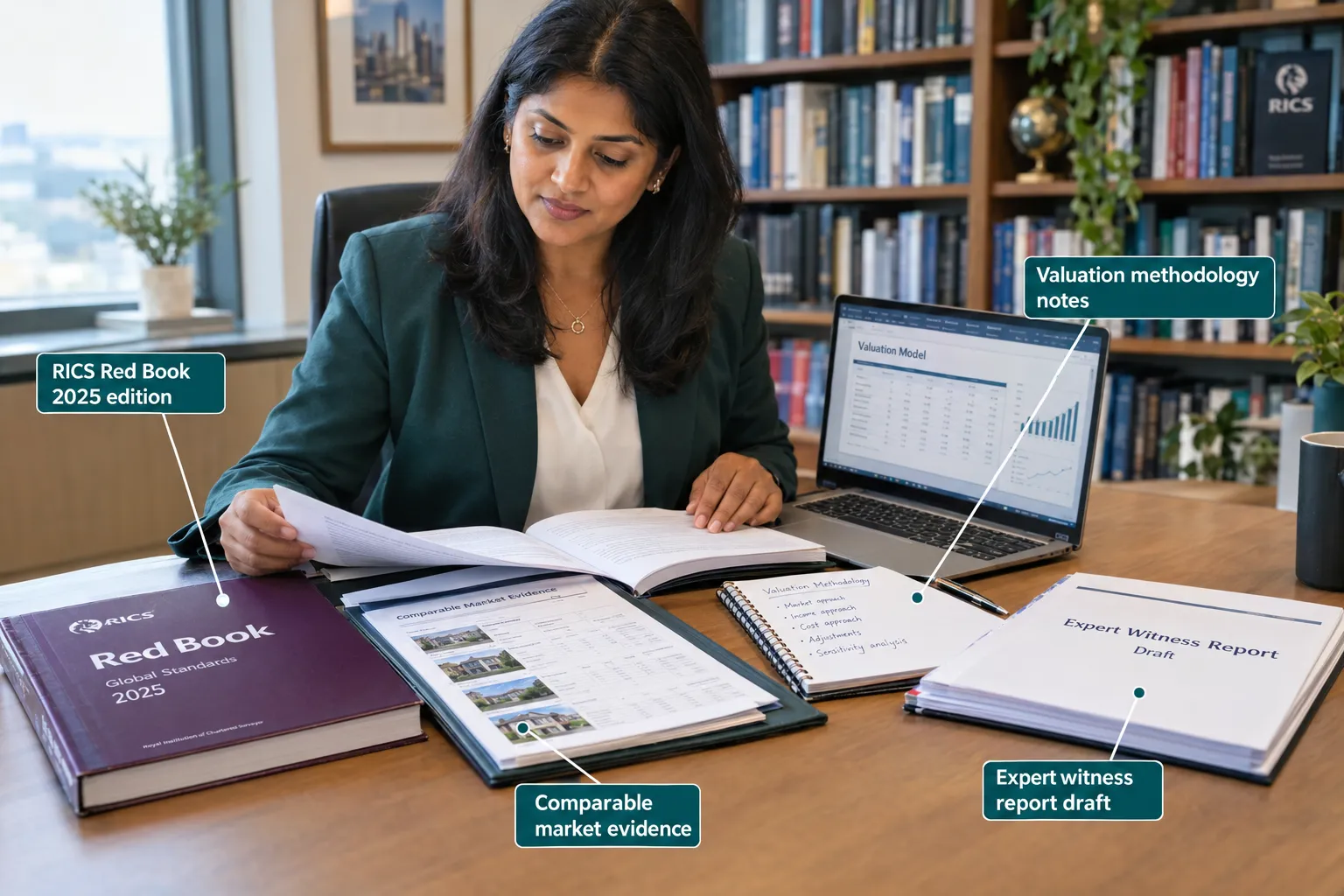
The RICS "Surveyors acting as expert witnesses" 5th edition, updated and combined in August 2026, is now the authoritative global standard for surveyors giving expert evidence [10][13]. It supersedes the 4th edition published in 2020 and introduces important clarifications that affect how instructions should be structured and how reports must be prepared.
The Overriding Duty to the Tribunal
The 5th edition reiterates, unambiguously, that an expert witness's primary duty is to the tribunal, not to the party who instructs or pays them [13]. This duty requires:
- Independence: The expert must not be influenced by the outcome desired by the instructing party
- Impartiality: Opinions must reflect genuine professional judgment, not advocacy
- Completeness: Where a range of values is supportable, the expert should present that range rather than advocate a single figure [13]
- Transparency: The reasoning, assumptions, and evidence base underpinning every opinion must be fully disclosed
The Prohibition on Dual Roles
One of the sharpest provisions in the 5th edition is the prohibition on combining the expert witness role with an advisory or advocacy role before the same tribunal [13]. A surveyor who has previously advised a party on strategy, negotiated on their behalf, or prepared a without-prejudice position paper should not then give expert evidence in the same dispute. Solicitors and clients who are accustomed to using the same surveyor for everything must plan ahead and separate these functions from the outset.
Accepting Instructions: Competence and Resources
The 5th edition requires that surveyors accept expert witness instructions only where they have suitable expertise, experience, and resources [13][4]. This means:
- Demonstrable expertise in the relevant asset class (residential, commercial, industrial, agricultural)
- Familiarity with the valuation methodology and Red Book provisions applicable at the relevant date
- Capacity to complete the work within tribunal timetables
- Ability to withstand sustained cross-examination on methodology and assumptions [9]
This last point is often underestimated. A surveyor who is an excellent practitioner but has limited experience of formal proceedings may produce a technically sound report that falls apart under cross-examination because they cannot clearly articulate why they weighted certain comparables over others, or why they departed from a particular Red Book provision.
Fee Disputes and Engagement Terms
Earlier RICS guidance (4th edition) included specific clauses for managing fee disagreements with expert surveyors, such as requiring undisputed amounts to be paid promptly and referring contested fees to a third party [7]. While the 5th edition now governs engagement terms, these contractual principles remain relevant in practice. Critically, fee disputes between expert and instructing solicitor must never be allowed to affect the independence of the expert's evidence, a point the RICS has consistently emphasised [7][13].
Documentation, Market Evidence, and Methodology: What Must Stand Up in Court
A valuation opinion that cannot be defended with contemporaneous evidence is not expert evidence, it is assertion. The following elements are non-negotiable in any expert witness report on a valuation dispute.
Comparable Evidence
The expert must compile a schedule of comparable transactions that were available to a competent valuer at the relevant date. Post-date comparables may be used to illuminate market trends but must be clearly distinguished from contemporaneous evidence. Each comparable must be analysed for:
- Lot size, tenure, and physical condition
- Date of transaction relative to the valuation date
- Any special purchaser, distress, or abnormal circumstances
- Adjustments made and the reasoning for each
Methodology Transparency
Under the 2025 Red Book, the bases of value (market value, market rent, investment value, and others) are now set out in VPS 2 [3]. The expert must clearly state which basis of value was applicable to the original instruction, whether the original valuer applied it correctly, and, if not, what value would have resulted from a correct application.
ESG, AI, and Data Governance
The 2025 Red Book introduces mandatory ESG elements and explicit requirements around AI in valuation [5][6]. For disputes involving valuations prepared after 31 January 2025, expert witnesses will increasingly be expected to address:
- Whether ESG factors (energy performance, flood risk, retrofit costs) were properly considered
- Whether any automated valuation model or AI tool was used, and if so, whether its data lineage and model risk were adequately disclosed
- Whether the data sources underpinning the valuation were appropriate and independently verifiable [5][6]
This is a forward-looking development. As RICS and the courts begin to scrutinise AI-assisted valuations more closely, experts who cannot explain the data governance behind a valuation model will find their evidence challenged on grounds that did not exist five years ago.
The Expert's Report: Structure and Content
A compliant expert witness report in a valuation dispute should include:
- Statement of truth and independence, confirming the expert's overriding duty to the tribunal
- Scope of instruction, what the expert was asked to opine on, and any limitations
- Factual background, the property, the original instruction, and the relevant valuation date
- Red Book analysis, which edition applied, whether it was followed, and any departures
- Comparable evidence schedule, with full analysis and adjustments
- Valuation opinion, stated as a range where appropriate, with full reasoning
- Matters outside expertise, any issues the expert declines to opine on, and why
For property owners or solicitors who want to understand when a Red Book valuation is needed in the first place, before a dispute arises, reviewing the standard requirements is a useful starting point.
Practical Steps for Property Owners, Lenders, and Solicitors
Understanding the framework is useful; acting on it correctly is what protects a client's position. The following practical steps apply across the most common dispute scenarios.
Step 1, Identify the dispute type early. Not all valuation disagreements require expert evidence. Minor differences in value that fall within the accepted margin of error (typically 5-10% for residential property) may not justify the cost of formal expert instruction. Seek initial advice from a chartered surveyor before committing to litigation.
Step 2, Separate advisory and expert witness roles. If a surveyor has already been advising on strategy or negotiating, appoint a separate expert for tribunal purposes. Conflating these roles is a common and costly mistake.
Step 3, Identify the correct Red Book edition. Confirm the original valuation date and establish whether the 2021/2022 or 2025 Red Book applies. For UK properties, confirm whether the UK National Supplement was operative [2][5].
Step 4, Instruct an expert with the right asset class expertise. A residential valuation expert is not automatically qualified to give evidence on a complex commercial or mixed-use development. Match the expert's specialism to the asset [13][4].
Step 5, Preserve all documentation. Original valuation reports, comparable evidence relied upon, instructions to the original valuer, and any correspondence about the valuation should be preserved and disclosed. Courts and arbitral tribunals expect full documentary transparency.
Step 6, Plan for ESG and data scrutiny. For post-January 2025 valuations, ensure the expert is prepared to address ESG assumptions and any AI or AVM tools used in the original valuation [5][6].
For disputes that also involve structural or physical condition issues, for example, where a valuer is alleged to have missed significant defects, a condition survey report from a separate building surveyor may be needed alongside the valuation expert's evidence. Similarly, where boundary issues contribute to a value dispute, reviewing the average cost of a boundary dispute can help parties assess proportionality before committing to proceedings.
Understanding surveyor responsibilities in both standard and contentious contexts is also valuable for any party considering formal proceedings.
Conclusion
Valuation Disputes: When to Instruct a Surveyor as Expert Witness Under RICS Red Book Standards is a question that deserves a precise, structured answer, not a reactive one made under litigation pressure. The core principle is straightforward: a standard Red Book valuation and an expert witness valuation are governed by different RICS standards, serve different purposes, and impose different duties on the surveyor.
In 2026, the landscape has become more demanding. The 2025 Red Book's mandatory ESG provisions and AI governance requirements mean that expert witnesses must be prepared to engage with data lineage, model risk, and sustainability assumptions in ways that were not expected even three years ago. The RICS 5th edition expert witness standard reinforces the absolute primacy of the tribunal duty and the prohibition on dual roles.
Actionable next steps:
- If a valuation dispute has arisen or is anticipated, obtain early advice from a qualified RICS surveyor to assess whether the value gap is material and whether expert evidence is proportionate.
- Instruct separate surveyors for advisory and expert witness functions from the outset.
- Confirm the correct Red Book edition for the relevant valuation date before any expert report is commissioned.
- Ensure the instructed expert has specific experience in the relevant asset class and in giving tribunal evidence.
- For post-January 2025 valuations, brief the expert on ESG and AI-related issues in the original valuation file.
Acting on these steps early is the single most effective way to ensure that expert evidence in a valuation dispute is credible, admissible, and persuasive.
References
[1] Red Book – rics.org
[2] Red Book Global Standards Incorporating IVS – rics.org
[3] Red Book Global – rics.org
[4] Surveyors acting as expert witnesses (Feb 2023 amendment) – rics.org
[5] Red Book 2024 Basis for Conclusions – rics.org
[6] New RICS Global Red Book Updates: Mandatory Standards, Data Management, Technology, ESG Valuation – rics.org
[7] Surveyors Acting as Expert Witnesses 4th Edition (August 2020) – rics.org
[8] Red Book Global Standards: Supporting High Standards in Valuation Delivery Worldwide – rics.org
[9] Surveyors as Expert Witnesses – rics.org
[10] Surveyors Acting as Expert Witnesses (RICS profession standards page) – rics.org