
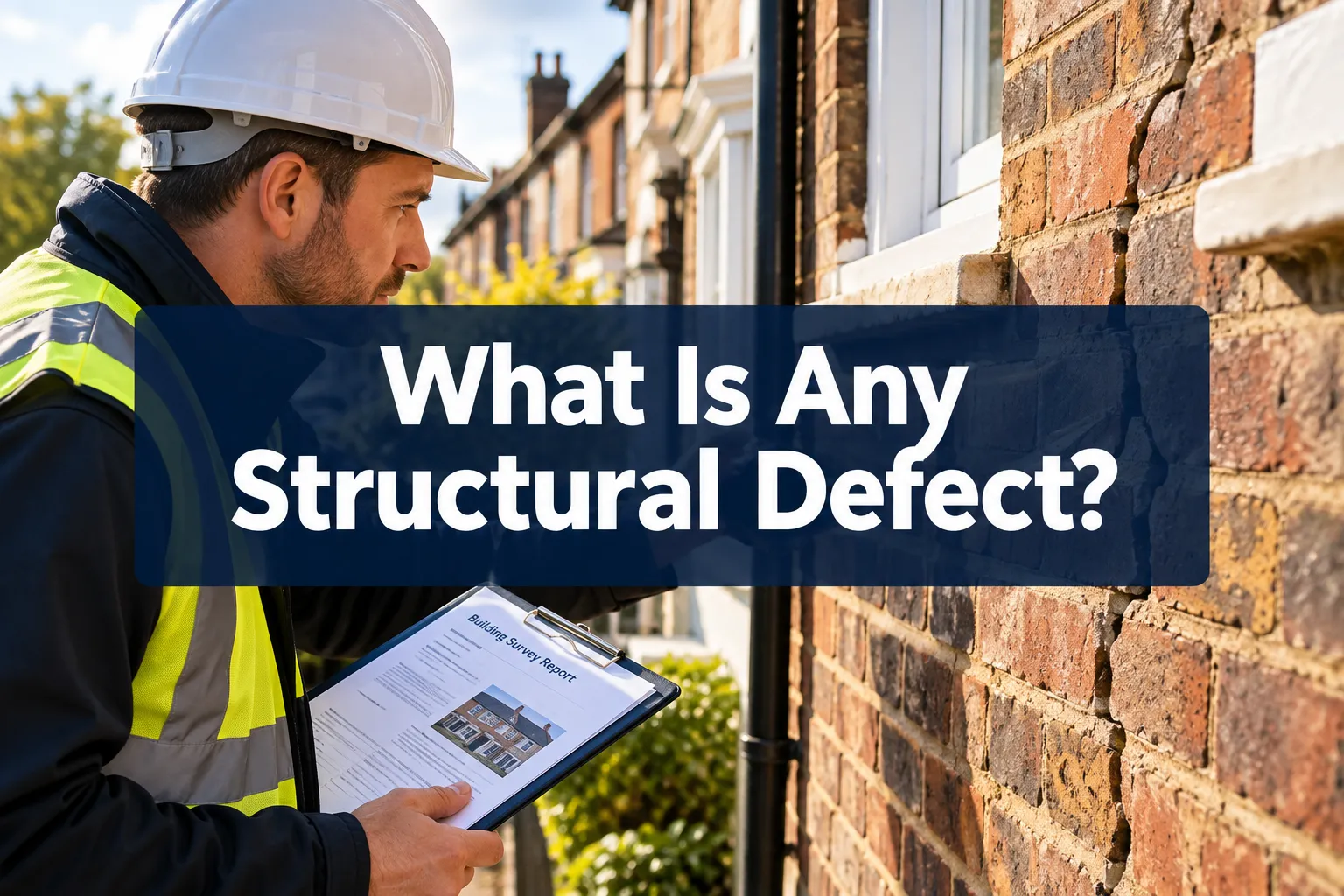
Nearly one in three UK homebuyers who commission a building survey receive a report flagging at least one serious structural concern, yet many buyers struggle to understand what that actually means for their purchase, their mortgage, or their safety. The phrase "structural defect" appears throughout survey reports, mortgage conditions, and property contracts, but it is rarely defined clearly for the people who need to act on it. Understanding what is any structural defect, and how surveyors decide what really matters in a building survey report, can be the difference between a confident purchase and a costly mistake.
Key Takeaways
- A structural defect is any fault that compromises the load-bearing capacity, stability, or weathertightness of a building's primary elements.
- Surveyors use a three-tier condition rating system (1 to 3, or green to red) to communicate urgency and severity to buyers.
- Not all defects are structural; surveyors distinguish between cosmetic, maintenance, and structural issues with very different implications.
- A Condition 3 (red) rating typically signals that further specialist investigation or urgent repair is required before exchange of contracts.
- New-build properties are not immune, complaints about serious structural defects in new homes have tripled in recent years, making independent surveys increasingly important.
Defining a Structural Defect: What the Term Actually Means
The term "structural defect" is used in survey reports, building contracts, insurance policies, and legislation, but its precise meaning shifts depending on the context. In the broadest sense, a structural defect is any fault, failure, or deterioration in a building element that affects its ability to carry loads, maintain stability, or resist the elements [1].
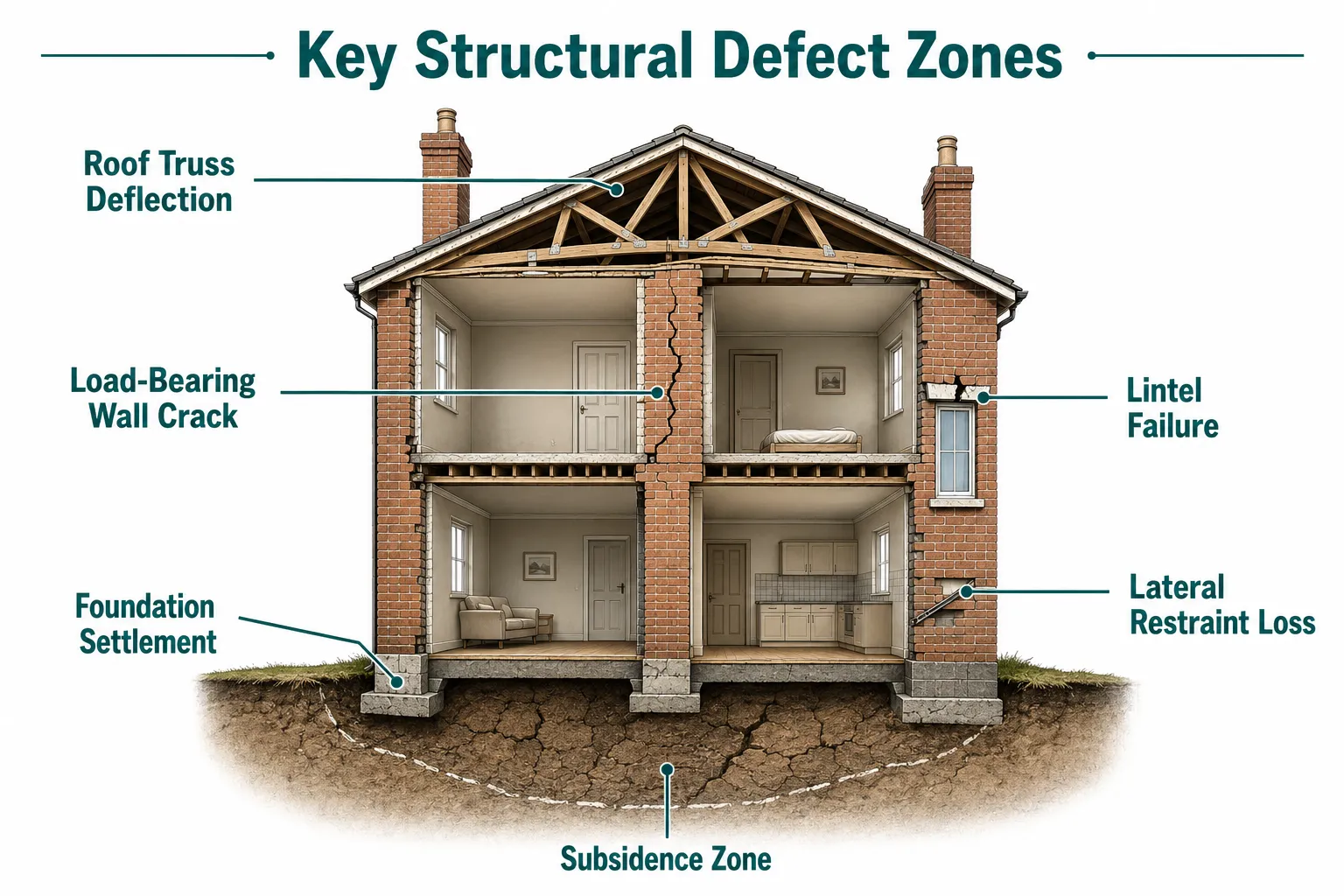
The primary structural elements of a building include foundations, load-bearing walls, floors, roofs, and the frame or superstructure that ties them together. When any of these elements fails to perform its intended function, whether through poor design, substandard materials, inadequate workmanship, or gradual deterioration, the result is classified as a structural defect [5].
Three broad categories help surveyors organise defects in a building survey report:
- Structural defects, faults in load-bearing or stability-critical elements (foundations, walls, roof structure, lintels)
- Fabric defects, deterioration in the building envelope (roofing felt, pointing, render, window frames) that may become structural if untreated
- Cosmetic or maintenance defects, surface-level issues (peeling paint, minor cracking in plaster, worn floor coverings) with no structural implication
The legal and contractual framing matters too. In new-build warranties and sale contracts, the phrase "any structural defect" is often used as a catch-all trigger for warranty claims or remediation obligations. In this context, it typically means any defect in the structural shell that was not caused by the occupant and that a reasonable person would not have accepted at handover [5].
For older properties, understanding what constitutes a structural defect is especially important because age-related movement, settlement, and material decay can blur the line between normal wear and genuine structural failure.
How Surveyors Decide What Really Matters in a Building Survey Report
The core professional challenge in any building survey is not simply identifying defects, it is communicating which ones genuinely matter and why. This is where the surveyor's judgement, training, and reporting framework become critical.
The Condition Rating System
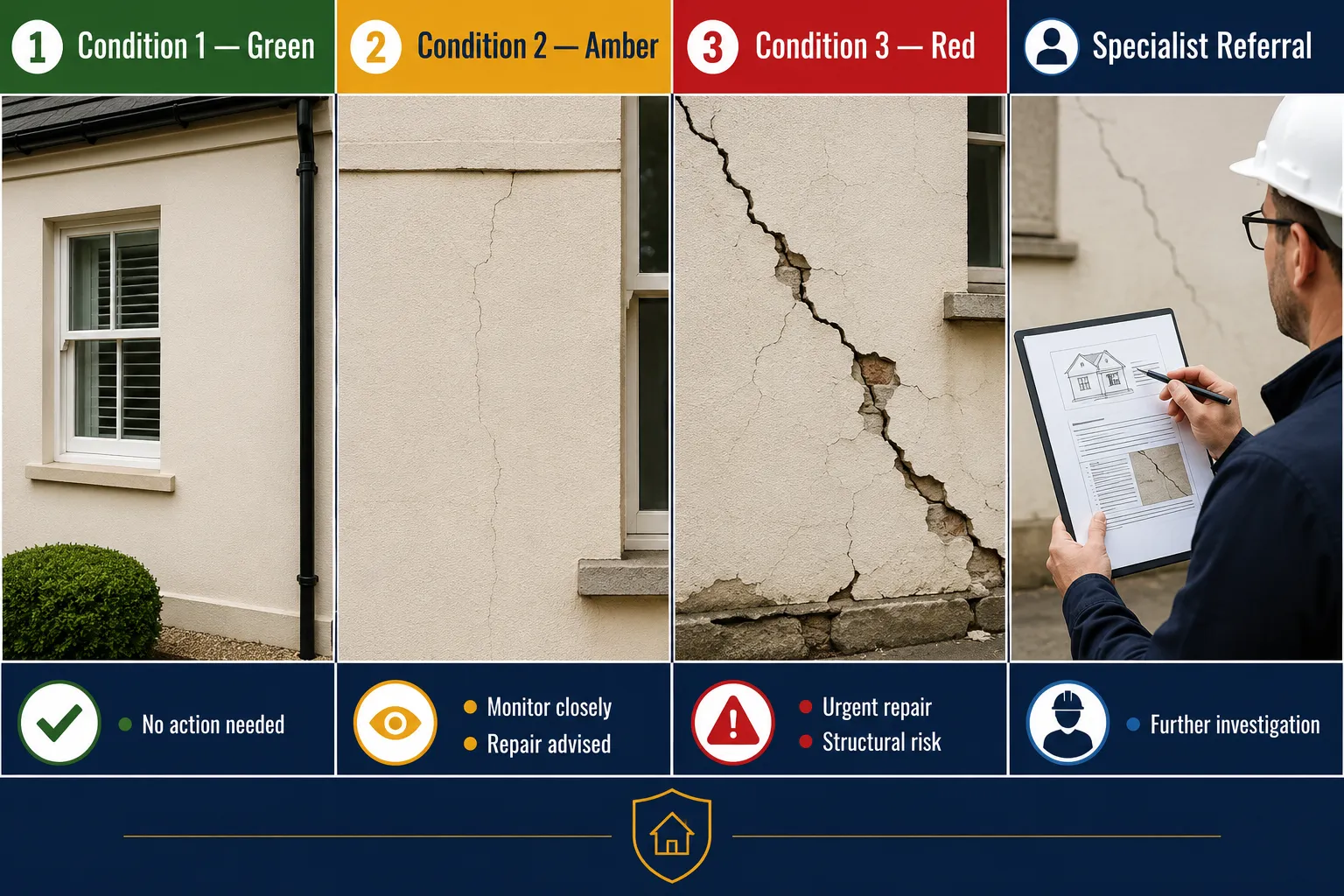
RICS-regulated surveyors use a standardised three-tier condition rating system in Level 2 (Homebuyer) and Level 3 (Building Survey) reports [4]:
| Rating | Colour | Meaning | Typical Action |
|---|---|---|---|
| Condition 1 | Green | No repair needed at time of inspection | Routine maintenance only |
| Condition 2 | Amber | Defects requiring repair or replacement but not urgent | Budget for works; obtain quotes |
| Condition 3 | Red | Serious defects requiring urgent attention | Specialist investigation before exchange |
A Condition 3 rating does not automatically mean a building is unsafe or unmortgageable. It means the surveyor has identified a defect serious enough to warrant further investigation, specialist input, or immediate repair planning [4]. Buyers who receive a report with multiple Condition 3 items should read the guidance on what to do after a bad building survey report before deciding how to proceed.
What Surveyors Actually Look For
When assessing whether a defect crosses the threshold from minor to structural, surveyors apply a combination of visual inspection, professional experience, and technical benchmarks. Key indicators include:
- Crack width and pattern, diagonal stair-step cracking in brickwork, horizontal cracking in retaining walls, or vertical cracking at structural junctions are all red flags [7]
- Wall lean or bow, any wall leaning more than one-third of its thickness from vertical is considered structurally significant; in new builds, even small deviations from tolerance can trigger a defect classification
- Roof spread, outward movement of roof feet pushing walls apart, visible as cracking at eaves level or bowing of external walls
- Foundation movement, differential settlement producing uneven floors, sticking doors, or cracking concentrated around corners and openings [7]
- Lintel failure, cracking or deflection above window and door openings, indicating that the structural element spanning the opening is failing
"A surveyor's job is not to alarm buyers, but to ensure that no material defect capable of affecting value, safety, or mortgageability goes unreported."
The RICS building pathology competency framework requires surveyors to diagnose the cause of a defect, not merely describe its appearance [3]. This means a good survey report will explain whether cracking is due to thermal movement (usually benign), moisture-related shrinkage (moderate concern), or differential foundation settlement (potentially serious).
Structural vs Non-Structural: Why the Distinction Matters
Not every crack is a structural defect. Hairline plaster cracking caused by seasonal thermal movement is cosmetic. Spalling brickwork from freeze-thaw cycles is a fabric defect. But a diagonal crack running from a window corner down to a damp proof course, widening progressively, is a structural warning sign that demands investigation.
The distinction matters for three practical reasons:
- Mortgageability, lenders may decline or condition a mortgage offer on properties with unresolved Condition 3 structural items
- Insurance, some insurers exclude pre-existing structural defects from standard buildings cover
- Negotiation, buyers can use confirmed structural defects to renegotiate the purchase price; see the average price reduction achievable after a survey for practical benchmarks
For properties with suspected subsidence, the guide to subsidence signs, causes, and when to worry provides a detailed breakdown of what surveyors look for and when specialist structural engineers are required.
When Surveyors Escalate: From Survey Report to Specialist Investigation
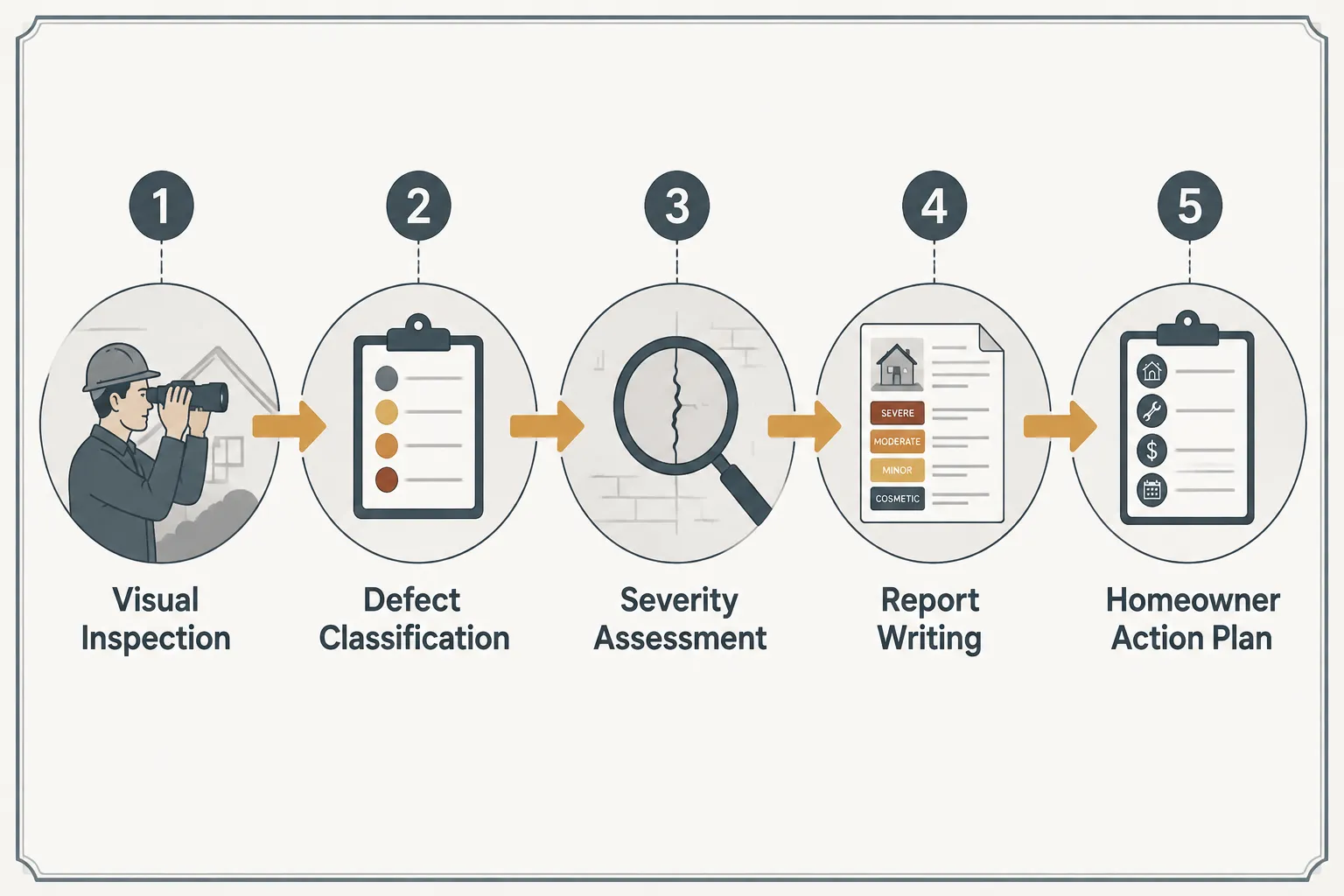
A building survey report is a visual, non-invasive inspection. Surveyors cannot open up walls, lift floorboards without permission, or conduct load calculations. When the evidence points to a potential structural defect but the surveyor cannot confirm its extent or cause from a visual inspection alone, they will recommend further investigation [1].
The Escalation Process
The typical escalation pathway looks like this:
- Surveyor identifies a potential structural defect during the building survey inspection
- Condition 3 rating is assigned with a recommendation for specialist investigation
- Structural engineer or specialist surveyor is appointed to carry out an intrusive or detailed investigation
- Specialist report confirms or rules out structural failure and specifies remediation
- Buyer uses findings to renegotiate, request repairs, or withdraw from the purchase
This process is particularly common with older properties where a Level 3 building survey is recommended over a basic Level 2 Homebuyer Report. The Level 3 survey provides a more detailed analysis of construction, materials, and defects, and is better suited to identifying complex structural issues in period properties.
For buyers in central London, building surveyors in Knightsbridge and surrounding areas regularly encounter Victorian and Edwardian properties where foundation movement, timber decay, and roof spread are common escalation triggers.
New Builds Are Not Exempt
A persistent misconception is that new-build properties are free from structural defects. Recent data tells a different story. Complaints about serious defects in new-build homes have tripled in a single year, with homeowners winning significantly larger payouts from developers and warranty providers [10]. The Housing, Communities and Local Government Committee has issued formal warnings about new-build quality standards, particularly as the government pursues a target of 1.5 million new homes [9].
One specific issue gaining attention in 2026 is wall verticality tolerance in new builds. Industry standards define acceptable tolerances for wall lean during construction; when walls fall outside these tolerances, the deviation constitutes a structural defect even if the wall appears superficially sound. Buyers of new properties should consider commissioning an independent survey before legal completion, the expert guide to whether you need a building survey for a new build sets out the key considerations.
Damp as a Precursor to Structural Defects
Damp is frequently misclassified as a cosmetic issue when it is actually a precursor to serious structural damage. Persistent penetrating damp can saturate timber floor joists, causing wet rot and eventual structural failure. Rising damp that breaches a damp proof course can undermine masonry at foundation level. A damp survey report provides the detailed moisture mapping that a standard building survey cannot always deliver, and is a sensible follow-up when a surveyor flags unexplained damp readings.
Structural Defects, Regulation, and the Homeowner's Responsibility in 2026
The regulatory landscape around structural defects is evolving. Awaab's Law Phase 2, coming into force from October 2026, extends mandatory repair timescales for structural hazards in social housing, requiring landlords to begin emergency repairs within 24 hours and complete them within a defined period. While this directly affects social housing providers, it signals a broader legislative direction toward enforceable standards for structural safety across the housing stock [6].
For private homeowners, the practical implication is that structural defects identified in a survey report carry real legal and financial weight. Sellers who knowingly conceal material defects, including structural ones, risk claims under misrepresentation. Buyers who commission a thorough survey and act on its findings are in a far stronger legal and financial position.
Practical steps for buyers in 2026:
- Always commission at minimum a Level 2 survey; for any property built before 1980 or showing visible signs of movement, commission a Level 3
- Read the condition ratings carefully and ask the surveyor to clarify any Condition 3 items before exchange
- Obtain specialist quotes for any structural remediation recommended in the report before committing to the purchase price
- Do not assume a mortgage valuation identifies structural defects, it does not; it is a lender's security check, not a buyer's survey
- For new builds, commission an independent snagging survey and consider a structural assessment if the developer's warranty documentation is unclear
The demand for structural assessment is rising sharply. Industry data from 2026 shows that homeowner confidence in self-assessing structural issues is low, driving increased demand for professional surveys and specialist structural reports [2]. This trend reflects a growing awareness that the cost of a survey is trivial compared to the cost of an undetected structural defect.
Conclusion
Understanding what is any structural defect, and how surveyors decide what really matters in a building survey report, is not a matter of technical expertise reserved for professionals. It is practical knowledge that every property buyer, seller, and owner needs in order to make sound decisions.
A structural defect is any fault in a primary building element that compromises load-bearing capacity, stability, or weathertightness. Surveyors classify defects using a three-tier condition rating system, with Condition 3 (red) signalling serious issues that require urgent attention or specialist investigation. The distinction between structural, fabric, and cosmetic defects has direct consequences for mortgageability, insurance, and purchase price negotiation.
Actionable next steps:
- Commission the right level of survey for the property type and age, a comparison of Level 2 and Level 3 surveys will help identify the appropriate choice
- If the report flags structural concerns, obtain specialist investigation before exchange of contracts
- Use confirmed structural defects as a basis for price renegotiation, supported by contractor quotes
- For new builds, do not rely on developer assurances alone, independent surveys remain the most reliable protection against undisclosed structural defects
- Keep a copy of every survey report; they form part of the property's documented history and may be required by future buyers or insurers
A building survey report is only as useful as the buyer's ability to understand and act on it. Knowing what a structural defect really means is the first step toward making that report work in your favour.
References
[1] Rics Structural Survey Practice – bathnes.gov.uk
[2] Groundworks Reports Rising Foundation Repair Demand As U S Housing Stock Ages – constructionowners.com
[3] APC Building Pathology Core Building Surveying Competency – ww3.rics.org
[4] Reading Structural Survey Report – rcbgroup.co.uk
[5] Defects And Rectification Archived – rics.org
[6] BBC News – bbc.co.uk
[7] Structural Issues Guide – housesurveys.co.uk
[9] HCLG Committee New Build Quality Warning – guidedhome.co
[10] New Build Complaints Triple In A Year As Homeowners Win Bigger Payouts Over Defects – msn.com