
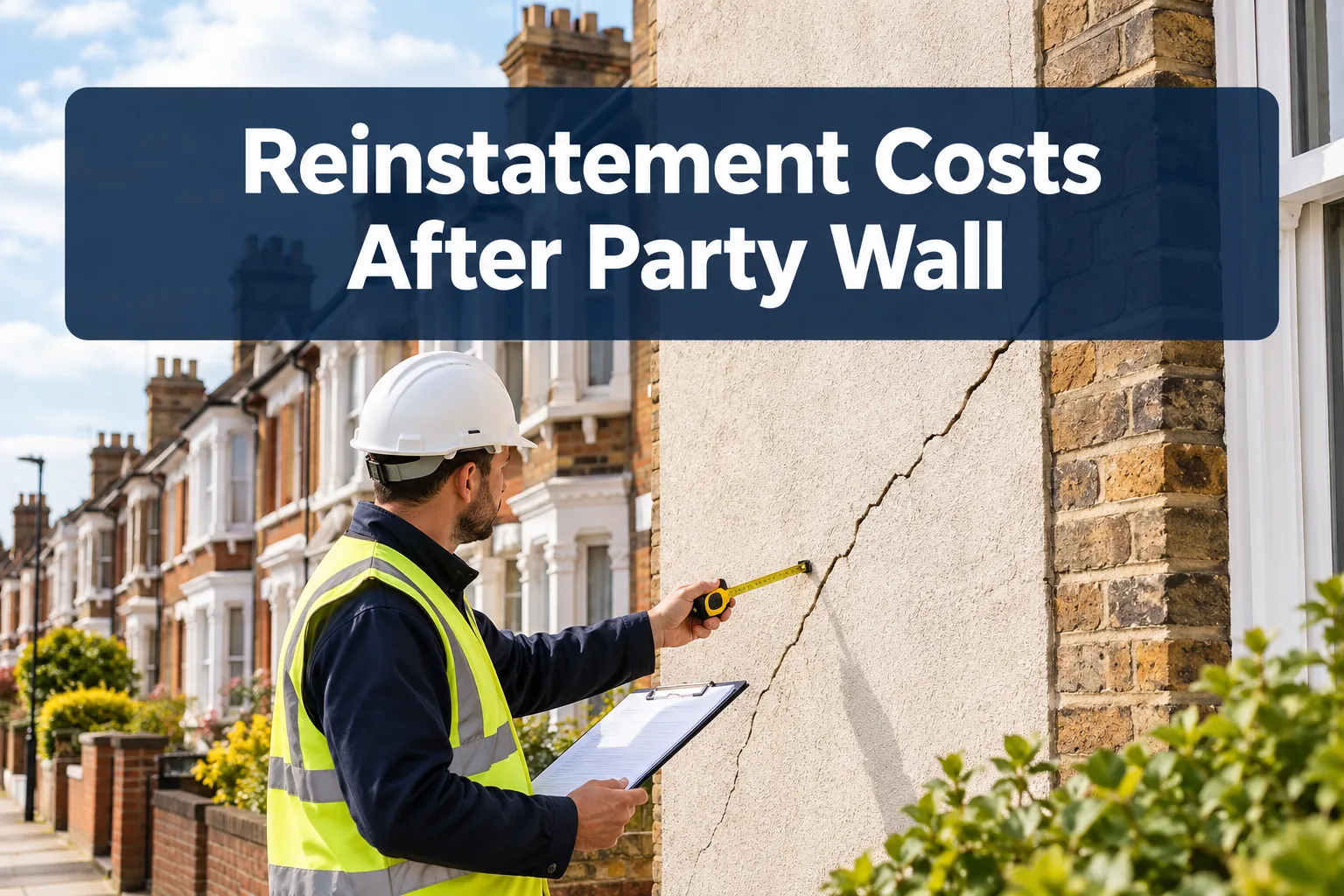
Nearly one in three party wall disputes in London involves a disagreement about who should pay for damage caused during construction, and the gap between what building owners offer and what adjoining owners expect can run into thousands of pounds. Understanding reinstatement costs after party wall works: how surveyors assess damage, repair scope and claims is therefore not a niche technical matter. It is a practical financial concern for anyone whose home shares a boundary with an active building site.
This article explains the full process: from the pre-works schedule of condition through to post-works inspection, reinstatement cost assessment methodology, and the drafting of party wall awards or expert witness reports that resolve disputes about cracking, movement, and damaged finishes.
Key Takeaways
- A pre-works Schedule of Condition is the single most important document for proving whether damage was caused by party wall works.
- Reinstatement costs are assessed using RICS methodology, not simply contractor quotes, and must reflect the cost of restoring the property to its pre-works condition.
- The Party Wall etc. Act 1996 places the financial burden of making good on the building owner, not the adjoining owner.
- Surveyors have wide discretion in assessing scope and cost; there is no statutory fee scale and no fixed formula.
- Disputes about reinstatement that cannot be resolved by agreement are determined through the party wall award process or, ultimately, the county court.
Why the Pre-Works Baseline Matters
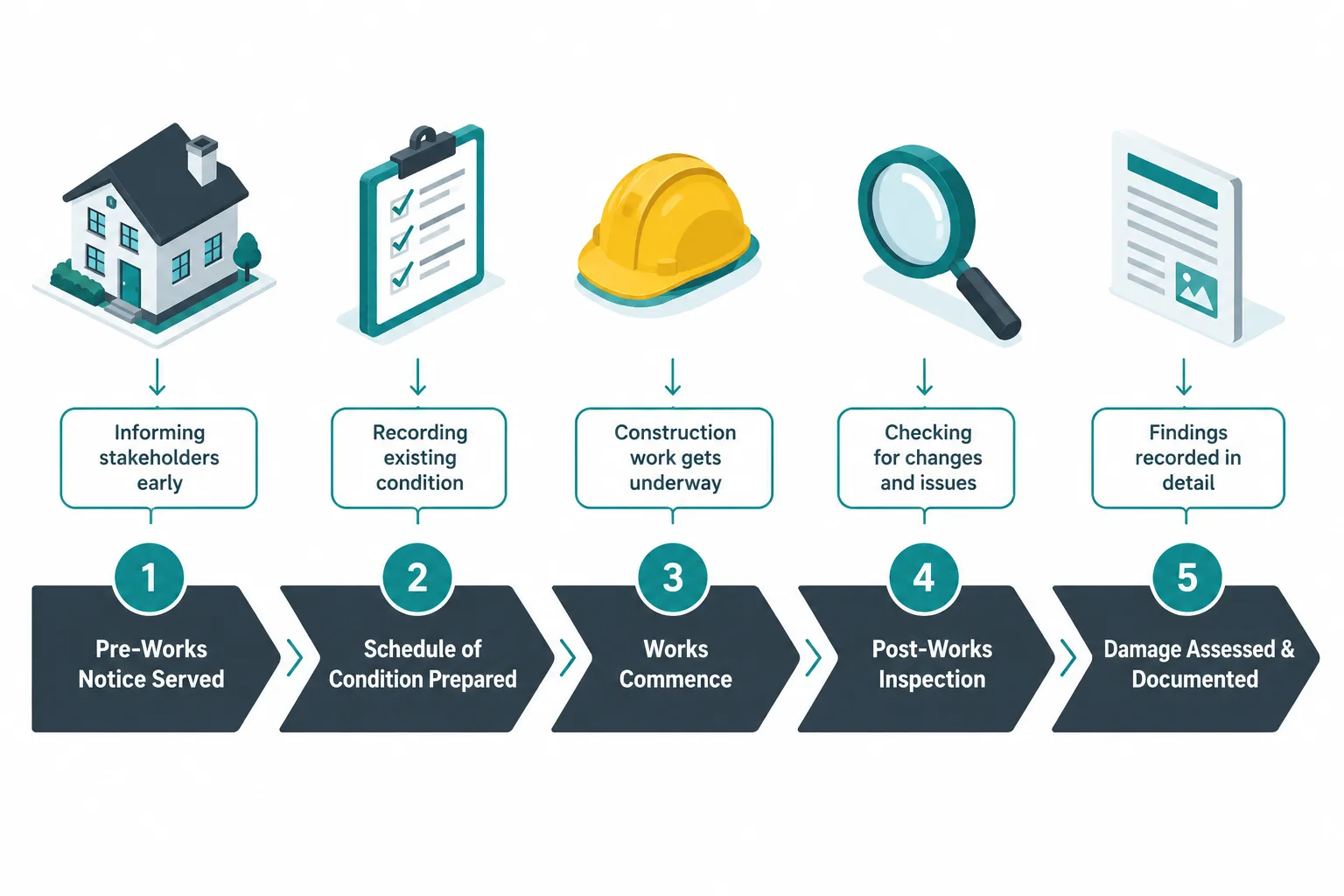
Before any reinstatement cost can be assessed, surveyors need a reliable baseline. That baseline is the Schedule of Condition, a detailed, photographic and written record of the adjoining property's state immediately before works begin [3].
Without this document, any claim that a crack, damp patch, or damaged floor finish was caused by the neighbouring works becomes a matter of assertion rather than evidence. Surveyors on both sides will argue about pre-existing defects, and the dispute becomes difficult and expensive to resolve.
A thorough Schedule of Condition will typically record:
- Existing cracks, width, length, location, and BRE crack classification (Category 0 to 5)
- Plasterwork condition, hollowness, staining, previous repairs
- Floor finishes, tiles, timber boards, any existing movement gaps
- Ceilings, hairline cracks, cornice condition, previous patch repairs
- External elevations, pointing, render, brickwork condition
This document is prepared by the party wall surveyor before works commence and is usually appended to the party wall award [10]. It forms the evidential foundation for any later reinstatement claim.
"The schedule of condition is not a formality, it is the difference between a provable claim and an unprovable one."
For properties in older housing stock, Victorian and Edwardian terraces in areas such as Battersea or Fulham, pre-existing hairline cracking is common. The schedule allows surveyors to distinguish between historic cosmetic cracking and new structural movement attributable to the works.
How Surveyors Assess Damage After Party Wall Works
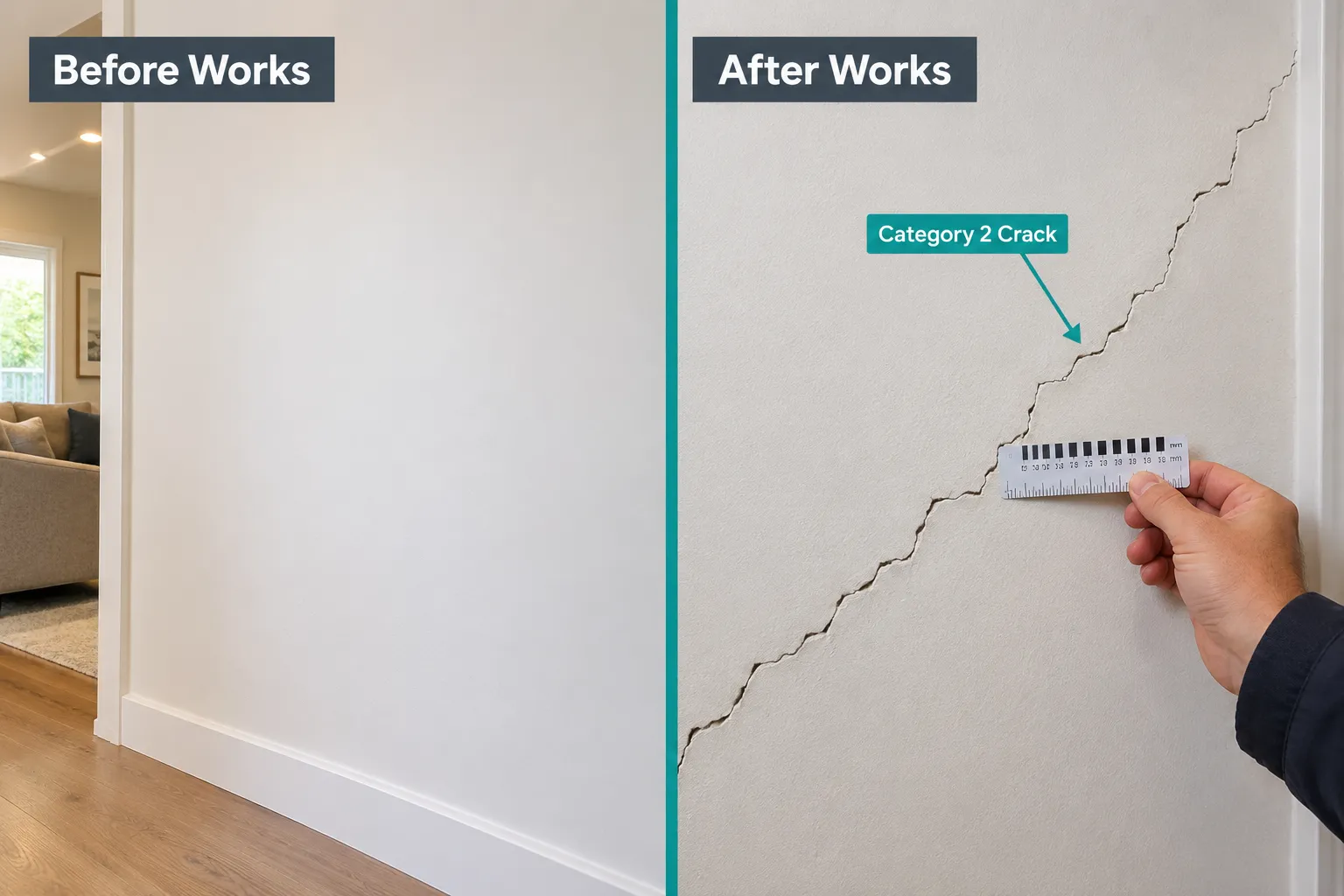
Once works are complete, or if damage becomes apparent during construction, the party wall surveyor conducts a post-works inspection. This is a systematic comparison between the Schedule of Condition and the current state of the property.
The Inspection Process
The surveyor will visit the adjoining property and methodically work through each area recorded in the schedule. Key tasks include:
- Identifying new defects, cracks, settlement, delaminated plaster, damaged finishes that were not present before works
- Classifying crack severity, using the BRE classification system, which ranges from Category 0 (hairline, less than 0.1mm) to Category 5 (very severe structural damage)
- Assessing cause, determining whether the damage is attributable to the party wall works or to independent factors such as seasonal movement, pre-existing subsidence, or normal ageing
For more detail on interpreting crack types and severity, the structural crack assessment guidance published by Wimbledon Surveyors provides a useful reference.
Establishing Causation
Causation is often the most contested element of any reinstatement claim. The surveyor must consider:
- Proximity, is the damage close to the works, or remote from them?
- Pattern, does the cracking pattern match the type of movement expected from the specific works (e.g., vibration from piling, lateral loading from excavation)?
- Timing, did the damage appear during or immediately after works, or months later?
- Structural logic, is there a plausible load path between the works and the damage?
Where the cause is unclear, surveyors may instruct a structural engineer to provide an opinion. This is common in cases involving basement excavations, underpinning, or significant alterations to a shared wall [10].
Understanding what a party wall surveyor does and their duties to homeowners helps clarify why this investigative role is central to the process, not peripheral to it.
Reinstatement Costs After Party Wall Works: How Surveyors Assess Damage, Repair Scope and Claims
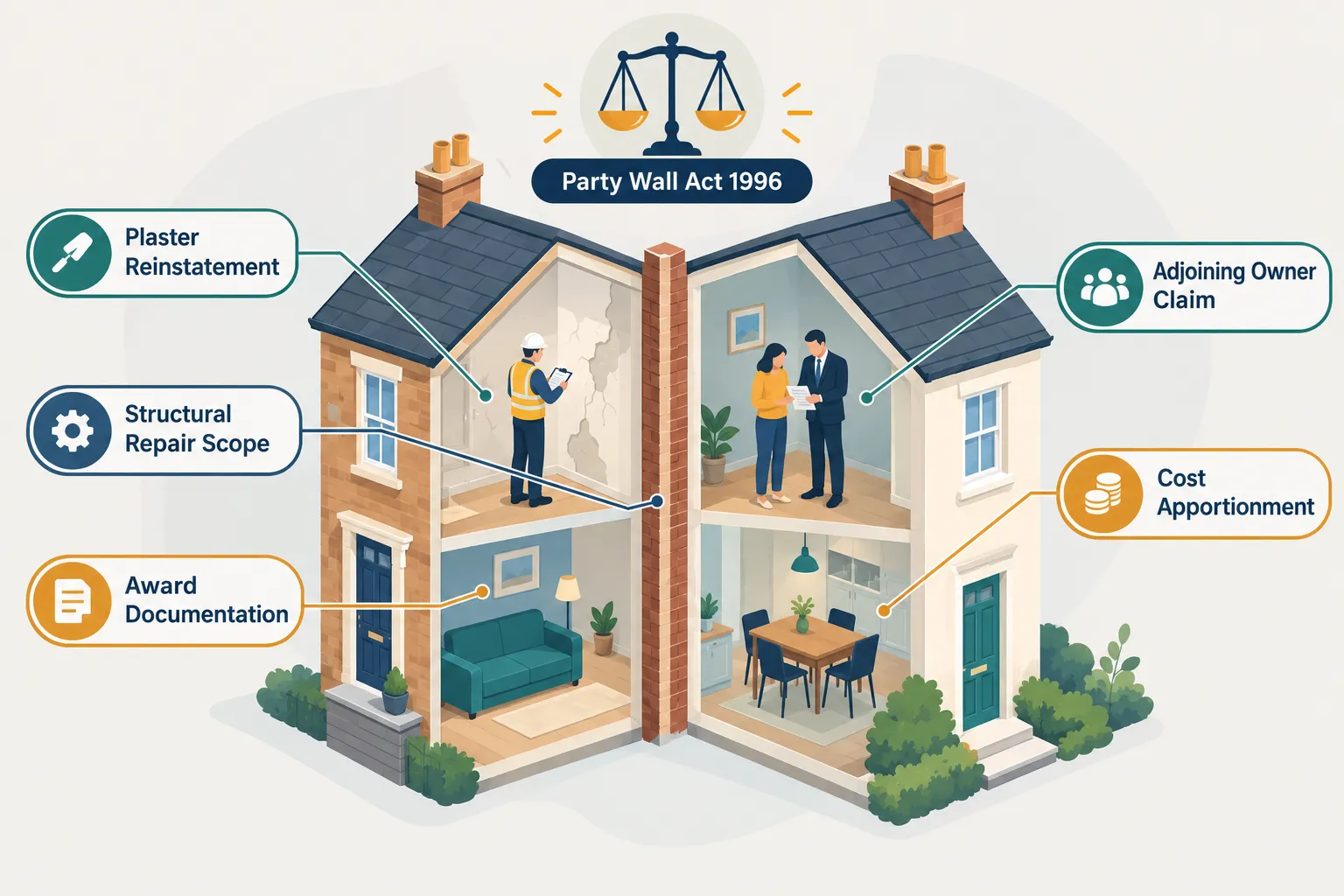
Once damage has been identified and causation established, the surveyor must calculate the reinstatement cost, the sum needed to restore the adjoining property to the condition it was in before the works took place.
The RICS Reinstatement Cost Assessment Methodology
RICS guidance on Reinstatement Cost Assessment (RCA) sets out the professional standard for calculating these figures [2]. While RCA methodology was originally developed for insurance purposes, the underlying principles apply directly to party wall reinstatement:
- Costs must reflect current market rates for labour and materials
- The assessment should be based on rebuilding or restoring to the pre-works standard, not upgrading
- Betterment, where repairs result in an improvement over the pre-works condition, may be deducted from the sum awarded
- Like-for-like replacement is the default standard; substituting cheaper materials is not acceptable
The RICS building surveying standards provide the overarching professional framework within which party wall surveyors operate [1].
Typical Components of a Reinstatement Assessment
| Damage Type | Typical Repair Scope | Key Considerations |
|---|---|---|
| Plaster cracking | Hack off, re-plaster, redecorate | Extent of affected area; match existing finish |
| Structural cracking | Stitching, repointing, structural repair | Engineer’s specification required |
| Floor movement | Re-lay tiles or boards, re-screed | Matching discontinued materials is costly |
| Ceiling damage | Patch or full replacement, redecorate | Cornicing and period features add cost |
| Damp ingress | Identify source, remediate, redecorate | Must distinguish from pre-existing damp |
| External brickwork | Repoint, replace damaged bricks | Matching brick type and mortar colour |
"Making Good" vs Cash Compensation
The Party Wall etc. Act 1996 gives the building owner the right to make good damage themselves rather than pay cash compensation [8]. In practice, this means the building owner's contractor carries out the repairs. The adjoining owner cannot simply demand a cash payment unless:
- The building owner fails to carry out repairs within a reasonable time
- The parties agree to a cash settlement instead
- The party wall award specifically provides for cash payment
This distinction matters because it affects how the reinstatement cost figure is used. If the building owner makes good, the surveyor's assessment sets the scope of works the contractor must complete. If cash compensation is agreed, the assessment becomes the payment sum [9].
For a broader understanding of how costs and responsibilities are allocated, the guide to party wall agreements and the costs involved provides useful context.
Who Pays Reinstatement and Surveyor Costs
The financial responsibility for reinstatement falls squarely on the building owner, the party carrying out the works. This is a fundamental principle of the Party Wall etc. Act 1996 and is not subject to negotiation [8].
Surveyor Fee Apportionment
Surveyor fees are a separate matter from reinstatement costs. The general rule is:
- The building owner pays the adjoining owner's surveyor fees where the works are notifiable under the Act
- Where a dispute arises specifically about reinstatement, the costs of resolving that dispute are also typically borne by the building owner
- If the adjoining owner's claim is found to be exaggerated or unsupported by evidence, the surveyor making the award has discretion to apportion costs differently [7]
There is no statutory fee scale for party wall surveyors. Fees are set at the surveyor's discretion, and the government has confirmed it has no plans to introduce a fixed scale [6]. In 2026, typical party wall surveyor fees in London range from approximately £700 to £2,500 per surveyor for standard residential cases, with complex reinstatement disputes attracting higher fees. For a detailed breakdown, the party wall surveyor cost guide for 2026 covers current London fee ranges in full.
The Agreed Surveyor Route
Where both parties trust a single professional, appointing an agreed surveyor under the party wall process can reduce costs significantly. One surveyor acts for both parties, producing a single award and a single fee. This is particularly effective where the reinstatement scope is relatively straightforward and both parties are cooperative.
Structuring the Party Wall Award and Expert Witness Reports
When reinstatement costs after party wall works are disputed, the resolution mechanism depends on the stage at which the dispute arises.
The Party Wall Award
The party wall award is the formal document that governs the works. It can include:
- Provisions for making good, specific obligations on the building owner to repair identified damage
- Reinstatement cost figures, where cash compensation is agreed or ordered
- Timescales, deadlines by which repairs must be completed
- Access rights, allowing the surveyor to inspect completed repairs
The award is binding on both parties and can be enforced in the county court [10]. Understanding the difference between a party wall notice, agreement, and award is essential for anyone navigating this process.
Expert Witness Reports
Where reinstatement disputes proceed to litigation, which is relatively rare but does occur, the party wall surveyor may be asked to prepare an expert witness report. This document must comply with Civil Procedure Rules Part 35 and must:
- Set out the surveyor's qualifications and independence
- Describe the methodology used to assess damage and calculate reinstatement costs
- Provide a clear, reasoned opinion on causation
- Quantify the reinstatement sum with supporting evidence (contractor quotes, BCIS cost data, or RICS guidance)
The expert's overriding duty is to the court, not to the party instructing them. This is a critical distinction from the advocacy role a surveyor plays during the award process [1].
Underinsurance and Adequacy of Reinstatement Sums
A recurring issue in 2026 is underinsurance. Many homeowners hold buildings insurance based on outdated reinstatement valuations that do not reflect current construction costs. If party wall damage triggers an insurance claim rather than a direct claim against the building owner, an inadequate sum insured can leave the adjoining owner significantly out of pocket [5].
RICS guidance emphasises that reinstatement cost assessments should be reviewed regularly, at least every three years, and updated to reflect current rebuild costs [2]. This is particularly relevant for period properties in Chelsea and similar high-value areas where specialist materials and craftsmanship command a premium.
Practical Steps for Adjoining Owners
If works are planned next door and the property shares a party wall, the following steps reduce financial and legal risk:
- Respond promptly to any party wall notice, dissenting triggers the formal surveyor appointment process, which provides legal protection
- Insist on a Schedule of Condition before works begin, this is the foundational evidence document for any later claim
- Keep a photographic record throughout the works, date-stamped photographs of any new cracking or damage as it appears
- Report damage promptly, delay in reporting can complicate causation arguments
- Obtain independent contractor quotes for any repairs, these support the reinstatement cost assessment
- Do not accept verbal assurances from the building owner's contractor, all agreements about making good should be recorded in writing or in the award
For adjoining owners who have already received a survey report raising concerns about damage, guidance on what to do after a bad survey report may also be relevant.
Conclusion
Reinstatement costs after party wall works, and the process by which surveyors assess damage, repair scope and claims, sit at the intersection of property law, building pathology, and cost management. The process is not arbitrary. It follows a structured methodology grounded in RICS professional standards, the Party Wall etc. Act 1996, and the evidential record established by the Schedule of Condition.
Actionable next steps:
- If works are imminent, commission a Schedule of Condition immediately, before the first tool touches the wall
- If damage has already occurred, instruct a chartered party wall surveyor to carry out a post-works inspection and prepare a formal reinstatement cost assessment
- If the building owner disputes the claim, request that the matter be determined through the party wall award process rather than attempting informal resolution
- Review your buildings insurance reinstatement sum to ensure it reflects current rebuild costs, particularly for period or listed properties
- Seek professional advice early, the cost of a surveyor's assessment is almost always less than the cost of an unresolved dispute
The legal framework exists to protect both parties. Used correctly, it ensures that damage is properly documented, fairly valued, and promptly remedied.
References
[1] Building Surveying Standards – rics.org
[2] Oct18 Reinstatement Cost Assessment Of Buildings 3rd Edition – rics.org
[3] Schedule Of Condition – hardingsurveyors.co.uk
[4] Party Wall Costs Guide – hampsteadrenovationcosts.co.uk
[5] Blog Reinstatement Cost Assessment – blackacresurveyors.com
[6] Party Wall Surveyor Cost – hoa.org.uk
[7] Party Walls And The Public – ww3.rics.org
[8] Party Wall Legislation And Procedure – isurv.com
[9] Party Walls – rics.org
[10] Jan 22 Party Wall Legislation And Procedure 7th Edition – rics.org