
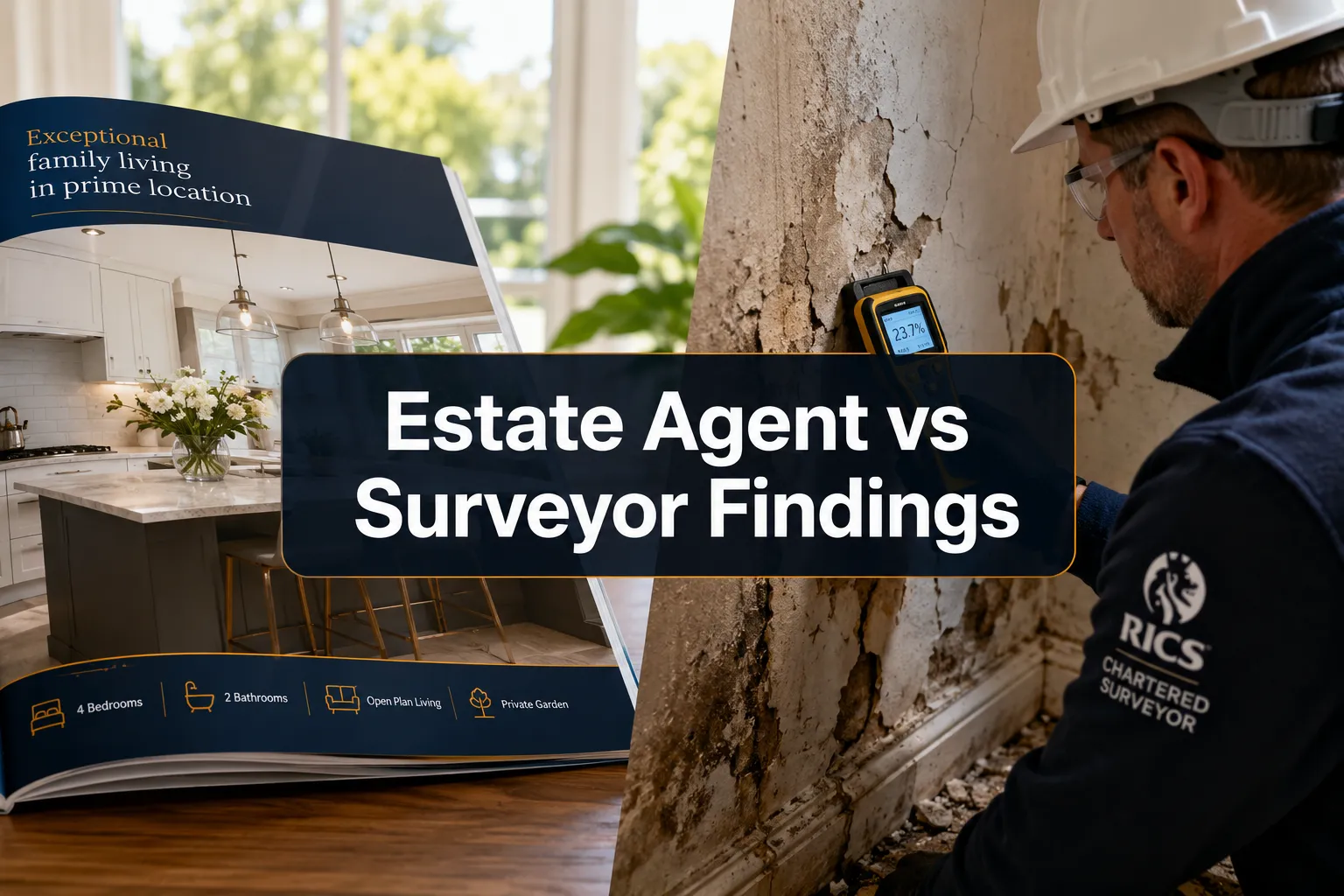
Nearly 90% of UK homebuyers still rely primarily on mortgage valuations and estate agent particulars when making one of the largest financial decisions of their lives, yet only 10.6% commission a dedicated home condition survey alongside their purchase. For those who do instruct a RICS-qualified surveyor, the gap between estate agent description and surveyor findings can be startling, and financially significant. [1]
This article examines why that gap exists, what drives it, and how buyers can use professional survey findings to protect their investment and negotiate effectively.
Key Takeaways
- Estate agents are legally required to market properties accurately, but their role is fundamentally promotional, not technical.
- RICS Home Surveys are structured to expose defects that marketing language routinely glosses over or omits entirely.
- The gap between estate agent descriptions and surveyor findings is not accidental; it reflects two fundamentally different professional objectives.
- Buyers who commission a RICS building survey gain documented leverage to renegotiate price or request repairs before exchange.
- New material information disclosure rules in 2026 mean sellers who commission pre-sale surveys must disclose significant defects, narrowing but not eliminating the gap.
Why the Gap Between Estate Agent Description and Surveyor Findings Exists
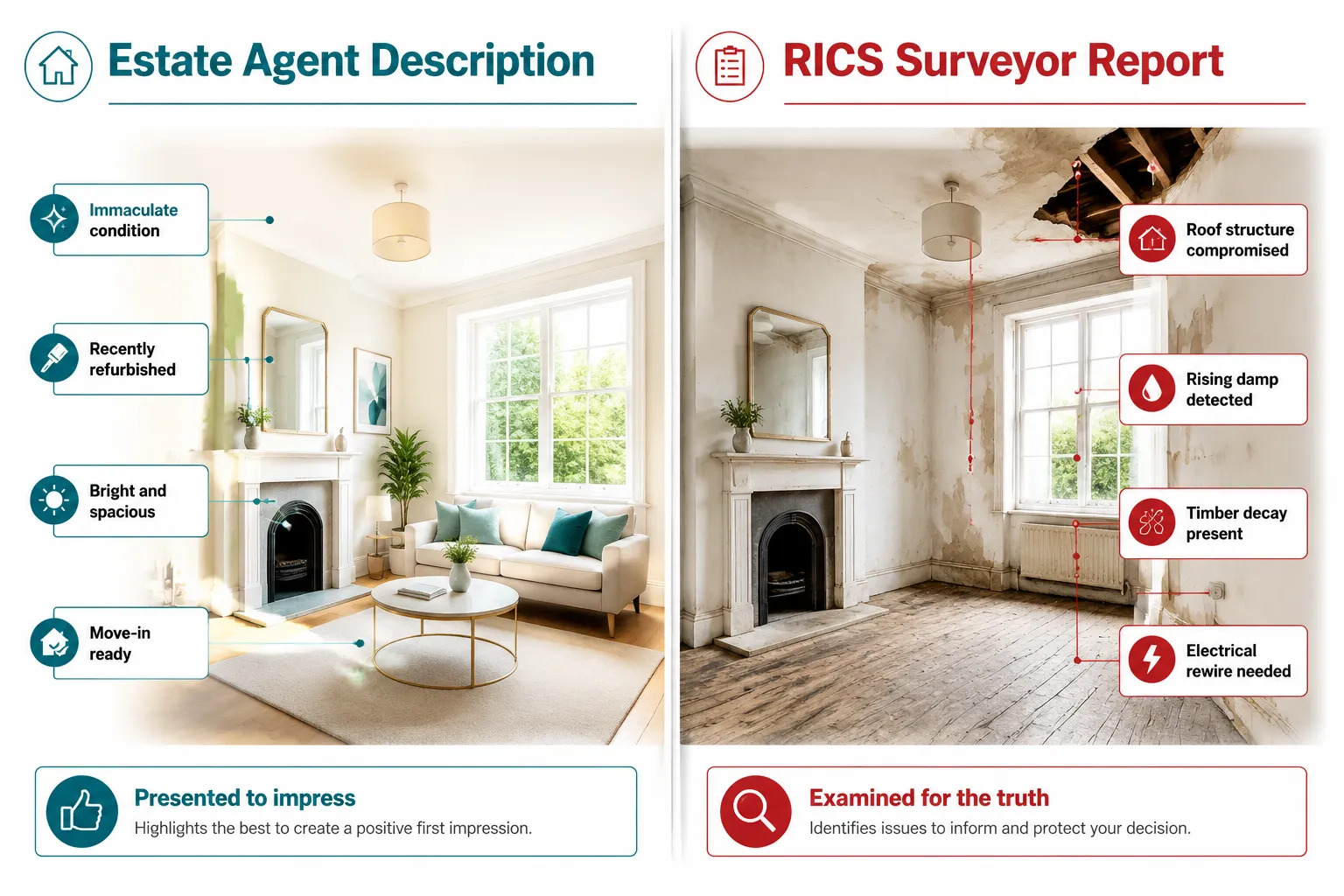
The starting point for understanding this mismatch is recognising that estate agents and RICS surveyors serve entirely different principals and answer to different professional standards.
An estate agent's primary duty is to the seller. Their job is to present the property in the most favourable light possible to achieve the best achievable sale price. The RICS Property Agency and Management Principles, which became effective on 1 January 2025, do require members to communicate accurately, avoid misrepresentation, and provide realistic, justifiable advice on selling price. These principles explicitly prohibit dishonest or manipulative marketing methods. However, and this is the critical point, none of these obligations transform estate agents into condition surveyors. Their descriptions are marketing documents, not technical assessments.
A RICS Home Survey, by contrast, is governed by the RICS Home Survey Standard, which requires surveyors to describe each element of the building, explain its condition, and deliver a clear professional assessment with facts and professional opinion clearly separated. The standard mandates objectivity, balance, and property-specific research. Surveyors are required to report known risks rather than present the property favourably. [1]
The result is an almost inevitable collision between two documents produced for opposite purposes.
Consider the language difference:
| Estate Agent Description | RICS Surveyor Finding |
|---|---|
| "Beautifully presented throughout" | Condition Rating 2: evidence of historic water ingress to rear elevation |
| "Recently refurbished kitchen" | Non-compliant electrical installation; recommend specialist inspection |
| "Spacious loft room" | Unauthorised loft conversion; no building regulations sign-off identified |
| "Charming period features" | Timber decay to original sash window frames; replacement recommended |
| "Lovely mature garden" | Japanese knotweed identified within 7 metres of main structure |
The phrases on the left are not necessarily lies. They are selective truths, and that selectivity is precisely what professional home surveys are designed to counteract.
What RICS Surveys Are Structured to Find That Agents Are Not
A RICS Home Survey is not a casual walk-through. It follows a structured methodology that systematically examines every accessible element of the building, roofs, chimneys, walls, windows, floors, ceilings, services, drainage, and the surrounding grounds. The resulting report uses condition ratings to communicate urgency:
- Condition Rating 1, No repair is currently needed
- Condition Rating 2, Defects that need repairing or replacing but are not considered serious or urgent
- Condition Rating 3, Defects that are serious and/or need to be repaired, replaced, or investigated urgently
Since August 2024, RICS has provided standardised Level 3 (full building survey) report formats and introduced licensing for branded RICS Home Survey reports, with new formats required from September of the transition year. These standardised templates are intended to increase consistency and clarity of defect reporting, making it harder for estate agent narratives to gloss over recurring categories of problems.
The April 2026 update to the 2nd edition Home Survey Standard further reinforces that members must only accept instructions they are competent to carry out and must deliver services in a professional, diligent manner, strengthening the authority and consistency of RICS surveys. [1]
The Most Common Defects the Survey Finds That the Listing Omits
Industry practitioners consistently identify several categories of defect that appear regularly in RICS reports but are absent from estate agent particulars:
Damp and moisture ingress, Rising damp, penetrating damp, and condensation are among the most frequently flagged issues. A damp survey can reveal moisture levels that are invisible to the naked eye during a casual viewing but detectable with a calibrated meter.
Roof condition, Agents describe roofs as "recently replaced" or "in good order." Surveyors check for slipped or missing tiles, deteriorating flashings, inadequate ventilation, and signs of water penetration at the roof void.
Structural movement, Cracks described as "settlement" in casual conversation can indicate active subsidence, differential movement, or failed lintels. A structural crack assessment distinguishes cosmetic from structural concerns in a way no marketing brochure can.
Timber decay and infestation, Woodworm, wet rot, and dry rot are invisible behind painted surfaces. Surveyors probe accessible timbers and flag risk areas for specialist investigation.
Electrical and plumbing services, A property described as "modernised" may have a consumer unit that does not meet current standards, or plastic push-fit plumbing installed without building regulations consent.
Japanese knotweed, This invasive plant can remain dormant in winter and be entirely absent from an agent's description. Its presence within seven metres of a structure has serious implications for mortgage lending and future saleability. The complete guide to Japanese knotweed outlines the risks in detail.
How the Gap Translates Into Financial Exposure for Buyers
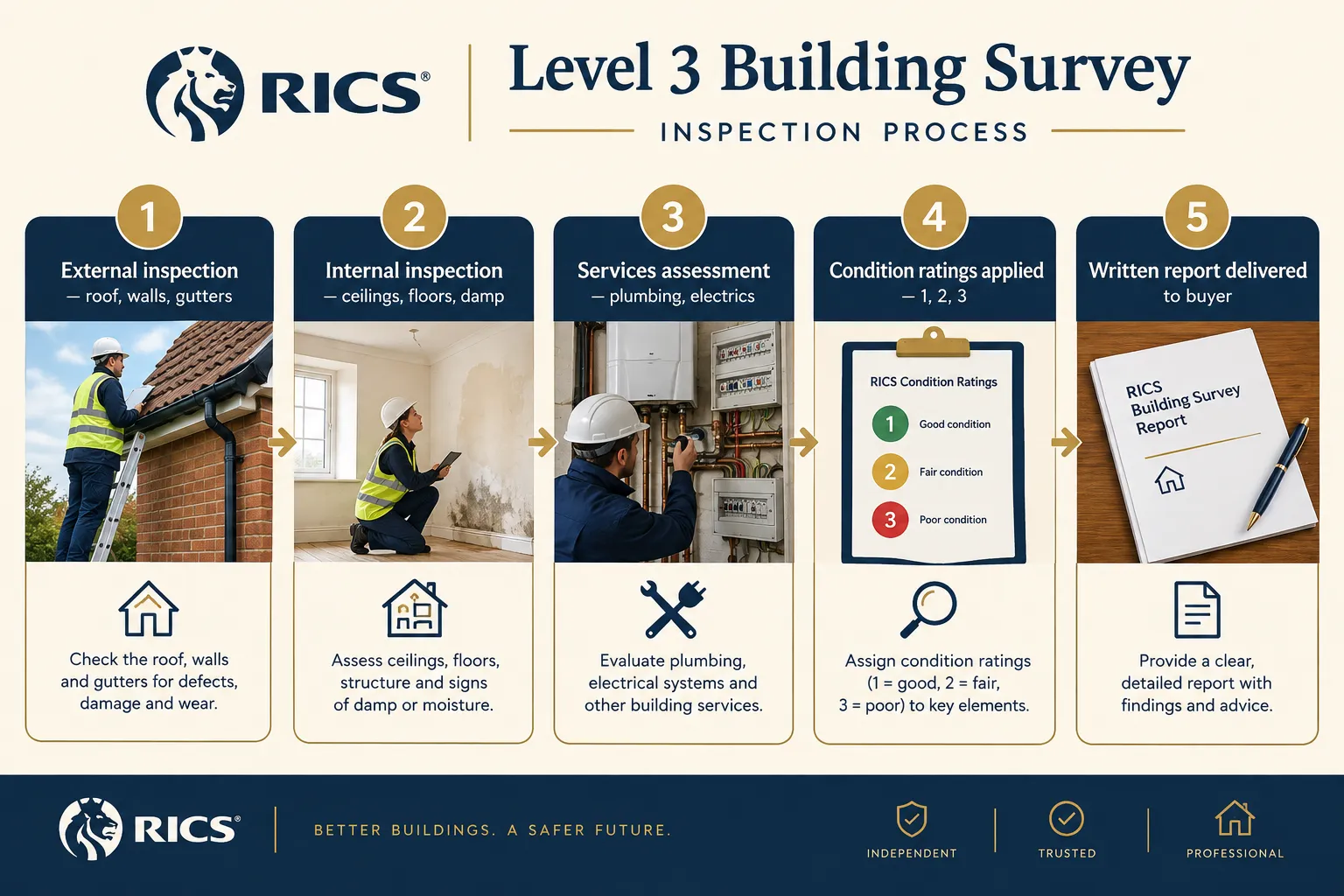
The financial consequences of the gap between estate agent description and surveyor findings are not abstract. They materialise as unexpected repair bills, renegotiated prices, or, in the worst cases, failed purchases after exchange.
Industry analysis consistently shows that buyers who commission a RICS Level 2 or Level 3 survey are better positioned to negotiate. For a detailed breakdown of how survey findings affect purchase price negotiations, the average price reduction after survey guide provides practical benchmarks.
"Only the Home Survey gives a thorough view of defects and future maintenance costs. Estate agent appraisals are marketing-oriented opinions on achievable price; mortgage valuations primarily protect the lender's security."
Three distinct assessments exist in every residential transaction:
- The estate agent's market appraisal, An opinion on achievable sale price, designed to win the instruction and attract buyers.
- The lender's mortgage valuation, A brief inspection confirming the property is adequate security for the loan. It does not assess condition in detail.
- The RICS Home Survey, A professional condition report that documents defects, estimates repair costs, and highlights legal and environmental risks.
The vast majority of buyers receive only the first two. The third, the one that actually describes the building's condition, is commissioned by fewer than 11% of purchasers.
Choosing the Right Survey Level
Not every property requires the same depth of investigation. The choice between a Level 2 (HomeBuyer Report) and a Level 3 (Full Building Survey) depends on the property's age, construction type, and apparent condition. For a clear comparison, see the guide on exploring the key difference between Level 2 and Level 3 surveys.
As a general rule:
- Level 2 suits modern, conventionally constructed properties in reasonable condition with no obvious significant defects.
- Level 3 is recommended for older properties, those with extensions or alterations, any property where the agent's description raises questions, or where the buyer simply wants maximum detail.
The cost of commissioning the wrong level, or no survey at all, almost always exceeds the cost of the survey itself.
The 2026 Regulatory Landscape: Disclosure Rules Are Tightening the Gap
The gap between estate agent description and surveyor findings is not purely a matter of professional culture. It is also shaped by legal disclosure obligations, and those obligations are changing significantly in 2026.
The UK's material information regime, tied to the Digital Markets, Competition and Consumers Act, has significantly raised the bar on what sellers and agents must disclose. Guidance issued in March 2026 makes a particularly important point: if a vendor commissions a survey and it reveals issues such as subsidence, damp, or structural problems, those defects must be disclosed on the TA6 property information form and communicated to the estate agent. The seller "cannot 'unknow' what the survey found", failure to disclose creates exposure to enforcement action and civil claims.
This creates a new dynamic in the pre-sale survey market. Sellers who commission vendor surveys to reduce fall-throughs and align buyer expectations must now factor in the legal obligation to disclose whatever those surveys reveal. A pre-sale survey that uncovers serious defects cannot simply be filed away, it must be acted upon, priced in, or disclosed.
For buyers, this means that in 2026, properties where a vendor survey has been conducted and disclosed represent a more transparent transaction. The gap between the agent's description and the true condition is narrower, though it is never entirely closed, because even disclosed defects are often described in softer language than a RICS surveyor would use.
In Scotland, the gap is structurally narrower still. A Home Report including a single survey and valuation is a legal prerequisite before marketing, meaning condition information is embedded in the sale process from the outset.
Practical Steps to Navigate the Gap Between Estate Agent Description and Surveyor Findings
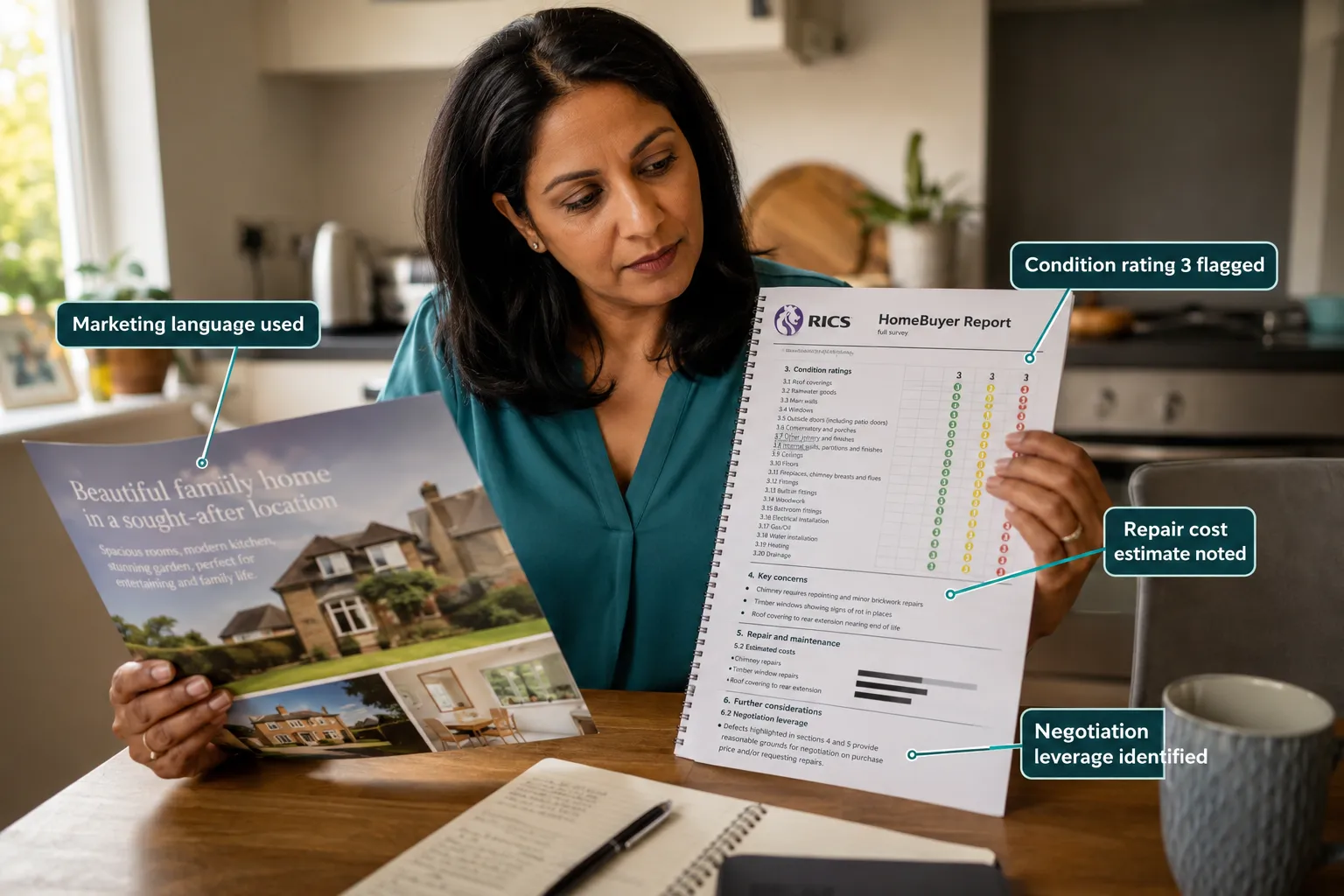
Understanding that a gap exists is the first step. Acting on that understanding is what protects buyers financially. The following practical framework applies to any residential purchase in England or Wales in 2026.
Before Instructing a Survey
- Read the estate agent's particulars carefully and note every positive claim: "recently refurbished," "new roof," "no onward chain complications." These become a checklist for the surveyor.
- Ask the agent directly whether a vendor survey exists and whether any defects have been disclosed on the TA6 form.
- Check whether the property is listed, in a flood zone, or close to known ground movement areas, these factors influence which survey level is appropriate.
- Consult a local surveyor with specific knowledge of the area's construction types and common defects.
When Commissioning the Survey
- Instruct a RICS-regulated surveyor directly, not through the estate agent's recommended panel, which may create a conflict of interest.
- Specify a Level 3 Full Building Survey for any property built before 1980, any property with visible alterations, or any property where the asking price is at the upper end of the local market.
- Provide the surveyor with the estate agent's particulars so they can specifically address claims made in the marketing material.
After Receiving the Report
- Do not panic at a long list of Condition Rating 2 items, these are normal for most properties and represent maintenance rather than emergency expenditure.
- Focus negotiation efforts on Condition Rating 3 items and any specialist investigations recommended. These are the items that represent genuine financial risk.
- Use the report to obtain repair cost estimates from qualified contractors before renegotiating. Vague survey language becomes concrete negotiating leverage when backed by contractor quotes.
- If the report reveals issues that were not disclosed and that the seller was likely aware of, seek legal advice before proceeding.
Common Myths Worth Dismissing
Many buyers hesitate to commission surveys based on misconceptions. The common myths about a property survey resource addresses the most frequent misunderstandings, including the persistent belief that a mortgage valuation provides meaningful condition information.
Conclusion
The gap between estate agent description and surveyor findings is not a flaw in the system, it is an inherent consequence of two professions serving different principals with different objectives. Estate agents market properties; RICS surveyors assess them. These are not the same activity, and the documents they produce are not interchangeable.
In 2026, with tighter material information disclosure rules, updated RICS Home Survey Standards, and growing awareness of the financial risks of uninspected purchases, the case for commissioning a professional building survey has never been stronger. Fewer than 11% of buyers currently do so, which means the vast majority are making six-figure decisions based on marketing documents alone.
Actionable next steps for buyers:
- Treat every estate agent description as a starting point for questions, not a statement of condition.
- Commission a RICS Level 2 or Level 3 survey from an independent, RICS-regulated firm before exchange of contracts.
- Use the survey report, not the agent's particulars, as the basis for any price negotiation.
- Check whether the seller has disclosed a vendor survey and whether all material information has been provided on the TA6 form.
- Seek specialist investigations for any Condition Rating 3 items before proceeding.
The cost of a professional survey is a fraction of the cost of discovering a serious defect after completion. The gap between what an agent describes and what a surveyor finds is real, it is common, and it is entirely navigable, with the right professional advice.
References
[1] Home Surveys – rics.org