

"
Nearly one in five UK property transactions is renegotiated or abandoned after a building survey reveals serious defects, yet the majority of those defects are manageable with the right professional guidance. The principle of "Mitigate, Don't Panic: How UK Building Surveyors Help You Reduce Structural and Damp Risks After a Bad Survey" is not just reassuring advice; it is a structured, evidence-based methodology that chartered surveyors use every day to help buyers convert alarming survey findings into clear, costed action plans. Understanding that methodology can mean the difference between losing a home you want and securing it at a fair price.
Key Takeaways
- A bad survey report is a tool, not a verdict, it identifies risks that can be quantified, negotiated, and mitigated.
- Structural and damp defects must be separated from cosmetic issues before any decision is made about the purchase.
- Surveyors recommend commissioning specialist reports only for the highest-priority findings, not for every condition rating.
- Repair costs should be quantified with at least two contractor quotes before using the survey as a negotiation instrument.
- Buyers who discover defects after completion still have structured options, including retrospective surveys and legal advice.
What a Bad Survey Report Actually Tells You
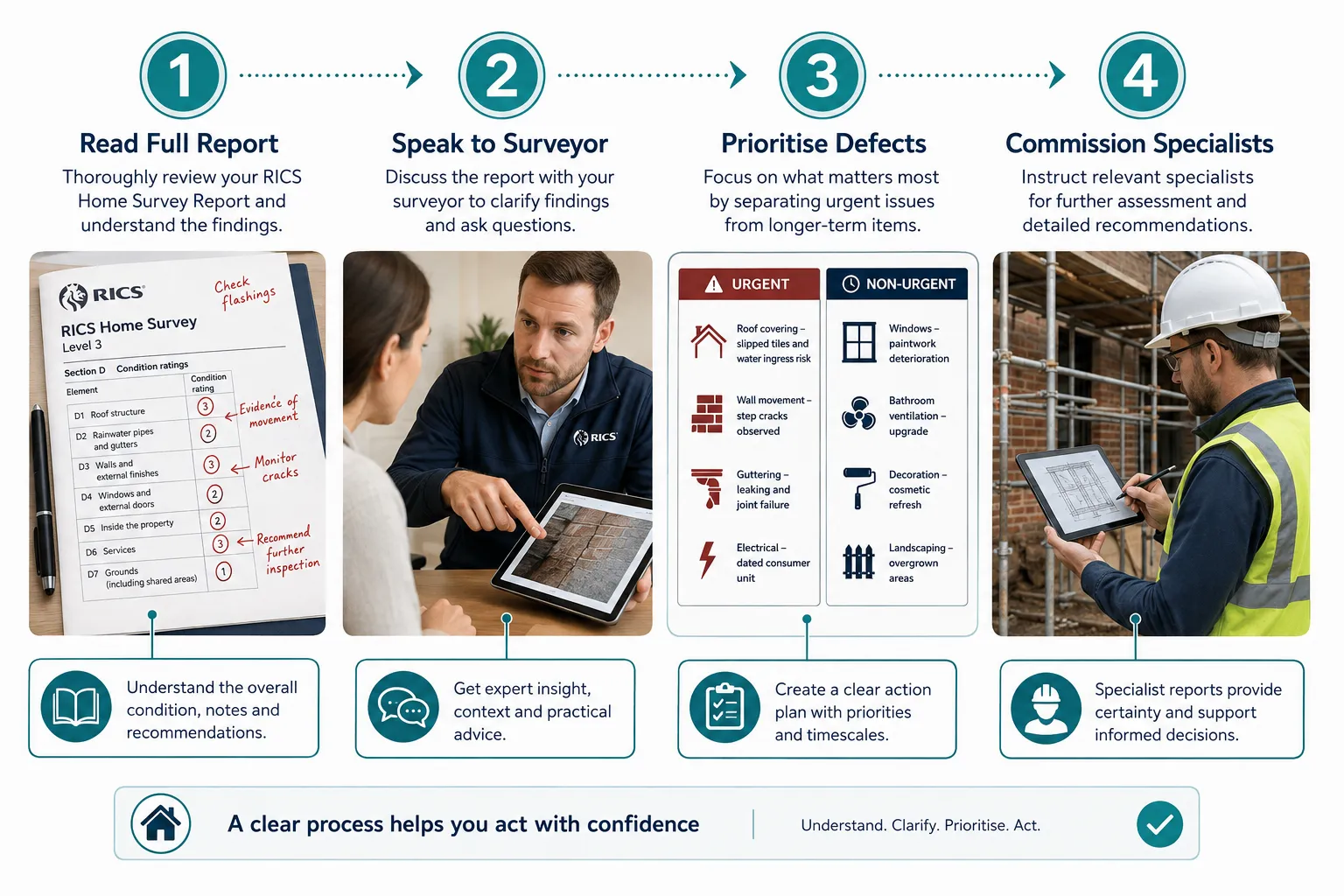
Receiving a survey report dense with amber and red condition ratings can feel overwhelming. The first and most important step is to read the full written report rather than reacting to the summary traffic-light ratings alone [1]. Condition Rating 3 (the most serious RICS classification) does not automatically mean a property is unsalvageable, it means the defect requires urgent attention and further investigation.
Surveyors classify structural movement in considerable detail: recording cracking, bulging, deflection, and loss of verticality, and, critically, judging whether that movement is historic or ongoing [2]. A wall that cracked during the 1976 drought and has been stable for four decades presents a very different risk profile from a wall showing fresh cracking with no obvious cause. That distinction is not visible in a condition rating; it lives in the body text of the report.
The right response sequence after a serious survey finding is:
- Read the full report, including the surveyor's narrative descriptions.
- Highlight every Condition Rating 3 item and list them separately.
- Call or meet the surveyor to discuss each red-rated item in plain language.
- Ask specifically: is this movement historic or active? Is immediate structural intervention required?
- Commission specialist reports only for items the surveyor explicitly recommends investigating further.
This sequence prevents two common mistakes: ignoring serious findings because the report feels too technical, and commissioning expensive specialist reports for every minor defect the surveyor has already assessed as stable.
For guidance on what different survey types cover and which level of inspection is appropriate for a given property, the comparison at Need A Homebuyers Report Or Structural Survey Choose The Right One is a useful starting point.
Separating Structural Risks from Cosmetic Concerns
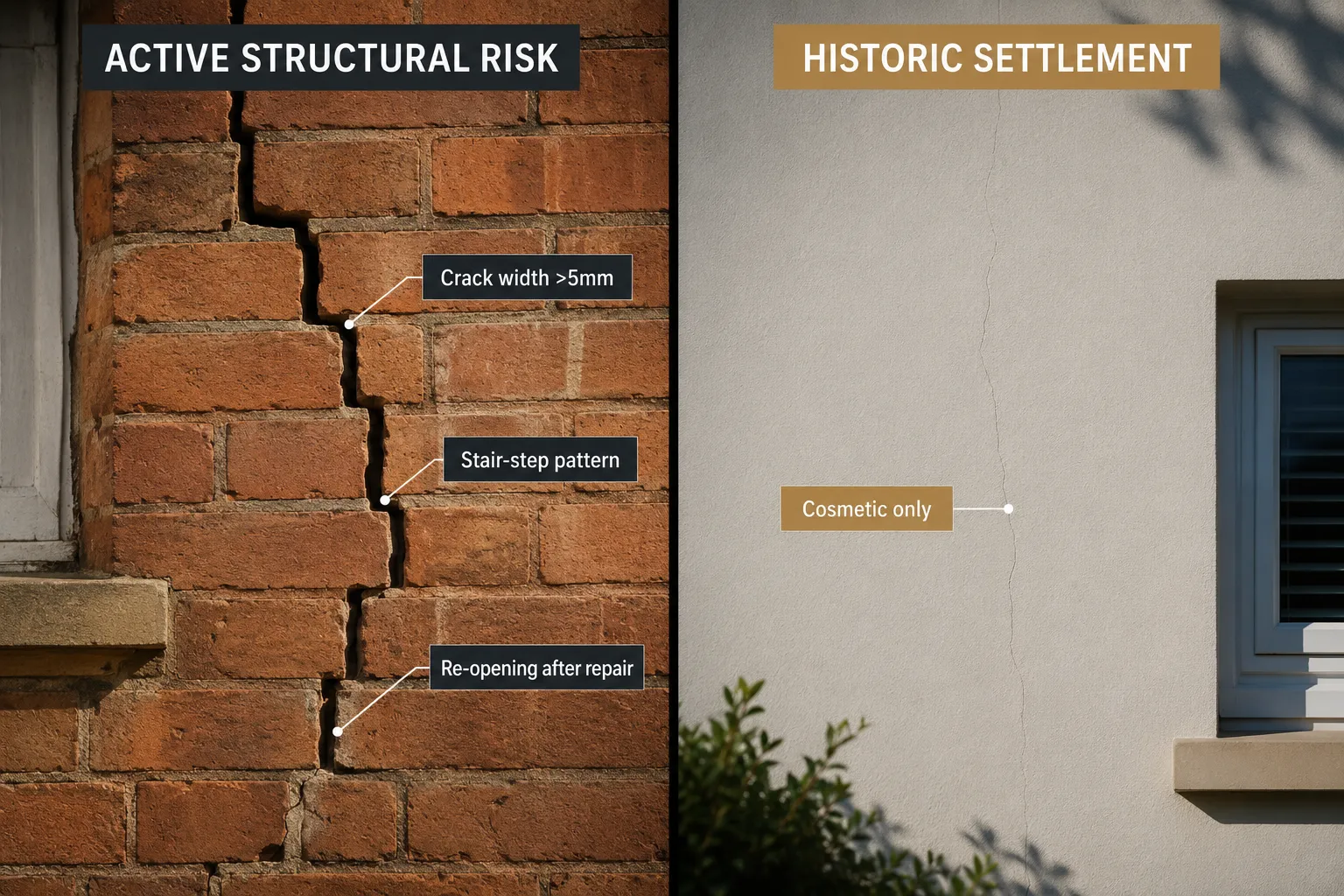
One of the most valuable things a chartered surveyor does after a bad survey is help the client separate genuine structural risk from cosmetic deterioration. These two categories require entirely different responses, and confusing them is expensive in both directions, either spending money unnecessarily on cosmetic repairs or underestimating a real structural problem.
The Evergreen Red Flags Surveyors Prioritise
Across UK surveying practice in 2026, certain findings consistently trigger urgent follow-up [3]:
- Cracks wider than approximately 5 mm in masonry or render
- Stair-step cracking in brickwork, particularly following mortar joints
- Cracks that have been filled previously and have re-opened
- Significant distortion in walls, floors, or door frames
- Visible damp accompanied by mould growth on internal surfaces
- Sloping floors exceeding expected tolerances in older properties
- Evidence of subsidence or heave, such as gaps at window or door frames
These findings warrant specialist input, typically a structural engineer for movement-related issues, or a qualified damp specialist for moisture-related ones. By contrast, items such as dated electrical fittings, worn decorative finishes, or a tired kitchen do not belong in the same category and should not drive the same level of alarm.
When to Commission a Structural Engineer
A structural engineer's report is not always necessary after a bad survey. Surveyors recommend it specifically when [2]:
- Diagonal or stair-step cracking suggests differential settlement
- There is evidence of roof spread or wall bulging
- A previous extension or structural alteration appears to lack adequate support
- The surveyor cannot confirm whether movement is ongoing without further investigation
The cost of a structural engineer's report is typically several hundred pounds, a modest investment relative to the financial exposure of buying a property with active structural movement. For properties where calculations are needed to confirm structural adequacy, Structural Calculations services provide that specialist layer of analysis.
How Surveyors Help You Mitigate Damp and Mould Risks
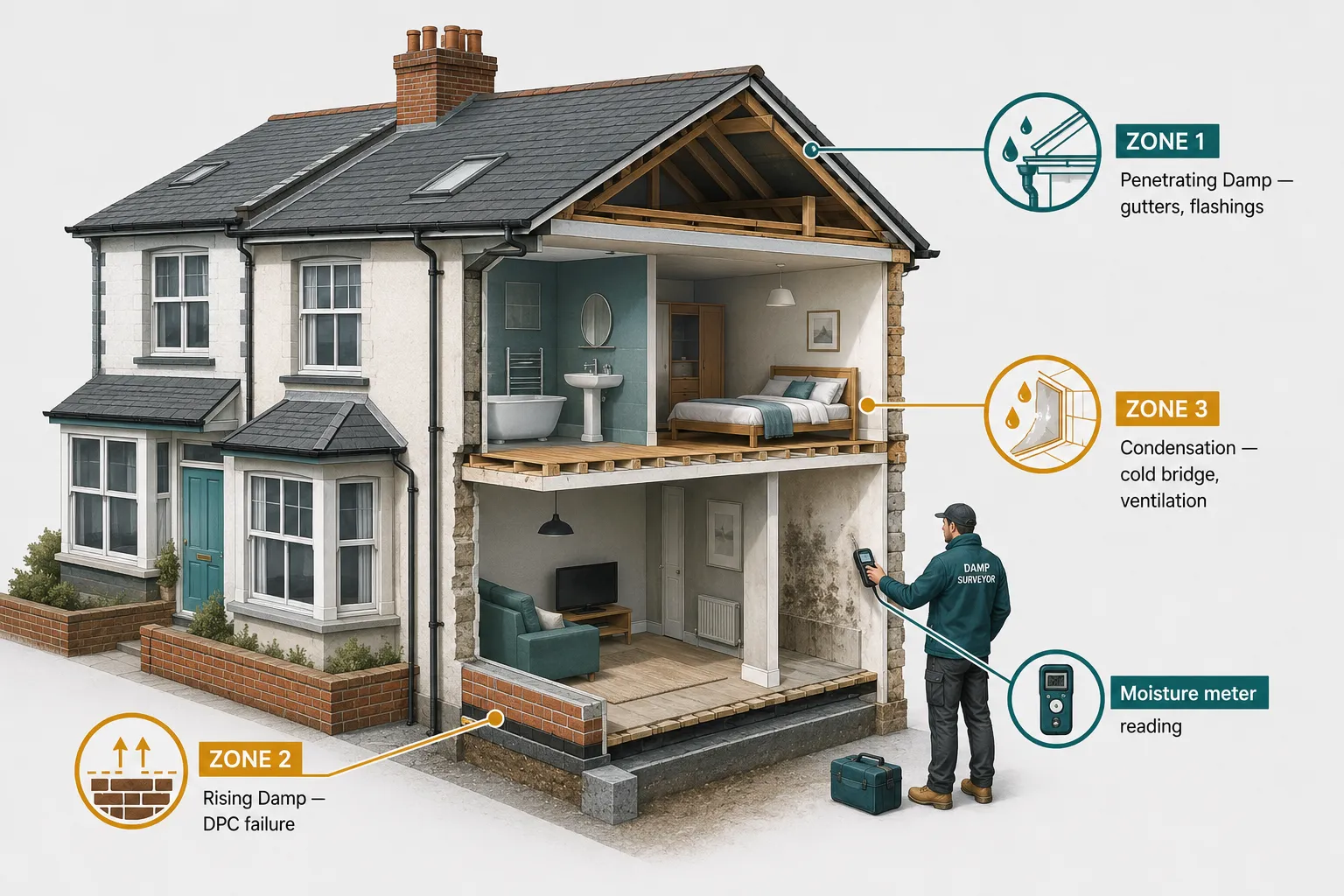
Damp is now treated as a health-critical issue across UK surveying practice, not merely a maintenance inconvenience. RICS consumer guidance emphasises that damp and mould inspections should look systematically at moisture sources, rising damp, penetrating damp, leaks, and condensation, as well as ventilation, occupant behaviour, and building pathology [4]. A surveyor using a moisture meter and reporting in line with current standards will identify not just the presence of damp but its probable cause and the remediation pathway.
This matters because the remediation cost varies enormously depending on the cause:
| Damp Type | Common Cause | Typical Remediation | Approximate Cost Range |
|---|---|---|---|
| Condensation | Poor ventilation, cold bridges | Improved ventilation, insulation | A few hundred pounds |
| Penetrating damp | Failed gutters, roof, or pointing | Roof/gutter repairs, repointing | Several hundred to low thousands |
| Rising damp | Failed or absent damp-proof course | New DPC installation | Can exceed £5,000 |
[3]
"Surveyors are urging buyers to convert qualitative defect findings into quantified repair budgets before committing to or abandoning a purchase."
A surveyor who identifies rising damp requiring a new damp-proof course is not delivering bad news without purpose, they are giving the buyer the information needed to either renegotiate the purchase price or budget accurately for post-completion remediation. For a detailed explanation of what a specialist damp investigation covers, Damp Survey London Report What It Contains And How To Get One sets out the full scope of that process.
The cost of a damp and timber report is also worth understanding before commissioning one. The Damp and Timber Report Cost 2026: Prices Explained guide provides current pricing context to help buyers plan their investigation budget.
Awaab's Law and Raising Standards
The introduction of Awaab's Law has reinforced the importance of rigorous damp investigation across the housing sector. Social landlords are now required to investigate significant damp and mould reports within 10 working days, issue written findings within three days of inspection, and make the property safe within a further five days [5]. While this legislation applies specifically to social housing, it signals a broader shift in expectations: damp is a health risk requiring structured, documented response, not a cosmetic issue to be minimised. Private buyers and their surveyors are increasingly applying the same standard of rigour.
Using the Survey as a Negotiation Tool
The principle behind "Mitigate, Don't Panic: How UK Building Surveyors Help You Reduce Structural and Damp Risks After a Bad Survey" extends well beyond the technical findings. A well-evidenced survey report, supported by specialist quotes, is one of the most powerful negotiation instruments available to a property buyer [7].
The standard approach surveyors and solicitors recommend in 2026 is as follows:
Step 1, Prioritise defects into urgent and non-urgent categories.
Urgent items include structural problems, roof integrity failures, significant damp, and suspected subsidence. Non-urgent items include cosmetic finishes, dated fittings, and minor maintenance items [3].
Step 2, Obtain at least two contractor quotes for urgent items.
Qualitative findings in a survey report ("significant damp" or "cracking requiring investigation") carry limited negotiating weight on their own. Two written contractor quotes convert those findings into a specific monetary figure.
Step 3, Present a costed schedule of works to the seller.
With quantified repair costs in hand, buyers have three realistic options: request a price reduction equivalent to the remediation cost, ask the seller to undertake the repairs before completion, or adjust contract wording to reflect agreed works or price changes.
Step 4, Assess the impact on mortgage and insurance.
Serious damp or structural issues can affect mortgage offers and buildings insurance terms. Solicitors and surveyors should be consulted together to understand whether the findings change the financial viability of the transaction before any negotiation position is finalised [7].
For a detailed breakdown of how price reductions are calculated and presented after a survey, Average Price Reduction After Survey Negotiating The Purchase Price With A Building Survey provides practical benchmarks and strategies.
Mitigate, Don't Panic: Practical Steps When You Discover Defects After Completion
Not every buyer has the benefit of a pre-purchase survey that flags all defects. Some serious problems only become apparent after keys are handed over. In these situations, the "mitigate, don't panic" approach still applies, but the steps differ.
Recent guidance for post-completion defect discovery recommends [1]:
- Commission a retrospective RICS Level 3 Building Survey within the first 12 months of ownership to establish a baseline record of the property's condition.
- Obtain structural engineer input for any movement-related problems, particularly cracking that appears to be progressing.
- Secure multiple repair quotes before beginning any remedial work, to document the cost of the defects properly.
- Take legal advice before starting repairs, beginning remediation without legal guidance can compromise potential claims against the seller, the original surveyor, or the conveyancer.
This last point is frequently overlooked. Carrying out repairs before the extent of the original defect has been professionally documented and legally assessed can significantly weaken any subsequent claim. The surveyor's role here is to provide an objective, contemporaneous record of the defect as found, a function that is just as important after completion as before it.
For buyers who are uncertain whether their pre-purchase survey adequately covered the property's condition, After a Bad Survey Report | Wimbledon Surveyors outlines the full range of options available at each stage of the transaction.
Choosing the Right Survey Level to Minimise Risk from the Start
Much of the distress that follows a bad survey can be traced back to an earlier decision: choosing a survey level that was not appropriate for the property. A Level 2 HomeBuyers Survey is a cost-effective choice for a modern, well-maintained property in good condition. For a pre-1930s terrace, a property that has been extended, or any building showing visible defects at the viewing stage, a Level 3 Full Building Survey provides the depth of investigation needed to surface hidden risks [3].
The RICS condition classification system used in Level 3 surveys records structural movement in far greater detail than a Level 2 report, covering cracking, bulging, deflection, loss of verticality, and an assessment of whether movement is historic or active [2]. That granularity is precisely what buyers need to make informed decisions about structural risk.
For a structured comparison of survey levels and the circumstances in which each is appropriate, Home Survey Levels 2 Vs Level 3 Choosing The Right Option sets out the key differences clearly.
Conclusion
A bad survey report is not the end of a property transaction, it is the beginning of an informed one. The core message of "Mitigate, Don't Panic: How UK Building Surveyors Help You Reduce Structural and Damp Risks After a Bad Survey" is that structural and damp risks, however alarming they appear on first reading, can almost always be assessed, quantified, and addressed through a structured professional process.
Actionable next steps for buyers facing a difficult survey:
- Read the full report and speak directly with the surveyor before drawing any conclusions.
- Separate Condition Rating 3 structural and damp findings from cosmetic issues.
- Commission specialist reports, structural engineer, damp specialist, only where the surveyor explicitly recommends them.
- Obtain at least two contractor quotes for all urgent defects to build a costed remediation schedule.
- Work with both the surveyor and solicitor to negotiate a price reduction, request seller repairs, or adjust contract terms.
- If defects are discovered after completion, commission a retrospective survey and take legal advice before beginning any remedial work.
- For future purchases, match the survey level to the property type, Level 3 for older, extended, or visibly defective buildings.
The surveyor's role is not to deliver bad news; it is to give buyers the professional intelligence they need to make sound decisions. Used correctly, a thorough survey, even a difficult one, is the most effective risk-mitigation tool available in any UK property transaction.
References
[1] Retrospective Building Surveys And Valuations After Buying What To Do If You Discover Serious Defects – princesurveyors.co.uk
[2] Rics%20structural%20survey%20practice 0 – bathnes.gov.uk
[3] Most Common House Survey Problems – surveyorlocal.co.uk
[4] Damp And Mould – rics.org
[5] Blog – survey-mate.co.uk
[6] Damp Mould Moisture Movement Consumer Guide – ww3.rics.org
[7] What To Do After A Bad Home Survey – gowers.co.uk