
London homeowners who skip a structured cost plan before starting works routinely overspend by 20-40%, yet a well-researched property improvement plan costs in London framework, covering surveys, repairs and phased upgrades, can contain almost every surprise before it becomes a bill. With average annual property-related costs for a standard London buy-to-let now reported at £19,604, and HMO landlords facing £35,720 per year, the financial stakes of poor planning have never been higher [1].
This article walks through the full cost picture: from the survey fees that should anchor every improvement plan, to realistic repair cost ranges by project type, to a practical phased budgeting structure that matches expenditure to available funds.
Key Takeaways
- A RICS Level 3 building survey, the essential first step in any serious improvement plan, typically costs £630,£1,500 for London properties, with larger or more complex homes at the upper end.
- London refurbishment costs range from roughly £400,£900 per m² for a light refresh to £2,500+ per m² where structural work is involved.
- Phasing upgrades over two to three years reduces financial pressure and allows survey findings to drive spending priorities.
- Leaseholders in blocks must follow Section 20 consultation rules for major works exceeding £250 per leaseholder, failure to do so caps landlord cost recovery at £250 per leaseholder.
- Reserving 10-15% of any project budget as a contingency fund is standard practice for London works, where labour and material costs remain volatile.
Why Every London Improvement Plan Must Start With the Right Survey
The single most common budgeting error London homeowners make is commissioning works before commissioning the right survey. A survey does not just satisfy a mortgage lender, it produces a prioritised defect list that becomes the backbone of a cost-effective property improvement plan. Skipping this step means repair budgets are built on guesswork.
Understanding Survey Levels and Their Costs
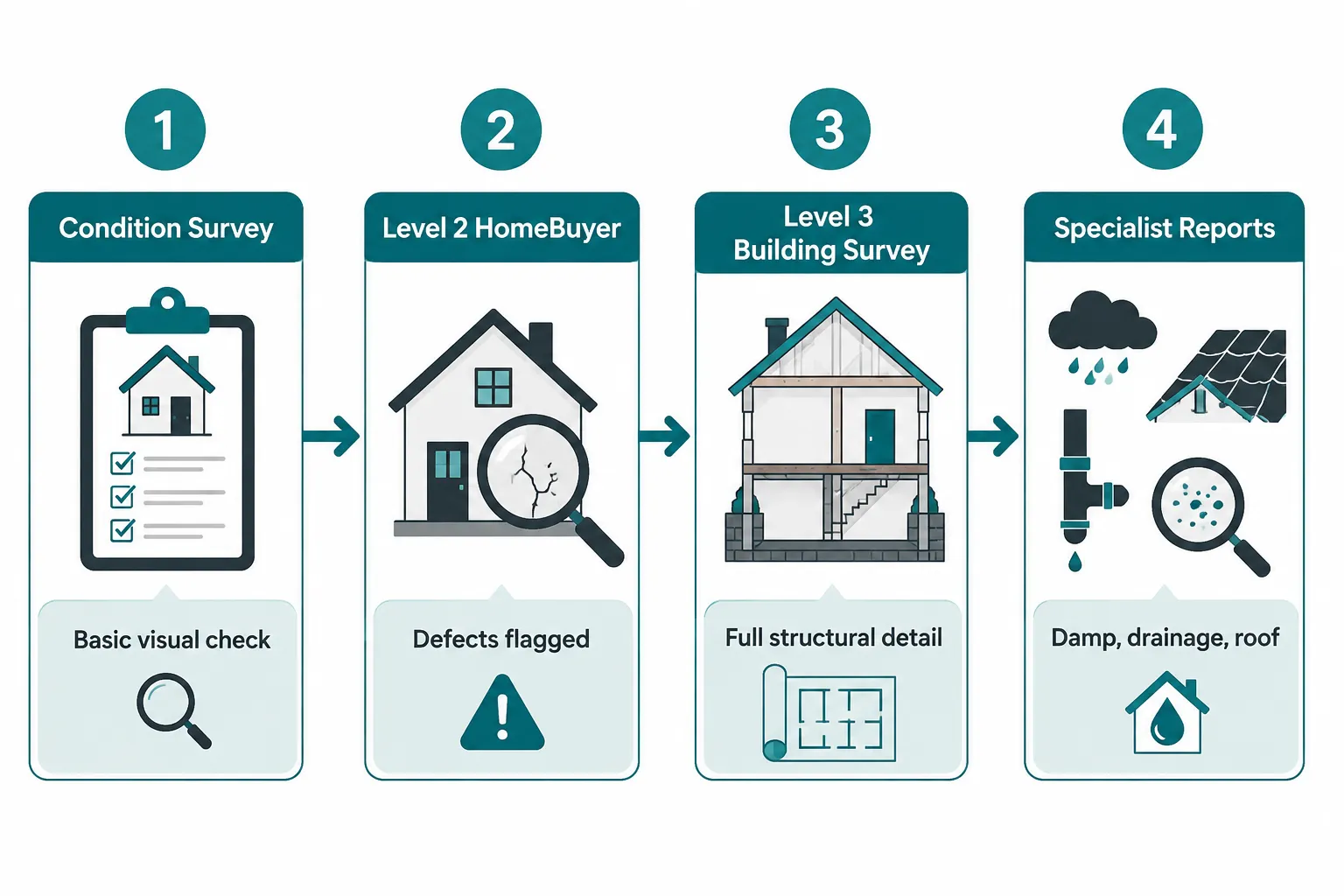
RICS Home Surveys are structured in three levels, and the choice directly affects how much useful cost data a homeowner receives [2]:
| Survey Level | Best For | Typical London Cost |
|---|---|---|
| Level 1 (Condition Report) | New builds, recently refurbished homes | £250,£400 |
| Level 2 (HomeBuyer Report) | Standard properties in reasonable condition | £400,£700 |
| Level 3 (Building Survey) | Older, larger or altered properties | £630,£1,500+ |
For any property where significant upgrades are planned, a Level 3 Building Survey is the appropriate starting point. It provides detailed commentary on construction, materials and defects, and, critically, can include estimated repair costs to inform staged improvement plans [2]. London properties frequently attract quotes at the upper end of the £630,£1,500 range due to size, age and complexity [5].
Broader building survey guidance confirms that comprehensive surveys for typical London houses commonly cost £1,000,£1,500+, with specialist firms noting that size, access and property type all influence the final fee [5][8]. Homeowners should treat this fee as an investment: a Level 3 report that identifies £30,000 of deferred maintenance pays for itself many times over.
For properties where accurate floor plans are needed before design-led upgrades begin, a measured building survey adds another layer of cost. A 2-3 bedroom property typically costs £400,£600 for a standard measured survey, rising to £650,£1,100 for full CAD drawings. Four-bedroom-plus homes range from £500 to £800 for the standard version. Commercial buildings can reach £800,£2,500+ depending on size and complexity.
Specialist Surveys That Feed Into the Improvement Budget
A general building survey may flag areas needing specialist investigation. Common add-ons for London properties include:
- Damp and timber surveys: Essential for Victorian and Edwardian stock. See Damp Survey Cost UK 2026 for a full breakdown of what these investigations cost and what they cover.
- Drainage CCTV surveys: Relevant for older terraced properties with shared or clay drainage runs.
- Structural engineer's report: Required where the Level 3 survey identifies movement, cracking or non-standard construction.
- Asbestos survey: Mandatory before any intrusive works on properties built before 2000.
For a thorough grounding in what surveys reveal and how to use their findings, the condition survey London resource provides useful context on what each inspection type covers.
It is also worth reviewing common myths about a property survey before commissioning work, several widely held misconceptions lead homeowners to under-survey their properties and then face unexpected costs during the improvement phase.
London Refurbishment Cost Ranges: What Budgets Actually Look Like in 2026
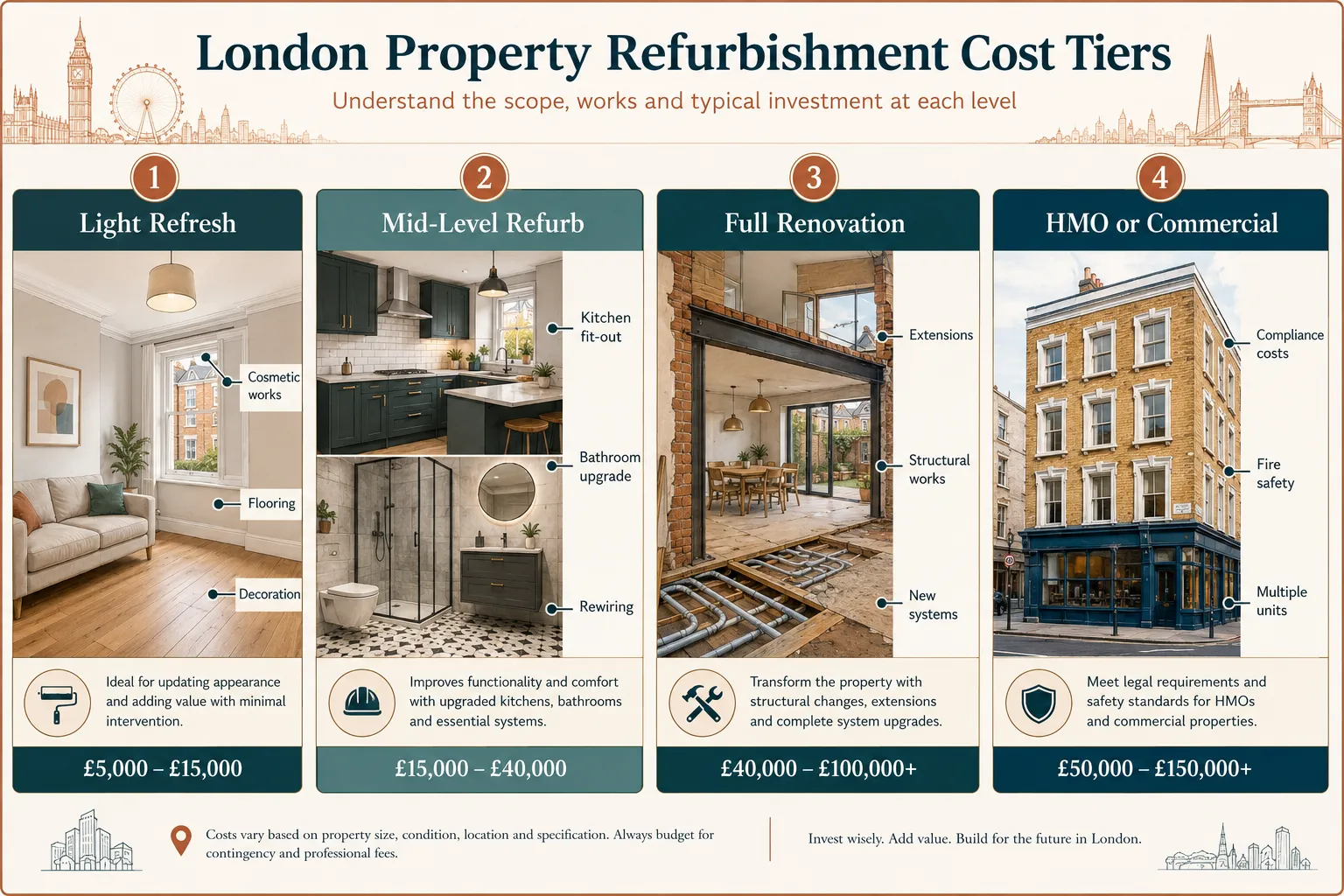
Once survey findings are in hand, the next task is matching defect priorities to realistic cost ranges. London refurbishment costs vary enormously by scope, but 2026 benchmarks provide a clear framework for budgeting [4][7].
Cost Per Square Metre: The Most Reliable Budgeting Metric
Pricing by square metre allows homeowners to scale estimates to their specific property size. Current London benchmarks break down as follows [7]:
Light refresh (cosmetic works, decoration, flooring, minor fixtures):
- £400,£900 per m²
- Equivalent to roughly £120,£250 per sq ft
Full refurbishment (kitchen, bathrooms, rewiring, new heating, replastering):
- £1,200,£2,200 per m²
- Equivalent to roughly £200,£400 per sq ft
Structural renovation (extensions, loft conversions, wall removals, underpinning):
- £2,500+ per m²
- Equivalent to £400,£500+ per sq ft
Translating these into project totals for a typical London property [4]:
- Light refurbishment: £30,000,£100,000+
- Mid-level renovation: £100,000,£250,000+
- Full house renovation with structural works: £250,000,£600,000+
"The gap between a light refresh and a full structural renovation in London is not just a matter of degree, it is a difference of an entire order of magnitude in cost. Getting the scope right before committing to a budget is essential."
Common Repair Cost Benchmarks
For homeowners planning phased upkeep rather than full renovation, order-of-magnitude figures for recurring repair items are equally important. Useful reference points include [10]:
- Gutter cleaning (15m of guttering, medium semi-detached): £100,£150 per visit
- Roof tile replacement (minor repairs): £200,£500
- Boiler replacement: £2,000,£4,500 including installation
- Full rewire (3-bed Victorian terrace): £5,000,£10,000+
- Damp treatment (rising damp, one wall): £1,500,£4,000 depending on extent
- External redecoration (Victorian terrace): £3,000,£8,000+
These figures underscore the importance of ring-fencing annual budgets for smaller cyclical tasks alongside larger planned projects [10]. A property that receives regular maintenance at £1,000,£3,000 per year will almost always cost less over a decade than one where all maintenance is deferred until a single large intervention is unavoidable.
For home improvement projects involving roofing specifically, the guidance on checking the roof when buying a house in London provides a useful primer on what to look for and what remedial costs to anticipate.
The HMO and Landlord Premium
Landlords operating houses in multiple occupation face a structural cost premium over standard buy-to-let properties. Annual property-related costs for London HMOs are reported at £35,720 on average, compared with £19,604 for standard buy-to-let properties [1]. This premium reflects higher compliance requirements, faster wear cycles, more frequent maintenance callouts and the cost of meeting licensing conditions.
Any improvement plan for an HMO must therefore budget not just for physical repairs but for compliance works, fire doors, interlinked alarms, emergency lighting, and any conditions attached to the HMO licence itself.
Structuring a Phased Upgrade Plan That Matches Your Budget
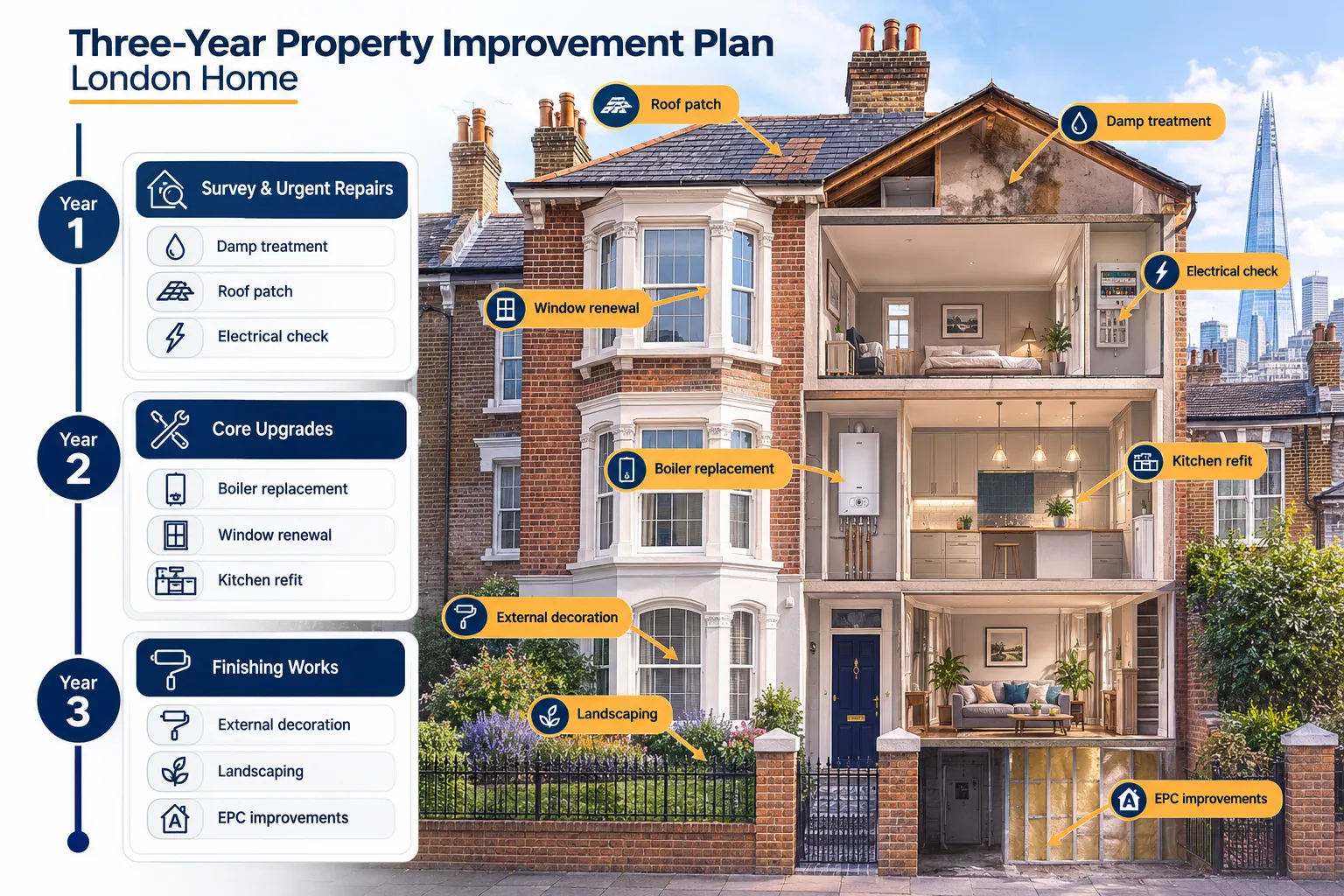
A phased approach to property improvement is not a compromise, it is sound financial management. Spreading works over two to three years reduces peak expenditure, allows survey findings to drive spending priorities, and creates space to obtain competitive quotes rather than accepting the first available contractor.
Phase 1: Survey, Assess and Address Urgent Defects (Year 1)
The first phase should always begin with a professional survey. The findings then drive a triage process:
- Safety-critical defects, structural instability, active water ingress, electrical hazards, gas safety issues. These must be addressed immediately regardless of cost.
- Defects that will worsen if deferred, roof leaks, blocked gutters, failed pointing, rising damp. Deferring these typically doubles or triples the eventual repair cost.
- Defects that are stable but require attention within 1-3 years, ageing boiler, dated wiring, single-glazed windows.
Typical Year 1 budget allocation for a London Victorian terrace in average condition:
- Survey fees: £1,000,£1,500
- Urgent structural or weatherproofing repairs: £5,000,£20,000
- Safety-related electrical or gas works: £1,500,£5,000
- Total Year 1 range: £7,500,£26,500
Phase 2: Core System Upgrades (Year 2)
With urgent defects resolved, Year 2 focuses on the building's core systems, heating, plumbing, electrical, insulation. These upgrades improve energy performance, reduce running costs and form the platform on which cosmetic improvements sit.
Typical Year 2 expenditure items:
- Boiler replacement and heating system upgrade: £3,000,£6,000
- Partial or full rewire: £4,000,£10,000
- Window replacement (double or triple glazing): £5,000,£15,000
- Loft insulation and draught-proofing: £500,£2,000
Phase 3: Cosmetic and Value-Adding Works (Year 3)
The final phase covers the improvements that are most visible but least urgent: kitchen and bathroom refits, internal decoration, flooring, external landscaping and any extensions or loft conversions where planning permission has been secured.
This is also the phase where EPC (Energy Performance Certificate) rating improvements can be formalised, increasingly important given the direction of travel in rental property regulations.
Contingency Budgeting: The 10-15% Rule
Every phase of a London improvement plan should carry a contingency reserve of 10-15% of the phase budget. London construction projects are particularly exposed to cost escalation due to:
- Labour shortages in specialist trades
- Material price volatility
- Unforeseen defects uncovered during intrusive works
- Planning or building control requirements that emerge mid-project
A project budgeted at £50,000 should therefore carry a £5,000,£7,500 contingency line. This is not pessimism, it is standard professional practice.
Leasehold Properties: Section 20 and Major Works Costs
For leaseholders in London blocks, the property improvement plan costs picture is complicated by Section 20 of the Landlord and Tenant Act 1985. This legislation governs how freeholders and managing agents must consult leaseholders before carrying out "qualifying works" [6].
The key thresholds are:
- Any qualifying works where the cost to an individual leaseholder exceeds £250 requires formal Section 20 consultation
- Long-term agreements (over 12 months) costing more than £100 per leaseholder per year also trigger the process [6][9]
If a freeholder or managing agent fails to follow the Section 20 process correctly, their ability to recover costs through the service charge is generally capped at £250 per leaseholder for that set of works [6].
Major works in this context typically include roof replacement, external redecoration, window renewal, lift works and fire-safety upgrades [9]. These costs are usually recovered as additional service charge demands on top of normal annual charges, and they can be substantial. One widely discussed 2025 case saw a roof replacement estimate for a London block rise from £40,000 to £100,000, with significant dispute over whether fresh Section 20 consultation was required [3].
Best practice for leaseholder-managed buildings:
- Maintain a sinking fund or reserve fund specifically for major works
- Produce a planned maintenance schedule forecasting upcoming Section 20-scale projects over a 5-10 year horizon
- Align service charge contributions with projected expenditure to avoid very large one-off demands [6][9]
For detailed guidance on the costs and process involved in works affecting shared or boundary structures, the article on party wall agreements and the costs involved is a valuable companion resource.
Using Survey Findings to Negotiate and Prioritise
A professional survey report is not just a planning document, it is a negotiating tool. For buyers, an RICS survey can support price renegotiation where significant defects are identified. The guide on using an RICS survey to negotiate property price in London explains how to use survey findings effectively in purchase negotiations, potentially recovering the cost of the survey many times over through a reduced purchase price.
For existing owners, the survey report provides documented evidence of defect severity, useful when obtaining contractor quotes, applying for grants or insurance claims, and demonstrating due diligence to future buyers.
Those who want to understand what a completed survey report looks like before commissioning one can download an example of a homebuyers report to review the format and level of detail provided.
Conclusion
A structured property improvement plan costs in London framework, one that begins with the right survey, applies realistic cost benchmarks by project scope, and sequences works across defined phases, is the most reliable way to control expenditure on London property. The numbers involved are significant: survey fees of £630,£1,500, repair costs ranging from a few hundred pounds for cyclical maintenance to £600,000+ for full structural renovation, and annual property-related costs that can exceed £35,000 for HMO landlords [1][2][4].
Actionable next steps for London homeowners and landlords in 2026:
- Commission a Level 3 Building Survey before committing to any significant improvement budget. Use the findings to build a prioritised defect list.
- Apply the cost-per-square-metre benchmarks (£400,£900/m² for light works, £1,200,£2,200/m² for full refurb, £2,500+/m² for structural works) to size your overall budget realistically [7].
- Structure works in three phases, urgent defects, core system upgrades, cosmetic and value-adding works, with a 10-15% contingency at each stage.
- If you own a leasehold flat, map upcoming major works against Section 20 thresholds and begin building a sinking fund now to avoid large one-off demands [6][9].
- Obtain at least three competitive quotes for each phase before committing to a contractor, and ensure all quotes are based on the same specification derived from your survey report.
For professional survey services covering the full range of residential and commercial property needs across London, Wimbledon Surveyors provides RICS-accredited home surveys, valuations and specialist reports to support every stage of a property improvement plan.
References
[1] Rising Maintenance Costs In 2026 How Guaranteed Rent Protects Landlord Margins – elliotleigh.com
[2] How Much Does A House Survey Cost – hoa.org.uk
[3] Service Charge Increase For Major Works No – reddit.com
[4] How Much Does It Cost To Renovate A House In London – chelseaandfulhambuilders.co.uk
[5] How Much Is A Building Survey – westvilleassociates.com
[6] An Overview Of Major Works And Section 20 – residentsline.co.uk
[7] House Flat Renovation Cost London 2026 Definitive Guide – kapeti.com
[8] How Much Does A Building Survey Cost – crestsurveyors.co.uk
[9] Major Works And Section 20 What Leaseholders Need To Know – pauzible.com
[10] Property Maintenance Cost – checkatrade.com