
Last updated: September 17, 2026
Quick Answer
The Bank of England held Bank Rate at 4.00% on 17 September 2026, following an earlier rise from the 3.75% level that had held through much of the year [4]. For UK property buyers, this means mortgage costs stay broadly where they have been for months, with the best five-year fixed rates sitting around 4.38%. Surveyors, meanwhile, are seeing steadier but still cautious demand as buyers weigh borrowing costs against long-term value.
Key Takeaways
- Bank of England Holds Base Rate at 4% September 17 2026, keeping borrowing costs unchanged after a bruising 18 months of rate rises and holds [4].
- Best five-year fixed mortgage rates sit around 4.38% in September 2026; tracker deals track the base rate plus lender margin.
- Halifax puts the average UK house price at £306,000, Nationwide at £278,500, and Zoopla at £272,800, the gap reflects different measurement methods.
- RICS's August 2026 survey shows new buyer enquiries at -19% and agreed sales at -17%, signalling stabilisation rather than a downturn.
- Surveyors are reporting steady demand for Level 3 Building Surveys, HomeBuyer Reports and mortgage valuations as buyers seek certainty before committing at 4% borrowing costs.
- Homeowners coming off 2021-era fixed deals face the sharpest payment increases and should start remortgaging conversations three to six months before their deal ends.
- A held rate is not a falling rate, buyers waiting for cheaper borrowing may be waiting longer than expected.
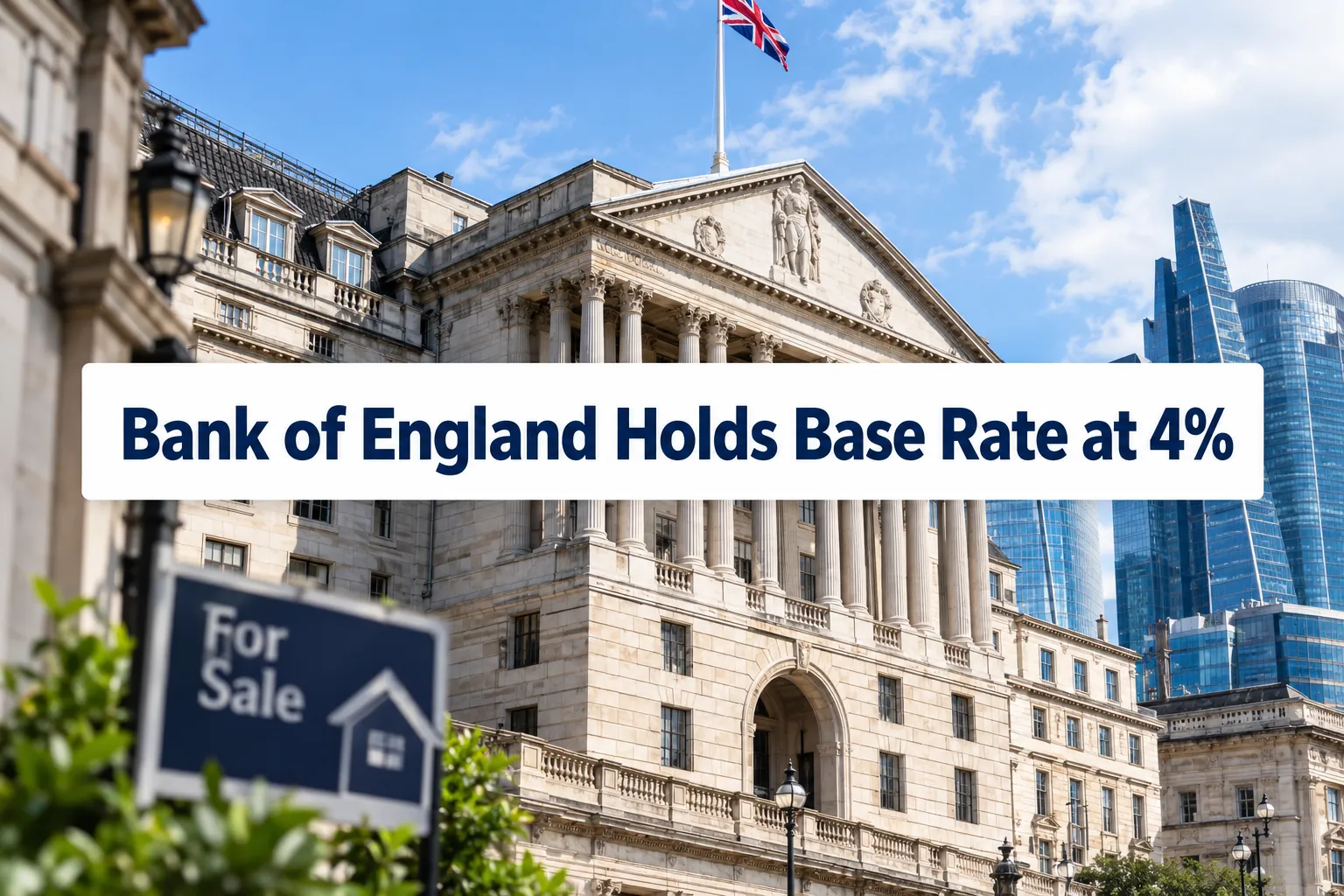
Bank of England Holds Base Rate at 4% September 17 2026: The MPC Decision Explained
The Monetary Policy Committee voted to hold Bank Rate at 4.00% on 17 September 2026, choosing continuity over further tightening despite a persistent minority pushing for another increase [4]. This is the clearest signal yet that the Bank sees 4% as roughly where policy needs to sit for now, rather than a stepping stone to something higher.

Context matters here. Bank Rate had been held at 3.75% across several consecutive meetings earlier in 2026, including February, March, June and July, as the Committee weighed inflation risks against a fragile economy [6][9][8][10]. Inflation fears mounted through the summer, with the Bank holding rates in July even as price pressures built [5][7]. That backdrop explains why a subsequent move to 4.00% and today's hold reflect a Committee still cautious about cutting too soon, even as some members argue the economy needs relief.
Decision rule: if you are waiting for the Bank's own commentary to signal cheaper mortgages, note that a "hold" at 4% is a statement of caution, not a promise of future cuts. The minutes and voting pattern matter more than the headline rate alone [4].
What Does the Bank of England Base Rate Mean for Mortgage Rates
The base rate is the interest rate the Bank of England charges commercial banks, and it acts as the anchor for nearly all UK mortgage pricing, from tracker deals to new fixed-rate products [1][3]. When Bank Rate sits at 4.00%, lenders build their margins, funding costs and profit expectations on top of that figure to set the rates borrowers actually pay.
Base Rate vs Mortgage Rate: What's the Difference
Base rate and mortgage rate are not the same thing, and confusing them leads to bad financial decisions. Base rate is the wholesale rate set eight times a year by the MPC; mortgage rates are retail products priced by individual lenders using swap rates, risk appetite and competition, not just the base rate alone.
- Tracker mortgages move in near-lockstep with Bank Rate, typically at base rate plus a fixed margin (for example, base plus 0.75%).
- Fixed-rate mortgages are priced off swap rates, which reflect where markets expect rates to go over the fix's term, not just today's base rate.
- Standard variable rates (SVRs) sit well above base rate and are the most expensive option for most borrowers who fall off a deal without switching.
Current Fixed and Tracker Mortgage Rates in September 2026
Best-buy five-year fixed mortgages are pricing around 4.38% in September 2026, a level that has held fairly steady since the base rate settled at 4.00%. Two-year fixes and tracker products sit close behind, generally within half a percentage point either way depending on deposit size and lender appetite.
How Much More Expensive Are Mortgages at 4% Compared to Lower Rates
A mortgage at 4.00% base-rate-linked pricing costs noticeably more than the sub-2% deals common in 2021, and borrowers should budget for that gap rather than hope it closes quickly. On a £250,000 repayment mortgage over 25 years, moving from a 2% rate to a 4.4% rate adds roughly £330 to £380 to the monthly payment, depending on the exact product and fees involved. That is not a rounding error for most household budgets, and it is the single biggest reason remortgagers need to plan early.
How Does a 4% Base Rate Affect House Prices in the UK
A held base rate at 4% keeps mortgage affordability roughly stable, which supports gentle price growth rather than sharp swings in either direction. The three main UK house price indices currently sit at different levels because they measure different things: Halifax reports an average price of £306,000 based on its own mortgage completions, Nationwide reports £278,500 from its mortgage book, and Zoopla puts its market estimate at £272,800 using a broader valuation model across listed and sold stock.
Common mistake: treating one index as "the" national average. Each provider samples a different slice of the market, Halifax and Nationwide skew towards their own mortgage customers, while Zoopla covers a wider valuation base including cash buyers. Compare trend direction across indices, not absolute figures.
RICS August 2026 Survey: Signs of Market Stabilisation
The RICS residential survey for August 2026 shows new buyer enquiries at a net balance of -19% and agreed sales at -17%, figures that indicate a market cooling gently rather than collapsing. A net balance measures the difference between surveyors reporting increases and those reporting decreases, so a reading below zero still means most respondents saw flat or falling activity, but the pace of decline has slowed compared with earlier in the cycle.
- Buyer enquiries softening at -19% suggests hesitancy tied to the 4% rate environment, not a full retreat from the market.
- Sales at -17% point to transactions still completing, just at a slower rhythm as buyers negotiate harder on price.
- Surveyors report price expectations flattening across most UK regions, consistent with a held rather than falling base rate.
How Do Surveyors Price Properties When Interest Rates Are High
Surveyors do not set prices; they assess evidence of value using comparable sales, condition, and local market activity, and higher interest rates influence that evidence indirectly by slowing transaction volumes and softening buyer competition. When fewer deals go through, surveyors have less fresh comparable data to work with, so they lean more heavily on recent sold prices, adjusted for condition and any signs of price reductions during marketing.
Can Surveyors Adjust Valuations Based on Interest Rate Changes
Surveyors do not apply an automatic interest-rate adjustment to a valuation figure, but rate-driven market conditions feed into their judgement about risk, marketability and realistic sale timescales. A property that would have sold in three weeks at 2% base rates may need six to eight weeks of marketing at 4%, and a cautious surveyor will reflect that slower liquidity in how confidently they support a given price.
Edge case: in a market with a held rate like September 2026's 4%, valuations tend to be more stable than in a rapidly rising or falling rate environment, because lenders and surveyors both have more recent, comparable evidence to rely on.
Surveyor Demand: Level 3, HomeBuyer, Valuations and Level 2 Reports
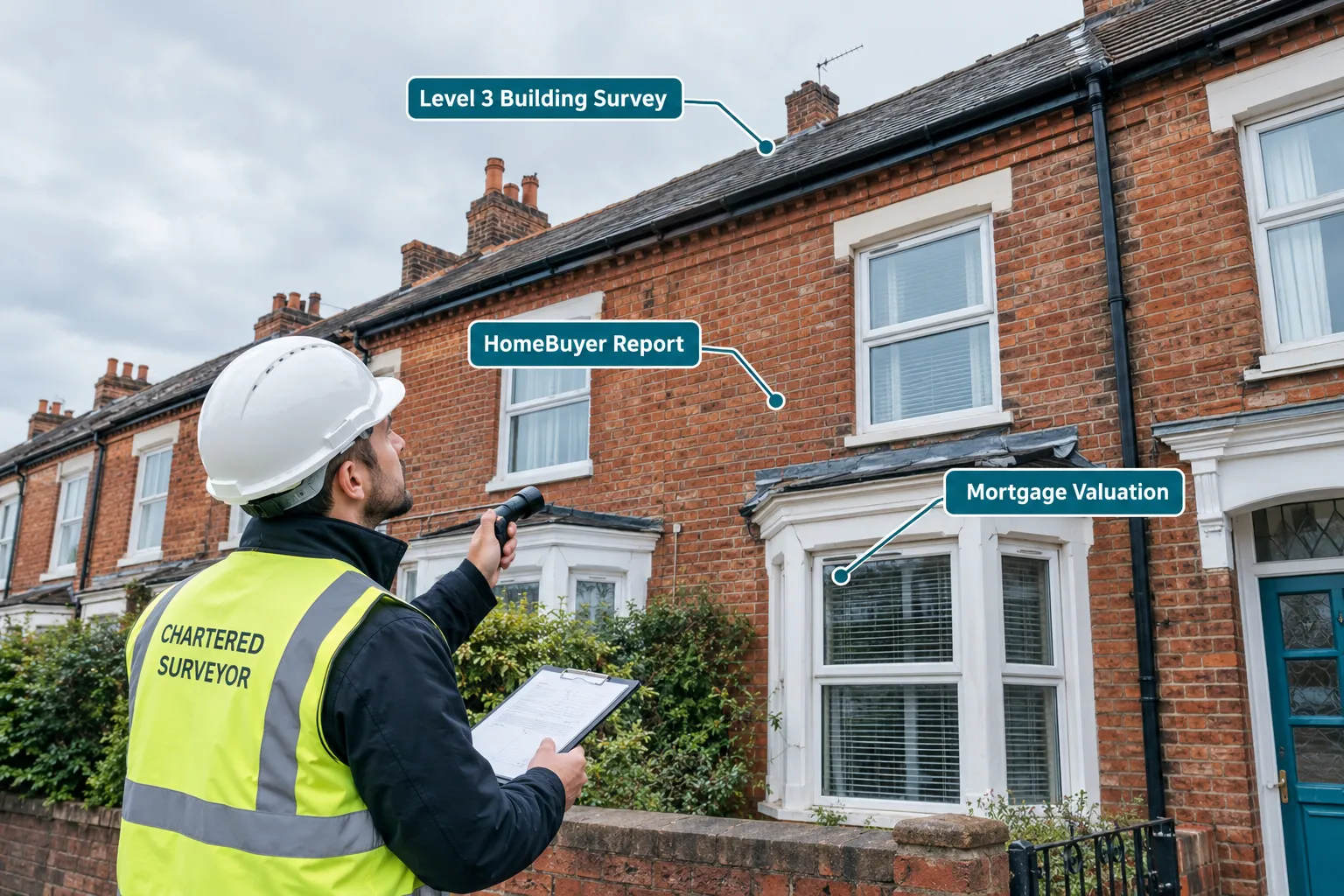
Demand for detailed surveys is rising relative to basic valuations because buyers borrowing at 4% want fewer surprises after completion. Property Merchant and other RICS-regulated firms report steady bookings across three tiers:
| Report type | Best suited to | Why demand is holding |
|---|---|---|
| Level 3 Building Survey | Older, period, or altered properties | Buyers want full structural clarity before committing at higher borrowing costs |
| HomeBuyer Report (Level 2) | Conventional, reasonably modern homes | Balances cost and detail for straightforward purchases |
| Mortgage Valuation | Lender requirement on all mortgaged purchases | Confirms security value for the loan, unaffected by rate holds |
Survey Merchant's Level 3 Building Survey, HomeBuyer Report and Valuation services are seeing consistent enquiry volumes through September 2026, reflecting buyers who would rather pay a few hundred pounds for certainty than risk an expensive repair bill on top of a 4% mortgage.
Remortgagers: What Happens When 2021 Fixed Deals Roll Off
Borrowers coming off five-year fixed deals taken out in 2021, when many rates sat between 1.5% and 2.5%, face the steepest payment jump of any group in this cycle. Moving onto a 4.00-4.5% product roughly doubles the interest portion of a typical monthly payment, even before accounting for any capital repayment changes.
Is It a Good Time to Refinance My Mortgage at 4% Base Rate
Refinancing now is generally sensible for anyone whose current deal is ending within the next six months, because waiting rarely produces a materially cheaper rate while risking a costly move onto a lender's standard variable rate. Locking a new deal three to six months ahead, using a rate-lock or reservation feature where available, protects against any further tightening without forcing a decision too early.
- Check exit fees and early repayment charges before switching lenders.
- Compare a straight product transfer with your existing lender against a full remortgage, transfers are often faster and cheaper.
- Get a fresh valuation early if your loan-to-value has shifted, since a lower LTV band can unlock a meaningfully better rate.
Should I Buy Property Now or Wait for Rate Cuts
Buying now suits anyone financially ready and planning to stay put for five-plus years, because a held 4% rate offers pricing stability that waiting does not guarantee to improve. Choose to wait only if affordability is genuinely marginal, since a small future rate cut is unlikely to offset the risk of house prices firming further while you sit out.
Will Mortgage Rates Go Down After September 2026
Mortgage rates may ease modestly if inflation continues to fall and the MPC eventually cuts Bank Rate, but the September 2026 hold signals the Committee is not rushing that decision [4]. Borrowers should plan around today's 4.00-4.5% pricing rather than budgeting for a rate cut that has not yet been confirmed.
What Happens to First-Time Buyers When Base Rate Stays at 4%
First-time buyers face tighter affordability calculations at 4%, since lender stress tests apply a further margin above the actual mortgage rate to check borrowers can cope with future rises. A held rate at least removes the risk of sudden further tightening mid-application, giving first-time buyers a stable target to plan deposits and Agreement in Principle timing around.
- Focus on maximising deposit size to access better loan-to-value bands.
- Get pre-approved before house-hunting seriously; rate holds still mean lenders review affordability closely.
- Budget a HomeBuyer Report or Level 3 survey into upfront costs rather than skipping it to save a few hundred pounds.
What Should Property Investors Do When Base Rate Is Held Steady
Property investors should treat a held 4% rate as a planning window rather than a signal to rush or retreat, using the stability to model rental yields against realistic, not optimistic, borrowing costs. Buy-to-let mortgage pricing tends to sit above residential rates, so investors should stress-test cash flow at 5%-plus to allow margin for future refinancing.
Does Base Rate Affect Commercial Property Differently Than Residential
Commercial property responds to base rate changes more slowly and less directly than residential, because commercial valuations lean heavily on lease length, tenant covenant strength and rental yield rather than mortgage affordability alone. A held base rate supports steadier commercial lending terms, but occupier demand and lease renewals matter more to commercial values than the base rate itself.
Practical Guidance for Buyers, Sellers and Remortgagers
- Buyers: get an Agreement in Principle before viewing seriously, and budget for a Level 3 Building Survey on any period property.
- Sellers: price realistically against local sold comparables, not last year's asking prices, given the -17% RICS sales balance.
- Remortgagers: start the process three to six months before your current deal ends and compare product transfers against full remortgages.
- Investors: stress-test yields at 5%-plus and treat the current hold as a stable but not permanent baseline.
- Everyone: book a valuation or survey early, surveyor capacity tightens as the autumn market picks up.
FAQ
What is the Bank of England base rate as of September 2026?
Bank Rate stands at 4.00% following the Monetary Policy Committee's decision to hold on 17 September 2026 [4].
How does the base rate affect my mortgage?
Tracker mortgages move directly with base rate changes, while fixed-rate mortgages are priced off swap rates that reflect where markets expect rates to head over the fix's term.
Will mortgage rates fall before the end of 2026?
Possibly, but not guaranteed. The MPC's decision to hold rather than cut on 17 September 2026 suggests no imminent reduction in Bank Rate [4].
Should first-time buyers wait for cheaper rates?
Only if affordability is genuinely too tight now. A held rate offers planning stability, and waiting risks house prices firming further without a guaranteed rate cut.
Do I need a survey when remortgaging?
Lenders require a mortgage valuation, but an independent HomeBuyer Report or Level 3 Building Survey gives homeowners their own view of the property's condition, which a lender's valuation does not provide.
How does RICS survey data affect house prices?
RICS survey balances track sentiment among surveyors on enquiries, sales and price expectations, offering an early signal of market direction before official price indices catch up.
Conclusion
The Bank of England's decision to hold Bank Rate at 4.00% on 17 September 2026 gives the UK property market a period of relative stability rather than a fresh shock in either direction [4]. Mortgage pricing around 4.38% for best five-year fixes, house price benchmarks from Halifax, Nationwide and Zoopla sitting within a fairly tight range, and RICS data pointing to stabilising rather than collapsing activity all tell the same story: a market adjusting to higher borrowing costs, not one in crisis.
Buyers ready to proceed should move forward with realistic budgeting rather than waiting on a rate cut that has not been confirmed. Sellers should price against current comparables, not last year's market. Remortgagers coming off cheaper 2021 deals need to start the refinancing conversation now, and anyone buying should build a Level 3 Building Survey, HomeBuyer Report or Valuation into their plans early, before autumn demand tightens surveyor availability.
References
[1] The Interest Rate Bank Rate – bankofengland.co.uk
[2] C3dky111m40o – bbc.com
[3] Monetary Policy – bankofengland.co.uk
[4] September 2026 – bankofengland.co.uk
[5] Bank Of England Holds Interest Rates Inflation Fears Mount – theguardian.com
[6] February 2026 – bankofengland.co.uk
[7] Interest Rates Inflation Bank Of England – cnbc.com
[8] July 2026 – bankofengland.co.uk
[9] June 2026 – bankofengland.co.uk
[10] Bank Of England Holds Interest Rates Iran War Inflation – theguardian.com
.cg-wrap{max-width:480px;margin:0 auto;font-family:Arial,Helvetica,sans-serif;border:1px solid #d8dde3;border-radius:10px;padding:20px;background:#f7f9fb}
.cg-wrap h2{font-size:18px;color:#0b2e4f;margin:0 0 12px}
.cg-row{margin-bottom:12px}
.cg-row label{display:block;font-size:13px;color:#3a4a5a;margin-bottom:4px;font-weight:bold}
.cg-row select,.cg-row input{width:100%;padding:8px;border:1px solid #c3ccd4;border-radius:6px;font-size:14px;box-sizing:border-box}
.cg-btn{background:#0b2e4f;color:#fff;border:none;padding:10px 16px;border-radius:6px;font-size:14px;cursor:pointer;width:100%}
.cg-btn:hover{background:#123f6b}
.cg-result{margin-top:16px;padding:14px;background:#eaf1f7;border-radius:8px;font-size:14px;color:#0b2e4f}
.cg-result strong{font-size:20px;display:block;margin-top:4px}
.cg-note{font-size:11px;color:#6b7a89;margin-top:10px}
Mortgage Payment Impact Calculator
2021-era fix: 2.00%
Sep 2026 best 5-yr fix: 4.38%
Base rate + tracker margin: 4.75%
Lender SVR: 5.50%
function cgCalc(){
var P=parseFloat(document.getElementById(‘cg-loan’).value);
var years=parseFloat(document.getElementById(‘cg-term’).value);
var rate=parseFloat(document.getElementById(‘cg-rate’).value)/100/12;
var n=years*12;
var pay=P*rate/(1-Math.pow(1+rate,-n));
var out=document.getElementById(‘cg-out’);
if(isNaN(pay)||P<=0||n<=0){out.innerHTML='Please enter valid figures.';return;}
out.innerHTML='Estimated monthly payment£’+pay.toFixed(2)+’Total over term: £’+(pay*n).toFixed(0);
}