Nearly one in three party wall disputes resolved in London during 2025 originated from either a basement dig or a loft conversion — two project types that together account for the majority of structural damage claims between neighbours in dense UK cities. That figure alone explains why Party Wall Surveys for Basement and Loft Conversions: Practical Risk Hotspots Surveyors Are Seeing Most in 2026 has become one of the most searched topics among homeowners, architects, and appointed surveyors alike.
Both project types sit at the intersection of ambition and risk. Owners want more space. Neighbours want protection. The Party Wall Act 1996 exists precisely to manage that tension — but only when its procedures are applied with precision to the specific hazards each project type creates.
This article maps the most common structural and neighbour-damage risks surveyors are encountering in 2026, explains how party wall procedures should be tailored to basements versus lofts, and shows how a well-drafted Schedule of Condition can be the difference between a smooth project and a costly legal dispute.
Key Takeaways 📋
- Basement conversions carry the highest risk of foundation undermining, groundwater disruption, and vibration damage to adjoining structures.
- Loft conversions most commonly trigger disputes over shared gable walls, roof structure interference, and inadequate fire separation.
- A Schedule of Condition is not optional — it is the primary evidence document if a neighbour later claims damage.
- Party wall notices must be served correctly and on time: two months before basement work begins; one month for loft works affecting the party wall.
- Appointing an experienced surveyor early — before design is finalised — can prevent the most expensive risk hotspots from being built in.
Why Basements and Lofts Create Unique Party Wall Challenges
Standard extensions and single-storey rear additions are relatively predictable from a party wall perspective. Basements and lofts are not. Each one attacks the shared structure from a different direction and at a different depth of risk.
The Basement Problem: Going Down Changes Everything
When a building owner excavates below the existing foundation level of an adjoining property, they are — almost by definition — triggering Section 6 of the Party Wall Act 1996, which governs excavations within 3 metres of a neighbour's structure (or 6 metres if the new foundations will cut the 45-degree line of influence). This is separate from, and in addition to, any Section 2 works on the wall itself.
The risk hotspots surveyors are consistently flagging in 2026 include:
| Risk Category | Specific Hazard | Frequency Seen |
|---|---|---|
| Foundation undermining | Removal of lateral support during dig | Very High |
| Groundwater disruption | Altered drainage causing neighbour subsidence | High |
| Vibration damage | Percussive piling and breaking out | High |
| Waterproofing failure | Tanking membrane breaching party wall | Medium |
| Temporary works collapse | Inadequate shoring of shared wall | Medium |
💬 "The most expensive party wall claims we see in 2026 are not from the finished basement — they are from the excavation phase, when temporary works are under-specified and the neighbour's foundations are left unsupported for weeks." — Pattern observed across London surveying practices
Underpinning is the single biggest flashpoint. When a basement requires the party wall's foundations to be underpinned or temporarily supported, the adjoining owner's property is directly at risk of settlement, cracking, and in extreme cases, structural instability. Surveyors in areas like Kensington, Notting Hill, and Chiswick — where Victorian terraces sit on shallow brick footings — are seeing this pattern repeatedly.
For projects in these areas, working with local property surveyors who understand the specific ground conditions is not a luxury; it is a practical necessity.
The Loft Problem: Going Up Is Deceptively Risky
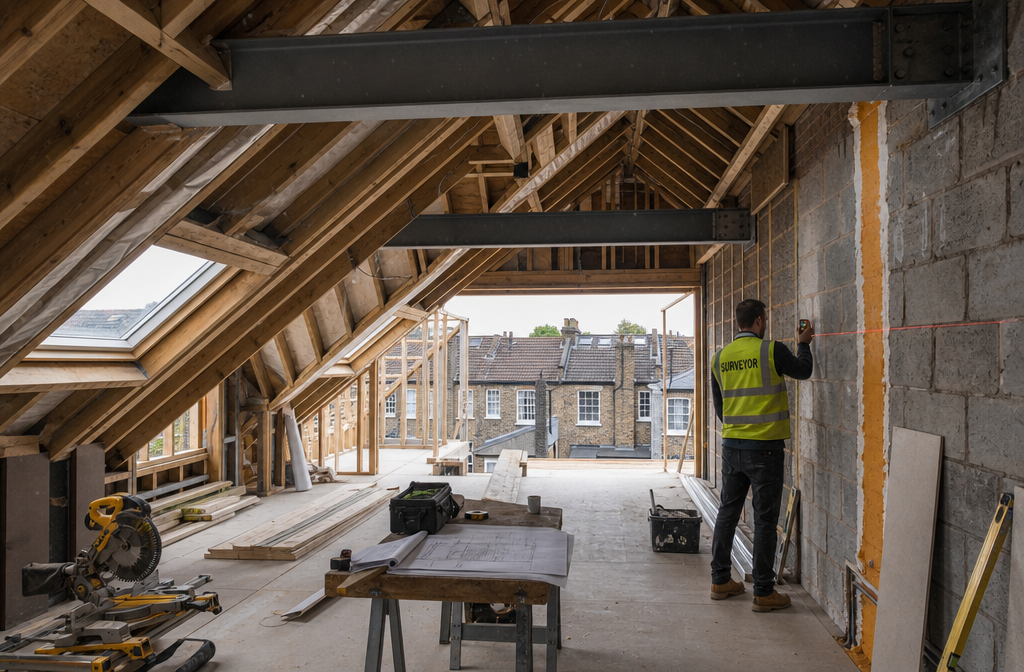
Loft conversions look less dramatic than basement digs, but they generate a surprisingly high volume of party wall disputes. The reasons are structural and procedural.
Common loft conversion risk hotspots in 2026:
- 🔴 Shared gable wall alterations — cutting into or loading onto a gable that is partly owned by the neighbour
- 🔴 Ridge beam installation — steel ridge beams often bear onto or very close to the party wall
- 🟠 Dormer construction — rear dormers can alter the load path through party walls
- 🟠 Roof light positioning — structural trimming near party wall junctions
- 🟡 Fire separation — upgrading to 60-minute fire resistance can require works to the shared wall
- 🟡 Joist notching — floor joists bearing into party walls being cut or repositioned
The subtlety here is that many homeowners — and even some architects — do not realise that loading a new steel beam onto a party wall, or cutting into a shared gable, triggers the Act even if no visible "demolition" is taking place. Understanding when a party wall agreement is actually required is the first step to avoiding a dispute.
Practical Risk Hotspots Surveyors Are Seeing Most in 2026: The Schedule of Condition Imperative
The Schedule of Condition (SoC) is the document that records the pre-existing state of the adjoining owner's property before works begin. In theory, every party wall award should include one. In practice, the quality of SoCs varies enormously — and that variation is where disputes are won and lost.
What a Proper Schedule of Condition Must Cover
For basement projects, an adequate SoC in 2026 should include:
- Photographic record of all internal walls, floors, and ceilings within 6 metres of the excavation
- Crack monitoring data — existing cracks measured and documented with tell-tales or crack gauges
- Foundation survey — where accessible, the depth and condition of the adjoining owner's foundations
- Drainage survey — CCTV drainage report to establish pre-existing condition of shared drains
- External elevations — full photographic record of brickwork, pointing, and render
For loft conversions, the SoC should specifically capture:
- Roof structure condition at the party wall junction — including any existing defects in the shared gable
- Ceiling and plaster condition in the rooms directly below the party wall
- Internal wall surfaces adjacent to the party wall on both sides
- Chimney breast condition if the party wall includes a shared chimney stack
⚠️ Critical point: Without a thorough SoC, any crack or damage that appears during or after works becomes a "he said, she said" dispute. With a proper SoC, the surveyor can determine with confidence whether damage is attributable to the works or was pre-existing.
The 2026 Pattern: Inadequate SoCs Are Driving Dispute Volumes
Surveyors across London and other dense UK cities are reporting a consistent pattern: disputes that could have been resolved quickly are dragging on because the original SoC was superficial. Common failures include:
- SoCs prepared from external inspection only, missing internal crack evidence
- No drainage survey, leaving groundwater damage claims unresolvable
- Photographs taken in poor light or at low resolution
- No crack monitoring baseline, making settlement claims impossible to assess
The solution is straightforward: commission a detailed SoC as a standalone document, prepared by an independent surveyor with no financial interest in minimising the scope of the record.
How Party Wall Procedures Should Be Tailored: Basements vs Lofts
The Party Wall Act 1996 applies differently depending on the nature of the works. Understanding which sections apply — and in what combination — is essential for both building owners and adjoining owners.
Basement Conversion: The Multi-Notice Scenario
Most basement conversions trigger multiple notice types simultaneously:
- Section 3 Notice — if the party wall itself is being cut into, underpinned, or structurally altered
- Section 6 Notice — for any excavation within 3 metres (or 6 metres) of the adjoining owner's foundations
This creates a procedural complexity that catches many building owners off guard. Both notices must be served correctly, and the adjoining owner has the right to appoint their own surveyor for each. The cost of a party wall surveyor for a basement project is therefore typically higher than for simpler works — often significantly so when two surveyors are appointed.
Practical tip: Serve notices early and include structural drawings with the notice. Adjoining owners who receive clear, professionally prepared notices with supporting information are far more likely to consent promptly. Vague notices generate objections.
Loft Conversion: Getting the Notice Type Right
For loft conversions, the most common error is serving only a Section 3 Notice (party structure notice) when the works also affect the line of junction or the adjoining owner's roof structure. Surveyors in 2026 are seeing a rise in awards being challenged because the original notice failed to describe the full scope of works.
Key procedural checklist for loft conversions:
- ✅ Confirm whether the gable wall is a party wall or a party fence wall — the distinction affects which sections apply
- ✅ Check whether the ridge beam bears onto or into the party wall
- ✅ Confirm fire separation requirements and whether these require works to the shared wall
- ✅ Serve notice at least one month before works begin (two months for basement works)
- ✅ Include structural engineer's drawings with the notice
The Agreed Surveyor Option
Where the relationship between neighbours is good, an agreed surveyor — a single surveyor appointed by both parties — can significantly reduce the cost and time of the party wall process. For straightforward loft conversions, this is often the most practical route. For complex basement projects, the risk profiles are usually too divergent for a single surveyor to serve both parties effectively, and separate appointments are advisable.
For those seeking professional guidance, a party wall agreement surveyor in London can advise on the most appropriate appointment structure for a specific project.
Neighbour Relations and the Practical Reality of 2026 Disputes
Beyond the technical and procedural dimensions, party wall disputes in 2026 are increasingly shaped by neighbour relations dynamics that experienced surveyors are learning to navigate carefully.
The "Consent but Complain" Pattern
One of the most common patterns seen in London terraces and semi-detached properties is the adjoining owner who consents to the works initially but then raises damage claims during or after construction. This pattern is particularly common in:
- Properties with elderly residents who may not fully understand the implications of consent
- Rental properties where tenants notice damage that landlord-owners later dispute
- High-value areas where the financial incentive to claim is significant
The protection against this pattern is a robust party wall award that clearly defines the permitted works, the hours of working, the dust and vibration management requirements, and — critically — the dispute resolution mechanism if damage occurs.
Vibration and Noise: The Underrated Risk Hotspot
Vibration monitoring is becoming standard practice on basement projects in 2026, but it remains underused on loft conversions. The reality is that percussive work on a party wall — whether breaking out concrete, installing joist hangers, or drilling for structural fixings — generates vibration that can crack plaster, loosen render, and disturb pre-existing settlement cracks in the adjoining property.
Recommended vibration management measures:
- Install vibration monitors on the party wall before works begin
- Set peak particle velocity (PPV) limits in the party wall award
- Require the contractor to use lower-vibration methods where limits are approached
- Document all vibration readings and make them available to the adjoining owner
For those concerned about neighbour disputes arising from construction works, early engagement with a qualified surveyor is the most effective preventive measure available.
Choosing the Right Surveyor for High-Risk Projects
Not all party wall surveyors have equal experience with basement and loft conversion risk profiles. In 2026, the complexity of these projects — particularly in London's dense Victorian housing stock — means that surveyor selection is itself a risk management decision.
What to look for in a surveyor for basement or loft work:
| Criterion | Why It Matters |
|---|---|
| Structural engineering knowledge | Basement underpinning requires understanding of foundation behaviour |
| Local ground condition experience | Clay soils in London behave differently from chalk or gravel |
| SoC preparation track record | Quality of SoC directly affects dispute outcomes |
| Experience with multi-notice projects | Basement projects often require coordinated Section 3 and Section 6 notices |
| Dispute resolution experience | If things go wrong, an experienced surveyor resolves issues faster |
Understanding what a surveyor actually does and the scope of their responsibilities helps building owners and adjoining owners make better-informed choices about who to appoint.
For those comparing survey options or unsure about the level of survey appropriate for their situation, resources on choosing the right home survey can provide useful context.
Conclusion: Actionable Next Steps for Building Owners and Neighbours
Party Wall Surveys for Basement and Loft Conversions: Practical Risk Hotspots Surveyors Are Seeing Most in 2026 represent a concentrated set of structural, procedural, and relational challenges that are entirely manageable — but only with the right preparation.
Here are the concrete steps to take before any basement or loft project begins:
-
Engage a party wall surveyor at design stage — not after planning permission is granted. Early input can redesign out the most expensive risk hotspots before they are built in.
-
Serve notices correctly and on time — use the correct notice type, include structural drawings, and give proper notice periods (two months for basement works, one month for loft works affecting the party wall).
-
Commission a comprehensive Schedule of Condition — cover all rooms within the zone of influence, include drainage surveys for basement projects, and ensure photographic quality is high.
-
Build vibration monitoring into the contract — for basement projects especially, this is no longer optional in responsible practice.
-
Maintain neighbour communication throughout — a surveyor who facilitates good communication between building owners and adjoining owners prevents the majority of disputes before they start.
-
Understand the costs upfront — reviewing party wall surveyor fees before appointing ensures there are no surprises and that the budget reflects the true complexity of the project.
The risk hotspots described in this article are not inevitable. They are predictable — and predictable risks can be managed. The building owners and adjoining owners who navigate basement and loft conversions most successfully in 2026 are those who treat the party wall process not as a bureaucratic hurdle, but as the structural and legal safety net it was designed to be.