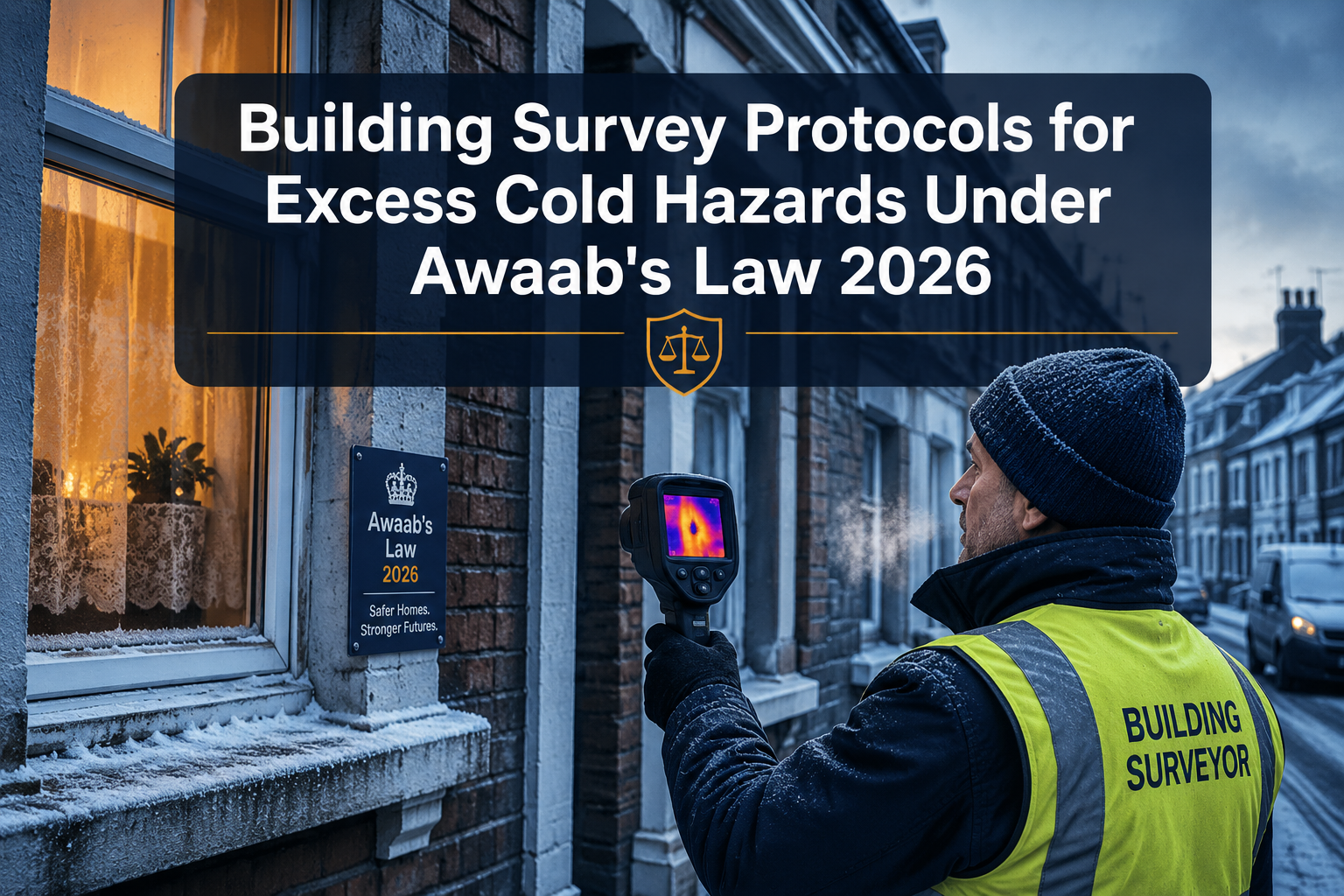
Cold homes kill. In England alone, an estimated 10,000 excess winter deaths per year are attributable to living in cold, poorly insulated housing — a figure that has driven legislators to act with unprecedented urgency. From 2026, Building Survey Protocols for Excess Cold Hazards Under Awaab's Law 2026: Insulation and Heating Assessments become a legal compliance requirement for social landlords, with private rented sector (PRS) expansion firmly on the horizon [8]. For building surveyors, this is not a minor regulatory update — it is a fundamental shift in how thermal performance deficiencies must be identified, documented, and remediated.
Key Takeaways 📋
- From 2026, Awaab's Law Phase 2 extends legally enforceable repair timeframes to excess cold hazards, requiring landlords to investigate within 10 working days and complete safety works within 5 working days of investigation [8].
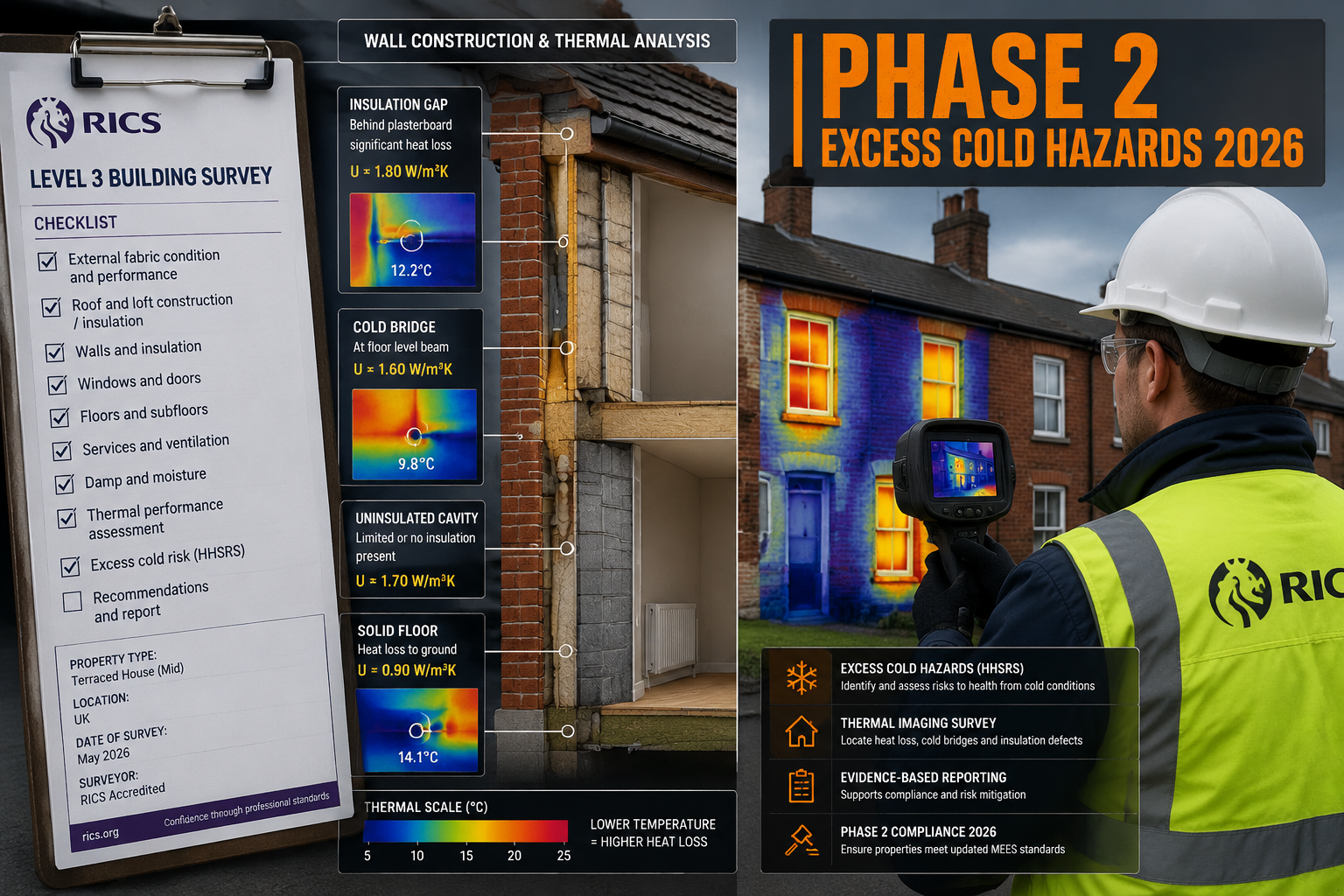
- RICS Level 3 surveys are the appropriate framework for excess cold assessments, incorporating thermal imaging, U-value analysis, and HHSRS scoring.
- Thermal bridging, inadequate insulation, and heating system failures are the three primary defect categories surveyors must systematically assess.
- Written investigation summaries must be provided to tenants within 3 working days after investigation — meaning survey reports must be structured for rapid, clear communication [8].
- Surveyors working across London and the South East should align protocols with both RICS 2nd Edition guidance and emerging whole-life carbon obligations.
What Awaab's Law 2026 Means for Excess Cold Hazards
Awaab's Law — named after two-year-old Awaab Ishak, who died in 2020 following prolonged exposure to mould in a Rochdale social housing flat — was initially enacted to address damp and mould hazards. The legislation has since evolved into a phased regulatory framework with far broader reach [1].
Phase 2, effective from 2026, extends the law's enforceable repair obligations to include excess cold and excess heat, structural collapse, fire, electrical hazards, falls, and domestic hygiene risks — wherever these present a significant risk of harm under the Housing Health and Safety Rating System (HHSRS) [8]. A further Phase 3 in 2027 will capture all remaining HHSRS hazards (except overcrowding) [7].
💬 "Excess cold is no longer just a comfort issue — from 2026, it is a legally actionable safety hazard with the same enforcement weight as gas leaks or dangerous electrics." [5]
For surveyors engaged in property condition assessments across the social and private rented sectors, this means excess cold deficiencies identified during a building inspection now carry direct legal consequences for landlords if not remediated within statutory timeframes.
The Statutory Repair Timeframes Surveyors Must Support
| Hazard Type | Investigation Deadline | Written Summary to Tenant | Safety Works Completion | Long-Term Works Start |
|---|---|---|---|---|
| Significant hazard (incl. excess cold from 2026) | 10 working days | 3 working days post-investigation | 5 working days post-investigation | Within 12 weeks |
| Emergency hazard (imminent risk of harm) | As soon as practicable / within 24 hours | N/A — immediate action required | Within 24 hours | N/A |
Source: UK Government Awaab's Law Guidance for Social Landlords [8]
These timeframes mean that survey reports must be actionable, clearly structured, and defect-specific — not generic condition overviews. Surveyors must understand that their documentation directly enables or delays a landlord's legal compliance.
Core Building Survey Protocols for Excess Cold Hazards Under Awaab's Law 2026: Insulation and Heating Assessments
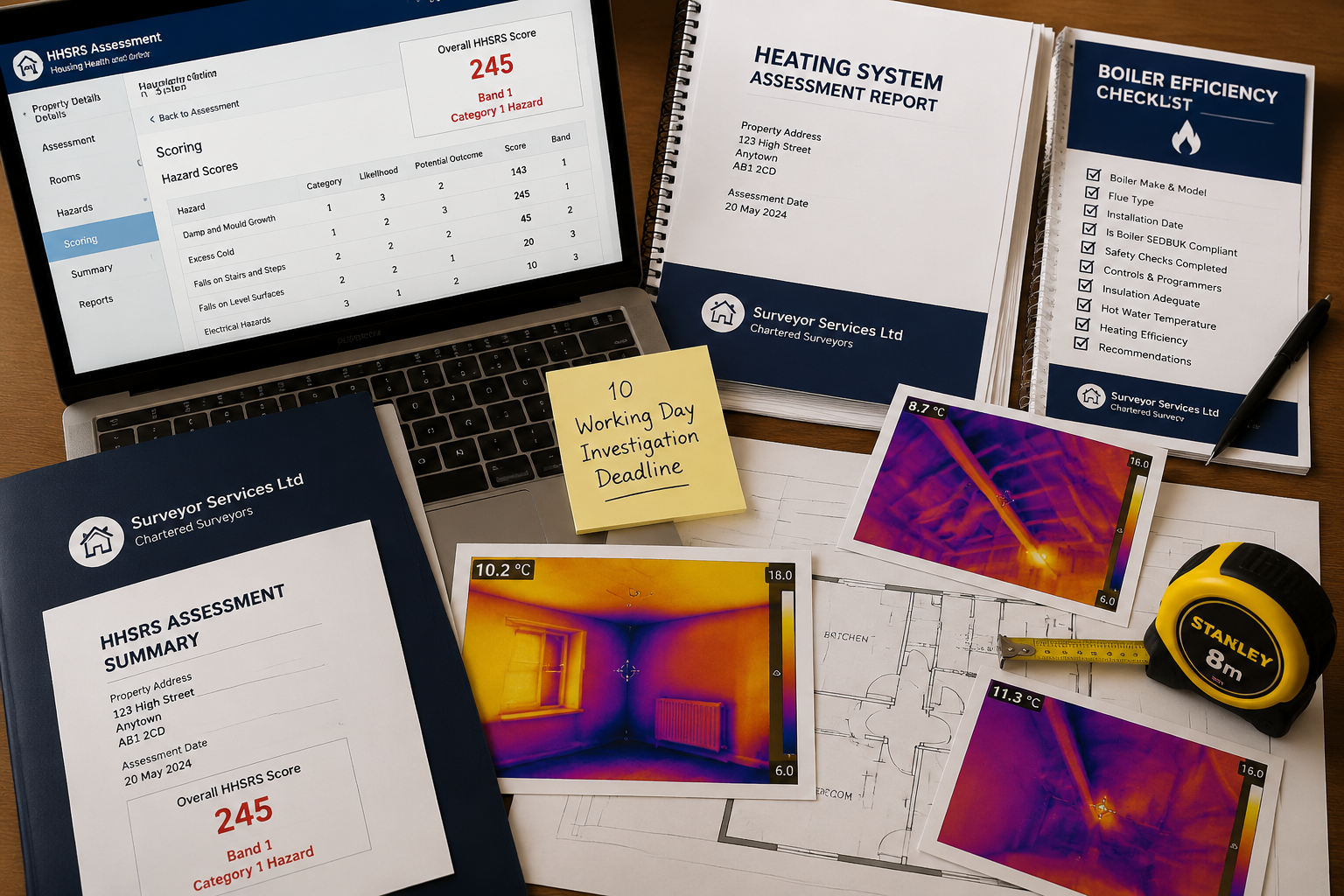
A robust survey protocol for excess cold hazards integrates three distinct assessment streams: fabric performance (insulation), heating system adequacy, and HHSRS scoring methodology. The RICS Home Survey Standard 2nd Edition provides the technical baseline, while Awaab's Law imposes the legal urgency.
Stream 1: Fabric Performance and Insulation Assessment 🏠
Thermal fabric deficiencies are the most common root cause of excess cold hazards in UK housing stock. A Level 3 survey checklist should systematically address:
Walls and Cavity Insulation
- Visual inspection for cavity wall insulation (CWI) — check for drill hole evidence, borescope access where possible
- Assessment of solid wall construction for internal or external insulation presence
- Identification of cold bridges at wall-floor junctions, window reveals, and structural elements
- U-value estimation using construction type and age data (cross-referenced against CIBSE Guide A benchmarks)
Roof and Loft Insulation
- Loft access inspection: measure insulation depth (minimum 270mm mineral wool recommended under current Building Regulations)
- Check for gaps, compression, or displacement of insulation material
- Assess flat roof constructions for warm or cold deck configuration
- Note any uninsulated service penetrations or hatch surrounds
Windows and Glazing
- Identify single, double, or triple glazing by frame type and age
- Check for failed sealed units (condensation between panes)
- Assess draught-proofing condition at frames and thresholds
Floors
- Identify suspended timber floors and check for sub-floor ventilation vs. insulation conflict
- Assess solid ground floors for insulation presence (typically absent in pre-1990 stock)
Thermal Imaging Integration 🌡️
Thermal imaging cameras are now considered best practice for excess cold surveys under RICS 2nd Edition guidance. When conditions are appropriate (minimum 10°C differential between internal and external temperatures), surveyors should:
- Capture thermographic images of all external-facing walls, floor-wall junctions, and ceiling-wall junctions
- Document cold bridge locations with GPS-tagged imagery
- Include thermal images directly within the survey report as evidential exhibits
This is particularly important for moisture damage assessments where cold surfaces drive interstitial condensation — a secondary consequence of excess cold that Awaab's Law also captures under its damp and mould provisions [2].
Stream 2: Heating System Adequacy Assessment 🔥
An excess cold hazard under HHSRS is not solely a fabric issue. Heating system failures — whether through inadequate output, unreliable operation, or unaffordable running costs — are equally actionable. The Level 3 checklist should cover:
Boiler and Primary Heat Source
- Age, make, and model of boiler (cross-reference with manufacturer's expected lifespan — typically 15 years)
- Boiler efficiency rating (ErP label or SEDBUK rating) — flag any system below Band C
- Evidence of recent servicing (Gas Safe certificate, service record)
- Assess flue condition and combustion ventilation adequacy
Heat Distribution
- Radiator sizing: calculate approximate output (kW) relative to room volume — flag undersized radiators in bedrooms and living rooms
- Check TRV (thermostatic radiator valve) presence and operation
- Assess pipework insulation in unheated voids (lofts, underfloor spaces)
Controls and Programmability
- Presence of room thermostat and programmer/timer
- Smart thermostat compatibility (relevant for fuel poverty assessment)
- Assess whether controls allow adequate zoning for vulnerable occupants
Fuel Poverty Risk Indicators
- Estimate annual heating costs using EPC data or SAP calculation
- Flag properties where heating costs exceed 10% of estimated household income (standard fuel poverty threshold)
- Note any pre-payment meter arrangements that may restrict heating access
Surveyors conducting building inspections in older London housing stock — particularly pre-1919 terraced properties common in areas like Hackney or Camberwell — will frequently encounter combinations of solid wall construction, single glazing, and ageing boilers that together produce HHSRS excess cold scores well above the Category 1 threshold.
Stream 3: HHSRS Scoring for Excess Cold 📊
The HHSRS excess cold hazard profile uses a likelihood × spread of harm × severity formula. Surveyors must:
- Identify the deficiency: Document specific fabric and heating failures that reduce indoor temperature below 18°C in living areas and 16°C in bedrooms (WHO minimum thresholds)
- Assess likelihood: Consider occupancy patterns, heating affordability, and building fabric condition
- Score the hazard: Calculate the hazard score and determine Category 1 (score ≥1000) or Category 2 status
- Record the most vulnerable likely occupant: HHSRS scoring is calibrated to the most vulnerable person likely to occupy the dwelling — typically elderly residents, infants, or those with respiratory conditions
A Category 1 excess cold hazard triggers mandatory enforcement action by the local housing authority from 2026 under Awaab's Law provisions [3].
Reporting Standards and Compliance Documentation Under Awaab's Law 2026
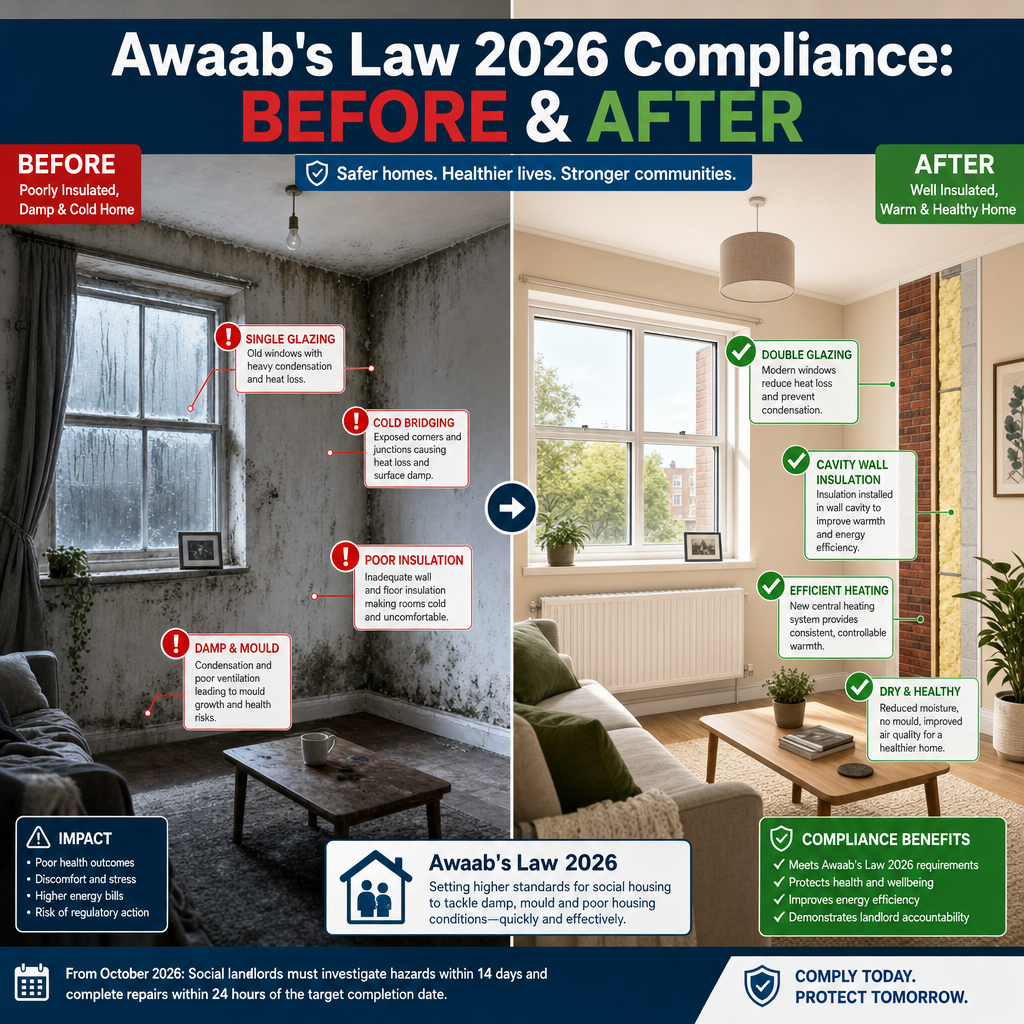
The legal timeframes imposed by Awaab's Law place new demands on how building surveyors structure and deliver their reports. A survey report that takes three weeks to produce is incompatible with a 10-working-day investigation deadline.
Structuring the Survey Report for Legal Compliance
Reports for excess cold hazard assessments should follow a tiered defect structure:
Tier 1 — Safety-Critical Defects (Immediate Action)
- Defects that could constitute an emergency hazard (e.g., total boiler failure in winter, no heating in a property with vulnerable occupants)
- Must be flagged in a standalone summary section at the front of the report
- Recommend landlord notification within 24 hours of survey completion
Tier 2 — Significant Hazard Defects (10-Working-Day Investigation)
- Category 1 HHSRS excess cold findings
- Specific insulation failures, heating inadequacies, or cold bridge patterns
- Include photographic and thermographic evidence
- Provide a prioritised schedule of works with indicative costs
Tier 3 — Improvement Recommendations (12-Week Programme)
- Category 2 HHSRS findings and general thermal performance improvements
- Whole-life carbon considerations aligned with RICS 2nd Edition guidance
- Retrofit sequencing advice (e.g., insulate before upgrading heating system)
Whole-Life Carbon and Retrofit Sequencing 🌱
RICS 2nd Edition guidance increasingly requires surveyors to consider whole-life carbon implications of recommended remediation works. For excess cold hazards, this means:
- Prioritising fabric-first approaches (insulation, air-tightness) before recommending heating system upgrades
- Flagging compatibility of existing heating systems with future heat pump installation
- Noting any EPC improvement potential and its relationship to the property's pathway to EPC Band C (the proposed minimum standard for PRS properties)
This integrated approach ensures that Awaab's Law compliance works in concert with — rather than against — the UK's broader net-zero housing agenda.
Documentation Checklist for Awaab's Law Compliance ✅
- HHSRS excess cold hazard score calculated and recorded
- Thermal imaging survey conducted (where temperature differential permits)
- Heating system age, efficiency, and output assessed
- Insulation depths and U-values estimated for all building elements
- Fuel poverty risk assessment completed
- Tiered defect report produced with clear timelines
- Written summary suitable for tenant communication prepared
- Whole-life carbon and retrofit sequencing notes included
Surveyors working in Westminster, Ealing, or other high-density London boroughs with significant social housing stock should ensure their reporting templates are updated to reflect these requirements before the Phase 2 commencement date [4].
Practical Considerations for Surveyors in 2026
Adapting Existing Level 3 Survey Frameworks
Surveyors already delivering RICS Level 3 structural surveys will find that many excess cold assessment components are already embedded within their existing methodology. The key adaptations required are:
- Formalising HHSRS scoring as a mandatory output (not an optional addendum)
- Integrating thermal imaging as standard rather than an additional service
- Restructuring reports to front-load safety-critical findings with explicit Awaab's Law compliance language
- Training on fuel poverty indicators and their relationship to hazard likelihood scoring
Common Defect Patterns in UK Rental Stock
Based on typical building stock characteristics, the following defect combinations most frequently produce Category 1 excess cold scores:
| Property Type | Common Defects | Typical HHSRS Risk |
|---|---|---|
| Pre-1919 solid wall terrace | No wall insulation, single glazing, ageing boiler | High — Category 1 likely |
| 1930s–1960s cavity wall (unfilled) | Unfilled cavity, poor loft insulation, older controls | Medium-High |
| 1960s–1980s system-built flat | Thermal bridging at panel joints, district heating issues | High in top-floor/corner units |
| Post-1990 stock | Generally lower risk, but check for failed CWI or boiler age | Low-Medium |
Working with Landlords and Housing Associations
From 2026, landlords who receive a survey report identifying a significant excess cold hazard are legally obligated to act within the statutory timeframes [5]. Surveyors should:
- Communicate urgency clearly — avoid passive language in defect descriptions
- Provide a works specification alongside the survey report where possible, to accelerate the landlord's response
- Retain copies of all reports and correspondence — these may become evidence in enforcement proceedings or tribunal cases [9]
💬 "A survey report that clearly evidences an excess cold hazard and its likely cause is the single most important document in a landlord's compliance chain under Awaab's Law." [3]
Conclusion: Actionable Next Steps for Surveyors in 2026
Building Survey Protocols for Excess Cold Hazards Under Awaab's Law 2026: Insulation and Heating Assessments represent a genuine step-change in the legal weight attached to thermal performance deficiencies in rented housing. The days of noting "inadequate heating" as a minor observation are over.
Here are the immediate actions every surveyor should take:
- Update survey templates to include formal HHSRS excess cold scoring, tiered defect reporting, and Awaab's Law compliance language before Phase 2 takes effect.
- Invest in or access thermal imaging equipment — thermographic surveys are now a professional expectation, not an optional extra, for excess cold assessments.
- Review reporting turnaround times — ensure internal processes allow for rapid report delivery compatible with the 10-working-day investigation window.
- Engage with CPD on RICS 2nd Edition and HHSRS methodology — particularly the interaction between excess cold scoring, fuel poverty, and whole-life carbon obligations.
- Communicate proactively with landlord clients about the new legal landscape — many will be unaware of the Phase 2 expansion and will rely on their surveyor for guidance.
For landlords and property managers seeking expert support, working with qualified professional surveyor services that understand both the technical and legal dimensions of Awaab's Law compliance is no longer optional — it is essential risk management.
References
[1] Awaabs Law Explained – https://firntec.com/blog/awaabs-law-explained
[2] Excess Temperature Hazards – https://wimbledonsurveyors.com/tag/excess-temperature-hazards/
[3] Awaabs Law Is Here The Surveyors Guide For Compliance – https://www.surventrix.com/blog/awaabs-law-is-here-the-surveyors-guide-for-compliance
[4] Party Wall Surveys For Excess Cold Hazards Under Awaabs Law 2026 Surveyor Protocols For Insulation Defects And Valuation Adjustments In PRS Properties – https://nottinghillsurveyors.com/blog/party-wall-surveys-for-excess-cold-hazards-under-awaabs-law-2026-surveyor-protocols-for-insulation-defects-and-valuation-adjustments-in-prs-properties
[5] Awaabs Law 2026 Social Landlords Housing Associations – https://www.villageheating.co.uk/awaabs-law-2026-social-landlords-housing-associations/
[7] Part 3 Awaabs Law 2027 Full Compliance All Housing Hazards – https://www.linkedin.com/pulse/part-3-awaabs-law-2027-full-compliance-all-housing-hazards-duncan-dgtce
[8] Awaabs Law Guidance For Social Landlords Timeframes For Repairs In The Social Rented Sector – https://www.gov.uk/government/publications/awaabs-law-guidance-for-social-landlords/awaabs-law-guidance-for-social-landlords-timeframes-for-repairs-in-the-social-rented-sector
[9] Excess Cold And Structural Collapse Hazards In Awaabs Law 2026 Party Wall Survey Safeguards For PRS Extensions – https://www.canterburysurveyors.com/blog/excess-cold-and-structural-collapse-hazards-in-awaabs-law-2026-party-wall-survey-safeguards-for-prs-extensions/