{"cover":"Professional landscape format (1536×1024) hero image with bold text overlay: 'Level 3 Building Surveys for Passivhaus & Fabric-First Retrofits: Detecting Defects in 2026' in extra large 70pt white bold sans-serif font with dark semi-transparent overlay box, centered upper third. Background shows a RICS chartered surveyor in hi-vis vest using a thermal imaging camera on the exterior wall of a modern Passivhaus-standard home with visible external wall insulation boards, airtightness membrane, and triple-glazed windows. Color palette: deep slate blue, white, and lime green accents. Editorial magazine cover quality, high contrast, sharp architectural photography style.","content":["Detailed landscape format (1536×1024) illustration showing a cross-section cutaway diagram of a fabric-first retrofit wall build-up: external wall insulation, airtightness membrane, service cavity, and internal plasterboard layers, with red thermal anomaly hotspots highlighted at junctions and penetrations. A RICS Level 3 surveyor holds a clipboard checklist in the foreground. Color scheme: technical blueprint blue with warm red thermal anomaly highlights, white annotation labels. Clean infographic style, educational, professional.","Detailed landscape format (1536×1024) image showing a professional building surveyor using a handheld blower door test kit and thermal imaging camera inside a Passivhaus retrofit property, with a large digital display showing air permeability readings and a colour-coded thermographic scan of a wall revealing cold bridging at a window reveal. Equipment labels visible. Color palette: cool grey, orange thermal gradient, white. Realistic editorial photography style, sharp focus on instrumentation.","Detailed landscape format (1536×1024) overhead drone perspective of a row of Victorian terraced houses mid-retrofit in London, showing varying stages of external wall insulation installation, some with completed render finish and others with exposed insulation boards and airtightness tape at junctions. One property has a surveyor on a scaffold platform inspecting a parapet detail. Color palette: warm brick red, grey insulation board tones, overcast British sky. Aerial editorial photography style, high detail."]
Roughly 80% of the homes that will exist in the UK in 2050 have already been built — and the vast majority fall far short of modern energy performance standards. That single fact explains why fabric-first retrofits and Passivhaus-standard upgrades have moved from niche ambition to mainstream construction activity in 2026. It also explains why Level 3 Building Surveys for Passivhaus and Fabric-First Retrofits: Detecting Defects in 2026 Energy Efficiency Upgrades have become one of the most technically demanding services a chartered surveyor can deliver.
Where a standard structural survey once focused on damp, cracks, and roof condition, today's high-performance retrofit environment demands a far more granular checklist — one that interrogates airtightness membranes, thermal bridging at junctions, vapour control layers, and mechanical ventilation systems. Miss a defect in any one of these elements and the energy savings promised by the retrofit can evaporate, along with the occupant's comfort and the property's resale value.
This article examines what a properly scoped Level 3 survey looks like when applied to low-carbon retrofits, which defects are most commonly missed, and how 2026 diagnostic technology is raising the bar for surveyors working to RICS sustainability standards.
Key Takeaways
- A Level 3 Building Survey is the only survey type with sufficient scope to assess the complex build-ups found in Passivhaus and fabric-first retrofits.
- Airtightness failures and thermal bridging at junctions are the two most frequently overlooked defect categories in energy efficiency upgrades.
- Thermal imaging, blower door testing, and automated fault detection diagnostics are now standard tools in high-quality Level 3 surveys for retrofitted properties.
- RICS sustainability guidance requires surveyors to comment on energy performance evidence, not just structural condition.
- Identifying defects before purchase or at practical completion protects buyers from hidden remediation costs that can run into tens of thousands of pounds.
Why Standard Surveys Fall Short on Fabric-First Retrofits
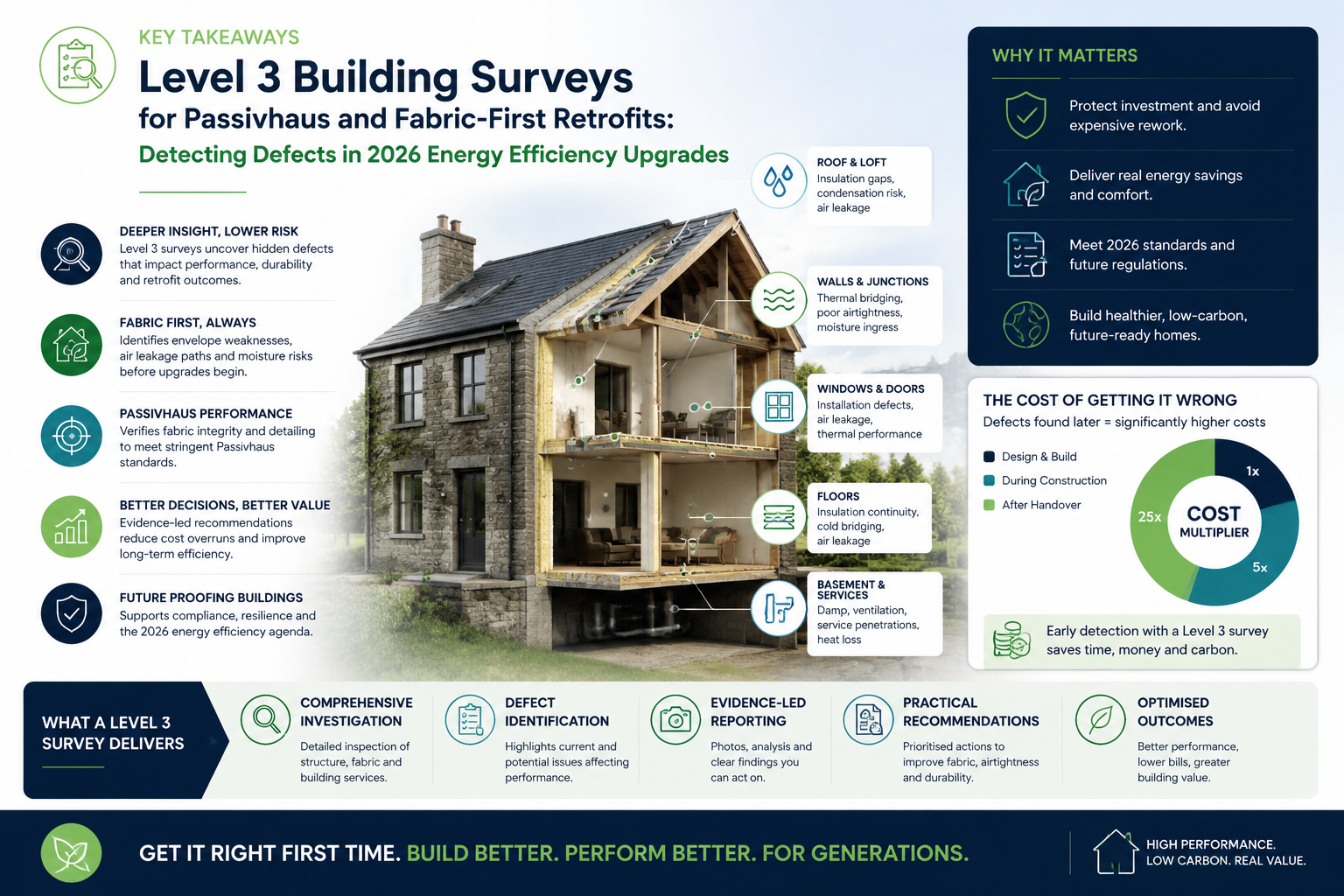
A Level 2 HomeBuyer Report was never designed for a property wrapped in 200mm of external wall insulation with a mechanical ventilation and heat recovery (MVHR) system threaded through its ceiling voids. Understanding the key difference between a Level 2 and Level 3 survey makes this clear: a Level 2 report provides a condition rating and flags visible defects, while a Level 3 survey delivers a full structural and fabric analysis with detailed advice on repairs, maintenance, and likely costs [4].
For retrofitted properties, that distinction is critical. Fabric-first upgrades alter the fundamental physics of a building. They change where moisture condenses within a wall, how air moves through the structure, and how heat is lost or gained at junctions between different materials. A surveyor who applies a standard checklist to a deep retrofit risks missing the defects that matter most.
The Passivhaus Standard and What It Demands of Surveyors
The Passivhaus standard sets demanding targets: air permeability of no more than 0.6 air changes per hour at 50 Pascals (ACH50), specific heating demand below 15 kWh/m2/year, and elimination of thermal bridges at all junctions. EnerPHit — the Passivhaus retrofit standard — allows slightly relaxed targets to reflect the constraints of working with existing structures, but the principles remain the same.
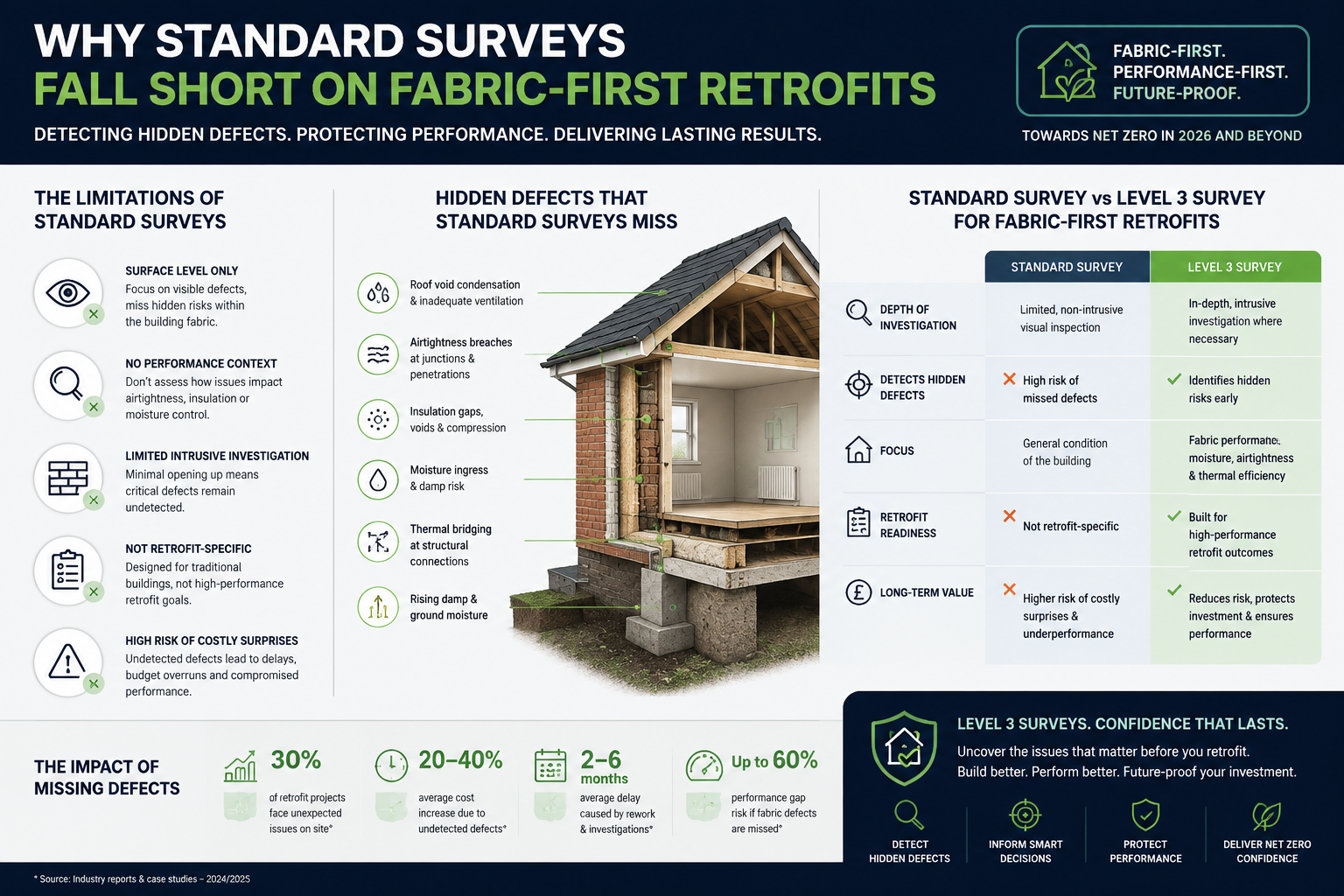
When a property is marketed as meeting EnerPHit or Passivhaus criteria, a Level 3 survey must verify that the construction evidence supports those claims. This means examining:
- Airtightness layer continuity — Is the membrane intact and correctly lapped at all penetrations, junctions, and service entries?
- Insulation installation quality — Are boards fully bonded, correctly butted, and free from voids or compression?
- Thermal bridge details — Have window reveals, roof-wall junctions, and floor-wall junctions been treated to eliminate cold bridges?
- MVHR commissioning records — Has the system been balanced and tested to design flow rates?
- Vapour control layer position — Is it correctly placed on the warm side of insulation to prevent interstitial condensation?
Each of these elements requires a surveyor with specific knowledge of low-carbon construction, not just general building pathology.
The Level 3 Survey Checklist for Detecting Defects in 2026 Energy Efficiency Upgrades
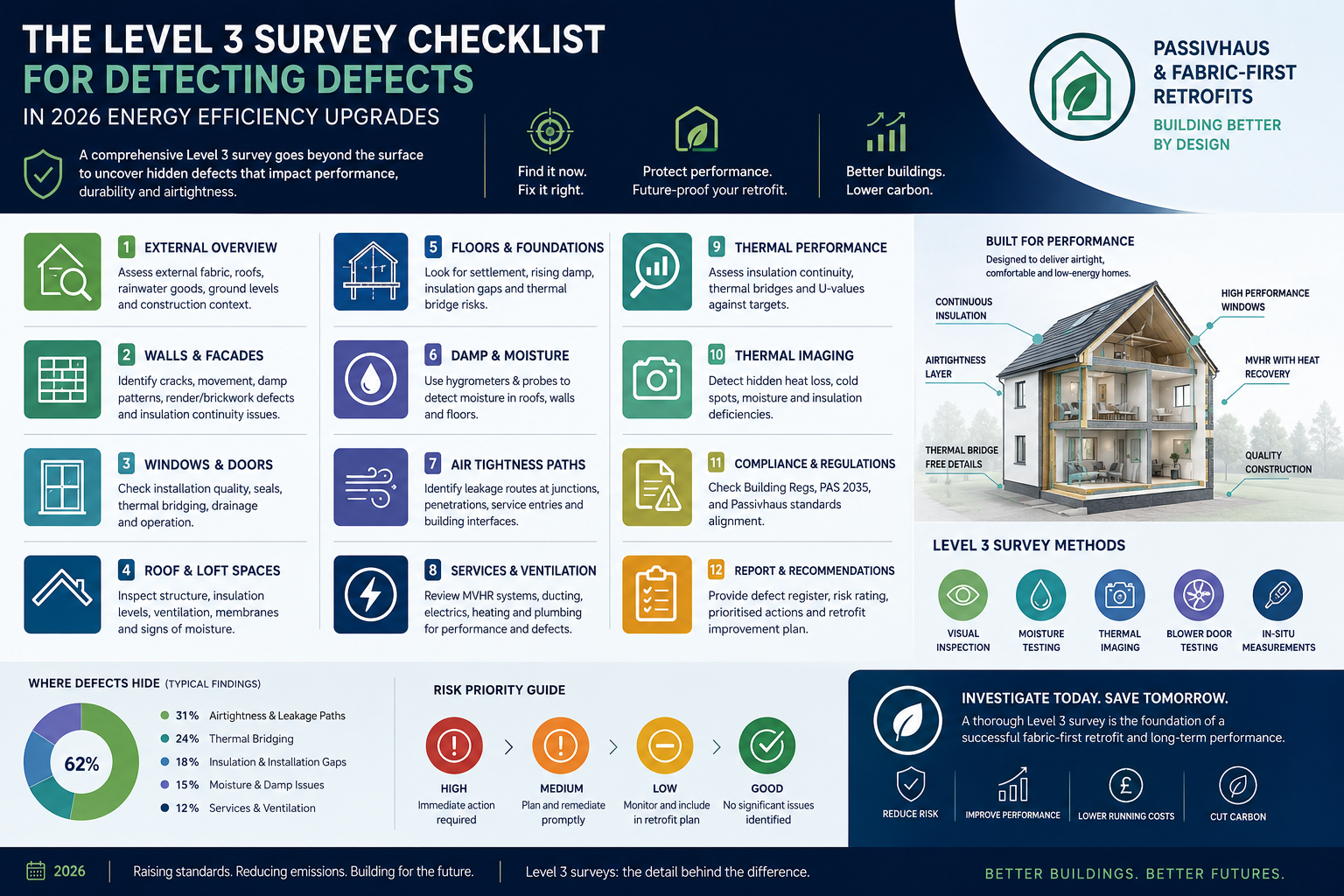
Level 3 Building Surveys for Passivhaus and Fabric-First Retrofits: Detecting Defects in 2026 Energy Efficiency Upgrades require a structured checklist that goes well beyond the standard roof-to-foundations walkthrough. The following table sets out the key inspection zones and the defects most commonly found in each.
| Inspection Zone | Common Defects in Retrofits | Diagnostic Method |
|---|---|---|
| External wall insulation (EWI) | Delamination, impact damage, missing render, voids behind boards | Visual, thermal imaging |
| Airtightness membrane | Tears, unsealed penetrations, failed tape at junctions | Blower door test, thermal imaging |
| Windows and doors | Cold bridging at reveals, failed triple-glazed units, inadequate airtight seals | Thermal imaging, visual |
| Roof-wall junction | Thermal bridge, discontinuous insulation, membrane lap failures | Thermal imaging, probe |
| Floor-wall junction | Cold bridge, missing perimeter insulation, damp ingress | Thermal imaging, moisture meter |
| MVHR system | Blocked filters, unbalanced flows, condensate drainage failure | Commissioning records, flow meter |
| Vapour control layer | Wrong position, punctures, missing at service penetrations | Visual, moisture monitoring |
| Roof insulation | Compression, voids, wind-washing at eaves | Visual, thermal imaging |
Thermal Imaging: The Surveyor's Most Powerful Tool in 2026
Thermal imaging has become indispensable for Level 3 surveys on retrofitted properties. The technology detects surface temperature variations that reveal hidden heat loss, moisture ingress, and airtightness failures that are invisible to the naked eye [3]. In 2026, the resolution and sensitivity of handheld thermal cameras have improved significantly, allowing surveyors to identify cold bridges as narrow as a single fixing point through an insulation board.
The technique works best when there is a temperature differential of at least 10°C between inside and outside — a condition that is reliably met during a British winter. Surveyors carrying out Level 3 surveys on fabric-first retrofits should ideally schedule inspections during heating season and request that the property is heated to normal occupancy temperature for at least 24 hours beforehand.
Thermal imaging also reveals the presence and location of moisture within wall build-ups, complementing the damp survey investigations that form part of any comprehensive Level 3 assessment. Where thermal anomalies suggest moisture, a surveyor can follow up with a calibrated moisture meter or, where necessary, an invasive probe to confirm the diagnosis.
Blower Door Testing and Airtightness Verification
A blower door test is the definitive method for quantifying airtightness. It depressurises the building to 50 Pascals and measures the volume of air leaking in through the envelope. For Passivhaus properties, the target is 0.6 ACH50; for EnerPHit retrofits, 1.0 ACH50 is typically accepted.
Not all Level 3 surveyors carry blower door equipment, but those specialising in high-performance retrofits should either conduct the test themselves or commission a specialist air permeability tester as part of the survey scope. The results tell a buyer or building owner whether the airtightness layer is performing as designed — or whether the energy savings projected in the Energy Performance Certificate (EPC) are simply not being achieved.
Where a blower door test reveals elevated air leakage, the surveyor should use simultaneous thermal imaging to locate the specific failure points. This combination of pressurisation and thermal scanning is the most efficient diagnostic method available in 2026 and directly informs the remediation specification that should accompany any Level 3 report on a retrofitted property [9].
Automated Fault Detection and Smart Diagnostics
The U.S. Department of Energy's work on Automated Fault Detection and Diagnostics (AFDD) demonstrates how algorithms can identify deviations from normal building system operation and diagnose their causes, significantly reducing the time required to locate faults [8]. In 2026, similar principles are being applied to building fabric monitoring, with sensors embedded in retrofit assemblies capable of tracking temperature, relative humidity, and moisture content at critical points within wall and roof build-ups.
Where a property has been fitted with such a monitoring system, a Level 3 surveyor should request access to the data logs as part of the survey. Anomalies in the data — such as rising moisture content at a specific sensor location — can direct the surveyor's physical inspection to the most vulnerable areas of the fabric.
Predictive maintenance approaches, such as those developed for industrial motor systems [1], are increasingly being adapted for building fabric monitoring, offering the prospect of early warning systems that flag insulation degradation or airtightness deterioration before they cause significant damage.
RICS Sustainability Standards and the Surveyor's Duty of Care
RICS has been clear in its sustainability guidance that chartered surveyors have a professional obligation to consider energy performance as part of any building survey. For Level 3 surveys on properties that have undergone fabric-first retrofits or Passivhaus upgrades, this obligation is particularly acute.
The reasons to choose RICS-regulated surveyors are especially relevant here: RICS members are bound by professional standards that require them to report on matters that affect value and habitability, and a poorly executed retrofit that fails to deliver its promised energy performance clearly falls within that scope.
What RICS Guidance Requires Surveyors to Report
In the context of fabric-first retrofits, RICS guidance requires surveyors to:
- Comment on the existence and condition of any insulation, airtightness, or ventilation systems installed as part of an energy upgrade.
- Flag the absence of commissioning records for MVHR systems, airtightness test certificates, or thermal bridge calculations.
- Identify visible defects in the retrofit installation that may compromise energy performance or cause building pathology (such as interstitial condensation).
- Advise on further specialist investigations where the survey reveals anomalies that cannot be fully assessed by visual inspection alone.
- Reference the EPC and note where the surveyor's observations are inconsistent with the energy performance rating claimed.
This last point is increasingly important. An EPC is a modelled assessment based on inputs, not a measured performance certificate. A Level 3 survey that identifies significant airtightness failures or insulation voids is providing evidence that the actual energy performance of the property may be materially lower than the EPC suggests — information that is directly relevant to the buyer's decision.
Defects That Affect Value: The Negotiation Dimension
Identifying defects in a Passivhaus or fabric-first retrofit is not merely a technical exercise. It has direct financial consequences. Understanding the average price reduction achievable after a building survey is relevant here: a well-evidenced Level 3 report that quantifies the cost of remediation — whether that is re-taping airtightness membrane failures, replacing failed triple-glazed units, or rebalancing an MVHR system — gives a buyer a concrete basis for price negotiation.
Remediation costs for fabric defects in high-performance retrofits can be substantial. Re-doing a failed airtightness layer on a medium-sized terraced house can cost between £5,000 and £15,000 depending on the extent of the failure. Replacing a poorly installed EWI system on a semi-detached property can exceed £30,000. These are not minor snagging items; they are material defects that a Level 3 survey is specifically designed to identify.
For buyers who receive a report with significant findings, understanding what to do after a bad building survey report is an essential next step — whether that means renegotiating, requesting specialist investigations, or, in some cases, walking away.
Specific Defect Patterns in 2026 Fabric-First Retrofits
Experience from Level 3 surveys on retrofitted properties in 2026 reveals a set of recurring defect patterns. Surveyors and buyers should be aware of these high-risk areas.
External Wall Insulation Failures
EWI systems are only as good as their installation. Common defects include:
- Boards not fully bonded to the substrate, creating voids that allow convective heat loss and moisture accumulation.
- Missing or inadequate starter tracks at the base of the system, allowing moisture ingress and insect infestation.
- Render cracking at board joints, particularly where different board thicknesses meet or where movement joints have been omitted.
- Penetrations not made good — pipes, cables, and fixings that pass through the EWI without adequate airtight sealing.
Thermal imaging is highly effective at detecting bonding voids and thermal bridges through EWI systems, particularly when the external surface temperature is measured on a cold day with the heating on [3].
Internal Wall Insulation and Vapour Risk
Internal wall insulation (IWI) carries a higher risk of interstitial condensation than EWI because it moves the dew point into or near the original wall structure. Where IWI has been installed, a Level 3 survey should assess:
- Whether a vapour control layer has been installed on the warm (room) side of the insulation.
- Whether the original wall has adequate drying potential to the outside.
- Whether hygroscopic insulation materials (such as wood fibre or hemp) have been used appropriately.
- Whether the installation meets the requirements of BS 5250 (condensation risk assessment).
Failure to manage vapour in IWI systems is one of the most serious defects a Level 3 survey can identify, because the resulting interstitial condensation can cause structural timber decay, mould growth, and long-term fabric deterioration that is expensive to remediate.
Roof and Junction Details
The roof-wall junction is consistently one of the weakest points in a fabric-first retrofit. Surveyors are increasingly using drone technology to inspect parapet details, flat roof upstands, and eaves junctions that are inaccessible from ground level or scaffold [10]. Aerial inspection reveals:
- Discontinuities in the insulation layer at the roof perimeter.
- Airtightness membrane laps that have failed or been left untaped.
- Ponding water on flat roofs that indicates drainage failure.
- Chimney stacks that have not been thermally upgraded, creating significant cold bridges through an otherwise well-insulated roof.
Commissioning a Level 3 Survey for a Retrofitted Property: Practical Guidance
Buyers and owners considering a Level 3 survey on a Passivhaus or fabric-first retrofit property should take the following steps to ensure the survey delivers maximum value.
Before the survey:
- Request all available documentation from the seller: EPC, airtightness test certificate, thermal bridge calculations, MVHR commissioning report, EWI system installer warranty, and any monitoring data.
- Confirm that the surveyor has specific experience with high-performance retrofits and is familiar with Passivhaus and EnerPHit standards.
- Ask whether the surveyor will use thermal imaging as part of the inspection, and if so, whether the survey can be scheduled during heating season.
During the survey:
- Ensure the property is heated to normal occupancy temperature for at least 24 hours before the thermal imaging inspection.
- Request that the surveyor conducts or commissions a blower door test if airtightness is a key concern.
- Ask the surveyor to inspect the MVHR unit, check filter condition, and review commissioning records.
After the survey:
- Review the report's findings against the documentation provided by the seller.
- Where the survey identifies defects, obtain specialist contractor quotations for remediation before proceeding with the purchase.
- Use the report as the basis for price negotiation where material defects are identified.
For first-time buyers approaching a retrofitted property, understanding the full scope of what a building survey covers is essential — the first-time buyer's guide to booking a building survey provides a useful starting point before engaging a specialist surveyor.
Buyers who are uncertain whether a Level 2 or Level 3 survey is appropriate for a retrofitted property should consult a guide to choosing the right home survey level — the answer for any property with significant fabric upgrades is almost always Level 3.
Conclusion
Level 3 Building Surveys for Passivhaus and Fabric-First Retrofits: Detecting Defects in 2026 Energy Efficiency Upgrades represent a significant evolution in the surveying profession's role. As the UK's housing stock undergoes large-scale decarbonisation, the technical demands placed on surveyors have grown to match the complexity of the construction interventions being applied.
The core message is straightforward: a high-performance retrofit is only as good as its installation quality, and a Level 3 survey is the instrument that verifies whether that quality has been achieved. Airtightness failures, thermal bridges, vapour control layer errors, and poorly commissioned MVHR systems are not theoretical risks — they are the defects that surveyors are finding repeatedly in 2026 on properties marketed as energy-efficient upgrades.
Actionable next steps for buyers and owners:
- Always commission a Level 3 Building Survey — not a Level 2 — on any property that has undergone a fabric-first retrofit or Passivhaus upgrade.
- Confirm the surveyor's specific competence in low-carbon construction and RICS sustainability standards before appointment.
- Request thermal imaging and, where appropriate, a blower door test as part of the survey scope.
- Collect all available documentation from the seller and provide it to the surveyor before the inspection.
- Use the survey report as both a technical record and a negotiation tool — defects in high-performance retrofits carry real and quantifiable remediation costs.
The investment in a thorough Level 3 survey is modest compared to the cost of inheriting a poorly executed retrofit. In 2026, with energy prices remaining elevated and building regulations tightening, the value of independent expert verification has never been higher.
References
[1] New Eaton Predictive Maintenance Software – https://www.eaton.com/us/en-us/company/news-insights/news-releases/2026/new-eaton-predictive-maintenance-software.html?utm_source=openai
[2] Module Level Sensor System Detects Faults In Large Photovoltaic Power Plants Early – https://www.bindt.org/News/june-2026/module-level-sensor-system-detects-faults-in-large-photovoltaic-power-plants-early/?utm_source=openai
[3] The Role Of Thermal Imaging In Daw Building Surveys – https://www.dawsurveyors.co.uk/home-survey-blog/the-role-of-thermal-imaging-in-daw-building-surveys?utm_source=openai
[4] Level 3 Building Surveys – https://www.pfminspections.co.uk/level-3-building-surveys?utm_source=openai
[5] Brightspot Automation Launches Large Area Pv Photoluminescence Testing Tool – https://www.pv-magazine.com/2026/02/17/brightspot-automation-launches-large-area-pv-photoluminescence-testing-tool/?utm_source=openai
[6] Sense Announces Edge Powered Fault Detection To Improve Safety Reliability And Wildfire Prevention – https://www.prnewswire.com/news-releases/sense-announces-edge-powered-fault-detection-to-improve-safety-reliability-and-wildfire-prevention-302675447.html?utm_source=openai
[7] Mfe Pulsepro Launch – https://mfe-is.com/mfe-pulsepro-launch/?utm_source=openai
[8] Energy Management Information System Capabilities – https://www.energy.gov/femp/energy-management-information-system-capabilities?utm_source=openai
[9] What A Full Building Survey Guide – https://strutsurveyors.com/what-a-full-building-survey-guide/?utm_source=openai
[10] Rics Level 3 Building Survey – https://www.dawsurveyors.co.uk/rics-level-3-building-survey?utm_source=openai