


Property transactions in England and Wales take an average of 22 weeks from offer acceptance to completion — a figure that has barely shifted in a decade despite sweeping advances in digital technology. Much of that delay originates in the survey and due diligence phase, where incomplete data, boundary ambiguity, and undetected defects force renegotiations, legal queries, and abortive sales. Building survey certainty strategies: leveraging landmark data and GIS for faster transactions in 2026 represent the clearest path to compressing that timeline without sacrificing accuracy.

Key Takeaways
- GIS spatial analysis and Landmark environmental datasets dramatically improve defect identification and risk assessment accuracy before a surveyor sets foot on site.
- Integrating cadastral data, LiDAR models, and historical aerial imagery reduces boundary disputes and uncovers hidden risks faster than traditional desk-based research alone.
- GIS property lines are not legally binding; a professional building survey remains the only document that establishes legally defensible findings and boundaries [6].
- Surveyors who combine digital data tools with on-site inspection deliver more comprehensive reports, reducing post-survey renegotiations and transaction delays.
- Data-driven survey strategies benefit buyers, sellers, lenders, and solicitors by creating a shared, evidence-based picture of a property's condition from day one.
Why Survey Delays Cost More Than Time
Every week a property transaction stalls has a measurable cost. Buyers pay mortgage commitment fees on deals that may collapse. Sellers lose onward purchase opportunities. Solicitors face mounting queries. Lenders hold reserved capital against uncertain valuations. At the centre of many delays sits a single document: the building survey report.
Traditional survey workflows rely heavily on the surveyor's site visit, manual cross-referencing of paper records, and sequential communication with solicitors and environmental search providers. When a defect is found late, or a boundary discrepancy surfaces during conveyancing, the entire chain can stall for weeks.
The solution is not to rush the surveyor. It is to ensure the surveyor arrives on site with the richest possible pre-visit dataset, so that observations made in the field can be contextualised, verified, and reported with precision. This is where Landmark data products and Geographic Information System (GIS) technology have become genuinely transformative tools for professional surveyor services across London and beyond.
What Landmark Data and GIS Actually Deliver for Surveyors
Spatial Context Before the Site Visit
Landmark Information Group is one of the UK's leading providers of environmental and property risk data. Its datasets cover flood risk, ground stability, contaminated land, radon potential, energy infrastructure proximity, and planning history. When a surveyor accesses this data before visiting a property, they arrive with a pre-formed risk hypothesis rather than a blank canvas.
GIS platforms take this further by layering multiple datasets into a single spatial view. Rather than reading a flood risk report in isolation, a surveyor can visualise how a property's position relative to a watercourse interacts with its soil type, its drainage infrastructure, and the elevation of neighbouring land. This geoenrichment capability — combining spatial analysis with property-specific data — has been shown to improve the accuracy of property assessments and enable the detection of valuation errors that would otherwise go unnoticed [1].
For RICS building surveys, this pre-visit intelligence directly improves the quality of the on-site inspection. A surveyor who knows from Landmark data that a property sits on a former industrial site will probe drainage and ground conditions with greater rigour. One who has reviewed GIS-derived subsidence risk mapping will pay closer attention to crack patterns, window frames, and door reveals.
LiDAR and 3D Building Modelling
Light Detection and Ranging (LiDAR) technology uses laser pulses to generate highly detailed three-dimensional maps of terrain and structures. In 2026, LiDAR datasets covering most of England are freely available through the Environment Agency and can be accessed within GIS platforms. For surveyors, this means:
- Roof plane analysis: Identifying slope anomalies, sagging ridgelines, or drainage irregularities from a desktop before visiting.
- Ground level modelling: Detecting areas where ground has subsided or heaved relative to surrounding land.
- Flood modelling: Understanding precisely how surface water would behave around a specific building during a high-rainfall event.
The adoption of LiDAR in property assessment has revolutionised the accuracy of evaluations and urban planning applications alike [3]. When combined with a condition survey on site, LiDAR-informed preparation means fewer surprises and more targeted inspection time.
Cadastral Data and Parcel Accuracy
Cadastral data — the formal record of property boundaries, ownership, and land use — is a foundational layer in any GIS-based survey workflow. Platforms integrating cadastral data with real estate information such as ownership history, mortgage activity, and planning consents allow surveyors and conveyancers to cross-reference multiple risk factors simultaneously [4].
However, a critical caveat applies here: GIS property lines are not legally binding. Parcel boundaries shown in GIS systems are derived from historical records, digitised maps, and administrative data, and may not reflect the physical reality on the ground [6]. Discussions within the surveying community consistently emphasise the gap between precision (how consistently a measurement is reproduced) and accuracy (how closely it reflects reality) in parcel mapping [8].
This distinction matters enormously. GIS data is an exceptionally powerful tool for identifying where boundary questions may exist, but a professional building survey — and where necessary, a formal land survey — remains the only legally defensible record of a property's extent. Surveyors should use GIS cadastral layers to flag potential boundary issues for further investigation, not to resolve them definitively.
Building Survey Certainty Strategies: Leveraging Landmark Data and GIS for Faster Transactions in 2026 — A Practical Framework

Step 1 — Pre-Instruction Data Screening
Before a survey is even instructed, buyers and their advisors can run a rapid GIS-based screening of a property. Tools such as MapWise's GIS Map Viewer enable users to filter parcels by land-use and zoning codes, pull local comparable sales data, and identify off-market development land — all within a single spatial interface [7]. For a buyer, this means understanding the planning context, flood risk category, and ground stability classification of a property within minutes of having an offer accepted.
This screening stage serves two purposes. First, it allows the buyer to make an informed decision about which level of survey is appropriate. A property flagged with high subsidence risk or proximity to contaminated land warrants a full structural building survey rather than a lighter-touch homebuyers report. Second, it gives the appointed surveyor a focused brief, reducing the time spent on general observation and increasing the time available for targeted investigation.
Step 2 — Landmark Environmental Data Integration
Once a survey is instructed, the surveyor should pull a comprehensive Landmark environmental search and integrate it with their GIS workspace. Key data layers to review include:
| Data Layer | Risk Assessed | Survey Impact |
|---|---|---|
| Flood risk (fluvial and surface) | Water ingress, drainage failure | Inspect DPC, air bricks, basement tanking |
| Ground stability | Subsidence, heave, mining legacy | Examine foundations, crack patterns |
| Contaminated land | Chemical hazards, gas migration | Flag for specialist investigation |
| Radon potential | Long-term health risk | Note in report; recommend testing |
| Planning history | Unauthorised works, enforcement notices | Cross-reference with physical evidence |
This structured approach aligns with how real estate professionals are increasingly leveraging GIS for data-driven market research and site analysis, enabling faster and more informed decision-making [2].
Step 3 — Historical Aerial Imagery Review
Historical aerial photographs, accessible through GIS platforms and providers such as Landmark, offer a chronological record of a property's physical development. Surveyors are increasingly using these images to provide context in boundary research and to identify changes in land use, extensions, outbuildings, or drainage features that may not appear in current records [5].
For a surveyor assessing a 1930s semi-detached house in South London, historical aerials might reveal:
- A rear extension constructed without apparent planning consent
- A former garage converted to habitable space
- Evidence of a previous pond or watercourse in the garden
- Changes to the boundary line over successive decades
Each of these findings can be raised in the survey report with photographic evidence, giving solicitors and buyers actionable intelligence rather than vague concerns. It is worth noting that historical aerials and GIS layers are used to support, not replace, traditional boundary evidence and physical inspection [5].
Step 4 — On-Site Inspection with Data-Informed Focus
Armed with pre-visit data, the surveyor's on-site time becomes significantly more productive. Rather than spending the first hour forming a general impression of the property, they can move directly to the areas flagged by the data — checking, for example, whether the subsidence risk identified in the GIS layer is supported by physical crack evidence, or whether the flood risk classification is consistent with the property's drainage infrastructure.
This focused approach is particularly valuable for building surveyors working across London, where high transaction volumes and tight inspection windows make pre-visit preparation essential. A surveyor covering properties in areas such as Southwark, Lewisham, or Hackney — all areas with varied ground conditions, flood risk profiles, and building stock ages — benefits enormously from this data-first methodology.
Step 5 — Report Delivery with Spatial Evidence
The final step is integrating GIS and Landmark data outputs directly into the survey report. Rather than describing a flood risk in general terms, a surveyor can include a map extract showing the property's precise position within a flood zone. Rather than noting "possible boundary encroachment," they can include a cadastral overlay with annotated discrepancies.
This approach produces reports that are more useful to solicitors, more persuasive in price negotiations, and more defensible if challenged. It also reduces the volume of post-report queries, which is one of the most common causes of transaction delay.
Building Survey Certainty Strategies: Leveraging Landmark Data and GIS for Faster Transactions in 2026 — Risk Categories That Benefit Most
Not every property presents the same data complexity. The following categories benefit most from a GIS and Landmark-enhanced survey approach:
Properties with subsidence history: Ground stability data combined with LiDAR terrain modelling allows surveyors to assess whether cracking is likely to be structural or cosmetic before arriving on site. For a detailed guide to this risk, see the comprehensive overview of subsidence.
Properties near watercourses or in low-lying areas: Flood risk mapping at parcel level, combined with surface water drainage modelling, gives buyers and lenders a precise risk picture rather than a broad zone classification.
Older properties with complex planning histories: Historical aerial review and planning data integration help identify unauthorised works, which remain one of the most common causes of mortgage offer withdrawal.
Properties with boundary ambiguity: Cadastral overlays and historical imagery allow surveyors to flag potential property boundary issues for legal resolution before exchange, rather than after.
Properties affected by Japanese knotweed or invasive species: Landmark environmental data can indicate the likelihood of invasive species presence based on proximity to known sites, allowing surveyors to conduct targeted inspections. Further detail on this risk is available in the guide to Japanese knotweed.
Common Misconceptions About GIS in Surveying
"GIS replaces the need for a physical survey." It does not. GIS and Landmark data are pre-visit intelligence tools. They cannot detect damp, assess timber condition, inspect roof coverings from inside a loft, or evaluate the quality of workmanship. The physical inspection remains irreplaceable. For a clear account of what surveyors actually do on site, see what a surveyor does: roles and responsibilities.
"GIS property lines are legally accurate." As noted above, they are not. GIS parcel data reflects administrative records, not legally surveyed boundaries [6]. Precision in GIS mapping does not equal accuracy in the legal sense [8].
"Only large firms can access these tools." In 2026, many GIS platforms and Landmark data products are available to sole practitioners and small surveying firms through subscription models. The barrier to entry has fallen significantly.
"Data tools slow down the survey process." The opposite is true when implemented correctly. Pre-visit data review reduces on-site uncertainty, shortens report drafting time, and cuts post-report query volumes — all of which accelerate the transaction timeline.
The Broader Impact on Transaction Speed and Certainty
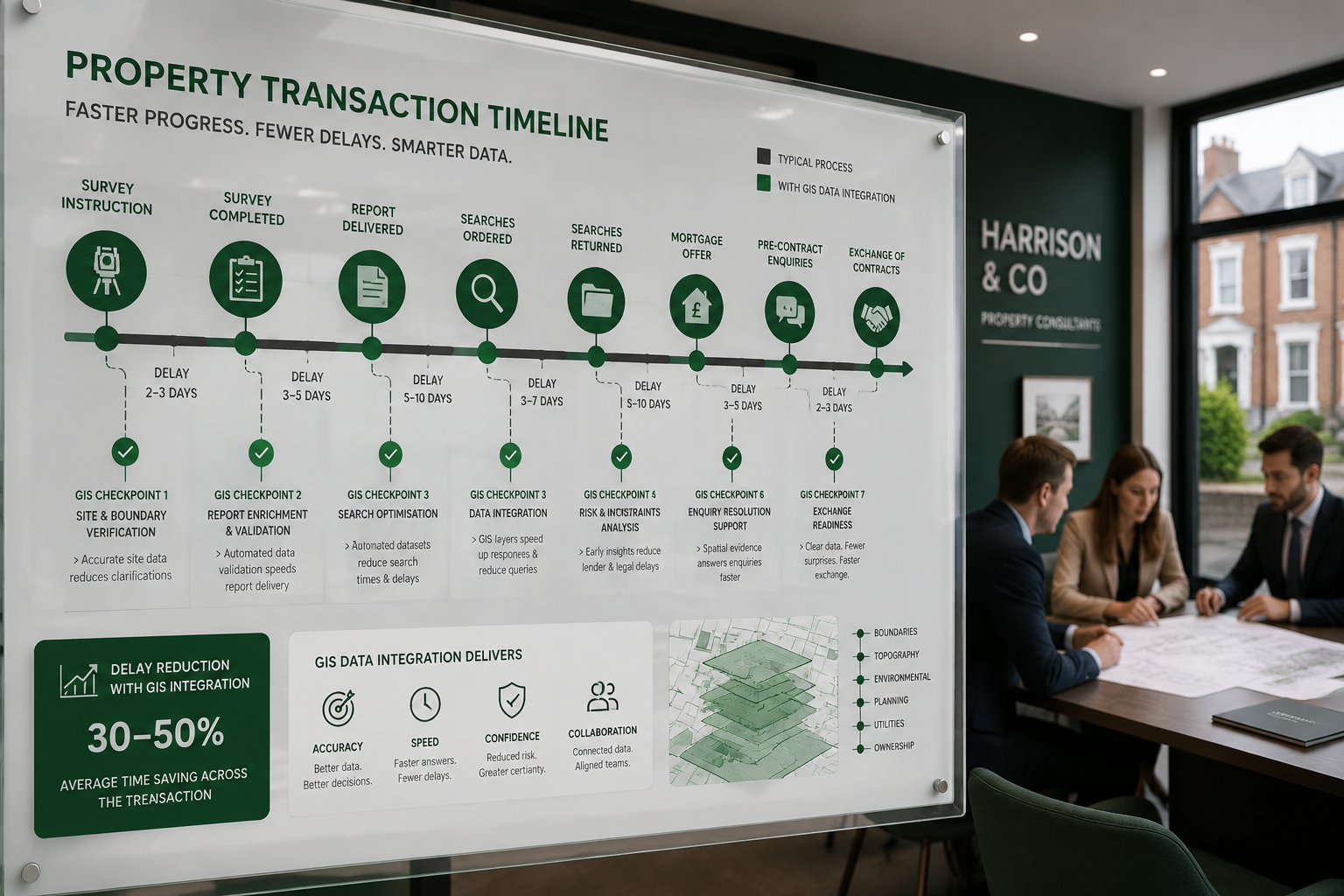
The cumulative effect of applying building survey certainty strategies — leveraging landmark data and GIS for faster transactions in 2026 — is a measurable compression of the due diligence phase. When surveyors deliver reports that anticipate solicitor queries, pre-empt lender concerns, and provide spatial evidence for every material finding, the number of post-report rounds of correspondence drops sharply.
For buyers, this means fewer sleepless nights waiting for answers. For sellers, it means reduced fall-through risk. For lenders, it means faster valuation sign-off. For solicitors, it means cleaner enquiry responses and earlier exchange dates.
"The value of a building survey is not just in what it finds — it is in how quickly and clearly that information reaches everyone who needs to act on it."
This is why the integration of GIS and Landmark data is not a luxury feature for high-value transactions. It is a baseline competency for any surveyor operating in a market where speed and certainty are both demanded simultaneously.
Conclusion
The property market in 2026 rewards surveyors who combine rigorous on-site expertise with the full power of available spatial data. Building survey certainty strategies: leveraging landmark data and GIS for faster transactions in 2026 are not theoretical — they are a practical, implementable framework that reduces delays, improves defect identification, and gives every party in a transaction the confidence to move forward.
Actionable next steps for buyers and their advisors:
- Request that your appointed surveyor confirms they use Landmark environmental data and GIS spatial analysis as part of their pre-visit preparation.
- Ensure the survey level matches the data complexity of the property — use the guide to choosing between a homebuyers survey and a full structural survey to make an informed choice.
- Ask your surveyor to include map extracts and spatial data references within the final report to support solicitor enquiries.
- Where boundary ambiguity is identified, instruct a formal land survey promptly — do not rely on GIS cadastral data for legal resolution.
- Use pre-instruction GIS screening to identify risk categories early, so that specialist investigations (damp, structural, environmental) can be instructed in parallel rather than sequentially.
Surveyors who embed these strategies into their standard workflow will not only deliver better reports — they will become the professionals that buyers, lenders, and solicitors actively seek out in a certainty-focused market.
References
[1] Value Analysis – https://www.esri.com/en-us/industries/land-administration/strategies/value-analysis?utm_source=openai
[2] Market Research Site Analysis – https://www.esri.com/en-us/industries/real-estate/strategies/market-research-site-analysis?utm_source=openai
[3] GIS Technology Transforming Property Tax Assessment and Urban Planning – https://gisuser.com/2026/05/how-gis-technology-is-transforming-property-tax-assessment-and-urban-planning/amp/?utm_source=openai
[4] First American DNA Spatial Data Platform – https://www.arcgis.com/home/item.html?id=0732504d226a4c038e8c689bdc8a12f0&utm_source=openai
[5] Using Historical Aerials And GIS Layers For Boundary Research – https://www.mckissock.com/blog/land-surveyor/using-historical-aerials-and-gis-layers-for-boundary-research/?utm_source=openai
[6] How Accurate Are GIS Property Lines For Legal Use – https://legalclarity.org/how-accurate-are-gis-property-lines-for-legal-use/?utm_source=openai
[7] GIS Map Viewer Use Cases – https://www.mapwise.com/help/gis-map-viewer/use-cases/?utm_source=openai
[8] How Accurate Are Your Parcels: Rethinking Parcel Mapping And Accuracy In GIS – https://www.pandaconsulting.com/logb/2025/4/28/how-accurate-are-your-parcels-rethinking-parcel-mapping-and-accuracy-in-gis?utm_source=openai