

London asking prices have fallen 2.4% year-on-year according to Rightmove's May 2026 data — and for buyers in South London and the wider South West, that headline figure carries real weight. Stock levels are now at their highest for this time of year since 2015, sellers are negotiating, and the balance of power has shifted firmly toward buyers. In this environment, a South London price correction May 2026 Level 3 building survey strategy is not a luxury — it is the single most effective tool a cautious buyer has to protect their investment, validate a price, and avoid inheriting costly defects in an already softening market.
Key Takeaways 🏠
- London asking prices are down 2.4% YoY (Rightmove, May 2026), with the South East down 1.6%, creating genuine negotiating leverage for buyers.
- Stock levels are the highest since 2015 for this time of year, meaning sellers face real competition and are more open to price reductions post-survey.
- A Level 3 Building Survey (formerly the Full Structural Survey) is the most comprehensive RICS-standard assessment — essential for older, extended, or non-standard South London properties.
- Specialist follow-ups (damp, structural movement, services) flagged in a Level 3 report can unlock further price renegotiation in a soft market.
- The RICS Home Survey Standard governs how Level 3 surveys must be conducted, giving buyers a clear benchmark for quality and scope.
Table of Contents
- The May 2026 Market Snapshot: What the Data Really Means for South London
- Why a Soft Market Makes Level 3 Surveys More Critical, Not Less
- Understanding the RICS Home Survey Standard and Level 3 Protocols
- When Surveyors Must Recommend Specialist Follow-Ups
- Turning Survey Findings Into Negotiating Power
- Practical South London Price Correction May 2026 Level 3 Building Survey Strategy: Step by Step
- FAQ
- Conclusion
1. The May 2026 Market Snapshot: What the Data Really Means for South London {#market-snapshot}
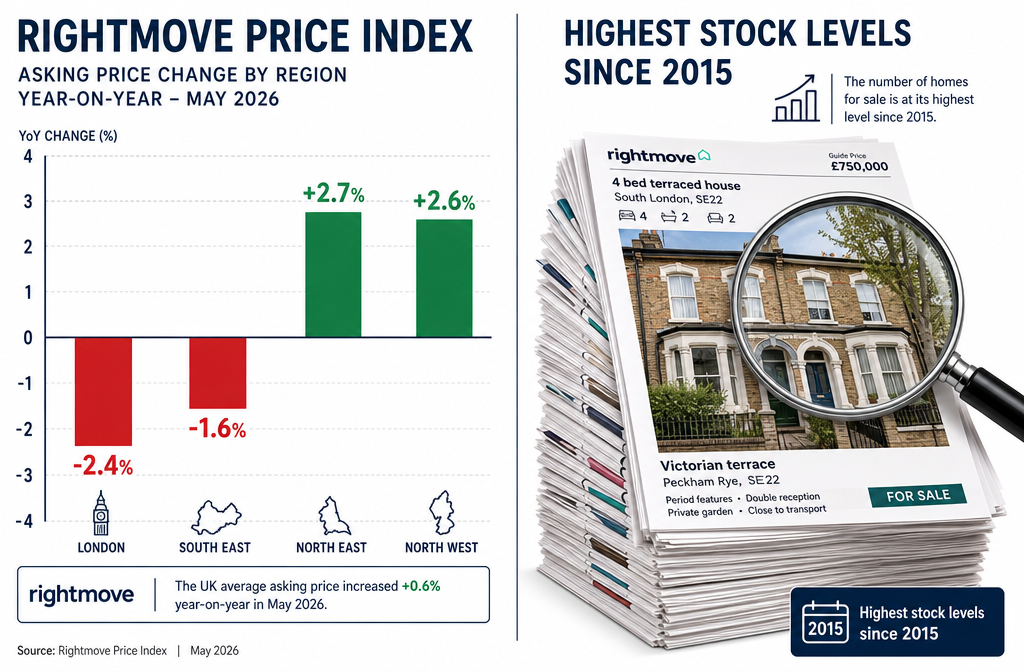
Rightmove's May 2026 report paints a clear picture of a two-speed property market across England and Wales. While the North East is up 2.7% and the North West up 2.6% year-on-year, London is heading in the opposite direction at -2.4%, with the South East down 1.6%. For buyers in Wimbledon, Merton, Wandsworth, and the broader SW London catchment, this is not abstract data — it translates directly into asking prices that are increasingly open to challenge.
"The number of available homes for sale is at its highest level for this time of year since 2015." — Rightmove, May 2026
That stock surplus matters enormously. When sellers outnumber motivated buyers, properties sit on the market longer, price reductions become more common, and survey findings carry greater weight in negotiations. Nationwide's house price indices have similarly shown subdued annual growth in London throughout 2025 and into 2026, reinforcing the trend. Knight Frank's prime South London analysis has noted increased days-on-market metrics across the SW postcode zones, consistent with a buyer's market dynamic.
For mortgage borrowers, Moneyfacts data from early 2026 shows that while fixed rates have eased slightly from their 2023 peaks, affordability constraints remain significant — making the total cost of ownership (purchase price plus remediation) a critical calculation before exchange.
What does this mean practically?
| Region | YoY Price Change (May 2026) | Market Sentiment |
|---|---|---|
| London | -2.4% | Buyer's market |
| South East | -1.6% | Softening |
| North East | +2.7% | Seller's market |
| North West | +2.6% | Seller's market |
Source: Rightmove, May 2026
In short: this is the market where a Level 3 Building Survey pays for itself many times over.
2. Why a Soft Market Makes Level 3 Surveys More Critical, Not Less {#why-level-3}
There is a common misconception that surveys matter most in a hot market, where buyers rush to exchange. In reality, the opposite is true. In a falling or flat market, the risks are compounded:
- Sellers may have deferred maintenance, knowing they need to accept a lower price anyway.
- Properties sit longer, meaning issues like damp and roof deterioration can worsen undetected.
- Valuations may lag actual market conditions, meaning the lender's valuation is not a substitute for a proper structural assessment.
- Buyers have more leverage — but only if they have documented evidence of defects.
A Level 3 Building Survey (the most thorough of the three RICS survey levels) provides exactly that evidence. Unlike a Level 1 Condition Report or a Level 2 HomeBuyer Report, a Level 3 survey involves a detailed, element-by-element inspection of the property's fabric, structure, and services. It is written in accessible language but backed by professional judgement on repair urgency and cost implications.
For South London's Victorian and Edwardian housing stock — which dominates the Wimbledon, Balham, Tooting, and Clapham markets — a Level 3 survey is almost always the appropriate choice. These properties routinely present with:
- Chimney stacks and flaunching in need of repointing
- Suspended timber floors with ventilation deficiencies
- Single-skin rear extensions with thermal bridging and damp ingress
- Older drainage systems with root intrusion or partial blockage
- Outdated electrical consumer units pre-dating 17th Edition wiring regulations
Understanding the difference between a Level 2 and Level 3 survey is essential before instructing a surveyor. For most pre-1980 South London properties, a Level 2 HomeBuyer Report simply does not go deep enough. You can also explore our guide to choosing between home survey levels to make the right call for your specific property type.
3. Understanding the RICS Home Survey Standard and Level 3 Protocols {#rics-standard}
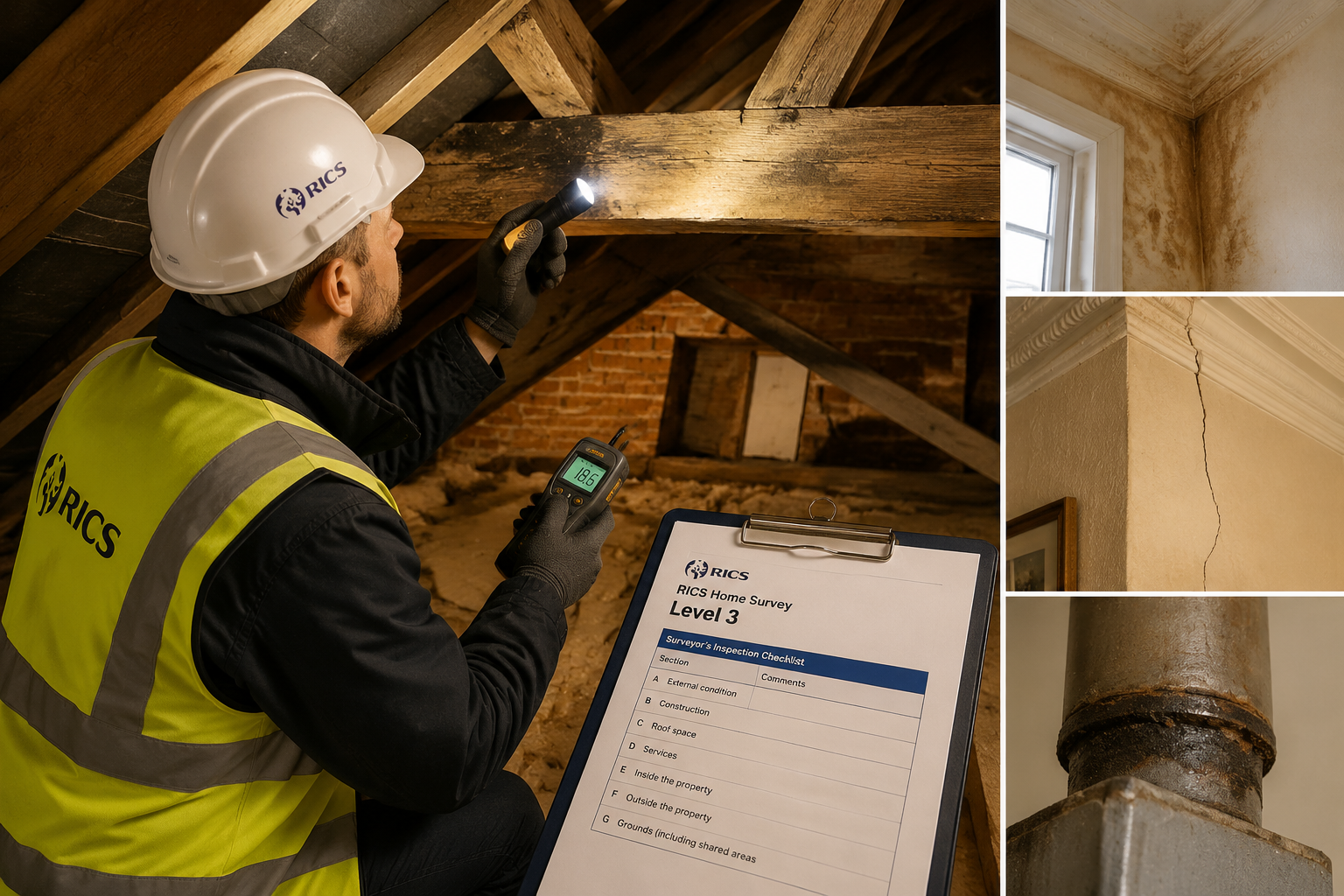
The RICS Home Survey Standard (HSS), which came into full effect in 2021 and remains the governing framework in 2026, sets out the minimum requirements for how all three survey levels must be conducted, reported, and communicated. For Level 3, the standard requires:
- A thorough inspection of all accessible parts of the building, including roof spaces, subfloor voids (where accessible), and outbuildings.
- Condition ratings (1, 2, or 3) applied to each element, with 3 indicating urgent repair or investigation needed.
- Clear advice on legal and regulatory matters relevant to the property.
- Identification of risks to the building, grounds, and people.
- Recommendations for specialist reports where the surveyor's findings exceed the scope of a visual inspection.
The RICS HSS also requires surveyors to apply professional judgement — not just describe what they see, but interpret it in the context of the property's age, construction type, and local environment. In a South London price correction scenario, this professional judgement becomes the foundation of a buyer's negotiating position.
💡 Key point: The RICS Level 3 Building Survey is not a pass/fail document. It is a risk map — and in a soft market, every Condition Rating 3 item is a potential price reduction.
For buyers who want to understand the full scope of what a Level 3 report covers, our detailed overview of the RICS Building Survey explains what to expect from instruction through to report delivery.
The UK Government's guidance on buying a home (GOV.UK) consistently recommends obtaining an independent survey before exchange, noting that a mortgage valuation is not a survey and does not protect the buyer's interests.
4. When Surveyors Must Recommend Specialist Follow-Ups {#specialist-followups}
One of the most important — and sometimes misunderstood — aspects of a Level 3 survey is the specialist follow-up recommendation. A chartered surveyor is not a damp specialist, a structural engineer, or a gas-safe engineer. When findings exceed the scope of a visual inspection, the RICS HSS requires the surveyor to recommend further investigation by an appropriate specialist.
In South London's older housing stock, the three most common specialist referrals are:
🔍 Damp and Timber Investigations
Rising damp, penetrating damp, and condensation are endemic in Victorian terraces with solid brick walls and suspended timber floors. A Level 3 survey will identify visual evidence — staining, salting, blown plaster, high moisture readings — but a specialist damp surveyor provides detailed diagnosis, source identification, and a costed remediation schedule. This is critical because damp remediation costs in London can range from a few hundred pounds (ventilation improvement) to tens of thousands (full tanking or wall tie replacement).
Understanding the average cost of a damp survey in London helps buyers budget appropriately before instructing follow-up specialists. You can also learn more about what a London damp survey report contains to understand what you are commissioning.
🏗️ Structural Movement Investigations
Cracked brickwork, distorted door frames, stepped cracking in mortar joints, and sloping floors are all indicators of structural movement. In South London, clay subsoils make subsidence a real risk — particularly in properties near mature trees. A structural engineer's report will classify movement as historic, active, or progressive, and recommend underpinning, monitoring, or cosmetic repair accordingly. The cost difference between these outcomes is enormous, making early specialist input essential.
⚡ Services Investigations
Older properties frequently have electrical installations that pre-date current Part P regulations, lead or iron water supply pipes, and boilers approaching end of service life. A Level 3 survey will flag these, but a Gas Safe engineer's boiler inspection or an NICEIC electrical installation condition report (EICR) provides the costed evidence needed for negotiation.
5. Turning Survey Findings Into Negotiating Power {#negotiating}
In a market where London asking prices are already down 2.4% and stock is at an 11-year seasonal high, a Level 3 survey with Condition Rating 3 items is not bad news — it is leverage.
The process works as follows:
- Receive the Level 3 report and identify all Condition Rating 3 items and recommended specialist follow-ups.
- Obtain specialist quotes for remediation (damp, structural, services).
- Calculate the total remediation cost and present this to the vendor with supporting documentation.
- Renegotiate the purchase price or request that works are completed before exchange.
Research consistently shows that buyers who use survey findings to renegotiate achieve meaningful price reductions. Our analysis of average price reductions after a building survey shows that documented defects regularly support reductions of 1–5% of the purchase price — sometimes more for significant structural issues.
In a May 2026 South London market where vendors are already under pressure, this approach is particularly effective. Vendors who have been on the market for 8–12 weeks are far more receptive to a well-evidenced price reduction request than they would have been in 2021's frenzied conditions.
If you have already received a difficult survey report, our guide on what to do after a bad building survey result sets out your options clearly, including how to renegotiate after a poor survey outcome.
6. Practical South London Price Correction May 2026 Level 3 Building Survey Strategy: Step by Step {#step-by-step}
Here is a concise, actionable framework for applying a South London price correction May 2026 Level 3 building survey strategy from offer acceptance to exchange:
Step 1 — Instruct Early 📋
Commission your Level 3 Building Survey as soon as your offer is accepted. Do not wait for mortgage approval. Early instruction means more time to act on findings before exchange pressure builds.
Step 2 — Choose an RICS-Regulated Surveyor
Ensure your surveyor is RICS-regulated and experienced with South London period properties. Check their RICS membership on the RICS Find a Surveyor register.
Step 3 — Brief the Surveyor Thoroughly
Share any concerns you have about the property — damp smells noticed during viewing, visible cracks, age of boiler, loft conversion without visible planning permission. A well-briefed surveyor focuses attention where it matters most.
Step 4 — Read the Report Carefully
Focus on Condition Rating 3 items first, then Rating 2 items that may escalate. Note every specialist follow-up recommendation.
Step 5 — Commission Specialist Reports Promptly
Instruct damp, structural, or services specialists within 48–72 hours of receiving the Level 3 report. Delays cost time and can jeopardise your position if the vendor has other interested parties.
Step 6 — Compile Your Renegotiation Pack
Combine the Level 3 report findings with specialist quotes into a clear, costed schedule of works. Present this to the vendor's estate agent professionally and without emotion.
Step 7 — Agree Revised Terms or Walk Away
In a buyer's market with high stock levels, you have options. If the vendor will not negotiate reasonably on a well-evidenced defect schedule, the market has alternatives.
💬 "In 2026's South London market, the survey is not the end of the process — it is the beginning of a better deal."
For first-time buyers navigating this process for the first time, our first-time buyer guide to building surveys in Wimbledon provides additional context on timelines and costs.
FAQ {#faq}
Q1: Is a Level 3 Building Survey always necessary in South London, or can I use a Level 2 HomeBuyer Report?
For most pre-1980 South London properties — particularly Victorian and Edwardian terraces, semi-detached houses, and converted flats in period buildings — a Level 3 survey is strongly recommended. Level 2 reports are better suited to modern, standard-construction properties in good condition. If there is any doubt, instruct Level 3.
Q2: How much does a Level 3 Building Survey cost in South London in 2026?
Fees vary by property size and complexity, but buyers in the SW London market should budget approximately £700–£1,500 for a Level 3 survey on a typical Victorian terrace. Larger or more complex properties will attract higher fees. The cost is almost always recovered through renegotiation.
Q3: Can I use the survey to renegotiate the price after my offer has been accepted?
Yes. Survey findings are a legitimate and widely accepted basis for price renegotiation in England and Wales. There is no obligation to exchange at the originally agreed price if material defects are identified post-survey.
Q4: What is the RICS Home Survey Standard and why does it matter?
The RICS Home Survey Standard (HSS) is the professional framework that governs how all RICS-regulated surveys must be conducted and reported. It ensures consistency, transparency, and accountability. When you instruct an RICS-regulated surveyor, you are protected by this standard and have recourse through RICS if the survey falls short.
Q5: How long does a Level 3 Building Survey take?
A thorough Level 3 inspection of a typical South London terraced house takes 3–5 hours on site. The written report is usually delivered within 3–5 working days. For complex properties, allow up to 7 working days.
Q6: What happens if the specialist reports reveal major structural problems?
You have three options: renegotiate the price to reflect full remediation costs, request the vendor completes works before exchange, or withdraw from the purchase. In a high-stock market like May 2026 South London, walking away from a structurally compromised property is a viable and often sensible choice.
Conclusion {#conclusion}
The May 2026 South London property market is defined by falling asking prices, elevated stock, and cautious buyers — and that combination makes a robust South London price correction May 2026 Level 3 building survey strategy more valuable than at any point in the past decade. Rightmove's data showing London down 2.4% year-on-year is not a reason to panic; it is a reason to buy carefully, survey thoroughly, and negotiate confidently.
Your actionable next steps:
- ✅ Instruct a Level 3 Building Survey from an RICS-regulated surveyor as soon as your offer is accepted.
- ✅ Read your report in full and prioritise Condition Rating 3 items and specialist follow-up recommendations.
- ✅ Commission specialist reports (damp, structural, services) promptly to build your renegotiation evidence.
- ✅ Use documented findings to negotiate a price reduction or request pre-exchange remediation.
- ✅ Know your exit option — in a buyer's market, walking away from a defective property is a legitimate strategy.
The survey is not a formality. In 2026's South London market, it is your most powerful financial protection tool.
References
- Rightmove House Price Index, May 2026
- RICS Home Survey Standard, RICS (2021)
- Nationwide House Price Index, Q1 2026
- Knight Frank, Prime South London Residential Market Report, 2025
- Moneyfacts UK Mortgage Trends Treasury Report, 2025
- UK Government, GOV.UK — Buying a Home: Surveys and Valuations (2023)