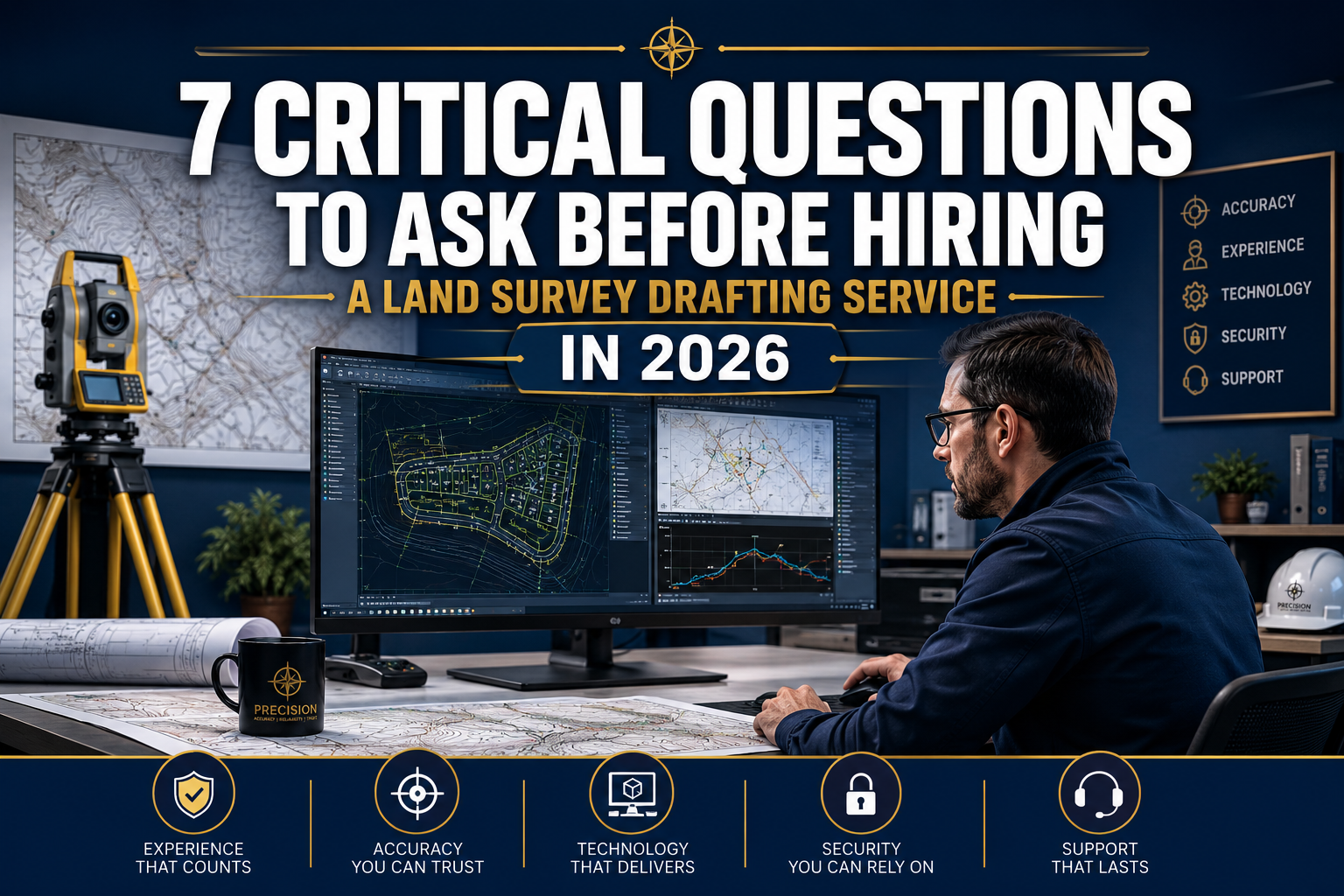
A single drafting error in a land survey can trigger boundary disputes that cost property owners upwards of £15,000 to resolve in court — and that figure does not include the months of project delays that follow. Understanding the true cost of boundary disputes makes it clear why choosing the right drafting service partner is one of the most consequential decisions a developer or property owner can make. The 7 Critical Questions to Ask Before Hiring a Land Survey Drafting Service in 2026 outlined in this guide are designed to help you vet providers rigorously, so that accuracy, compliance, and efficiency are never left to chance.
Key Takeaways
- Software compatibility between your team and the drafting provider is non-negotiable — mismatched platforms produce incomplete, flat files that cause costly rework.
- A provider's quality control protocols are the single strongest predictor of output accuracy in complex drafting projects.
- Compliance with local surveying standards, including layering conventions and annotation styles, protects you from regulatory setbacks.
- Scalability matters: a provider that cannot handle seasonal workload peaks will become a bottleneck on your most time-sensitive projects.
- Relevant project experience reduces revision cycles and accelerates delivery timelines significantly.
Why Asking the Right Questions Matters More Than Ever in 2026
The land surveying and drafting sector is undergoing rapid transformation. Drone-based data capture, LiDAR scanning, AI-assisted feature extraction, and cloud-based CAD collaboration have all become standard tools rather than novelties [2]. This technological acceleration means that the gap between a high-performing drafting service and a mediocre one has widened considerably.
For property owners, developers, and building surveyor professionals alike, the stakes are higher than they were even three years ago. Outsourcing land survey drafting is increasingly common, with the AEC (Architecture, Engineering, and Construction) sector seeing a marked rise in remote drafting partnerships [4]. Yet not every provider has kept pace with evolving standards, software versions, or regulatory requirements.
Asking the 7 Critical Questions to Ask Before Hiring a Land Survey Drafting Service in 2026 before signing any contract is not due diligence for its own sake — it is a practical framework that protects your project budget, timeline, and legal standing.
The 7 Critical Questions to Ask Before Hiring a Land Survey Drafting Service in 2026
Question 1: What Quality Control Protocols Do You Follow for Field-to-Finish Processes?
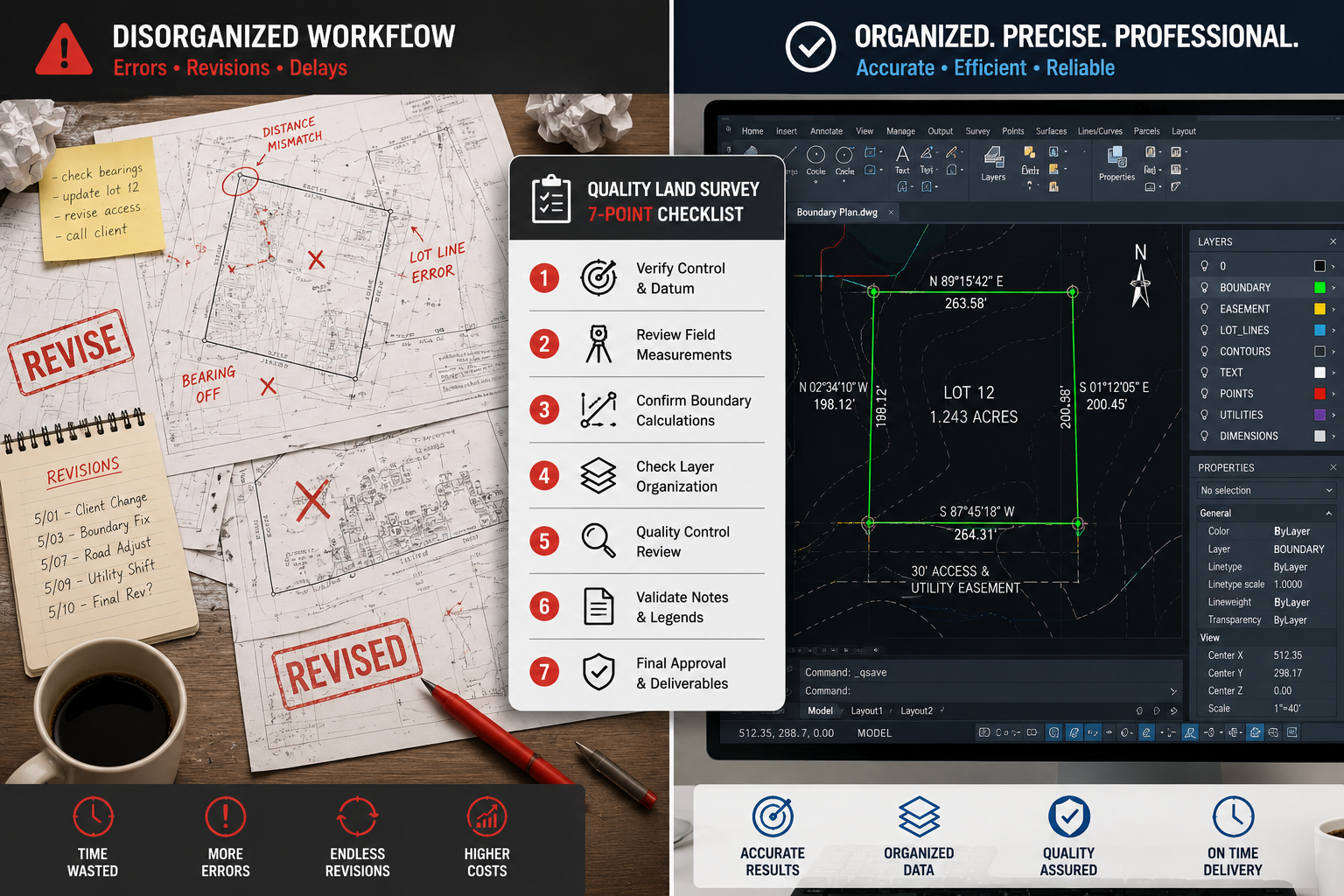
Quality control is the backbone of reliable drafting output. The field-to-finish process — converting raw field data into polished, deliverable drawings — involves multiple handoff points where errors can enter the workflow undetected.
Ask specifically whether the provider has:
- A dedicated QA/QC team separate from the drafters themselves
- Documented checklists for each stage of the drafting process
- A system for flagging anomalies in field data before drafting begins
- A final review step before any drawing is delivered
Providers without structured QA/QC protocols are significantly more likely to produce drawings with coordinate errors, missing features, or incorrect layer assignments [1]. These errors rarely announce themselves — they surface during construction or permitting, at the worst possible moment.
"Quality control is not a final step — it is a continuous process embedded at every stage of field-to-finish drafting."
Question 2: Which CAD Platforms and Versions Are You Proficient In?
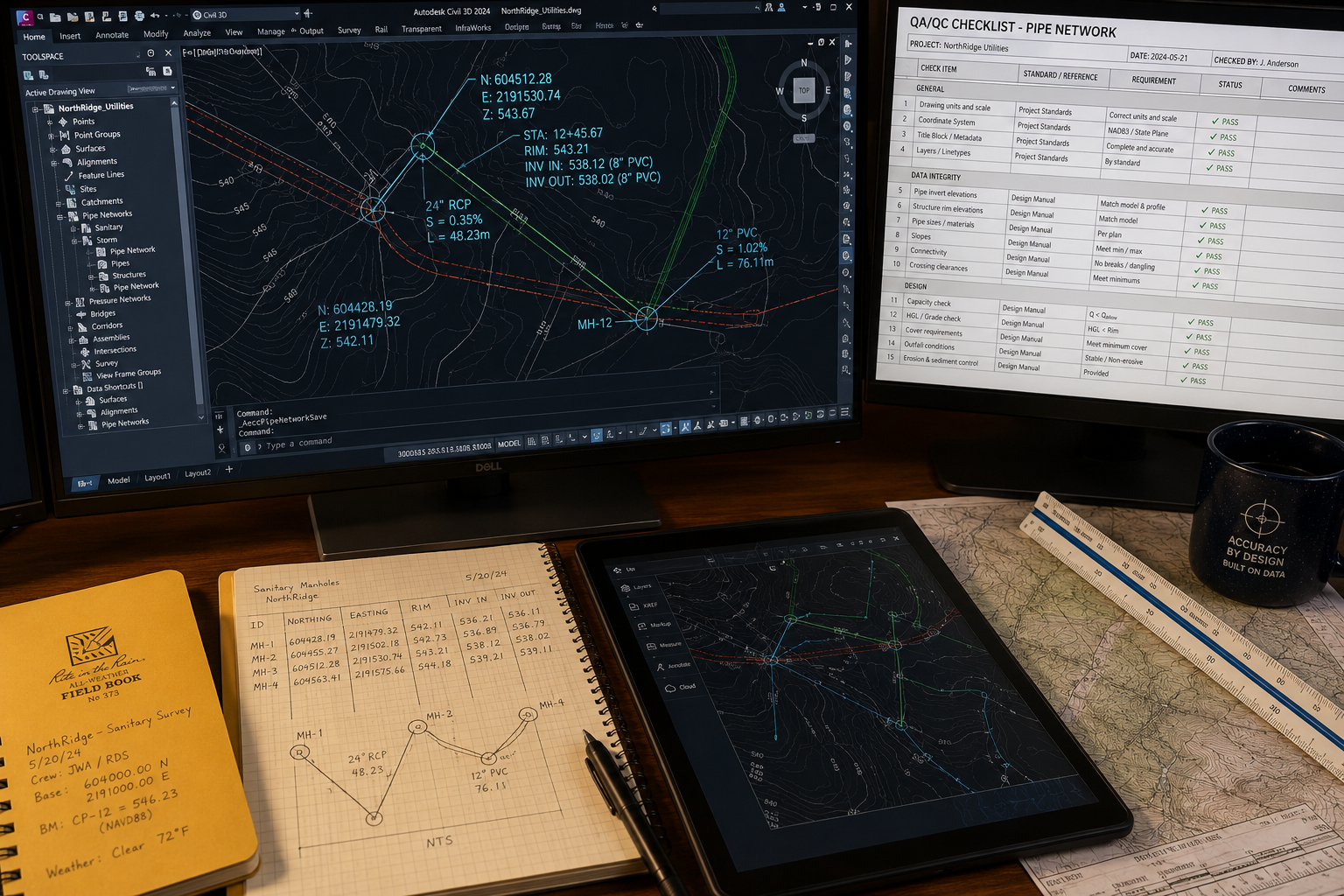
Software compatibility is a surprisingly common source of project failure. If your project relies on Civil 3D pipe networks, surface models, or corridor data, but the provider only uses standard AutoCAD, you will receive flat 2D files stripped of the intelligent data your engineering team needs [1].
Before committing to any provider, confirm:
- The specific software platforms they use (AutoCAD, Civil 3D, MicroStation, Revit, etc.)
- The version numbers they operate on
- Whether they can work within your company's template files and layer standards
- Their ability to export in your required file formats (DWG, DXF, PDF, SHP, etc.)
This question is especially important for projects involving topographic mapping or construction surveying, where data-rich models are essential for downstream engineering decisions.
| Software Type | Common Use Case | Risk if Mismatched |
|---|---|---|
| Civil 3D | Infrastructure, grading, pipe networks | Loss of 3D data, manual rework |
| AutoCAD | General drafting, 2D plans | Limited for complex projects |
| MicroStation | Transport and utilities | Incompatible file formats |
| Revit | BIM integration | Missing parametric data |
Question 3: What Is Your Typical Turnaround Time and Rework Policy?
Drafting delays cascade. A two-day slip in drawing delivery can push a planning submission back by weeks if it misses a council deadline. Understanding turnaround commitments upfront prevents these situations from blindsiding your project schedule [1].
Ask the provider to specify:
- Standard turnaround times for different drawing types (boundary surveys, topographic surveys, as-built drawings)
- Whether rush delivery is available and at what cost
- Their formal rework policy — how many revision rounds are included, and what triggers additional charges
- How they handle errors that originate from their own drafting process versus ambiguous field data
A provider with a clear, written rework policy demonstrates confidence in their output quality. Vague or verbal commitments on revisions are a warning sign.
Question 4: Can You Scale Your Services to Accommodate Seasonal Workload Fluctuations?
Property development and land surveying are cyclical industries. Spring and summer typically bring surges in planning applications, site investigations, and new construction starts. A drafting provider that performs well on a steady stream of small projects may buckle under the pressure of a high-volume peak period [1].
Scalability questions to ask include:
- How many drafters do you currently employ, and can that capacity expand quickly?
- Do you use subcontractors during peak periods, and if so, how is quality maintained?
- What is your maximum concurrent project capacity?
- Can you provide references from clients who have used your services during high-demand periods?
This matters particularly for firms managing multiple sites simultaneously or working across several local surveying areas where planning cycles may not align.
Question 5: How Do You Ensure Compliance With Local Surveying Standards and Units?
Land survey drafting is not a globally uniform discipline. Standards for coordinate systems, unit conventions, layer naming protocols, annotation styles, and boundary representation vary between countries, regions, and even individual local authorities [1].
A provider working primarily with US clients may default to imperial units and ALTA/NSPS standards, which are entirely incompatible with UK projects governed by RICS guidelines and Ordnance Survey coordinate frameworks. Misaligned standards can invalidate drawings for planning or legal purposes.
Verify that the provider:
- Has direct experience with the regulatory framework applicable to your project location
- Can adapt to your company-specific drafting standards without extensive hand-holding
- Understands the difference between coordinate systems such as OSGB36 and WGS84, and when each applies
- Is familiar with building regulations requirements that affect how survey drawings must be presented
Compliance failures are not just administrative inconveniences — they can delay planning permissions and expose you to legal liability in land boundary disagreements.
Question 6: Do You Have Experience With Projects Similar to Ours?
General drafting competence and specialist project experience are different things. A provider skilled at residential boundary surveys may lack the technical vocabulary and workflow knowledge required for a complex mixed-use development requiring topographic, utility, and as-built surveys to be integrated into a single deliverable [1].
Request the following before proceeding:
- A portfolio of completed projects in your sector (residential, commercial, infrastructure, etc.)
- References from clients with comparable project complexity
- Examples of drawings produced for projects with similar data sources (drone, total station, GPS, LiDAR)
- Evidence of experience with any specialist requirements your project carries, such as party wall agreements or schedule of condition surveys
Providers with directly relevant experience require fewer revision cycles, ask fewer clarifying questions, and deliver drawings that integrate more smoothly into your wider project documentation [1].
Question 7: How Do You Handle Data Security and Confidentiality?
This question is increasingly critical as remote drafting partnerships become the norm [4]. Survey data contains sensitive information: precise property boundaries, infrastructure layouts, and site conditions that could be commercially valuable or legally significant if disclosed to the wrong parties.
A responsible drafting service provider should be able to demonstrate:
- A formal data handling policy, preferably in writing
- Secure file transfer protocols (encrypted cloud platforms, VPN-secured access, or similar)
- Non-disclosure agreements as a standard part of their client contracts
- Clarity on where data is stored, who has access, and how long it is retained
- Compliance with applicable data protection legislation (such as UK GDPR for UK-based projects)
As the surveying industry increasingly relies on cloud-based collaboration and remote workflows, data security is no longer a secondary concern — it is a core service quality indicator [2].
How to Evaluate Responses to These Questions
Asking the right questions is only half the process. Evaluating the answers requires a structured approach. The table below provides a quick-reference framework for scoring provider responses.
| Question Area | Strong Response | Weak Response |
|---|---|---|
| QA/QC Protocols | Written procedures, dedicated review team | "We check everything before sending" |
| Software Proficiency | Named platforms, version numbers, template compatibility | "We use AutoCAD and similar tools" |
| Turnaround and Rework | Written SLA, clear revision policy | Verbal commitments only |
| Scalability | Documented capacity, named subcontractor process | "We'll manage it when the time comes" |
| Standards Compliance | Named regulatory frameworks, adaptable to client standards | "We follow industry standards" |
| Project Experience | Portfolio, references, relevant examples | General claims without evidence |
| Data Security | Written policy, encryption protocols, NDA | "We keep everything confidential" |
Providers who respond to these questions with vague generalities are signalling that their processes are informal — and informal processes produce inconsistent results.
Red Flags to Watch for During the Vetting Process
Beyond the seven questions themselves, certain behaviours during the initial consultation should prompt caution:
- Reluctance to provide references. Any reputable provider should be able to supply at least two or three client contacts willing to speak about their experience.
- No written contract or SLA. Verbal agreements offer no protection when deliverables fall short.
- Unusually low pricing. Drafting services priced significantly below market rates often reflect lower-skilled staff, outdated software, or a high-volume, low-attention model that produces generic output.
- Inability to name the specific drafter assigned to your project. Accountability requires knowing who is responsible for your work.
- No mention of surveying technology investment. Providers who have not invested in current surveying technology are likely falling behind on accuracy and efficiency benchmarks [3].
Aligning Your Vetting Process With Project Type
The weight given to each of the 7 Critical Questions to Ask Before Hiring a Land Survey Drafting Service in 2026 should shift depending on the nature of your project.
For residential property transactions: Compliance with local standards and turnaround time are the highest priorities. Delays in drawing delivery can jeopardize mortgage offers and exchange deadlines. Reviewing what to do before an RICS home survey can help align your preparation with what the drafting service will need from you.
For commercial development projects: Software compatibility and scalability take precedence. Large commercial sites typically involve multiple survey types that must integrate within a shared data environment.
For infrastructure and utilities work: Compliance with coordinate systems and data security are paramount. Utility survey data carries significant liability if mishandled or incorrectly represented.
For boundary dispute resolution: QA/QC protocols and project experience with land boundary disagreements are critical. Drawings used as legal evidence must be demonstrably accurate and produced by a provider with a verifiable quality record.

The Cost of Getting This Decision Wrong
The financial consequences of hiring the wrong drafting service extend well beyond the cost of the service itself. Rework on a complex survey drawing can consume two to three times the original drafting fee. Planning application rejections caused by non-compliant drawings add weeks to project timelines and incur resubmission costs. In the most serious cases, boundary errors discovered post-construction can trigger litigation.
The AEC outsourcing sector is growing rapidly, and with that growth comes an increase in providers of varying quality [4]. The market is not self-regulating — due diligence falls entirely to the client. Applying the 7 Critical Questions to Ask Before Hiring a Land Survey Drafting Service in 2026 systematically to every prospective provider is the most reliable way to separate capable partners from risky ones.
Conclusion
Selecting a land survey drafting service in 2026 requires more than comparing price quotes. The seven questions covered in this guide — covering quality control, software compatibility, turnaround and rework policies, scalability, standards compliance, project experience, and data security — form a comprehensive vetting framework that protects your investment and your project outcomes.
Actionable next steps:
- Build these seven questions into a formal supplier evaluation form before any initial consultation.
- Request written responses or supporting documentation for each answer, not just verbal assurances.
- Score each provider against the strong/weak response framework in the table above.
- Check at least two references before shortlisting any provider.
- Ensure that any final agreement includes a written SLA covering turnaround times, revision rounds, and data security obligations.
For complex property projects where survey accuracy directly affects planning, legal standing, or construction outcomes, the time invested in rigorous vetting pays dividends many times over. A thorough selection process is not a delay — it is the foundation of a project that runs on time, on budget, and without costly surprises.
References
[1] 7 Critical Questions To Ask Before Hiring A Land Survey Drafting Service Provider In 2026 – https://www.gsourcedata.com/7-critical-questions-to-ask-before-hiring-a-land-survey-drafting-service-provider-in-2026/?utm_source=openai
[2] Future Land Surveying 2026 – https://haller-blanchard.com/future-land-surveying-2026/?utm_source=openai
[3] Land Surveyor Industry Trends – https://surveyslate.com/blog/land-surveyor-industry-trends/?utm_source=openai
[4] Remote Drafting Aec Outsourcing Trends 2026 – https://www.ensdesigngroup.com/post/remote-drafting-aec-outsourcing-trends-2026?utm_source=openai