

Over 70% of property disputes in England and Wales that enter formal Alternative Dispute Resolution (ADR) processes reach settlement without ever proceeding to a full hearing — yet the quality of the surveyor's technical evidence is often the single factor that determines which party achieves a favourable outcome. The role of Expert Witness Surveyors in Mediation and ADR: How to Present Technical Evidence Outside the Courtroom is fundamentally different from courtroom testimony, and many surveyors underestimate just how much that difference matters.
Whether the dispute involves a boundary disagreement, a dilapidations claim, or a structural defect argument, the surveyor instructed as an expert in a mediation, arbitration, or expert determination setting must adapt their entire approach — from the language used in reports to the way document bundles are assembled and presented.
Key Takeaways 📋
- ADR is not a relaxed version of court — neutrality, precision, and structure are equally critical outside the courtroom.
- Expert witness surveyors must adapt their reports specifically for the ADR format they are operating in (mediation, arbitration, or expert determination).
- Joint instructions and single joint expert (SJE) appointments require a distinctly different mindset and presentation style.
- Document bundles in ADR must be logically organised, cross-referenced, and stripped of unnecessary technical jargon.
- A surveyor's credibility and impartiality are their most valuable assets — perceived bias can undermine even technically sound evidence.
Understanding the ADR Landscape for Surveyors
Alternative Dispute Resolution covers a wide spectrum of processes. Before adapting presentation style, it is essential to understand which forum is being used and what each one demands from a technical expert.
The Three Main ADR Formats
| ADR Format | Decision Maker | Surveyor's Role | Binding? |
|---|---|---|---|
| Mediation | Neutral mediator (facilitator) | Advisor to party; may present technical summaries | No (unless settled) |
| Arbitration | Arbitrator (quasi-judicial) | Expert witness; formal report required | Yes |
| Expert Determination | Independent expert | May be the decision-maker OR an expert witness | Yes |
💡 Pull Quote: "In mediation, the surveyor's job is to make complexity accessible. In arbitration, it is to make complexity defensible."
Each format calls for a different tone, level of formality, and document structure. A report written for a High Court hearing will often be too adversarial and too dense for a mediation session, where the goal is to facilitate agreement rather than win an argument.
For surveyors working across London and the South East, understanding what a surveyor does across different professional contexts is the foundation for effective ADR participation.
How Expert Witness Surveyors in Mediation and ADR Should Adapt Their Reports
The single most common mistake surveyors make when moving from litigation support to ADR is submitting the same report format they would use for court. This approach misses the mark in almost every case.
Adapting Report Structure for Mediation
In mediation, the surveyor typically acts as a technical advisor to one party rather than a neutral expert. The mediator is not a judge and will not make binding technical findings. The goal is to help the parties reach a commercial agreement.
Reports prepared for mediation should:
- ✅ Lead with a clear executive summary (no more than one page)
- ✅ Use plain English — avoid unexplained technical terms
- ✅ Present findings in a logical, non-combative tone
- ✅ Highlight areas of agreement as well as disagreement
- ✅ Include a realistic cost or value range, not a single fixed figure
- ❌ Avoid lengthy legal arguments — that is counsel's role
- ❌ Avoid dismissing the opposing party's position without explanation
For disputes involving dilapidations or lease-end obligations, a well-structured dilapidations report that clearly separates items of genuine dispute from agreed items can dramatically accelerate mediation.
Adapting Report Structure for Arbitration
Arbitration is more formal. The arbitrator will make a binding decision, and the expert's report will be scrutinised in detail. Here, the surveyor must demonstrate:
- Methodological rigour — how were measurements, assessments, or valuations carried out?
- Evidential basis — what inspections, tests, or data sources were used?
- Independence — is the report genuinely objective, or does it read as advocacy?
- Compliance with CPR Part 35 principles — even outside court, these standards set the benchmark for expert evidence quality
⚠️ Important: In arbitration, an expert who appears to be an advocate for their instructing party risks having their evidence given significantly reduced weight. Impartiality is not optional — it is the foundation of credibility.
Adapting for Expert Determination
In expert determination, the appointed expert is often the decision-maker, not a witness. If a surveyor is appointed as the determining expert, their role shifts entirely — they must act with complete neutrality, gather evidence from both parties, and issue a reasoned determination.
When acting as an expert witness within an expert determination process, the surveyor should treat the appointed expert as the audience and write accordingly: technically precise, well-referenced, and free from emotional language.
Joint Instructions and Single Joint Expert Appointments
One of the most significant shifts in ADR practice in recent years has been the increased use of jointly instructed experts and Single Joint Experts (SJEs). Under this model, both parties agree to instruct one surveyor, whose report is intended to be neutral and definitive.
What Joint Instructions Mean in Practice
When instructed jointly, the surveyor must:
- Acknowledge both parties' instructions in the report
- Communicate with both parties simultaneously and transparently
- Avoid private conversations with one party about the substance of the dispute
- Produce a report that addresses the questions posed by both parties
- Clearly state where the evidence is insufficient to reach a firm conclusion
This is a markedly different dynamic from being instructed by a single client. Surveyors who are accustomed to party wall surveyor responsibilities will recognise the parallel — an agreed surveyor under the Party Wall etc. Act 1996 operates with a similar duty of impartiality to both building and adjoining owners.
The Joint Statement of Experts
In arbitration and some expert determination processes, opposing experts may be required to produce a Joint Statement (sometimes called a Scott Schedule in construction disputes). This document:
- Lists all issues in dispute
- Records where the experts agree
- Records where they disagree and the reasons why
- Narrows the scope of the hearing to genuine points of contention
Producing a good Joint Statement requires professional maturity. Surveyors should approach the process collaboratively, not competitively. The goal is to narrow issues, not to score points.
Organising Document Bundles for ADR Proceedings
Document management is an underrated skill in ADR. A poorly organised bundle can confuse a mediator, frustrate an arbitrator, and undermine confidence in the expert's overall competence.
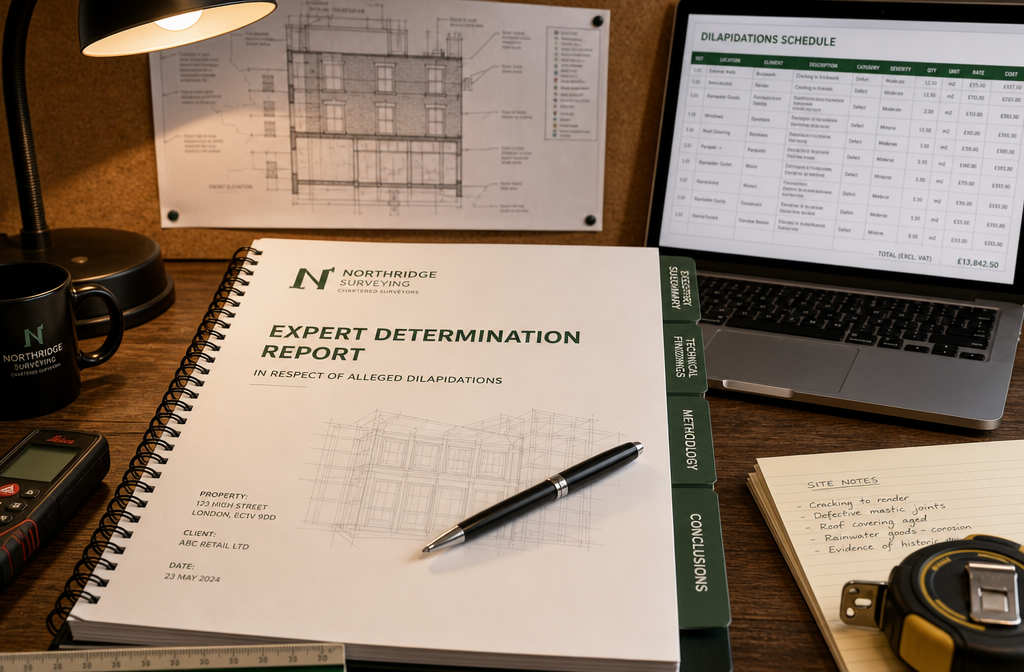
Best Practice for ADR Document Bundles
A well-constructed bundle for ADR proceedings should follow this structure:
Tab 1 — Expert's CV and Terms of Instruction
- RICS membership and relevant qualifications
- Statement of independence (or joint instruction letter)
- Scope of instruction
Tab 2 — Executive Summary
- Key findings in plain English
- Areas of agreement and disagreement
- Recommended resolution range (where appropriate)
Tab 3 — Main Technical Report
- Methodology
- Site inspection notes and dates
- Technical findings with supporting data
Tab 4 — Supporting Evidence
- Photographs (numbered and dated)
- Plans, drawings, and surveys
- Test results or third-party reports
Tab 5 — Appendices
- Correspondence relied upon
- Relevant standards or guidance (e.g., RICS guidance notes)
- Glossary of technical terms
💡 Tip: Every photograph should be numbered, dated, and cross-referenced to the relevant paragraph in the main report. An arbitrator should be able to move between the text and the evidence without confusion.
For disputes involving structural issues, a thorough structural survey forms the evidential backbone of the bundle and should be presented in full, not summarised.
Neutrality, Credibility, and the Overriding Duty
Whether in court or in an ADR forum, the expert witness surveyor's overriding duty is to the process, not to the client. This principle is enshrined in CPR Part 35 for litigation but applies equally — as a matter of professional ethics — in ADR.
Maintaining Neutrality Under Pressure
Clients under the stress of a dispute will sometimes push their expert to adopt stronger positions than the evidence supports. Surveyors must be prepared to:
- Acknowledge weaknesses in their own analysis
- Concede points to the opposing expert where the evidence warrants it
- Resist pressure to overstate conclusions
- Communicate clearly to the instructing party what the evidence can and cannot support
This is not weakness — it is the mark of a credible expert. An arbitrator or mediator who senses that an expert is acting as an advocate will discount their evidence accordingly.
The RICS Expert Witness Standard
The RICS Professional Standard Surveyors Acting as Expert Witnesses (currently in its 4th edition) sets out the core obligations. Key points include:
- The expert's duty to the tribunal overrides the duty to the client
- Opinions must be based on facts and sound methodology
- The expert must not suppress inconvenient facts
- The report must be the expert's own genuine opinion
Surveyors involved in party wall disputes or boundary disagreements will frequently encounter situations where ADR is the preferred route to resolution — and where these standards become directly relevant.
Practical Tips for Presenting Technical Evidence in ADR Sessions
Beyond the written report, surveyors are sometimes asked to present their findings verbally — in a mediation session, an arbitration hearing, or an expert determination meeting. Verbal presentation skills matter.
Do's and Don'ts for Verbal Presentation
Do:
- Speak slowly and clearly — the audience may not be technically trained
- Use visual aids (annotated plans, photographs on screen) to anchor complex points
- Summarise your key conclusions at the start and repeat them at the end
- Answer questions directly — do not deflect or over-qualify
- Acknowledge uncertainty where it genuinely exists
Don't:
- Use unexplained acronyms or industry jargon
- Argue with the opposing expert in a way that appears personal
- Speculate beyond the scope of your instruction
- Appear defensive when your methodology is questioned
For surveyors working across London — whether covering Wimbledon, Westminster, or Southwark — the variety of property types and dispute contexts encountered makes strong ADR presentation skills an increasingly valuable professional asset in 2026.
Common Disputes Where Expert Witness Surveyors in Mediation and ADR Add the Most Value
Understanding where surveyor expertise is most frequently called upon in ADR helps practitioners focus their preparation.
High-Value ADR Dispute Categories
| Dispute Type | Key Technical Issues | Typical ADR Forum |
|---|---|---|
| Dilapidations | Schedule of condition, repair obligations, diminution in value | Mediation / Arbitration |
| Boundary disputes | Title plan interpretation, physical features, adverse possession | Expert Determination |
| Party wall matters | Damage causation, schedule of condition | Agreed surveyor / Arbitration |
| Structural defects | Causation, extent of damage, remediation costs | Mediation / Arbitration |
| Lease extensions | Premium valuation, relativity | Tribunal / Expert Determination |
Each of these dispute types requires the surveyor to present highly specific technical evidence in a way that is accessible to a non-specialist decision-maker. The Party Wall Act 1996 itself contains a built-in dispute resolution mechanism that closely mirrors ADR principles — making party wall surveyors particularly well-placed to operate effectively in broader ADR contexts.
Conclusion: Actionable Next Steps for Surveyors in ADR
The role of Expert Witness Surveyors in Mediation and ADR: How to Present Technical Evidence Outside the Courtroom demands a distinct set of skills that go well beyond technical knowledge. Surveyors who master the art of adapting their reports, maintaining genuine neutrality, and presenting evidence clearly in non-courtroom settings will find themselves in high demand as ADR continues to grow as the preferred route for resolving property disputes in 2026 and beyond.
Actionable Next Steps ✅
- Review your standard report template — does it work for mediation and arbitration, or is it written purely for litigation?
- Familiarise yourself with the RICS Expert Witness Professional Standard — ensure your practice aligns with current requirements.
- Practise producing joint statements — seek opportunities to collaborate with opposing experts in lower-stakes disputes first.
- Invest in plain English writing skills — technical accuracy and accessibility are not mutually exclusive.
- Build your ADR-specific document bundle template — having a ready-made structure saves time and improves consistency.
- Seek CPD in ADR processes — RICS and the Chartered Institute of Arbitrators both offer relevant training.
The surveyor who can walk into a mediation room, present a clear and balanced technical report, and help two parties find common ground is not just a technical expert — they are a genuine dispute resolution asset.