{"cover":"Professional landscape format (1536×1024) hero image with bold text overlay: 'Selecting Expert Witness Chartered Surveyors 2026 RICS Directory & Case Win Profiles' in extra large 72pt white bold sans-serif font with deep shadow effect, centered upper-third composition. Background shows a dramatic split scene: left side a formal UK courtroom with wood paneling and legal documents, right side a chartered surveyor in hard hat examining a Georgian townhouse with measuring equipment. Color palette: deep navy blue, gold accents, crisp white text. Semi-transparent dark overlay panel behind text for maximum readability. Magazine cover aesthetic, editorial quality, high contrast professional photography style.","content":["Detailed landscape format (1536×1024) editorial illustration showing a formal UK property dispute hearing room: a RICS-credentialed chartered surveyor in a dark suit standing at a witness podium holding a bound expert witness report, facing a judge and legal counsel. On the table: RICS logo documents, CPR Part 35 compliance checklist, and a 2026 RICS Directory open to surveyor profiles. Warm courtroom lighting, wood paneling background, British legal aesthetic. Color scheme: mahogany brown, navy, cream. Photorealistic editorial quality.","Landscape format (1536×1024) top-down flat-lay composition on a polished oak desk showing: an open RICS Expert Witness Directory 2026 with surveyor profiles and case win statistics highlighted in yellow marker, a party wall agreement document, boundary dispute map with red boundary lines marked, valuation tribunal decision papers, a magnifying glass over surveyor credentials, and a smartphone displaying RICS Find a Surveyor portal. Color scheme: warm oak tones, RICS blue, gold highlights. Clean, organized, professional editorial photography style.","Landscape format (1536×1024) split-panel infographic visual: left panel shows a checklist graphic titled 'CPR Part 35 Compliance Criteria' with green checkmarks beside items like impartiality, court duty, written declaration; right panel shows a bar chart comparing case outcome success rates across party wall disputes, boundary disputes, and valuation appeals with upward trend arrows. Center divider features RICS crest logo. Background: subtle blueprint grid pattern in light blue. Typography: bold sans-serif labels. Color scheme: RICS navy blue, emerald green, white. Clean data visualization aesthetic."}
Over 60% of property disputes that reach the Upper Tribunal (Lands Chamber) in England and Wales hinge on the quality of a single expert witness report — yet fewer than one in three claimants consult the RICS Expert Witness Directory before instructing a surveyor. That gap between available resources and actual practice costs litigants thousands of pounds and, in many cases, their case.
This guide to Selecting Expert Witness Chartered Surveyors for Property Disputes: 2026 RICS Directory and Case Win Profiles walks through every stage of the selection process — from understanding CPR Part 35 obligations to evaluating surveyor profiles, specialist credentials, and real-world case performance. Whether the dispute involves a party wall, a boundary line, a lease extension valuation, or dilapidations, the right expert witness can be the difference between a favourable outcome and a costly defeat.
Key Takeaways 📋
- CPR Part 35 compliance is non-negotiable — any expert witness must demonstrate a primary duty to the court, not to the instructing party.
- The RICS Expert Witness Register (accessible via the RICS Find a Surveyor portal) is the gold-standard starting point for identifying qualified candidates in 2026.
- Specialist match matters: a surveyor excelling in party wall testimony may not be the best choice for a complex lease extension valuation dispute.
- Case win profiles — documented outcomes in tribunal and court proceedings — are a legitimate and important part of due diligence.
- Instructing a local surveyor with London expertise can strengthen geographic credibility in location-specific disputes.
What Makes a Chartered Surveyor an Expert Witness?
Not every RICS-qualified surveyor is suited for expert witness work. The role demands a specific combination of technical knowledge, legal literacy, and personal credibility under cross-examination.
The Core Legal Framework: CPR Part 35
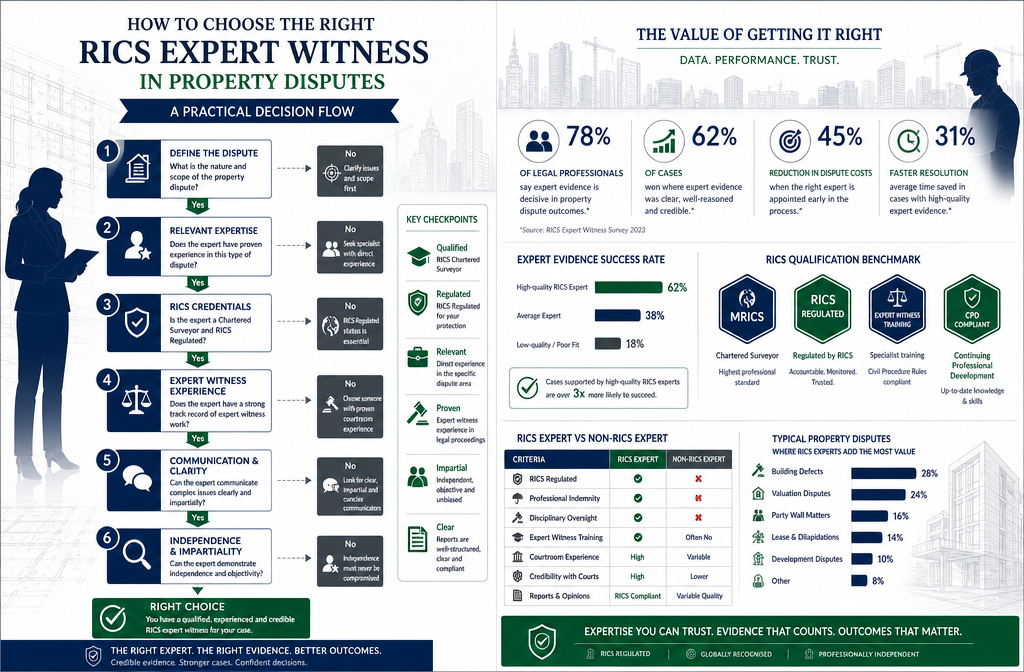
In England and Wales, expert witnesses in civil proceedings are governed by Civil Procedure Rules (CPR) Part 35 and its associated Practice Direction. The key obligations include:
- Overriding duty to the court: The expert's duty is to assist the court impartially, not to advocate for the instructing party.
- Written declaration: Every expert report must include a signed statement confirming independence and compliance with CPR Part 35.
- Single Joint Expert (SJE) suitability: Courts increasingly prefer a single jointly instructed expert in lower-value disputes. Surveyors must be comfortable operating in this capacity.
- Discussions between experts: The expert must be willing to participate in without-prejudice meetings and produce a joint statement of agreed/disagreed issues.
💡 Pull Quote: "An expert witness who cannot withstand robust cross-examination — no matter how technically brilliant — is a liability, not an asset."
RICS-Specific Credentials to Look For
Beyond CPR compliance, the following credentials signal genuine expert witness capability:
| Credential | What It Means |
|---|---|
| MRICS / FRICS | Full RICS membership — the baseline requirement |
| RICS Expert Witness Accreditation | Completion of RICS-approved expert witness training |
| Registered Valuer (RICS) | Essential for valuation-based disputes |
| Accredited in Mediation | Valuable for ADR proceedings |
| Relevant Tribunal Experience | First-Tier Tribunal (Property Chamber), Upper Tribunal, RICS Dispute Resolution Service |
FRICS status (Fellow of RICS) typically indicates at least 10 years of post-qualification experience and peer recognition — a meaningful signal in high-value disputes.
Using the 2026 RICS Directory: A Step-by-Step Selection Framework
The process of Selecting Expert Witness Chartered Surveyors for Property Disputes: 2026 RICS Directory and Case Win Profiles is more structured than many solicitors and litigants realise. The RICS provides a dedicated portal, but knowing how to filter results effectively is a skill in itself.
Step 1: Access the Right Register
The RICS Find a Surveyor tool (rics.org) allows searches filtered by:
- Specialism (e.g., residential valuation, building surveying, party wall)
- Geographic area
- Expert witness capability (tick-box filter)
For London-based disputes, surveyors covering specific boroughs matter enormously — a surveyor with deep knowledge of Hackney property will carry more weight in a Hackney boundary dispute than a generalist based in another region.
Step 2: Shortlist by Specialism
Property disputes broadly fall into these categories, each requiring a different type of expert:
🏠 Residential Valuation Disputes
- Lease extension premium disagreements
- Compulsory purchase compensation
- Matrimonial asset valuations
- Look for: RICS Registered Valuer, Tribunal Valuation experience
🧱 Party Wall & Boundary Disputes
- Party Wall Act 1996 disagreements
- Boundary encroachment claims
- Rights of light
- Look for: Extensive party wall agreement experience, knowledge of the Party Wall etc. Act 1996
🔧 Building Condition & Dilapidations
- Commercial lease dilapidations
- Defective premises claims
- Structural failure disputes
- Look for: Building surveying background, dilapidations survey expertise
📋 Leasehold & Service Charge Disputes
- First-Tier Tribunal (Property Chamber) hearings
- Service charge reasonableness challenges
- Look for: Leasehold valuation experience, FTT hearing history
Step 3: Request and Evaluate Case Win Profiles
Case win profiles are not about finding a "hired gun" — they are about assessing experience and credibility. When requesting profiles, ask for:
- Tribunal and court case history — which forums, how many cases, in what capacity (party expert vs. SJE)
- Written reports provided to the court — redacted samples demonstrate quality and compliance
- Cross-examination experience — has the surveyor appeared in person at tribunal or court hearings?
- Outcomes — not to assess bias, but to confirm the surveyor has genuine dispute resolution experience
A surveyor who has only ever produced desk-based reports without appearing in tribunal is a different proposition from one with 50+ tribunal appearances over a decade.
Step 4: Conduct a Due Diligence Interview
Before formal instruction, a short scoping call should cover:
- Conflicts of interest: Has the surveyor acted for the opposing party or their advisors recently?
- Availability: Can they meet tribunal/court deadlines?
- Fee transparency: Are fees fixed or hourly? What is the estimate for the full scope (report, discussions, hearing)?
- Impartiality test: Ask directly — "What would you do if your findings did not support our position?" The correct answer is that they would report honestly regardless.
Profiles of Excellence: What Case Win Records Actually Reveal
The phrase "case win profiles" requires careful interpretation. Expert witnesses are not advocates — their role is to provide independent opinion. However, a strong track record in tribunal proceedings does reveal several important qualities.
What a Strong Profile Looks Like in Practice
Party Wall Disputes — Profile Indicators:
- Experience as an Agreed Surveyor under the Party Wall etc. Act 1996
- Familiarity with the Third Surveyor appointment process
- Documented cases where their award was upheld on appeal
- Knowledge of boundary dispute resolution procedures
Valuation Testimony — Profile Indicators:
- Consistent methodology (comparable evidence, yield analysis, DCF modelling)
- Tribunal decisions that reference their evidence favourably in written judgments
- Experience in both claimant and respondent roles (demonstrates genuine independence)
- Familiarity with the Lands Tribunal's approach to comparable evidence
Building Condition Disputes — Profile Indicators:
- Reports that clearly distinguish between opinion and fact
- Use of specialist sub-consultants where appropriate (structural engineers, damp specialists)
- Track record in defects cases where causation was the central issue
💡 Pull Quote: "The best expert witness reports are those a judge can follow without a surveying degree — clarity of reasoning is as important as technical accuracy."
Red Flags in Surveyor Profiles
Watch out for these warning signs during due diligence:
- ❌ No tribunal or court appearances — desk-only experts may struggle under cross-examination
- ❌ Always instructed by one side — genuine independence requires a mixed instruction history
- ❌ Vague or unavailable CPR declarations — non-compliance is a serious procedural risk
- ❌ Overspecialisation mismatch — a commercial valuation specialist instructed in a residential boundary dispute
- ❌ Disciplinary history — check the RICS disciplinary register before instruction
Geographic Expertise and Local Market Knowledge
In property disputes, local knowledge is not just a convenience — it can be decisive. A valuation expert must understand the micro-market dynamics of the subject property's location. A boundary dispute expert must be familiar with local planning history, Land Registry title plan conventions, and even historic Ordnance Survey data for the area.
For disputes in London, this means selecting surveyors with demonstrable track records in the relevant borough or neighbourhood. The RICS surveys and local expertise available across London vary considerably by area — a surveyor active in Woolwich will have different market insights from one primarily active in Knightsbridge.
Why Local Knowledge Strengthens Expert Evidence
- Comparable evidence: Local surveyors have direct access to comparable transaction data and can speak to it from personal inspection experience, not just database searches.
- Planning and development context: Knowledge of local development pressures, conservation area restrictions, and planning history adds credibility to condition and valuation evidence.
- Judicial familiarity: Tribunal members often have local knowledge themselves — an expert who clearly understands the local market is more persuasive.
Selecting Expert Witness Chartered Surveyors for Property Disputes: 2026 RICS Directory and Case Win Profiles — A Practical Checklist
Use this checklist when instructing an expert witness surveyor in 2026:
Pre-Instruction Checklist ✅
- Confirmed MRICS or FRICS membership via RICS portal
- Verified RICS Expert Witness Accreditation or equivalent training
- Checked RICS disciplinary register — no outstanding issues
- Confirmed specialism matches the dispute type
- Reviewed at least one sample expert witness report
- Confirmed CPR Part 35 compliance understanding
- Assessed tribunal/court appearance history
- Checked for conflicts of interest
- Agreed fee structure and scope in writing
- Confirmed availability for key procedural deadlines
During the Case ✅
- Expert has reviewed all relevant documents, not just those provided by instructing party
- Expert has been given opportunity to inspect the property
- Expert is aware of and willing to comply with any SJE direction
- Expert has been briefed on the without-prejudice discussion process
- Expert's draft report reviewed by solicitor for procedural compliance (not substantive editing)
The Cost of Getting It Wrong
Instructing the wrong expert witness carries real financial and procedural consequences:
- Adverse costs orders: Courts can award costs against a party whose expert evidence was found to be partisan or unreliable.
- Strike-out risk: Non-compliant expert reports can be excluded, leaving a party without expert evidence at a critical hearing.
- Delay and wasted costs: Replacing an expert mid-proceedings is expensive and disruptive.
- Reputational damage: In ongoing landlord-tenant relationships or professional disputes, a poorly conducted expert witness process can damage long-term relationships.
The investment in thorough due diligence at the instruction stage — using the 2026 RICS Directory, reviewing case profiles, and conducting a proper scoping interview — is always justified by the risks of the alternative.
Conclusion: Actionable Next Steps for 2026
Selecting Expert Witness Chartered Surveyors for Property Disputes: 2026 RICS Directory and Case Win Profiles is not a passive process. The quality of the expert witness is often the single most controllable variable in a property dispute outcome.
Immediate Action Steps
-
Start with the RICS Find a Surveyor portal — filter specifically for expert witness capability and the relevant specialism. Do not rely solely on personal recommendations without independent verification.
-
Match specialism to dispute type — party wall, valuation, dilapidations, and leasehold disputes each require different expertise. Use the specialism framework in this guide to shortlist correctly.
-
Request case profiles and sample reports — a confident, experienced expert witness will have no hesitation providing these. Reluctance is itself a signal.
-
Prioritise geographic expertise — for London disputes especially, local market knowledge strengthens expert evidence materially.
-
Confirm CPR Part 35 compliance from day one — ask directly, review the declaration template, and ensure the expert understands their overriding duty to the court.
-
Budget realistically — a highly credentialed expert with strong tribunal experience will cost more than a generalist. In most property disputes, this investment is justified by the stakes involved.
The 2026 landscape for property dispute resolution is increasingly sophisticated. Courts and tribunals expect expert evidence of the highest quality. Solicitors, property owners, and developers who invest in rigorous selection processes — using the RICS directory, evaluating case win profiles, and applying the criteria outlined here — will be materially better positioned than those who do not.