

Over 60% of property dispute cases that proceed to UK tribunals involve contested valuations — yet fewer than one in three instructing solicitors fully understands what separates a court-ready RICS expert report from one that gets dismissed at the first hearing. In 2026, with automated valuation models (AVMs) increasingly being cited as evidence by opposing parties, the stakes for instructing the right valuation surveying expert witness have never been higher.
Valuation Surveying Expert Witnesses: Navigating 2026 Court Challenges with RICS Evidence Standards sits at the intersection of property law, professional regulation, and evidential credibility. This guide breaks down how qualified surveyors build authoritative, court-proof valuations, why RICS frameworks matter more than ever, and what property owners, solicitors, and developers need to know before stepping into any tribunal in 2026.
Key Takeaways 📌
- RICS-accredited expert witnesses must follow strict professional conduct standards that go beyond ordinary surveying practice, covering impartiality, methodology, and court procedure. [1]
- Automated Valuation Models (AVMs) are increasingly used as opposing evidence — but they lack the contextual depth that a qualified RICS valuation expert can provide. [3]
- The RICS Red Book (Global Valuation Standards) remains the gold standard framework for valuation evidence accepted in UK courts and tribunals. [5]
- Credibility on the RICS Firms Register significantly strengthens an expert witness's standing before judges and tribunal panels. [6]
- Early instruction of a valuation expert — before litigation commences — can shape case strategy and reduce overall dispute costs.

The Role of Valuation Experts in UK Property Disputes
Property disputes come in many forms: lease extensions, boundary disagreements, dilapidations claims, compulsory purchase challenges, matrimonial asset splits, and inheritance tax assessments. What they share is a need for independent, professionally credible valuation evidence that can withstand cross-examination.
A valuation surveying expert witness is not simply a surveyor who writes a report. Under the Civil Procedure Rules (CPR) Part 35, an expert's primary duty is to the court, not to the instructing party. This distinction is fundamental. RICS reinforces this obligation through its own professional standards, requiring members acting as expert witnesses to maintain impartiality, disclose conflicts of interest, and clearly separate fact from opinion. [1]
What Qualifies a Surveyor as an Expert Witness?
Not every RICS member is automatically qualified to act as an expert witness. The key criteria include:
| Qualification Factor | Why It Matters |
|---|---|
| RICS membership (MRICS/FRICS) | Demonstrates regulated professional competence |
| Specialist valuation experience | Ensures methodology is defensible under cross-examination |
| CPD in expert witness practice | Keeps the surveyor current with court procedure |
| Listing on RICS Firms Register | Provides verifiable credibility for instructing solicitors [6] |
| Familiarity with CPR Part 35 | Ensures procedurally compliant reports |
💡 Pull Quote: "An expert witness who does not understand their overriding duty to the court — regardless of who is paying their fee — risks having their evidence struck out entirely."
For property owners involved in disputes, understanding what RICS property valuations involve is a useful starting point before engaging expert witness services.
Common Dispute Types Requiring Valuation Expert Evidence
- 🏠 Residential lease extension (Leasehold Reform Act claims)
- 🏗️ Dilapidations at end of commercial tenancy
- ⚖️ Compulsory purchase and compensation assessments
- 💔 Matrimonial proceedings involving jointly owned property
- 🌿 Nuisance and damage claims (e.g., subsidence, Japanese knotweed encroachment)
- 🏚️ Boundary disputes affecting market value
RICS Evidence Standards: The Framework That Makes or Breaks a Case
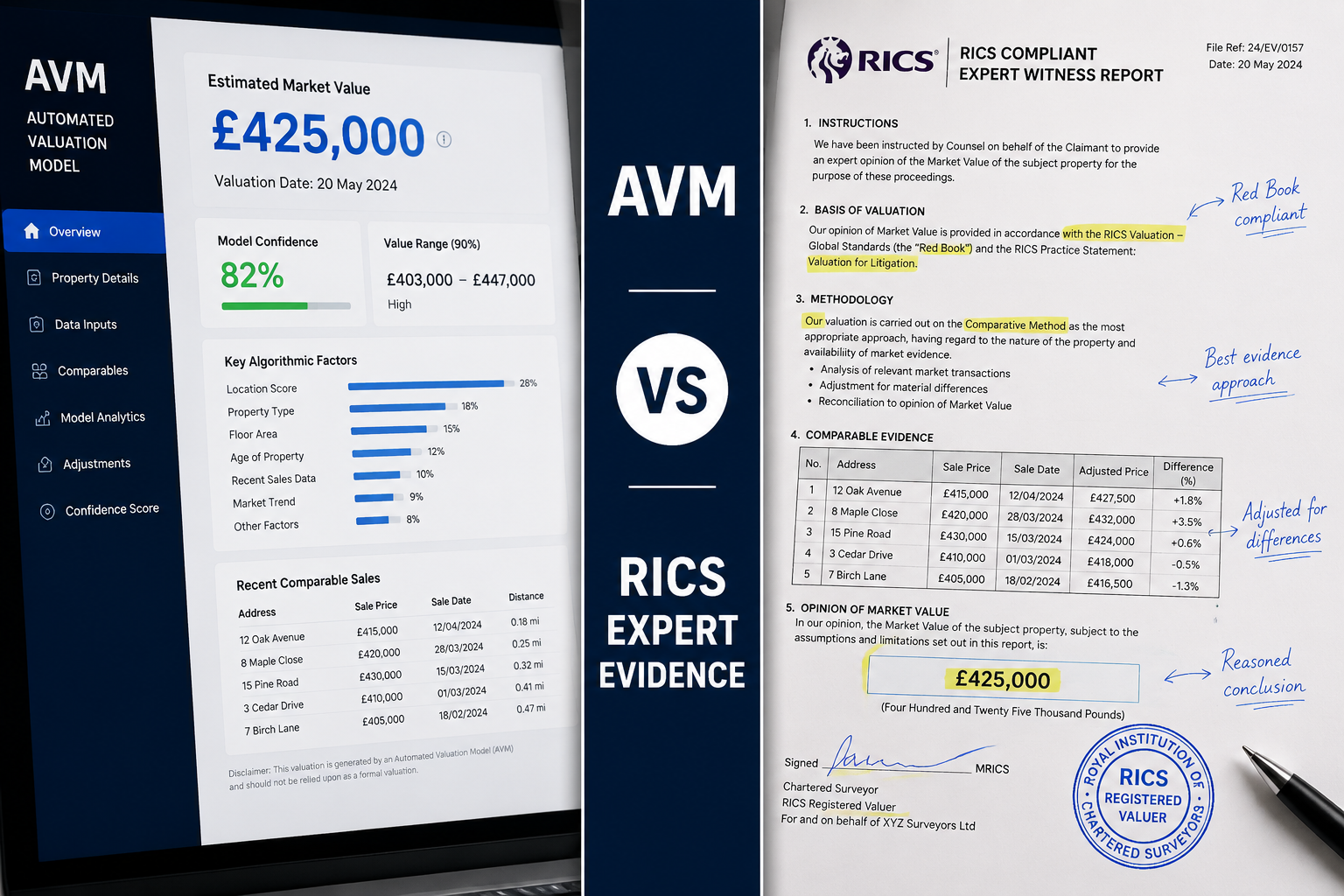
The RICS Valuation – Global Standards (commonly called the Red Book) set out the mandatory requirements for valuations carried out by RICS members. [5] In a litigation context, adherence to these standards is not merely best practice — it is often the difference between evidence being accepted or rejected.
Why the Red Book Matters in Court
Courts and tribunals in England and Wales expect valuation evidence to be:
- Methodologically transparent — the approach (comparable evidence, income capitalisation, residual method, etc.) must be clearly stated and justified.
- Independently verifiable — comparable transactions cited must be real, dated, and relevant.
- Proportionate — the depth of analysis should match the complexity and value of the dispute.
- Impartial — the valuer must not have acted for either party in a way that creates a conflict.
RICS Practice Alerts regularly update members on evolving regulatory expectations, including guidance on digital evidence and remote inspections. [4] In 2026, these updates have become particularly relevant as courts increasingly encounter digitally generated valuation evidence.
Countering AVMs in 2026 Court Proceedings
Automated Valuation Models have grown in sophistication. Mortgage lenders, insurers, and even some legal teams now present AVM outputs as a quick proxy for market value. However, AVMs carry significant limitations in a litigation context:
- They rely on historical transaction data and cannot account for property-specific condition
- They cannot assess access issues, structural defects, or planning constraints
- They provide a range estimate, not a reasoned professional opinion
- They are not produced by a named, accountable professional subject to cross-examination [3]
A skilled RICS valuation expert witness can systematically dismantle AVM evidence by demonstrating these gaps. The expert's report should include a direct comparison between the AVM methodology and the Red Book-compliant approach, highlighting why the latter produces a more reliable figure for the specific property in dispute. [5]
For context on how professional valuations are structured in practice, the Red Book valuation guide for Wimbledon and London provides a clear overview of what a compliant valuation report contains.
The Single Joint Expert vs. Party-Appointed Expert
Courts sometimes direct parties to use a Single Joint Expert (SJE) to reduce costs and avoid a "battle of experts." In other cases, each party appoints their own expert. Understanding which route applies — and the strategic implications — is critical:
| Appointment Type | Pros | Cons |
|---|---|---|
| Single Joint Expert | Cost-effective, court-preferred | Less control over methodology |
| Party-Appointed Expert | Full control over instruction | Risk of adversarial perception |
| Agreed Statement of Facts | Narrows issues efficiently | Requires cooperation from both sides |
Solicitors instructing valuation experts should consider the court costs implications of each route early in the dispute process.
Building Credibility: Strategies from RICS Register Listings and Professional Standards
Credibility is the currency of expert witness work. A valuation surveyor may produce a technically flawless report, but if their professional standing cannot be verified, opposing counsel will exploit that gap. In 2026, verifiable credentials matter more than ever as courts become more sophisticated in scrutinising expert qualifications.
Using the RICS Firms Register Strategically
The RICS Firms Register is a publicly searchable database of regulated firms. Instructing solicitors and judges increasingly use it to verify:
- Regulatory compliance of the firm providing the expert
- Scope of regulated activities (ensuring valuation is included)
- Insurance and professional indemnity coverage [6]
Surveyors acting as expert witnesses should ensure their firm's register entry is current, accurate, and clearly reflects valuation expertise. This is a simple but often overlooked step that directly impacts perceived credibility in court. [2]
Structuring a Court-Ready Valuation Report
A RICS-compliant expert witness report for court proceedings should include the following sections:
- Expert's declaration — confirming understanding of CPR Part 35 duties
- Instructions received — transparent statement of what was asked
- Scope of inspection — what was and was not inspected, and why
- Methodology — Red Book-compliant approach with reasoning [5]
- Comparable evidence — minimum three to five verified comparables
- Valuation opinion — stated as a specific figure or narrow range
- Matters outside expertise — honest acknowledgement of limitations
- Statement of truth — signed declaration required by the court
💡 Pull Quote: "The most persuasive expert witness reports are not the longest — they are the clearest. Judges value precision and intellectual honesty over exhaustive detail."
The Importance of Pre-Litigation Instruction
One of the most effective strategies available to property dispute parties is instructing a valuation expert before proceedings commence. Early involvement allows the expert to:
- Advise on the realistic range of values to inform settlement negotiations
- Identify weaknesses in the opposing party's likely valuation approach
- Help structure the pleadings so that valuation issues are framed correctly
- Potentially resolve the dispute without reaching tribunal at all
This approach aligns with the court's expectation that parties attempt pre-action resolution. For those navigating disputes following a survey, understanding how to renegotiate after a poor building survey result can also inform early strategy.
Specialist Areas Requiring Expert Valuation Evidence in 2026
Several property dispute categories have seen increased activity in 2026:
🏢 Leasehold Reform Disputes
The ongoing implementation of leasehold reform legislation has generated a significant volume of First-tier Tribunal (Property Chamber) cases. Valuation experts are central to determining the premium payable for lease extensions and freehold acquisitions.
🌊 Environmental and Climate-Related Diminution
Flood risk, subsidence from tree roots, and energy efficiency rating impacts on value are increasingly contested. Experts must demonstrate familiarity with current market evidence on these factors. For subsidence-related disputes, understanding how garden trees can cause subsidence is directly relevant.
🏗️ Development Viability Disputes
Planning appeals and compulsory purchase cases frequently turn on residual land valuations. These require experts with specific development appraisal expertise beyond standard residential valuation.
⚖️ Boundary and Encroachment Claims
Where a boundary dispute affects property value, a valuation expert may be needed alongside a boundary surveyor. Understanding boundary dispute costs helps parties budget realistically for expert instruction.
Maintaining Expert Witness Competence
RICS requires members to maintain continuing professional development (CPD) relevant to their practice areas. [1] For expert witnesses, this includes:
- Attending RICS dispute resolution training events
- Reviewing tribunal and court decisions involving valuation evidence
- Participating in mock cross-examination exercises
- Staying current with RICS Practice Alerts on regulatory changes [4]
Surveyors who treat expert witness work as a distinct professional discipline — rather than an extension of ordinary valuation practice — consistently produce more defensible reports and perform better under cross-examination.
How to Find and Instruct the Right Valuation Expert Witness
Given the complexity outlined above, selecting the right expert is a critical decision. The following checklist provides practical guidance:
✅ Expert Witness Selection Checklist
- Verified RICS membership (MRICS or FRICS) with valuation competency
- Listed on RICS Firms Register with current regulated status [6]
- Demonstrable experience in the specific dispute type (residential, commercial, leasehold, etc.)
- Familiarity with CPR Part 35 and tribunal-specific procedural rules
- No conflict of interest with either party or the subject property
- Clear fee structure with realistic timeline for report delivery
- Willingness to attend joint expert meetings and give oral evidence if required
For those seeking qualified local surveyors with the professional depth needed for expert witness work, resources like how to find the best local surveyor near you offer practical starting points.
Conclusion: Actionable Next Steps for 2026 Property Disputes
Valuation Surveying Expert Witnesses: Navigating 2026 Court Challenges with RICS Evidence Standards is not a passive subject — it demands proactive decisions from property owners, solicitors, and developers alike.
The rise of AVM evidence, the complexity of leasehold reform cases, and the courts' increasing scrutiny of expert credentials all point in the same direction: the quality of your valuation expert witness is a strategic asset, not an administrative afterthought.
Actionable Next Steps 🎯
- Instruct early. Engage a RICS-accredited valuation expert before proceedings commence to shape strategy and explore settlement.
- Verify credentials. Check the RICS Firms Register and confirm the expert's specific experience in your dispute type. [6]
- Understand the framework. Familiarise yourself with Red Book standards so you can assess the quality of reports produced. [5]
- Challenge AVM evidence. If the opposing party relies on automated valuations, instruct your expert to produce a detailed methodological critique. [3]
- Budget for quality. A well-qualified expert witness costs more upfront but dramatically reduces the risk of losing a case on evidential grounds.
- Stay updated. Monitor RICS Practice Alerts for regulatory changes that may affect valuation methodology in your dispute category. [4]
The property disputes landscape in 2026 rewards those who treat valuation evidence as a discipline requiring the same rigour as legal argument. With the right RICS-accredited expert at the table, the evidential foundation of any property case becomes significantly stronger.
References
[1] Surveyors Acting As Expert Witnesses – https://www.rics.org/profession-standards/rics-standards-and-guidance/sector-standards/dispute-resolution-standards/surveyors-acting-as-expert-witnesses
[2] RICS Expert Witness – https://www.jamesscottassociates.com/rics-expert-witness/
[3] RICS Valuation Expert Witness Services – https://edsltd.com/rics-valuation-expert-witness-services/
[4] Regulation Practice Alerts – https://www.rics.org/regulation/how-we-regulate/regulation-practice-alerts
[5] Valuation Standards – https://www.rics.org/profession-standards/rics-standards-and-guidance/sector-standards/valuation-standards
[6] Expert Witness – https://www.ricsfirms.com/residential/legal-issues/expert-witness/