
Over one in five UK landlords considered selling at least one rental property in early 2026 — not because of falling rents, but because of mounting compliance costs, tax reform, and an entirely new legal framework for the private rented sector [1]. For those still buying, the stakes around due diligence have never been higher.
Pre‑Purchase Building Surveys for UK Landlords: Assessing Rental Stock Risks After Tax and Regulatory Changes is no longer a box-ticking exercise. In 2026's regulatory environment, a thorough pre-purchase survey is one of the most powerful risk-management tools a buy-to-let (BTL) investor can deploy — protecting yield, ensuring compliance, and informing long-term financial modelling.
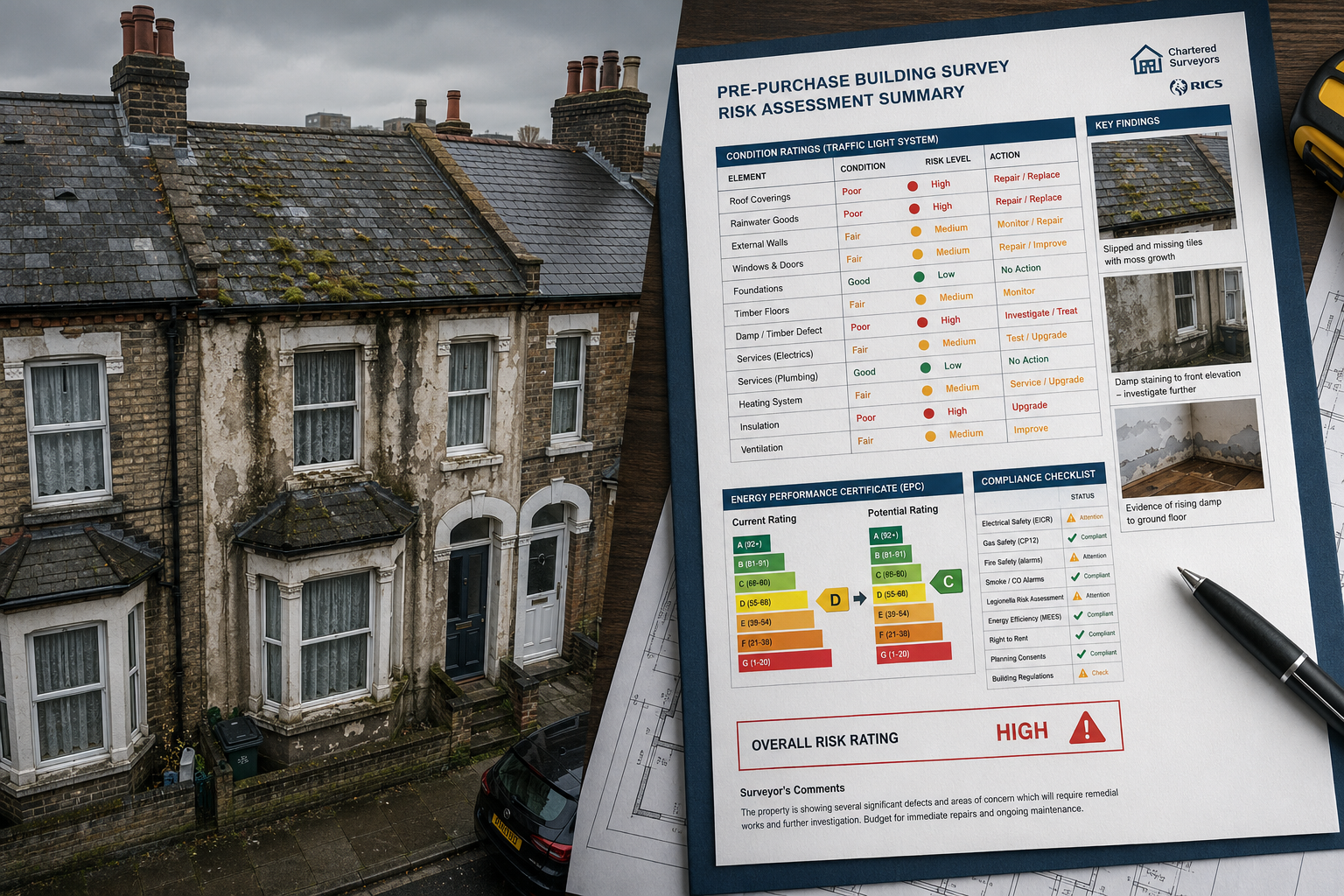
Key Takeaways 📋
- The Renters' Rights Act 2025, in force from 1 May 2026, dramatically raises compliance risk for landlords — making pre-purchase physical and legal due diligence essential [8].
- A Level 2 or Level 3 building survey should now include EPC upgrade feasibility, fire safety, damp and mould risk, and HHSRS hazard assessment — not just structural condition.
- Forthcoming Private Rented Sector (PRS) database registration will tie possession rights to compliance records, so historic issues on a property can affect future landlord rights [4].
- Tax changes — including higher stamp duty on additional dwellings and the phasing out of mortgage interest relief — mean survey data must feed directly into yield and tax modelling.
- Landlords acquiring stock in 2026 should treat the survey report as a financial planning document, not merely a structural checklist.
Why the Regulatory Landscape Has Changed Everything
The private rented sector in England entered a new era on 1 May 2026, when the Renters' Rights Act 2025 came into force [8]. The Act abolishes Section 21 "no-fault" evictions entirely, replaces fixed-term tenancies with periodic tenancies, and introduces a reformed Section 8 possession framework with stricter grounds and notice requirements [7].
For landlords purchasing new stock, this creates a fundamental shift in risk calculus. A property with hidden defects — damp, structural movement, fire safety gaps — is no longer just a maintenance headache. Under the new regime, tenants have stronger rights to demand repairs, and a landlord's failure to maintain a property to the required standard can trigger possession challenges, rent repayment orders, and civil penalties [5].
💡 Pull Quote: "In 2026, a pre-purchase building survey is not just about what you're buying — it's about what legal obligations you're inheriting."
The Private Rented Sector Database: A New Layer of Risk
From late 2026, a new national PRS database will require all private landlords in England to register their properties [4]. Critically, possession rights under the new Section 8 framework will be tied to valid registration. This means that if a property being purchased has a history of non-compliance — unlicensed HMO status, outstanding enforcement notices, or unresolved hazard notices — the buyer inherits those problems [4].
Pre-purchase due diligence must therefore extend beyond the physical fabric of the building to include a review of the property's compliance history. A building condition assessment from a qualified RICS surveyor, combined with local authority searches, provides the clearest picture of inherited risk.
Understanding Survey Types: Matching the Tool to the Risk
Not all surveys are equal, and in the current climate, choosing the right level of inspection is itself a risk-management decision.
RICS Survey Levels Explained
| Survey Level | Best For | What It Covers |
|---|---|---|
| Level 1 (Condition Report) | New-build or recently refurbished properties | Basic traffic-light condition ratings; no advice on repairs |
| Level 2 (HomeBuyer Report) | Standard properties in reasonable condition | Condition ratings, visible defects, market valuation option |
| Level 3 (Building Survey) | Older, larger, or non-standard properties | Full structural inspection, repair advice, cost estimates |
For most BTL acquisitions in 2026 — particularly older Victorian and Edwardian terraced stock that dominates the rental market — a Level 3 Building Survey is strongly advisable. Understanding the key difference between Level 2 and Level 3 surveys is essential before commissioning any inspection.
A Level 3 report provides costed repair estimates, which feed directly into financial modelling. A Level 2 report, while cheaper upfront, may miss the structural or latent defects that become costly liabilities post-completion. You can download an example of a HomeBuyers Report to understand what a typical survey document contains before instructing a surveyor.
When to Commission a Stock Condition Survey
Landlords acquiring multiple units — whether a small portfolio or a block of flats — should consider a stock condition survey, which assesses the condition of each unit systematically and produces a planned maintenance schedule. This is particularly valuable when:
- Purchasing an existing portfolio from a retiring landlord
- Acquiring a converted or purpose-built block
- Assessing deferred maintenance liability before negotiating price
The Six Critical Risk Areas Every Survey Must Address

Pre‑Purchase Building Surveys for UK Landlords: Assessing Rental Stock Risks After Tax and Regulatory Changes — The Compliance Checklist
A modern pre-purchase survey for BTL investors should systematically assess six key risk areas:
1. 🔥 Fire Safety Compliance
Since the Grenfell Tower tragedy and subsequent legislation, fire safety obligations for landlords have expanded significantly. Pre-purchase surveys should check:
- Presence and condition of smoke and carbon monoxide alarms (required under the Smoke and Carbon Monoxide Alarm (Amendment) Regulations 2022)
- Fire door compliance in HMOs and converted blocks
- Electrical Installation Condition Report (EICR) status — mandatory every 5 years
- Evidence of fire risk assessments for communal areas
A property with outstanding fire safety deficiencies is a liability from day one. Remediation costs should be factored into the purchase price negotiation.
2. 💧 Damp, Mould, and HHSRS Hazards
The Housing Health and Safety Rating System (HHSRS) provides the legal framework for assessing housing hazards. Since the Awaab's Law provisions within the Renters' Rights Act 2025, landlords face strict timeframes for investigating and remedying damp and mould — with serious consequences for non-compliance [8].
A pre-purchase survey should identify:
- Rising damp, penetrating damp, or condensation issues
- Evidence of previous mould remediation (and whether root causes were addressed)
- Poor ventilation in bathrooms, kitchens, and roof voids
- Defective rainwater goods, pointing, or roof coverings
Specialist London damp surveys can provide detailed moisture mapping where a standard survey flags concern.
3. ⚡ EPC Rating and Energy Upgrade Feasibility
This is arguably the most financially significant risk area for BTL investors in 2026. The government is actively consulting on raising the minimum EPC standard for private rented homes from Band E to Band C, with implementation expected in the late 2020s.
A property currently rated D or E may require:
| Upgrade Measure | Typical Cost Range (2026) |
|---|---|
| Cavity wall insulation | £500 – £1,500 |
| Loft insulation (top-up) | £300 – £600 |
| External wall insulation (solid walls) | £8,000 – £20,000+ |
| Heat pump installation | £7,000 – £15,000 |
| Double glazing replacement | £3,000 – £8,000 |
A surveyor should assess not just the current EPC rating but the feasibility and cost of achieving Band C — particularly for solid-walled Victorian properties where upgrade costs can be prohibitive. This data is essential for yield modelling.
4. 🏗️ Structural Integrity and Latent Defects
Standard structural risks remain central to any pre-purchase survey:
- Subsidence and heave — particularly relevant in clay-soil areas of London and the South East. Tree-related subsidence is a well-documented risk that surveyors should assess carefully.
- Roof condition — flat roofs, aging lead flashings, and failing felt coverings
- Chimney stacks and party walls — shared structural elements with neighbour liability implications
- Foundation depth — relevant for older properties and those near trees
5. 📋 Regulatory and Licensing Status
Pre-purchase due diligence should confirm:
- Whether the property requires an HMO licence (mandatory or additional licensing scheme)
- Compliance with selective licensing schemes in the local authority area
- Outstanding enforcement notices or improvement notices
- Planning permission status for any conversions or extensions
Properties in areas with selective licensing schemes — now operating in dozens of London boroughs and other cities — carry ongoing annual costs that must be factored into yield calculations.
6. 🔧 Planned Maintenance Liability
A Level 3 survey provides repair cost estimates, but landlords should push for a 5–10 year maintenance schedule as part of their due diligence. Key items to assess include:
- Remaining lifespan of the roof covering
- Condition of external joinery and decoration
- Boiler age and efficiency (and heat pump readiness)
- Electrical wiring age and condition
Tax Changes and Why Survey Data Now Feeds Financial Models
Pre‑Purchase Building Surveys for UK Landlords: Assessing Rental Stock Risks After Tax and Regulatory Changes — The Financial Dimension
The tax environment for UK landlords has been transformed over the past decade, and 2026 brings further complexity [1]. Key considerations include:
Stamp Duty Land Tax (SDLT): The additional 3% surcharge on second homes and BTL properties was increased to 5% in October 2024, adding significant upfront acquisition costs for investors.
Mortgage Interest Relief: Section 24 restrictions mean landlords can only claim a 20% tax credit on mortgage interest — a major squeeze on higher-rate taxpayers' net yields.
Capital Gains Tax (CGT): CGT rates on residential property disposals remain at 18% (basic rate) and 24% (higher rate) following the 2024 Autumn Budget changes.
Making Tax Digital (MTD): From April 2026, landlords with rental income above £50,000 are required to use MTD-compatible software for quarterly reporting. This digitisation means landlords need accurate, costed data on property condition and planned expenditure — data that a thorough survey provides [1].
💡 Pull Quote: "A survey that quantifies repair costs and planned maintenance expenditure is not just a property document — it's a tax planning tool."
Repair costs identified in a pre-purchase survey can inform:
- Price negotiation — reducing the purchase price to reflect remediation costs
- Capital vs. revenue expenditure classification — relevant for tax relief eligibility
- Long-term yield modelling — ensuring net returns remain viable after compliance costs
The RICS February 2026 residential market survey noted continued caution among BTL investors, with landlord instructions to sell outpacing new BTL purchases in most regions [10]. In this environment, investors who proceed must do so with rigorous due diligence — and a comprehensive pre-purchase survey is the foundation of that process.
Preparing for Your Survey: Maximising Its Value
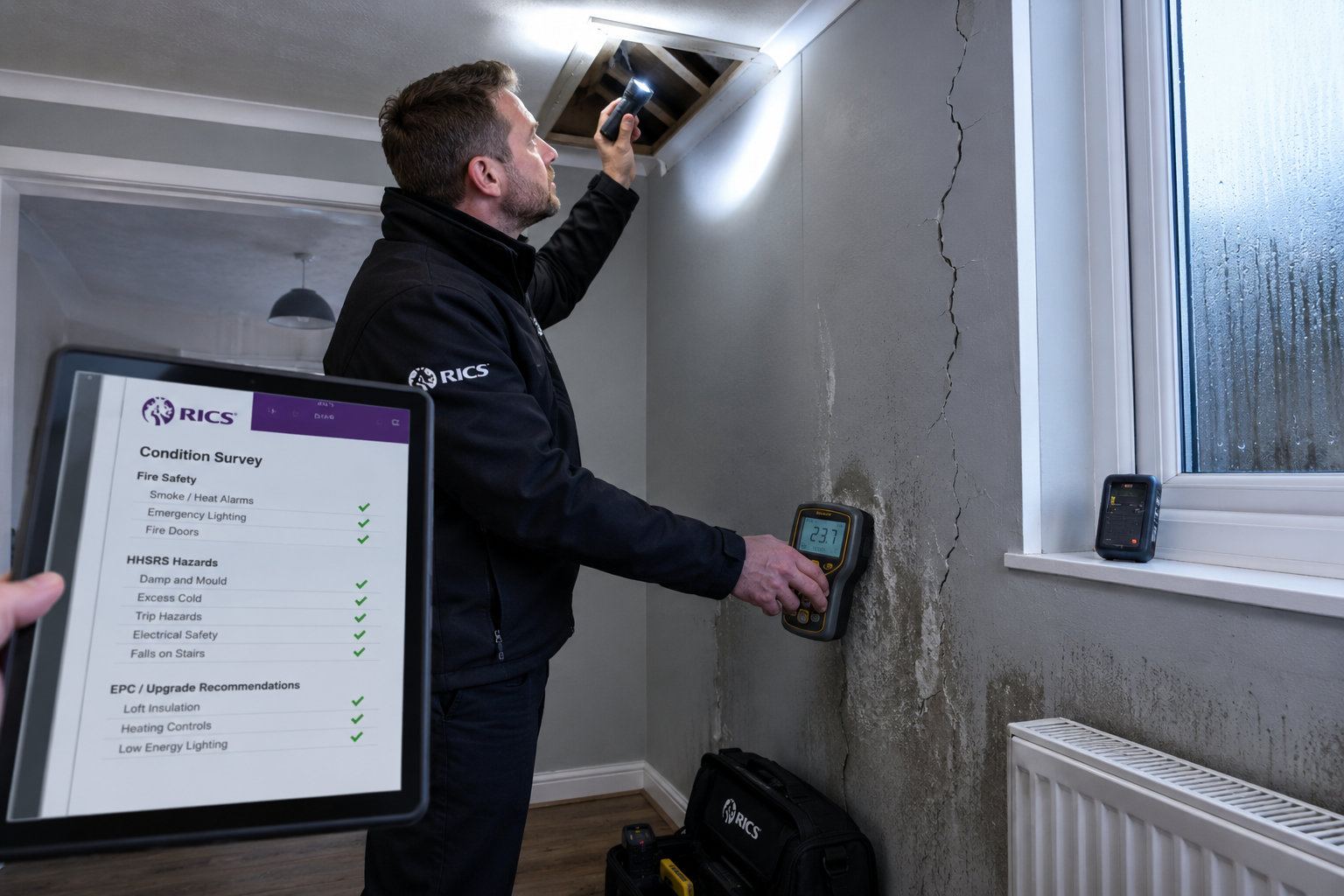
Practical Steps Before Instructing a Surveyor
Getting maximum value from a pre-purchase survey requires preparation. Key steps include:
-
Instruct a RICS-qualified surveyor with specific experience in the property type and location. Local expertise matters — a RICS HomeBuyer Survey from a surveyor familiar with local stock is more valuable than a generic national report.
-
Request specific BTL-relevant additions — ask the surveyor to comment explicitly on EPC upgrade feasibility, fire safety compliance, damp and mould risk, and HMO suitability if relevant.
-
Review what to do before an RICS home survey — preparing access to all areas of the property, including loft spaces, cellars, and outbuildings, ensures nothing is missed. See this pre-survey preparation guide for a full checklist.
-
Cross-reference with local authority data — request a local authority search to check for enforcement notices, licensing requirements, and planning history.
-
Use survey data in price negotiation — a Level 3 survey with costed repairs provides a clear basis for renegotiating the purchase price or requesting remediation before exchange.
Choosing the Right Surveyor for Your Location
Surveyor local knowledge is genuinely valuable. A surveyor familiar with the specific challenges of a given area — whether that's clay-soil subsidence risk in South London, Victorian terrace stock in North London, or post-war flat conversions in East London — will provide more actionable intelligence. Professional surveyors covering areas including Wimbledon, Lewisham, Newham, and Stratford bring area-specific insight that national providers often lack.
Conclusion: The Survey as a Strategic Investment Tool
The case for Pre‑Purchase Building Surveys for UK Landlords: Assessing Rental Stock Risks After Tax and Regulatory Changes has never been stronger. In 2026's environment — defined by the Renters' Rights Act, forthcoming PRS database registration, EPC upgrade obligations, and a more demanding tax regime — the cost of inadequate due diligence can dwarf the cost of the survey itself.
A comprehensive Level 3 building survey, properly scoped for the BTL context, delivers:
- ✅ Compliance risk identification before legal obligations are inherited
- ✅ Costed repair data for price negotiation and tax planning
- ✅ EPC upgrade feasibility for long-term yield modelling
- ✅ Fire safety and HHSRS hazard assessment to avoid enforcement action
- ✅ Planned maintenance schedules for accurate cash flow forecasting
Actionable Next Steps for Landlords in 2026
- Before making an offer: Commission a desktop review of the property's compliance history, licensing status, and EPC rating.
- After offer acceptance: Instruct a RICS Level 3 Building Survey with explicit BTL-specific scope additions.
- On receipt of the report: Use costed repair estimates to renegotiate price or request vendor remediation.
- Before completion: Confirm PRS database registration eligibility and resolve any outstanding compliance issues.
- Post-purchase: Use the survey's maintenance schedule to build a 5-year capital expenditure plan for MTD reporting purposes.
The landlords who thrive in 2026 and beyond will be those who treat due diligence as a competitive advantage — not a compliance cost.
References
[1] Landlords 2026 – https://theindependentlandlord.com/landlords-2026/
[4] Changes For Property Lawyers To Expect In 2026 – https://broadfield-law.com/thought-leadership/changes-for-property-lawyers-to-expect-in-2026/
[5] Selling A Rental Property In 2026 How The New Renters Rights Bill Affects You – https://www.gorvinsresidential.com/selling-a-rental-property-in-2026-how-the-new-renters-rights-bill-affects-you/
[7] Renters Rights – https://www.nrla.org.uk/resources/renters-rights
[8] How Landlords Can Best Prepare For Changes In May 2026 – https://jacksons.law/news/how-landlords-can-best-prepare-for-changes-in-may-2026/
[10] UK Residential Market Survey February 2026 – https://www.rics.org/content/dam/ricsglobal/documents/market-surveys/uk-residential-market-survey/UK-Residential-Market-Survey_February-2026.pdf