Over 40% of party wall disputes in England and Wales arise not from genuine disagreements about building works — but from procedural errors made before a single brick is laid. Missed notice deadlines, incorrectly appointed surveyors, and poorly drafted awards cost homeowners thousands of pounds and months of delay every year. With the Royal Institution of Chartered Surveyors (RICS) now consulting on its landmark 8th edition of Party Wall Legislation and Procedure in 2026, understanding the full process has never been more important.
This guide covers Party Wall Awards Explained: Surveyor Roles, Notice Periods, and Dispute Resolution Under 2026 RICS Guidance — breaking down every stage from serving notice to resolving disputes, with practical checklists for building owners planning extensions, loft conversions, or excavations.
Key Takeaways
- 📋 Two routes exist before works begin: a written agreement from the adjoining owner OR a formal Party Wall Award prepared by an independent surveyor.
- ⏱️ Notice periods vary — one month for most works, two months for works directly to the party wall itself.
- 🏗️ A Party Wall Award must include a schedule of condition with photographs to protect both parties.
- ⚖️ Surveyor independence is a legal requirement — the 2026 RICS draft guidance strengthens this rule explicitly.
- 🔄 The Third Surveyor acts as a referee if the two appointed surveyors cannot agree.
What Is a Party Wall Award and Why Does It Matter?
A Party Wall Award (sometimes called a "party wall agreement") is a legally binding document prepared under the Party Wall etc. Act 1996. It sets out the rights and responsibilities of both the Building Owner (the person carrying out the works) and the Adjoining Owner (the neighbour whose property is affected).
💬 "A Party Wall Award is not just paperwork — it is the legal shield that protects both parties if something goes wrong during construction."
The award covers:
- Description of the proposed works in precise detail
- Working hours and access arrangements
- A schedule of condition with photographs of the adjoining property before works start [4]
- Compensation provisions if damage occurs
- Cost allocation between the parties
Without a valid award in place, a building owner who causes damage has far weaker legal protection, and an adjoining owner has far less recourse. For anyone planning a rear extension or basement excavation in London, understanding this document is essential. You can explore what a party wall agreement involves in plain terms before diving into the formal process.
Understanding Notice Periods Under the Party Wall etc. Act 1996
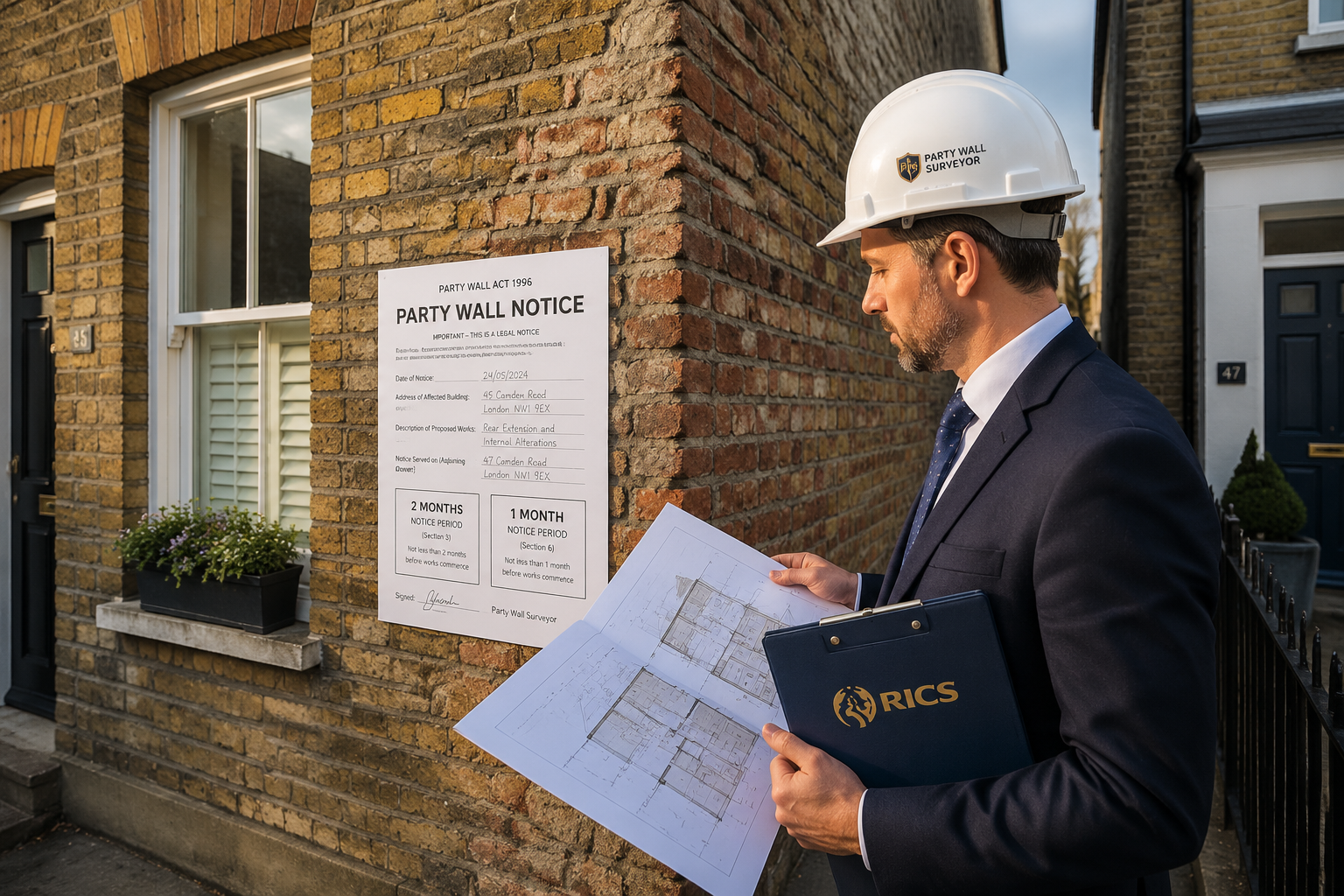
One of the most common — and costly — mistakes building owners make is serving notice too late. The Act specifies different notice periods depending on the type of work involved.
Notice Period Summary Table
| Type of Work | Notice Required | Notice Period |
|---|---|---|
| Works to the party wall itself (e.g., raising, cutting into) | Party Structure Notice | 2 months |
| New building at or astride the boundary line | Line of Junction Notice | 1 month |
| Excavation within 3m or 6m of neighbour's foundations | 3m/6m Notice | 1 month |
Key Rules on Notice Service
- Notices must be served in writing — verbal notification has no legal standing.
- Once a Party Wall Notice is formally served, the Building Owner has up to one year to commence the building works [4]. If works do not start within that window, a fresh notice must be served.
- Adjoining owners have 14 days to respond. If they do not respond, a dispute is deemed to have arisen automatically.
- Notices can be hand-delivered, sent by post, or served electronically if the adjoining owner has agreed to receive them that way.
✅ Building Owner Notice Checklist
- Identify all adjoining owners (including upstairs/downstairs in flats)
- Confirm the correct notice type for your specific works
- Serve notice in writing with full property address and description of works
- Keep proof of service (recorded delivery, signed receipt)
- Diarise the response deadline (14 days)
- Do not commence works until the process is complete
For clarity on when you actually need a party wall agreement, it is worth checking whether your project triggers the Act at all — not every building job does.
Surveyor Roles: Agreed Model vs. Two-Surveyor Model
Party Wall Awards Explained: The Two Routes to an Award
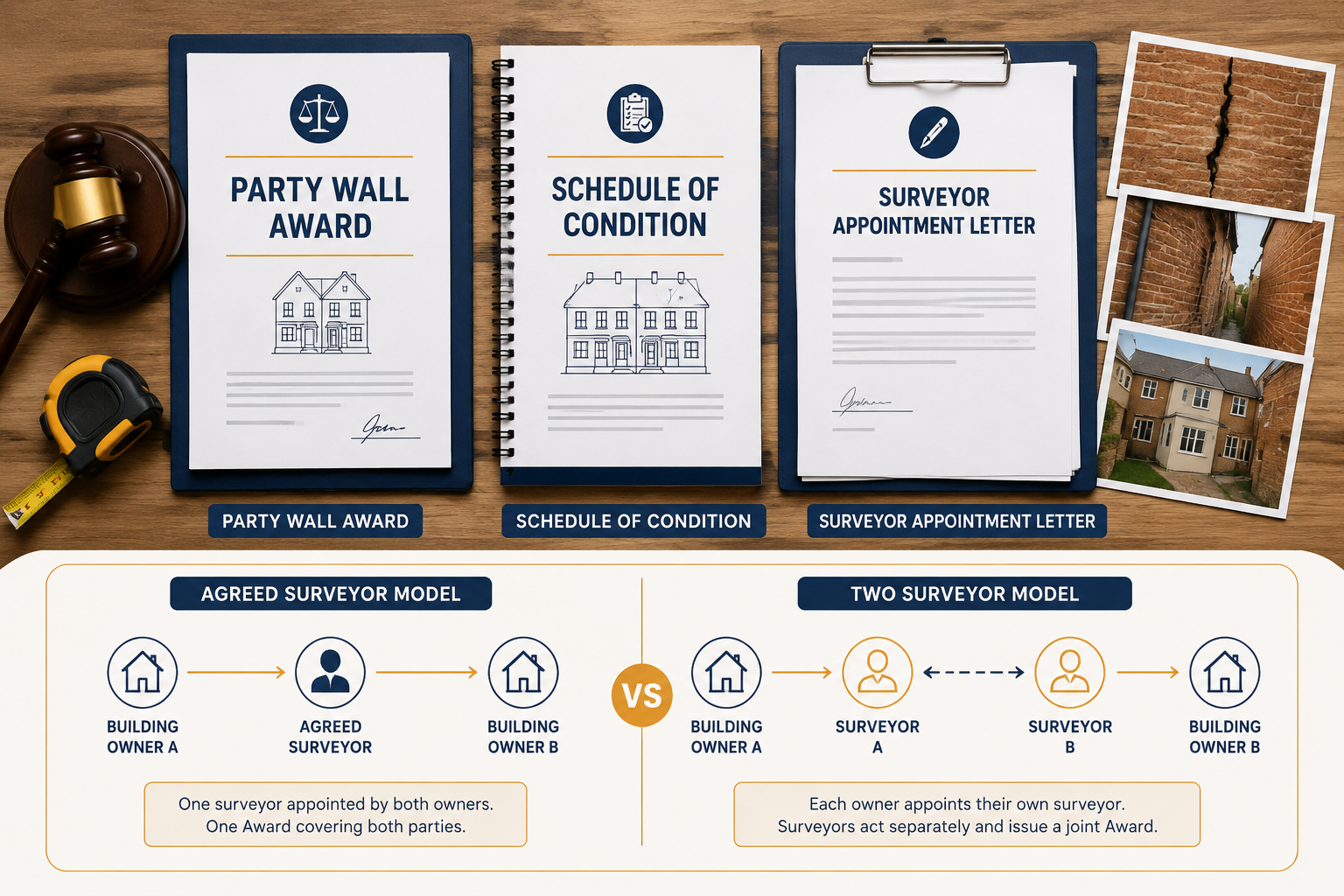
Once a dispute is deemed to have arisen (either because the adjoining owner dissents or fails to respond), the parties must appoint surveyors. There are two models under the Act [4]:
🤝 Model 1: The Agreed Surveyor
Both parties jointly appoint a single independent surveyor to act for both of them. This is faster and cheaper, but only works when both parties trust the process.
Important rule: The agreed surveyor must be independent and NOT the same surveyor already employed by the building owner for their own project [4]. An adjoining owner is unlikely to view a shared surveyor as neutral if that surveyor has a pre-existing relationship with the building owner.
⚖️ Model 2: Two Surveyors (One Each)
Each party appoints their own surveyor. The two surveyors then work together to prepare the Party Wall Award. If they cannot agree, they refer the matter to a Third Surveyor — selected at the outset by both surveyors.
Comparison Table: Agreed vs. Two-Surveyor Model
| Factor | Agreed Surveyor | Two Surveyors |
|---|---|---|
| Cost | Lower (one fee) | Higher (two fees + potential third) |
| Speed | Faster | Slower |
| Perceived neutrality | May be questioned | Higher — each party has representation |
| Best for | Straightforward works, cooperative neighbours | Complex works, disputes, high-value properties |
Understanding party wall surveyor fees is important before choosing a model, as costs can vary significantly depending on the complexity of the project and the number of surveyors involved.
The Role of the Third Surveyor
The Third Surveyor is not an arbitrator brought in after a dispute — they are selected at the very beginning of the two-surveyor process as a standing referee. Their role is to resolve disagreements between the two appointed surveyors if they cannot reach consensus on the award.
The 2026 RICS draft guidance specifically addresses the proper use of the Third Surveyor, noting that this mechanism must not be used inappropriately or to circumvent the normal award process [1].
The 2026 RICS Guidance: What's Changing and Why It Matters
Party Wall Awards Explained Under the Draft 8th Edition
RICS launched a formal consultation on the draft 8th edition of Party Wall Legislation and Procedure in April 2026, running for approximately eight weeks through May 2026 [1]. This replaces the 7th edition and represents the most significant update to professional best-practice guidance in years.
Key Changes in the Draft 8th Edition
1. Strengthened Surveyor Independence Rules
The draft guidance explicitly clarifies that a party wall surveyor's appointment is personal and statutory — meaning it must be independent of client instruction [1]. This is a direct response to cases where surveyors were seen to be acting in their client's interests rather than as independent officers of the Act.
2. Jurisdiction Clarification
Recent legal cases have highlighted situations where Party Wall Awards were successfully challenged because surveyors acted without proper jurisdiction — including cases where no genuine dispute existed between the parties [1]. The updated guidance addresses this directly, helping surveyors avoid ultra vires awards.
3. Updated Award Templates and Appendices
The 8th edition includes enhanced appendices, revised letters of appointment, updated terms of engagement, and a new draft award document template — all designed to improve consistency across the profession [1].
4. Fee Practices and Conduct Standards
The guidance strengthens requirements around transparent fee practices, proper notice service, and public engagement standards [1]. This is particularly relevant given growing concerns about "notice-chasing" practices where surveyors solicit work by targeting neighbours of building owners.
5. EV Charging Infrastructure
In a sign of the times, 2026 RICS protocols now specifically address how Party Wall Awards should handle shared EV charging infrastructure in terrace developments — allocating costs fairly between adjoining owners for shared access installations [2].
💬 "The 8th edition signals a profession maturing its standards — moving from reactive dispute resolution toward proactive, transparent practice."
Dispute Resolution: What Happens When Things Go Wrong

Party Wall Awards Explained: Resolving Disagreements
Even with the best intentions, disputes arise. The Act provides a structured escalation path:
Stage 1: Surveyor Negotiation
The two appointed surveyors attempt to agree the award through professional dialogue. The vast majority of party wall matters are resolved at this stage.
Stage 2: Third Surveyor Referral
If the two surveyors cannot agree, either surveyor (or either owner) can refer the matter to the Third Surveyor. The Third Surveyor then makes a binding determination.
Stage 3: County Court Appeal
A Party Wall Award can be appealed to the County Court within 14 days of service. Appeals are relatively rare and must demonstrate that the award is wrong in law or fact — not simply that one party dislikes the outcome.
Common Grounds for Award Challenges
- Surveyor acted without proper jurisdiction (no genuine dispute existed) [1]
- Notice was not validly served
- The award contains works outside the scope of the Act
- Procedural errors in the appointment process
Retrospective Agreements
Sometimes works proceed without proper party wall procedures in place. In these cases, retrospective party wall agreements can be arranged post-completion to address damage complaints or provide clarity on the scope of works carried out [4]. Either an agreed surveyor or two party wall surveyors with knowledge of both owners can be appointed for this purpose.
This is not a recommended route — retrospective agreements are more complex and more expensive than getting the process right from the start. However, they do provide a legal remedy when things have gone wrong.
✅ Adjoining Owner Protection Checklist
- Respond to the Party Wall Notice within 14 days (consent or dissent in writing)
- Appoint your own surveyor if dissenting — do not rely solely on the building owner's surveyor
- Ensure a schedule of condition is prepared with photographs before works start
- Keep copies of all correspondence and the final award
- Note the 14-day window if you wish to appeal the award to court
Practical Examples: Extensions and Excavations
Rear Extension (Party Wall Notice Required)
A homeowner in a terraced house plans a single-storey rear extension that will involve cutting into the shared party wall to install a new steel beam. This triggers the Act because it involves works directly to the party wall.
- Notice type: Party Structure Notice
- Notice period: 2 months
- Likely outcome: Agreed surveyor or two surveyors prepare an award covering the beam installation, working hours, and a schedule of condition for the neighbour's kitchen wall
Basement Excavation (Excavation Notice Required)
A homeowner plans a basement extension requiring excavation within 3 metres of the neighbour's foundations and to a depth greater than those foundations. This triggers the 3m Notice under Section 6 of the Act.
- Notice type: 3m/6m Notice
- Notice period: 1 month
- Likely outcome: Award will include structural monitoring requirements, underpinning provisions if needed, and detailed photographic schedule of condition
For properties in London, boundary wall rules are an important companion consideration — especially where the line of junction between properties is unclear. Issues around boundary disputes can sometimes intersect with party wall matters, adding complexity to the process.
If you are also purchasing a property where party wall works are ongoing or planned, a RICS building survey can identify structural issues related to previous party wall works before you commit to a purchase.
Conclusion: Getting Party Wall Right From the Start
The party wall process exists to protect everyone — building owners and neighbours alike. When followed correctly, it enables construction to proceed with legal clarity, documented protection, and a clear route to compensation if things go wrong.
The 2026 RICS consultation on the 8th edition signals a profession raising its standards: stronger surveyor independence rules, clearer jurisdiction guidance, updated award templates, and new provisions for modern challenges like EV charging infrastructure [1]. These changes make it more important than ever to work with qualified, independent surveyors who understand their statutory duties.
Actionable Next Steps
- Check whether your project triggers the Act — not all building works do. Confirm with a qualified surveyor before assuming.
- Serve notice early — build the notice period into your project timeline from day one. A 2-month notice period can derail a project if overlooked.
- Choose your surveyor carefully — independence is not optional. The 2026 RICS guidance makes this clearer than ever.
- Insist on a schedule of condition — this photographic record protects both parties and is a mandatory component of any valid award.
- Seek expert advice for complex projects (basements, excavations, boundary works) where jurisdiction and structural risk are higher.
For expert party wall advice tailored to your specific project and location, working with a local chartered surveyor who knows the area's property stock is the most reliable first step.
References
[1] Rics Launches Consultation On Updated Party Wall Practice Guidance – https://www.rics.org/news-insights/rics-launches-consultation-on-updated-party-wall-practice-guidance
[2] Party Wall Surveys For Ev Charging Infrastructure Rics Protocols For Shared Access And Cost Apportionment In 2026 Terrace Developments – https://nottinghillsurveyors.com/blog/party-wall-surveys-for-ev-charging-infrastructure-rics-protocols-for-shared-access-and-cost-apportionment-in-2026-terrace-developments
[4] Party Wall Agreement – https://hoa.org.uk/advice/guides-for-homeowners/i-am-improving/party-wall-agreement/