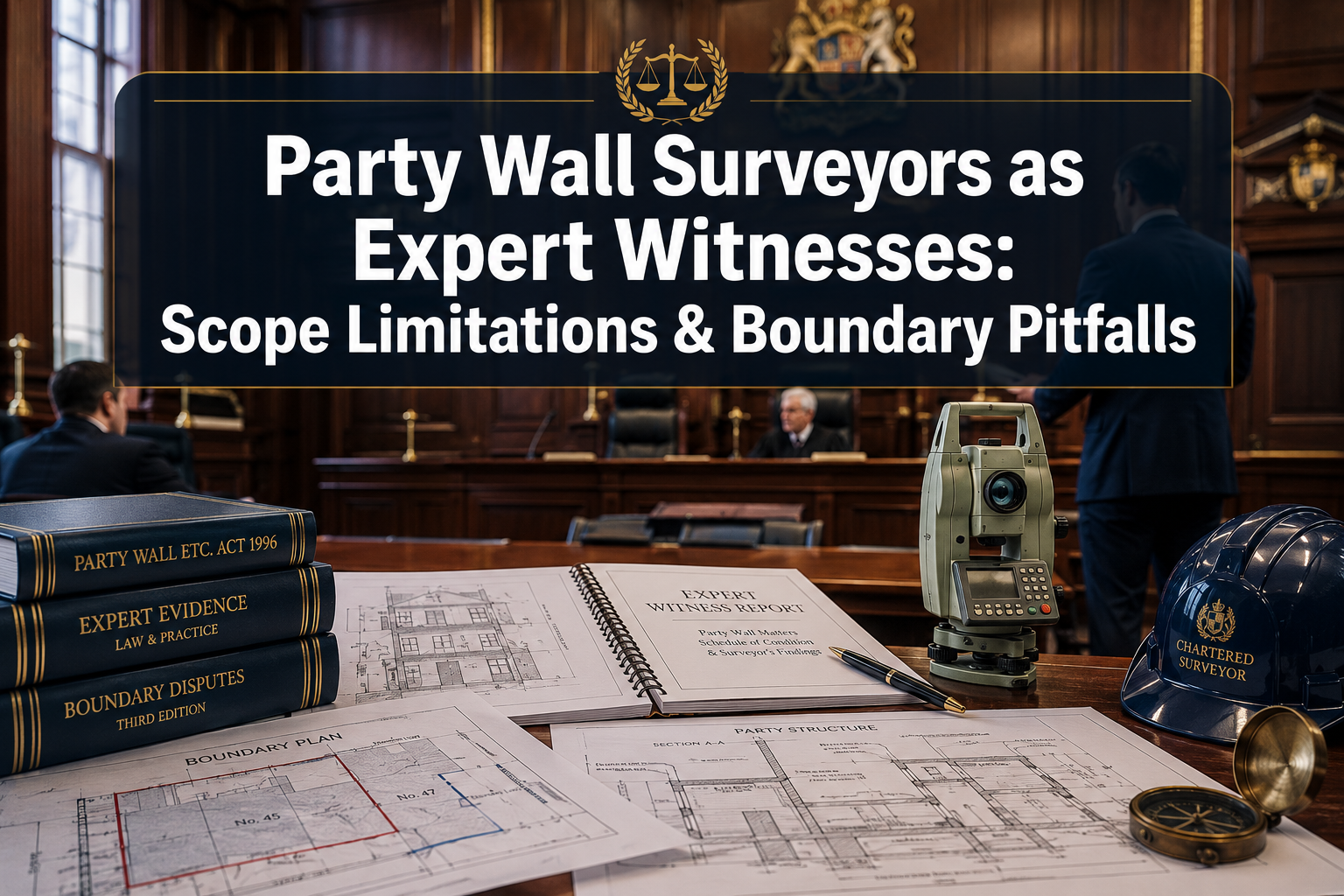
Over a third of surveying expert witness reports reviewed in recent UK construction litigation were found to contain opinions that exceeded the expert's stated area of competence — and party wall surveyors are disproportionately represented in that statistic [9]. As courts tighten their scrutiny of expert evidence, the question of what a party wall surveyor can legitimately opine on in litigation has never been more consequential.
The topic of Party Wall Surveyors as Expert Witnesses: Scope Limitations and Boundary Determination Pitfalls from Recent Litigation sits at the intersection of statutory law, professional ethics, and courtroom procedure. It matters enormously — not just for surveyors building expert witness practices, but for property owners and solicitors who instruct them. Getting the scope wrong can mean evidence being discounted, costs penalties, and damaged professional reputations.
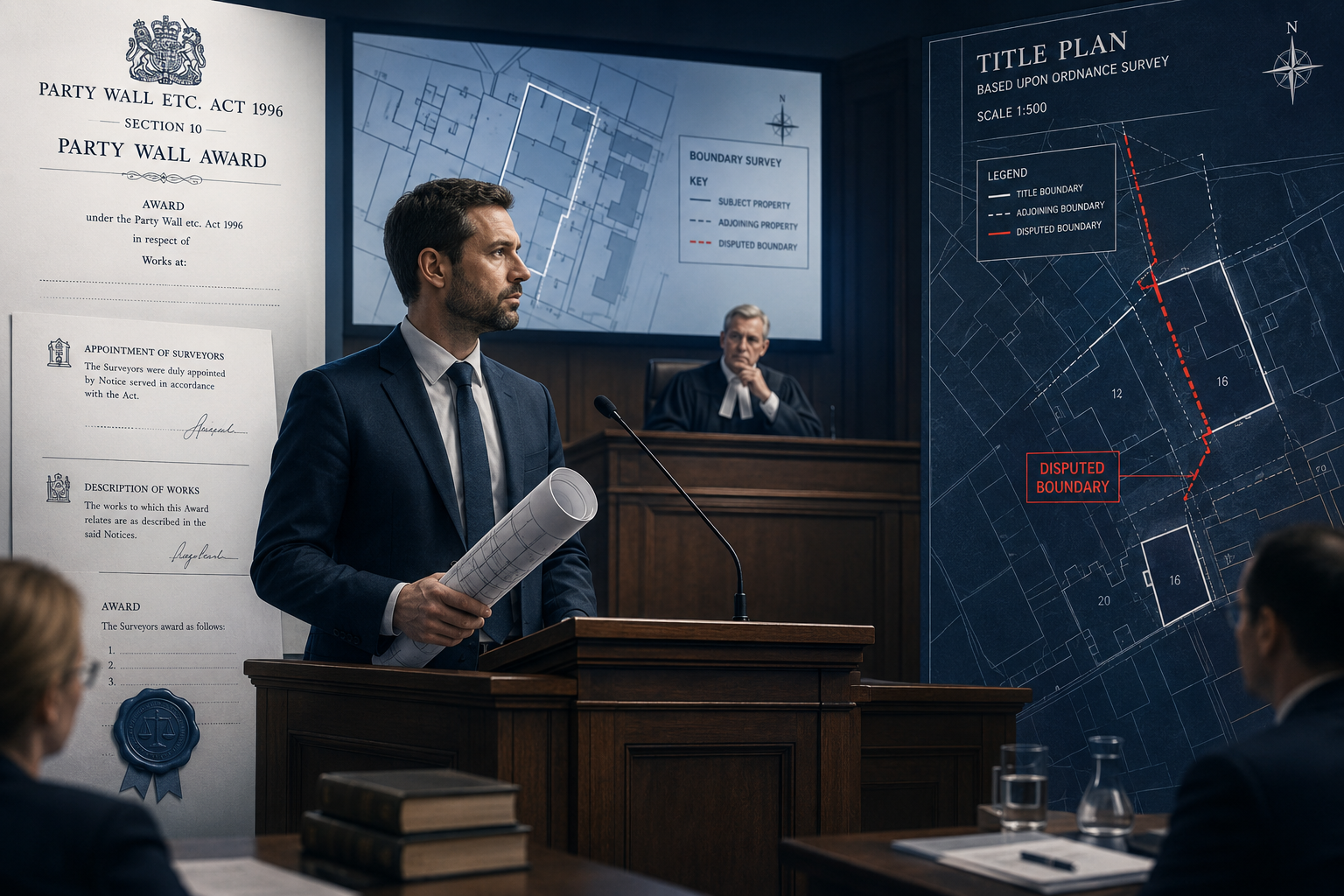
Key Takeaways 📌
- Scope creep is the primary risk: Party wall surveyors acting as expert witnesses frequently stray into boundary determination — an area requiring distinct qualifications.
- Courts are increasingly critical: Recent county court and Technology and Construction Court (TCC) decisions have explicitly reduced the weight given to expert evidence where surveyors overstepped their remit.
- CPR Part 35 is non-negotiable: All expert witnesses, including party wall surveyors, must comply with Civil Procedure Rules Part 35 and owe their primary duty to the court, not the appointing party.
- Joint reports and co-experts help: Using a structural engineer alongside a party wall surveyor, for example, avoids evidence being discounted in complex collapse or defect cases.
- Clear Letters of Instruction are essential: Explicit scoping from the outset protects both the expert and the integrity of the evidence.
Understanding the Statutory Role vs. the Expert Witness Role
Before examining the pitfalls, it is essential to understand a fundamental distinction that courts have repeatedly emphasised: the statutory role of a party wall surveyor is not the same as the role of an expert witness in litigation.
Under the Party Wall etc. Act 1996, a party wall surveyor acts in a quasi-judicial capacity. Their job is to resolve disputes between building owners and adjoining owners by issuing awards, inspecting works, and ensuring compliance with the Act. This role is bounded — deliberately — by the Act's provisions.
When that same surveyor steps into a courtroom as an expert witness, an entirely different legal framework applies. Civil Procedure Rules (CPR) Part 35 governs their conduct. Their overriding duty shifts from resolving a statutory dispute to assisting the court on matters within their expertise [6]. These are not the same thing, and conflating them is where problems begin.
💬 "A party wall surveyor's statutory role under the Party Wall etc. Act 1996 is distinct from being an expert witness in court litigation; the former is quasi-judicial and limited to issues under the Act, while the latter is governed by evidence rules and may involve broader boundary or negligence questions." [10]
What Party Wall Surveyors Can Legitimately Opine On
There is a clear and valuable role for party wall surveyors as expert witnesses — when properly scoped. Legitimate areas of opinion include:
| ✅ Within Scope | ❌ Outside Scope (Without Additional Qualifications) |
|---|---|
| Adequacy of party wall notices | Legal boundary determination |
| Quality of schedules of condition | Interpretation of title deeds |
| Reasonableness of party wall awards | Land Registry ownership disputes |
| Compliance with the Party Wall Act 1996 | Structural causation in collapse cases |
| Standard of notifiable works | Housing safety regulation compliance |
| Third surveyor appointment procedures | Conveyancing or land law conclusions |
For a deeper understanding of what party wall surveyor responsibilities actually entail under the Act, it helps to review the statutory framework before considering expert witness appointments.
The Boundary Determination Problem: Scope Limitations and Pitfalls from Recent Litigation
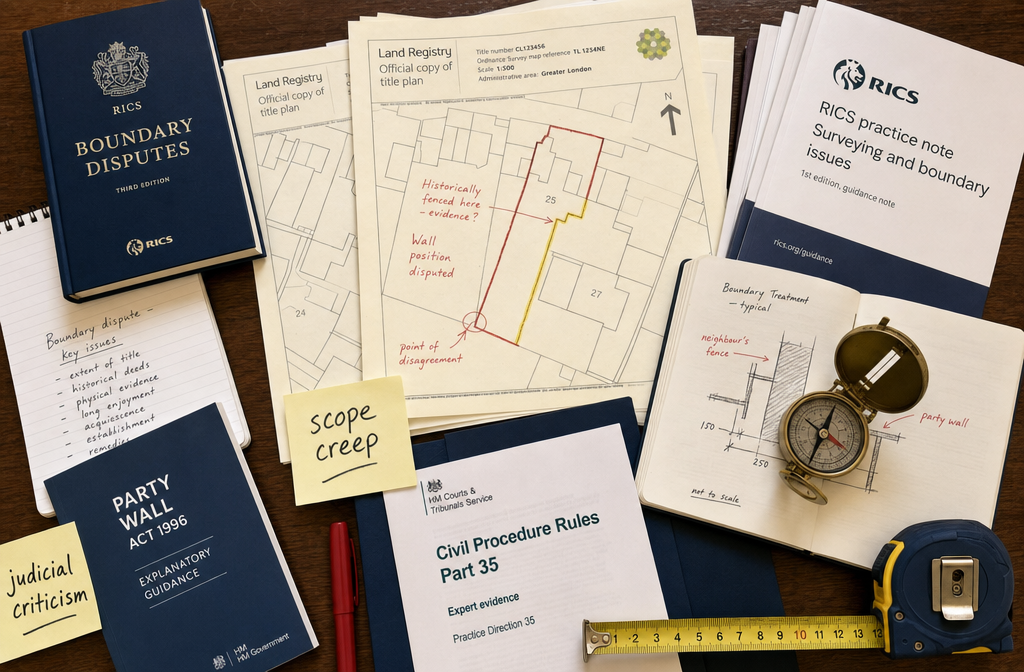
This is where the most damaging errors occur. Boundary determination is a specialist discipline — one that requires analysis of title plans, historical conveyances, topographic surveys, and often Land Registry expert input. It is not an automatic extension of party wall expertise, even though the two subjects frequently overlap in practice.
Recent litigation has exposed this confusion repeatedly. In several county court decisions discussed in 2026 commentary, judges rejected expert evidence from party wall surveyors who treated the line of junction (the position of the party wall itself) as automatically defining the legal boundary [7]. These are related but legally distinct concepts. A wall may stand on, straddle, or even be entirely within one owner's land — and its physical position does not resolve the legal question of where the boundary lies.
Why "Scope Creep" Damages Expert Credibility
Courts have used the phrase "scope creep" to describe situations where expert witnesses gradually expand their opinions beyond their stated competence. In party wall and boundary-adjacent disputes, this manifests in several ways:
- Offering definitive boundary opinions based solely on physical inspection of the wall
- Interpreting conveyancing documents without legal or boundary-survey training
- Drawing conclusions about land ownership from the party wall award alone
- Opining on structural causation without engineering credentials [5]
The consequences are serious. When a judge reduces the weight of expert evidence — or disregards it entirely — the instructing party may lose a case they might otherwise have won. Costs penalties can follow. And the expert's professional reputation suffers lasting damage [4].
💬 "Courts have criticised reports where party wall surveyors effectively attempted boundary determination under the guise of party wall expertise." [7]
The Line of Junction Trap
One of the most common property boundary disputes in urban areas involves disagreements about where a party wall sits relative to the legal boundary. Party wall surveyors, having inspected the wall and issued awards, are often perceived as the natural expert on this question. But perception and legal reality diverge sharply here.
Recent guidance from RICS explicitly states that party wall surveyors acting as experts must make clear where they are not boundary experts and where specialist boundary determination is required [6]. Failure to do so has been highlighted in judicial criticism as blending expert and partisan roles — precisely what CPR Part 35 is designed to prevent.
The practical advice from 2026 litigation commentary is clear [7]:
- Avoid definitive boundary opinions unless specifically qualified in boundary determination
- Clearly identify all assumptions made about boundary position within the report
- Flag where legal interpretation of deeds or Land Registration issues exceed competence
- Recommend appointment of a dedicated boundary expert where the legal boundary is genuinely in dispute
The average cost of a boundary dispute can run into tens of thousands of pounds — making the quality of expert evidence at every stage critically important to the outcome.
Structural Collapse Cases and Awaab's Law Complications
An emerging area of concern involves party wall surveyors being instructed in cases where walls adjacent to boundaries have failed structurally. Post-Grenfell reforms and the implementation of what commentators call "Awaab's Law" — housing safety standards addressing damp, mould, and structural integrity in social housing — have generated a new category of litigation [5].
In several recent claims involving wall failures near boundaries, judges were critical where a party wall expert opined on structural causation or compliance with housing safety standards without appropriate structural engineering or building pathology credentials [5]. The lesson is unambiguous: party wall expertise does not extend to structural engineering, and courts will not accept it as a substitute.
Staying Within Statutory Powers: A Practical Checklist for Courtroom Credibility
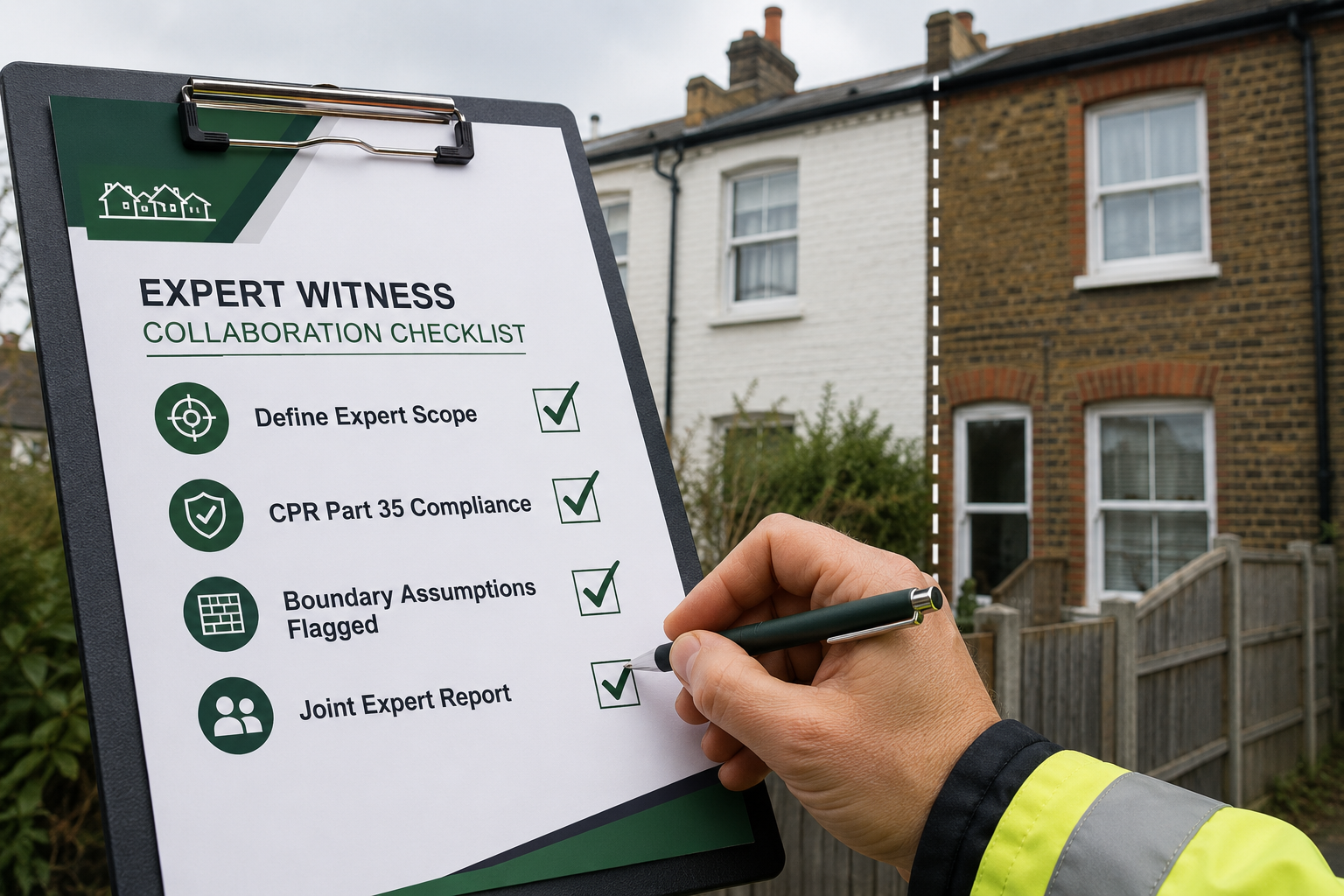
Understanding the pitfalls is only half the battle. The more important question is: what practical steps can party wall surveyors take to protect their expert witness credibility and stay within their statutory powers?
The following checklist draws on 2026 RICS guidance, recent litigation commentary, and expert witness best practice [1][4][6].
✅ Pre-Instruction Checklist
- Review the Letter of Instruction carefully — does it ask you to opine on matters outside party wall expertise?
- Assess your own competence — can you genuinely support opinions on boundary determination, structural engineering, or housing safety if asked?
- Clarify scope with instructing solicitors before accepting the appointment
- Check your CV accurately reflects party wall experience (appointments under the Act, awards, third surveyor roles) versus boundary mapping or determination work [8]
- Identify whether a co-expert is needed — e.g., a structural engineer for collapse cases, or a boundary surveyor for title-related questions [5]
✅ Report-Writing Checklist
- State your qualifications and experience clearly — and their limits
- Separate factual observations from legal conclusions — describe the condition of the wall; do not determine who owns it [9]
- Flag boundary assumptions explicitly — if your opinion rests on an assumed boundary position, say so prominently
- Comply with CPR Part 35 — include the required declaration that you understand your duty to the court
- Avoid advocacy language — your report must assist the court, not advance your instructing party's case [1]
- Reference methodology transparently — explain how you reached each conclusion and what you inspected
✅ Joint Expert and Concurrent Evidence Checklist
- Engage constructively in joint expert discussions — courts look favourably on experts who narrow issues genuinely
- Document areas of agreement and disagreement clearly in any joint report
- Do not change your opinion under pressure — only update views when genuinely persuaded by new evidence or argument
- Be candid about limitations in concurrent evidence (hot-tubbing) sessions
For surveyors operating across London, understanding local property dynamics is also relevant — those working as party wall surveyors in London will encounter boundary and party wall overlap issues with particular frequency given the density of terraced and semi-detached housing stock.
The Mis-Labelling Problem 🏷️
One issue that has drawn specific judicial and professional attention is the mis-labelling of party wall surveyors as "boundary experts" in expert directories and court documents. Expert directories used by litigators to locate specialists often list party wall surveyors who also claim boundary dispute expertise — but courts will look for demonstrable training and case experience in boundary determination, not just a self-applied label [8].
This matters because solicitors instructing experts may not always understand the distinction. The responsibility falls on the surveyor to be transparent. If a CV or directory listing implies boundary expertise that does not exist in practice, the expert risks judicial criticism, reduced weight for their evidence, and potential professional conduct issues.
💬 "Experts must ensure their CVs and reports clearly delineate party wall experience versus true boundary mapping and determination work." [8]
The Role of the Schedule of Condition
One area where party wall surveyors genuinely add expert value — and where courts have accepted their evidence — is in assessing the quality and adequacy of schedules of condition. These documents record the pre-works state of an adjoining property and are central to damage claims. Expert opinion on whether a schedule was properly prepared, whether it captured relevant defects, and whether subsequent damage was pre-existing or works-related is squarely within party wall expertise.
This is a useful reminder that staying within scope does not mean being less useful — it means being more credible. A focused, well-scoped expert report on party wall procedure and schedule adequacy will carry far more weight than a sprawling report that ventures into boundary law and structural engineering without proper foundation.
For those navigating boundary dispute costs and the financial implications of litigation, the quality of expert evidence directly affects settlement prospects and trial outcomes.
The RICS Framework and CPR Part 35: Non-Negotiable Standards
RICS has updated its expert witness practice guidance for 2026, reiterating three core obligations for any surveyor acting as an expert witness [6]:
- Work within their field of expertise — not the field they wish they had expertise in
- Comply with CPR Part 35 and relevant Practice Directions — including the duty of candour to the court
- Make clear where specialist boundary determination is required — and recommend it where appropriate
Academic analysis of expert evidence reliability in construction litigation reinforces this framework. Research published in late 2025 found that expert evidence is most often found wanting where experts opine outside the precise scope of their expertise or instructions [9]. The study explicitly identifies boundary and party wall disputes as high-risk areas, noting that courts have discounted evidence where a party wall surveyor failed to separate factual observation from legal conclusions about ownership or boundary lines.
The recommended solution — clearer expert instructions and robust judicial control of expert scope — is now reflected in 2026 practice commentary across RICS-regulated firms [9].
Conclusion: Actionable Steps for Party Wall Surveyors in 2026
The landscape for Party Wall Surveyors as Expert Witnesses: Scope Limitations and Boundary Determination Pitfalls from Recent Litigation has shifted decisively. Courts are more sophisticated, RICS guidance is more explicit, and the consequences of scope overreach are more severe than ever.
The path to courtroom credibility is not complicated, but it requires discipline:
🔑 Actionable Next Steps:
-
Audit your expert witness CV — ensure it accurately reflects party wall experience versus boundary determination experience. Remove or qualify any claims that cannot be substantiated in cross-examination.
-
Insist on a clear Letter of Instruction — before accepting any expert appointment, confirm in writing that the scope is limited to matters within your genuine expertise.
-
Recommend co-experts proactively — where a case involves boundary determination, structural causation, or housing safety compliance, identify the need for additional specialist expertise early. Courts reward this candour.
-
Invest in CPR Part 35 training — if you are building or expanding an expert witness practice, formal training in civil procedure and expert evidence rules is not optional.
-
Separate observation from conclusion — in every report, be rigorous about distinguishing what you observed from what you conclude, and what you conclude from what is a legal question for the court.
-
Engage with RICS guidance updates — the 2026 expert witness practice note updates are directly responsive to recent judicial criticism. Reading and applying them is both a professional and a practical obligation.
Party wall surveyors bring genuine, valuable expertise to litigation. The challenge — and the opportunity — in 2026 is to deploy that expertise with precision, transparency, and the intellectual honesty that courts increasingly demand.
References
[1] How A Building Surveyor Expert Witness Can Assist With Your Court Case – https://www.expertcourtreports.co.uk/blog/how-a-building-surveyor-expert-witness-can-assist-with-your-court-case/
[2] How Expert Witness Surveyors Help Resolve Construction Disputes – https://novusresolve.com/knowledge-base/how-expert-witness-surveyors-help-resolve-construction-disputes
[4] Building Your Expert Witness Practice In 2026 Specializations In Party Wall Defects And Valuations – https://www.canterburysurveyors.com/blog/building-your-expert-witness-practice-in-2026-specializations-in-party-wall-defects-and-valuations/
[5] Expert Witness Roles In Structural Collapse Disputes Under Awaabs Law 2026 Evidence Standards For Party Wall Awards – https://wimbledonsurveyors.com/expert-witness-roles-in-structural-collapse-disputes-under-awaabs-law-2026-evidence-standards-for-party-wall-awards/
[6] Expert Witness – https://www.ricsfirms.com/residential/legal-issues/expert-witness/
[7] Expert Witness Essentials For 2026 Boundary Disputes Strengthening Cases In A Recovering Property Market – https://nottinghillsurveyors.com/blog/expert-witness-essentials-for-2026-boundary-disputes-strengthening-cases-in-a-recovering-property-market
[8] Party Walls – https://www.jspubs.com/expert-witness/si/p/party-walls/
[9] MDPI – The Reliability of Expert Evidence in Construction Litigation – https://www.mdpi.com/2075-5309/15/23/4215
[10] Architect Party Wall Surveyor – JustAnswer – https://www.justanswer.co.uk/law/th6if-architect-party-wall-surveyor.html