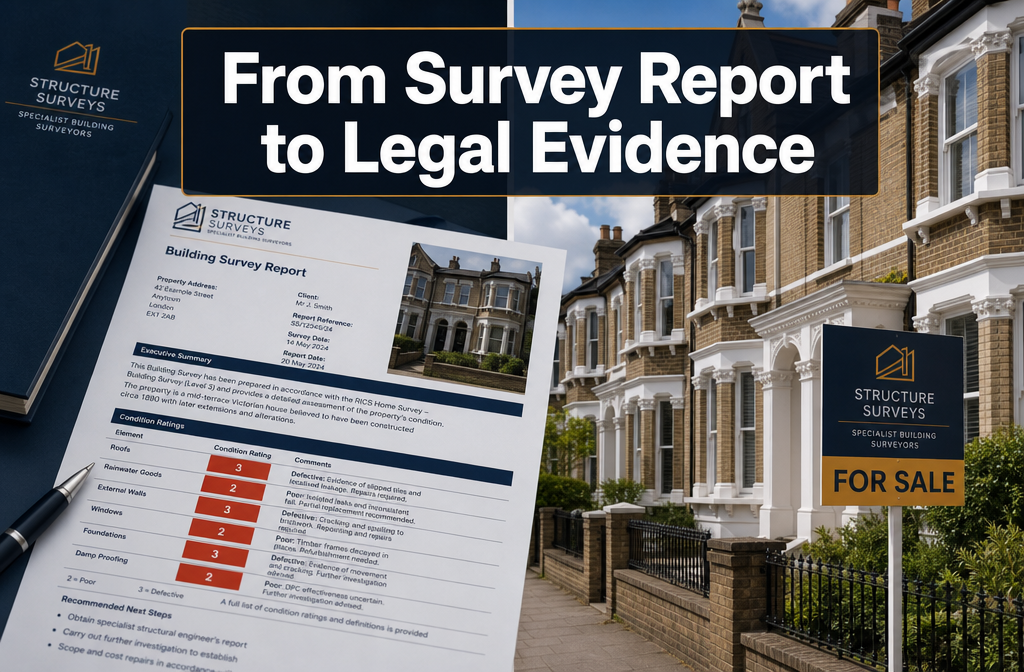
Only 1 in 5 UK homebuyers commissions a full building survey before exchange — yet those who do recover an average of £5,750 in price reductions or remedial concessions, according to industry estimates. The gap between getting a survey and using it effectively is where thousands of pounds are routinely lost. Understanding the journey from survey report to legal evidence — how UK homebuyers should use building surveys in price negotiations and disputes — is not just useful knowledge; it is a practical financial skill that every buyer needs before signing anything.
This guide explains, in plain English, how a standard building survey supports renegotiation, retention requests, and later legal claims — and exactly when a separate expert witness report becomes necessary.
Key Takeaways 📋
- A RICS building survey report is a professional opinion document, not automatically admissible legal evidence — but it can become the foundation of one.
- Specific defects flagged in a survey give buyers legitimate grounds to renegotiate price, request repairs, or hold retention funds.
- The wording you use when presenting survey findings to a seller or estate agent matters enormously — vague language weakens your position.
- If a dispute reaches court or tribunal, a separate expert witness report is almost always required alongside the original survey.
- Acting quickly after receiving a survey report protects both your negotiating position and any future legal rights.
What a Building Survey Actually Tells You (And What It Doesn't)
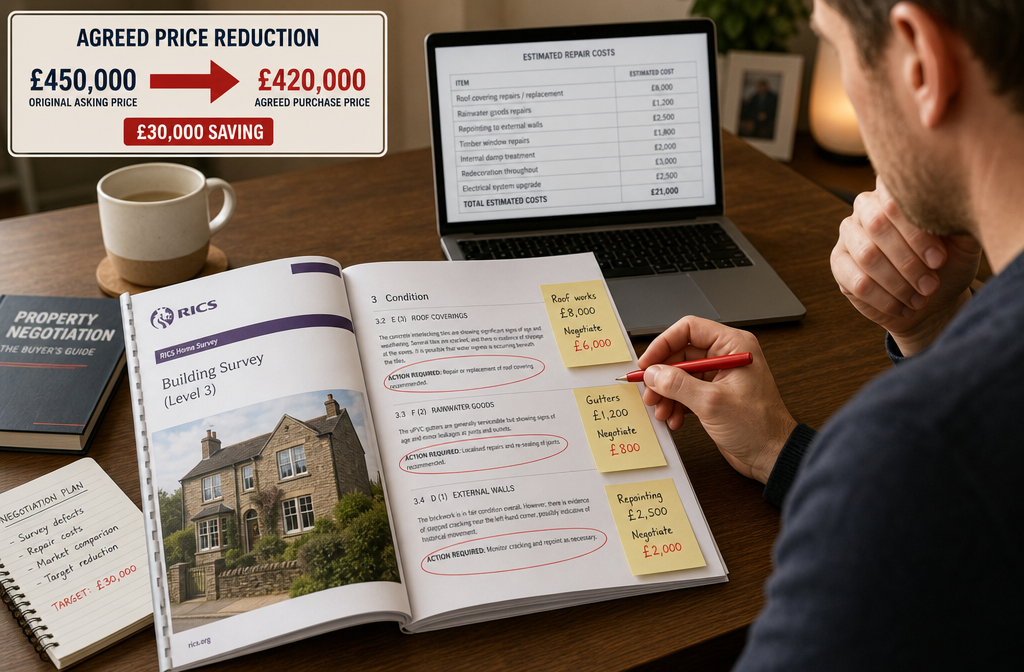
Before using a survey report strategically, it helps to understand exactly what it contains and — critically — what its limitations are.
The Three Levels of Survey 🏠
UK residential surveys are classified by RICS (Royal Institution of Chartered Surveyors) into three levels:
| Survey Level | What It Covers | Best For |
|---|---|---|
| Level 1 (Condition Report) | Basic traffic-light ratings, no advice | New-builds, modern homes in good condition |
| Level 2 (HomeBuyer Report) | Visible defects, maintenance advice, market valuation option | Conventional homes in reasonable condition |
| Level 3 (Building Survey) | Full structural inspection, detailed defect analysis, repair advice | Older, extended, or unusual properties |
For negotiation and dispute purposes, a Level 3 Building Survey provides the most usable detail. A Level 2 report can still support renegotiation, but its scope is more limited. Understanding home survey levels — Level 2 vs Level 3 before commissioning is essential to ensuring the report serves your needs.
What the Report Is — and Isn't
A building survey is a professional opinion from a qualified surveyor about the visible condition of a property at the time of inspection. It is not:
- A guarantee of the property's condition
- A legal document in itself
- An exhaustive list of every possible defect (hidden defects behind walls, for example, are excluded)
💬 "A survey report is your surveyor's professional judgement — authoritative, but not infallible. Its strength in any dispute depends on how it is used."
This distinction matters enormously if a dispute later arises. The report's value as evidence depends on how it was prepared, by whom, and how it is presented.
Using the Survey Report in Price Negotiations: A Practical Playbook
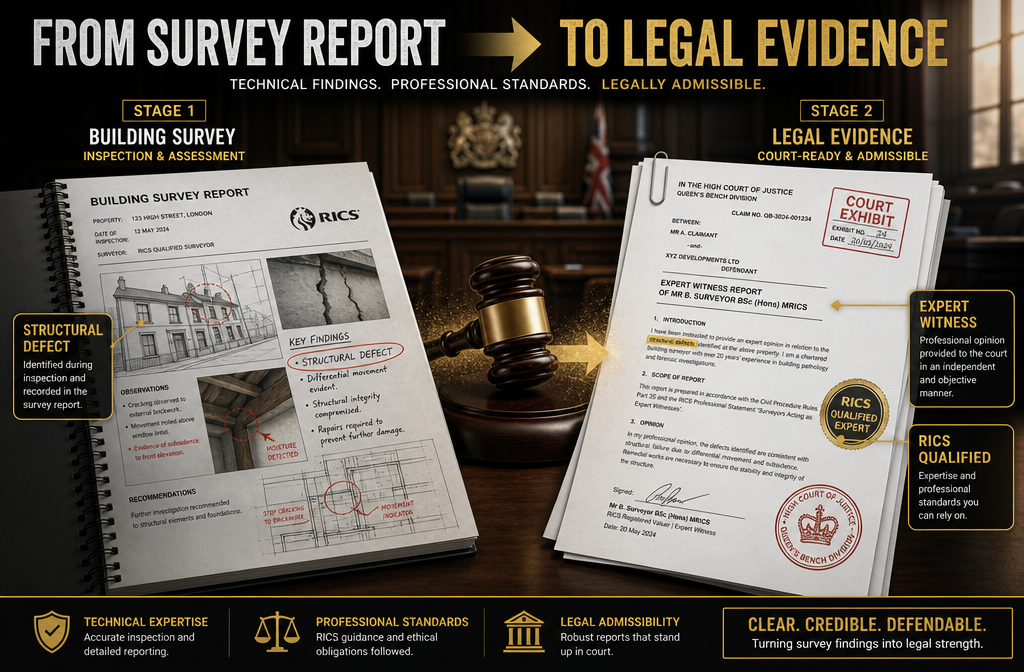
The most immediate use of a building survey is renegotiation. This is where most buyers can recover real money — if they approach it correctly. The journey from survey report to legal evidence often begins here, in the negotiation stage.
Step 1: Triage the Findings
Not every defect warrants renegotiation. Surveyors typically use a condition rating system:
- Condition 1 — No repair needed
- Condition 2 — Defects that need attention but are not urgent
- Condition 3 — Serious defects requiring urgent repair or further investigation
Focus renegotiation efforts on Condition 3 items and significant Condition 2 issues. Attempting to renegotiate every minor defect risks irritating the seller and undermining your credibility.
Step 2: Get Repair Quotes
A survey report describes defects but rarely provides exact repair costs. Before approaching the seller, obtain at least two independent contractor quotes for the significant issues identified. This transforms a vague concern into a specific, evidenced financial claim.
For example, if the survey flags structural defects or significant damp, a specialist's written quote gives you a concrete figure to work with.
Step 3: Use Precise, Professional Language
Vague renegotiation requests fail. Sellers and estate agents are experienced at deflecting them. The following table shows the difference between weak and strong renegotiation language:
| ❌ Weak Wording | ✅ Strong Wording |
|---|---|
| "The survey found some problems" | "The Level 3 Building Survey by [Surveyor Name], MRICS, dated [date], identifies Condition 3 defects at the roof structure" |
| "We'd like a reduction" | "We are requesting a price reduction of £12,500 to reflect the cost of remediation as quoted by [Contractor], attached" |
| "There might be damp" | "Active rising damp is confirmed at Condition 3, with specialist treatment quoted at £4,200" |
Always reference the surveyor's name, qualification, and report date. Always attach supporting quotes. Always state a specific figure.
Step 4: Know Your Options Beyond Price Reduction
A price reduction is not the only tool available. Buyers can also request:
- Repairs before completion — seller fixes the defect at their cost
- Retention — a sum held by solicitors post-completion until repairs are verified
- Indemnity insurance — particularly useful for planning or building regulations issues
- Delayed completion — allowing time for specialist investigations
A specific defect survey commissioned after the main survey can provide deeper analysis of a particular issue — useful both for negotiating and for building a stronger evidence base.
Pitfalls to Avoid ⚠️
- Acting too slowly: Sellers can accept other offers while you deliberate. Present findings within 5–7 working days of receiving the report.
- Negotiating verbally only: Always follow up any verbal discussion with a written summary via your solicitor.
- Overstating defects: Exaggerating findings damages credibility. Stick to what the report actually says.
- Forgetting the survey is not a guarantee: If the seller disputes a finding, be prepared to commission further specialist investigation rather than insisting the survey is definitive.
From Survey Report to Legal Evidence: When Disputes Escalate
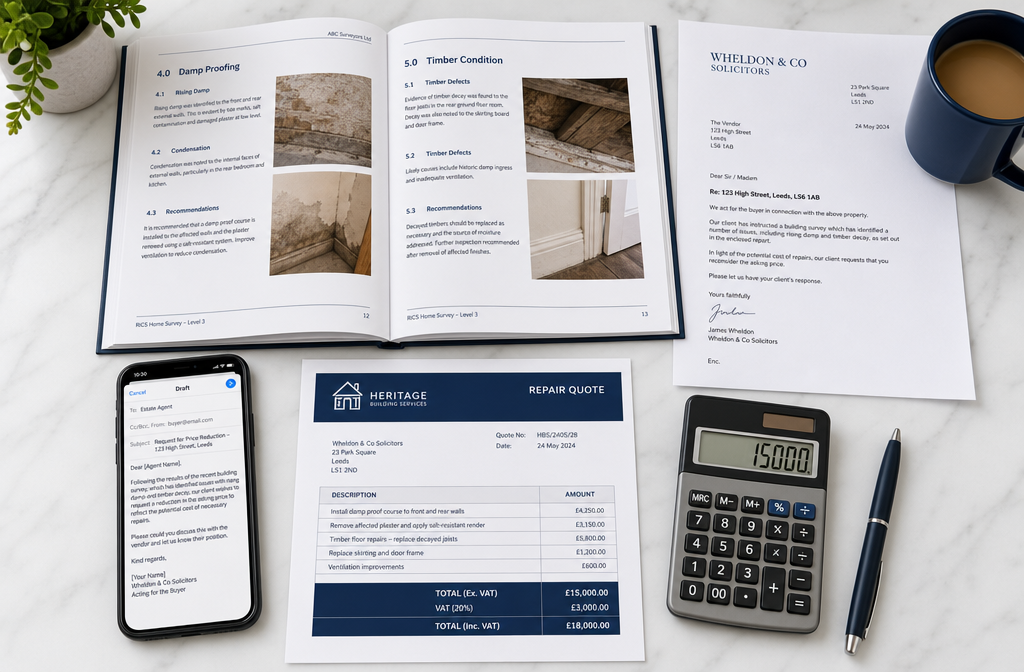
Sometimes negotiations fail. A seller refuses to reduce the price, completion occurs, and defects emerge that were either present at the time of survey or — more problematically — were concealed. This is where the journey from survey report to legal evidence: how UK homebuyers should use building surveys in price negotiations and disputes becomes genuinely critical.
When Can You Bring a Legal Claim?
There are two main scenarios where a building survey becomes relevant to legal proceedings:
1. Claim Against the Surveyor (Negligence)
If the survey failed to identify a defect that a competent surveyor should have found, the buyer may have a claim for professional negligence against the surveying firm. To succeed, the buyer must demonstrate:
- A duty of care existed (the surveyor was commissioned and paid)
- The surveyor breached that duty (the defect was visible and should have been reported)
- The breach caused financial loss
The original survey report is central evidence here — but it will be scrutinised against the standard expected of a reasonably competent RICS surveyor.
2. Claim Against the Seller (Misrepresentation)
Under the Misrepresentation Act 1967, a seller who makes false statements about the property's condition — including on the TA6 Property Information Form — can be liable. If the survey report contradicts claims made by the seller, it becomes supporting evidence of the discrepancy.
Why the Original Survey Report Is Rarely Enough on Its Own
Courts and tribunals require expert evidence that meets specific standards. A standard building survey, however detailed, is written for the buyer — not for litigation. It may lack:
- The specific format required for Civil Procedure Rules (CPR) Part 35 expert evidence
- A declaration of the expert's duty to the court
- Detailed analysis of causation and quantum (the extent and cost of loss)
💬 "A building survey is a starting point for legal action, not the finishing line. The report identifies the problem; expert witness evidence proves it in court."
Commissioning an Expert Witness Report
If a dispute is heading toward litigation, a separate expert witness report must be commissioned from a suitably qualified professional. This report:
- Is addressed to the court, not the client
- Follows CPR Part 35 requirements
- Includes the expert's declaration of independence
- Provides an opinion on causation, not just condition
The original building survey is used as background evidence — it establishes what was known (or should have been known) at the time of purchase. The expert witness report then builds the technical case.
For boundary-related disputes, a boundary survey and associated expert evidence follow a similar process, with boundary dispute costs often running into thousands of pounds before reaching resolution.
The Role of a Schedule of Condition
In some cases — particularly where a buyer is purchasing a property with known defects, or where a party wall is involved — a schedule of condition provides a timestamped photographic and written record of the property's state before works begin. This document can be invaluable in later disputes about whether damage pre-existed or was caused by subsequent events.
Practical Scenarios: Survey Findings in Action
Scenario A: Damp and Timber Decay 🪵
A Level 3 survey identifies active rising damp and evidence of timber decay in the ground floor joists. The buyer obtains specialist quotes totalling £9,800. Using the survey report as the basis, the buyer's solicitor writes to the seller requesting a £10,000 price reduction, citing the report reference, the surveyor's Condition 3 rating, and the attached specialist quotes.
The seller agrees to a £7,500 reduction. The survey report — combined with contractor evidence — delivered a tangible financial outcome.
If the seller had refused and the buyer had proceeded, discovering post-completion that the seller had previously obtained a damp report and concealed it, the original survey would form part of a misrepresentation claim. For deeper context on damp survey issues in London, specialist investigation is always recommended before exchange.
Scenario B: Roof Defects Missed by Surveyor 🏚️
A buyer commissions a Level 2 HomeBuyer Report. The surveyor notes the roof covering appears in reasonable condition. Six months after completion, significant roof failure occurs, with repair costs of £22,000. A structural engineer's inspection reveals the defects were visible and longstanding.
The buyer's solicitor commissions a CPR-compliant expert witness report from an independent RICS surveyor, who concludes the defects were identifiable at the time of the original survey. The original survey report is produced as evidence of what was — and was not — reported. A professional negligence claim proceeds.
This scenario illustrates why reviewing a homebuyers report example before commissioning helps buyers understand what their survey should cover.
Scenario C: Undisclosed Planning Issues
A buyer's survey flags an extension that may lack building regulations approval. The seller's TA6 form states all works have the necessary consents. Post-completion, the local authority confirms no approval was obtained.
The survey report — which flagged the concern — combined with the seller's written misrepresentation on the TA6 form, supports a claim under the Misrepresentation Act. The buyer's solicitor uses both documents as evidence.
Key Timelines and Limitation Periods ⏱️
Acting promptly is not just good practice — it is legally necessary.
| Type of Claim | Limitation Period |
|---|---|
| Professional negligence (surveyor) | 6 years from date of survey (or date of knowledge) |
| Misrepresentation (seller) | 6 years (or 3 years from date of discovery) |
| Latent damage (hidden defects) | 3 years from date of knowledge, maximum 15 years |
These periods can feel generous, but evidence degrades. Photographs, contractor quotes, and correspondence become harder to produce years later. Document everything from the moment the survey is received.
Conclusion: Turning a Survey Report Into Your Strongest Asset
A building survey is only as valuable as the action taken with it. In 2026, with UK property prices remaining high and buyer protections depending heavily on due diligence, treating a survey report as a passive document is a costly mistake.
Actionable next steps for every UK homebuyer:
- ✅ Commission the right level of survey — Level 3 for older, extended, or non-standard properties
- ✅ Read the report critically — focus on Condition 3 ratings and any recommendations for further investigation
- ✅ Obtain written specialist quotes within 5–7 working days of receiving the report
- ✅ Renegotiate in writing, through your solicitor, using precise language and specific figures
- ✅ Preserve all documentation — the survey, quotes, correspondence, and the seller's property information forms
- ✅ Seek legal advice early if a dispute arises — do not wait until limitation periods become a concern
- ✅ Commission a CPR-compliant expert witness report if litigation becomes necessary — the original survey alone will not be sufficient
The path from survey report to legal evidence is navigable — but only for buyers who understand how building surveys function in both commercial negotiation and legal proceedings. For expert guidance on building surveys and what they cover, or to discuss a specific property concern, speaking with a qualified RICS surveyor at the earliest opportunity is always the right first step.