

Nearly one in three party wall disputes in England and Wales involves a single-storey extension — yet bungalow projects consistently generate the most complex schedule of condition requirements of any residential build type. The combination of low-level excavation, shallow foundations, and shared boundary walls at ground level creates a unique set of risks that standard party wall procedures were not originally designed to address with precision. Understanding Party Wall Challenges in Bungalow Extensions: RICS Survey Protocols for Single-Storey Boundary Works in 2026 has never been more critical, particularly as RICS launched a major consultation on the draft 8th edition of Party Wall Legislation and Procedure in April 2026 [1].
This guide examines the specific structural, legal, and procedural challenges that arise when extending a bungalow near or at the boundary line — and how current RICS protocols help protect both building owners and their neighbours.
Key Takeaways 🏠
- Bungalows carry unique structural risks — including subsidence, roof spread, and rising damp — that demand specialist attention during party wall surveys.
- Two distinct notice periods apply: two months for party wall works, one month for excavation or new boundary walls.
- A schedule of condition is mandatory and must be thorough enough to serve as a legally defensible pre-works record.
- The RICS draft 8th edition (2026) introduces enhanced guidance on fee practices, Third Surveyor use, and notice service procedures.
- Low-level excavation near shared boundaries poses disproportionate risk in bungalow projects and requires targeted monitoring protocols.
Why Bungalows Present Distinct Party Wall Challenges
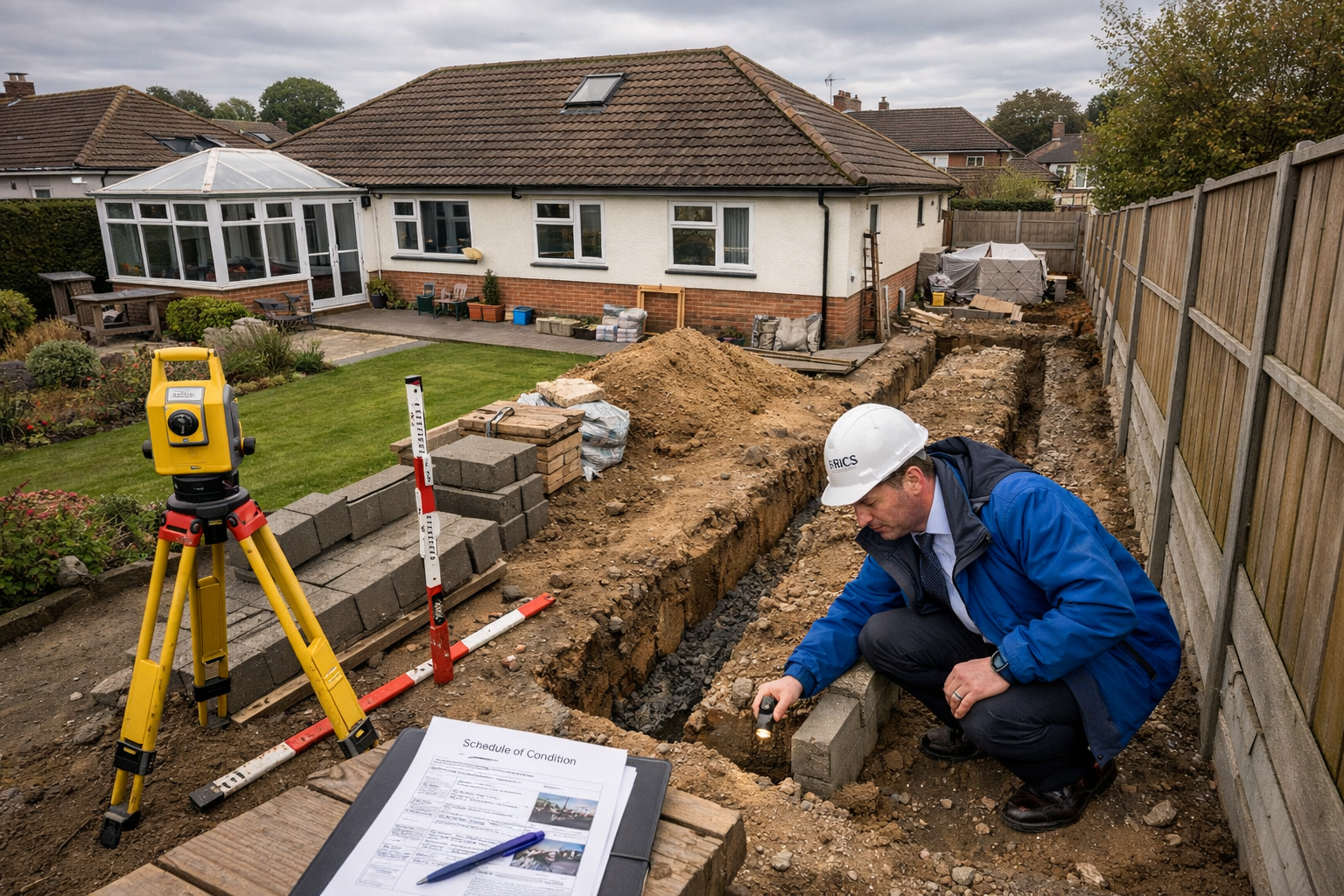
Most party wall guidance is written with two-storey or multi-storey construction in mind. Bungalows break that mould in several important ways. Their single-storey construction means the entire structural load — including often heavy roof spans — bears down on foundations that sit at relatively shallow depths. When an extension is planned at or near the boundary, excavation for new footings can destabilise those existing shallow foundations with alarming speed [2].
Structural Risks Specific to Single-Storey Boundary Works
Three structural issues dominate the risk profile of bungalow extensions near party walls:
| Risk Factor | Why It Matters for Party Wall Works |
|---|---|
| Subsidence | Large roof spans exert significant pressure on foundations; excavation nearby can trigger settlement [2] |
| Roof Spread | Heavy roofs without adequate lateral restraint push walls outward — a risk amplified near boundary excavations [2] |
| Rising Damp | Low ground clearance makes bungalows inherently moisture-prone; disturbing boundary ground increases infiltration risk [2] |
💡 Pull Quote: "Bungalow foundations are often shallower than those of two-storey properties, meaning even modest excavation at the boundary can have outsized consequences for the adjoining structure."
These risks are not merely theoretical. A surveyor conducting a party wall inspection on a bungalow extension project must specifically assess whether the proposed excavation depth will undercut the line of protection defined under Section 6 of the Party Wall etc. Act 1996. This is the provision that governs excavation within three or six metres of a neighbouring structure, depending on the depth of the new foundations relative to the existing ones.
For older bungalows — those built before the 1960s — a Level 3 Building Survey is almost always advisable before party wall works commence. Newer bungalows may be adequately assessed at Level 2, but any property showing signs of structural movement, damp, or non-standard construction warrants the more comprehensive inspection [2].
Understanding building walls on property lines and the associated legal obligations is a foundational step before any bungalow extension project begins.
RICS Survey Protocols for Single-Storey Boundary Works in 2026
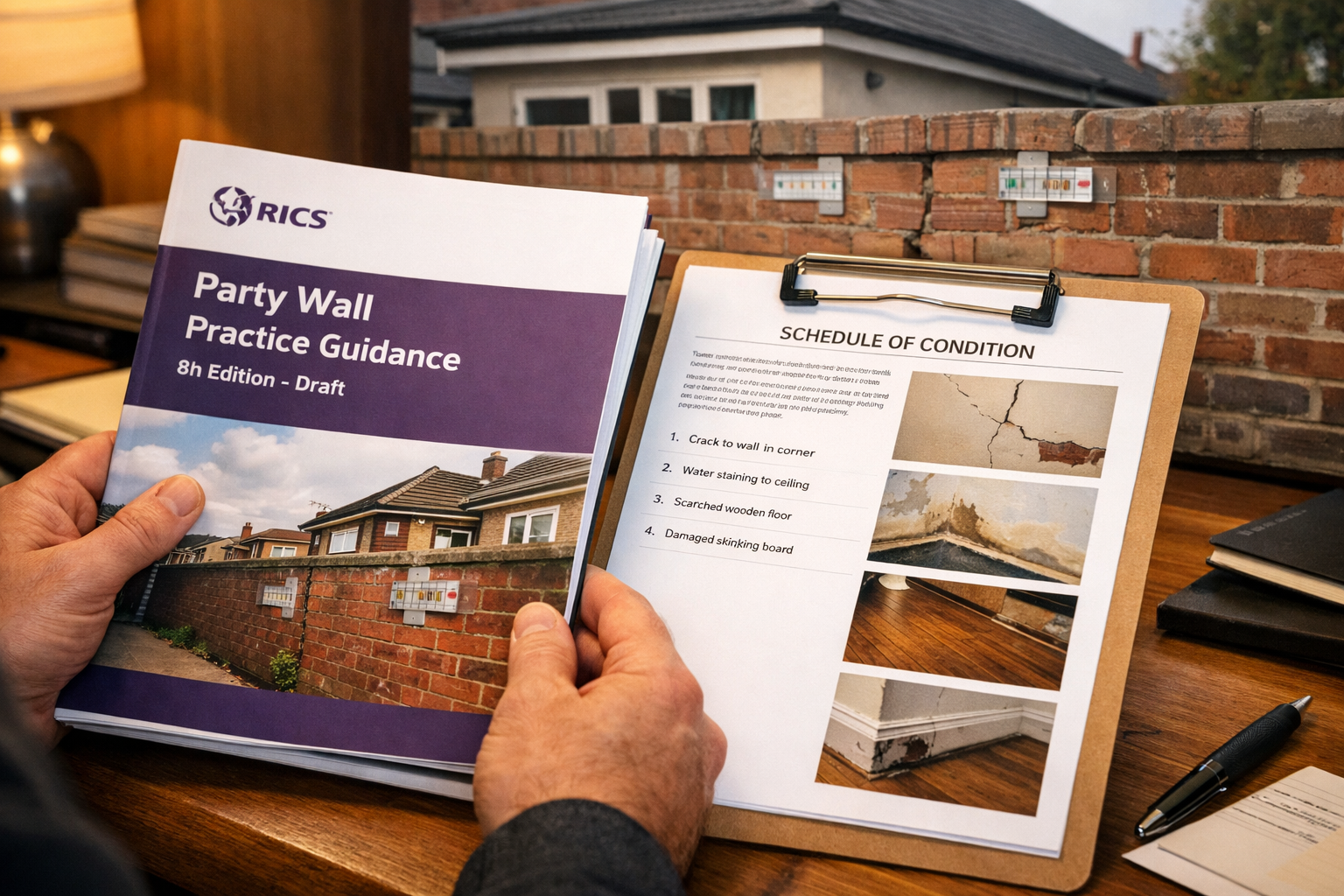
The most significant development shaping Party Wall Challenges in Bungalow Extensions: RICS Survey Protocols for Single-Storey Boundary Works in 2026 is the RICS consultation on the draft 8th edition of Party Wall Legislation and Procedure, which ran across approximately eight weeks in April and May 2026 [1].
What the Draft 8th Edition Changes
The updated guidance introduces several enhancements directly relevant to bungalow extension projects:
- Enhanced appendices covering revised letters of appointment, updated terms of engagement, and a modernised draft award format [1]
- Strengthened regulatory guidance on fee practices — addressing concerns about disproportionate charges in straightforward single-storey projects [1]
- Clearer protocols for the use of the Third Surveyor, particularly in cases where the two appointed surveyors cannot agree on the scope of monitoring required [1]
- Updated notice service procedures, clarifying digital service methods and the obligations on building owners to demonstrate proper service [1]
For party wall surveyors in London handling bungalow extension projects, these updates represent a material shift in best practice. The enhanced appendices, in particular, provide clearer templates for schedules of condition — documents that are especially important in bungalow projects given the structural vulnerabilities outlined above.
The Schedule of Condition: The Cornerstone of Bungalow Party Wall Protection
A schedule of condition is a detailed photographic and written record of the adjoining property's state before works begin [4]. In bungalow extension projects, this document carries exceptional weight because:
- Ground-level access makes damage to boundary walls, garden structures, and low-level brickwork more likely than in multi-storey projects.
- Existing damp or structural issues in bungalows may be pre-existing but will be attributed to the works unless documented beforehand.
- Shallow foundations mean settlement or cracking can occur at some distance from the works, requiring the schedule to cover a wider area than might seem necessary.
A robust schedule of condition for a bungalow boundary extension should include:
- ✅ Photographic record of all external walls, including any existing cracks with crack gauges fitted where appropriate
- ✅ Internal inspection of rooms adjacent to the party wall or boundary
- ✅ Damp readings at ground-floor level on the adjoining property
- ✅ Documentation of any pre-existing roof spread indicators (bowing walls, displaced roof tiles)
- ✅ Survey of any garden structures, outbuildings, or hard landscaping near the boundary
🔍 Key Insight: Crack monitoring gauges — small devices fitted across existing cracks — are increasingly standard practice in bungalow party wall awards. They provide objective, time-stamped evidence of whether movement has occurred during works, protecting both the building owner and the neighbour.
For homeowners seeking expert party wall advice before commencing an extension, engaging a surveyor early in the design stage — before planning permission is even sought — can prevent costly disputes later.
Notice Periods, Awards, and Neighbour Protections Under the Current Act
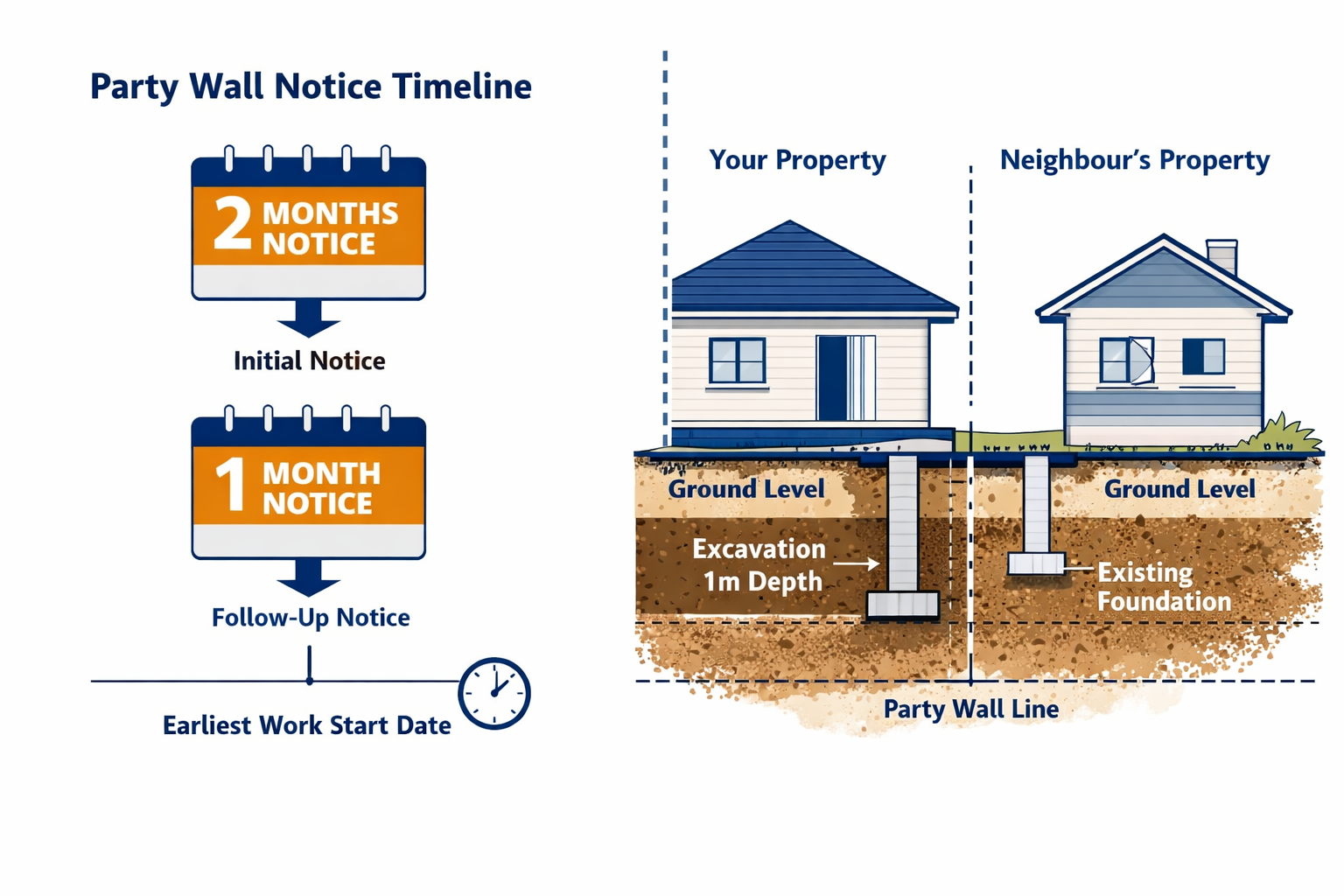
Understanding the procedural framework is essential for anyone navigating Party Wall Challenges in Bungalow Extensions: RICS Survey Protocols for Single-Storey Boundary Works in 2026. The Party Wall etc. Act 1996 sets out specific notice requirements that vary depending on the type of work proposed [4].
Notice Periods at a Glance
| Type of Work | Notice Period Required |
|---|---|
| Works to an existing party wall or structure | 2 months |
| Excavation or new wall at the boundary line | 1 month |
| Starting work after notice served | Up to 1 year from service date |
| Appealing a Party Wall Award | 14 days to County Court |
Source: Party Wall etc. Act 1996 / HomeOwners Alliance [4]
For bungalow extensions, it is common for both notice types to apply simultaneously — for example, where a new extension involves both building on the boundary line (one-month notice) and tying into an existing party wall (two-month notice). In such cases, the longer notice period governs, and the party wall notice must be served with sufficient time to allow both requirements to be met [4].
What Requires a Formal Party Wall Agreement?
Not all works trigger the Act. Minor works — including plastering, electrical installations, or fixing shelving to a party wall — do not require a formal agreement [4]. However, the following works commonly associated with bungalow extensions do require compliance:
- Excavating for new foundations within three or six metres of a neighbouring structure
- Building a new wall at or astride the boundary line
- Cutting into a party wall to insert beams or load-bearing elements
- Underpinning or raising the height of a party wall
The Party Wall Award Process
When a neighbour does not consent to the proposed works, the dispute resolution mechanism under the Act requires the appointment of surveyors. The process works as follows:
- Building owner appoints a party wall surveyor
- Adjoining owner appoints their own surveyor (or agrees to a single agreed surveyor)
- The two surveyors prepare a Party Wall Award — a legally binding document specifying how works must proceed, working hours, protection measures, and monitoring requirements [4]
- Either party has 14 days to appeal the award to the County Court [4]
The 2026 RICS draft guidance strengthens the framework around this process, particularly regarding party wall surveyor responsibilities and the conduct expected of surveyors when preparing awards for complex single-storey projects [1].
Low-Level Excavation Monitoring: A Specialist Requirement
In bungalow projects, the award must typically include specific monitoring provisions that go beyond those required for standard two-storey extensions. These include:
- Pre-works crack surveys with photographic evidence at defined intervals
- Settlement monitoring using precise levelling surveys at key stages of excavation
- Vibration monitoring where mechanical excavation is used close to the boundary
- Post-works inspection to confirm no damage attributable to the works has occurred
The Third Surveyor — an independent figure agreed upon before works begin — plays a critical role when the two appointed surveyors cannot agree on the scope of these monitoring requirements. The updated RICS guidance clarifies the circumstances under which the Third Surveyor should be engaged, reducing the risk of procedural disputes delaying the project [1].
For those concerned about costs, understanding party wall surveyor fees upfront helps building owners budget appropriately and avoid surprises.
Practical Steps for Building Owners and Adjoining Owners in 2026
Whether planning a bungalow extension or receiving notice of one from a neighbour, the following practical steps reflect current RICS best practice and the updated 2026 guidance framework.
For Building Owners Planning an Extension
Step 1 — Engage a surveyor at design stage
Before finalising plans, commission a building survey of the bungalow to identify pre-existing structural issues that could complicate the party wall process.
Step 2 — Identify all notifiable works
Work with an architect or surveyor to determine which elements of the extension trigger the Act. Many bungalow extensions involve multiple notifiable elements.
Step 3 — Serve notice correctly and on time
Use the correct notice form, serve it at the correct address, and retain proof of service. The 2026 RICS guidance clarifies digital service methods, but physical service remains the safest approach for dispute prevention.
Step 4 — Commission a thorough schedule of condition
Do not rely on a minimal schedule. For bungalow projects, a comprehensive pre-works record is the most effective protection against future claims.
Step 5 — Agree monitoring provisions in the award
Work with the appointed surveyors to agree proportionate but robust monitoring — particularly for excavation phases.
For Adjoining Owners Receiving Notice
- Do not ignore the notice. Failure to respond within 14 days is deemed dissent, triggering the surveyor appointment process automatically.
- Appoint your own surveyor rather than agreeing to a single agreed surveyor if the works are complex or if the bungalow has pre-existing structural issues.
- Request a comprehensive schedule of condition covering all areas that could be affected, including internal rooms and garden structures.
- Understand your appeal rights. The 14-day window to appeal a Party Wall Award to the County Court is a firm deadline [4].
🏗️ Did You Know? Once a party wall notice is served, the building owner has up to one year to commence works. This flexibility allows time for proper survey coordination without requiring the notice process to restart [4].
Choosing the Right RICS Surveyor for Bungalow Boundary Works
The complexity of party wall matters in bungalow extensions makes surveyor selection critically important. Not all surveyors have equivalent experience with the specific challenges of single-storey boundary works — particularly the low-level excavation risks and moisture-related concerns that characterise bungalow projects.
When selecting a surveyor, look for:
- RICS accreditation and familiarity with the 2026 updated guidance framework
- Demonstrable experience with bungalow or single-storey extension projects specifically
- Clear fee structures — the 2026 RICS draft guidance specifically addresses disproportionate fee practices [1]
- Local knowledge of soil conditions, which vary significantly across London and the South East and affect excavation risk
Understanding why RICS-accredited surveyors offer superior protection in complex boundary disputes is an important consideration for both building owners and adjoining owners.
For those dealing with boundary disagreements that extend beyond party wall matters, the boundary dispute resolution process may run in parallel with party wall procedures — another reason to engage a surveyor with broad expertise.
Conclusion: Acting Early Prevents Costly Disputes
The party wall challenges specific to bungalow extensions are not insurmountable — but they demand a level of procedural rigour and structural awareness that goes beyond standard residential construction. The 2026 RICS consultation on the draft 8th edition of Party Wall Legislation and Procedure signals a clear direction: stronger guidance, clearer fee practices, and more robust protocols for complex cases like single-storey boundary works [1].
Actionable next steps for 2026:
- 📋 Commission a pre-works building survey — particularly for bungalows built before 1970 — to establish the structural baseline before any party wall process begins.
- 📬 Serve party wall notices early — allow the full notice period plus contingency time for surveyor appointment and award preparation.
- 📸 Invest in a comprehensive schedule of condition — this single document is the most effective defence against future claims and the most important protection for adjoining owners.
- ⚖️ Understand the award and appeal process — both parties have rights and responsibilities that must be exercised within strict time limits.
- 🔍 Choose an RICS-accredited surveyor with specific bungalow extension experience and transparent fee structures aligned with the updated 2026 guidance.
The intersection of structural vulnerability, low-level excavation risk, and neighbour protection obligations makes bungalow party wall matters among the most nuanced in residential surveying. Getting the protocols right from the outset is not just good practice — it is the most reliable way to protect the project, the property, and the relationship with the neighbours next door.
References
[1] Rics Launches Consultation On Updated Party Wall Practice Guidance – https://www.rics.org/news-insights/rics-launches-consultation-on-updated-party-wall-practice-guidance
[2] Survey For Bungalows 2025 – https://surveymatch.co.uk/survey-for-bungalows-2025/
[3] Home Extensions Improvements – https://www.rics.org/consumer-guides/home-extensions-improvements
[4] Party Wall Agreement – https://hoa.org.uk/advice/guides-for-homeowners/i-am-improving/party-wall-agreement/
[5] Party Wall Surveys And Neighbour Disputes During 2026s Construction Uptick Rics Compliance Framework – https://nottinghillsurveyors.com/blog/party-wall-surveys-and-neighbour-disputes-during-2026s-construction-uptick-rics-compliance-framework