Last updated: May 21, 2026
Quick Answer: In May 2026, London sold values are running approximately 2.4% below year-ago levels while Rightmove's national asking price index rose 1.2% month-on-month — a widening gap that is pushing mortgage lenders to value Wimbledon properties below agreed sale prices. This is called a down-valuation, and it is becoming a material risk for SW19 transactions right now. An independent RICS survey and valuation gives buyers and sellers the evidence they need to renegotiate or protect a chain before it collapses.
Key Takeaways
- London sold values fell ~2.4% year-on-year as of May 2026 (Rightmove/Halifax data), while national asking prices nudged up 1.2% — creating a dangerous optimism gap in SW19.
- A down-valuation occurs when a mortgage lender's surveyor values a property below the agreed purchase price, forcing the buyer to cover the shortfall or renegotiate.
- Wimbledon house price down-valuations 2026 are most likely on older Victorian and Edwardian stock where structural defects or deferred maintenance widen the gap between asking price and market reality.
- A RICS Level 2 HomeBuyer Report or Level 3 Building Survey gives buyers independent evidence to negotiate price reductions — and often costs far less than the shortfall it uncovers.
- Sellers can commission an independent RICS Red Book valuation before listing to price accurately and reduce the chance of a late-stage down-valuation collapsing a chain.
- First-time buyers face the sharpest impact because they typically have smaller deposits, leaving less buffer when a lender's figure comes in low.
- Challenging a down-valuation is possible but requires comparable sold evidence — not just asking price data.
- Acting early with a professional survey is the single most effective way to avoid transaction failure in the current Wimbledon market.
Table of Contents
- Why Are House Prices Dropping in Wimbledon?
- How Much Have Property Values Fallen in Wimbledon?
- What Causes a Down-Valuation in SW London?
- Which Areas of Wimbledon Are Most Affected?
- Are Down-Valuations Happening Across All Property Types?
- How Do Down-Valuations Impact Mortgage Applications?
- How Do Down-Valuations Differ for First-Time Buyers vs. Investors?
- What Should You Do If Your Wimbledon Home Gets Down-Valued?
- Can You Challenge a Down-Valuation from Your Mortgage Lender?
- How an Independent Survey Protects Wimbledon Buyers and Sellers
- Is Now a Good Time to Buy or Sell in Wimbledon?
- FAQ
Why Are House Prices Dropping in Wimbledon? {#why-dropping}
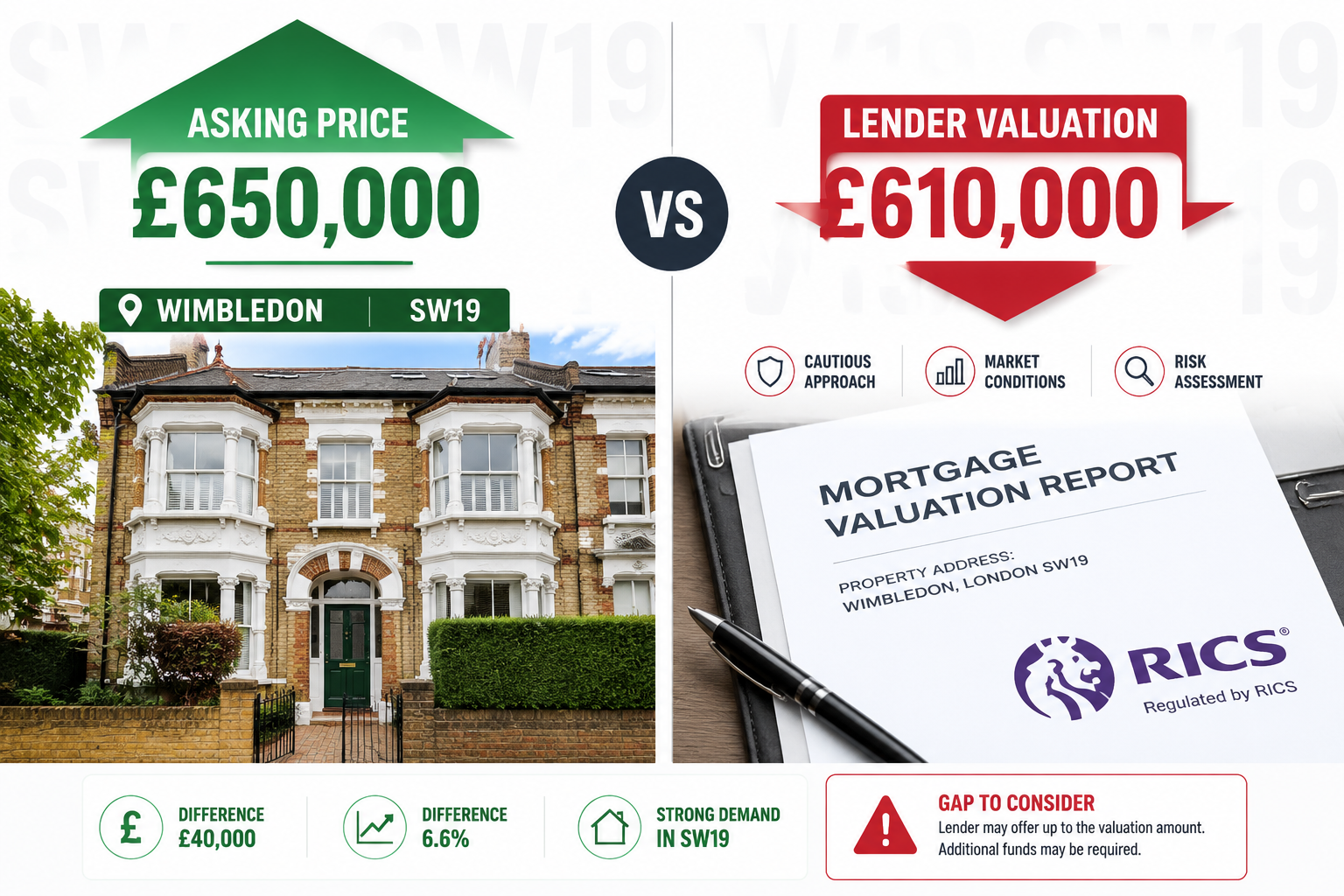
Wimbledon's price softness in 2026 is not a local anomaly — it reflects broader London and South East dynamics, amplified by SW19's high price point. London asking and sold values are down approximately 2.4% year-on-year as of May 2026, with the South East recording a decline of around 1.6% over the same period (Rightmove, May 2026). At the same time, the Halifax House Price Index shows the average UK house price dipped 0.1% to approximately £299,313 in May 2026.
Several factors are converging in Wimbledon specifically:
- Affordability pressure: SW19 average asking prices sit well above the national average, making buyers more sensitive to mortgage rate movements.
- Stamp duty recalibration: The March 2025 stamp duty threshold changes increased transaction costs for buyers above £500,000, a bracket that covers a large share of Wimbledon sales.
- Cautious lender sentiment: Lenders are instructing their panel surveyors to apply conservative comparable evidence, favouring recent sold prices over optimistic asking prices.
- Supply creeping up: More SW19 sellers listed in early 2026 as owners who delayed post-pandemic tried to exit, increasing buyer choice and reducing urgency.
How Much Have Property Values Fallen in Wimbledon? {#how-much}
London sold values are down approximately 2.4% year-on-year as of May 2026, though the picture in SW19 varies by property type and micro-location. The national Rightmove asking price average rose 1.2% month-on-month to around £378,304 in May 2026 — but this national figure masks a divergence: London and the South East are moving in the opposite direction on a sold-price basis.
For context, a Wimbledon property agreed at £750,000 in a market where sold values have softened 2.4% could attract a lender valuation closer to £732,000 — a £18,000 gap the buyer must bridge or negotiate away. On a £1 million property, the same percentage produces a £24,000 shortfall.
Key point: Asking prices and sold prices are not the same thing. Mortgage lenders value against comparable sold evidence, not what sellers are currently asking.
What Causes a Down-Valuation in SW London? {#what-causes}
A down-valuation happens when a mortgage lender's surveyor concludes that a property is worth less than the price the buyer and seller have agreed. In SW London in 2026, the primary trigger is the widening gap between seller expectations (anchored to 2024–2025 peak asking prices) and the sold comparable evidence available to lenders.
Specific triggers in Wimbledon transactions include:
- Stale comparables: The lender's surveyor can only use completed sales, not active listings. If recent sold prices in the street are lower than the agreed price, the valuation will reflect that.
- Structural or condition issues: Defects identified during a survey — damp, roof problems, subsidence risk — reduce a property's market value in a lender's eyes. Many Wimbledon Victorian terraces carry latent issues that affect valuation. See our guide on buying a house in Wimbledon and checking the roof for what to look for.
- Overpriced listing: Some sellers priced in late 2024 or early 2025 at peak expectations and have not adjusted. Lenders will not validate an inflated asking price.
- Leasehold complications: Short leases or high service charges on SW19 flats reduce lender appetite and can trigger a lower valuation figure.
Which Areas of Wimbledon Are Most Affected? {#which-areas}
Price softness in Wimbledon 2026 is not uniform. The highest-value pockets — particularly around Wimbledon Village, Parkside, and the roads bordering Wimbledon Common — are seeing the largest absolute gaps between asking prices and lender valuations, simply because the numbers are bigger.
Mid-market streets in SW19 4 and SW19 5 (closer to Wimbledon town centre and South Wimbledon) are seeing more realistic pricing from sellers, partly because buyers at that level are more price-sensitive and have pushed back harder in negotiations.
Areas to watch:
- Wimbledon Village / SW19 5: High asking prices, fewer recent comparable sold transactions, higher down-valuation risk.
- Raynes Park and Merton Park borders: More active transaction volume provides better comparables, slightly lower risk.
- Flat conversions near the town centre: Leasehold complications and service charge scrutiny add a separate layer of valuation risk.
Are Down-Valuations Happening Across All Property Types? {#property-types}
Down-valuations in Wimbledon 2026 are more common on certain property types, but no category is immune. Detached and larger semi-detached houses in premium streets carry the highest absolute risk because the gap between aspirational asking prices and conservative lender comparables is widest. Victorian terraces with deferred maintenance are also frequently flagged.
Flats face a different but equally real risk: lenders are scrutinising lease length, cladding status, and service charges more carefully following regulatory changes. A flat with fewer than 80 years remaining on the lease can attract a significantly reduced valuation or be declined entirely by some lenders.
New-build properties in SW19 tend to have more predictable valuations because developers provide comparable evidence — but even these are not immune if the local market has moved since exchange.
How Do Down-Valuations Impact Mortgage Applications? {#mortgage-impact}
A down-valuation directly affects how much a lender will lend, because mortgage offers are calculated as a percentage of the lower of the purchase price or the valuation. If a lender values a property at £620,000 but the agreed price is £650,000, the mortgage is calculated on £620,000.
The practical consequences:
- The buyer must fund the £30,000 gap from savings, or renegotiate the price down.
- Loan-to-value ratios shift, potentially pushing the buyer into a higher-rate mortgage band.
- Chains can collapse if the buyer cannot cover the shortfall and the seller refuses to reduce.
- Completion timelines extend while parties dispute the valuation.
For Wimbledon transactions in 2026, where prices regularly exceed £600,000, even a modest 2–3% down-valuation produces a five-figure cash shortfall. Understanding how an RICS survey can help you negotiate the price of your property is therefore directly relevant to protecting your mortgage position.
How Do Down-Valuations Differ for First-Time Buyers vs. Investors? {#ftb-vs-investors}
First-time buyers are more exposed to down-valuations than experienced investors or cash buyers. A first-time buyer in Wimbledon typically has a deposit of 5–15%, leaving very little room to absorb a shortfall without renegotiating. A £20,000 down-valuation on a £500,000 property can effectively kill a transaction for a buyer with a 5% deposit.
Investors and repeat buyers often have:
- Larger deposits providing a buffer against a lower lender valuation.
- Experience recognising when a price is aggressive and negotiating before exchange.
- In some cases, access to cash or bridging finance that bypasses the lender valuation entirely.
For first-time buyers in SW19, commissioning a RICS Level 2 or Level 3 survey before exchange is especially important — it surfaces defects that compound the down-valuation risk and provides negotiating leverage before the lender's surveyor even visits.
What Should You Do If Your Wimbledon Home Gets Down-Valued? {#what-to-do}
If a down-valuation occurs, there are four practical options. The right one depends on how large the gap is and how motivated both parties are to proceed.
Option 1: Renegotiate the purchase price. The most common resolution. The buyer presents the lender's valuation figure to the seller and requests a price reduction. In the current Wimbledon market, sellers are often more willing to negotiate than they were in 2022–2023. See our resource on average price reductions after a survey for realistic benchmarks.
Option 2: Challenge the valuation (see next section).
Option 3: Increase the deposit. If the buyer has savings available, covering the shortfall avoids renegotiation. This is less common at Wimbledon price points but remains an option.
Option 4: Walk away. If the seller will not negotiate and the shortfall is unaffordable, withdrawing before exchange is legally clean. Losing a survey fee is far less costly than overpaying by tens of thousands.
Sellers facing a down-valuation should consider commissioning an independent RICS Red Book valuation to either confirm the lender's figure is wrong or to reset their pricing expectations with credible evidence.
Can You Challenge a Down-Valuation from Your Mortgage Lender? {#challenge}
Yes, down-valuations can be challenged, but success depends on the quality of evidence provided. A challenge based purely on "we agreed this price" will not succeed. A challenge supported by recent comparable sold transactions — not asking prices — has a realistic chance.
Steps to challenge effectively:
- Request the lender's valuation report and identify the comparables used.
- Instruct an independent RICS-registered surveyor to provide a formal opinion of value with alternative comparables. A RICS property valuation carries professional weight that informal estate agent opinions do not.
- Submit the independent evidence to the lender's complaints or appeals process.
- Ask the broker to approach a different lender. Different lenders use different panel surveyors, and valuations can legitimately differ between firms.
One important constraint: lenders are not obliged to change their valuation. If the independent evidence is strong, they often will — but there is no guarantee.
How an Independent Survey Protects Wimbledon Buyers and Sellers {#survey-protection}
An independent RICS survey does two things that directly reduce down-valuation risk: it surfaces condition issues before the lender's surveyor visits, and it gives both parties accurate information to price and negotiate from.
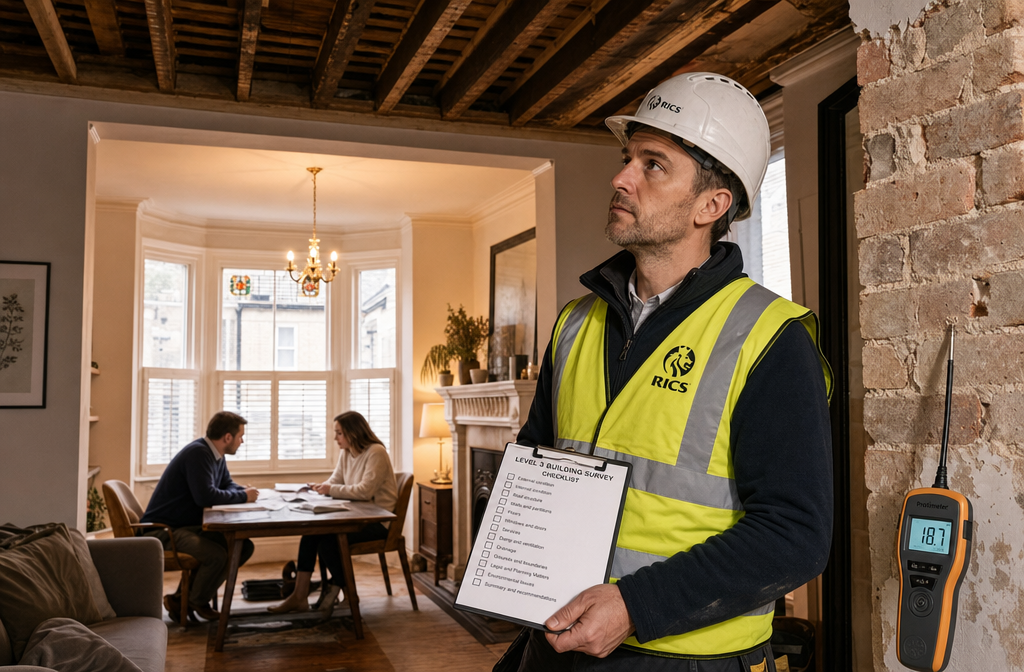
For buyers: A RICS Level 2 HomeBuyer Report identifies defects that reduce market value — damp, roof condition, structural movement — and provides a market valuation section. If the report reveals significant issues, the buyer can renegotiate before the lender's valuation, reducing the chance of a late-stage chain collapse. A Level 3 Building Survey is appropriate for older, larger, or non-standard Wimbledon properties and provides greater depth of analysis.
For sellers: Commissioning a pre-sale independent valuation or survey removes the element of surprise. A seller who knows their property has a damp issue or short lease can either remedy it, adjust the price, or disclose it upfront — all of which reduce the probability of a buyer's lender coming in low at a critical stage.
The choice between a Level 2 and Level 3 report is covered in detail in our guide on HomeBuyer Report or Building Survey: choosing the right assessment.
Is Now a Good Time to Buy or Sell in Wimbledon? {#buy-or-sell}
This is a factual question, not a financial advice question, and the honest answer is: it depends on individual circumstances and realistic pricing.
For buyers: The May 2026 data suggests genuine negotiating leverage exists in SW19. Sellers who listed at 2024–2025 peak expectations are increasingly open to price reductions, particularly where a survey or down-valuation provides objective justification. Buyers who commission a survey before exchange are better positioned to negotiate and less likely to face a lender shortfall they cannot cover.
For sellers: Overpricing in the current Wimbledon market is counterproductive. A property that attracts an offer but then suffers a down-valuation wastes weeks and risks losing the buyer entirely. Accurate pricing from the outset — supported by a professional valuation rather than an estate agent's optimistic appraisal — reduces time on market and transaction failure risk.
The Wimbledon property surveyors team at this firm works with both buyers and sellers across SW19 to provide RICS-standard surveys and valuations that reflect current market conditions, not aspirational asking prices.
FAQ {#faq}
Q: What is a down-valuation and why does it matter in Wimbledon in 2026?
A down-valuation occurs when a mortgage lender's surveyor values a property below the agreed purchase price. In Wimbledon in 2026, it matters because London sold values are approximately 2.4% below year-ago levels while many sellers are still pricing at 2024–2025 expectations, creating a gap that lenders will not bridge.
Q: How common are down-valuations in SW19 right now?
There is no single published figure for SW19 specifically. However, given that London asking prices and sold prices are diverging by approximately 2.4% year-on-year as of May 2026, any Wimbledon property priced above recent comparable sold transactions carries a meaningful down-valuation risk.
Q: Does a RICS survey prevent a down-valuation?
Not automatically. A RICS survey identifies condition issues and provides an independent opinion of value, which buyers can use to renegotiate before the lender's surveyor visits. This reduces the probability of a surprise down-valuation but does not eliminate it entirely if the agreed price was already above market value.
Q: How much does an independent RICS survey cost in Wimbledon?
Survey costs vary by property size and survey level. A Level 2 HomeBuyer Report typically starts from a few hundred pounds; a Level 3 Building Survey on a larger Wimbledon property will cost more. In both cases, the cost is typically a fraction of the shortfall a down-valuation can produce on a £600,000+ transaction.
Q: Can the seller refuse to reduce the price after a down-valuation?
Yes. The seller has no legal obligation to reduce the price. However, if the buyer cannot fund the shortfall and walks away, the seller must relist — often at a lower price and after losing weeks of marketing time. Most sellers in the current Wimbledon market prefer to negotiate rather than restart.
Q: What is a RICS Red Book valuation and when do I need one?
A RICS Red Book valuation is a formal, independent opinion of market value prepared by a chartered surveyor to RICS Valuation Global Standards. It is used when a robust, defensible valuation figure is needed — for example, to challenge a lender's down-valuation, for probate, or for a matrimonial settlement. An estate agent's appraisal is not a substitute.
Conclusion
Wimbledon house price down-valuations in 2026 are a direct consequence of a market where seller expectations have not fully adjusted to the reality of falling London sold values. With London down approximately 2.4% year-on-year and lenders applying conservative comparable evidence, the gap between agreed prices and mortgage valuations is wide enough to collapse chains on a regular basis.
Actionable next steps:
- Buyers: Commission a RICS Level 2 or Level 3 survey before exchange — not after. Use the findings to renegotiate if defects or pricing issues are identified.
- Sellers: Obtain an independent RICS valuation before listing. Accurate pricing reduces the risk of a late-stage down-valuation and protects your chain.
- Anyone facing a down-valuation: Gather recent comparable sold evidence, instruct an independent RICS surveyor, and present a formal challenge to the lender with professional supporting documentation.
Local chartered surveyors with SW19 expertise understand the specific streets, property types, and micro-market conditions that determine whether a Wimbledon valuation holds up. Getting that expertise on your side early is the most practical step available in the current market.
References
- Rightmove House Price Index, May 2026 — rightmove.co.uk
- Halifax House Price Index, May 2026 — halifax.co.uk
- RICS Valuation Global Standards (Red Book) — rics.org
- RICS Home Survey Standard, 2019 — rics.org