Over 4.6 million households in England's private rented sector live under roofs that may now face stricter legal scrutiny than ever before — and many landlords still don't know it. The 2026 expansion of Awaab's Law has moved far beyond its original damp and mould focus. Building surveys for expanded Awaab's Law hazards 2026: protocols for excess temperature and fire risks in private rentals are now a frontline compliance tool, and the evidence standards required for enforcement are tighter than most landlords or tenants realise.
This article breaks down exactly what surveyors must assess, how Level 3 building surveys are adapting to new hazard categories, and what both landlords and tenants need to understand about the enforcement landscape in 2026.
Key Takeaways 📋
- Awaab's Law Phase 2 (2026) extends mandatory hazard remediation timelines to cover excess temperature and fire safety risks in private rentals.
- Level 3 building surveys must now include structured checklists for thermal performance, fire escape routes, electrical fire risks, and heating system adequacy.
- Evidence standards for enforcement require photographic records, thermal imaging data, and written condition assessments — not just verbal reports.
- Landlords face strict remediation deadlines once a hazard is formally identified, making proactive surveys essential.
- Tenants and local authorities can both trigger enforcement action, so documented survey findings carry significant legal weight.
What Awaab's Law Phase 2 Actually Changes in 2026
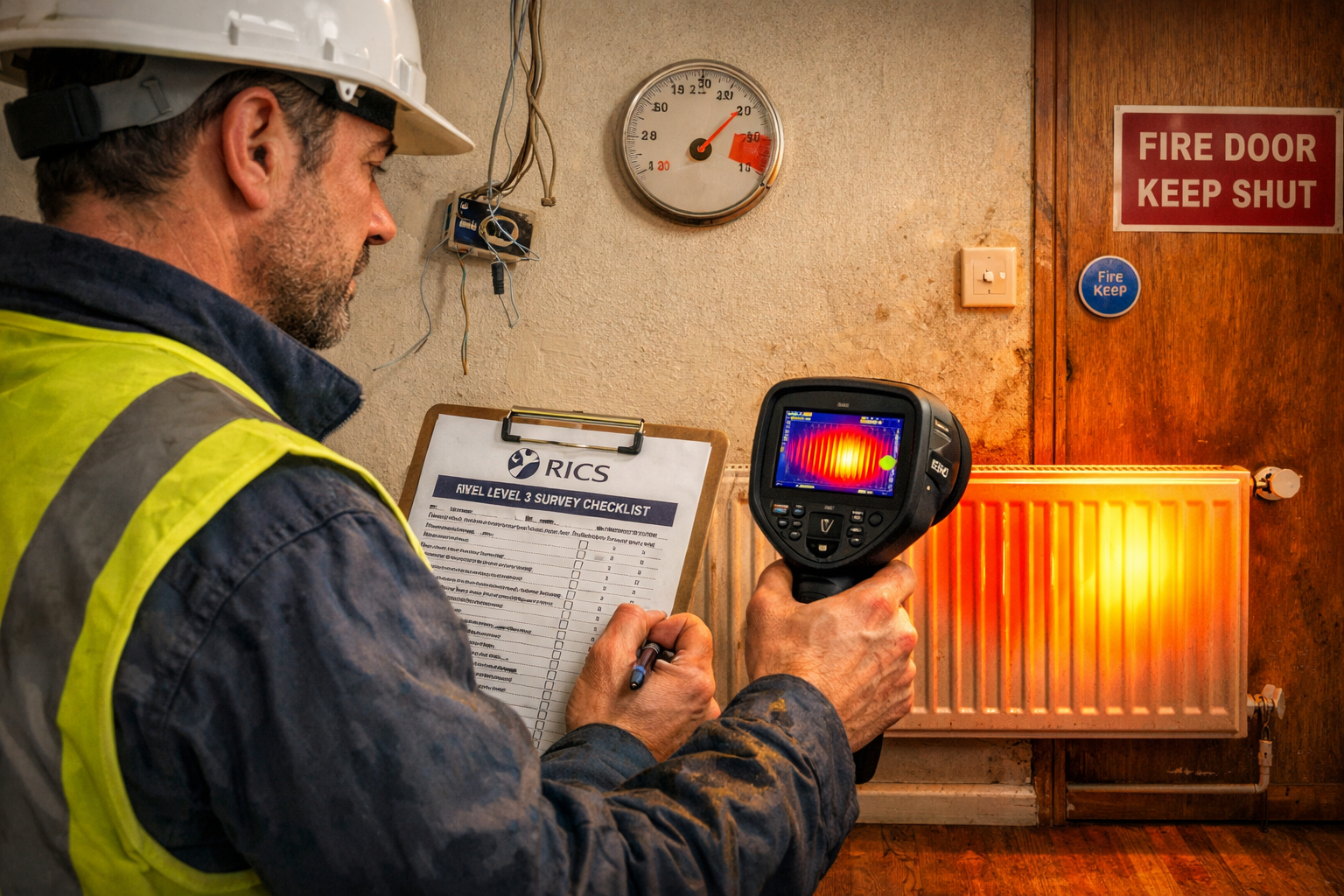
Awaab's Law was originally introduced following the tragic death of two-year-old Awaab Ishak in 2020, caused by prolonged exposure to mould in a social housing property. The initial legislation focused on damp, condensation, and mould remediation timelines. However, the Phase 2 expansion in 2026 places fire safety and temperature control at the forefront of rental property compliance across both social and private rented sectors. [1]
Under the Renters' Rights Act — which received Royal Assent and brought private landlords firmly within scope — the expanded framework now requires landlords to address Category 1 hazards under the Housing Health and Safety Rating System (HHSRS) within defined timeframes. The two newly prioritised hazard categories are:
- 🌡️ Excess cold and excess heat — inadequate heating systems, poor insulation, and overheating risks
- 🔥 Fire hazards — including electrical fire risks, inadequate fire detection, blocked escape routes, and non-compliant fire doors
The 2026 hazard expansions establish new surveyor protocols specifically addressing electrical, fire, and excess heat risks in rental properties. [2] This means a standard condition report is no longer sufficient. Landlords and their agents need structured, evidence-based assessments that can withstand scrutiny from local authority environmental health officers.
Why Private Rentals Are Now the Primary Focus
Social housing providers were brought into scope first. From 2026, the private rented sector (PRS) faces the same obligations. This matters because:
| Sector | Previous Obligation | 2026 Obligation |
|---|---|---|
| Social housing | Damp/mould remediation timelines | + Temperature & fire hazard timelines |
| Private rented sector | General HHSRS compliance | Full Awaab's Law hazard framework |
| HMOs | Licensing conditions | Enhanced survey evidence requirements |
For landlords managing older stock — Victorian terraces, converted flats, pre-1980s houses — the risks of non-compliance are highest. These properties are most likely to present excess temperature and fire hazards that a thorough RICS building survey would flag.
Level 3 Survey Checklists: What Must Be Assessed Under the New Protocols
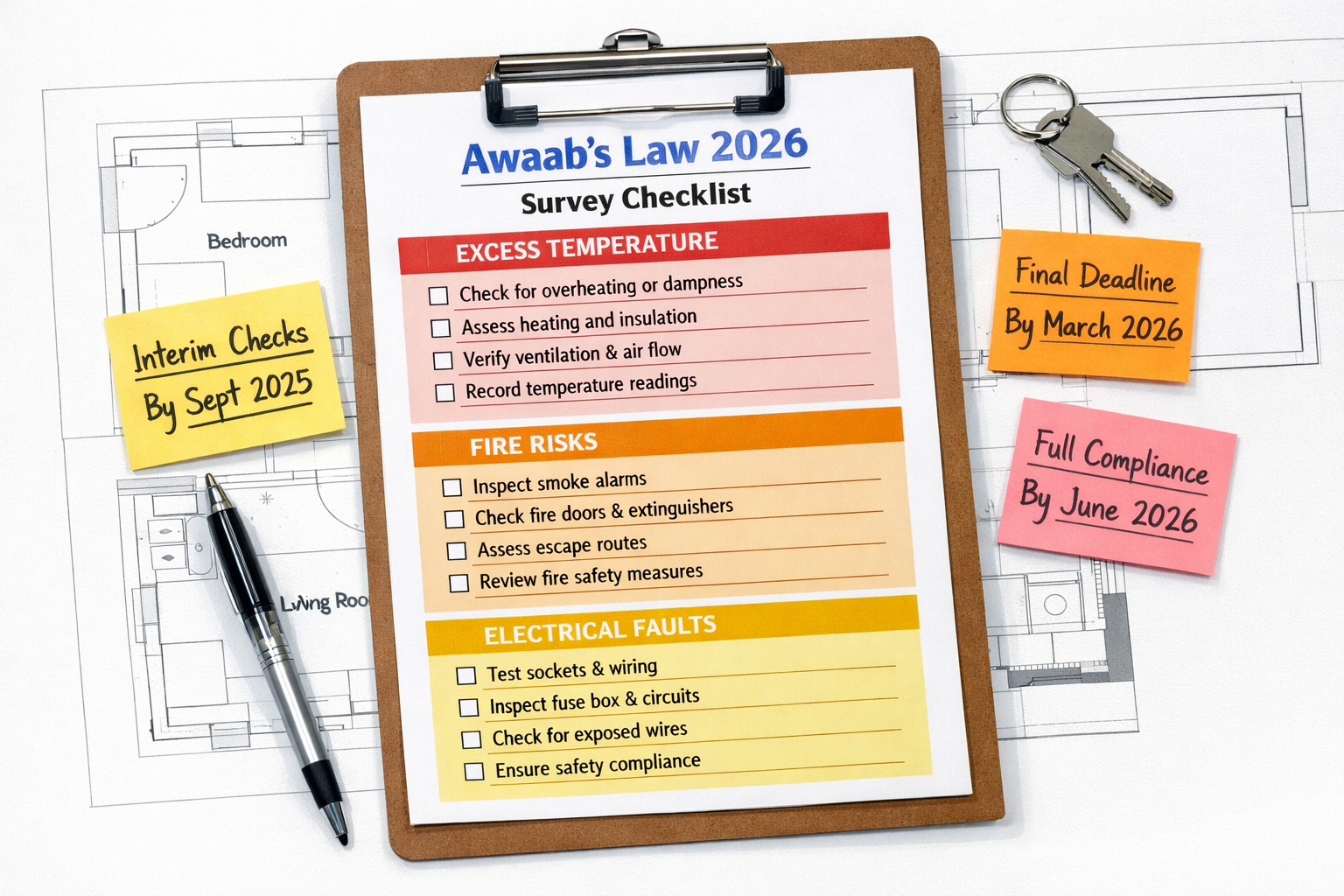
A Level 3 building survey (formerly known as a full structural survey) is the most comprehensive residential survey available. Under the 2026 protocols, surveyors conducting assessments on private rental properties must now work through expanded checklists covering the two new priority hazard categories. [1][2]
Understanding which home survey is right for your property is the first step — but for landlords facing Awaab's Law compliance, a Level 3 survey is almost always the appropriate choice.
🌡️ Excess Temperature Hazard Checklist
The HHSRS defines excess cold as an annual average indoor temperature below 18°C in living areas, and excess heat as sustained temperatures above 35°C. Surveyors must now document:
Heating System Adequacy
- Boiler age, service history, and output capacity relative to property size
- Radiator coverage and zoning — are all habitable rooms adequately served?
- Thermostat functionality and programmability
- Evidence of heating system failure history (corrosion, leaks, pressure loss)
Thermal Envelope Assessment
- Wall insulation type and estimated U-values (cavity, solid, or uninsulated)
- Loft insulation depth and condition
- Window glazing type — single, double, or secondary glazing
- Draught proofing at doors, windows, and floor junctions
Overheating Risk Factors
- South-facing glazing without shading devices
- Roof construction and ventilation in top-floor flats
- Proximity to heat-generating plant or equipment
- Cross-ventilation availability
🔑 Pull Quote: "A thermal imaging camera is no longer optional equipment for surveyors assessing Awaab's Law compliance — it is an evidential necessity."
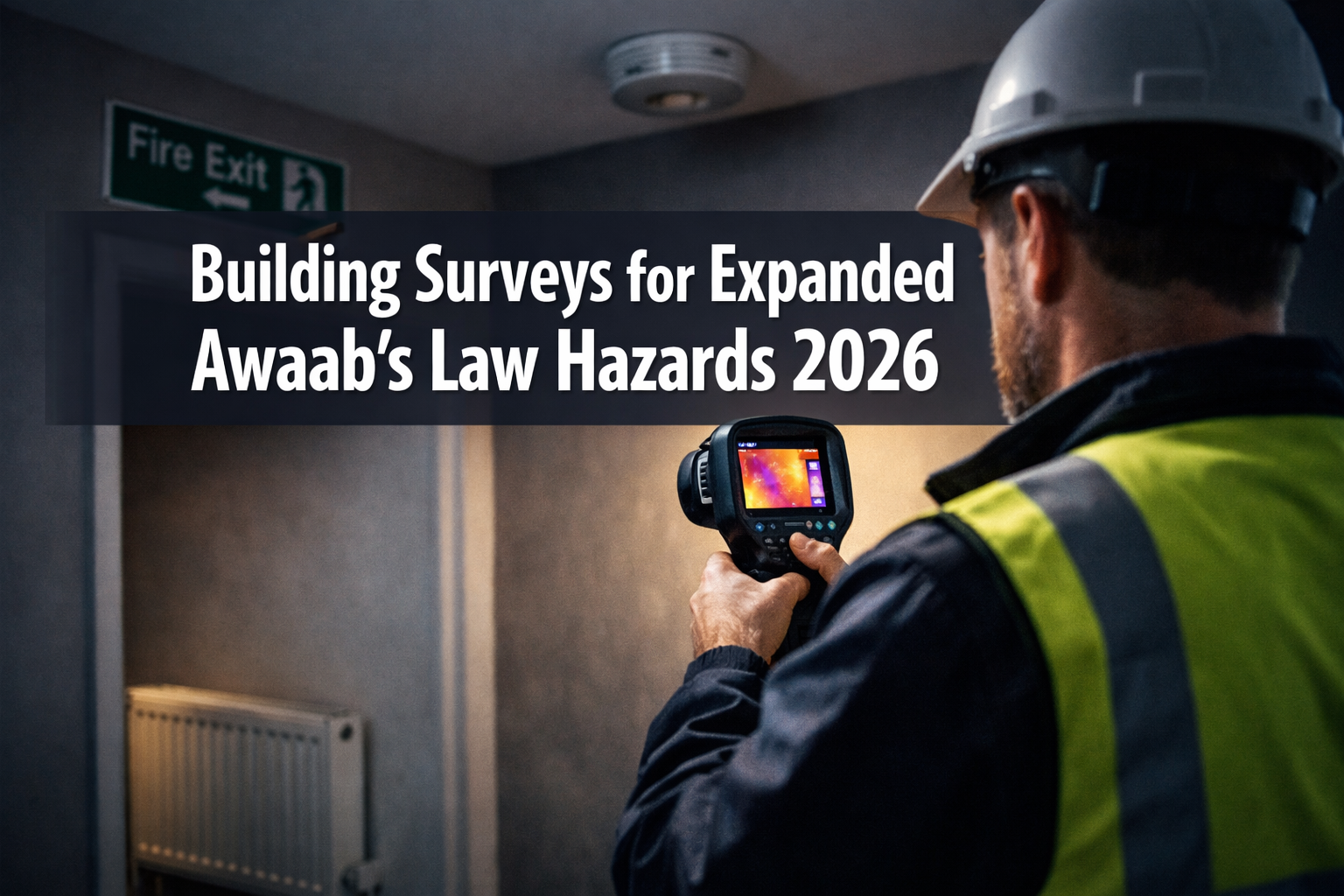
Each finding must be photographed, measured where possible, and graded against HHSRS scoring criteria. A written narrative alone will not meet the evidence standards now expected by enforcement authorities. [2]
🔥 Fire Hazard Checklist
Fire is consistently among the top Category 1 hazards identified in HHSRS assessments. The 2026 protocols require surveyors to assess:
Fire Detection and Warning Systems
- Smoke alarm placement (every floor, kitchen, living areas)
- Carbon monoxide detector presence near combustion appliances
- Alarm type — ionisation vs. photoelectric vs. combined units
- Interlinked alarm systems in HMOs and larger properties
Electrical Fire Risk Indicators
- Age and condition of consumer unit (fuse box)
- Presence of RCDs (residual current devices) and MCBs
- Visible wiring condition — signs of overloading, DIY modifications, or deterioration
- Evidence of recent Electrical Installation Condition Report (EICR)
- Socket and switch plate condition
Structural Fire Containment
- Fire door specification and self-closing mechanisms (especially in HMOs)
- Intumescent strips and cold smoke seals on fire doors
- Compartmentation integrity — unsealed service penetrations through walls/floors
- Loft hatch fire resistance
Escape Route Assessment
- Clear, unobstructed escape routes from all habitable rooms
- Window openings as secondary means of escape (minimum 0.33m² clear opening)
- External staircase condition in HMOs
For properties in London, surveyors from specialist firms — such as those covering Battersea or Camden — are increasingly being asked to provide these expanded assessments as standard.
Evidence Standards for Enforcement: What Makes a Survey Report Legally Robust
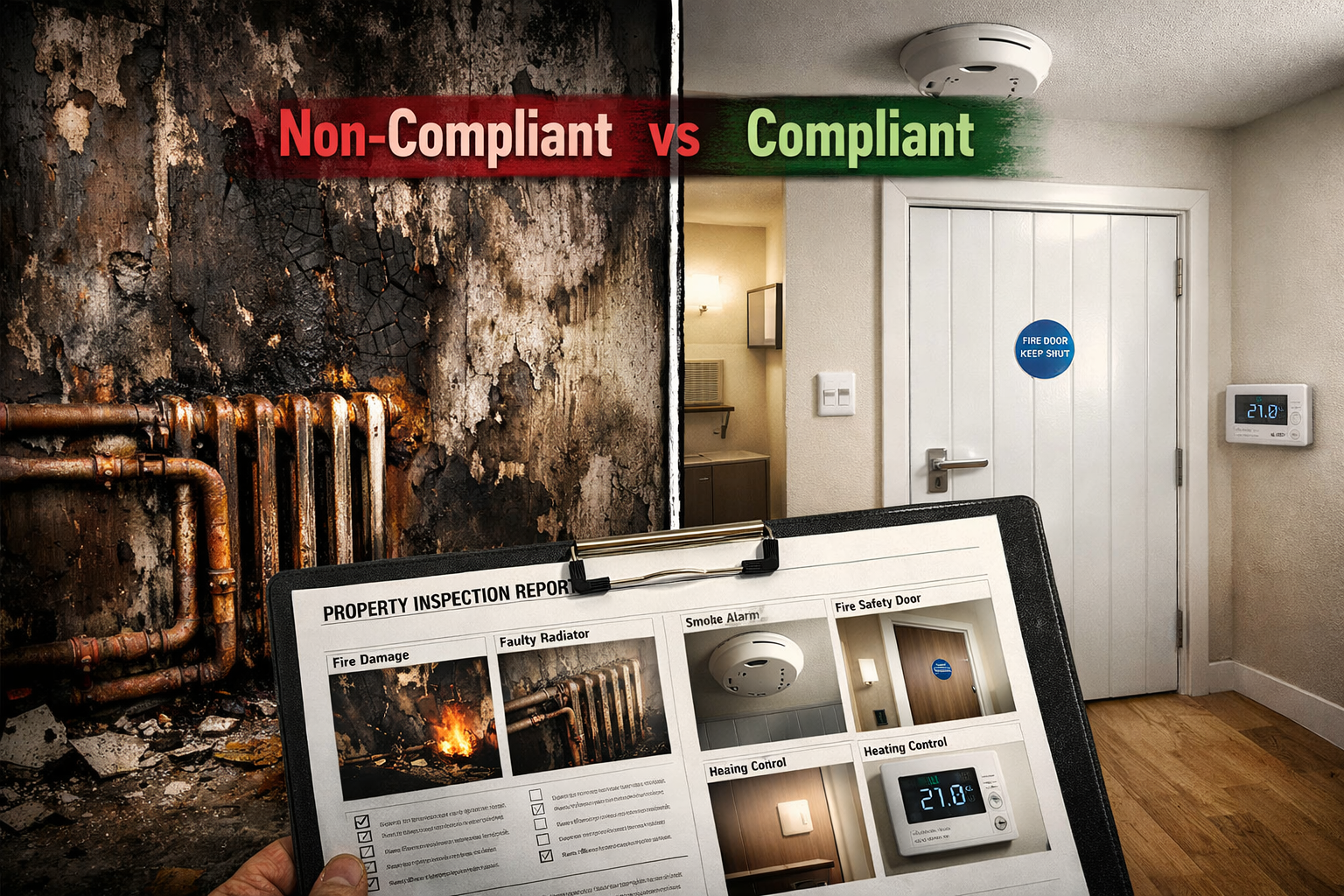
One of the most significant shifts in building surveys for expanded Awaab's Law hazards 2026: protocols for excess temperature and fire risks in private rentals is the emphasis on evidence quality. A report that merely states "heating system appears inadequate" is unlikely to support enforcement action. [2]
Local authority environmental health officers and housing tribunals now expect survey reports to include:
📊 Required Evidence Components
| Evidence Type | Purpose | Tools Required |
|---|---|---|
| Thermal imaging photographs | Demonstrate heat loss or cold bridging | Thermal imaging camera |
| Temperature readings | Quantify excess cold/heat against HHSRS thresholds | Calibrated thermometer |
| Photographic record | Document fire hazards, wiring condition, escape routes | High-resolution camera |
| HHSRS scoring | Calculate likelihood and severity of harm | HHSRS scoring matrix |
| Remediation cost estimates | Support enforcement notices and civil claims | Quantity surveying input |
| Comparison to regulatory standards | Reference Building Regulations, BS standards | Current regulatory documents |
Surveyors should also note that tenant vulnerability increases hazard scores under HHSRS. A property housing elderly residents, young children, or people with respiratory conditions will attract higher hazard scores for the same physical defect. This must be recorded in the survey narrative.
The Remediation Timeline Trigger
Once a Category 1 hazard is formally identified in a survey report, the clock starts. Under the 2026 framework:
- Emergency hazards (immediate risk of harm): landlord must act within 24 hours
- Urgent hazards: remediation required within 7 days
- Standard Category 1 hazards: remediation plan required within 14 days, works completed within a defined period
This is why understanding what to do after a bad building survey report is critical for both landlords and tenants. A survey finding is not just advisory — under Awaab's Law, it can trigger mandatory action.
Falls Hazards: The Third Expanded Category
While excess temperature and fire risks are the headline additions, falls hazards also feature in the 2026 expansion. Surveyors must assess:
- Stair handrail presence and fixity
- Step riser consistency (irregular risers are a significant falls risk)
- Balcony and landing balustrade height and structural integrity
- Wet room and bathroom slip resistance
These assessments align with the broader HHSRS framework and should be included in any comprehensive Level 3 survey conducted on a private rental property. Reviewing home survey levels and choosing the right option helps landlords understand why a Level 2 survey will often be insufficient for full Awaab's Law compliance documentation.
Practical Implications for Landlords and Surveyors in 2026
What Landlords Should Commission
Landlords who want to get ahead of enforcement action — rather than react to it — should commission a proactive Level 3 survey with an explicit Awaab's Law hazard assessment scope. This should include:
- ✅ Written instruction to the surveyor specifying HHSRS assessment against 2026 expanded hazard categories
- ✅ Thermal imaging as part of the survey scope
- ✅ EICR review or recommendation (surveyors cannot conduct EICRs but should flag the need)
- ✅ Photographic schedule with location references
- ✅ HHSRS hazard scoring for any Category 1 or 2 hazards identified
- ✅ Prioritised remediation schedule with cost guidance
Working with a qualified building surveyor who understands the 2026 regulatory landscape is essential. Not all surveyors have updated their scope of service to reflect the new hazard categories.
What Tenants Need to Know
Tenants in the private rented sector now have stronger grounds to request formal hazard assessments. If a landlord refuses to address reported excess temperature or fire risks, tenants can:
- Report to the local authority's environmental health department
- Apply to the First-tier Tribunal (Property Chamber) for a hazard awareness notice or improvement notice
- Seek rent repayment orders where hazards are proven
A well-documented survey report — even one commissioned by the tenant — carries significant weight in these proceedings.
The Role of Condition Surveys in Ongoing Compliance
For landlords managing multiple properties, periodic condition surveys provide a documented compliance trail. A condition survey report from chartered surveyors can establish a baseline assessment, identify emerging hazards before they reach Category 1 status, and demonstrate due diligence if enforcement action is ever pursued.
🔑 Pull Quote: "Proactive surveying is no longer just good practice — under the 2026 Awaab's Law framework, it is the most effective legal shield a private landlord can carry."
Common Deficiencies Found in 2026 Surveys
Based on the updated surveyor protocols [1][2], the most frequently identified hazards in private rental assessments include:
- Undersized boilers in extended or converted properties
- Single-glazed windows in older flats without secondary glazing
- Missing or faulty smoke alarms — particularly in kitchens and upper floors
- Outdated consumer units without RCD protection
- Blocked or obstructed fire escape routes in HMOs
- Inadequate loft insulation in pre-1990s terraced houses
- Non-fire-rated internal doors in converted flats
Each of these deficiencies, if scored as Category 1 under HHSRS, now triggers mandatory remediation timelines under the expanded Awaab's Law framework.
Conclusion: Actionable Next Steps for 2026 Compliance
The expansion of Awaab's Law into excess temperature and fire hazards represents the most significant shift in private rental compliance obligations in a generation. Building surveys for expanded Awaab's Law hazards 2026: protocols for excess temperature and fire risks in private rentals are no longer a niche specialism — they are a mainstream requirement for responsible landlords and a critical tool for tenant protection.
Immediate Actions for Landlords ✅
- Commission a Level 3 survey with explicit Awaab's Law hazard scope on all rental properties — prioritise older stock and HMOs
- Ensure EICR compliance — electrical installation condition reports must be current (within 5 years)
- Upgrade heating systems where boilers are over 15 years old or output is inadequate for property size
- Install interlinked smoke and CO alarms to meet the latest standards
- Document everything — survey reports, remediation works, contractor invoices, and communications with tenants
For Tenants 🏠
- Request written confirmation from your landlord that a current hazard assessment has been conducted
- Report excess cold, overheating, or fire safety concerns in writing (email creates a timestamped record)
- Contact your local authority's environmental health team if concerns are ignored
The 2026 regulatory landscape rewards preparation. Landlords who invest in thorough, evidence-based building surveys now will be far better positioned than those who wait for enforcement notices to arrive.
References
[1] Awaabs Law 2026 Hazard Expansions Surveyor Protocols For Electrical Fire And Excess Heat Risks In Rentals – https://nottinghillsurveyors.com/blog/awaabs-law-2026-hazard-expansions-surveyor-protocols-for-electrical-fire-and-excess-heat-risks-in-rentals
[2] Building Surveys And Awaabs Law 2026 Extensions Identifying Electrical Fire And Temperature Hazards In Prs Properties – https://nottinghillsurveyors.com/blog/building-surveys-and-awaabs-law-2026-extensions-identifying-electrical-fire-and-temperature-hazards-in-prs-properties