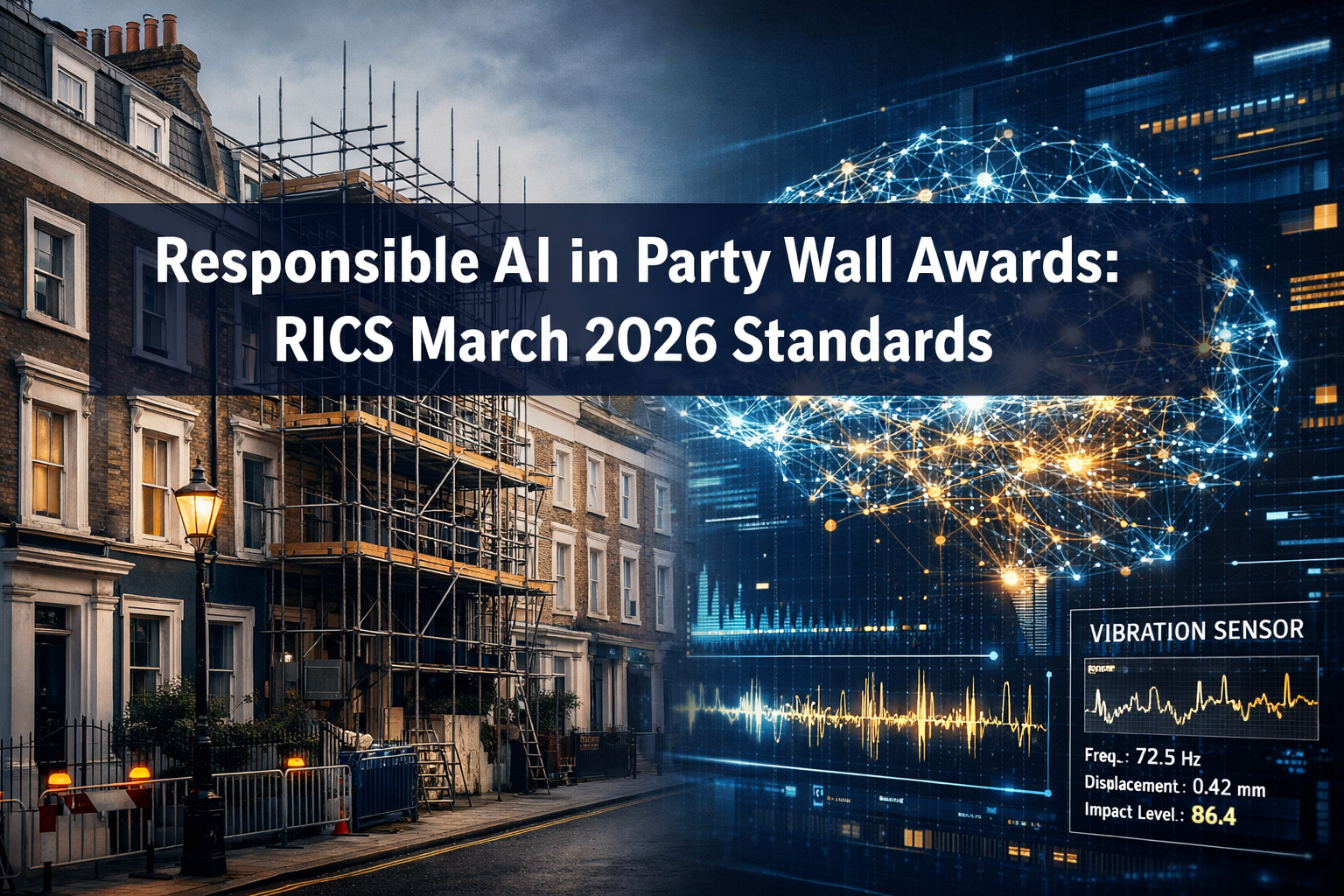
Only 12% of construction disputes in England and Wales are resolved without professional surveyor involvement — yet AI tools are now influencing the very reports and awards that determine those outcomes. As of March 9, 2026, every RICS-regulated firm and member must comply with the profession's first-ever mandatory standard on responsible AI use. For party wall practice specifically, this shift carries enormous implications for how vibration monitoring data is interpreted, how damage predictions are made, and how awards are drafted. [2]
This article unpacks what Responsible AI Use in Party Wall Awards: RICS March 2026 Standards for Automated Condition Monitoring means in practical terms — covering risk governance, data security, professional independence, and the ethical boundaries of automation in one of property law's most sensitive disciplines.
Key Takeaways 📋
- The RICS AI Professional Standard became mandatory on March 9, 2026, applying to all AI outputs with "material impact" on surveying service delivery. [2]
- Party wall surveyors cannot delegate final decision-making to automated systems — professional judgment must always override AI outputs. [2]
- Firms must maintain quarterly-reviewed risk registers using red/amber/green (RAG) ratings for every AI tool in use. [5]
- Express written consent is required before uploading any confidential party wall data to AI platforms. [3]
- Written governance assessments must be completed before any AI system is deployed in practice. [5]
What the RICS March 2026 AI Standard Actually Requires
Scope: When Does the Standard Apply?
The RICS Professional Standard on Responsible Use of Artificial Intelligence in Surveying Practice does not apply to every software tool a surveyor uses. Instead, it targets AI outputs that carry "material impact" on service delivery. [3]
In party wall practice, this threshold is crossed when AI is used to:
- Summarise schedule of condition reports for inclusion in a party wall award
- Generate opinion sections about likely damage causation
- Identify structural elements requiring investigation before or after notifiable works
- Analyse vibration monitoring data from automated sensors installed at shared walls
- Draft award clauses based on pattern-matching with previous awards
If an AI tool's output could influence what a surveyor recommends, records, or awards — it falls under the standard. Understanding what a party wall surveyor does helps clarify just how many of these touchpoints exist in a typical instruction.
The Governance Mandate: Before You Click "Generate"
One of the most operationally significant requirements is the pre-deployment governance assessment. Before using any AI system in practice, firms must conduct and record in writing: [5]
| Assessment Area | What Must Be Documented |
|---|---|
| System governance | Who controls the AI, how it is updated, and accountability structures |
| Sustainability impacts | Energy consumption and environmental footprint of AI use |
| Procurement due diligence | How the tool was selected and evaluated |
| Risk appetite | The firm's tolerance for AI-related errors or failures |
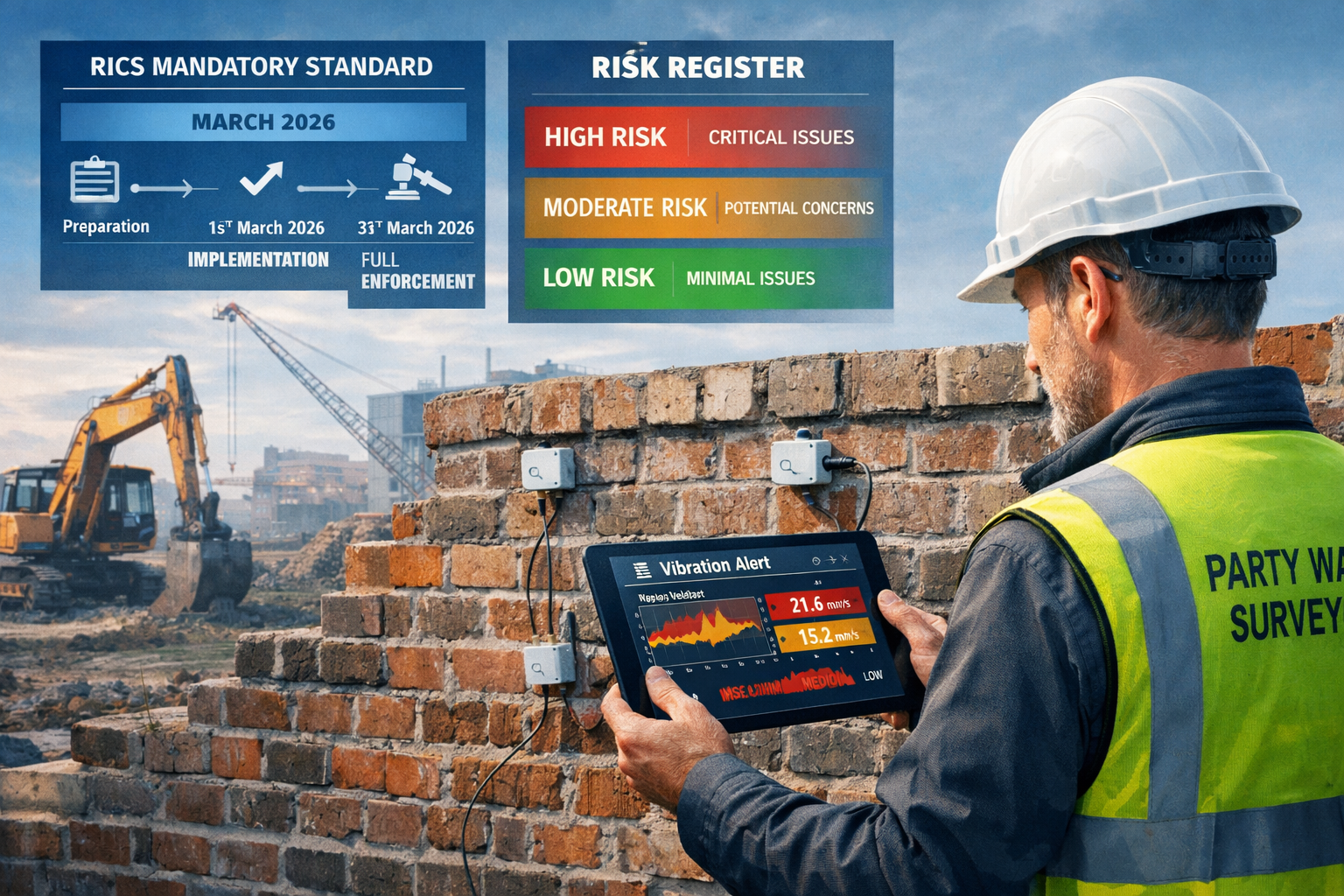
This is not a one-time exercise. The standard requires quarterly reviews of risk registers, using RAG (red/amber/green) ratings that document likelihood of harm, potential impact, and mitigation strategies. [5]
💡 Pull Quote: "Firms cannot simply adopt an AI tool because it is popular or efficient. The RICS standard demands documented evidence that governance, risk, and ethics have been considered before deployment." [5]
Applying Responsible AI Use in Party Wall Awards: RICS March 2026 Standards for Automated Condition Monitoring

Automated Vibration Monitoring: Opportunity and Obligation
Automated condition monitoring has become increasingly common on urban construction sites, particularly in London where terraced and semi-detached properties share party walls with neighbours. Vibration sensors, crack monitors, and tilt meters can now transmit real-time data to cloud platforms that use machine learning to flag threshold breaches and predict structural risk.
This technology offers genuine benefits:
- ✅ Continuous monitoring without site visits
- ✅ Objective, timestamped data records
- ✅ Early warning of vibration levels approaching British Standard BS 7385 thresholds
- ✅ Reduced dispute risk through transparent evidence trails
However, under the RICS March 2026 standard, the AI-generated alerts and risk predictions from these platforms now constitute outputs with material impact on surveying service delivery. [3] That means the surveyor reviewing the data cannot simply forward an automated report to a building owner as professional advice.
The surveyor must:
- Independently assess the AI-generated findings against their own site knowledge
- Document their professional judgment about whether the AI output is reliable in context
- Record any divergence between their own assessment and the automated prediction
- Ensure the award reflects their opinion, not the algorithm's
For those managing party wall surveyor responsibilities on active construction sites, this creates a clear workflow requirement: AI monitoring data is evidence, not conclusion.
AI-Assisted Award Drafting: Where the Line Falls
Large language models and AI drafting tools are increasingly used to generate boilerplate award clauses, condition descriptions, and even dispute resolution language. The RICS standard does not prohibit this — but it draws a firm line around professional independence. [2]
What is permitted:
- Using AI to draft initial award text for surveyor review
- Using AI to summarise lengthy schedules of condition
- Using AI to cross-reference previous awards for consistency
What is not permitted:
- Issuing an award where the opinion sections were generated by AI without critical human review
- Allowing AI to determine the scope of works in an award
- Using AI outputs as the basis for a surveyor's expert opinion without independent verification
This distinction matters enormously in party wall agreement assistance contexts, where the award is a legally binding document. A surveyor who issues an award containing unreviewed AI-generated opinions may face professional conduct proceedings under the RICS Rules of Conduct, in addition to potential liability under the Party Wall etc. Act 1996.
For a thorough grounding in the legal framework, the Party Wall Act 1996 guide remains an essential reference alongside the new AI standard.
Damage Prediction Models: Useful Tool, Not Expert Witness
AI damage prediction tools — which estimate the likelihood of cracking, settlement, or structural movement based on proximity to excavation works — are now widely available to party wall surveyors. These tools draw on databases of past cases, soil type data, and building age to generate risk scores.
Under the RICS standard, these outputs fall squarely within the "material impact" definition. [3] A surveyor using such a tool to inform their schedule of condition or their award must:
- Record which AI system was used and its version
- Note the data inputs provided to the system
- Assess whether the AI's assumptions are valid for the specific property
- Confirm that their professional opinion — not the AI score — drives the award
This is particularly relevant for property condition assessments conducted before notifiable works begin, where the baseline record forms the foundation of any future dispute.
Data Security, Consent, and Risk Governance Under the 2026 Standard
Protecting Confidential Party Wall Data
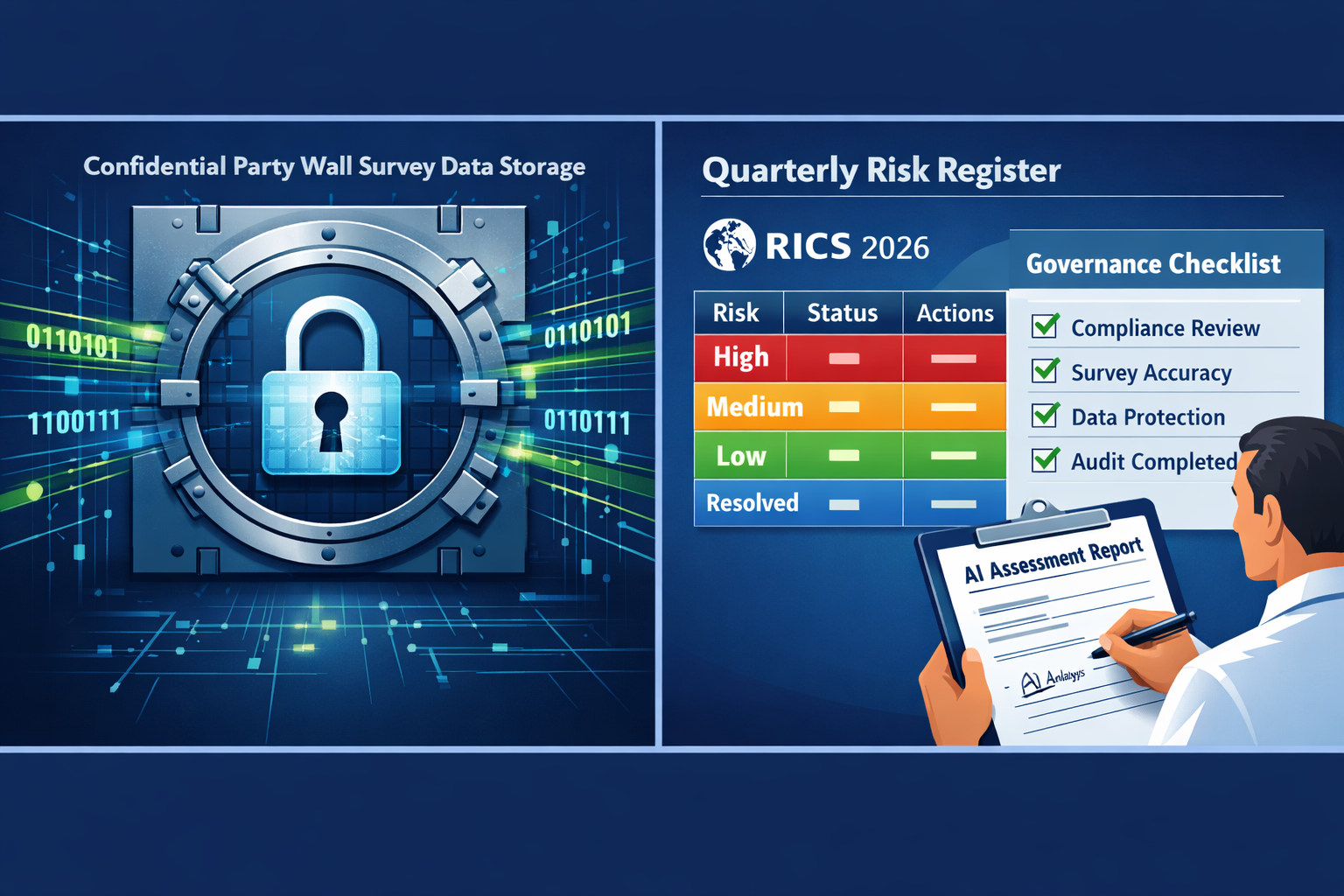
Party wall instructions involve sensitive information: property valuations, structural reports, neighbour disputes, and personal correspondence. When this data is fed into AI platforms — even for legitimate purposes like summarisation or drafting — it creates serious data security obligations. [3]
The RICS standard requires organisations to: [3]
- Store private data securely with appropriate encryption and access controls
- Restrict access to staff who genuinely need it for the task at hand
- Provide regular training to all staff who interact with AI systems handling client data
- Obtain express written consent before uploading any confidential client data to an AI system
That last point is critical. If a surveyor uploads a neighbour's schedule of condition report to an AI drafting tool without written consent, they are in breach of both the RICS standard and likely the UK GDPR. The standard does not distinguish between free consumer AI tools and enterprise platforms — the consent requirement applies to both.
Firms should review their client care letters and engagement terms to ensure AI data use is explicitly addressed. This is especially important for expert party wall surveyors in London handling high-value or contentious instructions.
Building the Risk Register: A Practical Framework
The quarterly risk register requirement is one of the most concrete compliance obligations in the standard. [5] For a party wall practice using AI tools, the register should capture:
🔴 Red-rated risks (high likelihood, high impact):
- AI drafting tool generates factually incorrect award clauses that are issued without review
- Confidential data uploaded to unsecured AI platform without consent
- Vibration monitoring AI fails to flag threshold breach, leading to undetected damage
🟡 Amber-rated risks (moderate likelihood or impact):
- AI summarisation tool omits material defects from schedule of condition
- AI-generated opinion language is retained in final award without adequate review
- Staff use AI tools not approved under the firm's governance framework
🟢 Green-rated risks (low likelihood or impact):
- AI spell-check or grammar tool used on non-confidential correspondence
- AI used to generate meeting agendas with no client data involved
Each entry must document mitigation plans and be reviewed every quarter. [5] Firms that cannot demonstrate this register during a RICS audit or professional indemnity insurance review face significant exposure.
For context on how surveyor fees and professional obligations interact, the cost of party wall surveyor guide provides useful background on the commercial realities of compliance investment.
Why Professional Judgment Cannot Be Automated Away
The Party Wall etc. Act 1996 places a statutory duty on appointed surveyors to act impartially and in accordance with their professional judgment. This duty cannot be contracted out — and it certainly cannot be delegated to an algorithm. [2]
The RICS standard reinforces this by requiring that members maintain professional oversight of all AI outputs and retain final decision-making authority. [2] In practice, this means:
- Every AI-generated section of an award must be reviewed and endorsed by the named surveyor
- Where AI and surveyor disagree, the surveyor's view must prevail and be documented
- Clients must not be led to believe that AI has made professional decisions on their behalf
This principle is not new — it echoes the long-standing requirement for surveyor responsibilities to remain human-centred. What is new is that RICS has now codified it specifically for the AI context, with enforceable professional standards attached.
Conclusion: Actionable Steps for Party Wall Surveyors in 2026
Responsible AI Use in Party Wall Awards: RICS March 2026 Standards for Automated Condition Monitoring is not a distant regulatory concern — it is live, enforceable, and directly relevant to every party wall instruction taken on from March 9, 2026 onwards. [2]
The standard does not demand that surveyors abandon AI tools. It demands that they use them ethically, transparently, and with documented professional oversight. For party wall practice, this means treating automated vibration monitoring data as evidence to be assessed, AI-drafted award language as a starting point to be reviewed, and damage prediction scores as inputs to professional judgment — never substitutes for it.
✅ Immediate Action Checklist for Party Wall Practices
- Audit all AI tools currently in use and assess whether they meet the "material impact" threshold
- Complete written governance assessments for every qualifying AI system before continued use
- Build a risk register with RAG ratings and schedule quarterly reviews
- Update client care letters to include express consent provisions for AI data use
- Train all staff on data security obligations when using AI platforms
- Review award templates to ensure AI-generated content is clearly reviewed and endorsed
- Document professional judgment wherever it diverges from or endorses AI outputs
The intersection of property law, professional ethics, and artificial intelligence is complex — but the RICS March 2026 standard provides a clear framework for navigating it responsibly. Surveyors who embed these practices now will be better positioned for the inevitable increase in regulatory scrutiny ahead.
References
[1] Watch – https://www.youtube.com/watch?v=Xq23P8g2ldk
[2] RICS First Ever Standard On Responsible AI Use Now In Effect – https://www.rics.org/news-insights/rics-first-ever-standard-on-responsible-ai-use-now-in-effect
[3] AI Responsible Use Standard – https://ww3.rics.org/uk/en/journals/construction-journal/ai-responsible-use-standard.html
[4] RICS Introduces Mandatory AI Standard For Surveyors: What Insurers And Their Clients Need To Know – https://cms.law/en/gbr/legal-updates/rics-introduces-mandatory-ai-standard-for-surveyors-what-insurers-and-their-clients-need-to-know
[5] Responsible Use Of Artificial Intelligence In Surveying Practice September 2025 – https://www.rics.org/content/dam/ricsglobal/documents/standards/Responsible-use-of-artificial-intelligence-in-surveying-practice_September-2025.pdf
[6] Building Survey Quality Standards 2026: Navigating RICS Updates And Enhanced Home Inspection Requirements – https://nottinghillsurveyors.com/blog/building-survey-quality-standards-2026-navigating-rics-updates-and-enhanced-home-inspection-requirements