

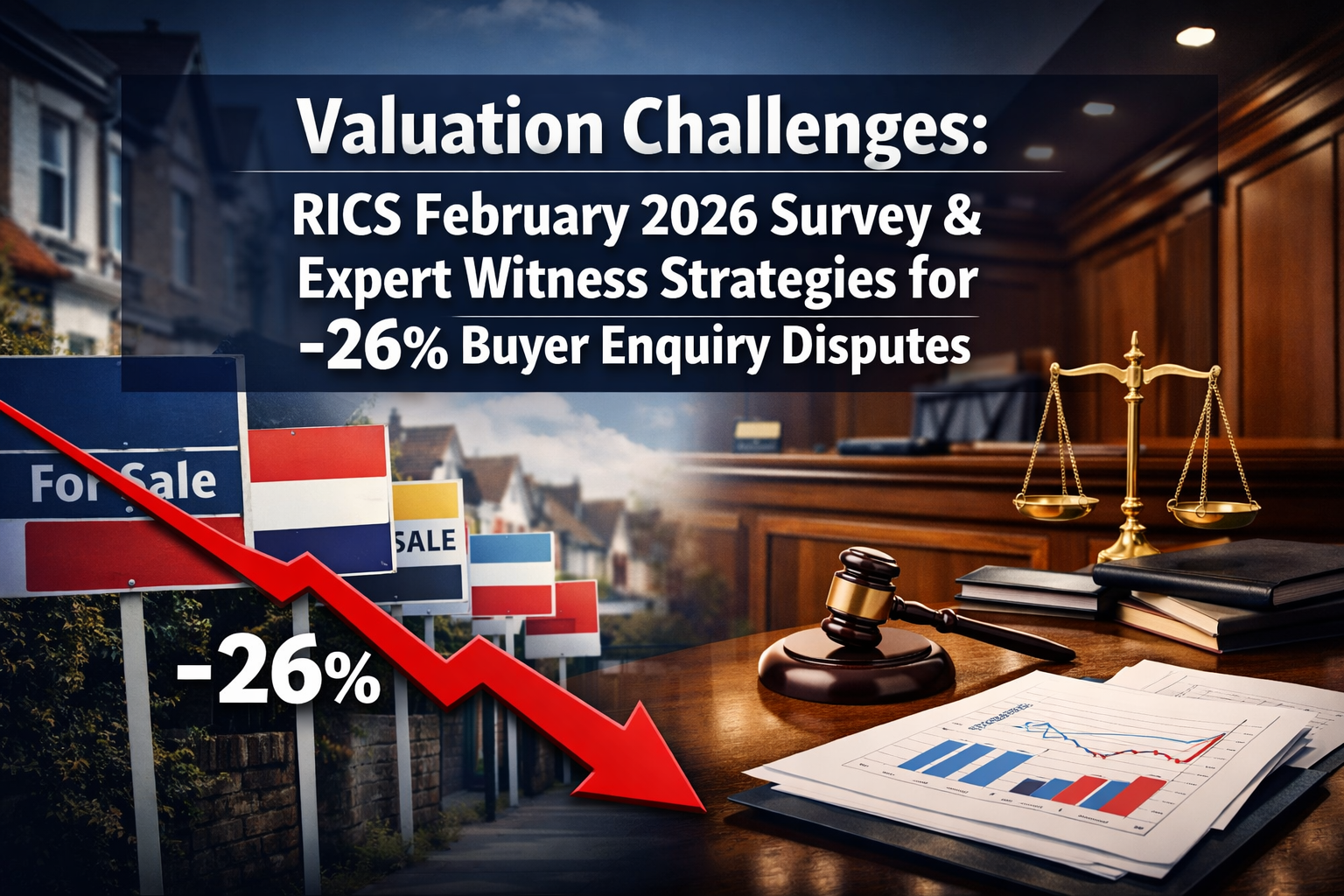
A net balance of -26% of surveyors reported falling buyer enquiries in February 2026 — the sharpest single-month deterioration recorded since mid-2023. That single data point, drawn from the RICS UK Residential Market Survey, is now appearing in courtrooms, mediation rooms, and renegotiation letters across England and Wales. Valuation challenges from RICS February 2026 survey data are reshaping how expert witnesses prepare, present, and defend their opinions in property disputes.

Key Takeaways 📌
- Buyer enquiries collapsed to -26% net balance in February 2026, accelerating to -39% by March, creating a volatile backdrop for property valuations [3]
- Short-term price expectations turned sharply negative at -18%, while 12-month expectations remain positive at +33% — a divergence that expert witnesses must explain clearly in disputes [3]
- Expert witness fees must never be success-based; RICS members face professional and legal consequences if they accept conditional fee arrangements [2]
- RICS EWAS accreditation is increasingly the benchmark for credibility in 2026 valuation dispute proceedings [1]
- Level 2 Survey uptake is rising, with more buyers using survey findings to renegotiate prices — directly fuelling the volume of valuation disputes [4]
Understanding the RICS February 2026 Market Data
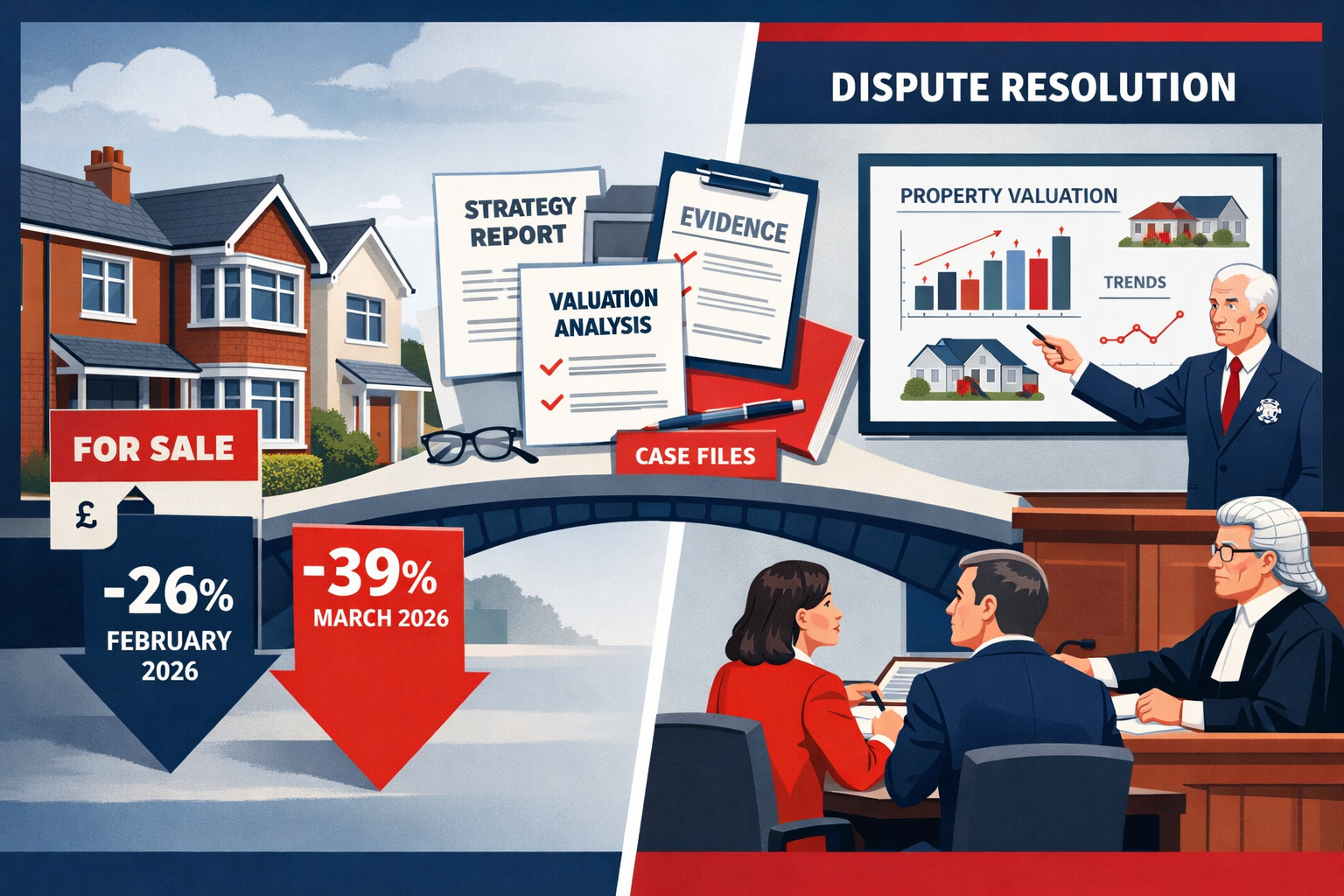
The RICS UK Residential Market Survey for February 2026 delivered a stark picture [3]. Buyer enquiries dropped to a net balance of -26%, a significant deterioration from -15% in January. By March 2026, the figure worsened further to -39% — confirming that February's reading was not an anomaly but the beginning of a sustained demand contraction [3].
What the Numbers Actually Mean
A net balance figure represents the percentage of surveyors reporting an increase minus those reporting a decrease. A reading of -26% means a substantial majority of RICS-registered surveyors across the UK observed fewer buyers coming through the door.
| Indicator | January 2026 | February 2026 | Direction |
|---|---|---|---|
| Buyer Enquiries (net balance) | -15% | -26% | ⬇️ Worsening |
| Agreed Sales (net balance) | — | -12% | ⬇️ Subdued |
| Short-term Price Expectations | -6% | -18% | ⬇️ Negative |
| Near-term Sales Expectations | Positive | -2% | ⬇️ Reversed |
| 12-month Price Expectations | — | +33% | ✅ Positive |
Source: RICS UK Residential Market Survey, February 2026 [3]
The Drivers Behind the Decline
Surveyors cited a cluster of overlapping pressures [3]:
- 📉 Persistent inflation eroding buyer purchasing power
- 🏦 Elevated mortgage rates reducing affordability
- 🌍 Geopolitical instability dampening consumer confidence
- ❓ Uncertainty over the Bank of England's rate path
Headline house prices remained broadly flat, but with notable regional divergence — meaning a national average tells only part of the story [3]. This regional split is precisely where valuation disputes are most likely to arise, and where expert witnesses face their toughest cross-examination.
Understanding these dynamics is essential for anyone involved in property valuation disputes in 2026.
Valuation Challenges from RICS February 2026 Survey: Why Disputes Are Rising
The combination of flat prices, falling demand, and negative short-term sentiment has created a fertile environment for disagreement. More buyers are instructing Level 2 and building surveys than in previous years, and a significant proportion are using survey findings to renegotiate agreed sale prices [4].

The Renegotiation Chain Reaction
When a buyer's surveyor flags structural concerns or highlights a market downturn, the buyer often returns to the seller with a revised offer. If the seller disputes the revised valuation — or if a mortgage lender's valuation diverges from the agreed price — the parties may end up in formal dispute resolution. This is where expert witness surveyors enter the picture.
💬 "The gap between what a seller believes their property is worth and what the current market will support has rarely been wider in recent memory. Expert witnesses must bridge that gap with evidence, not opinion."
The valuation challenges from RICS February 2026 survey conditions are not merely academic. They are driving real disputes involving:
- Mortgage down-valuations where lenders value below the agreed price
- Post-survey price renegotiations challenged by sellers
- Boundary and condition disputes compounded by falling market confidence
- Leasehold and short-lease valuation disagreements in a softening market
For buyers navigating these complexities, understanding what to do when your property offer has been accepted — including commissioning the right survey — is a critical first step in avoiding later disputes.
Regional Divergence as a Dispute Flashpoint 🗺️
The RICS data confirms notable regional divergence in house prices [3]. An expert witness operating in London may face very different comparable evidence than one working in the North of England or Scotland. This divergence means:
- Comparable selection becomes more contested
- Adjustments for market conditions are harder to justify with national averages
- Local market knowledge carries greater evidential weight
Surveyors providing professional surveyor services in specific regions must anchor their expert opinions firmly in local comparable evidence, not national trend data.
Expert Witness Strategies for -26% Buyer Enquiry Dip Disputes
Navigating valuation challenges from RICS February 2026 survey conditions requires expert witnesses to be technically precise, procedurally compliant, and strategically prepared. The following strategies reflect current RICS guidance and best practice for 2026 dispute proceedings.
Strategy 1: Anchor Opinions in Market Evidence, Not Market Mood
There is a critical difference between market sentiment (what surveyors feel about the market) and market evidence (what transactions actually demonstrate). Courts and arbitrators require the latter.
Expert witnesses should:
✅ Compile contemporaneous comparable transactions from the relevant valuation date
✅ Document the date of each comparable to demonstrate market conditions at the time
✅ Apply transparent adjustments for differences in property type, condition, and location
✅ Reference RICS survey data as contextual corroboration, not primary evidence
The -26% buyer enquiry figure is powerful context, but it must be supported by actual transaction evidence from the local market.
Strategy 2: Comply Fully with CPR and RICS Expert Witness Rules
RICS members acting as expert witnesses in England and Wales must comply with the Civil Procedure Rules (CPR), relevant court rules, and RICS professional standards [2]. This is non-negotiable.
Key compliance requirements include:
- Duty to the court takes precedence over duty to the instructing party
- Impartiality must be maintained throughout — the expert's opinion must not shift based on which side is paying
- Training in expert witness conduct is increasingly expected; without it, an expert's credibility may be challenged [2]
- RICS EWAS accreditation is the recognised benchmark for demonstrating competence in 2026 proceedings [1]
Surveyors who have not yet completed formal expert witness training should treat this as an urgent professional development priority.
Strategy 3: Get the Fee Structure Right — No Exceptions
One of the most common professional errors made by expert witnesses is accepting fee arrangements that compromise independence. RICS guidance is unambiguous: expert witness fees must never be success-based [2].
⚠️ "A fee arrangement tied to the outcome of a case — however it is structured — fundamentally undermines an expert's duty to the court. RICS members must refuse such instructions." [2]
Fees should reflect:
| Fee Component | Requirement |
|---|---|
| Report preparation | Time-based, clearly stated |
| Court attendance | Separately itemised |
| Cross-examination preparation | Included in scope |
| Time caps imposed by client | Must be disclosed with stated limitations [2] |
If a client imposes a fee cap that limits the scope of the expert's work, the expert must clearly state in their report what has been excluded and why. Failure to do so can expose both the expert and the instructing solicitor to criticism.
For context on the broader costs involved in professional surveying services, the property survey expenses associated with expert witness work are typically higher than standard survey fees, reflecting the additional legal preparation required.
Strategy 4: Address the Short-Term vs Long-Term Price Divergence
The February 2026 RICS data reveals a striking divergence: short-term price expectations at -18% versus 12-month expectations at +33% [3]. This split creates a specific challenge in disputes where the valuation date matters enormously.
An expert witness must be able to explain clearly:
- Why short-term and long-term expectations diverge (market uncertainty, rate outlook, geopolitical factors)
- Which time horizon is relevant to the specific dispute
- How the valuation date intersects with the market cycle
In renegotiation disputes triggered by survey findings, the relevant date is typically the date of the original agreed sale — which may fall in a different market environment than the date of the dispute hearing.
Strategy 5: Use the RICS Red Book as Your Framework
All RICS-regulated valuations must comply with the RICS Valuation — Global Standards (Red Book). In dispute contexts, adherence to the Red Book provides a defensible framework that courts recognise and respect.
Understanding when you need a Red Book valuation — and ensuring that the valuation in dispute was conducted to that standard — is often a pivotal issue in proceedings.
If the original valuation departed from Red Book standards, this may itself be grounds for challenge. Expert witnesses should assess this early in their instruction.
Practical Preparation: Building a Dispute-Ready Expert Report
A well-constructed expert witness report in a 2026 valuation dispute should follow a clear structure:
Report Structure Checklist ✅
- Statement of Truth — mandatory under CPR Part 35
- Qualifications and experience — including RICS EWAS accreditation status [1]
- Instructions received — full disclosure of who instructed the expert and on what basis
- Methodology — Red Book compliance, comparable selection process, adjustments applied
- Market context — RICS February 2026 survey data as supporting evidence [3]
- Expert opinion — clearly distinguished from fact
- Limitations — any restrictions on scope due to fee caps or information availability [2]
- Declaration of independence — confirmation that the opinion is not influenced by the outcome
Handling Cross-Examination on Market Conditions
Cross-examination in valuation disputes frequently targets the expert's comparable evidence and market condition adjustments. Anticipate these challenges:
- "Why did you select those comparables and not others?" — Have a documented, transparent selection methodology
- "Isn't the -26% buyer enquiry figure evidence of a market crash?" — Distinguish between sentiment indicators and transactional evidence; reference the +33% 12-month expectation [3]
- "Aren't you just supporting your client's position?" — Reference your RICS professional obligations and the CPR duty to the court [2]
Surveyors who regularly conduct building surveys and condition reports will have a strong foundation of comparable inspection experience to draw upon in dispute proceedings.
The Broader Market Context: What 2026 Means for Valuation Professionals
The conditions described in the RICS February 2026 survey are not temporary noise. The acceleration to -39% buyer enquiries by March 2026 suggests a structural shift in market dynamics [3]. Valuation professionals should expect:
- Increased volume of mortgage down-valuation disputes as lenders apply greater caution
- More frequent use of expert witnesses in renegotiation and breach of contract cases
- Greater scrutiny of valuation methodology from both courts and professional regulators
- Rising importance of local market expertise given regional price divergence [3]
For first-time buyers and their advisors, the importance of commissioning a proper survey before exchange cannot be overstated. Resources like guidance on first-time buyer building surveys help buyers understand what they are entitled to know about a property before committing.
Sellers, meanwhile, should understand that a surveyor's valuation opinion — even one they disagree with — carries significant weight when it is backed by RICS accreditation, Red Book compliance, and transparent comparable evidence.
Conclusion: Turning Market Turbulence into Expert Credibility
The valuation challenges from RICS February 2026 survey data are real, significant, and already generating disputes across the UK property market. A -26% net balance in buyer enquiries, flat headline prices, and sharply negative short-term sentiment have created the conditions for valuation disagreements to multiply — and to become more contested when they reach formal proceedings.
For expert witnesses, the path forward is clear:
Actionable Next Steps for Expert Witnesses in 2026:
- 🎓 Obtain or renew RICS EWAS accreditation — courts increasingly expect it [1]
- 📋 Audit your fee arrangements — remove any success-based elements immediately [2]
- 📊 Build a local comparable database — regional divergence makes national data insufficient [3]
- 📖 Reread CPR Part 35 and ensure your report template reflects current requirements [2]
- 🔍 Reference the RICS February 2026 survey as contextual market evidence in relevant reports [3][4]
- ⚖️ Distinguish short-term and long-term price expectations explicitly when the valuation date is contested [3]
The surveyors who will perform best in 2026 dispute proceedings are those who combine rigorous market evidence with procedural compliance and unimpeachable independence. In a market defined by uncertainty, expert credibility is the most valuable asset in any valuation dispute.
References
[1] Expert Witness Testimonies In 2026 Valuation Disputes Rics Strategies Amid Stabilising House Prices And Regional Divides – https://nottinghillsurveyors.com/blog/expert-witness-testimonies-in-2026-valuation-disputes-rics-strategies-amid-stabilising-house-prices-and-regional-divides
[2] Expert Witness Duties Responsibilities – https://ww3.rics.org/uk/en/journals/built-environment-journal/expert-witness-duties-responsibilities.html
[3] Uk Residential Survey February 2026 – https://www.rics.org/news-insights/uk-residential-survey-february-2026
[4] Uk Residential Market Survey February 2026 – https://www.rics.org/content/dam/ricsglobal/documents/market-surveys/uk-residential-market-survey/UK-Residential-Market-Survey_February-2026.pdf
[5] RICS – https://www.rics.org