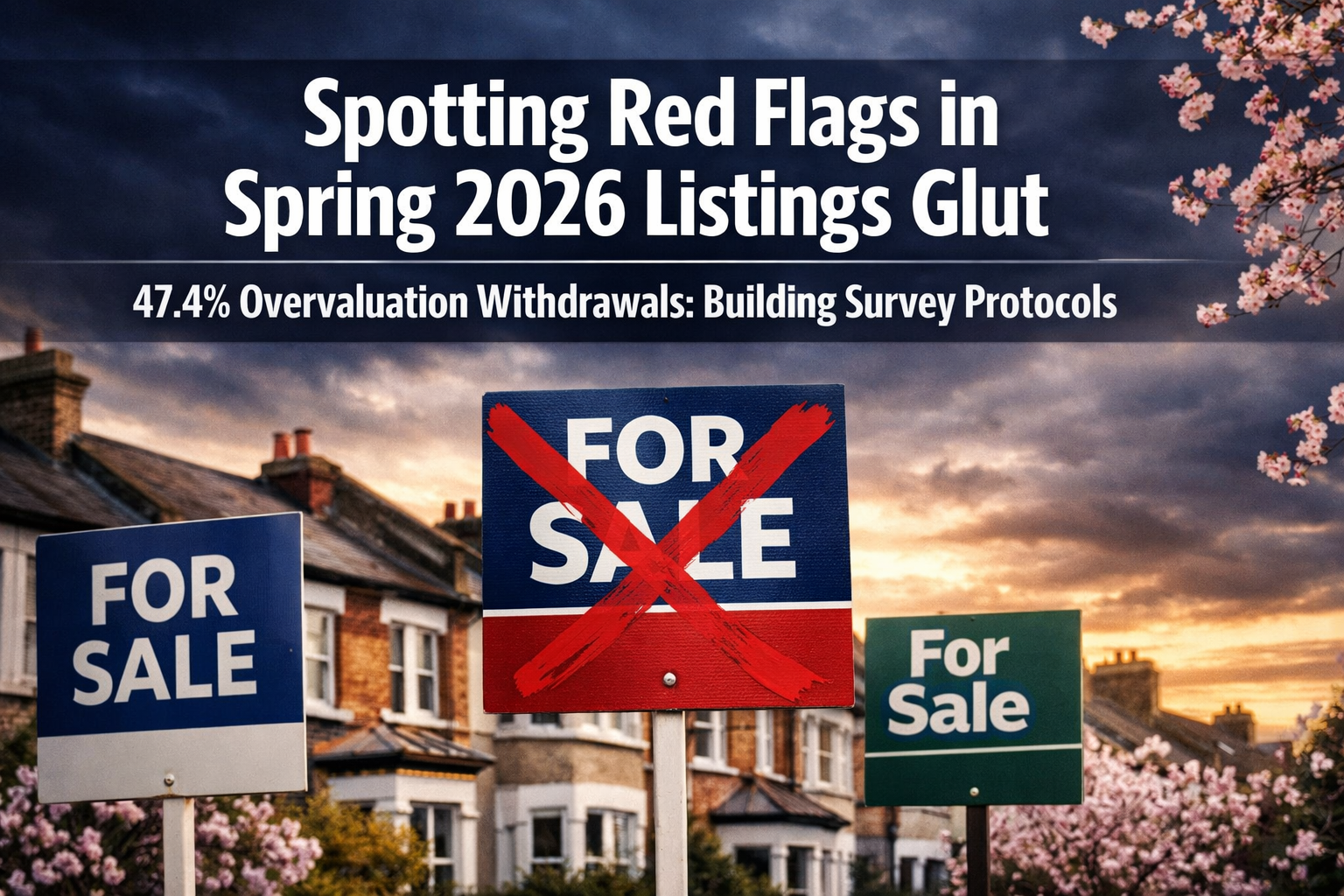
Nearly half of all withdrawn UK property listings in early 2026 share one common thread: a surveyor's report that exposed a gap between asking price and true market value. As Week 14 data confirms a swelling spring listings glut, buyers and their advisors face a critical window to apply rigorous building survey protocols before overpriced properties disappear — or worse, before an uninformed buyer completes on one.
This guide unpacks the building survey protocols for 47.4% overvaluation withdrawals: spotting red flags in spring 2026 listings glut conditions, integrating RICS certainty tools and Level 3 checklist methodology to help buyers move faster and smarter.
Key Takeaways 📌
- Nearly half of spring 2026 listing withdrawals are linked to overvaluation gaps exposed at survey stage — making early survey commissioning essential.
- Level 3 (Full Building Survey) protocols are the most effective tool for identifying structural, damp, and condition-based red flags in overpriced properties.
- RICS certainty tools — including condition ratings and cost-to-repair estimates — give buyers leverage to renegotiate or withdraw before exchange.
- Spring 2026's listings glut creates both opportunity and risk: more choice, but also more sellers testing inflated asking prices.
- Acting in Week 14 and beyond means commissioning surveys early, knowing which defects drive the largest price corrections, and understanding when to walk away.
Understanding the Spring 2026 Listings Glut and the 47.4% Problem
Spring is traditionally the busiest season for UK property listings. In 2026, that seasonal surge has collided with a market under pressure from sustained affordability constraints, shifting mortgage rates, and seller expectations anchored to 2022–2023 peak values. The result: a glut of listings, many priced well above what current buyers can justify.
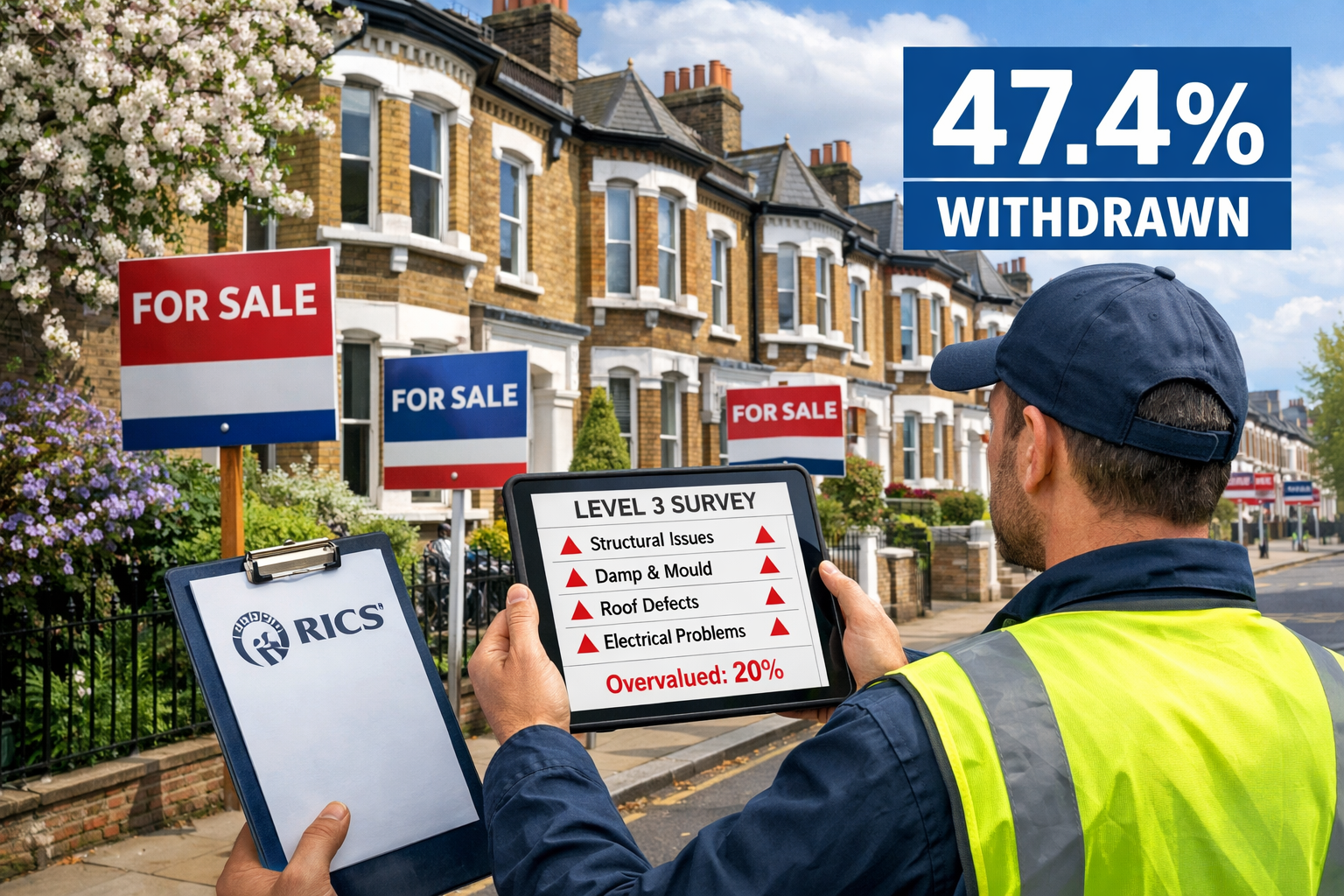
The 47.4% figure at the heart of building survey protocols for 47.4% overvaluation withdrawals refers to the proportion of withdrawn or collapsed transactions in which a professional survey identified material defects or valuation discrepancies significant enough to prompt renegotiation or withdrawal. This is not a fringe statistic — it represents a structural pattern in how the 2026 market is functioning.
"A survey isn't just a box-ticking exercise. In a listings glut, it's the single most powerful tool a buyer has to avoid paying a premium for a problem property."
Demand uncertainty is reshaping how both buyers and builders approach the market [2]. Homebuilders are already adjusting strategies in response to unpredictable demand signals — and individual buyers face the same challenge at the street level. When sellers price optimistically and buyers compete less aggressively than in prior years, the survey becomes the arbiter of true value.
Why Spring 2026 Is Different
Several converging factors make the current listings environment uniquely risky for uninformed buyers:
- 📈 Elevated asking prices set during low-inventory periods have not been corrected downward
- 🏚️ Deferred maintenance from cost-of-living pressures means more properties have hidden defects
- 📋 Longer time-on-market gives sellers incentive to obscure condition issues in listings
- 🔍 Increased buyer scrutiny means more surveys are being commissioned — and more problems found
Level 3 Checklist: The Core of Effective Survey Protocols
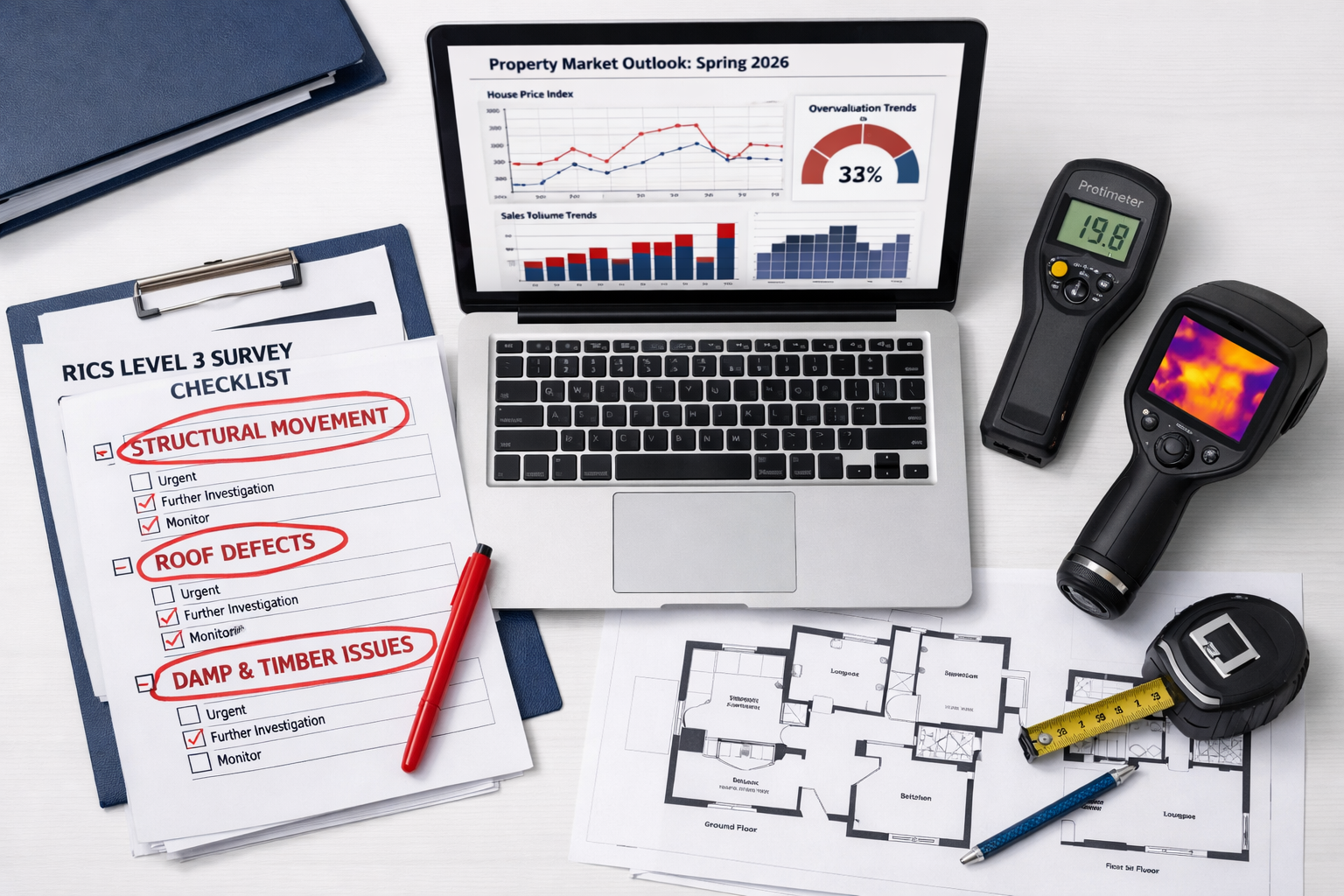
The RICS Level 3 Building Survey (formerly the Full Structural Survey) is the most comprehensive residential survey available in the UK. For buyers navigating a listings glut with significant overvaluation risk, it is not optional — it is the baseline. Understanding which home survey is right for you is the first step, but in a market like spring 2026, the Level 3 protocol is almost always the correct answer for older or non-standard properties.
The Level 3 Protocol: What It Must Cover
A properly executed Level 3 survey in 2026 should systematically assess the following categories, each of which carries overvaluation risk:
| Survey Category | Common Red Flags | Overvaluation Impact |
|---|---|---|
| Roof Structure | Sagging, missing tiles, felt deterioration | £8,000–£40,000+ |
| Damp & Timber | Rising damp, penetrating damp, rot | £3,000–£25,000 |
| Foundations | Subsidence, heave, settlement cracking | £10,000–£100,000+ |
| Electrical Systems | Pre-1970s wiring, lack of RCDs | £4,000–£12,000 |
| Drainage | Blocked drains, collapsed runs | £2,000–£15,000 |
| Party Walls | Undocumented works, crack patterns | Variable |
| Windows & Doors | Failed double glazing, rot, security | £3,000–£20,000 |
For properties in London and the South East — where the listings glut is most pronounced — saving money with building surveys is directly proportional to how thoroughly the Level 3 protocol is applied. A £600–£900 survey can identify defects that justify a £30,000+ price reduction.
RICS Condition Ratings Explained
RICS surveyors use a three-tier condition rating system:
- 🟢 Condition 1 — No repair currently needed
- 🟡 Condition 2 — Defects that need repairing or replacing but are not considered serious
- 🔴 Condition 3 — Defects that are serious and/or need to be repaired, replaced, or investigated urgently
In the context of overvaluation withdrawals, multiple Condition 3 ratings are the clearest signal that a property's asking price cannot be sustained. Buyers who receive reports with three or more Condition 3 items have strong grounds for renegotiation — and statistically, these are the cases most likely to result in either a price reduction or a withdrawal.
The 2026 ALTA/NSPS Land Title Survey standards updates (effective February 23, 2026) have reinforced the importance of surveyor transparency and responsibility documentation [1], a principle that aligns directly with RICS protocols in the UK context. Greater accountability in the surveying process means buyers can rely more confidently on formal condition assessments.
Integrating Specific Defect Surveys
When a Level 3 survey identifies a potential issue requiring specialist investigation — such as suspected subsidence or significant damp — a specific defect survey provides the detailed cost and remediation data needed to quantify the overvaluation gap precisely. This two-stage approach (Level 3 followed by specific defect investigation) is the gold standard for high-value or high-risk transactions in 2026.
Spotting Red Flags in Spring 2026 Listings: A Practical Framework
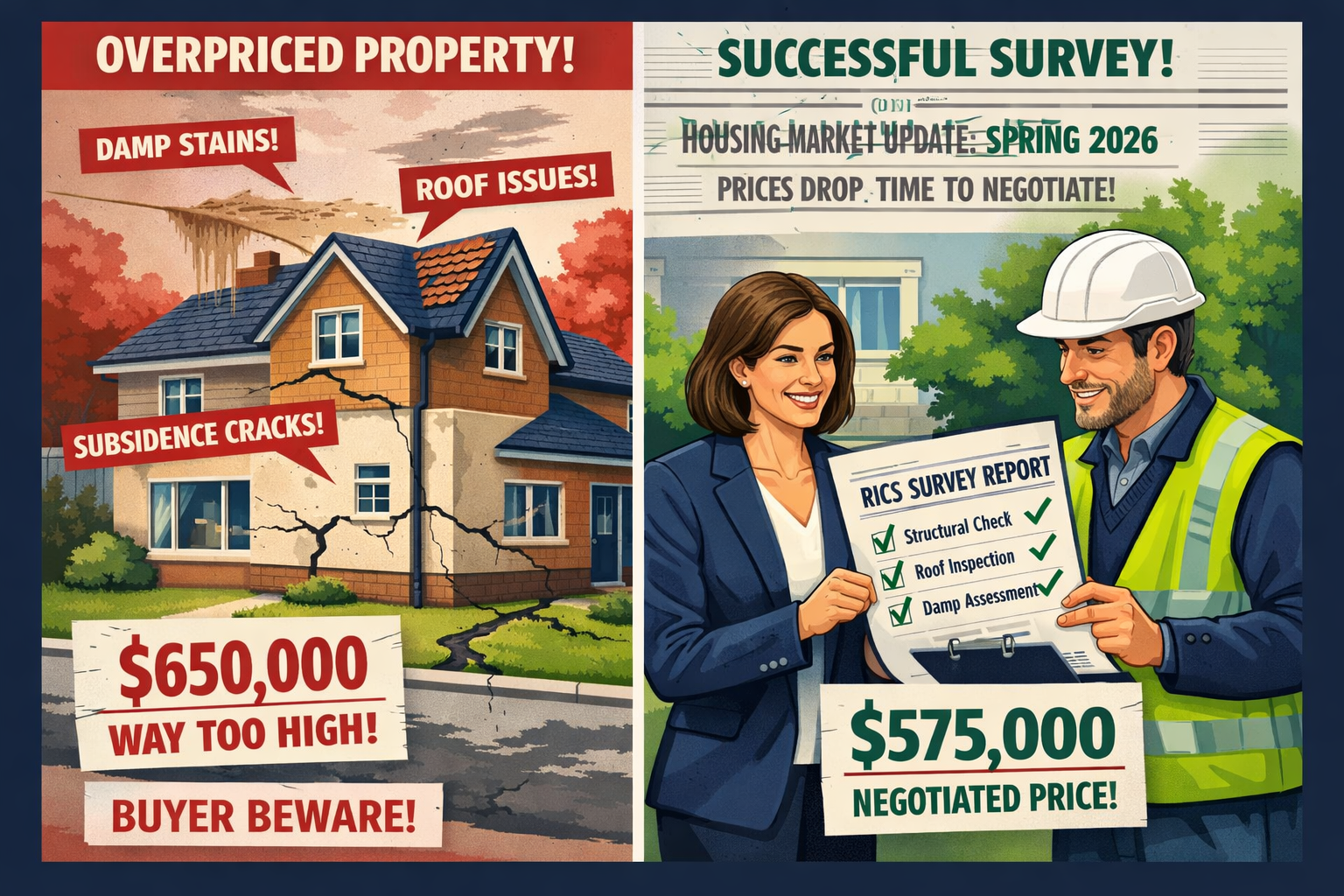
Applying building survey protocols for 47.4% overvaluation withdrawals: spotting red flags in spring 2026 listings glut conditions requires a structured approach that begins before a survey is even commissioned. The most effective buyers in the current market are those who pre-screen listings for overvaluation signals and then use the survey to confirm or quantify what they have already suspected.
Pre-Survey Red Flag Screening
Before commissioning a survey, apply this pre-screening checklist to any spring 2026 listing:
🚩 Listing-Level Red Flags
- Property has been relisted after a previous sale fell through
- Asking price is more than 8% above the street's recent sold prices
- Listing photos avoid showing specific rooms or areas
- Property has been on the market for more than 60 days without a price reduction
- Description emphasises "potential" or "development opportunity" without specifics
- EPC rating is F or G with no improvement plan disclosed
🚩 Viewing-Level Red Flags
- Fresh paint or plaster in isolated patches (possible damp concealment)
- Strong air fresheners or dehumidifiers running during viewing
- Uneven floors or sticking doors (possible subsidence or movement)
- Visible cracks wider than 3mm, especially diagonal or stair-step patterns
- Evidence of recent DIY work near structural elements
- Gutters, fascias, or soffits in poor condition
Any property triggering three or more of these flags warrants a full Level 3 survey as a minimum. Properties triggering five or more should also prompt a damp survey as a parallel investigation, given the high correlation between concealed damp and overvaluation in the current market.
Using RICS Survey Findings to Negotiate
The survey report is not the end of the process — it is the beginning of the negotiation. An RICS survey can help negotiate the price of a property in London in ways that go beyond simply listing defects. A well-structured Level 3 report provides:
- Condition ratings that establish severity objectively
- Estimated repair costs that quantify the overvaluation gap
- Reinstatement values that inform insurance and lending decisions
- Recommended specialist investigations that signal further risk
When presenting a renegotiation case to a seller, buyers should focus on Condition 3 items with documented cost estimates. This removes subjectivity from the conversation and anchors the discussion in surveyor-verified data.
"In a market where 47.4% of withdrawals trace back to survey findings, the report is your strongest negotiating asset — not just a safety check."
When to Walk Away
Knowing what to do after a bad building survey report is as important as knowing how to negotiate. Some defect combinations make withdrawal the only rational choice:
- Active subsidence without a completed and insured remediation programme
- Structural timber decay affecting load-bearing elements
- Unresolved party wall disputes with active legal proceedings
- Contaminated land or proximity to mining activity without specialist clearance
- Flood risk not reflected in the asking price or insurance availability
In these cases, the 47.4% withdrawal pattern is not a failure — it is the survey protocol working exactly as intended.
Accelerating Transactions with RICS Certainty Tools
Speed is a genuine competitive advantage in the spring 2026 market, even amid the listings glut. Sellers who have priced realistically want certainty; buyers who can demonstrate survey readiness are better placed to secure properties at fair value before competing offers emerge.
The RICS Home Survey Standard
The RICS Home Survey Standard (HSS), which governs how surveys are conducted and reported, provides a consistent framework that both buyers and lenders can rely on. Key certainty features include:
- Standardised condition ratings (1, 2, 3) that are universally understood
- Clear scope statements that define what was and was not inspected
- Mandatory risk flagging for legal, environmental, and structural concerns
- Signposting to specialist advice where the survey identifies limits of visual inspection
Buyers who understand the HSS framework can read survey reports more quickly and make faster decisions — a meaningful advantage when competing in a listings glut environment.
Choosing the Right Survey Level
Not every property requires a Level 3 survey. The decision framework is straightforward:
| Property Type | Recommended Survey | Rationale |
|---|---|---|
| New-build (under 10 years) | Snagging inspection | Structural risk low; defect focus |
| Post-war standard construction | Level 2 (HomeBuyer) | Standard condition check sufficient |
| Pre-1919 or non-standard build | Level 3 (Full Building) | High defect risk, overvaluation exposure |
| Listed building | Level 3 + specialist | Conservation constraints add complexity |
| Property with known issues | Level 3 + specific defect | Quantify risk before committing |
For buyers uncertain between a HomeBuyer Report and a Building Survey, the guide to choosing the right property assessment provides a clear decision framework. In the spring 2026 context, when in doubt, upgrade to Level 3.
Party Wall Considerations in Overvalued Properties
A frequently overlooked element of overvaluation risk is undocumented or disputed party wall works. Properties where extensions, loft conversions, or basement works have been carried out without proper party wall agreements can carry significant legal and structural liability — liability that is rarely reflected in the asking price.
A Level 3 survey should flag evidence of such works, but buyers should also independently verify whether Party Wall Act notices were served and awards obtained. Undocumented works are a direct overvaluation driver and a common reason for transaction withdrawal.
Regional Hotspots: Where the Listings Glut Bites Hardest in 2026
The spring 2026 listings glut is not uniform across the UK. Certain London boroughs and commuter belt areas are experiencing the highest concentration of overpriced listings, making survey protocols especially critical in these locations.
High-risk areas for overvaluation in spring 2026:
- South West London (Wandsworth, Merton, Wimbledon) — legacy premium pricing meeting affordability ceilings
- East London (Newham, West Ham) — post-regeneration pricing not yet validated by comparable sales
- North London (Islington, Camden) — period stock with deferred maintenance priced at refurbished rates
- Outer East London (Redbridge, Brentwood) — commuter premium erosion as hybrid working stabilises
Buyers in these areas should treat the Level 3 protocol as non-negotiable. Local surveyors with specific area knowledge — such as those covering Wandsworth, Islington, or Newham — bring comparable data and local defect pattern knowledge that national or remote surveyors cannot replicate.
Conclusion: Actionable Next Steps for Spring 2026 Buyers
The convergence of a spring listings glut and a 47.4% overvaluation withdrawal rate creates a market where professional survey protocols are not just advisable — they are the primary mechanism of buyer protection. The building survey protocols for 47.4% overvaluation withdrawals: spotting red flags in spring 2026 listings glut framework outlined here gives buyers a structured, evidence-based approach to navigating this environment.
Your Action Plan 🎯
- Pre-screen every listing using the red flag checklist before committing to a viewing
- Commission a Level 3 Building Survey for any pre-1919, non-standard, or flagged property
- Request specific defect surveys where the Level 3 identifies specialist investigation needs
- Use RICS condition ratings as the foundation of any price renegotiation
- Verify party wall compliance independently for properties with visible extensions or conversions
- Choose a local surveyor with demonstrable knowledge of the specific area and property type
- Know your walk-away triggers — active subsidence, structural timber decay, and unresolved legal disputes are non-negotiable
The survey is not a cost — it is the most efficient investment a buyer can make in the spring 2026 market. In a listings glut where nearly half of all withdrawals trace back to overvaluation exposed at survey stage, the buyers who commission thorough, RICS-compliant assessments early are the ones who complete on the right property at the right price.
References
[1] 2026 ALTA Survey Standards Updates – https://www.hklaw.com/en/insights/publications/2026/03/2026-alta-survey-standards-updates
[2] Survey Reveals Demand Uncertainty Is Changing 2026 Homebuilding Strategy – https://www.housingwire.com/articles/survey-reveals-demand-uncertainty-is-changing-2026-homebuilding-strategy/