
Over 4.6 million households in England's private rented sector now face a legal landscape transformed by the Renters' Rights Act 2026 — and for landlords planning retrofit works, the intersection of party wall obligations and Section 8 eviction validity has never been more consequential. Party Wall Surveys Under Renters' Rights Act 2026: Assessing Landlord Retrofit Obligations for Section 8 Validity is no longer a niche procedural concern; it sits at the heart of landlord compliance, tenant protection, and property law enforcement in 2026.
This guide breaks down exactly what landlords, surveyors, and tenants need to understand about party wall notice protocols, retrofit-driven hazard compliance, and how procedural failures can invalidate a Section 8 possession claim.
Key Takeaways 📋
- Party wall notices must be formally served and validated before any retrofit works affecting shared structures begin — failure to do so can undermine Section 8 proceedings.
- The Renters' Rights Act 2026 strengthens tenant protections around habitability, meaning landlords must address hazards identified during party wall surveys promptly.
- EPC Band C compliance is required for all private tenancies by 1 October 2030 — retrofit works to meet this standard frequently trigger Party Wall Act 1996 obligations [4].
- Damp and mould identified during party wall or pre-retrofit surveys must be investigated within 14 days and repairs begun within 7 days [3].
- Section 8 possession notices can be challenged if a landlord has failed to maintain the property to required standards — making pre-eviction survey compliance critical.
Understanding the Legal Framework: Party Wall Act 1996 Meets Renters' Rights Act 2026
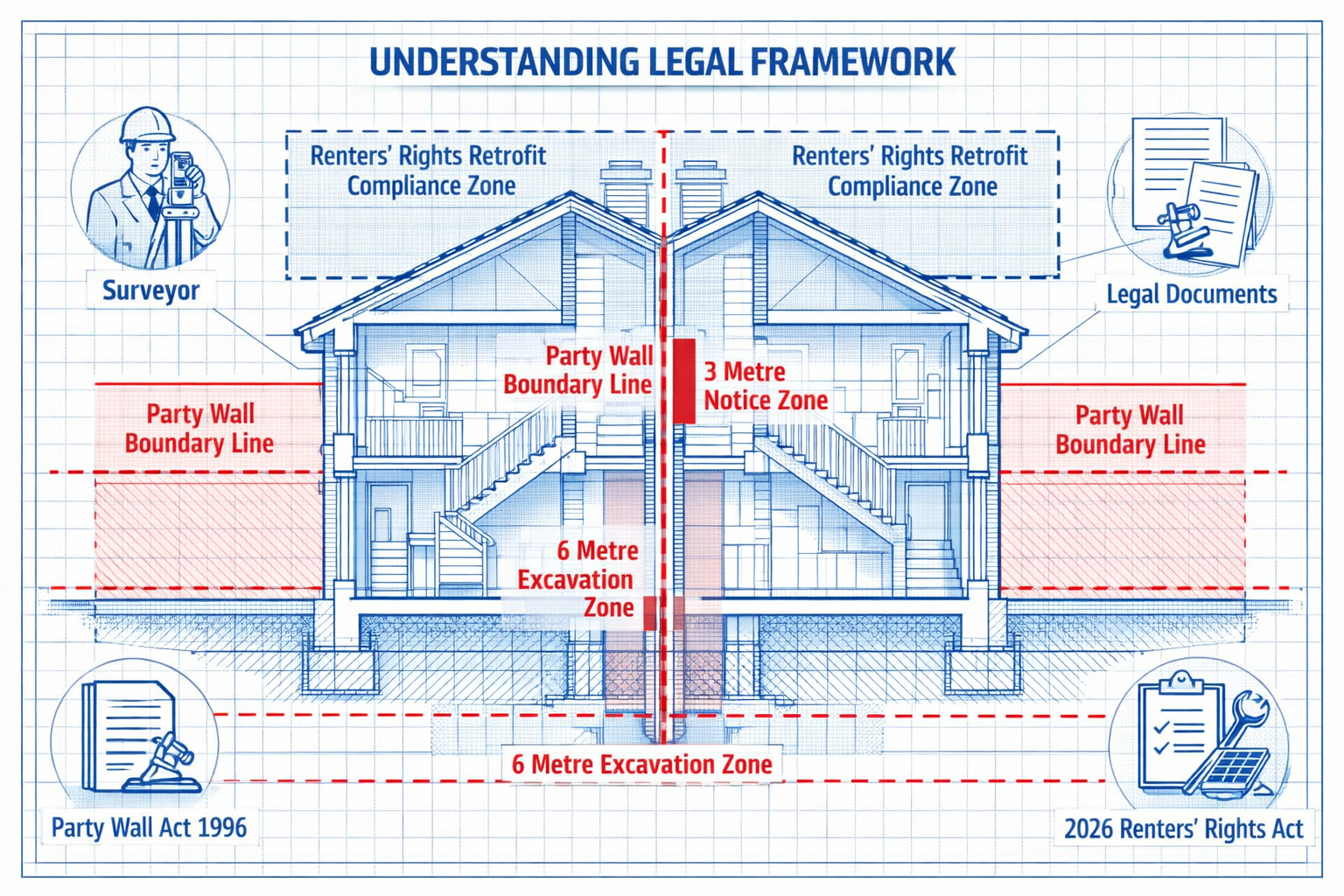
The Party Wall etc. Act 1996 has long governed works to shared walls, boundary structures, and excavations near neighbouring properties. It requires building owners to serve formal notices on adjoining owners before commencing notifiable works. What has changed in 2026 is the context in which those works are increasingly being triggered — namely, landlord retrofit obligations under the Renters' Rights Act 2026.
The Renters' Rights Act 2026 (which received Royal Assent in early 2026, building on the Renters' Reform Bill framework) introduced several critical changes to the private rented sector:
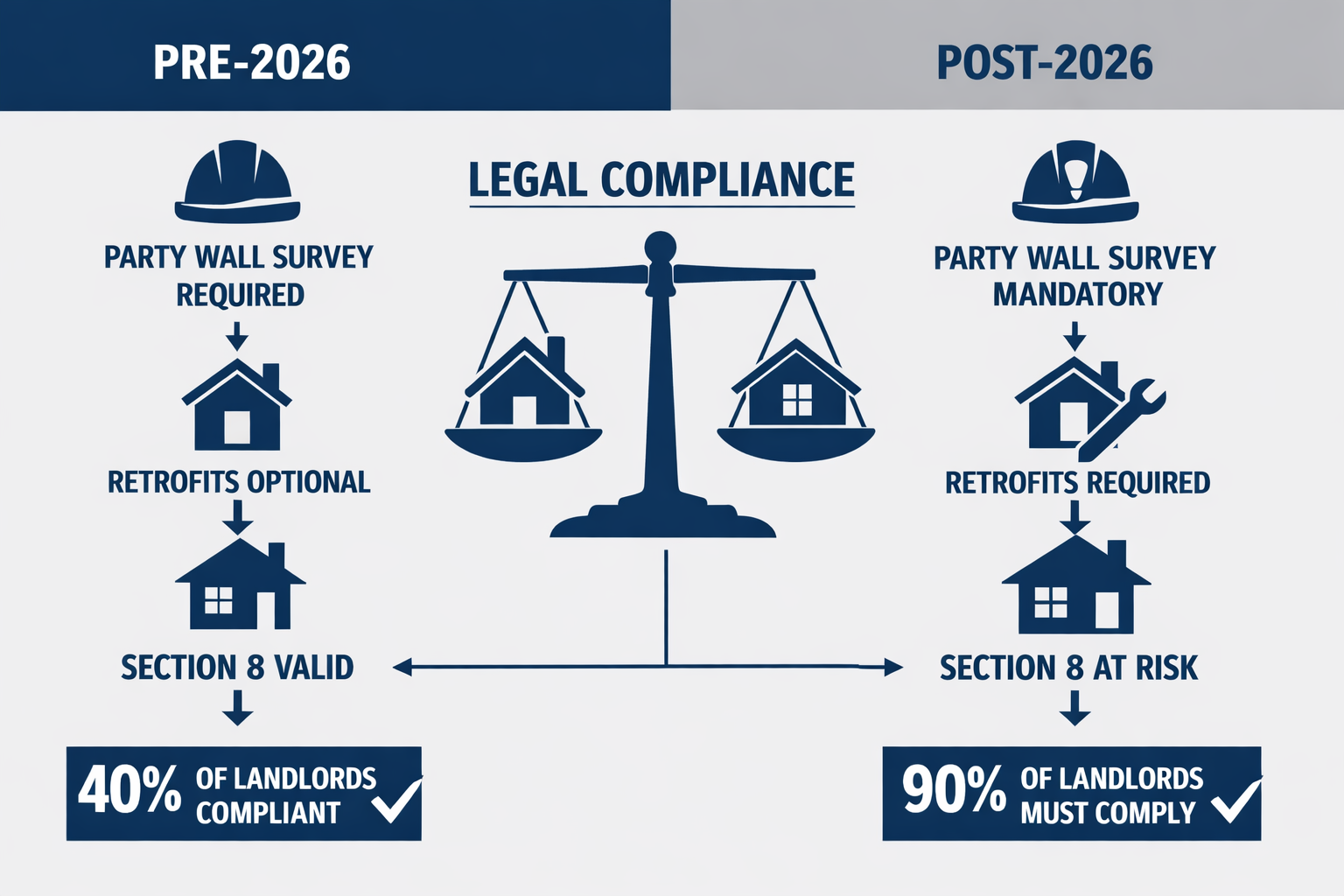
- Abolition of Section 21 "no-fault" evictions, making Section 8 the primary possession route
- Strengthened "fit for habitation" standards, directly linked to the Housing Health and Safety Rating System (HHSRS)
- Mandatory hazard investigation timelines for damp, mould, and structural defects [3]
- Retrofit participation obligations, allowing landlords to require tenant cooperation for essential energy-efficiency works [2]
💡 Pull Quote: "A Section 8 notice served by a landlord who has failed to comply with party wall obligations or left HHSRS hazards unaddressed is vulnerable to challenge — and courts are increasingly scrutinising compliance history."
For landlords undertaking insulation upgrades, solid wall treatments, or heating system replacements in terraced or semi-detached properties, these works frequently involve shared walls. That means the Party Wall etc. Act 1996 is engaged — and surveyor protocols must be followed meticulously.
To understand the full scope of what the Party Wall Act requires, the Party Wall Act 1996 guide by a party wall agreement surveyor provides an essential foundation.
How Retrofit Obligations Trigger Party Wall Survey Requirements
What Counts as a Notifiable Retrofit Work?
Not all energy-efficiency improvements require party wall notices. However, the following retrofit works — increasingly common under EPC compliance programmes — frequently engage the Act:
| Retrofit Work | Party Wall Act Engaged? | Notice Type Required |
|---|---|---|
| External wall insulation (shared wall) | ✅ Yes | Party Structure Notice |
| Internal wall insulation (party wall) | ✅ Yes | Party Structure Notice |
| Solid floor insulation near boundary | ✅ Possibly | Line of Junction Notice |
| Loft insulation (shared gable) | ✅ Yes | Party Structure Notice |
| Boiler/heat pump installation (no structural work) | ❌ No | None required |
| Excavation within 3m of adjoining structure | ✅ Yes | Three Metre Notice |
Private landlords in England and Wales must achieve EPC Band C by 1 October 2030 for all tenancies [4]. For older terraced housing stock — which dominates the private rented sector in London and other urban areas — meeting this target almost inevitably involves works to party walls or shared structures.
Landlords who frame these improvements as essential repairs to maintain "fit for habitation" standards can require tenant participation in the retrofit process [2]. However, this framing also means the works are subject to heightened scrutiny under the Renters' Rights Act 2026 — and any structural interference with a party wall without a valid notice and, where necessary, a Party Wall Award, creates both civil liability and a compliance gap that can affect Section 8 validity.
For a detailed look at how the Party Wall Act 1996 applies to your specific property situation, it is worth reviewing the obligations in full before planning any retrofit programme.
Party Wall Surveys Under Renters' Rights Act 2026: Surveyor Protocols for Notice Validation
Step 1: Pre-Works Condition Survey and Hazard Assessment
Before serving any party wall notice in connection with retrofit works, a responsible landlord should commission a Schedule of Condition survey. This documents the existing state of the adjoining owner's property and the shared structure before works begin. Under the Renters' Rights Act 2026 framework, this survey also serves a second purpose: identifying any pre-existing HHSRS hazards — particularly damp and mould — that the landlord is legally obligated to address.
Under the new damp and mould rules introduced by the Act:
- Reported damp or mould must be investigated within 14 days
- Repairs must begin within 7 days of investigation completion
- Emergency situations (e.g., active water ingress) require action within 24 hours [3]
A party wall surveyor conducting a pre-retrofit condition survey who identifies damp penetration through a shared wall is effectively triggering a mandatory landlord response timeline. Failure to act on that finding — and then proceeding to serve a Section 8 notice — creates a significant legal vulnerability.
⚠️ Critical Point: If a Schedule of Condition survey reveals HHSRS Category 1 hazards and the landlord proceeds to a Section 8 possession claim without remediation, a tenant can raise this as a defence under the Renters' Rights Act 2026.
Step 2: Serving Valid Party Wall Notices
The notice validation process requires strict adherence to the Party Wall etc. Act 1996 timelines:
- Party Structure Notice: Must be served at least 2 months before works begin
- Line of Junction Notice: At least 1 month before works
- Three Metre Notice: At least 1 month before excavation works
Notices must be served on all adjoining owners — not just occupying tenants. In the private rented sector context, this means identifying freeholders, leaseholders, and any other parties with a legal interest in the adjoining property.
Database Registration in 2026: A significant development under the Renters' Rights Act 2026 framework is the requirement for landlords to register properties on the Private Rented Sector Database (the new national landlord register). Party wall notices, Awards, and Schedules of Condition should be retained as part of the property's compliance record on this database. Surveyors are increasingly being asked to provide documentation formatted for database upload.
Understanding what a party wall surveyor does and their duties to property owners is essential for landlords navigating this process for the first time.
Step 3: The Party Wall Award and Its Role in Section 8 Validity
Where an adjoining owner dissents from a party wall notice (or fails to respond within 14 days, which is deemed dissent), a Party Wall Award must be agreed. This Award:
- Defines the scope of permitted works
- Sets out working hours and access arrangements
- Allocates costs between building owner and adjoining owner
- Records the Schedule of Condition
For Party Wall Surveys Under Renters' Rights Act 2026: Assessing Landlord Retrofit Obligations for Section 8 Validity, the Award document becomes critical evidence. A landlord who has completed retrofit works under a valid Award — and has addressed all identified hazards — is in a far stronger position when pursuing Section 8 possession than one who proceeded without proper process.
Conversely, a landlord who undertook notifiable retrofit works without serving notices, created structural damage or damp ingress through those works, and then served a Section 8 notice faces the prospect of that notice being challenged or set aside.
For those seeking professional support in London, party wall agreement surveyor assistance is available from RICS-accredited professionals who understand both the Act and the new regulatory context.
Section 8 Validity: How Compliance Failures Create Possession Risks
The Retaliatory Eviction Prohibition
The Renters' Rights Act 2026 significantly strengthens protections against retaliatory eviction. A Section 8 notice served within six months of a tenant making a formal complaint about the property's condition — including complaints that prompted a party wall or retrofit survey — is presumed to be retaliatory unless the landlord can demonstrate otherwise.
This creates a clear protocol for landlords:
- ✅ Commission pre-retrofit condition survey
- ✅ Serve valid party wall notices
- ✅ Address all identified HHSRS hazards within statutory timelines
- ✅ Complete retrofit works under Party Wall Award (if applicable)
- ✅ Register all documentation on the PRS Database
- ✅ Allow six-month "cooling off" period before any Section 8 action related to the tenancy
Grounds for Section 8 and the Compliance Checklist
Section 8 possession claims under the Housing Act 1988 (as amended) rely on specific grounds. The most commonly used grounds in the private rented sector — rent arrears (Ground 8), anti-social behaviour (Ground 14), and landlord wish to sell or occupy (Grounds 1/2) — are all subject to the overarching requirement that the landlord has met their statutory obligations.
Courts in 2026 are applying a compliance lens to Section 8 applications. Judges are asking:
- Has the landlord registered on the PRS Database? 🔍
- Are there outstanding HHSRS hazards? 🔍
- Were any party wall works carried out without valid notices? 🔍
- Has the property been maintained to "fit for habitation" standards? 🔍
A "no" to any of these questions does not automatically invalidate a Section 8 notice, but it provides grounds for tenant challenge and judicial discretion in mandatory ground cases.
For landlords dealing with building regulations compliance as part of retrofit programmes, ensuring that all works are signed off and documented before initiating possession proceedings is non-negotiable.
Practical Surveyor Protocols: A Step-by-Step Compliance Guide
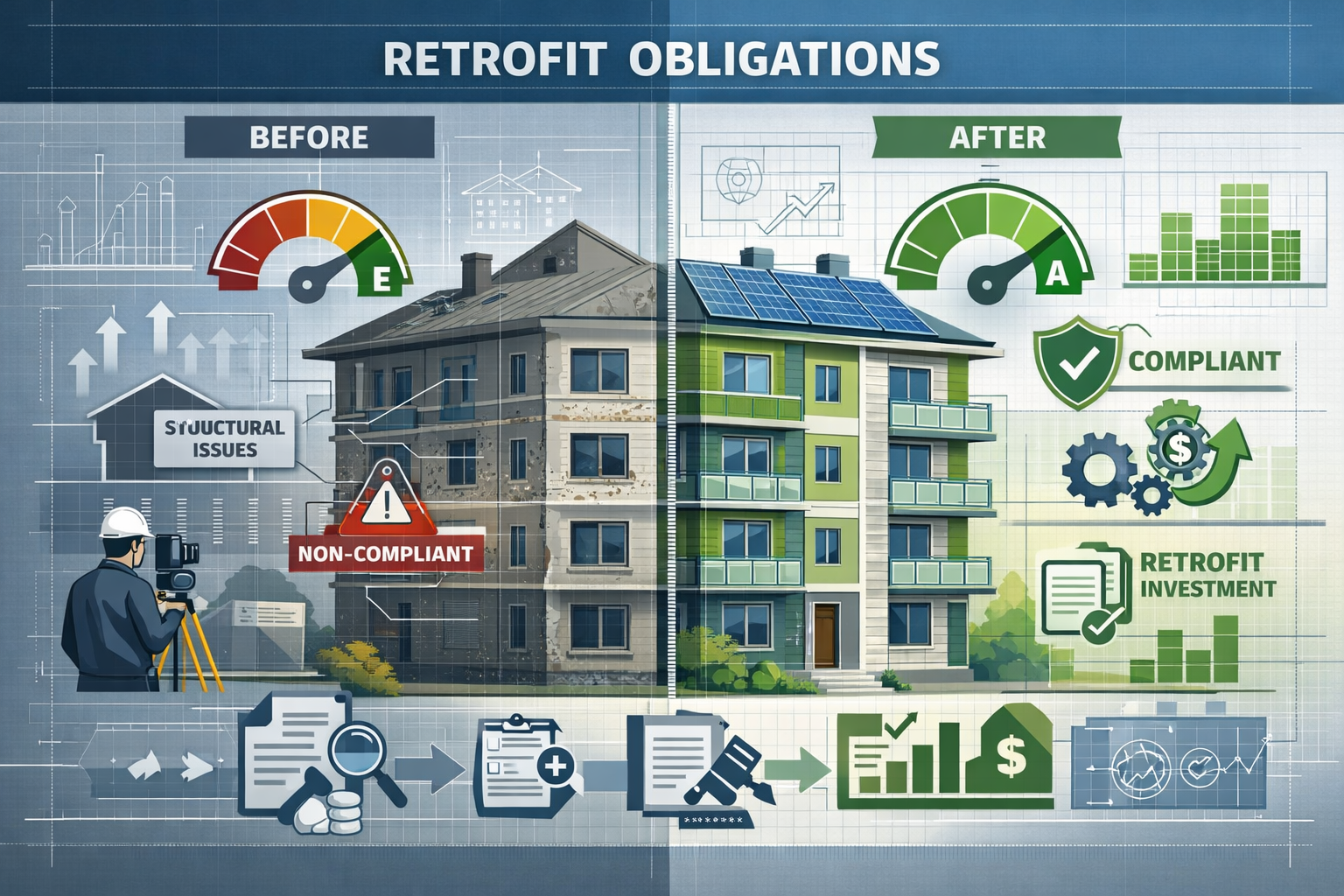
Party Wall Surveys Under Renters' Rights Act 2026: Assessing Landlord Retrofit Obligations for Section 8 Validity demands a structured approach from both landlords and their appointed surveyors. The following protocol reflects best practice in 2026:
🔧 Phase 1: Pre-Retrofit Assessment (8–10 Weeks Before Works)
- Instruct a RICS-accredited party wall surveyor for an initial property assessment
- Identify all shared/party walls affected by proposed retrofit works
- Commission a Schedule of Condition for adjoining properties
- Check for existing damp, mould, or structural defects — document findings
- Review EPC rating and confirm target works required to achieve Band C by 2030 [4]
📋 Phase 2: Notice Service and Dispute Resolution (6–8 Weeks Before Works)
- Serve appropriate party wall notices on all adjoining owners
- Await responses within statutory timeframes (14 days)
- If dissent received, appoint agreed surveyor or each party appoints their own
- Negotiate and agree Party Wall Award
- Ensure Award references all retrofit works and hazard remediation
🏗️ Phase 3: Works Execution and Documentation
- Carry out works strictly within Award parameters
- Document all works with photographs and contractor sign-off sheets
- Address any damp or mould identified during works within statutory timelines [3]
- Obtain building regulations completion certificate where applicable
- Update PRS Database with all relevant documentation
📁 Phase 4: Post-Works Compliance Verification
- Commission post-works inspection to confirm no new hazards created
- Update EPC certificate to reflect improvements
- Retain all party wall documentation for minimum 6 years
- Confirm compliance status before initiating any Section 8 proceedings
For landlords managing property disputes arising from retrofit works, early engagement with a qualified surveyor is the most effective risk mitigation strategy available.
Common Mistakes Landlords Make — and How to Avoid Them
❌ Mistake 1: Assuming minor retrofit works don't engage the Party Wall Act
Even internal insulation to a party wall is notifiable. When in doubt, seek professional advice.
❌ Mistake 2: Serving notice on the tenant rather than the adjoining owner
The Party Wall etc. Act 1996 requires notice to be served on the owner of the adjoining property, not their tenant.
❌ Mistake 3: Ignoring damp findings in Schedule of Condition surveys
Under the Renters' Rights Act 2026, a surveyor's finding of damp triggers mandatory investigation and repair timelines — ignoring it is not an option [3].
❌ Mistake 4: Failing to register party wall documentation on the PRS Database
The new national landlord register requires comprehensive property records. Missing documentation weakens Section 8 applications.
❌ Mistake 5: Serving Section 8 notices before retrofit works are complete and signed off
Courts will scrutinise whether outstanding works or hazards exist at the time of notice service.
For landlords unsure about property rights and obligations under the new legislative framework, specialist surveyor advice is strongly recommended before commencing any programme of works.
Conclusion: Actionable Next Steps for Landlords in 2026
The convergence of party wall law, retrofit obligations, and Section 8 validity under the Renters' Rights Act 2026 creates a demanding but navigable compliance landscape. The key is sequencing — getting the right surveys done, in the right order, with proper documentation at every stage.
✅ Immediate Actions for Landlords
- Audit your portfolio — identify all properties requiring EPC improvements by 2030 and assess which involve party wall structures [4]
- Instruct a RICS-accredited party wall surveyor before planning any retrofit works to shared walls
- Check for HHSRS hazards — particularly damp and mould — and address within statutory timelines [3]
- Register on the PRS Database and upload all existing party wall documentation
- Review your Section 8 readiness — ensure no outstanding hazards, incomplete works, or unserved notices exist before initiating possession proceedings
- Seek specialist legal and surveying advice if retrofit works have already been carried out without party wall notices
The cost of getting this right — a professional party wall survey, proper notice service, a well-drafted Award — is modest compared to the cost of a failed possession claim, a civil liability action from an adjoining owner, or a local authority enforcement notice under the Renters' Rights Act 2026.
For professional party wall surveying services in London, explore the full range of party wall support available from qualified, experienced surveyors who understand the 2026 regulatory environment.
References
[1] Party Wall Surveys For Commercial To Residential Conversions Managing Structural Complexity And Neighbour Disputes – https://nottinghillsurveyors.com/blog/party-wall-surveys-for-commercial-to-residential-conversions-managing-structural-complexity-and-neighbour-disputes
[2] How To Use The Law Effectively To Achieve Tenant Participation In Retrofitting – https://acuitylaw.com/how-to-use-the-law-effectively-to-achieve-tenant-participation-in-retrofitting/
[3] The Renters Rights Bill Is Your Rental Property Compliant With The New Damp Rules – https://mouldremovalspecialists.com/the-renters-rights-bill-is-your-rental-property-compliant-with-the-new-damp-rules/
[4] New Epc Rules – https://theindependentlandlord.com/new-epc-rules/