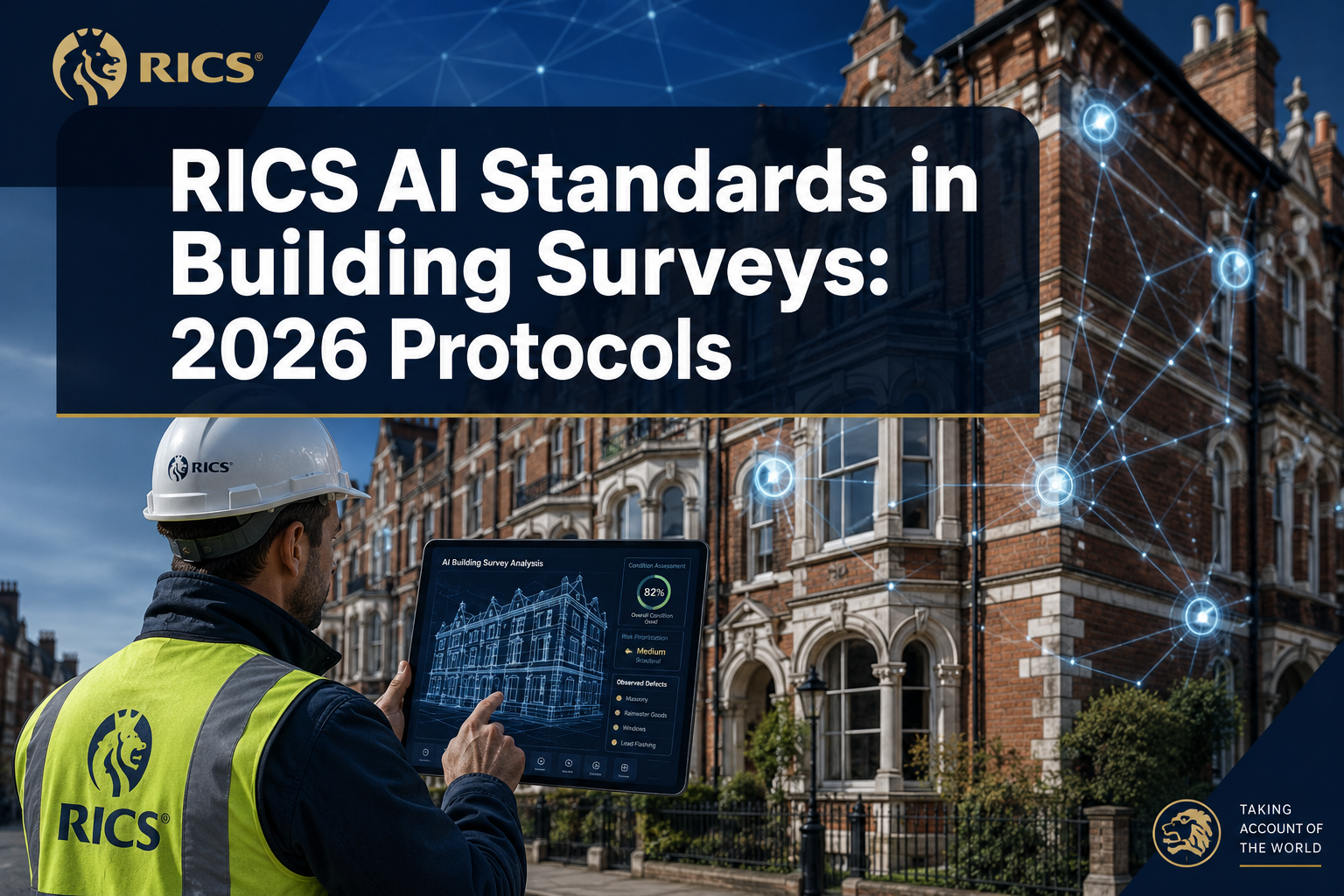
By 9 March 2026, every RICS member and regulated firm using artificial intelligence in surveying work became subject to the profession's first mandatory global AI standard — and non-compliance is no longer a theoretical risk. Integrating RICS AI Standards in Building Surveys: Practical 2026 Protocols Post-March Guidance is now the operational reality for building surveyors across the UK and beyond, whether they are running AI-assisted defect detection software, using automated report drafting tools, or relying on AI-enhanced drone imagery during inspections [1][5].
Yet many practitioners are still asking the same question: what does compliance actually look like on a Monday morning? This article answers that question directly — covering governance obligations, three-stage workflow protocols, ethical checklists, and the critical boundaries that prevent over-reliance on AI outputs, including automated valuation models (AVMs).
Key Takeaways 📋
- The RICS Responsible Use of AI standard became mandatory on 9 March 2026, applying to all building survey workflows where AI has a material impact on the service.
- AI may support professional judgement — it can never replace it. A named, qualified surveyor remains fully accountable for every conclusion.
- Compliant workflows follow three touchpoints: pre-inspection desktop AI, on-site AI-assisted inspection, and AI-supported report production — each with mandatory human review.
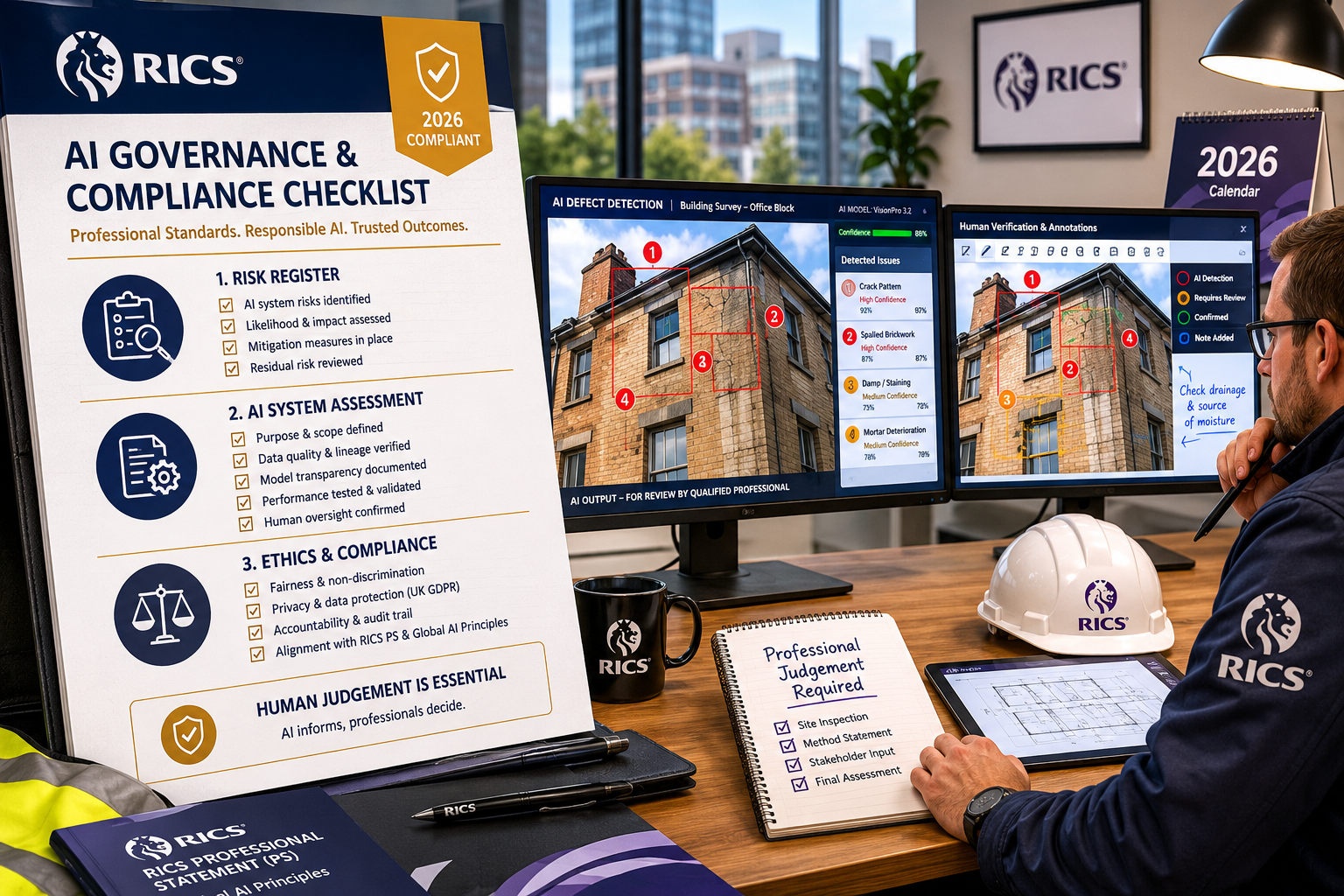
- Firms must maintain an AI systems register, a risk register, and written system assessments for each AI tool in use.
- Over-reliance on AVMs and AI defect-scoring tools without documented human challenge is a specific compliance risk under the new standard.
What the March 2026 RICS AI Standard Actually Requires
The Responsible Use of Artificial Intelligence in Surveying Practice standard did not arrive without warning, but its mandatory status from March 2026 onward marks a clear line in the sand [5]. Before this date, responsible AI use was guidance. After it, compliance is enforceable.
Scope: Which Building Survey Activities Are Covered?
The standard applies wherever AI has a "material impact" on the surveying service delivered [5]. For building surveyors, RICS and commentators confirm this includes:
| AI Application | Material Impact? | Covered by Standard? |
|---|---|---|
| AI defect detection from inspection images | ✅ Yes | ✅ Yes |
| Automated report drafting (Level 2/3) | ✅ Yes | ✅ Yes |
| AI-generated condition ratings | ✅ Yes | ✅ Yes |
| Spell-check / basic grammar tools | ❌ No | ❌ No |
| AVM-assisted risk scoring | ✅ Yes | ✅ Yes |
| AI desktop data extraction (EPC, planning) | Likely Yes | ✅ Yes |
Importantly, members are not required to use AI at all [5]. But if they do, the standard kicks in immediately.
Core Obligations at a Glance
Under the post-March 2026 framework, RICS members must [1][5][6]:
- Understand the type of AI being used (generative, predictive, image recognition) and its known limitations
- Identify and document hallucination risks, bias in training data, and data security concerns
- Maintain an AI systems register listing every tool used in practice
- Keep a risk register specific to AI use
- Produce written system assessments for each AI tool
- Document when AI use has materially shaped a surveying output or conclusion
- Be able to explain and justify any AI-influenced recommendation to a client or regulator
💬 "The named professional remains fully responsible for decisions and advice, even when AI tools are used." — RICS Responsible Use of AI Standard [5]
Understanding why choosing RICS-regulated surveyors matters has never been more relevant: the standard creates a direct accountability chain that protects clients.
Integrating RICS AI Standards in Building Surveys: The Three-Stage Workflow Protocol
Specialist building surveying firms publishing practical guidance in early 2026 describe a compliant AI workflow built around three distinct touchpoints [6][7][8]. Each stage has specific rules about what AI can and cannot do.
Stage 1: Pre-Inspection — AI-Assisted Desktop Studies
Before a surveyor sets foot on site, AI tools are increasingly used to:
- Summarise planning history and permitted development records
- Extract and flag EPC ratings, OS mapping data, and flood risk indicators
- Generate preliminary risk categorisations for the property
This is permitted under the 2026 standard, provided the surveyor [6][8]:
- ✅ Reviews all AI-generated summaries for hallucinations and factual errors
- ✅ Does not accept risk categorisations as final without independent verification
- ✅ Documents the AI tool used and any material reliance on its output
- ✅ Applies professional scepticism — especially to any AI-generated legal or planning interpretation
⚠️ Red flag: If an AI tool summarises planning history and the surveyor forwards that summary to a client without checking it, this is a compliance breach. Hallucinations in planning data are a documented risk [3].
For surveyors working on complex properties, reviewing a homebuyers report example alongside AI-generated pre-inspection notes can help calibrate what level of detail a compliant, human-reviewed output should contain.
Stage 2: On-Site — AI as a Prompt, Not a Substitute
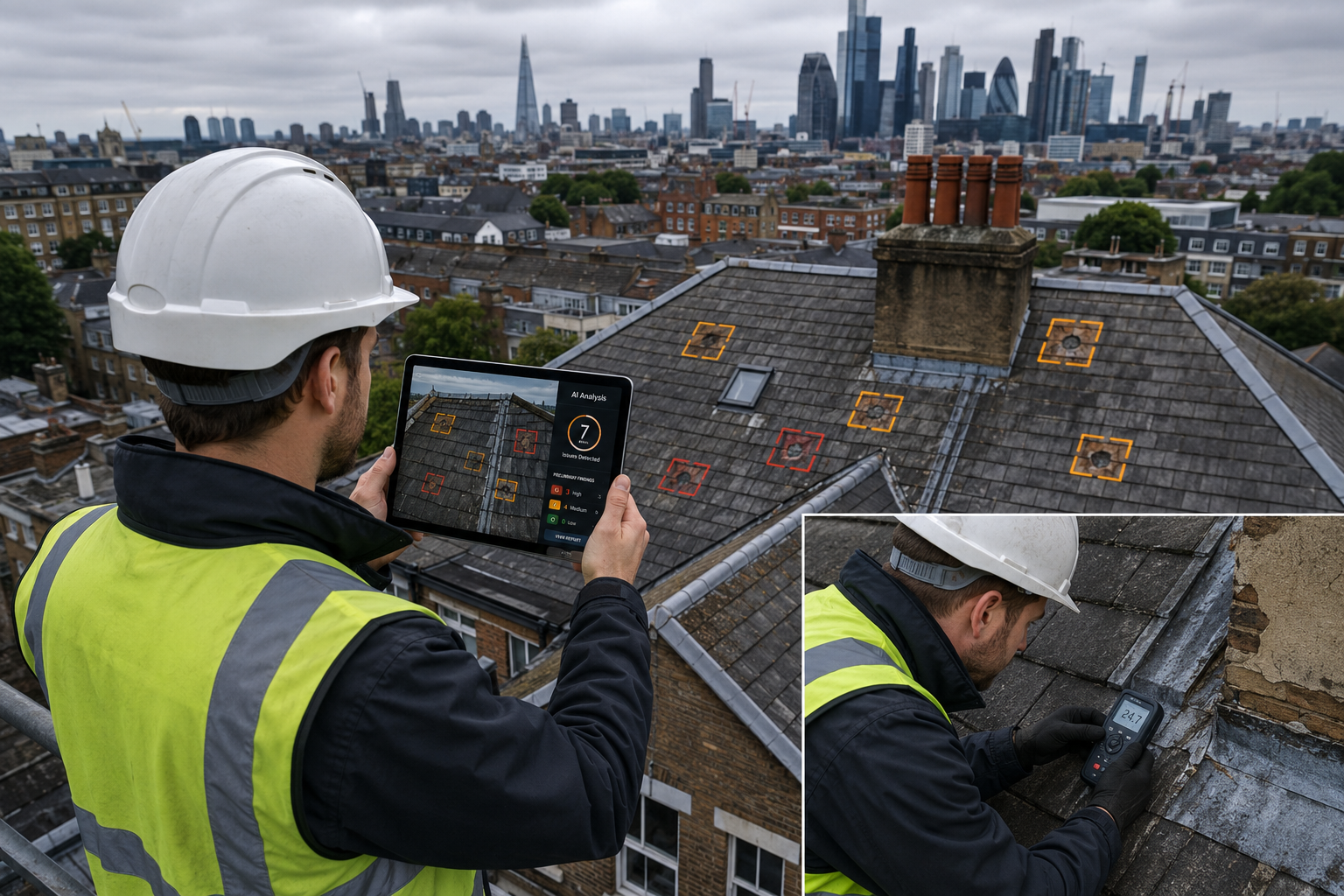
On-site AI use in building surveys typically involves:
- AI-enhanced camera apps that flag potential defects (cracks, damp staining, roof damage) in real time
- Drone imagery with AI analysis for roofs, chimneys, and inaccessible elevations
- Thermal imaging with AI interpretation for moisture and insulation anomalies
The 2026 standard is unambiguous here: AI outputs on site are prompts for further inspection, never conclusions [6][7][8].
Practical On-Site Compliance Checklist ✅
- AI-flagged defect areas must be physically inspected by the surveyor where accessible
- Drone AI outputs must be cross-referenced with ground-level observations
- AI thermal readings must be validated with a calibrated moisture meter or equivalent
- Any AI tool used on site must appear in the firm's AI systems register
- The surveyor must be able to explain the AI tool's methodology if challenged
This is particularly relevant for damp surveys, where AI thermal imaging might flag potential moisture ingress. The surveyor must still conduct a hands-on assessment — AI cannot diagnose rising damp, penetrating damp, or condensation from an image alone.
The AVM Over-Reliance Problem 🚫
A specific concern flagged in 2026 commentary is surveyors using automated valuation models (AVMs) as a shortcut during risk assessment [2][6]. AVMs can inform desktop research, but:
- They do not account for property-specific defects found during inspection
- They cannot assess condition ratings for individual elements
- Relying on AVM risk scores without physical inspection is not compliant with the RICS standard
This matters especially for Level 3 building surveys, where the depth of investigation required makes AI shortcuts particularly dangerous.
Stage 3: Post-Inspection — AI-Assisted Report Production
Post-inspection is where AI use is most widespread and, arguably, most risky from a compliance standpoint. AI tools are now commonly used to:
- Draft standard advisory text for common defects
- Generate condition ratings based on inspection notes
- Produce full Level 2 or Level 3 report drafts from structured data inputs
- Suggest remedial action recommendations
All of this is permitted under the 2026 standard — with mandatory controls [1][5][8]:
| Report Production Task | AI Role | Surveyor Role |
|---|---|---|
| Standard advisory text | Draft generation | Review, edit, personalise |
| Condition ratings | Suggested rating | Verify against inspection notes |
| Remedial recommendations | Options list | Select, justify, sign off |
| Risk summaries | Preliminary draft | Challenge, rewrite if needed |
| Final report sign-off | None | Mandatory human sign-off |
💬 "A qualified surveyor must review, challenge, and be able to explain any AI-influenced conclusion." [5][6]
Surveyors should also be aware that clients who receive a poor survey result may seek to renegotiate based on building survey findings — making accuracy and clear human reasoning in reports more important than ever.
Integrating RICS AI Standards in Building Surveys: Governance, Ethics, and Documentation
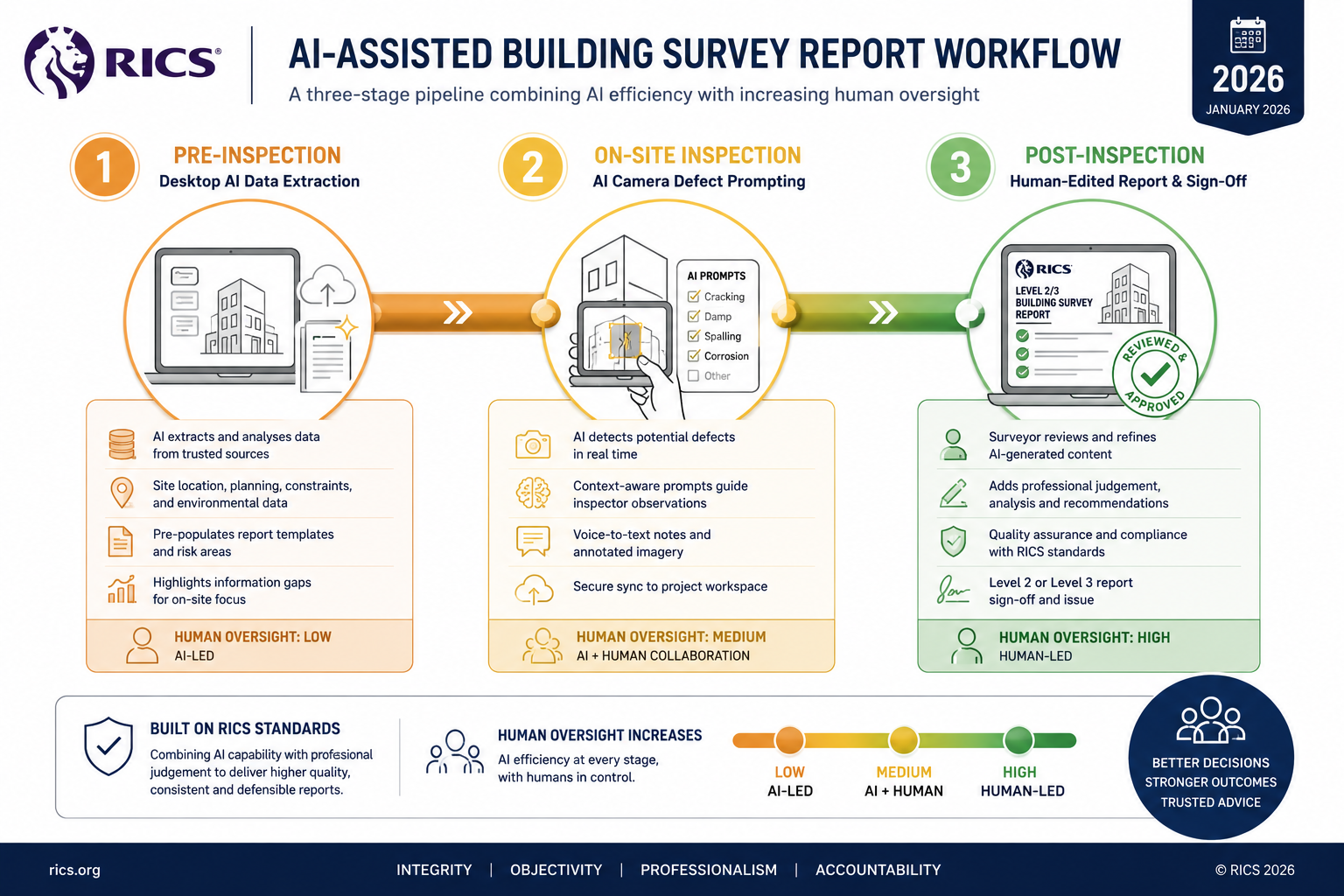
Compliance with the post-March 2026 standard is not just about what happens during a survey. It requires ongoing governance infrastructure within the firm [1][5][6].
Building Your AI Governance Framework
1. AI Systems Register
Every AI tool used in the practice must be logged, including:
- Tool name and version
- Type of AI (generative, predictive, image recognition)
- Surveying tasks it is applied to
- Known limitations and bias risks
- Data security classification
2. Risk Register
A separate, living document that records:
- Identified risks for each AI application
- Likelihood and impact ratings
- Mitigation measures in place
- Review dates
3. Written System Assessments
For each AI tool, a documented assessment covering:
- How the tool works (at a sufficient level for professional accountability)
- What the training data includes and any known biases
- How hallucinations or errors are detected and corrected
- Who in the firm is responsible for oversight
Ethical Checklist for AI Use in Building Surveys 🧭
The following checklist supports ethical, compliant AI integration in daily practice:
- Transparency: Has the client been informed that AI tools were used in their survey?
- Accountability: Is a named RICS-qualified surveyor accountable for every conclusion?
- Explainability: Can the surveyor explain why any AI output was relied upon?
- Bias check: Has the AI tool's training data been assessed for geographic or property-type bias?
- Hallucination review: Has every AI-generated text output been checked for factual accuracy?
- Data security: Does the AI tool comply with UK GDPR requirements for client data?
- Documentation: Is AI use and its material impact recorded in the survey file?
- No AVM substitution: Has physical inspection confirmed or challenged any AI risk score?
Practitioners seeking CPD on these requirements can access RICS's recorded webinar series on data and technology in surveying [9].
What "Material Impact" Means in Practice
The phrase "material impact" is central to the standard but can feel abstract [5]. In building survey terms, AI use has a material impact when:
- The AI output changed or shaped a condition rating
- The AI tool identified a defect that the surveyor then included in the report
- AI-generated text formed the basis of a client recommendation
- An AI risk score influenced the scope of inspection
If any of these apply, the use must be documented. If none apply — for example, AI was used only for spell-checking — documentation is not required, though best practice suggests noting it anyway.
Common Myths About AI in Building Surveys — Debunked 🚫
Several misconceptions have emerged since the March 2026 standard came into force. Clearing these up is essential for compliant practice. For a broader look at survey misconceptions, see common myths about property surveys.
Myth 1: "If AI found the defect, the AI is responsible."
❌ False. The named surveyor is always fully responsible, regardless of how a defect was identified [5].
Myth 2: "Using AI makes my survey faster and therefore cheaper — clients benefit."
⚠️ Partially true, but only if quality and compliance are maintained. Speed without accuracy is a liability risk.
Myth 3: "I don't need to understand how the AI works — I just need the output."
❌ False. The standard explicitly requires surveyors to understand AI types, limitations, and risks [1][5].
Myth 4: "AVMs can replace on-site risk assessment for straightforward properties."
❌ False. No property is straightforward enough for AVM-only risk assessment under the 2026 standard [6][7].
Myth 5: "The standard only applies to large firms with dedicated AI teams."
❌ False. It applies to all RICS members and regulated firms, regardless of size [5].
Conclusion: Actionable Next Steps for Compliant AI Integration in 2026
Integrating RICS AI Standards in Building Surveys: Practical 2026 Protocols Post-March Guidance is not a future consideration — it is an immediate professional obligation. The good news is that the framework is clear, and the three-stage workflow model gives practitioners a practical structure to follow.
Your 2026 Action Plan 🗓️
- Audit your current AI use — list every tool used in pre-inspection, on-site, and report production workflows
- Build your AI systems register — document each tool's type, limitations, and data risks
- Create or update your risk register — specific to AI applications in building surveys
- Train your team — ensure every surveyor understands the standard's requirements, not just partners and directors
- Review your report templates — add disclosure language where AI has materially contributed to outputs
- Establish a hallucination review process — a simple checklist for reviewing AI-generated text before it enters any client document
- Never substitute AI for physical inspection — especially for damp assessments and structural defect identification
- Seek CPD — RICS's webinar resources and APC guidance are available for ongoing competence development [9][10]
The March 2026 standard does not ask surveyors to abandon AI — it asks them to use it responsibly, transparently, and with professional accountability at every step. Firms that build these habits now will be better positioned for whatever comes next in the profession's evolving relationship with technology.
References
[1] Ai Responsible Use Standard – https://ww3.rics.org/uk/en/journals/construction-journal/ai-responsible-use-standard.html
[2] Rics Issues First Mandatory Global Standard Responsible Ai L9hie – https://www.linkedin.com/pulse/rics-issues-first-mandatory-global-standard-responsible-ai-l9hie
[3] New Rics Standard On The Responsible Use Of Ai – https://www.reddit.com/r/buildingsurveying/comments/1s0nbag/new_rics_standard_on_the_responsible_use_of_ai/
[4] Watch – https://www.youtube.com/watch?v=pKk36SJ4Y_g
[5] Responsible Use Of Ai – https://www.rics.org/profession-standards/rics-standards-and-guidance/conduct-competence/responsible-use-of-ai
[6] Rics Ai Standards In Building Surveys 2026 Implementing Responsible Use While Maintaining Professional Judgment – https://nottinghillsurveyors.com/blog/rics-ai-standards-in-building-surveys-2026-implementing-responsible-use-while-maintaining-professional-judgment
[7] Responsible Ai Use In Building Surveys Rics 2026 Standards For Level 3 Assessments And Risk Mitigation – https://kingstonsurveyors.com/responsible-ai-use-in-building-surveys-rics-2026-standards-for-level-3-assessments-and-risk-mitigation/
[8] Rics Ai Standards In Building Surveys 2026 Practical Protocols For Level 3 Assessments And Risk Detection – https://nottinghillsurveyors.com/blog/rics-ai-standards-in-building-surveys-2026-practical-protocols-for-level-3-assessments-and-risk-detection
[9] Recorded Webinar Series Data And Tech In Surveying – https://www.rics.org/training-events/online-training/on-demand/recorded-webinar-series-data-and-tech-in-surveying
[10] Rics Responsible Use Of Ai Explained For Apc Candidates – https://resources.apcguide.com/rics-responsible-use-of-ai-explained-for-apc-candidates/