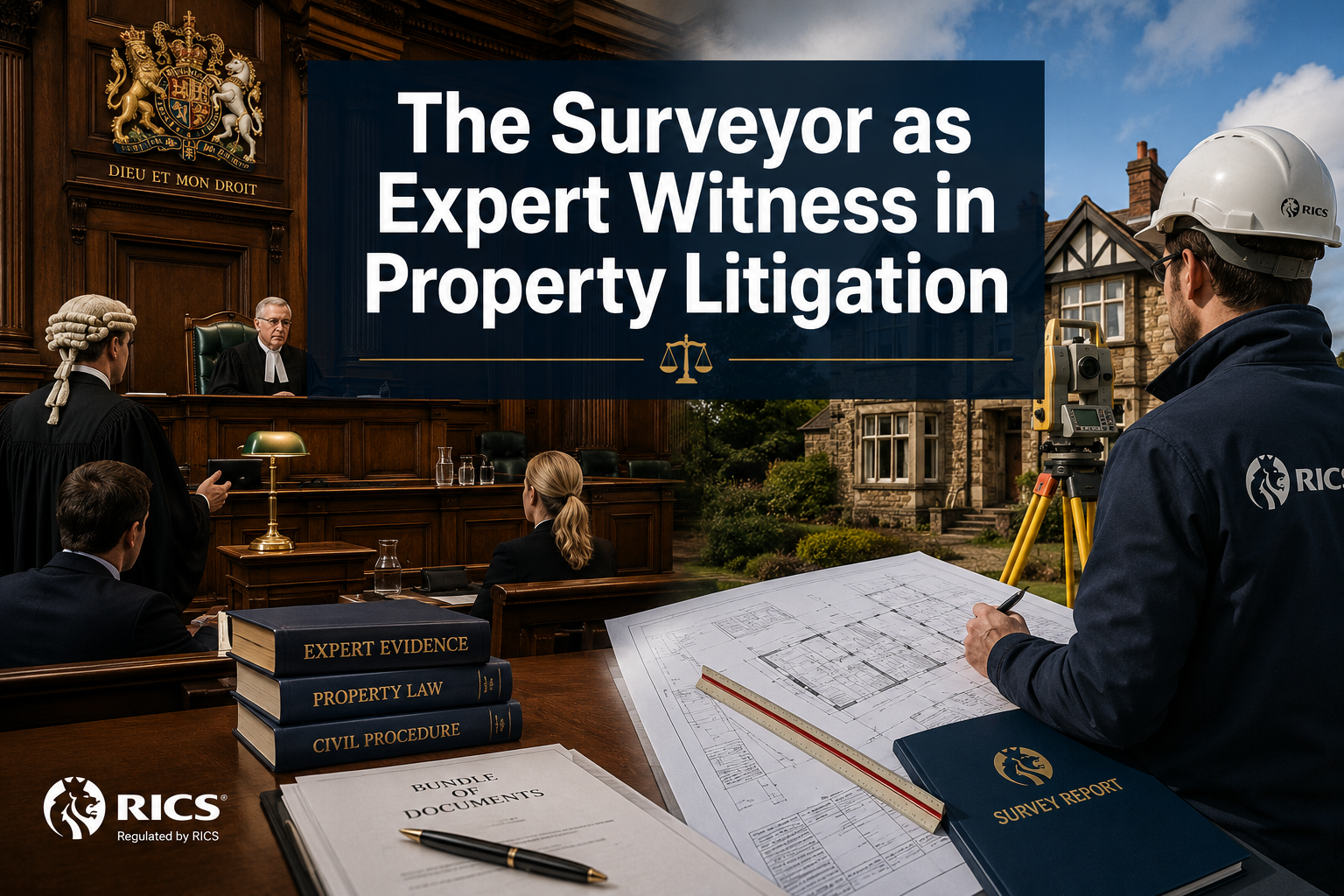
Fewer than 20% of expert witnesses in English property litigation are ever formally challenged on their methodology — yet when they are, inadequate preparation can unravel an entire case. [4] The role of the surveyor as expert witness in property litigation: roles, evidence standards, and RICS protocols is one of the most technically demanding positions in the legal system. It demands equal fluency in surveying science and courtroom procedure, and a single misstep — a poorly worded opinion, a misunderstood duty — can cost a client hundreds of thousands of pounds.
This article examines what surveyors must know before stepping into the witness box, covering duties, admissibility standards, RICS guidance, and practical cross-examination preparation across the most common dispute types in 2026.
Key Takeaways 📌
- A surveyor acting as an expert witness owes their primary duty to the court or tribunal, not to the instructing party — this overrides all other obligations.
- The governing RICS standard remains the 4th edition of Surveyors Acting as Expert Witnesses (September 2020), which aligns with CPR Part 35 requirements. [7]
- The three most common property litigation contexts in 2026 are boundary disputes, valuation disputes, and building defect/condition claims. [4]
- Expert reports must meet strict admissibility standards: they must be impartial, within the surveyor's expertise, and properly reasoned.
- RICS offers a dedicated Expert Witness Accreditation Service to validate competence and credibility. [2]
Understanding the Core Role: The Surveyor as Expert Witness in Property Litigation
The Overriding Duty to the Court
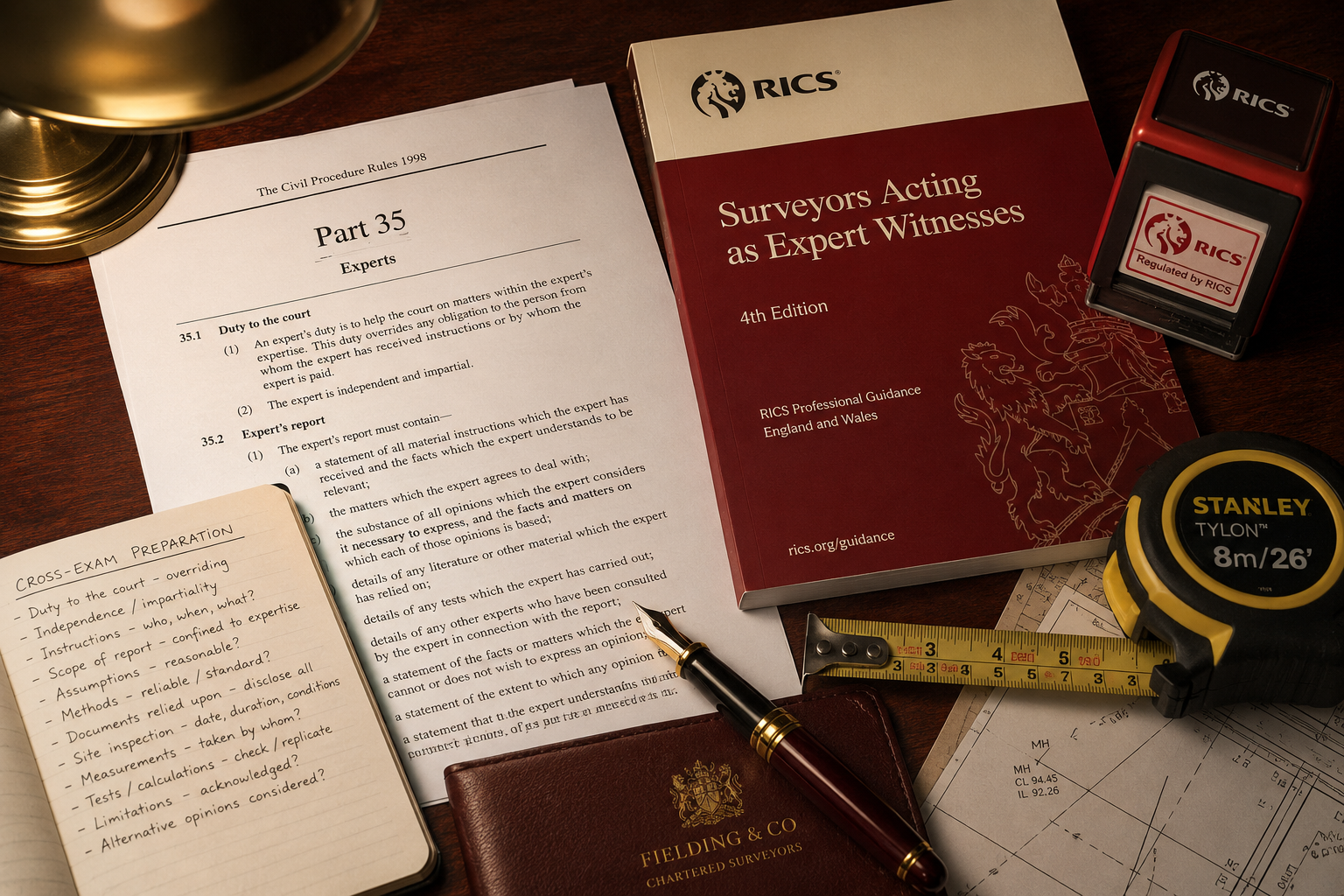
The single most important principle governing the surveyor as expert witness in property litigation is this: the expert's duty is to the court, not the client. This is not merely an ethical preference — it is a legal requirement under Civil Procedure Rules (CPR) Part 35 in England and Wales.
"An expert's overriding duty is to help the court on matters within their expertise. This duty overrides any obligation to the person from whom the expert has received instructions or by whom they are paid."
— CPR Part 35.3
This principle shapes every aspect of the role, from how opinions are formed to how evidence is presented under cross-examination. A surveyor who tailors their conclusions to favour the instructing party risks being found to have given partisan evidence, which can result in the report being disregarded and, in serious cases, a referral to RICS for disciplinary action. [5]
RICS reinforces this through its professional guidance. The 4th edition of Surveyors Acting as Expert Witnesses (September 2020) sets out clear obligations for impartiality, transparency of methodology, and the proper handling of conflicts of interest. [7] Surveyors must declare any prior relationship with the instructing party and must confirm in writing that their opinion would be the same regardless of who is paying.
What Qualifies a Surveyor to Act as an Expert?
Not every chartered surveyor is qualified to act as an expert witness. The courts expect experts to demonstrate:
- Specialist knowledge relevant to the specific dispute (e.g., valuation, building pathology, boundary surveying)
- Current professional practice — not merely historical experience
- Familiarity with court procedure and the obligations of CPR Part 35
RICS addresses this through its Expert Witness Accreditation Service (EWAS), which assesses surveyors against a structured competency framework. [2] Accreditation signals to instructing solicitors and tribunals that the surveyor has been independently validated — a significant credibility advantage during cross-examination.
For surveyors working across London property disputes and surrounding areas, understanding local market conditions and comparable evidence is often as important as procedural knowledge.
Evidence Standards and RICS Protocols in Property Expert Witness Work
The RICS 4th Edition: What It Requires
The RICS guidance note Surveyors Acting as Expert Witnesses (4th edition, September 2020) is the primary professional standard. [10] It covers:
| Requirement | Detail |
|---|---|
| Declaration of truth | Every report must include a signed statement of truth confirming the expert's impartiality |
| Scope of instructions | The report must clearly state what the surveyor was asked to opine on |
| Methodology transparency | The basis for all opinions must be fully explained and reproducible |
| Caveats and limitations | Any material uncertainty must be disclosed |
| Single Joint Expert (SJE) rules | Guidance on acting for both parties simultaneously |
The guidance also addresses without prejudice meetings between opposing experts — commonly called "experts' meetings" or "hot tubbing" — where surveyors must be prepared to narrow areas of disagreement before trial. [7]
Admissibility: What Makes Expert Evidence Stick?
Courts apply a structured test to expert evidence before admitting it. The key questions are:
- ✅ Is the opinion within the expert's area of expertise?
- ✅ Is the methodology sound and accepted in the profession?
- ✅ Is the evidence relevant to the issues in dispute?
- ✅ Has the expert disclosed all material facts, including those that undermine their opinion?
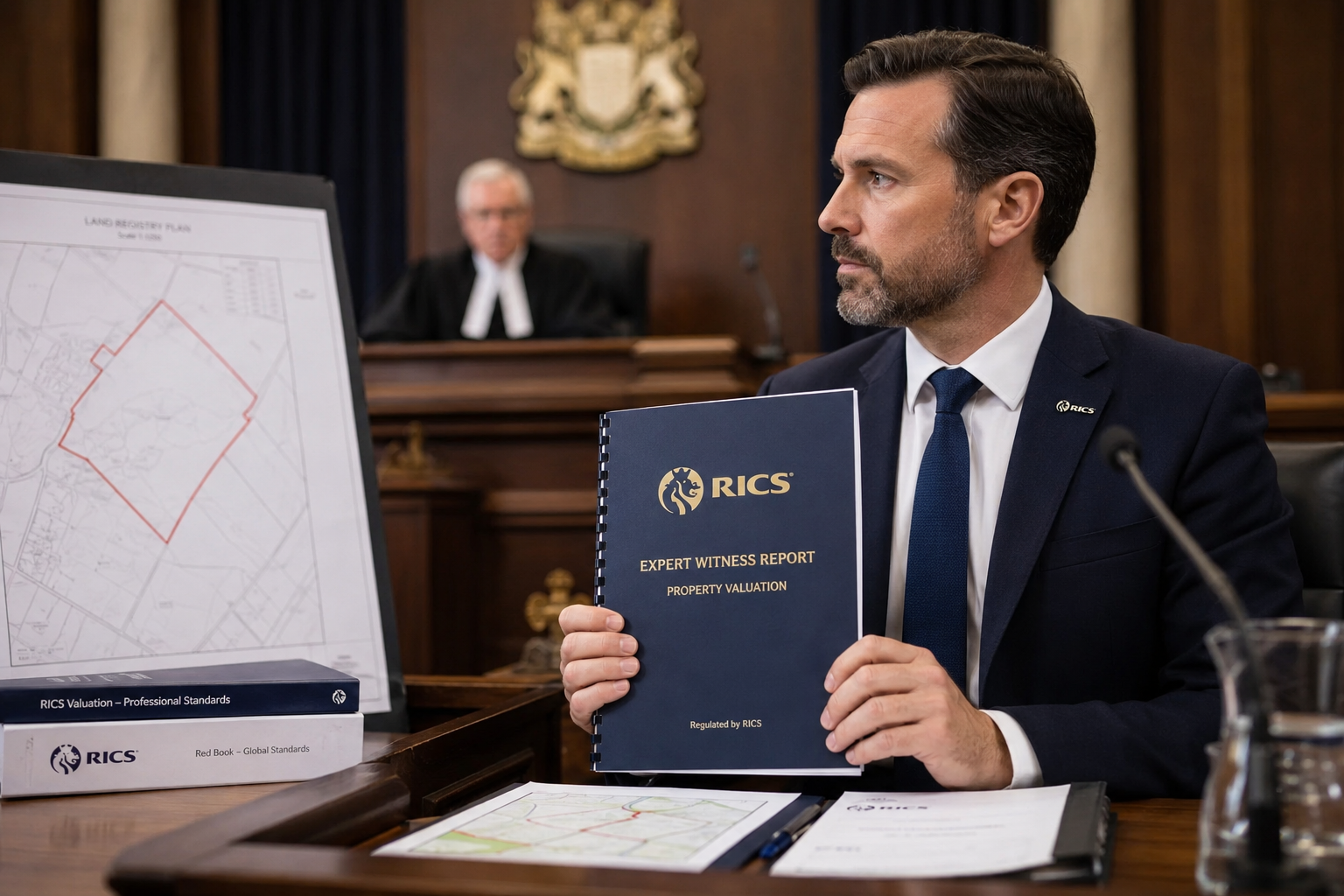
Surveyors who rely on RICS property valuations as part of their evidence base must ensure that valuations are conducted in accordance with the RICS Red Book (Valuation — Global Standards) to withstand scrutiny. [8] A valuation prepared for litigation purposes must be clearly distinguished from one prepared for mortgage or insurance purposes, as the scope and assumptions may differ materially.
Cross-Examination Preparation: The Falcon Chambers Approach
Barristers specialising in property law — particularly those from chambers with deep real estate expertise — are skilled at exposing weaknesses in expert evidence. Common lines of attack include:
- Challenging comparables: Were the comparable transactions truly comparable? Were adjustments made transparently?
- Questioning inspection scope: Did the surveyor inspect all relevant areas, or were assumptions made?
- Probing methodology: Is the approach consistent with RICS guidance and industry practice?
- Testing impartiality: Has the expert previously acted for the same client in a non-expert capacity?
Effective preparation involves stress-testing every opinion before the hearing. Surveyors should work through their report with instructing solicitors, identifying every statement that could be challenged and preparing clear, evidence-based responses. Reviewing surveyor responsibilities in detail before instruction is essential.
A useful discipline is to ask: "If I were cross-examining this report, where would I attack it?" Every vulnerability identified in advance is one less surprise in the witness box.
The Three Main Dispute Types: Valuation, Boundary, and Building Defect Claims
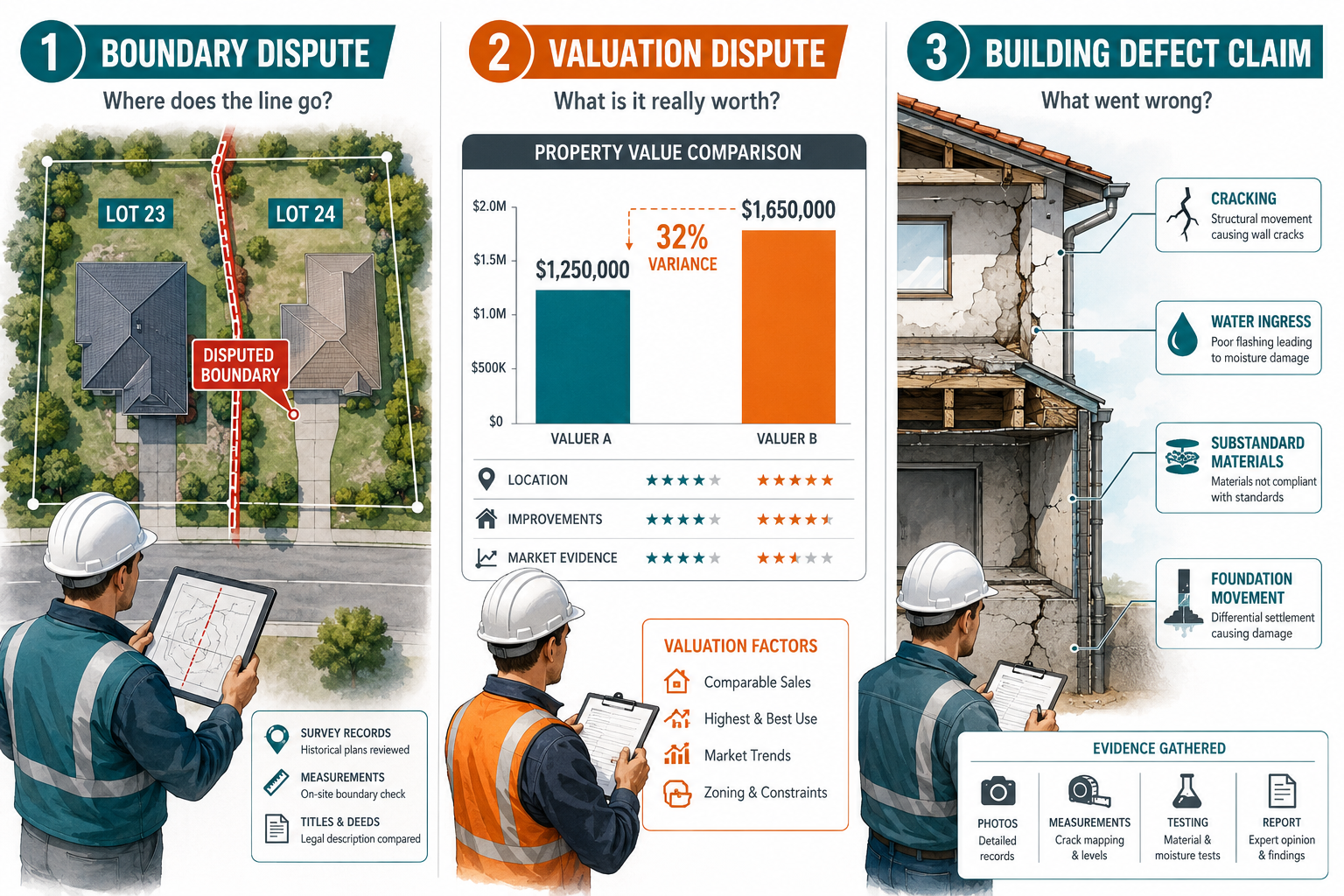
1. 🏠 Valuation Disputes
Valuation disputes are among the most technically complex in property litigation. They arise in contexts including:
- Compulsory purchase compensation
- Lease renewal rent reviews
- Professional negligence claims against valuers
- Matrimonial and probate proceedings
In 2026, the recovery of residential property markets in many parts of England has created significant valuation gaps between parties in dispute. [6] A claimant may argue that a property was undervalued at a critical date, while the defendant's expert contends the opposite. The surveyor's role is to provide an independent, reasoned opinion of value at the relevant date, supported by comparable evidence.
Key evidence standards in valuation disputes:
- The valuation must reference market conditions at the valuation date, not current conditions
- Comparable transactions must be identified, analysed, and adjusted with full transparency
- Any departure from standard RICS methodology must be explained and justified [8]
Surveyors in areas like Wimbledon, Kingston, and Croydon will be familiar with the micro-market variations that can significantly affect comparable analysis — local knowledge is a genuine asset in these cases.
2. 📐 Boundary Disputes
Boundary disputes represent one of the most emotionally charged — and technically demanding — areas of property litigation. [3] The surveyor's task is to determine the legal boundary between two properties, which requires interpreting:
- Title deeds and plans (often historical and imprecise)
- Ordnance Survey data
- Physical features on the ground (walls, fences, hedges)
- Witness evidence about historical use and occupation
The expert must clearly distinguish between the general boundary (as shown on the title register) and the legal boundary (the precise line of ownership). These are rarely the same thing.
Surveyors involved in property boundary disputes must be meticulous in their methodology. Courts have been critical of experts who rely too heavily on OS maps without acknowledging their inherent inaccuracies (typically ±1 metre at 1:1250 scale). [9]
3. 🔨 Building Defect and Condition Claims
Building defect claims require the surveyor to act as a building pathologist — diagnosing the cause, extent, and cost of remediation for structural or material defects. These cases arise from:
- Pre-purchase survey negligence claims
- Dilapidations disputes between landlords and tenants
- New build defect claims against developers
- Insurance disputes over the extent of damage
The expert must not only identify defects but must also opine on:
- Whether the defects were visible and reportable at the time of inspection
- What a competent surveyor would have identified using the standard of care applicable at the time
- The reasonable cost of remediation at the relevant date
For surveyors preparing condition survey reports as part of litigation, the standard of inspection must be clearly defined and defended. Courts will scrutinise whether the surveyor followed a logical, systematic inspection methodology and whether their conclusions are proportionate to the evidence found.
Practical Protocols: From Instruction to Report
Accepting Instructions Carefully
Before accepting an expert witness instruction, surveyors should:
- Confirm the scope of the instruction in writing
- Check for conflicts of interest — any prior involvement with the property or parties
- Assess competence — is the specific dispute type within genuine expertise?
- Agree fees — expert witness fees must not be contingent on the outcome of the case
Structuring the Expert Report
A compliant expert report under CPR Part 35 must include: [7]
- Cover page with the expert's name, qualifications, and the case reference
- Statement of instructions — what the expert was asked to do
- Summary of conclusions — a concise overview for the court
- Methodology — how the expert reached their conclusions
- Reasoned opinion — the substantive analysis
- Declaration of truth — signed confirmation of impartiality
- Statement of compliance with CPR Part 35 and RICS guidance
The Experts' Meeting
When both parties instruct experts, the court will often direct a without prejudice meeting to produce a joint statement identifying:
- Areas of agreement
- Areas of disagreement and the reasons for each
This process requires surveyors to engage constructively with opposing experts while maintaining their independent opinion. The joint statement is a critical document — courts pay close attention to what experts agree on, and any concessions made in the meeting can significantly affect the outcome. [5]
Conclusion: Actionable Next Steps for Surveyors in Litigation
The surveyor as expert witness in property litigation: roles, evidence standards, and RICS protocols is a demanding specialism that rewards thorough preparation and rigorous professional standards. In 2026, with property disputes becoming more technically complex and courts increasingly scrutinising expert methodology, the bar for credible expert evidence has never been higher.
Actionable steps for surveyors considering or currently undertaking expert witness work:
- ✅ Study the RICS 4th edition guidance (Surveyors Acting as Expert Witnesses, September 2020) thoroughly and keep it to hand during every instruction. [10]
- ✅ Pursue RICS Expert Witness Accreditation to validate competence and strengthen credibility before courts and tribunals. [2]
- ✅ Stress-test every report by identifying potential cross-examination challenges before submission.
- ✅ Maintain meticulous records of all inspections, data sources, and reasoning — courts can and do request underlying working papers.
- ✅ Engage early with instructing solicitors to clarify the scope of the dispute and ensure the report addresses the right legal questions.
- ✅ Never lose sight of the overriding duty — the court, not the client, is the ultimate audience for expert evidence.
For property owners and legal professionals seeking a qualified, RICS-accredited surveyor for litigation support, working with an experienced local practice — whether in Fulham, Harrow, or across the wider London area — ensures access to both technical expertise and local market knowledge that can make the difference in a disputed case.
References
[1] Watch – https://www.youtube.com/watch?v=GhT2FrpMbAI
[2] Expert Witness Accreditation Service – https://www.rics.org/dispute-resolution-service/panel-of-experts/expert-witness-accreditation-service
[3] Mapping Surveying Expert Witness Case Summary – https://www.expertwitnessblog.com/mapping-surveying-expert-witness-case-summary/
[4] Expert Witness Roles In 2026 Property Litigation Building Cases With Rics Residential Recovery Data – https://princesurveyors.co.uk/blog/expert-witness-roles-in-2026-property-litigation-building-cases-with-rics-residential-recovery-data/
[5] Understanding The Role Of A Surveyor As An Expert Witness – https://projectsurveyors.com.au/understanding-the-role-of-a-surveyor-as-an-expert-witness/
[6] Expert Witness Preparation For 2026 Property Disputes Using Recovery Market Data In Court Valuations – https://kingstonsurveyors.com/expert-witness-preparation-for-2026-property-disputes-using-recovery-market-data-in-court-valuations/
[7] Surveyors Acting As Expert Witnesses – https://www.rics.org/profession-standards/rics-standards-and-guidance/sector-standards/dispute-resolution-standards/surveyors-acting-as-expert-witnesses
[8] Rics Valuation Expert Witness Services – https://edsltd.com/rics-valuation-expert-witness-services/
[9] Pap 4028 – https://proceedings.esri.com/library/userconf/survey11/papers/pap_4028.pdf
[10] Surveyors Acting As Expert Witnesses 4th Ed Sep 2020 Rics – https://ajmsurveyors.com/PDF/surveyors-acting-as-expert-witnesses-4th-ed-sep-2020-rics.pdf