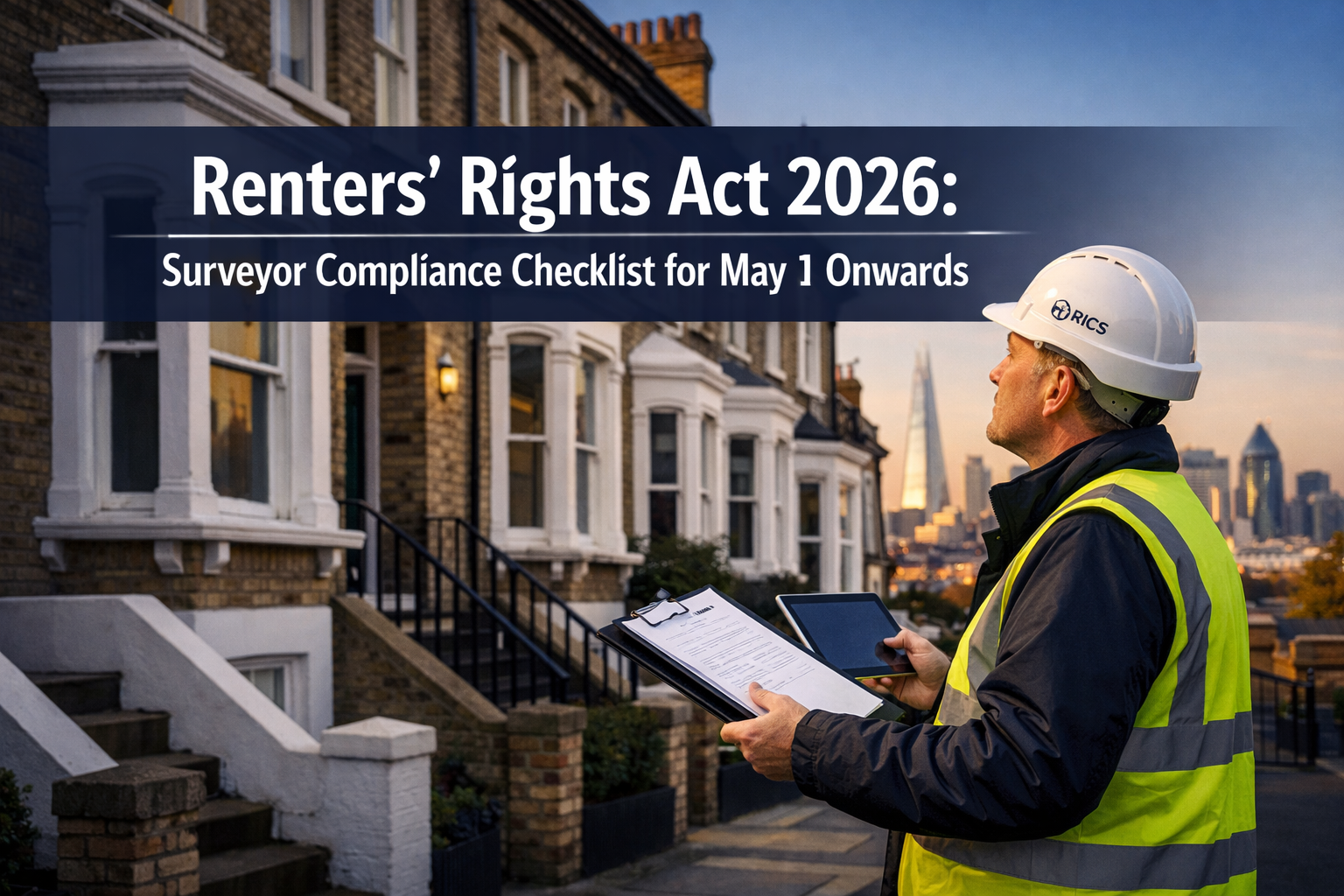
As of today — May 1, 2026 — the private rented sector in England has fundamentally changed. The Renters' Rights Act 2026 Implementation Day: Surveyor Compliance Checklist for May 1 Onwards is not a future planning exercise; it is an immediate operational requirement for every surveyor, landlord, and letting agent active in the market right now.
Section 21 "no-fault" evictions are abolished. All existing tenancies have converted to periodic tenancies overnight. The new Private Rented Sector (PRS) Database is live. For surveyors, these changes are not just legal background noise — they reshape how building surveys are scoped, how valuations are justified, how party wall protocols interact with tenancy law, and how landlord compliance is evidenced. [1][4]
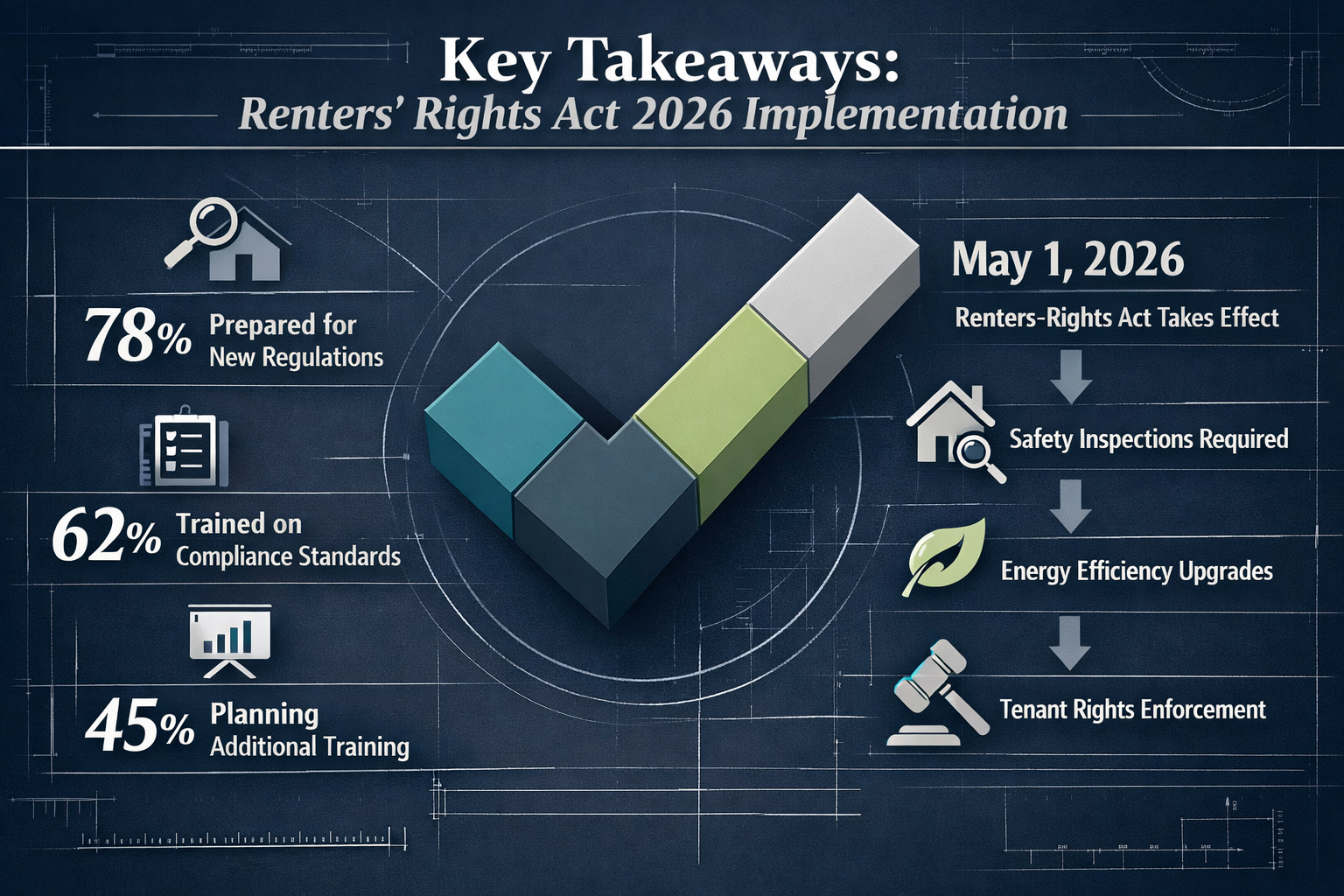
Key Takeaways 📋
- May 1, 2026 is live: All private tenancies in England are now periodic; Section 21 is abolished; surveyors must adapt their compliance frameworks immediately.
- Documentation deadlines are strict: Existing tenants must receive the government information leaflet by May 31, 2026; deposit protection certificates must be served within 30 days.
- Penalty exposure is significant: EICR non-compliance carries fines up to £30,000; gas safety failures are a criminal offence with penalties up to £6,000; Awaab's Law breaches cost up to £7,000.
- Surveyors play a central role: RICS-qualified surveyors are now critical partners for landlords navigating property condition standards, hazard identification, and evidence-based rent reviews.
- Proactive inspection is essential: Enhanced council enforcement powers (active since December 27, 2025) mean reactive compliance is no longer sufficient. [5]
Why May 1, 2026 Changes Everything for Property Professionals
The Renters' Rights Act 2026 is the most significant overhaul of England's private rented sector in a generation. Unlike previous incremental reforms, this legislation takes effect in a single sweeping phase — meaning there is no grace period for surveyors or landlords who are not already prepared. [10]
Section 21 Abolition and Its Survey Implications
With Section 21 notices no longer valid from today, landlords can only recover possession through Section 8 grounds. This has a direct impact on surveying practice. When a landlord needs to demonstrate that a property is genuinely uninhabitable or requires substantial redevelopment, independent survey evidence becomes the primary legal instrument.
Surveyors should expect a significant uptick in instructions where:
- Landlords seek documented evidence of disrepair to support Section 8 grounds
- Tenants commission counter-surveys to challenge landlord claims
- Courts require independent condition assessments as part of possession proceedings
💡 Pull Quote: "Section 21 abolition does not just affect landlords — it elevates the evidential weight of every building survey conducted in the private rented sector."
Periodic Tenancies and Valuation Adjustments
All assured shorthold tenancies have automatically converted to periodic tenancies. For surveyors conducting RICS property valuations, this changes the investment yield calculation. A property that previously offered a landlord the certainty of a fixed-term exit now carries different risk characteristics. Valuers must reflect the new tenancy structure in their comparable evidence and yield assumptions.
Automatic rent uplift clauses embedded in existing tenancy agreements are also nullified from today. Rent reviews must now be handled through transparent, documented discussions based on market evidence — which means surveyors providing rental market evidence will be in higher demand. [2]
The Private Rented Sector Database
The new PRS Database requires landlords to register their properties. Surveyors should be aware that database records may be cross-referenced during enforcement inspections. Any survey that identifies a hazard or defect in a registered property could trigger formal council action under the expanded enforcement powers granted since December 27, 2025. [5]
The Core Surveyor Compliance Checklist for May 1 Onwards
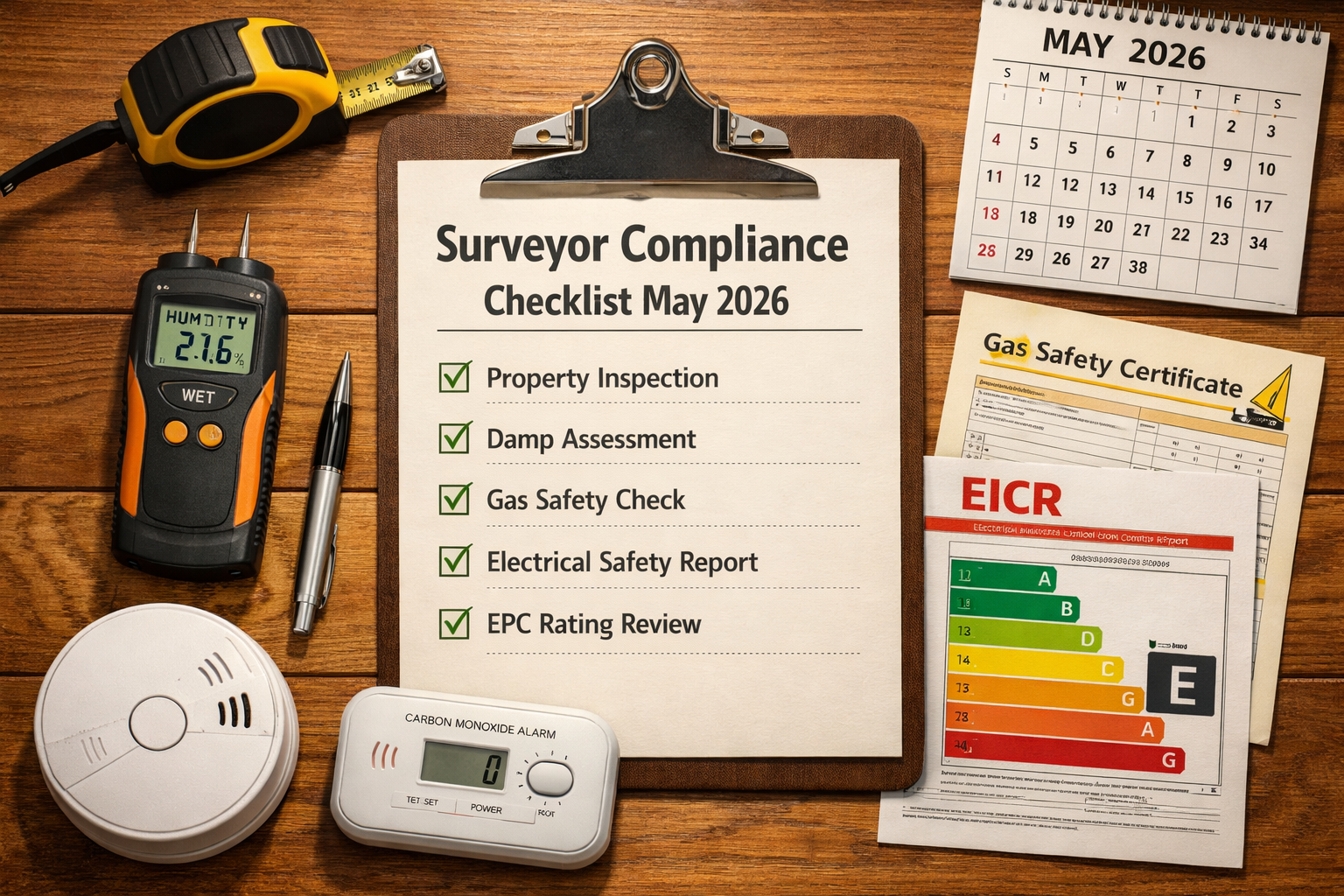
The following checklist consolidates the key compliance obligations that surveyors must understand, advise upon, and — where relevant — inspect against. This is the operational heart of the Renters' Rights Act 2026 Implementation Day: Surveyor Compliance Checklist for May 1 Onwards.
✅ 1. Electrical Installation Condition Reports (EICR)
| Requirement | Detail |
|---|---|
| Frequency | Every 5 years or on change of tenancy |
| Inspector qualification | Qualified electrician only |
| Remediation window | 28 days for unsatisfactory items |
| Tenant copy deadline | Within 28 days of request |
| Maximum penalty | £30,000 |
Surveyors conducting building surveys should note the EICR status of any rental property. If an EICR is overdue or unsatisfactory, this must be flagged as a compliance risk — not merely a maintenance observation. [3]
✅ 2. Gas Safety Certification
Annual checks by a Gas Safe registered engineer are mandatory. Certificates must be provided to tenants within 28 days. Non-compliance is a criminal offence with penalties up to £6,000. Surveyors should verify certificate dates during any inspection and flag expired certificates as urgent. [1]
✅ 3. Energy Performance Certificates (EPC)
A valid EPC with a minimum E rating is legally required. Surveyors are well-placed to advise landlords on proactive upgrades — enhanced insulation, energy-efficient heating systems, and window improvements — ahead of anticipated future tightening of minimum standards. [5]
For properties where damp or condensation issues affect thermal performance, a damp survey may be a necessary precursor to any EPC improvement programme.
✅ 4. Smoke and Carbon Monoxide Alarms
- Smoke alarms: Required on every habitable storey
- Carbon monoxide alarms: Required wherever fuel-burning appliances exist
- Both must be tested and confirmed working at the start of each tenancy
Surveyors should record alarm presence and apparent condition during inspections, noting any storeys where alarms are absent. [5]
✅ 5. Mandatory Documentation Pack
The following documents must be provided before move-in for new tenancies from May 1, 2026 onwards [3]:
- ✔ How to Rent guide (current edition)
- ✔ Gas safety certificate
- ✔ EICR
- ✔ Energy Performance Certificate
- ✔ Tenancy agreement (with mandatory written information about key terms)
- ✔ Deposit protection certificate and prescribed information (within 30 days)
⚠️ Critical Note: Missing any of these documents can invalidate a landlord's ability to rely on certain legal grounds. Surveyors advising landlord clients should confirm documentation status as part of their service.
✅ 6. Government Information Leaflet — Deadline: May 31, 2026
All existing tenants must receive the government-produced information leaflet by May 31, 2026 — just 30 days from today's implementation date. This applies to every existing tenancy, not just new ones, and can be delivered digitally or in hard copy. [4]
Surveyors visiting properties for any reason during May 2026 should remind landlord clients of this imminent deadline.
✅ 7. Awaab's Law — Hazard Response Protocol
Under Awaab's Law, landlords must investigate complaints about serious hazards within 5 working days. Penalties for non-compliance reach £7,000. [1]
For surveyors, this creates a new category of urgent instruction: the rapid condition assessment following a tenant complaint. A specific defect survey is the appropriate tool here — providing documented, independent evidence of the hazard's nature, cause, and required remediation within the statutory response window.
✅ 8. Pet Request Management
Landlords now have 28 days to respond to tenant pet requests. Failure to respond results in deemed acceptance. While this is primarily a landlord-management issue, surveyors may be asked to assess whether a property is suitable for pets or whether pet-related damage has occurred — particularly in end-of-tenancy inspections. [1]
How Surveyors Must Adapt Their Practice Post-May 1

Expanding the Scope of Building Surveys for Rental Properties
The standard RICS HomeBuyer Survey was designed primarily for purchase transactions. For rental properties, surveyors should consider whether their scope adequately captures:
- HHSRS (Housing Health and Safety Rating System) hazards — now more likely to trigger enforcement action
- Damp and condensation — a leading cause of Awaab's Law complaints; understanding damp survey costs and what to expect is increasingly relevant for landlord clients
- Structural defects that could constitute a serious hazard under the new framework
- Compliance document gaps that should be noted as advisory items
Surveyors working across London and the South East — including those covering Hounslow, Fulham, and Hackney — should note that council enforcement activity is expected to be particularly active in high-density rental markets.
Party Wall Protocols Under the New Framework
The abolition of Section 21 introduces complexity for party wall matters. Where a landlord wishes to carry out works covered by the Party Wall Act 1996 — for example, to improve insulation and upgrade an EPC rating — they can no longer rely on a fixed-term tenancy end date to time the works conveniently. Party wall surveyors must now factor in the indefinite nature of periodic tenancies when advising on timelines and access arrangements.
Evidence-Based Rent Reviews
With automatic rent uplift clauses nullified, landlords need documented market evidence to justify any rent increase. RICS-qualified surveyors are ideally positioned to provide this evidence. A formal rental valuation — supported by comparable evidence and recorded in a professional report — gives landlords a defensible basis for rent review discussions and protects against tribunal challenges. [2]
Enhanced Enforcement: What Surveyors Should Know
Councils have held expanded enforcement powers since December 27, 2025. [5] This means:
- Proactive inspections are more likely, particularly in areas with high complaint rates
- Survey reports identifying hazards may be shared with or requested by enforcement officers
- Surveyors' professional opinions on property condition carry greater weight in enforcement proceedings
Understanding why choosing a RICS surveyor matters has never been more relevant — both for landlords seeking credible compliance evidence and for tenants seeking independent condition assessments.
Quick-Reference Penalty Summary
| Compliance Area | Maximum Penalty | Offence Type |
|---|---|---|
| EICR non-compliance | £30,000 | Civil |
| Gas safety failure | £6,000 | Criminal |
| Awaab's Law breach | £7,000 | Civil |
| Deposit protection failure | 1–3× deposit | Civil |
| Smoke/CO alarm failure | £5,000 | Civil |
Conclusion: Act Now — Compliance Is Not Optional
The Renters' Rights Act 2026 Implementation Day: Surveyor Compliance Checklist for May 1 Onwards is not a document to file away for future reference. Every item on this checklist is live today.
For surveyors, the actionable next steps are clear:
- Update your survey scope templates to include HHSRS hazard assessment, compliance document verification, and Awaab's Law-relevant defect flagging for all rental property instructions.
- Brief landlord clients immediately on the May 31, 2026 deadline for the government information leaflet — this is the most urgent near-term obligation.
- Develop a rapid-response inspection protocol for Awaab's Law complaints, using specific defect surveys to provide documented evidence within the 5-working-day investigation window.
- Prepare rental valuation templates that support evidence-based rent reviews, replacing the automatic uplift clauses now rendered void.
- Coordinate with party wall colleagues to reassess project timelines for landlords planning improvement works under periodic tenancies.
- Stay current with council enforcement activity in your operating areas — proactive compliance is the only viable strategy under the new framework.
The surveyors who adapt fastest will become indispensable partners to landlords navigating the most complex regulatory environment the private rented sector has ever seen. Those who do not adapt risk being sidelined — or worse, implicated in a client's compliance failure.
References
[1] Renters Rights Act Landlord Checklist 2026 – https://propready.co.uk/blog/renters-rights-act-landlord-checklist-2026
[2] Renters Rights Act Landlord Checklist To Get Ready For 1st May 2026 – https://www.ashmoreresidential.com/ar-news/renters-rights-act-landlord-checklist-to-get-ready-for-1st-may-2026/
[3] Landlord Compliance Checklist – https://landlord-os.com/landlord-compliance-checklist/
[4] 503154 Mhclg Prs A4 Checklist Web – https://housinghub.campaign.gov.uk/wp-content/uploads/sites/172/2026/04/503154_MHCLG_PRS_A4_Checklist_Web.pdf
[5] 2026 Landlord Compliance Checklist – https://www.davistate.com/blog/2026-landlord-compliance-checklist
[10] Checklist May 1 Get Ready – https://www.nrla.org.uk/news/checklist-may-1-get-ready