
Renewed mortgage lending volumes, tracked by RICS through February 2026, have climbed to their strongest position in over 18 months — and the knock-on effect for building surveyors is already visible in booking queues across the country. The Building Survey Demand Surge in Q2 2026: Capitalising on Market Recovery While Managing Regional Price Divergence is not a uniform story, however. From stagnating instruction volumes in prime London postcodes to accelerating demand in the Midlands, the North, and coastal commuter belts, the recovery is patchy, price-sensitive, and full of both risk and opportunity for surveying practices ready to act strategically.
This article unpacks the data, identifies where demand is genuinely growing, and gives surveyors and property professionals a clear roadmap for scaling operations, setting competitive fees, and navigating the regional fault lines that define Q2 2026.
Key Takeaways 📌
- RICS February 2026 data confirms renewed lending activity, driving a measurable uptick in building survey instructions — but the recovery is price-driven more than volume-driven.
- Regional divergence is stark: London faces affordability-driven stagnation while regional markets in the Midlands, North, and South West show resilient demand growth.
- Builder confidence remains cautious (NAHB index at 38 in March 2026), with 40% of builders still cutting prices — signalling that the recovery is fragile.
- Construction cost pressures — including wage inflation exceeding 4% year-on-year — are squeezing margins and affecting survey fee benchmarking.
- Surveyors who invest in operational scaling now — through technology, associate networks, and tiered service models — will capture disproportionate market share as volumes recover.
Understanding the Q2 2026 Market Context
What the Data Actually Says
Before strategising, it pays to read the numbers honestly. The Building Survey Demand Surge in Q2 2026: Capitalising on Market Recovery While Managing Regional Price Divergence narrative rests on a foundation that is more nuanced than headlines suggest.
Building product orders rose 7% year-over-year in February 2026 — the strongest reading since September 2025. Yet dealers attribute this largely to a favourable base comparison against February 2025, which was itself down 8% [1]. Full-year 2026 volume growth is projected at less than 1%, and revenue gains of approximately 5.2% are expected to come almost entirely from price increases rather than genuine volume growth [1]. In short: the market looks better than it is, partly because the prior year was so weak.
More than half of dealers (54%) reported accelerating orders month-over-month in February 2026, buoyed by improved weather and a temporary dip in mortgage rates [1]. But this represents a weather-window effect, not a structural shift. Demand from custom homebuilders did reach its highest level since mid-2024, and single-family rental new construction accelerated in early 2026 — genuine bright spots worth tracking [1].
Builder confidence, as measured by the NAHB/Wells Fargo Housing Market Index, reached just 38 in March 2026 (up one point from February) [4]. All three components improved modestly: current sales conditions at 42, future sales expectations at 49, and prospective buyer traffic at 25 [4]. These are not the numbers of a booming market — they are the numbers of a market finding its footing.
💬 "Revenue gains are pricing-driven, not demand-driven. Surveyors who price as if volumes have fully recovered will lose instructions to more agile competitors."
The Affordability Constraint
Affordability remains the central drag on recovery. Builders continue to report concerns about elevated construction costs, shortages of buildable lots, and labour shortages [4]. Construction wages increased over 4% year-over-year, with high-demand markets and specialist trades seeing increases of 9% to 11% as of Q2 2026 [8]. These cost pressures flow directly into property valuations and buyer hesitancy — which in turn affects the volume and urgency of survey instructions.
Sales incentives in the new-build sector remained elevated at 65% in January 2026, marking the 10th consecutive month this share exceeded 60% [5]. Meanwhile, 40% of builders reported cutting prices in January 2026, with the average price reduction rising to 6%, up from 5% in December 2025 [5]. For surveyors advising buyers on new-build acquisitions, this context is critical — it shapes both the negotiation environment and the scope of building inspection requirements.
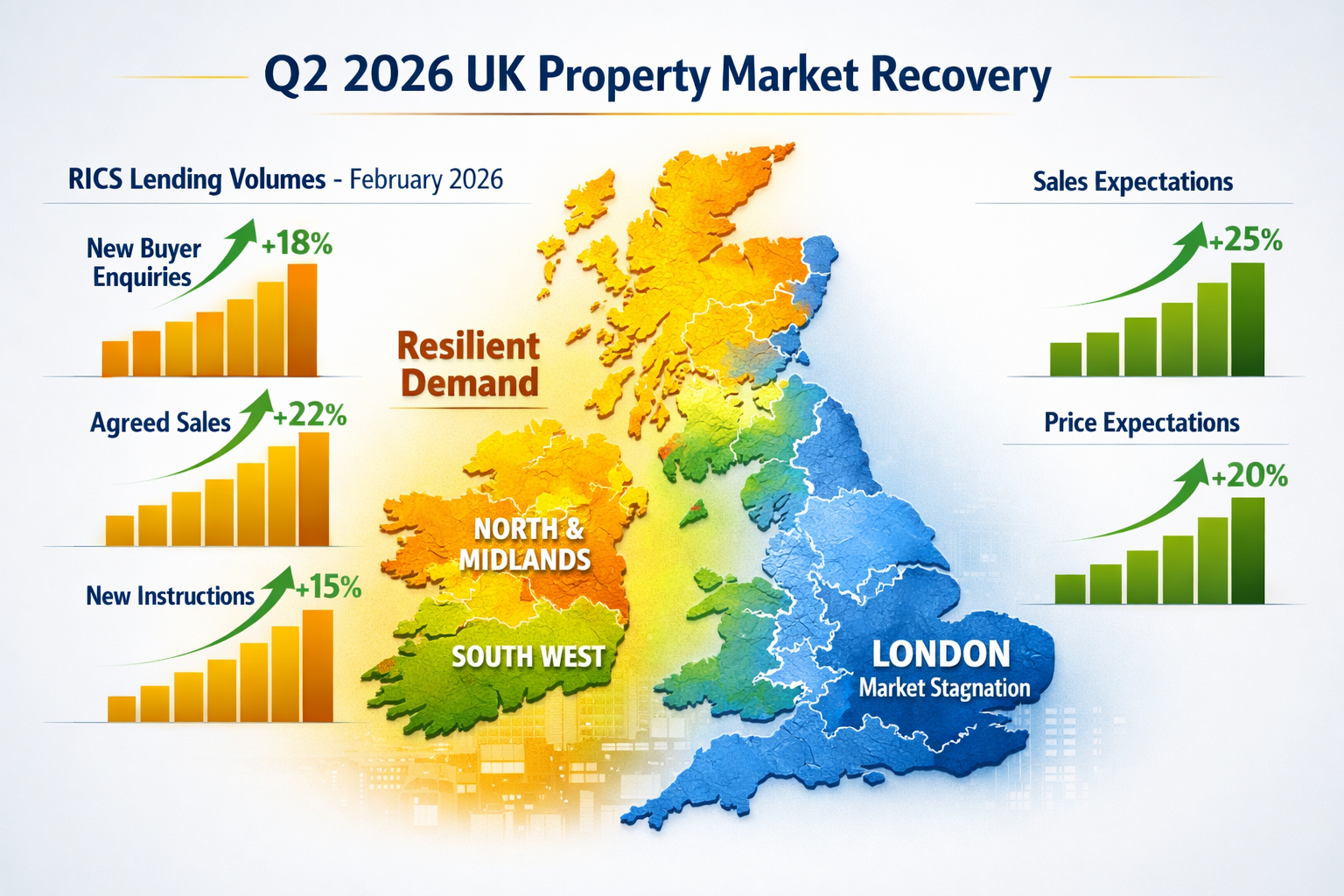
Regional Price Divergence: London Stagnation vs. Resilient Markets
The London Picture
London presents a paradox in Q2 2026. On paper, it remains the UK's highest-value property market. In practice, instruction volumes for building surveys in prime and mid-market London postcodes have plateaued or declined year-on-year. The reasons are structural:
- Stamp duty thresholds disproportionately affect higher-value transactions
- Mortgage affordability stress tests at current rates exclude a larger share of London buyers
- Remote and hybrid working continues to redirect buyer appetite toward regional markets
- Investor caution in the buy-to-let sector following recent tax and regulatory changes
Regional builder sentiment in March 2026 confirmed the divergence: the Northeast held at 44, the Midwest at 43, the South at 35, and the West declined to 31 using three-month moving averages [4]. While these figures reference the US market, the pattern mirrors UK regional dynamics — with London analogous to the high-cost, low-confidence western markets.
For surveyors operating across Richmond, Kensington, Knightsbridge, and Westminster, the Q2 2026 environment demands a different approach: premium positioning, relationship-led referrals, and value-added reporting rather than volume-based growth.
Where Demand Is Genuinely Growing 📈
Contrast London's stagnation with the picture in outer zones and regional hubs. Markets including Croydon, Bromley, Kingston, Southwark, and Newham are seeing more active transaction pipelines, driven by first-time buyer activity and continued demand for older housing stock — precisely the properties that generate the most complex survey requirements.
The Houzz Q2 2026 barometer recorded construction expectations at 58 with backlogs at 5.6 weeks, though clients are delaying some projects amid geopolitical uncertainty [2]. This delay dynamic is relevant: buyers who paused in late 2025 are now re-entering the market, creating a pent-up instruction pipeline for surveyors who have maintained their referral networks through the quiet period.
| Region | Demand Trend Q2 2026 | Survey Fee Pressure | Key Driver |
|---|---|---|---|
| Prime Central London | ⬇️ Declining | Low (premium maintained) | Affordability, stamp duty |
| Outer London (Zones 3–6) | ➡️ Stable/growing | Moderate | First-time buyers, older stock |
| South East commuter belt | ⬆️ Growing | Moderate-high | Remote work migration |
| Midlands & North | ⬆️ Strong | High (competitive) | Relative affordability |
| South West | ⬆️ Growing | Moderate | Lifestyle migration |
Capitalising on Market Recovery: Operational Strategies for Surveyors
Scaling Without Overextending
The Building Survey Demand Surge in Q2 2026: Capitalising on Market Recovery While Managing Regional Price Divergence creates a genuine operational dilemma for surveying practices: how to scale capacity quickly enough to capture rising instructions without committing to fixed costs that become unsustainable if volumes plateau.
Three proven approaches are emerging among practices navigating this well:
1. Associate and Subcontractor Networks 🤝
Rather than hiring full-time staff, leading practices are building associate networks of RICS-qualified surveyors who can absorb overflow instructions on a fee-share basis. This preserves margin flexibility while ensuring quality control through consistent report templates and supervision protocols. Explore professional surveyor services models that support this kind of flexible capacity.
2. Tiered Service Offerings
Not every buyer needs a Level 3 Building Survey. Practices that clearly communicate the key differences between Level 2 and Level 3 surveys — and price each tier competitively — convert more enquiries and serve a broader segment of the market. The homebuyers survey versus full structural survey question is one that every prospective client faces; practices that answer it proactively in their marketing win instructions before competitors are even contacted.
3. Digital Booking and CRM Systems
With backlogs at 5.6 weeks in some markets [2], the practices capturing the most instructions are those with frictionless online booking, automated follow-up sequences, and CRM systems that track enquiry-to-instruction conversion rates. Manual phone-based booking processes lose instructions to faster-responding competitors.

Managing Workload Quality Under Pressure
Increased demand creates a risk that quality suffers. A poorly executed survey that generates a bad building survey report — or one that misses significant defects — creates professional indemnity exposure and reputational damage that far outweighs any short-term revenue gain.
Practices scaling in Q2 2026 should implement:
- ✅ Standardised report templates that ensure consistent coverage regardless of which surveyor conducts the inspection
- ✅ Peer review protocols for complex properties (pre-1900 construction, unusual materials, suspected structural movement)
- ✅ Clear scope-of-service documentation that manages client expectations before inspection
- ✅ Post-report follow-up calls to reduce complaints and generate referrals
Pricing Strategy in a Divergent Market
Setting Fees That Reflect Regional Reality
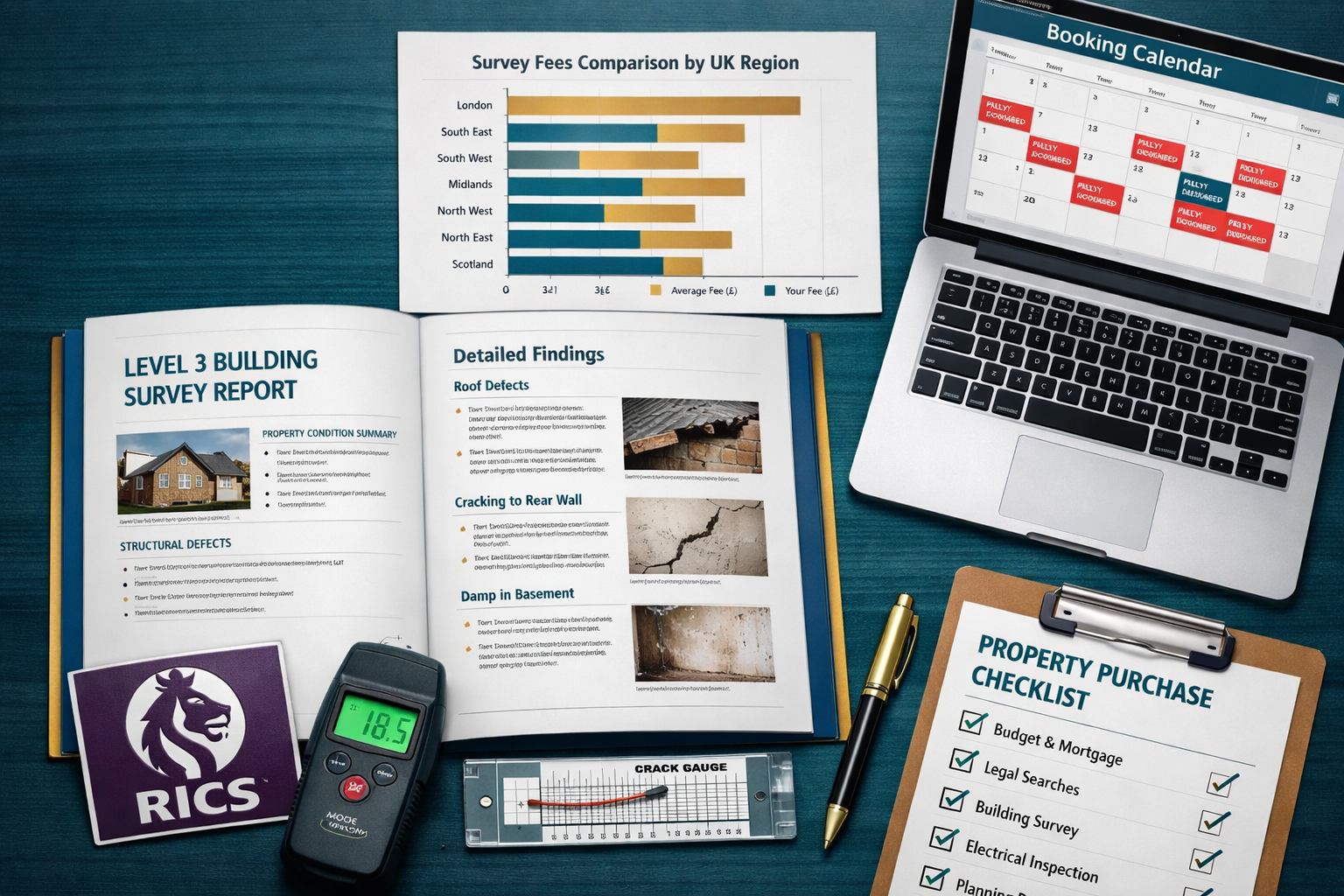
Fee benchmarking in Q2 2026 is complicated by the same regional divergence driving demand patterns. A Level 3 Building Survey on a £500,000 property in Harrow commands a different market rate than the same survey on a comparable property in Fulham — and both differ from equivalent surveys in outer markets like Ilford or Barking.
The data is clear: revenue growth in 2026 is coming from price, not volume [1]. This means surveyors who have not reviewed their fee schedules since 2024 are almost certainly underpriced relative to market rates — particularly given that construction wages have risen over 4% year-on-year [8].
💬 "With wage inflation running at 4%+ and specialist trades seeing 9–11% increases, survey fee schedules that haven't been updated since 2024 are eroding real margins with every instruction."
Practical fee review framework for Q2 2026:
- Benchmark against local competitors — use mystery shopping and online research quarterly
- Segment by property type and age — pre-1900 Victorian stock should command a premium over post-2000 construction
- Apply regional multipliers — prime London fees should reflect the complexity and liability exposure of high-value transactions
- Build in inflation indexing — link annual fee reviews to construction cost indices rather than relying on ad hoc adjustments
- Communicate value, not just price — clients who understand what a thorough property condition assessment protects them from are less price-sensitive
Avoiding the Race to the Bottom
One of the greatest risks of the current demand surge is that practices compete on price to win volume, compressing margins at precisely the moment when cost pressures are highest. The 40% of builders cutting prices in January 2026 [5] reflects a new-build sector under acute pressure — surveyors should resist importing that dynamic into their own pricing.
Instead, the strongest practices are competing on turnaround time, report quality, and specialist expertise — particularly in areas like damp assessment, structural movement, and party wall matters. Understanding party wall surveyor costs and London pricing is increasingly relevant as renovation activity picks up alongside transaction volumes.
Positioning for the 12-Month Outlook
What Positive Expectations Mean in Practice
RICS February 2026 data showing positive 12-month expectations is meaningful — but it needs to be read alongside the broader context. Builder confidence at 38 [4] is below the 50-point threshold that separates contraction from expansion. Future sales expectations at 49 [4] are just below neutral. The recovery is real but fragile, and external shocks — geopolitical uncertainty, further interest rate movements, or a deterioration in consumer confidence — could stall it.
For surveying practices, this translates into a 12-month strategy built on optionality:
- Invest in capacity that can flex — associate networks over permanent hires
- Diversify service lines — party wall work, dilapidations reports, and damp surveys provide counter-cyclical revenue when transaction volumes dip
- Build referral depth — estate agents, mortgage brokers, and solicitors who trust your practice will direct instructions regardless of market conditions
- Maintain geographic coverage — practices covering multiple areas, from Brent to Southwark, are less exposed to single-area demand fluctuations
The Renovation and Remodelling Opportunity
With transaction volumes constrained by affordability, a significant share of homeowners are choosing to improve rather than move. The Houzz Q2 2026 barometer recorded construction expectations at 58 [2] — indicating that renovation and remodelling activity is outperforming transaction-linked survey demand. Practices that have developed expertise in pre-renovation structural assessments, damp surveys, and dilapidations work are well-positioned to capture this secondary demand stream.
Conclusion: Turning Market Recovery Into Sustainable Growth
The Building Survey Demand Surge in Q2 2026: Capitalising on Market Recovery While Managing Regional Price Divergence is a genuine opportunity — but only for practices that approach it with clear eyes and a disciplined strategy.
The recovery is real, but it is fragile, price-driven rather than volume-driven, and profoundly uneven across regions. London's prime markets face structural headwinds that will not resolve quickly. Outer London, the South East commuter belt, and regional cities offer the strongest near-term volume growth. Construction cost inflation — with wages up over 4% year-on-year [8] — demands that fee schedules be reviewed and updated now, not at year-end.
Actionable next steps for surveying practices in Q2 2026:
- 📋 Audit your fee schedule against current regional benchmarks and update before the summer peak
- 🤝 Build or formalise an associate network to handle overflow without fixed cost commitment
- 🗺️ Map your geographic coverage against regional demand data and prioritise marketing spend on high-growth areas
- 📊 Diversify service lines into renovation surveys, dilapidations, and party wall work to reduce transaction dependency
- 💻 Implement digital booking and CRM tools to reduce friction and improve enquiry-to-instruction conversion
- 🔍 Invest in quality controls — peer review protocols and standardised templates protect reputation and reduce PI exposure as volumes rise
The practices that treat Q2 2026 as a strategic inflection point — rather than simply a busy period — will emerge from the recovery cycle with stronger market positions, better margins, and more resilient businesses.
References
[1] Building Product Orders Pricing Surge 2026 – https://jbrec.com/insights/building-product-orders-pricing-surge-2026/
[2] Houzz Q2 2026 Remodeling Barometer – https://www.housingwire.com/articles/houzz-q2-2026-remodeling-barometer/
[3] Survey Reveals Demand Uncertainty Is Changing 2026 Homebuilding Strategy – https://www.housingwire.com/articles/survey-reveals-demand-uncertainty-is-changing-2026-homebuilding-strategy/
[4] Builder Sentiment Inches Higher But Affordability Concerns Persist – https://www.nahb.org/news-and-economics/press-releases/2026/03/builder-sentiment-inches-higher-but-affordability-concerns-persist
[5] Builder Sentiment Loses Ground At Start Of 2026 – https://residentialdesignmagazine.com/builder-sentiment-loses-ground-at-start-of-2026/
[6] Housing Market Forecast 2026 2029 – https://www.noradarealestate.com/blog/housing-market-forecast-2026-2029/
[7] January 2026 – https://www.aia.org/resource-center/consensus-construction-forecast/january-2026
[8] 2026 Us Construction Cost Outlook Q2 Update – https://www.taxcreditadvisor.com/articles/2026-us-construction-cost-outlook-q2-update/