Roughly one in three UK property transactions collapsed in 2024 before completion — and defects discovered late in the conveyancing process were among the leading causes. That number has not gone unnoticed by lenders, regulators, or the surveying profession. The shift now underway — centred on Property Condition Assessments as Standard Upfront Requirements: How 2026 Lending Reforms Will Transform Building Survey Practices — represents the most significant structural change to property due diligence in a generation.
Across both sides of the Atlantic, 2026 is the year that building condition data moves from an optional, buyer-initiated step to a mandatory gateway in the lending process. For surveyors, lenders, buyers, and sellers alike, this is not a minor procedural tweak. It is a fundamental rewiring of when, how, and why property assessments are commissioned.

Key Takeaways 📋
- Full Reviews are now mandatory for condominium loan applications on buildings over 10 units, effective August 2026, eliminating the Limited Review shortcut [2]
- Reserve funding standards have tightened sharply, with minimum contributions rising from 10% to 15% of annual budgeted income [1]
- Upfront condition assessments are becoming embedded in lender checklists, meaning surveyors must deliver faster, more structured reports earlier in the transaction
- AI valuation tools and desktop appraisals are being promoted for low-risk transactions, reshaping the surveyor's competitive landscape [7]
- Surveyors who adapt their workflows now — building upfront PCA packages, streamlining turnaround times, and integrating reserve study data — will be best positioned for the new market
Why 2026 Is the Inflection Point for Building Survey Practices
The regulatory signals have been building for several years, but 2026 is when they crystallise into hard requirements. Fannie Mae's updated condo lending guidelines, effective for loan applications dated on or after 3 August 2026, eliminate the Limited Review process entirely for established condominium projects with more than 10 units [2]. Every loan in those communities must now go through Full Review — a comprehensive evaluation that includes inspection reports alongside budget analysis, reserve funding levels, insurance certificates, delinquency rates, pending litigation disclosures, and special assessments [2].
This is not a minor administrative change. It means that a building's physical condition is now a lending criterion, not merely a buyer's personal risk calculation. Lenders cannot approve a mortgage without evidence that the property has been properly assessed.
💬 "The physical condition of a building is no longer just the buyer's problem — it is the lender's problem too. That changes everything about when and how surveys are commissioned."
Simultaneously, a US Executive Order has directed regulators to consider modernising appraisal regulations, expanding the use of alternative valuation models, desktop and hybrid appraisals, and artificial intelligence valuation tools [7]. For low-risk transactions — including low loan-to-value refinancing and small balance loans — appraisal requirements may be reduced [4]. This creates a two-speed market: high-scrutiny full assessments for complex or higher-risk properties, and streamlined AI-assisted valuations for straightforward ones.
For the UK surveying profession, these international signals are highly relevant. UK lenders are watching the same data, facing the same post-pandemic building safety concerns, and operating under increasing pressure from the Building Safety Act 2022. The direction of travel is clear.
Understanding the New Mandatory Documentation Landscape
What Full Review Actually Requires
Under the reformed framework, every sale and refinance in buildings over 10 units now triggers a deeper lender review [2]. The documentation package required includes:
| Document | Purpose |
|---|---|
| Building inspection / condition report | Physical state of structure and systems |
| Reserve fund balance statement | Financial capacity for future repairs |
| Reserve study (within last 3 years) | Long-term capital expenditure planning |
| Insurance certificates | Coverage adequacy for the asset |
| Meeting minutes (recent) | Disclosure of known issues or disputes |
| Delinquency data | Financial health of the owner community |
| Pending litigation disclosure | Legal risk to the asset |
| Special assessments disclosure | Upcoming extraordinary costs |
The reserve study requirement deserves particular attention. Fannie Mae is raising reserve study standards and tightening documentation expectations, with reserve contribution expectations increasing from 10% to 15% of annual budgeted income [1]. However, associations that have a reserve study completed or updated within the last three years — and are funding reserves at the highest recommended level identified in that study — can satisfy the requirement without automatically hitting the 15% threshold [2].
Critically, the baseline funding method — which essentially targeted a near-zero reserve balance — is no longer permitted under any circumstances [2]. This removes a loophole that many poorly managed buildings had relied upon.
The Appraiser Shortage Problem
One of the most significant practical challenges facing this reform is the shortage of qualified appraisers and surveyors. The Executive Order proposing simplification of appraiser qualification requirements acknowledges that existing requirements pose a high barrier to entry, contributing directly to this shortage [7]. Longer qualification pathways mean fewer practitioners at precisely the moment demand is surging.
This creates real pressure on turnaround times. Lenders requiring upfront condition assessments as a standard step will need surveyors who can deliver structured, lender-ready reports quickly — not the traditional model of a detailed report delivered weeks after an offer is accepted.
Understanding which type of survey is right for your property becomes even more important when lenders are specifying minimum assessment standards.
How Property Condition Assessments as Standard Upfront Requirements Will Reshape Surveyor Workflows
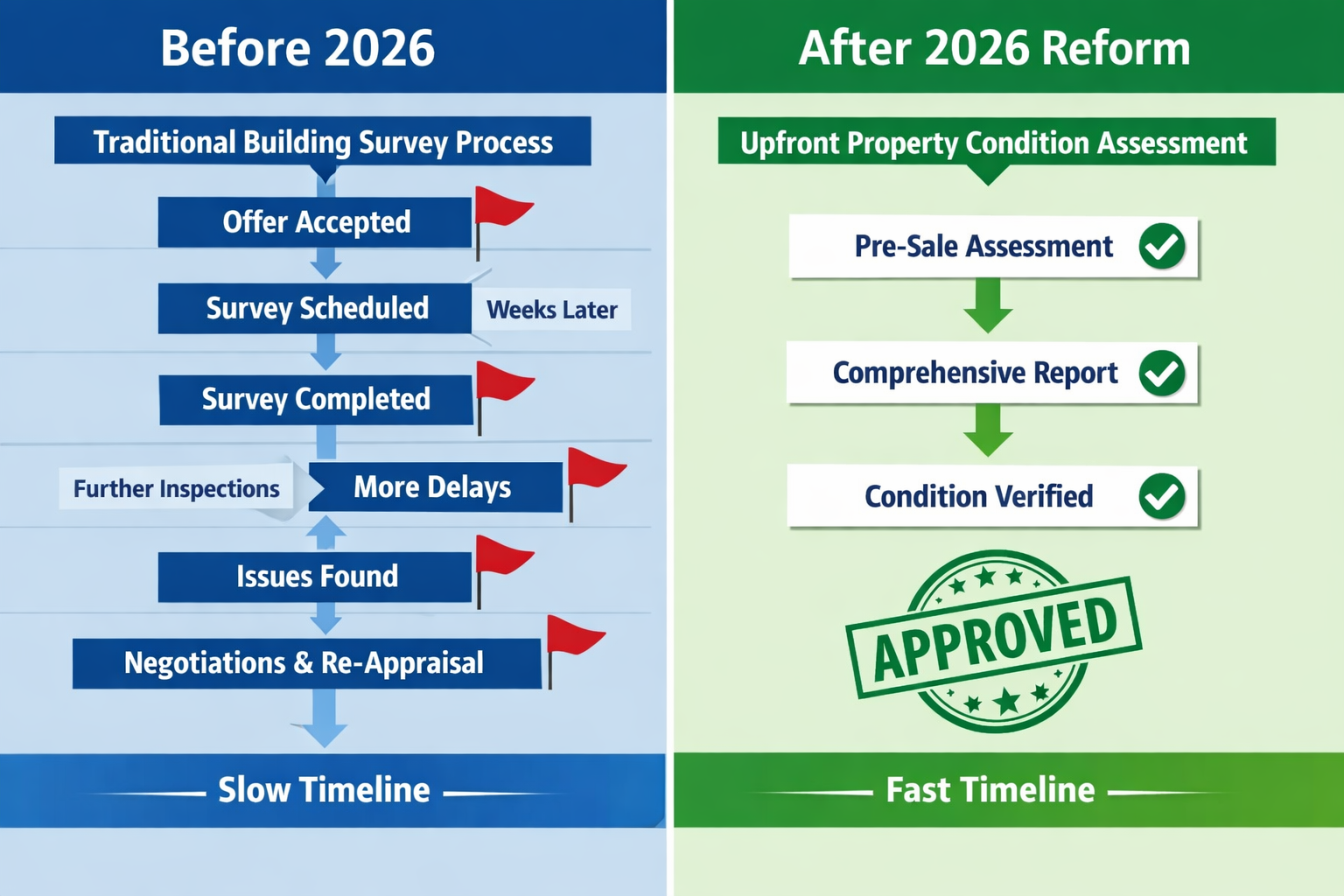
The traditional UK property transaction model places the survey after offer acceptance — typically 2–4 weeks into a process that can take 3–6 months. Under the emerging upfront assessment model, condition data needs to be available before or at the point of offer, so that lenders, buyers, and sellers all enter negotiations with the same information.
This is a profound workflow change. Here is what it means in practice:
🔄 Workflow Changes for Surveyors
1. Earlier Instruction
Sellers — or their agents — will increasingly commission condition assessments before listing. Surveyors must be ready to work with vendors, not just buyers, and to produce reports that serve multiple audiences.
2. Standardised Report Formats
Lenders need reports that map directly onto their checklist requirements. A narrative building survey written for a homebuyer is not the same as a lender-ready Property Condition Assessment. Surveyors will need to offer dual-format reporting or purpose-built PCA templates.
3. Faster Turnaround Times
When condition data is a gateway requirement rather than a post-offer formality, delays in survey delivery directly delay mortgage approval. The market will reward surveyors who can deliver within 5–7 working days of instruction.
4. Reserve Study Integration
For multi-unit buildings, surveyors will increasingly be expected to either produce or closely coordinate with reserve study providers. Understanding long-term capital expenditure needs — not just current defects — becomes a core competency.
5. Digital and AI-Assisted Tools
The promotion of desktop and hybrid appraisals [7] means surveyors must become fluent in AI-assisted valuation platforms, thermal imaging data integration, and digital report delivery. Those who resist these tools risk being bypassed for lower-risk transactions.
For buyers navigating this new landscape, knowing what to do before an RICS home survey is more important than ever — preparation on both sides of the transaction reduces delays.
The Impact on Buyers, Sellers, and the Transaction Process
For Buyers 🏠
The upfront assessment model is, in many ways, better for buyers. Receiving condition data before committing to a purchase price means:
- Stronger negotiating position from the outset (see how average price reductions after a survey work in practice)
- Fewer late-stage surprises that cause transactions to collapse
- Clearer understanding of future maintenance and reserve fund obligations
- Faster mortgage approval once the condition assessment is already in the lender's hands
For Sellers 🏷️
Sellers face a more complex adjustment. Commissioning a survey before listing requires upfront investment and the willingness to disclose condition issues that might previously have remained hidden until late in the process. However, sellers who embrace this model gain:
- Faster sales cycles with fewer fall-throughs
- Credibility with buyers and lenders
- The opportunity to address defects proactively before they become negotiating leverage for buyers
For Leasehold Properties 🏢
The reforms are particularly significant for leasehold and shared ownership properties. The expanded documentation requirements for buildings over 10 units directly affect the vast majority of UK flat purchases. Buyers of leasehold properties should understand what to check before buying a leasehold property — including reserve fund health, which is now a lender requirement, not just good practice.
AI, Desktop Appraisals, and the Two-Speed Assessment Market
The Executive Order directing regulators to consider expanding AI valuation tools and reducing appraisal requirements for low-risk transactions [4] signals a bifurcation of the assessment market that surveyors must understand clearly.
Tier 1 — Streamlined / AI-Assisted:
- Low loan-to-value refinancing
- Small balance loans
- Properties with strong comparable sales data
- New builds with developer warranties
Tier 2 — Full Physical Assessment Required:
- Multi-unit buildings over 10 units
- Older properties with complex structural histories
- Properties with known or suspected defects
- Leasehold properties requiring reserve study verification
Surveyors operating in Tier 2 will face higher standards and greater scrutiny but also stronger fee justification. Those who can produce comprehensive condition survey reports that satisfy lender checklist requirements will command premium positioning in the market.
The risk for the profession is that Tier 1 transactions — which currently generate significant survey volume — migrate toward automated valuation models. Surveyors who do not develop expertise in lender-grade PCA reporting may find their addressable market shrinking.
Practical Steps: Adapting to the New Standard

Whether operating as an independent chartered surveyor or within a larger practice, the steps below represent the most effective adaptation strategy for the 2026 landscape.
✅ Action Plan for Surveyors
-
Develop a lender-ready PCA template — Map your existing report structure against Fannie Mae's Full Review checklist and RICS guidance. Identify gaps, particularly around reserve fund commentary and structural system condition ratings.
-
Build relationships with reserve study providers — For multi-unit buildings, position your practice as a coordinator of the full documentation package, not just the physical inspection component.
-
Invest in digital delivery infrastructure — Lenders expect structured data, not just PDF narratives. Explore platforms that allow condition ratings to be exported in standardised formats.
-
Reduce turnaround times — Audit your current workflow. Where are the delays? Scheduling, report writing, or quality review? Each bottleneck becomes a competitive disadvantage in an upfront assessment model.
-
Train on AI valuation tool outputs — Understanding how automated valuation models reach their conclusions allows surveyors to identify where physical inspection adds irreplaceable value — and to articulate that clearly to clients and lenders.
-
Communicate proactively with clients — Buyers and sellers need to understand what to do when a property offer has been accepted in this new environment, including why upfront assessment data may already be available and how to use it.
For those unsure where to start, working with a qualified local surveyor who already understands lender requirements in your area is the most efficient first step.
Regional Considerations: London and South East
The reforms have particular resonance in London and the South East, where the proportion of leasehold flats in multi-unit buildings is significantly higher than the national average. Buildings over 10 units — the threshold that triggers mandatory Full Review — account for a substantial share of the housing stock in areas such as Islington, Battersea, Clerkenwell, and Notting Hill.
Surveyors operating in these markets will feel the impact of the reforms earliest and most acutely. The combination of high transaction values, complex building structures, and active lender scrutiny means that lender-grade condition assessments will become a standard expectation rather than an exceptional request within the next 12–18 months.
Practices already offering building condition assessments with structured, lender-compatible reporting are best placed to capture this demand.
Conclusion: The Profession Must Move First
The direction of travel is unambiguous. Property Condition Assessments as Standard Upfront Requirements: How 2026 Lending Reforms Will Transform Building Survey Practices is not a speculative future scenario — it is an active regulatory reality, with hard implementation dates already in place for the US market and strong directional signals for the UK.
Surveyors who treat this as an administrative inconvenience will find themselves outpaced by practices that have redesigned their service offerings around lender requirements. Those who move proactively — developing PCA templates, shortening turnaround times, integrating reserve study coordination, and building fluency in AI-assisted valuation tools — will find that the reforms create significant new demand for high-quality physical assessment expertise.
Your Next Steps 🚀
- If you are a surveyor: Audit your current report formats against lender Full Review checklists this month. Identify the gaps and build a roadmap to close them before demand peaks.
- If you are a buyer: Ask your surveyor whether their report format will satisfy your lender's documentation requirements upfront — do not wait until post-offer to find out.
- If you are a seller: Consider commissioning a condition assessment before listing. The upfront cost is modest compared to the risk of a late-stage transaction collapse.
- If you manage a residential building: Review your reserve fund position now. The baseline funding method is gone, and lenders will be checking.
The buildings have not changed. The standards being applied to them have. That is the opportunity.
References
[1] Fannie Mae's 2026 Condo Lending Changes: Simpler Processes, Higher Standards – https://www.pkfod.com/insights/fannie-maes-2026-condo-lending-changes-simpler-processes-higher-standards/
[2] 2026 Fannie Freddie Condo Requirements – https://eclipsecommunities.com/2026-fannie-freddie-condo-requirements/
[3] Fair Lending Update – https://www.ncontracts.com/nsight-blog/fair-lending-update
[4] Executive Order Seeks To Promote Mortgage Lending By Community And Smaller Banks Through Easing Regulatory Requirements – https://www.consumerfinancemonitor.com/2026/03/17/executive-order-seeks-to-promote-mortgage-lending-by-community-and-smaller-banks-through-easing-regulatory-requirements/
[5] ABA Mortgage Advocacy Update April 16 2026 – https://bankingjournal.aba.com/2026/04/aba-mortgage-advocacy-update-april-16-2026/
[6] 2026 Market Update: Appraisal Volume, Waivers And PDCs – https://www.workingre.com/2026-market-update-appraisal-volume-waivers-and-pdcs/
[7] Analysis Of The Executive Order On Mortgage Access – https://www.bakerdonelson.com/analysis-of-the-executive-order-on-mortgage-access
[8] Navigating Foreclosure Landscape – https://www.nationwideamc.com/blog/navigating-foreclosure-landscape
[9] Fannie Mae Single-Family Guidelines – https://singlefamily.fanniemae.com/media/44986/display
[10] Mortgage Market Reset 2026 – https://foundationmortgage.com/mortgage-market-reset-2026/