
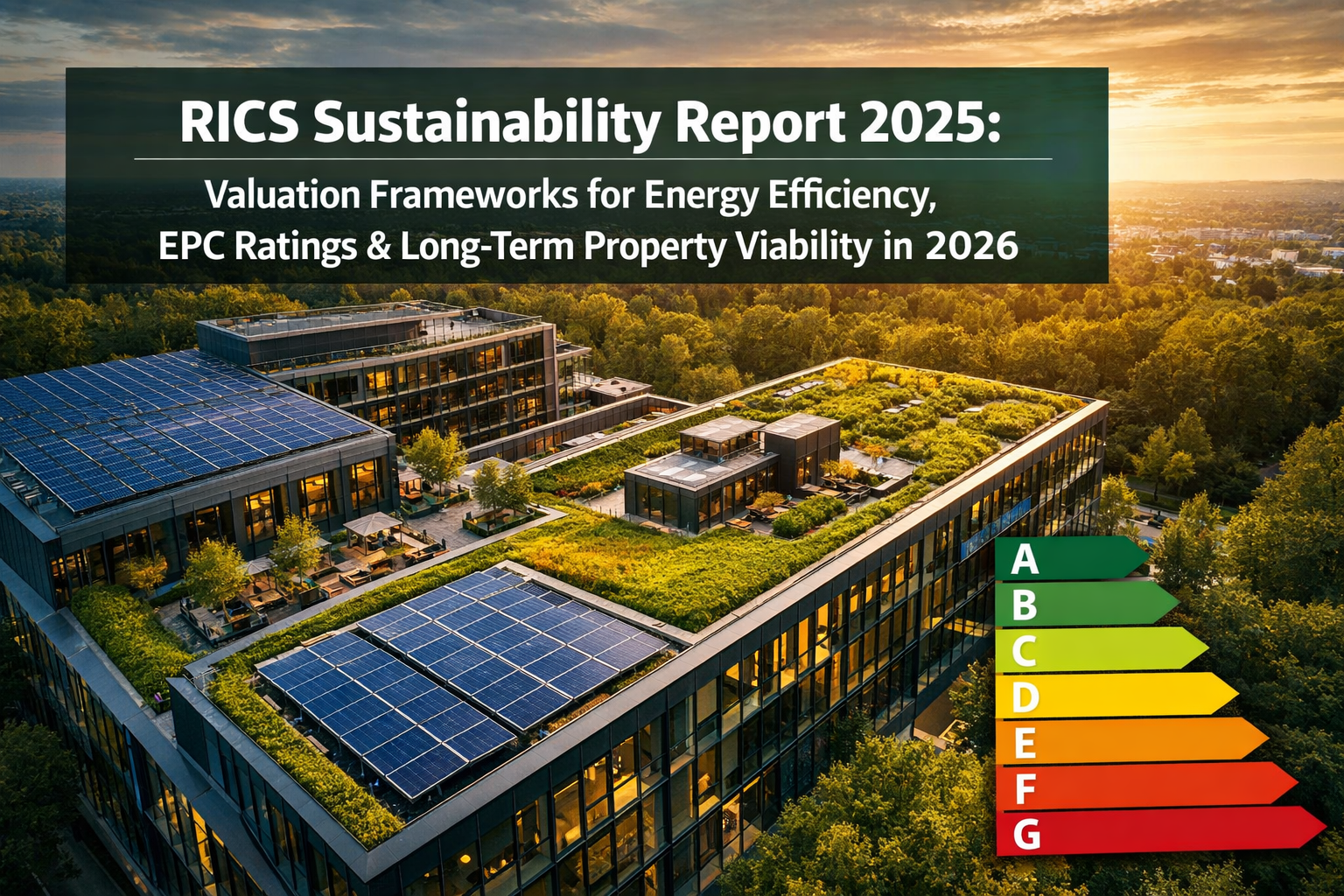
Only 43% of UK professionals report growing demand for green buildings — yet that figure places the United Kingdom second globally, behind only the Middle East and Africa. The RICS Sustainability Report 2025: Valuation Frameworks for Energy Efficiency, EPC Ratings, and Long-Term Property Viability in 2026 lands at a pivotal moment: momentum for sustainable property practices is measurably stalling, even as regulatory pressure intensifies and a landmark new ESG valuation standard takes effect. For surveyors, investors, and property owners, understanding this report is no longer optional — it is a professional obligation. [1]
Key Takeaways 📌
- The RICS Sustainable Building Index (SBI) remains positive but shows clear signs of stalling momentum across global markets [1]
- High upfront costs and a lack of clear ROI evidence are the two biggest barriers blocking green building investment [1]
- The RICS 4th Edition ESG Standard for commercial property valuation becomes mandatory from 30 April 2026, requiring compliance from all MRICS and FRICS valuers [4]
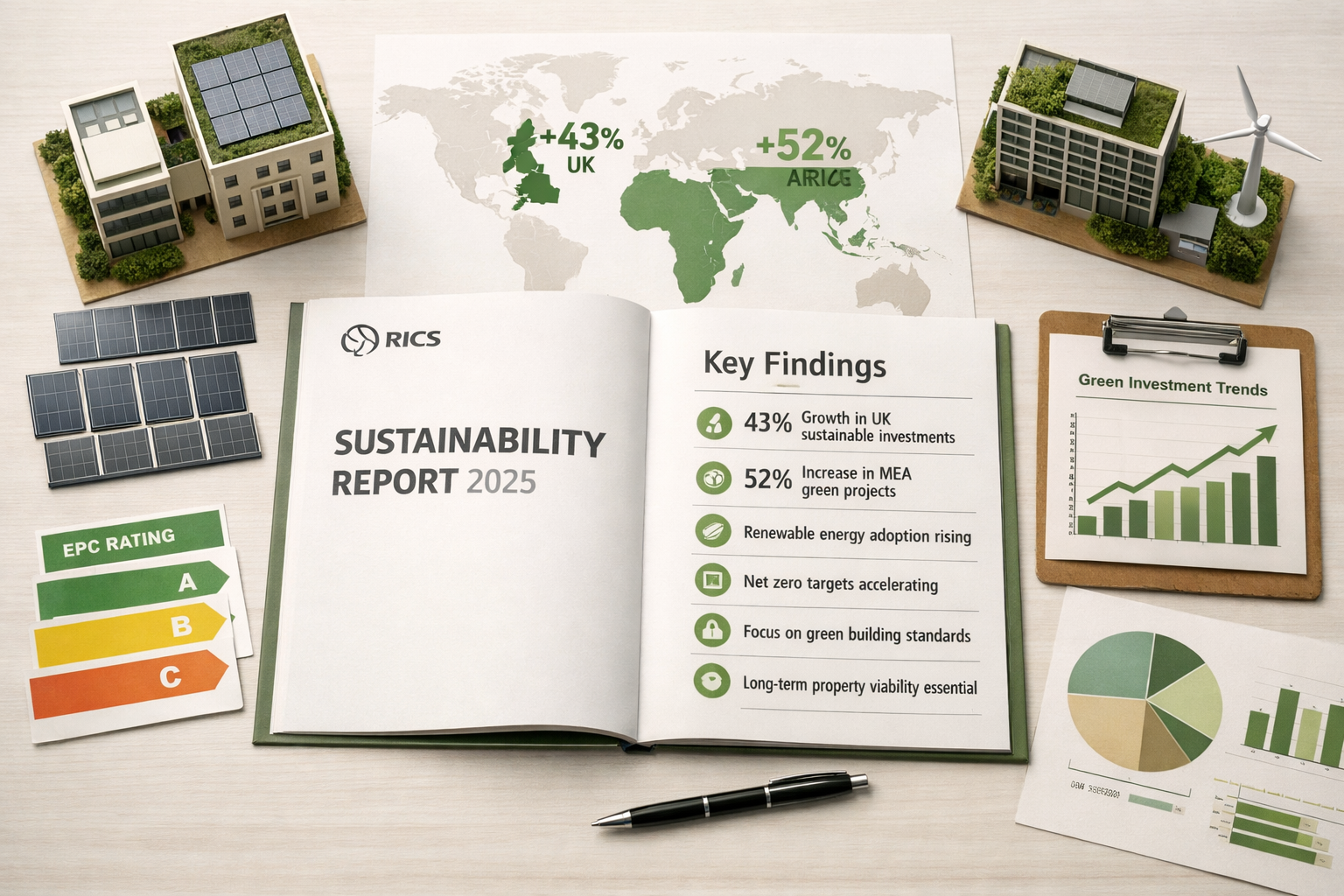
- The UK ranks second globally for green building demand growth at +43%, behind MEA at +52% [1]
- Surveyors must now integrate EPC data, thermal efficiency assessments, and net-zero retrofit potential directly into building surveys and valuation adjustments
What the RICS Sustainability Report 2025 Actually Found
The 2025 report drew on responses from over 3,500 professionals across commercial real estate and construction worldwide — making it one of the most comprehensive surveys of its kind. The findings paint a nuanced picture: the industry is moving in the right direction, but far too slowly. [1]
The Sustainable Building Index: Positive But Stalling
The RICS Sustainable Building Index (SBI) — the report's headline metric — remains in positive territory, meaning more professionals report increasing rather than decreasing sustainable activity. However, the report is explicit that momentum is stalling. The sector remains largely static in adopting sustainable practices, with adoption rates falling short of what climate targets demand. [1]
💬 "The sector remains largely stagnant in adopting sustainable practices, indicating slower adoption rates than anticipated." — RICS Sustainability Report 2025 [1]
This stagnation matters enormously for property valuers. When market adoption slows, the green premium — the additional value attributed to high-performing, energy-efficient buildings — becomes harder to evidence and quantify. That creates real challenges for surveyors trying to reflect sustainability factors in formal valuations.
Regional Breakdown: Where Green Demand Is Growing
The report reveals striking regional variation in green building demand growth:
| Region | Demand Growth for Green Buildings |
|---|---|
| 🌍 Middle East & Africa (MEA) | +52% |
| 🇬🇧 United Kingdom | +43% |
| 🇪🇺 Europe | +39% |
| 🌏 Asia Pacific | +27% |
| 🌎 Americas | +11% |
The UK's position at +43% is significant. It suggests that despite broader stagnation, British property markets are experiencing real and growing appetite for sustainable assets. For surveyors operating across London and the South East — from Westminster to Islington — this demand shift is already influencing buyer behaviour and lender requirements. [1]
The Barriers Holding the Market Back
Three core obstacles are slowing sustainable adoption: [1]
- High upfront costs — The single biggest barrier. Retrofit works, insulation upgrades, and renewable energy installations carry significant capital costs that many landlords and developers are reluctant to absorb.
- Lack of clear ROI evidence — Without robust comparable data showing that green buildings command measurable premiums, investment decisions stall.
- Insufficient investor awareness and limited client demand — Many buyers and tenants still do not prioritise sustainability credentials when making property decisions.
These barriers are interconnected. Without demand, there is no premium. Without a premium, there is no ROI evidence. Without ROI evidence, investment does not follow. Breaking this cycle requires both market education and policy intervention — the latter being a key recommendation from RICS itself. [1]
EPC Ratings, Thermal Efficiency, and the Valuer's New Toolkit
The RICS Sustainability Report 2025: Valuation Frameworks for Energy Efficiency, EPC Ratings, and Long-Term Property Viability in 2026 is not just a market sentiment survey. It directly informs how surveyors should approach their work — particularly in assessing Energy Performance Certificate (EPC) ratings and their impact on long-term asset value.
Why EPC Ratings Now Matter More Than Ever
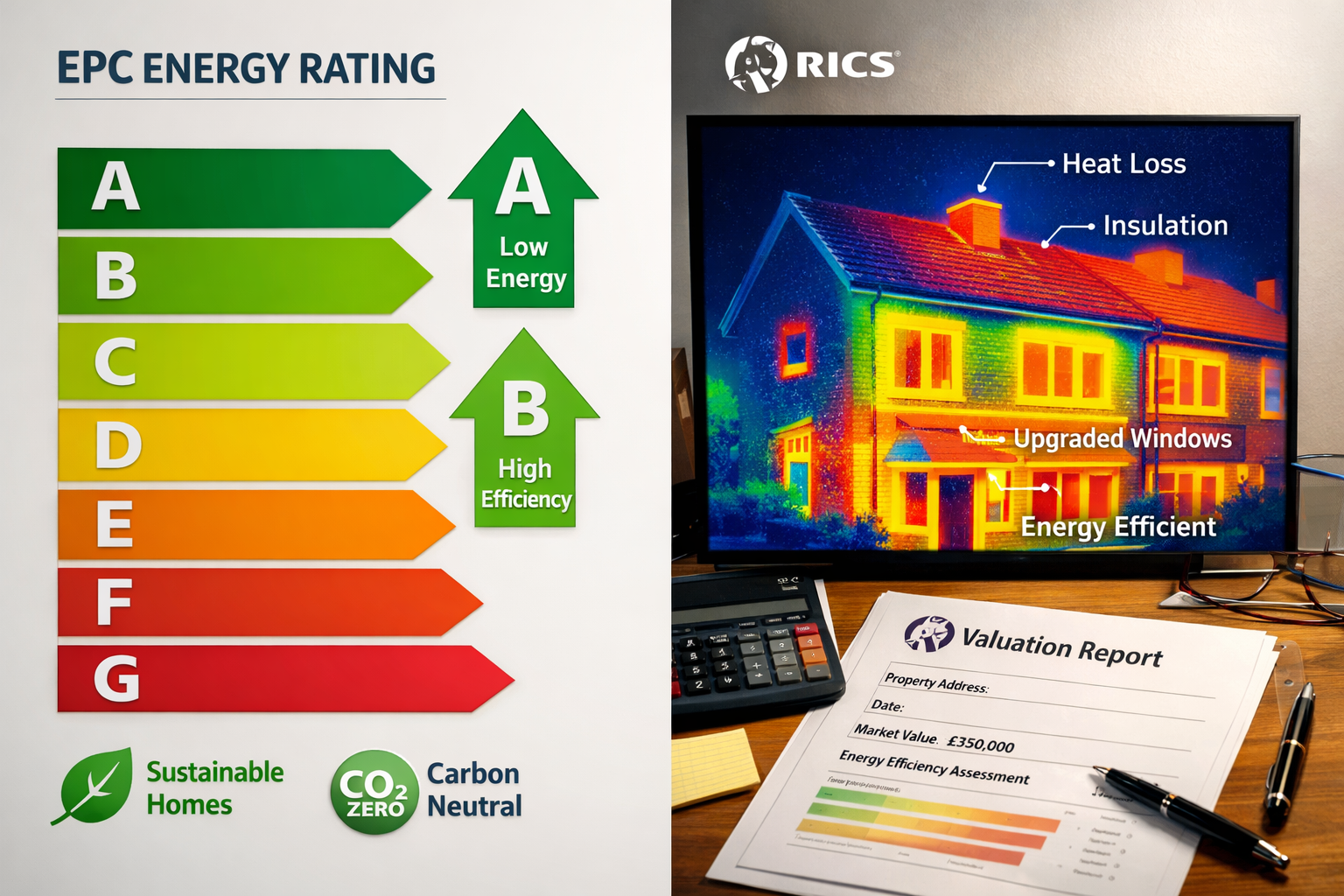
EPC ratings have shifted from a compliance checkbox to a core valuation input. In 2026, the regulatory landscape is tightening considerably:
- Minimum Energy Efficiency Standards (MEES) continue to evolve, with proposed requirements pushing minimum EPC ratings upward for both commercial and residential lettings
- Mortgage lenders are increasingly applying EPC-linked lending criteria, meaning lower-rated properties face reduced loan-to-value ratios or higher interest rates
- The RICS 4th Edition ESG Standard, effective from 30 April 2026, explicitly requires valuers to consider how energy performance and sustainability factors affect market value [4]
For buyers and sellers, this means a property's EPC rating is no longer just about energy bills — it directly affects saleability, mortgageability, and long-term capital value.
Integrating Thermal Efficiency Assessments
Beyond the EPC certificate itself, the updated RICS framework encourages surveyors to go deeper. A standard EPC provides a snapshot based on modelled performance, but thermal imaging and physical condition assessments offer far more granular data.
When commissioning a RICS property valuation or a full building survey, surveyors should now consider:
- Thermal bridging — Areas where heat escapes through structural junctions, often invisible without specialist equipment
- Insulation quality — Loft, wall, and floor insulation conditions that affect real-world energy performance
- Glazing standards — Double or triple glazing specifications and their contribution to heat retention
- Heating system efficiency — Boiler age, heat pump compatibility, and controls
These factors feed directly into assessments of net-zero retrofit potential — a concept the RICS framework increasingly treats as a material valuation consideration.
Net-Zero Retrofit Potential as a Valuation Factor
The concept of retrofit potential is emerging as a key differentiator between assets. A Victorian terrace with solid walls, no loft insulation, and a gas boiler faces a very different retrofit journey — and cost — than a 1990s semi-detached with cavity walls and a modern condensing boiler.
Surveyors conducting RICS surveys are increasingly expected to flag:
- Estimated cost ranges for bringing a property to EPC Band C or above
- Structural suitability for heat pump installation
- Roof condition and orientation for solar panel viability
- Any planning constraints affecting external insulation or glazing upgrades
This information helps buyers make informed decisions about long-term running costs and future capital expenditure — and helps valuers justify any sustainability-related adjustments to market value.
The RICS 4th Edition ESG Standard and Long-Term Property Viability in 2026
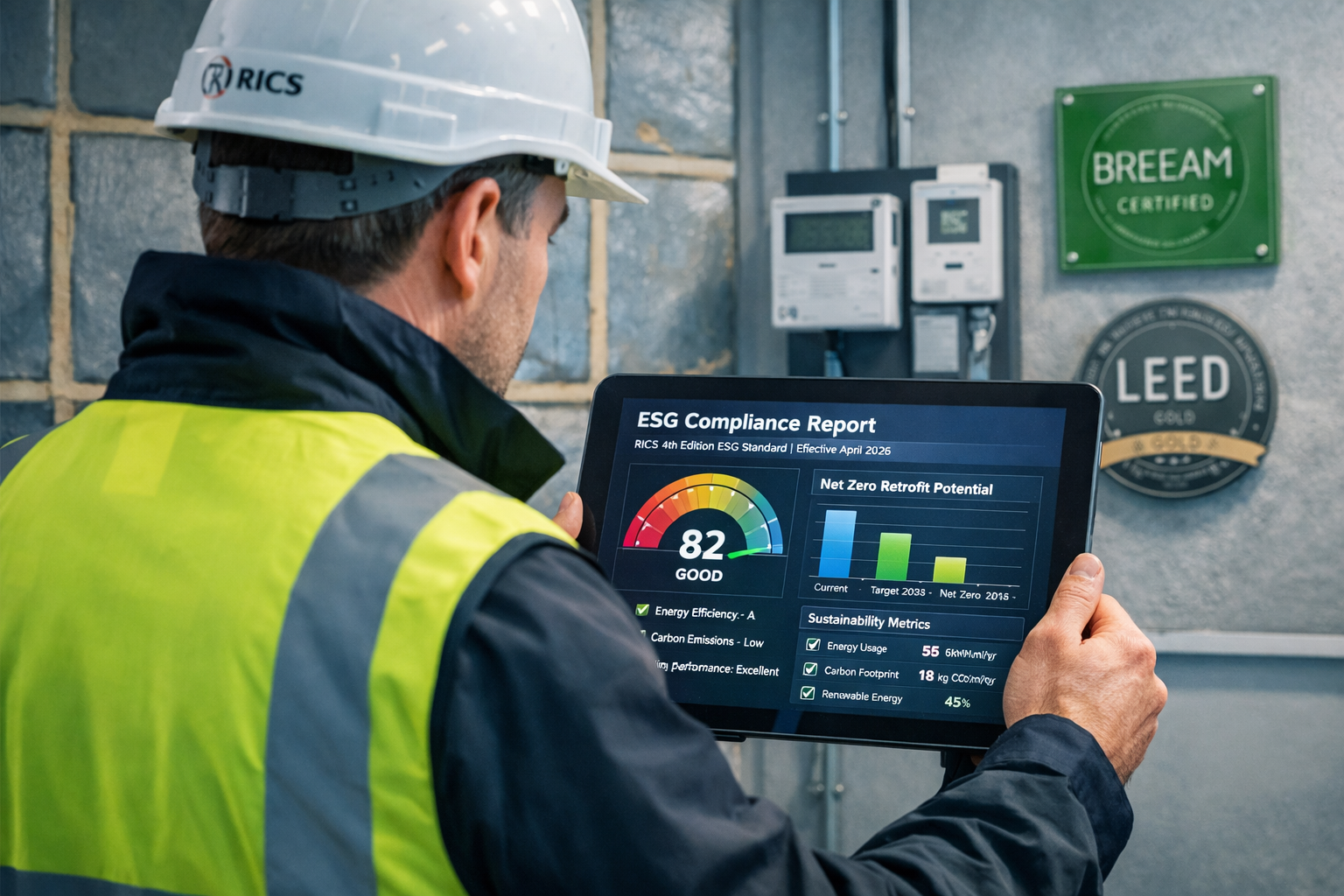
The most significant regulatory development flowing from the RICS Sustainability Report 2025: Valuation Frameworks for Energy Efficiency, EPC Ratings, and Long-Term Property Viability in 2026 context is the mandatory implementation of the RICS 4th Edition Professional Standard on Sustainability and ESG in Commercial Property Valuation, effective 30 April 2026. [4]
What the 4th Edition ESG Standard Requires
This updated standard is not guidance — it is mandatory compliance for all MRICS and FRICS valuers operating in commercial property. It must align with both the Red Book (RICS Valuation – Global Standards) and the International Valuation Standards (IVS). [4]
Key requirements include:
- Explicit consideration of ESG factors — Environmental, social, and governance factors must be assessed for their impact on value, not simply noted as background context
- Documentation of sustainability data — Valuers must record what ESG information was available, what was requested from clients, and how it influenced (or did not influence) the valuation
- Transparency on data gaps — Where sustainability data is absent or unreliable, this must be flagged clearly in the valuation report
- Consistency with market evidence — ESG adjustments must be grounded in comparable transaction evidence where available
For those working with commercial assets — whether in Southwark, Newham, or beyond — this standard fundamentally changes the scope of a compliant valuation.
Why Long-Term Viability Is Now a Core Concern
The concept of long-term property viability sits at the heart of the updated RICS framework. A building that cannot meet future EPC requirements, that faces prohibitive retrofit costs, or that carries significant stranded asset risk is not simply a lower-value property today — it may become unlettable or unmortgageable within a defined regulatory timeframe.
This is why the RICS report recommends that government intervene through: [1]
- Defining clear decarbonisation pathways for the built environment
- Mandating carbon assessment reporting as part of standard property transactions
- Driving green building investment through fiscal incentives
- Scaling biodiversity measures alongside energy efficiency requirements
Until these policy frameworks are fully in place, surveyors carry the responsibility of flagging viability risks that the market may not yet be pricing correctly.
Practical Implications for Property Buyers and Investors
For anyone buying, selling, or investing in property in 2026, the sustainability landscape has concrete financial implications:
🏠 Residential buyers should:
- Request EPC certificates and check the current rating and the potential rating
- Ask surveyors to comment on retrofit costs in their homebuyers report or building survey
- Factor in potential future MEES compliance costs when negotiating purchase price
🏢 Commercial investors should:
- Ensure all valuations comply with the RICS 4th Edition ESG Standard from April 2026 [4]
- Commission ESG due diligence reports alongside standard valuations
- Assess tenant lease terms in relation to future EPC minimum requirements
🔨 Landlords and developers should:
- Prioritise retrofit planning now to avoid last-minute compliance costs
- Explore government grant schemes for energy efficiency improvements
- Work with RICS-qualified surveyors to understand the value impact of planned improvements
Understanding why RICS surveyors matter in this context is straightforward: only qualified professionals can provide the compliant, evidence-based assessments that lenders, investors, and regulators now require.
Policy Recommendations and the Road Ahead
The RICS Sustainability Report 2025 is clear that market forces alone will not deliver the pace of change required. The recommendations directed at government are pointed and specific: [1]
- Establish mandatory carbon assessment reporting as part of property transactions
- Create defined decarbonisation pathways that give the industry long-term certainty
- Use fiscal policy — grants, tax incentives, and green finance mechanisms — to reduce the upfront cost barrier
- Expand biodiversity net gain requirements alongside energy efficiency standards
These recommendations echo what many in the surveying profession have argued for years: without regulatory clarity, the market will default to inertia.
For property professionals conducting commercial property inspections, the practical message is clear. Sustainability is no longer a specialist add-on — it is a core component of professional competence in 2026 and beyond.
Conclusion: Actionable Next Steps for 2026
The RICS Sustainability Report 2025: Valuation Frameworks for Energy Efficiency, EPC Ratings, and Long-Term Property Viability in 2026 delivers a frank assessment: the profession is moving, but not fast enough. The introduction of the mandatory 4th Edition ESG Standard from April 2026 raises the bar for every RICS-qualified valuer, while the UK's strong +43% green demand growth signals that the market is ready for leadership.
Here is what to do now:
✅ Buyers: Always request a full building survey that addresses EPC ratings, thermal performance, and retrofit potential before exchanging contracts
✅ Investors: Ensure all commercial property valuations from April 2026 onwards explicitly comply with the RICS 4th Edition ESG Standard [4]
✅ Landlords: Audit your portfolio against current and projected MEES requirements and budget for retrofit works
✅ Surveyors: Integrate sustainability data collection into every instruction — document what is available, what is missing, and how it affects value
✅ Developers: Design for long-term viability from the outset, targeting EPC Band A or B as a minimum standard
The properties that will hold and grow their value over the next decade are those that can demonstrate genuine energy efficiency, low carbon credentials, and adaptability to a net-zero future. The RICS framework now provides the tools to assess exactly that. The question is whether the market will use them with the urgency the moment demands.
References
[1] Sustainability Report 2025 – https://www.rics.org/news-insights/current-topics-campaigns/sustainability/sustainability-report-2025
[2] Sustainability Report 2025 – https://www.rics.org/content/dam/ricsglobal/documents/reports/Sustainability-report-2025.pdf
[3] Sustainability Report 2025 Infographic – https://www.rics.org/content/dam/ricsglobal/documents/reports/Sustainability-Report-2025-Infographic.pdf
[4] Watch – https://www.youtube.com/watch?v=wZ_XlcVSTRM