
Consumer sentiment hit its lowest point in recorded history in April 2026 — a University of Michigan reading of 47.6, falling below even the depths of the 2008 financial crisis [7]. For property professionals, that single statistic reframes everything about how building surveys should be positioned, communicated, and delivered right now. The theme of Market Caution and Building Survey Certainty: How Surveyors Can Position Professional Expertise Against AVMs in Spring 2026's Uncertain Lending Environment is not a niche concern — it is the central strategic question facing every RICS-qualified surveyor operating in the UK market this spring.
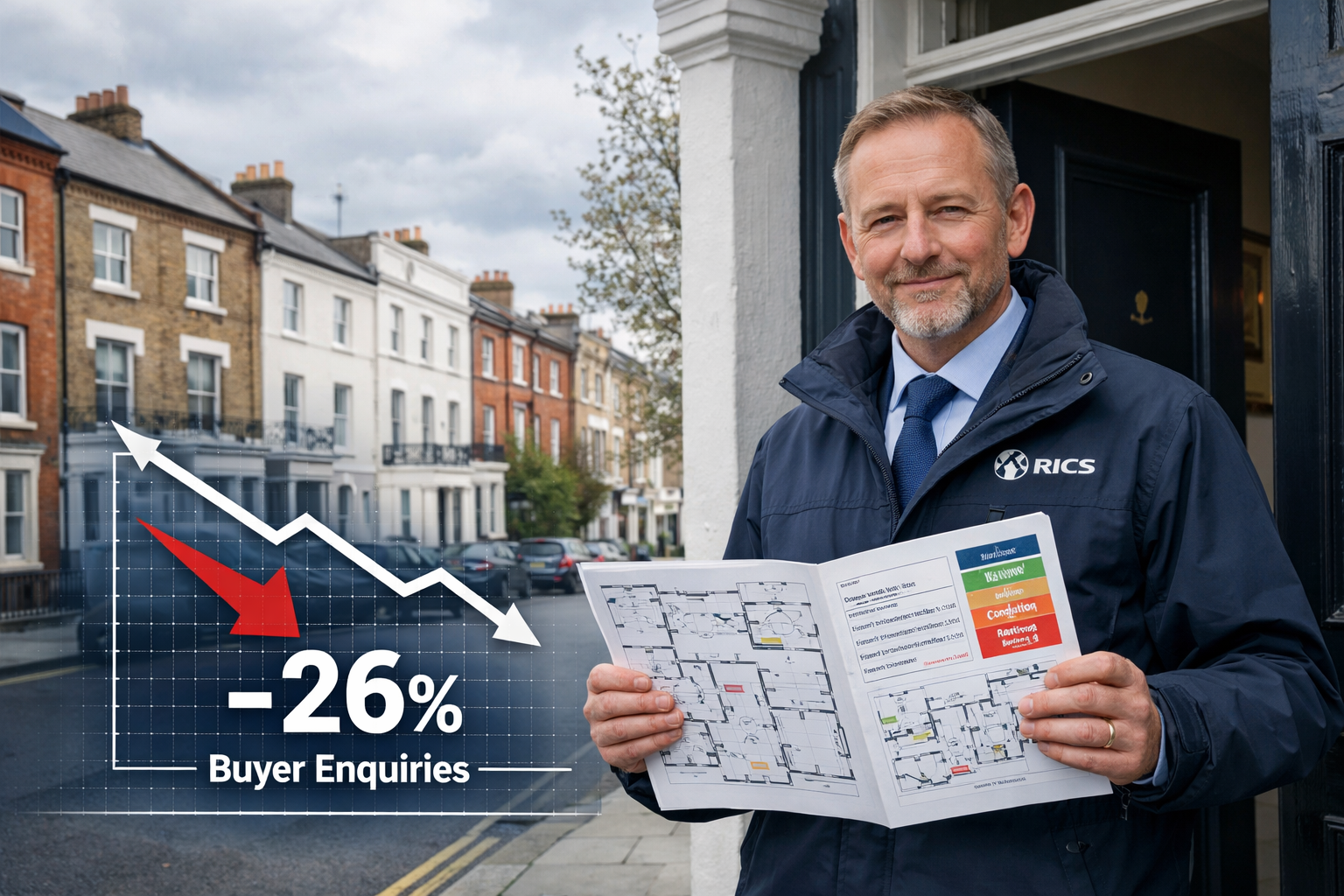
Buyer enquiries have dropped -26% nationally [6], lenders are tightening risk tolerances, and automated valuation models (AVMs) are being exposed as dangerously inadequate in a market defined by regional price divergence and macroeconomic volatility. This is the moment when professional surveyors can — and must — articulate their irreplaceable value.
Key Takeaways 📋
- Consumer sentiment is at an all-time low (47.6 in April 2026), creating a cautious transaction environment where professional risk assessment is more critical than ever [7].
- Buyer enquiries are down 26%, meaning every transaction that does proceed carries higher stakes — and demands more rigorous property due diligence [6].
- AVMs cannot apply macroeconomic adjustments for geopolitical risk, interest rate volatility, or regional price divergence — professional surveyors can and must [8].
- Mortgage rate uncertainty (forecasts ranging from below 6% to 6.5%) creates valuation complexity that only qualified professionals can navigate with appropriate judgment [2].
- Surveyors who clearly communicate their AVM advantage will win more instructions, support lender confidence, and protect clients in a market where errors carry serious financial consequences.
Understanding Spring 2026's Cautious Market Landscape
The property market entering spring 2026 is unlike anything seen in recent cycles. It is not a crash, but it is not a rebound either. The most accurate description — borrowed from Canada's housing commentary — is a "reset market" [5]. Prices have stabilised but momentum is absent. Confidence is fragile. And the gap between what sellers expect and what buyers will pay has widened considerably.
Several converging forces are driving this caution:
🌍 Geopolitical and Economic Headwinds
The onset of conflict in Iran on 28 February 2026 triggered a wave of geopolitical uncertainty that rippled through global financial markets throughout March [3]. This was not a localised shock — it affected energy prices, inflation expectations, and investor risk appetite simultaneously. For property markets, the knock-on effect was immediate: new home market activity softened, and buyers who had been on the cusp of committing pulled back.
Homebuilders in the US — a reliable leading indicator for broader market sentiment — responded by restructuring their development strategies. The 2026 Homebuilder Executive Outlook Survey described a market "navigating demand uncertainty with caution rather than exuberance" [1]. That phrase resonates equally in the UK context.
💷 Mortgage Rate Complexity
Mortgage rates hovering around 6% are lower than mid-2025 peaks, which technically improves purchasing power compared to 2023–2024 [2]. But lower rates alone do not restore confidence when the direction of travel is uncertain. The Mortgage Bankers Association sees 2026's rate zone as 6–6.5%, while the National Association of REALTORS® and Fannie Mae forecast modest declines [2]. This disagreement among major institutions creates exactly the kind of valuation complexity that AVMs cannot resolve.
📉 The -26% Buyer Enquiry Collapse
Perhaps the most significant data point for surveyors is the -26% national decline in buyer enquiries in spring 2026 [6]. Fewer transactions mean higher stakes per transaction. When buyers do commit, they are doing so with far greater scrutiny. Lenders are applying tighter due diligence. And the tolerance for valuation error — on either side — has shrunk dramatically.
💬 "In a market where only the most motivated buyers are transacting, every single survey instruction represents a client who needs certainty more than ever before."
The AVM Gap: Why Automated Valuation Models Fall Short in 2026
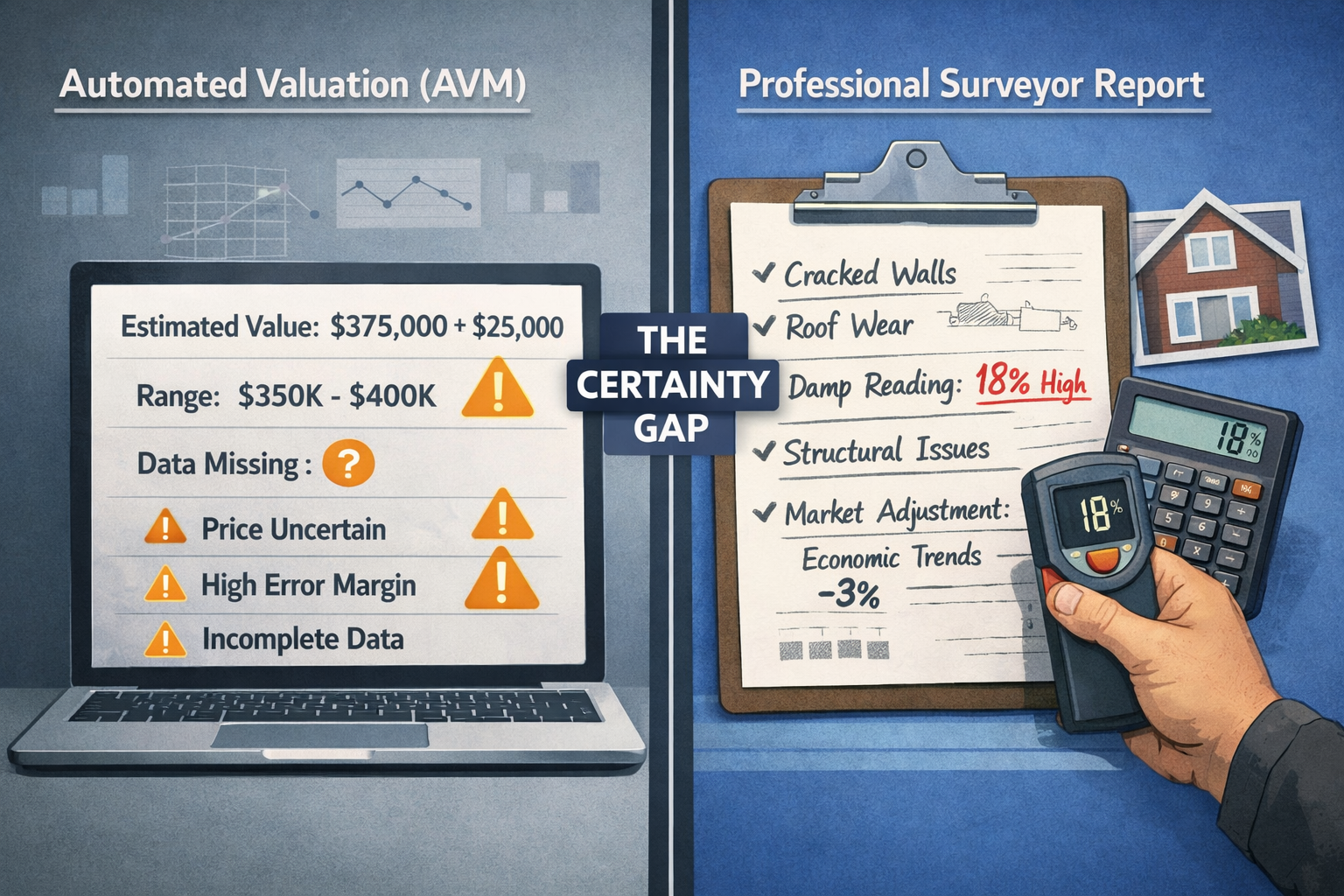
The case for professional building surveys has never been stronger — but surveyors need to articulate it clearly and specifically. The argument is not simply that "humans are better than computers." It is far more precise than that.
What AVMs Actually Do (and Don't Do)
Automated valuation models work by analysing comparable sales data, applying statistical weighting, and generating a price estimate. In a stable, data-rich market with consistent transaction volumes, they can be reasonably accurate for standard properties. But spring 2026 is not that market.
Here is where AVMs structurally fail:
| AVM Limitation | Spring 2026 Impact |
|---|---|
| Cannot inspect physical condition | Damp, structural movement, roofing defects go undetected |
| Relies on historic comparable data | -26% buyer enquiry decline means thin, unrepresentative comparables [6] |
| Cannot apply geopolitical risk adjustments | Iran conflict impact on sentiment is invisible to algorithms [3] |
| Cannot model regional price divergence | Urban vs. suburban splits are missed or averaged out [6] |
| Cannot caveat for interest rate uncertainty | 6%–6.5% rate range creates capitalization rate volatility [2][4] |
| No professional judgment on yield assumptions | Macroeconomic adjustments require explicit professional reasoning [8] |
The Macroeconomic Adjustment Imperative
Professional building surveyors are required — by both RICS standards and professional duty of care — to apply explicit adjustments to yield assumptions, comparable weighting, and caveat language when macroeconomic indicators show volatility [8]. This is not optional. It is a fundamental part of what separates a professional valuation from an algorithmic output.
Overall capitalisation rates have remained relatively stable at around 6.10% according to CoStar data [4], but that headline stability masks significant underlying volatility. A surveyor who understands this can communicate appropriate uncertainty ranges and protect their client. An AVM simply outputs a number.
For buyers in areas like London's diverse property market, where Victorian terraces sit alongside modern conversions and leasehold complexities abound, this distinction is especially critical. Understanding what to check before buying a leasehold property — something no AVM can assess — is just one example of where professional expertise delivers irreplaceable value.
Regional Price Divergence: The AVM Blind Spot
Home price growth in spring 2026 is sluggish and highly localised [2][6]. The national average masks enormous variation between micro-markets. A property in one London borough may be holding value while a similar property two miles away faces downward pressure. AVMs trained on broader datasets smooth out these divergences — often catastrophically misrepresenting individual property values.
Surveyors operating in specific local markets — whether Wandsworth, Notting Hill, or Romford — carry hyper-local knowledge that no algorithm can replicate. That knowledge is a competitive asset. It needs to be positioned as such.
Positioning Professional Expertise: Practical Strategies for Surveyors in 2026
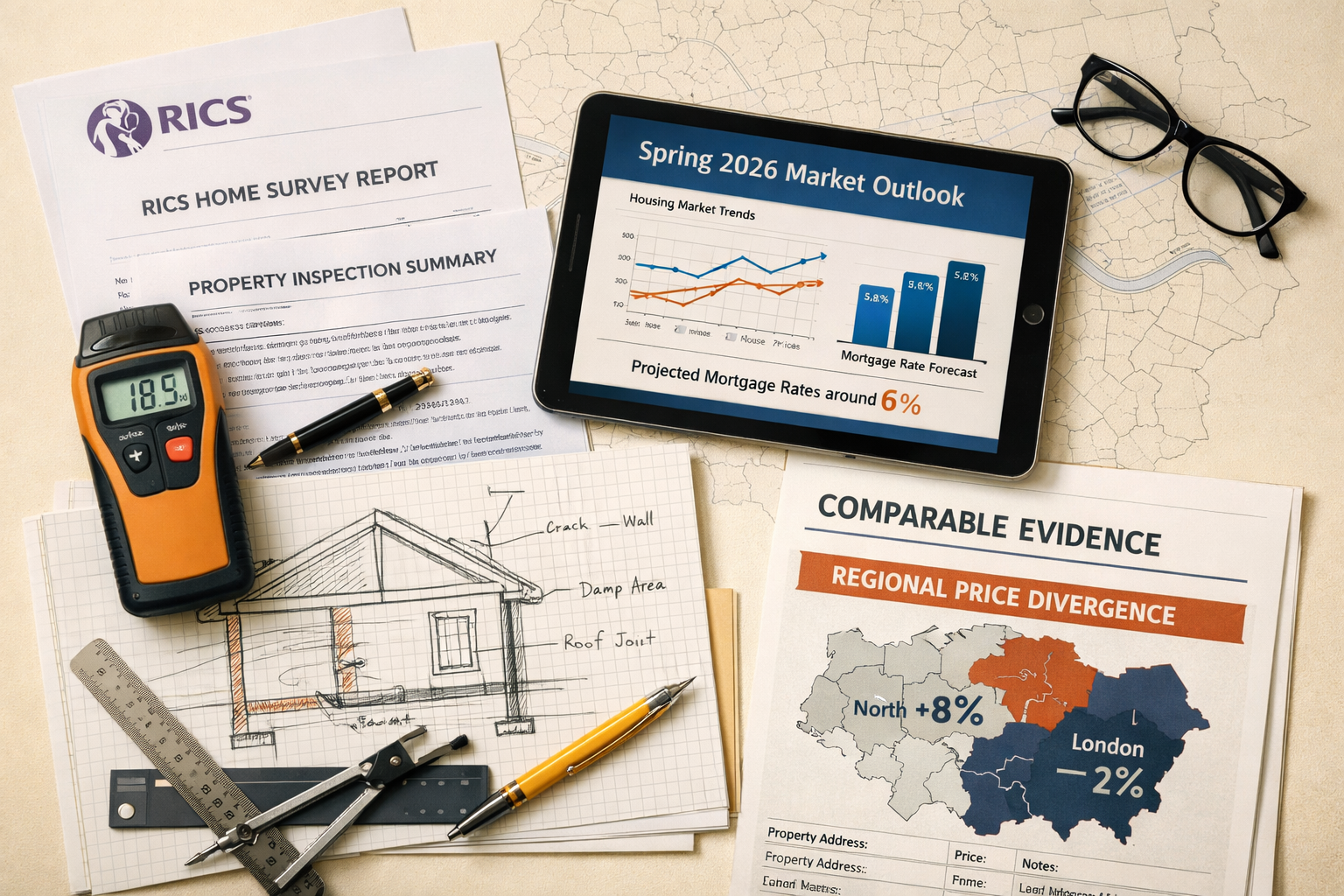
Understanding the market caution and building survey certainty dynamic is one thing. Translating it into a clear value proposition — one that wins instructions and supports lenders — is another. Here are the most effective positioning strategies for spring 2026.
1. 🎯 Lead With Risk Language, Not Technical Language
Clients in a cautious market are not primarily motivated by technical expertise. They are motivated by risk reduction. Frame every survey conversation around what the client stands to lose without professional assessment.
Instead of: "We conduct a Level 3 Building Survey with full structural analysis."
Try: "In a market where buyer enquiries are down 26% and lenders are tightening risk criteria, our survey identifies the issues that could collapse your transaction — or cost you tens of thousands in remediation after completion."
The homebuyers report versus building survey decision is one of the first conversations surveyors have with clients. In spring 2026, that conversation should start with market context, not product specifications.
2. 📊 Quantify the AVM Failure Rate in Your Local Market
Surveyors who track their own data have a powerful tool. If a surveyor can demonstrate — with local examples — that AVM estimates in their area have diverged significantly from post-survey agreed prices, that evidence is compelling for both buyers and lenders.
Consider building a simple one-page comparison document showing:
- AVM estimate range for a recently surveyed property type
- Actual condition-adjusted valuation after professional survey
- Key defects that the AVM could not identify (damp, subsidence, roof condition)
This kind of evidence-based positioning is far more persuasive than generic claims about professional expertise. For properties where damp surveys or structural assessments reveal hidden issues, the financial gap between AVM output and reality can be substantial.
3. 🤝 Strengthen Lender Relationships Through Explicit Macroeconomic Caveating
Lenders in spring 2026 are under pressure to demonstrate rigorous risk management. A professional survey report that explicitly addresses:
- Interest rate sensitivity of the valuation (noting the 6%–6.5% uncertainty range) [2]
- Geopolitical risk context and its impact on comparable evidence weighting [3][8]
- Regional price divergence and why national AVM benchmarks are unreliable for this specific property [6]
…is a document that lenders will value — and remember. Surveyors who consistently deliver this level of macroeconomic contextualisation will build stronger referral relationships with mortgage brokers and lenders.
Understanding why RICS surveyors are the preferred choice for professional valuations becomes especially relevant here — RICS standards mandate exactly this kind of professional judgment.
4. 🏗️ Expand the Conversation to Party Wall and Structural Risk
In a cautious market, buyers are more likely to be purchasing properties that require renovation — because competitively priced properties often need work. This creates natural opportunities to discuss party wall agreements and structural risk alongside the primary survey instruction.
A surveyor who identifies potential party wall implications during a building survey — and flags them proactively — demonstrates exactly the kind of holistic professional judgment that an AVM cannot begin to replicate.
5. 📱 Communicate Survey Value in Plain Language
Consumer sentiment at 47.6 [7] means clients are anxious. They are not in the mood for technical jargon. The most effective surveyors in spring 2026 will be those who can explain complex findings in accessible, reassuring terms.
Practical steps:
- Use condition ratings with plain-language explanations
- Include a one-page executive summary at the front of every report
- Offer a brief follow-up call to walk clients through key findings
- Provide remediation cost ranges (not just defect identification)
The condition survey report format, when delivered with clear client communication, becomes a powerful differentiator in a market where buyers are making high-stakes decisions under significant psychological pressure.
6. 🗺️ Leverage Local Market Knowledge as a Distinct Asset
With regional price divergence creating valuation complexity [6], surveyors should actively promote their local market expertise. Whether operating in Clerkenwell, Battersea, or Hounslow, the ability to contextualise a property's condition within its specific micro-market is something no national AVM can replicate.
This local expertise should be visible in:
- Website content and case studies
- Survey report introductions that reference local market conditions
- Conversations with estate agents and mortgage brokers
The Certainty Premium: Why Clients Will Pay More for Professional Surveys in 2026
There is a commercial opportunity embedded in spring 2026's uncertainty. When consumer sentiment is at historic lows and every transaction feels high-risk, certainty commands a premium. Clients who understand what is at stake will not baulk at professional survey fees — if the value is clearly communicated.
The market caution and building survey certainty equation works in surveyors' favour when positioned correctly:
- 🔴 High market uncertainty → Higher perceived risk per transaction
- 🟡 AVM limitations exposed → Lenders and buyers seek professional validation
- 🟢 Professional survey commissioned → Certainty delivered, risk quantified, transaction protected
This is not a difficult case to make. It simply requires surveyors to speak the language of risk and certainty — rather than the language of technical process.
Conclusion: Actionable Next Steps for Surveyors in Spring 2026
The convergence of all-time low consumer sentiment [7], a -26% collapse in buyer enquiries [6], geopolitical headwinds [3], and mortgage rate uncertainty [2] has created the most compelling environment in years for professional building surveyors to differentiate themselves from automated alternatives.
Market Caution and Building Survey Certainty: How Surveyors Can Position Professional Expertise Against AVMs in Spring 2026's Uncertain Lending Environment is not just a positioning exercise — it is a professional responsibility. When clients are making the most significant financial decisions of their lives in a market defined by uncertainty, they deserve the judgment, expertise, and accountability that only a qualified surveyor can provide.
✅ Immediate Actions for Surveyors
- Audit your client communication — does it lead with risk reduction or technical process?
- Build a local AVM comparison dataset — document cases where professional surveys revealed what algorithms missed.
- Update your report templates to include explicit macroeconomic context sections addressing interest rate uncertainty and regional price divergence.
- Contact two or three lender contacts this week to discuss how your survey approach addresses spring 2026's specific risk environment.
- Review your service range — are you offering the full spectrum from homebuyer surveys to full structural assessments to party wall services?
- Invest in plain-language client communication — anxious clients need reassurance as much as expertise.
The surveyors who thrive in spring 2026 will be those who understand that their greatest competitive advantage is not their technical knowledge — it is their professional judgment in a market that desperately needs it.
References
[1] Survey Reveals Demand Uncertainty Is Changing 2026 Homebuilding Strategy – https://www.housingwire.com/articles/survey-reveals-demand-uncertainty-is-changing-2026-homebuilding-strategy/
[2] Spring 2026 Housing Market Outlook – https://www.mtb.com/library/article/spring-2026-housing-market-outlook
[3] Zonda Provides New Home Market Update For March 2026 – https://www.sbcacomponents.com/media/zonda-provides-new-home-market-update-for-march-2026
[4] Portland Multifamily Market Shows Signs Of Stabilization As Suburban Markets Lead Recovery – https://www.hfore.com/portland-multifamily-market-shows-signs-of-stabilization-as-suburban-markets-lead-recovery/
[5] 2026 Spring Market A Slow Thaw – https://thefishergroup.ca/blog/2026-spring-market-a-slow-thaw
[6] Building Survey Risk Assessment In Spring 2026s Cautious Market Adjusting For 26 Buyer Enquiry Decline And Regional Price Divergence – https://nottinghillsurveyors.com/blog/building-survey-risk-assessment-in-spring-2026s-cautious-market-adjusting-for-26-buyer-enquiry-decline-and-regional-price-divergence
[7] Why Isnt My House Selling The Spring 2026 Nj Market Explained – https://prodigyre.com/blog/why-isnt-my-house-selling-the-spring-2026-nj-market-explained
[8] Macroeconomic Uncertainty And Spring 2026 Valuations How Building Surveyors Adjust For Interest Rate Volatility And Geopolitical Risk – https://nottinghillsurveyors.com/blog/macroeconomic-uncertainty-and-spring-2026-valuations-how-building-surveyors-adjust-for-interest-rate-volatility-and-geopolitical-risk