{"cover":"Professional landscape format (1536×1024) hero image with bold text overlay: 'RICS Sustainability Report 2025: Actionable Insights for Valuation Adjustments & Building Survey Protocols in 2026' in extra large 70pt white bold sans-serif font with dark semi-transparent overlay box, centered upper-third composition. Background shows a striking aerial view of a modern green-certified office building with solar panels on the roof, surrounded by urban landscape, lush green spaces visible. Color palette: deep forest green, crisp white, gold accents. Magazine cover aesthetic, editorial quality, high contrast, professional lighting.","content":["Detailed landscape format (1536×1024) infographic-style illustration showing a split-screen comparison: left side displays a bar chart of RICS Sustainable Building Index regional demand scores (MEA +52, UK +43, Europe +39, Asia Pacific +27, Americas +11) with color-coded bars in green and teal; right side shows a property valuation dashboard with sustainability premium indicators, green certification badges, and adjustment sliders. Clean white background with professional data visualization aesthetic, RICS branding colors, bold typography annotations.","Landscape format (1536×1024) showing a professional RICS-certified surveyor in high-visibility vest and hard hat conducting a building inspection on a modern commercial property, holding a digital tablet displaying carbon emission metrics and climate resilience checklists. Close-up perspective from ground level looking up at the building facade with solar panels and green wall features visible. Warm natural light, documentary photography style, depth of field blur on background cityscape, professional editorial quality.","Landscape format (1536×1024) conceptual illustration of a circular sustainability protocol framework diagram: outer ring shows building survey checklist items (carbon accounting, biodiversity assessment, EPC ratings, climate resilience), inner ring shows valuation adjustment factors, center shows a stylized green building icon. Surrounding the diagram are small icons representing waste tracking, water efficiency, and whole-life carbon assessment. Deep navy blue background with bright green and white accents, modern flat design with 3D depth effects, professional infographic quality."]
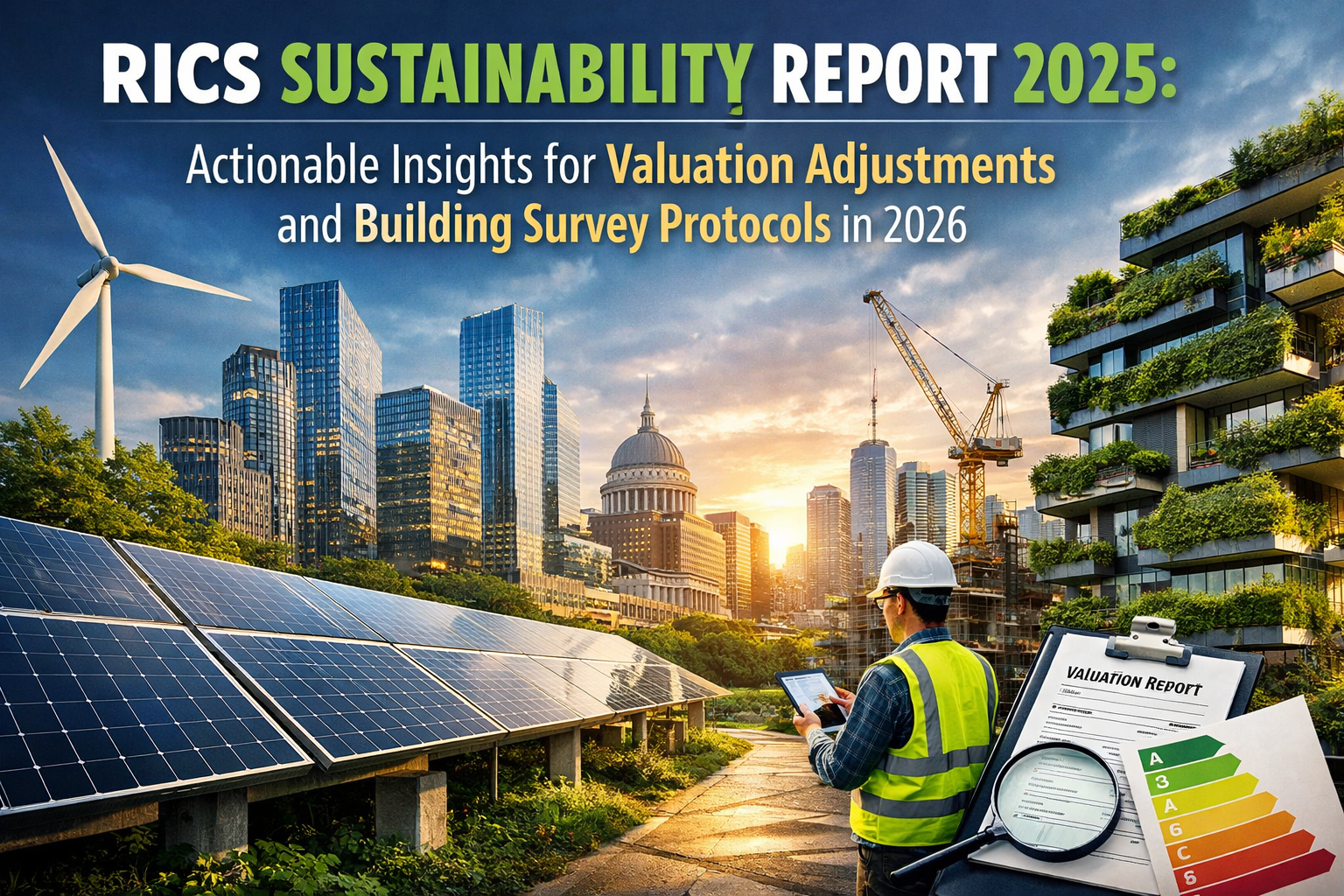
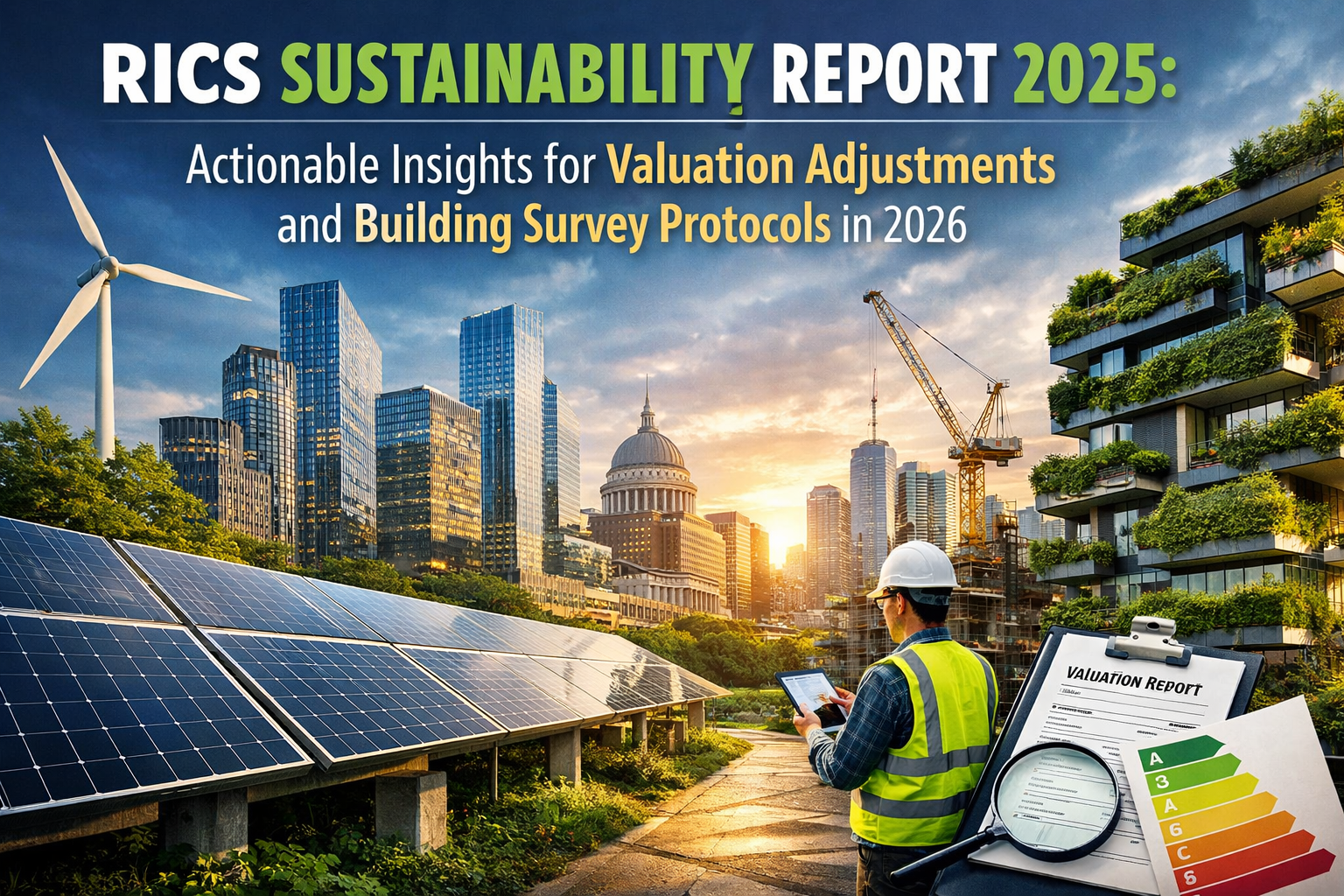
46% of construction professionals currently do not measure carbon emissions across their projects — a figure that has risen sharply from 34% in 2024. [2] That single statistic from the RICS Sustainability Report 2025 should stop every valuer and building surveyor in their tracks. The RICS Sustainability Report 2025: Actionable Insights for Valuation Adjustments and Building Survey Protocols in 2026 delivers a frank assessment of where the built environment profession stands on sustainability — and the gaps are significant enough to reshape how surveys are conducted and how properties are valued right now.
This article breaks down the report's most critical findings and translates them into concrete actions for surveyors, valuers, and property professionals operating in cautious Q2 2026 markets.
Key Takeaways 📌
- Demand for green buildings is slowing — the RICS Sustainable Building Index remains positive but is losing momentum, requiring recalibrated valuation premiums.
- Carbon measurement gaps are widening: 46% of professionals do not track emissions across projects, creating a data void that directly affects survey reliability.
- Regional performance varies enormously — the UK (+43 index) outperforms most global regions, but this advantage must be contextualised within individual survey assessments.
- Green certification, adaptability, and resilience are the top investor priorities — surveys must explicitly assess these features.
- Mandatory whole-life carbon assessment is a near-term regulatory inevitability — survey protocols should prepare for this now.
Understanding the RICS Sustainable Building Index in 2026
The built environment is responsible for 40% of global carbon emissions, making it one of the most consequential sectors in the global decarbonisation effort. [4] Against that backdrop, the RICS Sustainable Building Index provides a vital pulse check — and the 2025 reading reveals a market that is moving in the right direction but decelerating.
What the Regional Data Tells Valuers
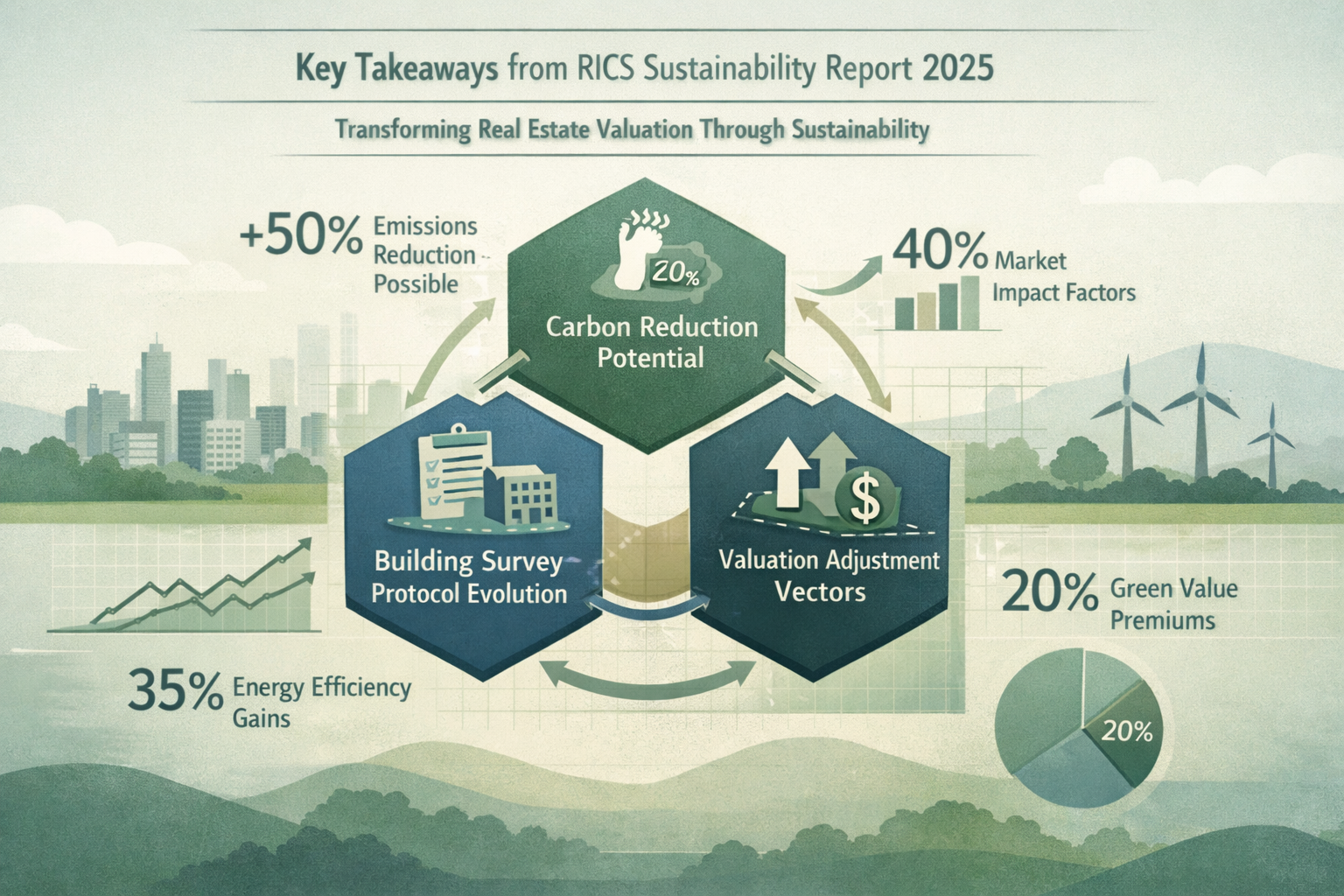
The regional breakdown from the RICS Sustainability Report 2025 is one of the most actionable datasets for valuation professionals:
| Region | RICS Sustainable Building Index Score |
|---|---|
| 🌍 MEA (Middle East & Africa) | +52 |
| 🇬🇧 UK | +43 |
| 🌍 Europe | +39 |
| 🌏 Asia Pacific | +27 |
| 🌎 Americas | +11 |
[2]
"Regional location should now be treated as a primary variable in sustainability-based valuation adjustments — not a footnote."
For UK-based surveyors, the +43 index score is encouraging. It signals that green building demand remains robust compared to most global peers. However, the deceleration in demand growth across almost all regions means that sustainability premiums applied in 2024 valuations may need downward recalibration for 2026. Properties that commanded a green premium based on trajectory assumptions may no longer justify the same uplift if market appetite is softening.
Practical implication for RICS property valuations: Valuers should now document the specific regional index score as a supporting reference point when justifying or adjusting sustainability-related value uplifts.
The Deceleration Problem
The slowing momentum does not mean green buildings are losing value — it means the rate of premium growth is easing. Valuers who built aggressive green uplift assumptions into comparable analysis should review those models. A more conservative, evidence-led approach to sustainability premiums is appropriate for 2026 market conditions.
Applying RICS Sustainability Report 2025: Actionable Insights for Valuation Adjustments and Building Survey Protocols in 2026 to Carbon Gaps
The carbon measurement crisis uncovered by the report is arguably its most urgent finding for building survey professionals.
The Carbon Accounting Gap
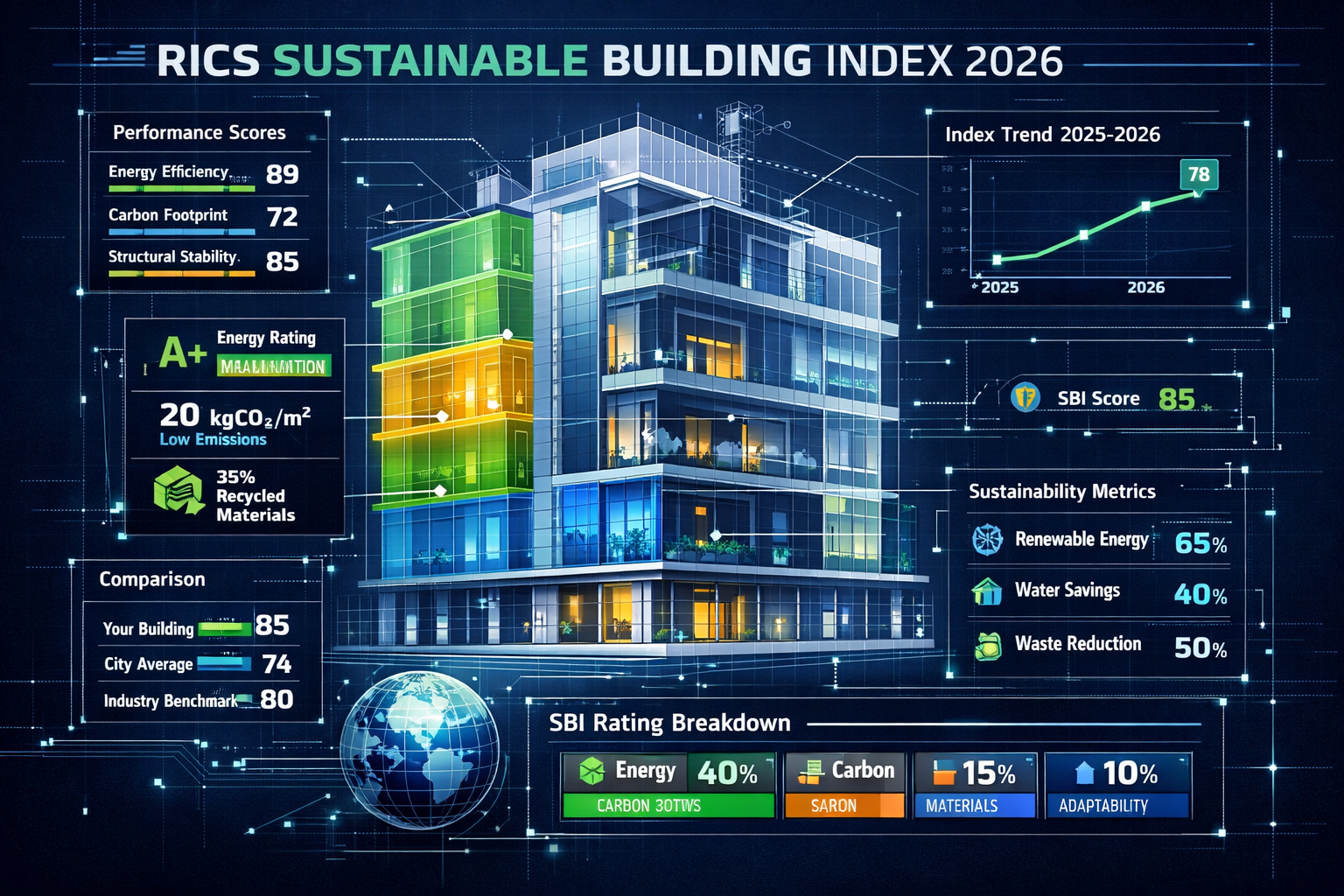
Consider these figures together: [2]
- 46% of construction professionals do not measure carbon emissions across projects (up from 34% in 2024)
- Over 60% report that carbon calculations and climate resilience assessments occur in fewer than half of projects — or not at all
- 30% of professionals lack sufficient knowledge and skills to reduce embodied carbon
These are not abstract statistics. They mean that a significant proportion of properties currently entering the market have no baseline carbon data. For building surveyors, this creates both a risk and an opportunity.
🔍 Survey Protocol Recommendation: Carbon Baseline Check
When conducting a RICS building survey, surveyors should now incorporate an explicit carbon baseline assessment step:
- Request existing carbon data from the client or vendor before the survey date
- Flag absence of carbon records as a material risk factor in the survey report
- Identify embodied carbon indicators — construction materials, age of fabric, insulation type, glazing specification
- Note climate resilience features — or their absence — including flood risk mitigation, overheating risk, and water efficiency measures
Properties with no carbon documentation should be clearly distinguished from those with robust tracking in survey reports. This distinction is becoming commercially significant as lenders, investors, and buyers increasingly scrutinise sustainability credentials.
Skills Gap and Its Impact on Survey Reliability
The finding that 30% of professionals lack the skills to reduce embodied carbon [2] has a direct bearing on survey quality. Surveyors should honestly assess their own competency in this area and seek CPD (Continuing Professional Development) training where gaps exist. A survey that misses significant embodied carbon risks — for example, in a property with RAAC panels, non-standard construction, or outdated insulation — could expose the surveyor to professional liability.
For clients seeking a building evaluation, it is entirely reasonable to ask surveyors about their specific training in sustainability and carbon assessment.
Building Survey Protocols: Translating RICS Sustainability Report 2025 Findings into Field Practice
The report's findings on biodiversity, waste tracking, and investor priorities provide a clear framework for updating building survey protocols in 2026.
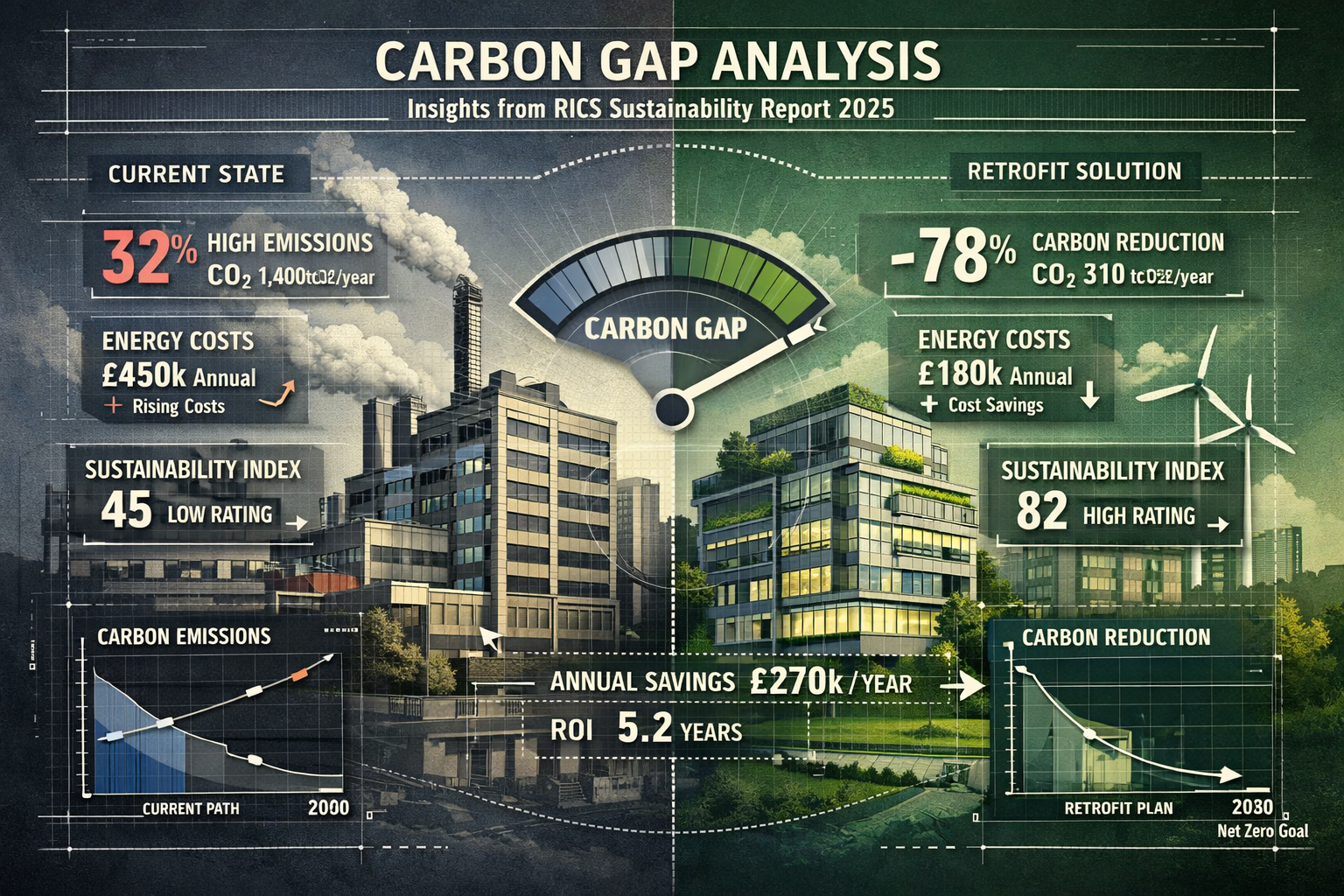
Biodiversity: From Checkbox to Core Assessment
60% of professionals now agree that biodiversity protection is a critical issue requiring immediate attention. [2] This consensus marks a meaningful shift. Biodiversity net gain (BNG) requirements, now embedded in UK planning policy, mean that surveyors assessing properties — particularly those with development potential — must evaluate biodiversity value as a material consideration.
For building surveys, this means:
- Noting the presence or absence of green roofs, living walls, or permeable surfaces
- Identifying features that support or impede local biodiversity (e.g., bat roosts, bird nesting sites, mature trees)
- Flagging biodiversity liabilities that could affect planning permissions or future development value
Waste Tracking and Sustainability Monitoring
Only 40% of professionals actively track waste reduction and data-sharing regularly. [2] This uneven adoption creates a clear two-tier market:
| Property Category | Sustainability Tracking | Valuation Implication |
|---|---|---|
| Tier 1 | Robust carbon, waste & energy data | Supports premium; lower risk profile |
| Tier 2 | Minimal or no tracking | Higher risk; may require value discount |
Surveyors conducting building inspections should explicitly categorise properties within this framework. The presence of smart metering, energy management systems, or documented waste reduction programmes should be recorded and referenced in valuation reports.
The Three Investor Priorities: A Valuation Framework
The report identifies three features most important to investors in sustainable buildings: [2]
- 🏅 Green building certification (BREEAM, LEED, EPC A/B ratings)
- 🔄 High adaptability (ability to retrofit, repurpose, or upgrade)
- 🛡️ Resilience (performance under climate stress — heat, flood, drought)
This hierarchy should directly inform how valuers weight sustainability factors. A property with a BREEAM Excellent rating and documented flood resilience measures warrants a more robust premium than one with a single green feature and no certification.
"Generic green designations are losing traction with sophisticated investors. Certification, adaptability, and resilience are the metrics that move markets."
For clients exploring which home survey is right for them, understanding that a Level 3 Building Survey now increasingly includes sustainability assessment components is important context.
Policy Direction and Mandatory Carbon Assessment: What to Expect
The RICS Sustainability Report 2025 is explicit about the policy direction of travel. Key recommendations include: [2] [3]
- Mandatory whole-life carbon assessment for buildings
- Stronger building regulations limiting energy use in both new and existing buildings
- Government-defined decarbonisation pathways with mandatory carbon assessment reporting
- Scaling biodiversity measures and professional skills development
For surveyors and valuers, this signals that what is currently best practice will become regulatory requirement. Firms that embed these protocols now will face a far smoother transition than those who wait for legislation.
Practical Steps for Firms in 2026
For valuation teams:
- Update comparable analysis frameworks to include sustainability certification data
- Develop a regional adjustment matrix referencing RICS index scores
- Build carbon data availability into standard due diligence checklists
For building survey teams:
- Integrate a sustainability checklist into standard survey templates
- Include explicit carbon baseline assessment as a named survey component
- Flag biodiversity liabilities and assets as standard practice
For professional development:
- Prioritise CPD in embodied carbon, climate resilience, and biodiversity net gain
- Consider specialist training for surveyors working on older or non-standard stock
The difference between Level 2 and Level 3 surveys is becoming increasingly relevant in this context — Level 3 surveys are better positioned to capture the depth of sustainability assessment the market now demands.
Regional Focus: UK Surveyors and the +43 Index Advantage
The UK's +43 RICS Sustainable Building Index score places it second globally, behind only the MEA region. [2] This is a competitive advantage for UK property — but it comes with responsibility.
UK surveyors operating across London and the South East should be aware that:
- Green building demand in the UK remains materially stronger than in the Americas (+11) or Asia Pacific (+27), supporting continued — if moderated — sustainability premiums
- Climate adaptation and resilience are becoming more prominent concerns, particularly for properties in flood-risk zones or areas with overheating vulnerability
- EPC ratings remain a key proxy for green certification in the residential market, but their limitations are well-documented — surveyors should supplement EPC data with direct assessment
For those commissioning surveys in specific London locations, local market conditions interact with these national trends. Whether in Wimbledon, Chiswick, or Islington, the sustainability profile of a property is increasingly a factor in both value and saleability.
Conclusion: Turning Report Findings into Competitive Advantage
The RICS Sustainability Report 2025: Actionable Insights for Valuation Adjustments and Building Survey Protocols in 2026 does not paint a picture of a profession that has solved sustainability — it reveals one that is at a critical inflection point. Demand is positive but slowing. Carbon measurement is improving but still deeply inconsistent. Policy is moving toward mandatory requirements that will reshape the survey and valuation landscape within years, not decades.
Actionable next steps for professionals in 2026:
✅ Recalibrate sustainability premiums using regional RICS index data — do not assume 2024 uplifts still apply
✅ Embed carbon baseline checks into every building survey protocol as a named, documented step
✅ Prioritise green certification, adaptability, and resilience over generic green claims in valuation analysis
✅ Flag biodiversity liabilities in survey reports — BNG requirements make this commercially material
✅ Invest in CPD on embodied carbon and climate resilience — the 30% skills gap is a professional liability risk
✅ Prepare for mandatory whole-life carbon assessment by building compliant workflows now
The firms and professionals who treat the RICS Sustainability Report 2025 as a practical operating manual — rather than background reading — will be best positioned to serve clients, manage risk, and maintain professional standards as the regulatory environment tightens through 2026 and beyond.
References
[1] Watch – https://www.youtube.com/watch?v=H7KaLmn4MAQ
[2] Sustainability Report 2025 – https://www.rics.org/news-insights/current-topics-campaigns/sustainability/sustainability-report-2025
[3] Sustainability Report 2025 Royal Institution Chartered Surveyors – https://build-up.ec.europa.eu/en/resources-and-tools/publications/sustainability-report-2025-royal-institution-chartered-surveyors
[4] Sustainability Report 2025 Infographic – https://www.rics.org/content/dam/ricsglobal/documents/reports/Sustainability-Report-2025-Infographic.pdf
[5] Sustainability Report 2025 – https://www.rics.org/content/dam/ricsglobal/documents/reports/Sustainability-report-2025.pdf
[6] Sustainability – https://www.rics.org/news-insights/current-topics-campaigns/sustainability