


From 1 May 2026, every private landlord in England must be registered on a centralized PRS (Private Rented Sector) database — and that single requirement is quietly reshaping how party wall surveyors operate on tenant-occupied properties. The Renters' Rights Act 2025, which comes into force on that date, has been described as "the most significant reform of residential landlord and tenant law for almost 40 years" [4]. For party wall professionals, the implications are immediate and practical: landlord registration status, Section 8 notice procedures, and boundary works are now legally entangled in ways that demand updated protocols.
This article breaks down exactly how Party Wall Surveyor Protocols Under Renters' Rights Act 2026: Managing Landlord Registration and Section 8 Disputes must evolve — with actionable checklists, clear explanations of the new legal landscape, and guidance on managing tenant-involved boundary works post-May 2026.
Key Takeaways 📋
- The Renters' Rights Act 2025 came into force on 1 May 2026, introducing mandatory landlord registration on a centralized PRS database [4].
- Party wall surveyors must now verify landlord registration status before progressing party wall awards on tenanted properties.
- Section 8 notices issued during active party wall works create complex overlapping obligations that surveyors must document carefully.
- Schedules of condition are more critical than ever, as tenants now have stronger legal standing to challenge damage claims.
- Surveyors operating without updated protocols risk awards being challenged on procedural grounds under the new legislative framework [2].
How the Renters' Rights Act 2026 Changes the Ground Rules for Party Wall Surveyors
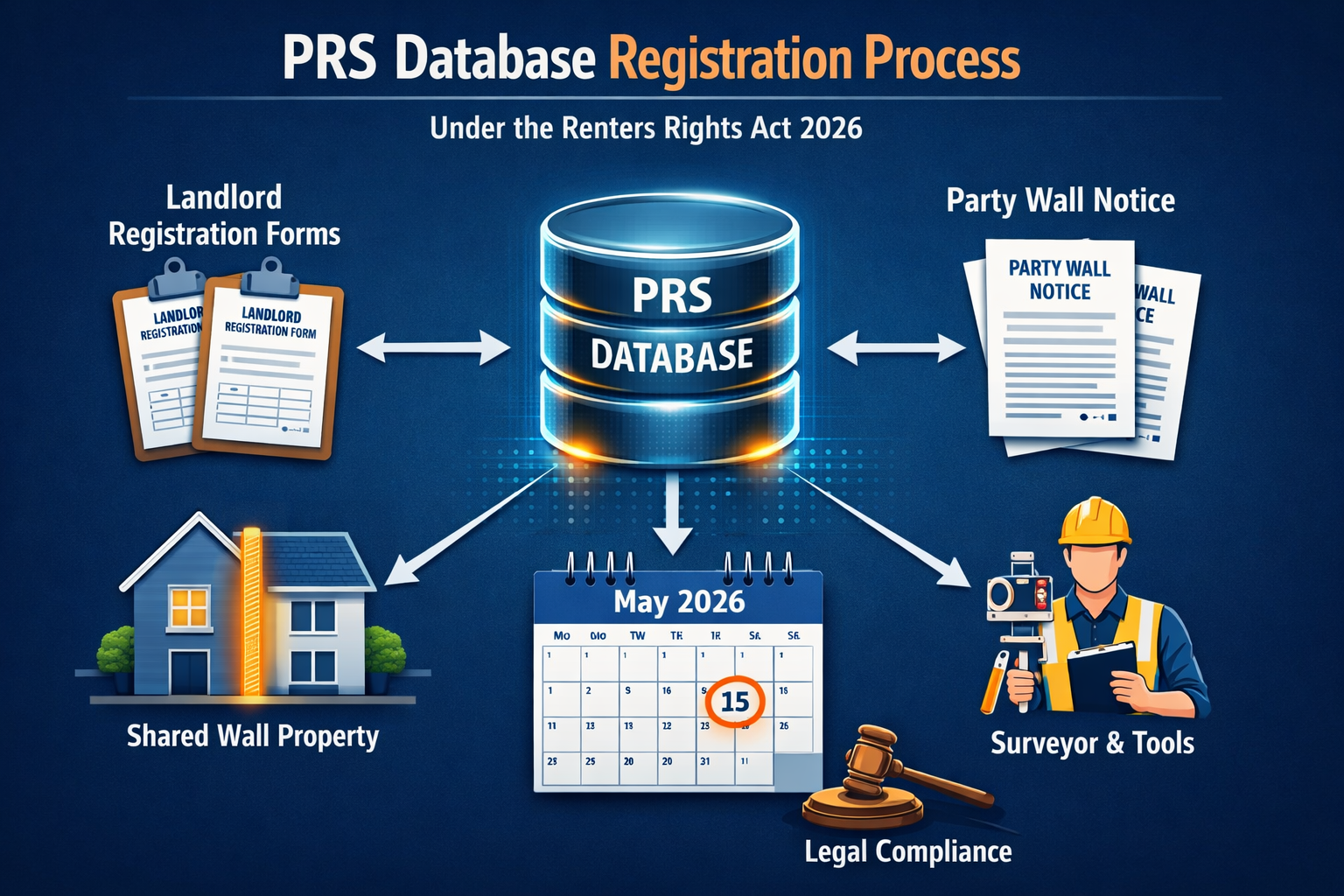
The Party Wall etc. Act 1996 was designed for a simpler world — one where the building owner and the adjoining owner were typically the freeholders. The Renters' Rights Act 2026 introduces a third layer of complexity: the registered tenant, who now has significantly enhanced legal protections that directly affect how boundary and party wall works can proceed.
The PRS Database: What Surveyors Need to Know
The centralized PRS database introduced by the Renters' Rights Act 2026 requires all private landlords to register before they can legally operate [2]. This is not merely an administrative formality. For party wall surveyors, it creates a verification obligation at the outset of any instruction involving a tenanted property.
Here is why this matters:
- A landlord who is not registered on the PRS database may lack the legal standing to serve a valid party wall notice as a building owner.
- Works carried out under a defective notice — where the landlord's registration status is in question — could expose the surveyor to professional liability.
- Adjoining owners who are also landlords must similarly be verified before a party wall award is sealed.
"Registration status is now a due diligence step, not an afterthought. Surveyors who skip this check are building on sand." [2]
The practical implication: add a PRS database verification check to the initial instruction checklist for every tenanted property instruction.
Section 8 Notices and Party Wall Works: A Collision Course
Section 8 of the Housing Act 1988 allows landlords to seek possession of a property on specified grounds. Under the Renters' Rights Act 2026, the grounds for Section 8 notices have been revised and, in some cases, tightened. When a Section 8 notice is served during active party wall works, surveyors face a set of overlapping legal pressures:
| Scenario | Risk to Party Wall Process | Recommended Action |
|---|---|---|
| Section 8 served before party wall award sealed | Tenant may vacate; access for schedule of condition lost | Complete schedule of condition immediately |
| Section 8 served mid-works | Works may be interrupted; liability for damage unclear | Document all works daily; notify both owners in writing |
| Section 8 contested by tenant | Court proceedings may delay works timeline | Build contingency periods into the party wall award |
| Landlord loses Section 8 case | Tenant remains; relationship with building owner deteriorates | Maintain neutral surveyor position; re-engage both parties |
The key principle: a party wall surveyor's duty runs to the wall and the award, not to either party's tenancy outcome. However, ignoring the tenancy situation entirely is no longer viable post-May 2026.
Surveyor Protocols for Landlord Registration and Section 8 Disputes

Understanding Party Wall Surveyor Protocols Under Renters' Rights Act 2026: Managing Landlord Registration and Section 8 Disputes in practice requires a structured approach. The following protocols are designed for surveyors handling instructions on tenanted properties from May 2026 onwards.
Protocol 1: Pre-Instruction Due Diligence Checklist ✅
Before accepting an instruction on a tenanted property, surveyors should confirm the following:
- Landlord PRS registration confirmed — request registration number and verify against the database [2]
- Tenancy type identified — assured tenancy, fixed term, or periodic
- Section 8 notice status checked — has one been served, is one anticipated?
- Tenant notification obligations reviewed — does the landlord have a duty to inform the tenant of works?
- Access rights confirmed — party wall access rights must be reconciled with tenant's right to quiet enjoyment
- Insurance position verified — does the landlord's policy cover party wall works on a tenanted property?
For guidance on understanding surveyor responsibilities in complex property situations, this checklist forms the foundation of professional practice.
Protocol 2: Serving Party Wall Notices on Tenanted Properties
The Party Wall etc. Act 1996 requires notices to be served on owners of adjoining properties, not tenants. However, the Renters' Rights Act 2026 introduces a practical complication: tenants now have stronger rights to be informed about works affecting their home.
Best practice post-May 2026:
- Serve the formal party wall notice on the registered owner (verified against PRS database).
- Provide a courtesy copy to the tenant — this is not legally required under the 1996 Act but is strongly advisable given enhanced tenant protections.
- Document both service steps with proof of delivery.
- Allow the standard 14-day response period before proceeding to appointment of surveyors.
Party wall notice costs and procedures are explored in detail in our guide to party wall agreements and surveyor support in London.
Protocol 3: Schedules of Condition in a Post-Act Environment
Schedules of condition have always been a critical tool in party wall practice. Under the Renters' Rights Act 2026, they become even more important because:
- Tenants can now raise damage claims through enhanced dispute channels, not just landlords.
- A robust schedule of condition protects the building owner from inflated claims by either the adjoining owner or their tenant.
- Photographic evidence standards must meet a higher threshold to withstand challenge [3].
Minimum documentation standards for schedules of condition (2026):
- 📸 High-resolution photographs (minimum 12 megapixels) of all surfaces within 3 metres of the party wall
- 📏 Measured crack monitoring points with baseline readings
- 📄 Written descriptions cross-referenced to numbered photographs
- 🗓️ Date and time stamps on all digital files
- 🔐 Secure storage with tamper-evident metadata
General party wall survey costs run from £150–£200 per hour, with full party wall awards typically costing around £1,000 [1]. A thorough schedule of condition is a cost-effective investment against future dispute costs. For a breakdown of party wall surveyor fees in London, see the linked guide.
Managing Disputes When Section 8 and Party Wall Awards Overlap
The most challenging scenario for surveyors operating under Party Wall Surveyor Protocols Under Renters' Rights Act 2026: Managing Landlord Registration and Section 8 Disputes is when a Section 8 possession claim runs concurrently with an active party wall dispute. This is not a theoretical edge case — it is increasingly common in London's high-pressure rental market.
Understanding the Legal Hierarchy
When Section 8 proceedings and party wall disputes overlap, surveyors must understand the legal hierarchy:
- The party wall award governs the physical works and remains binding on the building owner regardless of tenancy changes.
- The Section 8 proceedings are a separate legal process — a court matter between landlord and tenant.
- The surveyor's role does not extend to the tenancy dispute, but the surveyor must account for the practical consequences of a possession order.
Key principle: A change of occupier mid-works does not invalidate a party wall award, but it may require the award to be updated to reflect new access arrangements.
Dispute Resolution Steps for Surveyors 🔧
When a Section 8 notice is served during party wall works, follow these steps:
Step 1 — Notify both surveyors immediately
If a three-surveyor procedure is in place, all appointed surveyors should be informed of the Section 8 notice in writing within 5 working days of the surveyor becoming aware of it.
Step 2 — Review the works programme
Assess whether the possession timeline (typically 2–8 weeks from notice to possession, though courts may vary) conflicts with critical works milestones.
Step 3 — Document access arrangements
If the tenant vacates, document the change in occupancy and confirm with the building owner that access arrangements remain valid.
Step 4 — Consider a supplementary award
Where works extend beyond the original possession date, a supplementary party wall award may be needed to address changed circumstances.
Step 5 — Maintain impartiality
The surveyor must not advise either party on the tenancy dispute itself. Refer both parties to appropriate legal advisers.
For complex boundary wall disputes involving multiple parties, the same principles of documented impartiality apply.
When the Landlord Is Not PRS-Registered: Surveyor Liability
A landlord who has failed to register on the PRS database by 1 May 2026 faces significant penalties under the Renters' Rights Act 2026 [2]. For surveyors, the question is: what happens to a party wall award served by or on behalf of an unregistered landlord?
The honest answer is that this area of law is still developing. However, the prudent approach is:
- Do not proceed with a party wall award until registration is confirmed.
- If registration cannot be confirmed, raise the issue formally in writing with both parties.
- Seek legal advice before sealing an award where registration status is disputed.
- Record all steps taken in the instruction file.
This is consistent with the broader surveyor duties framework that governs professional practice.
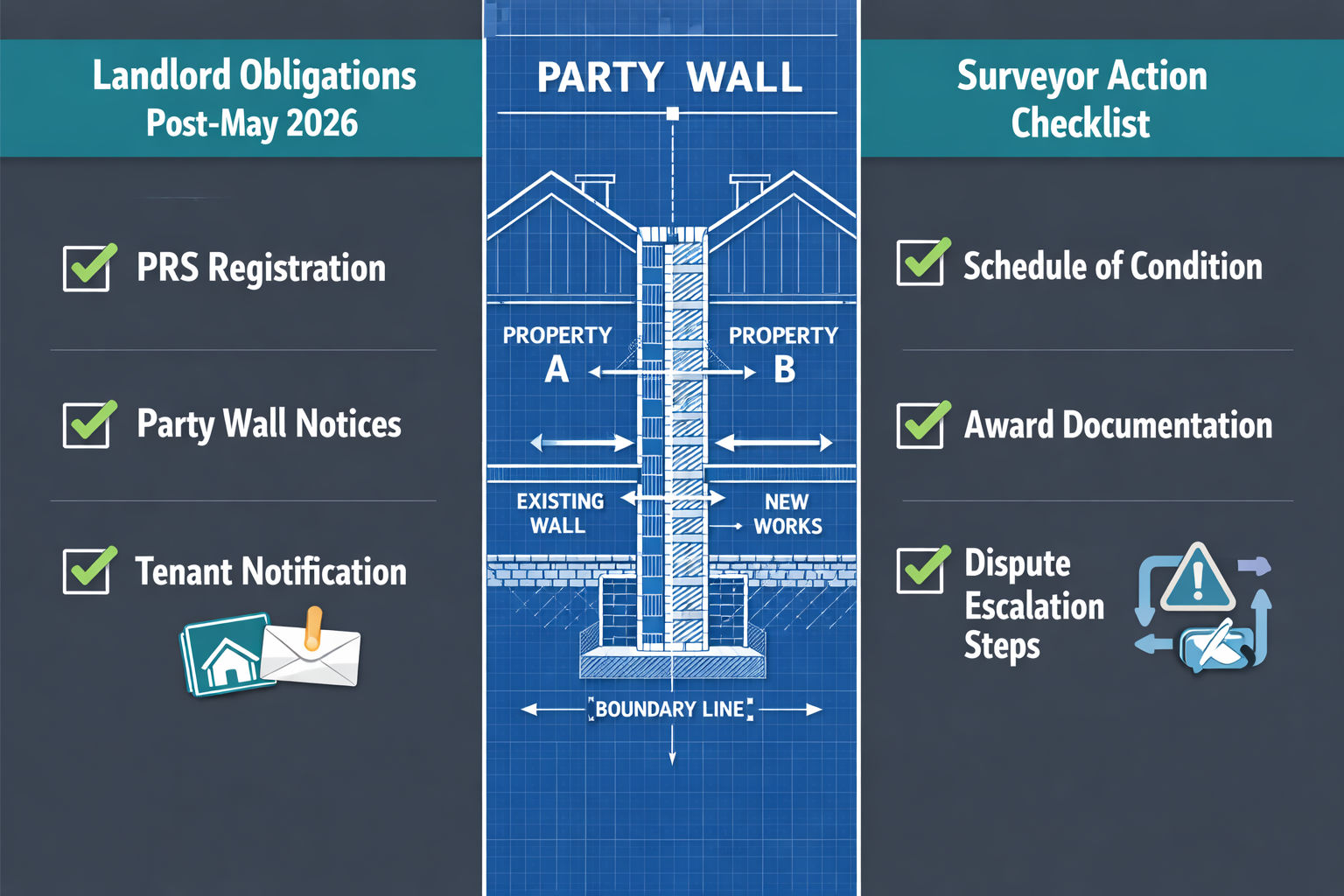
Practical Checklist: Party Wall Surveyors Working on Tenanted Properties Post-May 2026
The following consolidated checklist brings together the key protocols discussed above. It is designed for surveyors to use at each stage of an instruction involving a tenanted property.
🏁 At Instruction Stage
- Verify landlord PRS database registration number
- Identify tenancy type and current status
- Check for any existing or anticipated Section 8 notices
- Confirm tenant notification obligations with building owner
- Review access rights under tenancy agreement
📋 At Notice Stage
- Serve notice on registered owner (not tenant)
- Provide courtesy copy to tenant with covering letter
- Document all service with proof of delivery
- Record landlord registration number on file
🔍 At Schedule of Condition Stage
- Complete schedule before works commence (no exceptions)
- Meet minimum photographic standards [3]
- Obtain tenant's written acknowledgement where possible
- Store all files securely with metadata intact
⚖️ During Works
- Monitor for Section 8 notice service
- Document any change in occupancy
- Maintain daily works log
- Communicate any material changes to all parties in writing
📝 At Award Stage
- Confirm landlord registration remains current
- Address any tenancy changes in award recitals
- Include contingency provisions for access disruption
- Seal award with all required signatures
For surveyors working across London, understanding party wall agreements in the context of evolving legislation is essential to maintaining professional standards. Those handling instructions in specific boroughs can also access location-specific guidance, such as for Richmond or Chiswick properties where period terraced housing makes party wall matters particularly common.
Fees, Costs, and the Impact of Increased Complexity
The additional due diligence required under the Renters' Rights Act 2026 has a direct impact on party wall surveyor fees. Surveyors should review their fee structures to account for:
- PRS database verification time — typically 30–60 minutes per instruction
- Enhanced schedule of condition work — higher photographic and documentation standards
- Additional correspondence — tenant notification letters, Section 8 monitoring communications
- Contingency provisions — time spent managing works disruptions caused by tenancy disputes
At current rates of £150–£200 per hour [1], these additional steps can add £200–£400 to a standard instruction. Surveyors should make this clear in their terms of engagement from the outset.
For a full breakdown of party wall surveyor fees and what drives cost variations, the linked resource provides detailed guidance.
Conclusion: Actionable Next Steps for Surveyors
The Renters' Rights Act 2026 does not rewrite the Party Wall etc. Act 1996 — but it fundamentally changes the environment in which party wall surveyors operate. The introduction of mandatory landlord registration, enhanced tenant protections, and revised Section 8 procedures creates new procedural obligations that professional surveyors cannot afford to ignore.
Here are the immediate actions every party wall surveyor should take:
- Update your instruction checklist to include PRS database verification as a mandatory first step on all tenanted property instructions.
- Review your schedule of condition standards against the enhanced documentation requirements now expected in dispute proceedings [3].
- Brief your clients — both building owners and adjoining owners — on the impact of the Renters' Rights Act 2026 on works timelines and costs.
- Revise your fee schedules to reflect the additional due diligence work required post-May 2026.
- Seek legal advice on any instruction where landlord registration status is unclear before proceeding to award.
- Stay current — this legislation is new, and case law will develop rapidly. Engage with professional bodies for updated guidance.
The surveyors who adapt quickly will be the ones who protect their clients, their awards, and their professional reputations in the new landscape created by the Renters' Rights Act 2026.
References
[1] Party Wall Agreement – https://hoa.org.uk/advice/guides-for-homeowners/i-am-improving/party-wall-agreement/
[2] Party Wall Notice Requirements For Prs Database Compliance Works Surveyor Tactics Post Renters Rights Act Registration In 2026 – https://nottinghillsurveyors.com/blog/party-wall-notice-requirements-for-prs-database-compliance-works-surveyor-tactics-post-renters-rights-act-registration-in-2026
[3] Schedules Of Condition In Party Wall Disputes Photography Documentation And Evidence Standards For Surveyors – https://nottinghillsurveyors.com/blog/schedules-of-condition-in-party-wall-disputes-photography-documentation-and-evidence-standards-for-surveyors
[4] Watch – https://www.youtube.com/watch?v=z5s7dAiMhvs