

Last updated: June 3, 2026
Quick Answer: The draft Commonhold and Leasehold Reform Bill, published in January 2026 and confirmed in the May 2026 King's Speech, will fundamentally change how flats are owned in England and Wales. For SW London leaseholders — particularly those in period mansion blocks and Victorian or Edwardian conversions across SW19, SW18, SW20 and neighbouring postcodes — the Bill proposes a £250 ground rent cap, a ban on new leasehold flats, the abolition of forfeiture, and commonhold as the default tenure from around 2029. No changes to existing leases are immediate, but the Commonhold Leasehold Reform Bill 2026 SW London leaseholder implications are already affecting valuations, lease extension decisions, and buyer due diligence across the area.
Table of Contents
- What Exactly Does the Commonhold Leasehold Reform Bill Mean for My London Flat?
- What Is the Difference Between Leasehold and Commonhold After This Reform?
- How Will This Bill Change My Property Ownership Rights?
- The £250 Ground Rent Cap and What It Means for SW London Flat Owners
- Will I Save Money on Service Charges With the New Bill?
- Can I Convert My Existing Leasehold Property to Commonhold?
- Which SW London Areas Will Be Most Impacted by This Reform?
- Are Older Properties in SW London More Affected Than Newer Ones?
- Lease Extension Now or Wait? Practical Guidance for SW London Leaseholders
- What Are the Potential Risks and Downsides for SW London Leaseholders?
- What Legal Steps Do I Need to Take as a Current Leaseholder?
- Who Benefits Most From the Commonhold Leasehold Reform Bill?
- FAQ
Key Takeaways
- The draft Commonhold and Leasehold Reform Bill was published 27 January 2026 and is undergoing pre-legislative scrutiny; no changes to existing leases are in force yet [1][3]
- Ground rents on most existing long residential leases will be capped at £250 per year, then reduced to peppercorn after 40 years — with no compensation payable to landlords [1][2]
- New long leasehold flats (over 21 years) will be banned; commonhold will become the default tenure for new flats, likely from 2029 [4]
- Forfeiture of residential leases will be abolished, removing the risk of losing your home over unpaid service charges
- Leaseholders will gain a new right to request gigabit-capable broadband installation [9]
- Housing Minister Matthew Pennycook has acknowledged the full commonhold rollout may extend beyond this Parliament [9]
- SW London period conversions in SW19, SW18, SW20 are disproportionately affected due to their high concentration of leasehold flats with escalating ground rents
- Lease extension decisions should be made carefully now — waiting is not automatically the right strategy
What Exactly Does the Commonhold Leasehold Reform Bill Mean for My London Flat?
The Bill replaces the leasehold system for flats with commonhold ownership, caps ground rents on existing leases, and removes some of the most contentious landlord powers. For most SW London flat owners, the immediate practical effect in 2026 is limited — but the direction of travel is clear and will affect decisions you make today.
The Government published the draft Bill on 27 January 2026, and it is currently undergoing pre-legislative scrutiny in Parliament [3]. The Levelling Up, Housing and Communities Committee has described it as "a significant step" in giving leasehold homeowners greater control, while also calling for some protections to be strengthened [7]. This builds on the already-enacted Leasehold and Freehold Reform Act 2024, which extended leaseholders' rights to extend leases and challenge unreasonable charges.
Key provisions in the draft Bill:
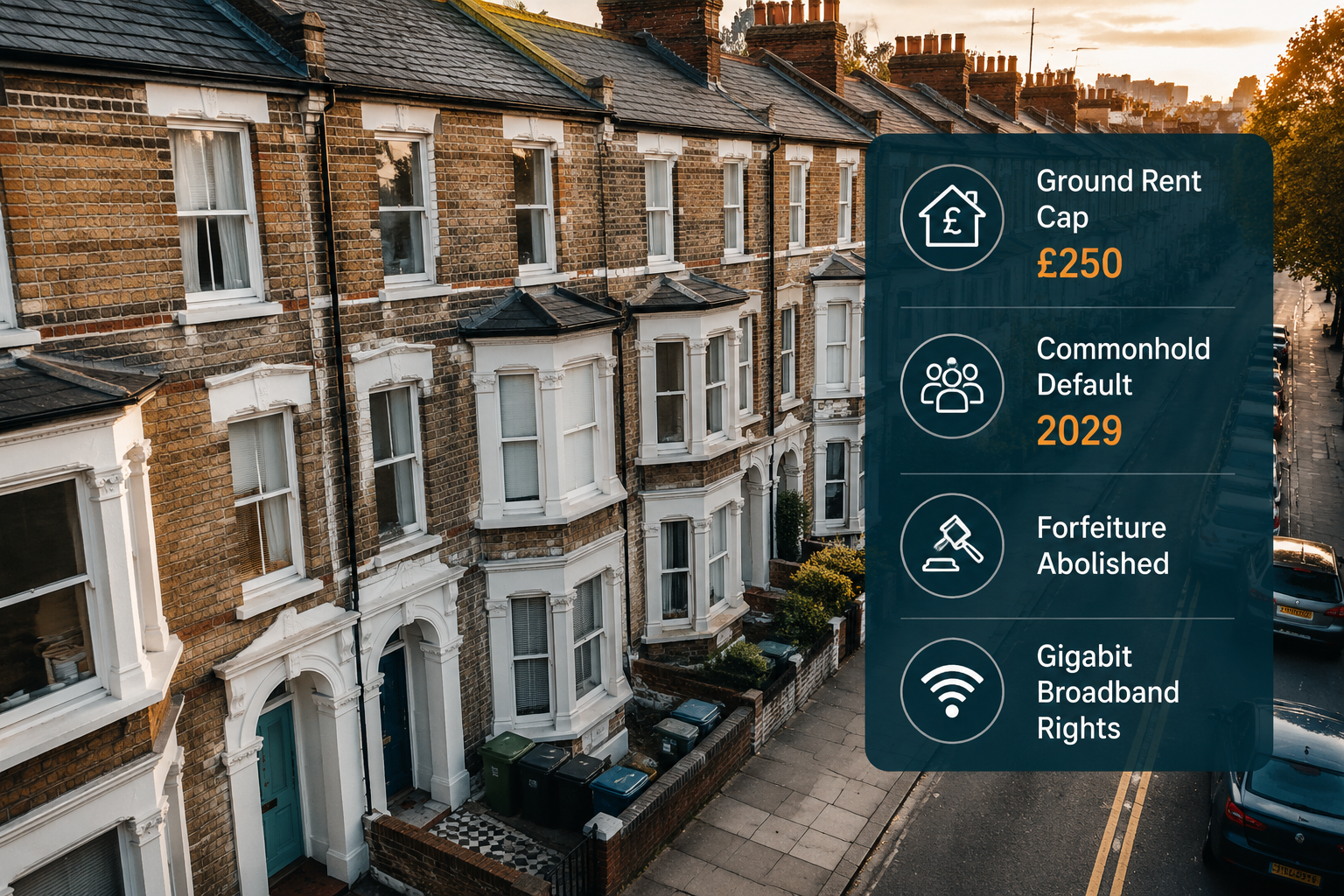
- Statutory cap on ground rents at £250 per year for most existing long residential leases [1]
- Ban on new long leasehold flats, with commonhold as the default [4]
- Abolition of forfeiture for residential leases [8]
- New right to request gigabit-capable broadband [9]
- Clearer routes for leaseholders to take over management of their building
What Is the Difference Between Leasehold and Commonhold After This Reform?
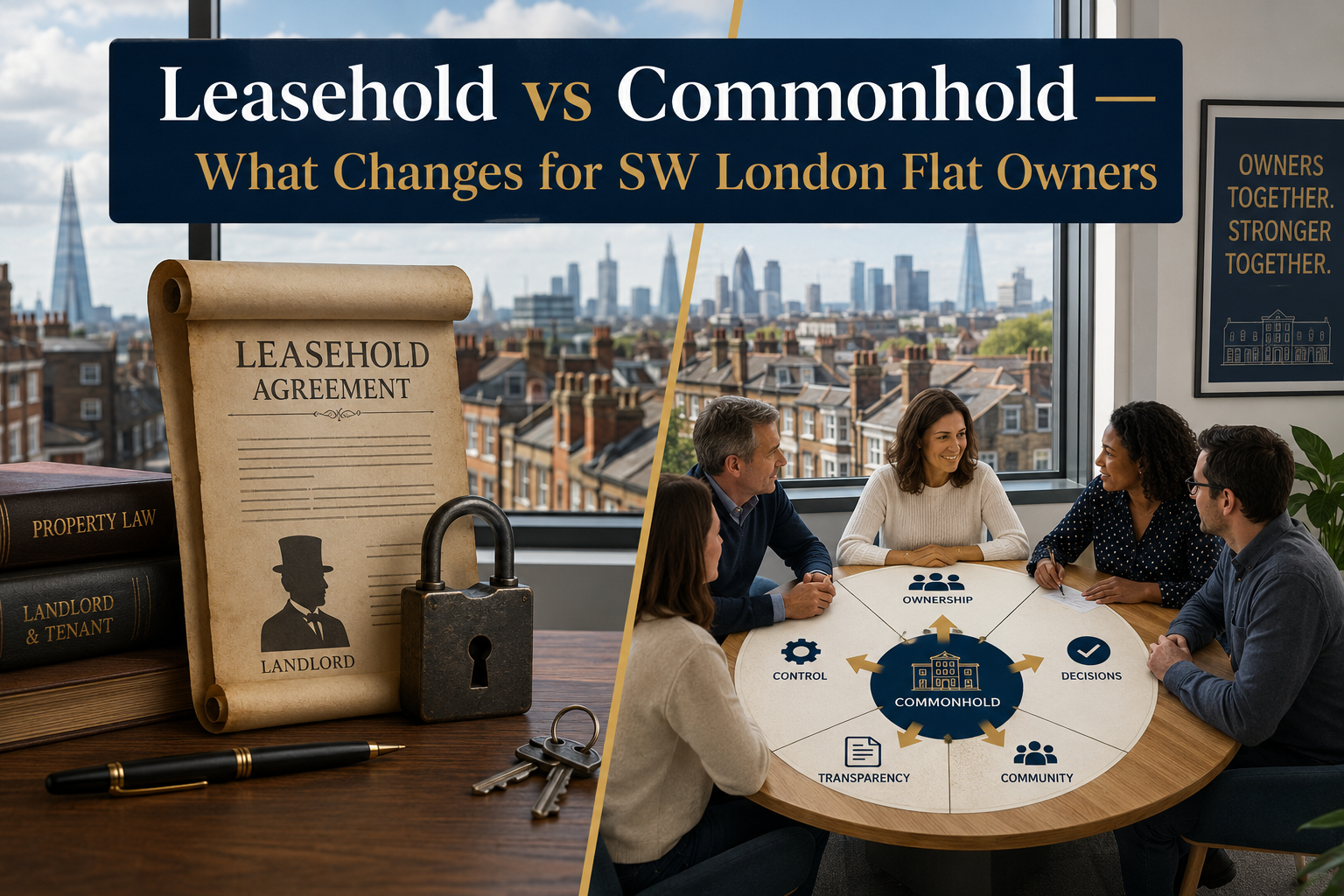
Under the current leasehold system, you own your flat for a fixed term — typically 99 to 999 years — and pay ground rent and service charges to a freeholder who retains ultimate ownership of the building. Under commonhold, each flat owner holds their unit outright (as freehold), and a Commonhold Association — owned collectively by the flat owners — manages the building.
| Feature | Leasehold (current) | Commonhold (post-reform) |
|---|---|---|
| Ownership | Time-limited lease | Outright freehold of the unit |
| Ground rent | Can be significant | None |
| Building management | Controlled by freeholder | Controlled by flat owners collectively |
| Lease length risk | Lease depreciates over time | No lease to expire |
| Forfeiture risk | Yes (until abolished) | No |
| Mortgage availability | Can be restricted on short leases | Expected to be straightforward |
For SW London leaseholders, the shift to commonhold removes the ticking clock of a depreciating lease — a significant issue in areas where Victorian and Edwardian conversions often carry leases that have already fallen below 80 years.
How Will This Bill Change My Property Ownership Rights?
The Bill materially strengthens leaseholder rights in three ways: it removes the ground rent obligation over time, abolishes the threat of forfeiture, and gives flat owners collective control of their building through commonhold.
Abolition of forfeiture is particularly significant. Currently, a freeholder can apply to court to forfeit your lease — effectively seizing your property — if you fall behind on service charges or ground rent, even for relatively small sums. The draft Bill proposes to end this entirely for residential leases [8]. This is one of the most widely welcomed proposals across the property sector.
The new right to request gigabit broadband means leaseholders can formally request that their landlord or building manager facilitates the installation of gigabit-capable broadband infrastructure, removing a common barrier in older mansion blocks where freeholders have historically refused access to telecoms providers [9].
For those reviewing their lease agreement obligations, these changes represent a structural shift in the landlord-leaseholder power balance.
The £250 Ground Rent Cap and What It Means for SW London Flat Owners
The draft Bill proposes capping ground rents on most existing long residential leases at £250 per year, with ground rent then falling to a peppercorn after 40 years [1]. No compensation will be payable to landlords for this loss of income [2].
This is directly relevant to SW London. Many flats in Wimbledon, Merton, Wandsworth, and Balham carry ground rents that have escalated well above £250 per year through doubling clauses or RPI-linked increases. For those leaseholders, the cap would represent an immediate annual saving once the legislation takes effect — currently anticipated around 2028, subject to parliamentary progress [1].
Important caveats:
- Some retirement housing schemes may be exempt where a lower purchase price was agreed in exchange for higher ground rent [2]
- The cap applies to existing leases, not just new ones
- Freeholders with large SW London ground-rent portfolios may challenge implementation, creating some legal uncertainty in the short term
For investors who purchased freehold ground-rent income in SW London, the Bill reduces the capital value of those assets significantly.
Will I Save Money on Service Charges With the New Bill?
The Bill does not directly cap service charges, but it does introduce stronger transparency and challenge rights. Leaseholders will have clearer routes to dispute unreasonable charges and to take over building management through a Commonhold Association [4][7].
Under commonhold, the Commonhold Association sets its own budget — meaning flat owners collectively decide what is spent on maintenance, insurance, and repairs, rather than accepting a freeholder's figures. For SW London mansion blocks where service charges have risen sharply in recent years, this could produce meaningful savings, though it also places the administrative responsibility on flat owners themselves.
Can I Convert My Existing Leasehold Property to Commonhold?
Conversion of existing leasehold buildings to commonhold will be possible under the Bill, but it will require the agreement of all leaseholders in the building — a significant practical hurdle [4][8]. In a block of six flats where one owner is absent or unwilling, conversion cannot proceed under current proposals.
The Government has acknowledged this is a complex area and further consultation is expected. For most SW London leaseholders in 2026, conversion remains a future option rather than an immediate one. The more realistic near-term route to collective control remains the Right to Manage, which was strengthened by the 2024 Act.
Which SW London Areas Will Be Most Impacted by This Reform?
SW London postcodes with the highest concentrations of leasehold flats in period buildings will feel the greatest impact. This includes SW19 (Wimbledon, Raynes Park), SW18 (Wandsworth, Southfields), SW20 (West Wimbledon, Raynes Park), SW12 (Balham), SW17 (Tooting), and SW4 (Clapham).
These areas are characterised by converted Victorian and Edwardian terraces and mansion blocks — many with leases originally granted in the 1970s and 1980s that are now approaching or below 80 years. The combination of depreciating lease lengths and escalating ground rents makes the Commonhold Leasehold Reform Bill 2026 SW London leaseholder implications particularly acute here compared with newer build areas.
New-build schemes in Battersea, Clapham, and Putney will also be affected: once the ban on new leasehold flats takes effect (likely 2029), developers will be required to sell new flats as commonhold, changing lender due diligence, service-charge structures, and resale dynamics [4].
Are Older Properties in SW London More Affected Than Newer Ones?
Yes. Period conversions in SW London are disproportionately affected for several reasons. Older leases often contain doubling ground-rent clauses that have pushed annual ground rents well above £250. Lease lengths in Victorian and Edwardian conversions are more likely to have fallen below the critical 80-year threshold, above which the marriage value premium applies in lease extension calculations.
For buyers considering a leasehold flat in SW London, an RICS survey can help you negotiate the purchase price and identify lease-related risks before exchange. Understanding what to check before buying a leasehold property is essential in the current reform environment, where the value of a lease can shift depending on legislative progress.
Lease Extension Now or Wait? Practical Guidance for SW London Leaseholders
This is the most common question from SW London flat owners in 2026, and the answer depends on your specific circumstances.
Extend now if:
- Your lease is below 80 years — every year below 80 costs you more in marriage value premium
- You plan to sell within the next three to five years
- Your ground rent is above £250 and causing mortgage or sale complications
- You have owned the property for at least two years and qualify for the statutory route
Consider waiting if:
- Your lease is comfortably above 90 years and your ground rent is already low
- You are confident the reform timeline suits your plans (but note Housing Minister Matthew Pennycook has cautioned the full rollout may extend beyond this Parliament) [9]
- You are exploring a collective enfranchisement with neighbours
The statutory lease extension process adds 90 years to your existing term and reduces ground rent to a peppercorn — a significant benefit regardless of the Bill's progress. An informal lease extension may also be worth considering where the freeholder is cooperative, as it can be faster and sometimes cheaper.
For a professional assessment of your lease extension premium, a lease extension valuation from a chartered surveyor gives you a defensible figure before entering negotiations.
Common mistake: Assuming the Bill will make lease extensions unnecessary. Even under the proposed reforms, existing leaseholders with short leases will still need to act — the Bill does not automatically extend existing leases.
What Are the Potential Risks and Downsides for SW London Leaseholders?
The Commonhold Leasehold Reform Bill 2026 SW London leaseholder implications are largely positive for flat owners, but there are genuine risks to consider.
Risks and downsides:
- Timeline uncertainty: The full commonhold rollout is likely 2029 at the earliest, and the ban on new leasehold flats may not be fully implemented within this Parliament [9]. Leaseholders who delay action on the basis of reform may find themselves worse off.
- Conversion complexity: Unanimous consent requirements for converting existing buildings to commonhold may leave many leaseholders in leasehold indefinitely.
- Commonhold management burden: Running a Commonhold Association requires competent, engaged flat owners. Buildings with absent or disengaged owners may struggle.
- Transitional valuation uncertainty: The ground-rent cap and forfeiture abolition may affect the valuation of both leaseholds and freeholds in ways that are not yet fully priced into the market.
- Lender caution: Some mortgage lenders are still developing their policies on commonhold lending. Until lender appetite is fully established, resale of commonhold flats could face friction.
What Legal Steps Do I Need to Take as a Current Leaseholder?
No immediate legal action is required in 2026, as the Bill has not yet been enacted. However, there are practical steps worth taking now.
Checklist for SW London leaseholders:
- Check your current lease length and ground rent — obtain a copy of your lease if you do not have one
- If your lease is below 80 years, seek a lease extension valuation promptly
- Review whether your ground rent exceeds £250 per year and consider the implications for mortgage lenders
- Explore whether your building qualifies for Right to Manage under the 2024 Act
- If buying a leasehold flat, commission a full RICS building survey and review the lease terms carefully
- Monitor the Bill's parliamentary progress — the pre-legislative scrutiny stage will produce further detail on implementation dates
For buyers of leasehold flats in SW London, understanding how to buy a flat on a short lease and the associated risks remains essential even as reform progresses.
Who Benefits Most From the Commonhold Leasehold Reform Bill?
Leaseholders with high or escalating ground rents benefit most from the £250 cap. Those in buildings where collective enfranchisement or Right to Manage has been blocked by freeholder resistance will benefit from the strengthened commonhold route. First-time buyers purchasing new flats from 2029 onwards will benefit from commonhold as the default tenure, giving them outright ownership without the leasehold treadmill.
Freeholders and ground-rent investors are the clear losers: the cap removes income without compensation, and the ban on new leasehold flats eliminates future ground-rent creation [1][2].
For property investors considering leasehold flats in SW London, the financial implications of leasehold reform should form part of any acquisition analysis in 2026.
FAQ
Q: When will the Commonhold and Leasehold Reform Bill become law?
The draft Bill was published in January 2026 and is undergoing pre-legislative scrutiny. Formal introduction to Parliament and Royal Assent are expected to follow, with commonhold as the default tenure likely from 2029. The full ban on new leasehold flats may extend beyond this Parliament [9][3].
Q: Does the £250 ground rent cap apply to my existing lease?
Yes, the cap is proposed to apply to most existing long residential leases, not just new ones. Ground rent would be capped at £250 per year and then fall to peppercorn after 40 years. No compensation will be payable to landlords [1][2].
Q: Should I extend my lease now or wait for the reform?
If your lease is below 80 years, extend now — waiting risks higher costs due to marriage value. If your lease is above 90 years with a low ground rent, you have more flexibility, but do not assume the Bill will resolve all leasehold issues automatically [9].
Q: What is forfeiture and why does abolishing it matter?
Forfeiture is the legal process by which a freeholder can apply to court to seize your property if you default on ground rent or service charges. Abolishing it removes the risk of losing your home over a disputed charge — a significant protection for leaseholders [8].
Q: Will my SW London flat be easier to sell after the reform?
Flats with high or escalating ground rents have faced mortgage lender restrictions in recent years. The £250 cap should resolve this for most affected properties once enacted. Commonhold flats are expected to be more straightforward to sell and mortgage long-term [4].
Q: Do I need a surveyor before buying a leasehold flat in SW London right now?
Yes. An RICS survey and a thorough review of the lease remain essential regardless of reform. A surveyor can identify structural issues, assess the lease terms, and help you negotiate the purchase price. See our guide on saving money with building surveys in Wimbledon for more detail.
Conclusion
The Commonhold Leasehold Reform Bill 2026 SW London leaseholder implications are significant, but they will unfold over several years rather than overnight. The £250 ground rent cap, the abolition of forfeiture, and the eventual ban on new leasehold flats represent the most substantial shift in residential property law in decades. For flat owners in Wimbledon, Southfields, Wandsworth, Balham, and the wider SW London area, the reform removes some long-standing injustices — but it does not remove the need to act on short leases today.
Actionable next steps for SW London leaseholders:
- Check your lease length immediately — if it is below 80 years, commission a lease extension valuation without delay
- Review your annual ground rent figure against the proposed £250 cap to understand your potential saving
- If buying a leasehold flat, instruct an RICS-qualified surveyor and read the lease carefully before exchange
- Monitor GOV.UK for the Bill's parliamentary progress and implementation dates
- Speak to a solicitor experienced in leasehold reform before making any major decision based on anticipated legislative changes
The reform is coming. The timeline is uncertain. Acting on the basis of your current lease terms — rather than waiting for legislation to solve the problem — remains the prudent approach for most SW London flat owners in 2026.
References
[1] United Kingdom Commonhold And Leasehold Reform Bill – https://www.bakermckenzie.com/en/insight/publications/2026/03/united-kingdom-commonhold-and-leasehold-reform-bill
[2] Commonhold And Leasehold Reform Steps Up A Pace – https://www.traverssmith.com/knowledge/knowledge-container/commonhold-and-leasehold-reform-steps-up-a-pace/
[3] Leasehold Reform – https://hoa.org.uk/advice/guides-for-homeowners/for-owners/leasehold-reform/
[4] The Draft Commonhold And Leasehold Reform Bill – https://www.housing.org.uk/resources/the-draft-commonhold-and-leasehold-reform-bill/
[7] Report – https://publications.parliament.uk/pa/cm5902/cmselect/cmcomloc/40/report.html
[8] Commonhold And Leasehold Bill Update What Is It All About – https://www.tlt.com/insights-and-events/insight/commonhold-and-leasehold-bill-update-what-is-it-all-about
[9] Housing Minister Speech On Leasehold And Commonhold Reform – https://www.gov.uk/government/speeches/housing-minister-speech-on-leasehold-and-commonhold-reform