
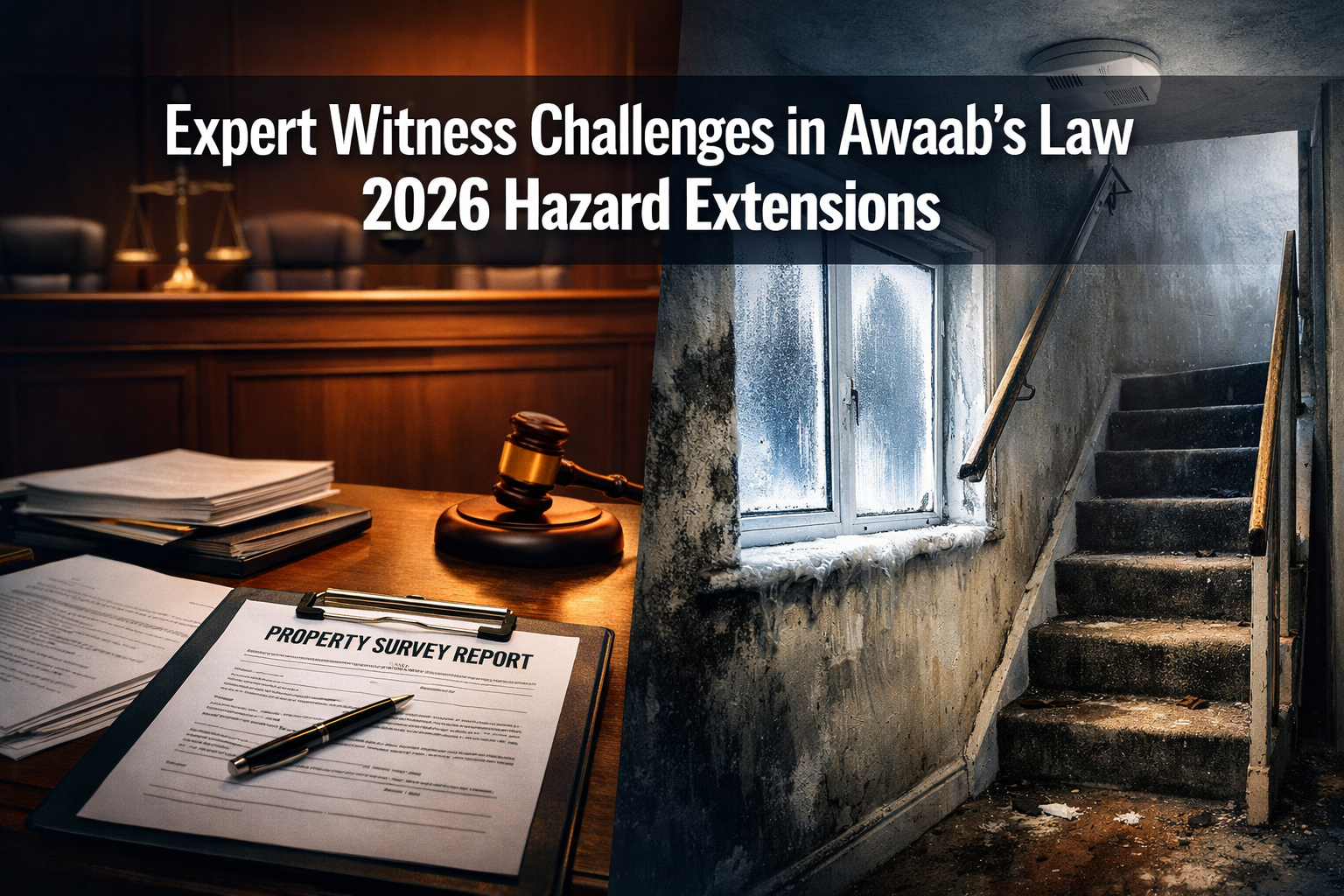
Over 250 errors, omissions, and contradictions were identified in the foundational evidence underpinning Awaab's Law Phase 1 — a forensic finding that sends a stark warning to every expert witness preparing reports for the expanded hazard categories arriving in October 2026. [1] The stakes for surveyors, environmental health officers, and building professionals acting as expert witnesses have never been higher. Expert Witness Challenges in Awaab's Law 2026 Hazard Extensions: Evidence Standards for Excess Cold, Falls, and Fire Risks sits at the intersection of housing law, forensic science, and professional accountability — and getting it wrong carries serious consequences for landlords, tenants, and the experts themselves.
Key Takeaways 📋
- Phase 2 of Awaab's Law launches October 2026, extending statutory investigation timelines to excess cold, heat, fire, electricity, and explosion risks beyond the existing damp and mould focus. [5]
- Over 250 evidential errors were identified in Phase 1 foundational evidence, highlighting the critical need for rigorous, defensible expert witness reports. [1]
- RICS protocols and HHSRS methodology form the backbone of defensible expert opinion in enforcement and tribunal proceedings.
- The Housing Ombudsman has warned that Phase 1 compliance may have created "false comfort," leaving many landlords unprepared for multi-hazard assessments. [3]
- Training gaps remain significant — frontline staff, surveyors, and contractors must be equipped to recognise and document cold, fire, and falls hazards to the standard courts and tribunals will expect. [2]
What Awaab's Law Phase 2 Actually Requires in 2026
Awaab's Law was born from tragedy. The death of two-year-old Awaab Ishak from prolonged exposure to mould in a Rochdale social housing flat prompted Parliament to act. Phase 1 introduced strict timelines for investigating and remedying damp and mould. Phase 2, launching October 2026, dramatically widens the scope. [5]
The Expanded Hazard Categories
Under Phase 2, social landlords face statutory investigation requirements for:
| Hazard Category | Examples |
|---|---|
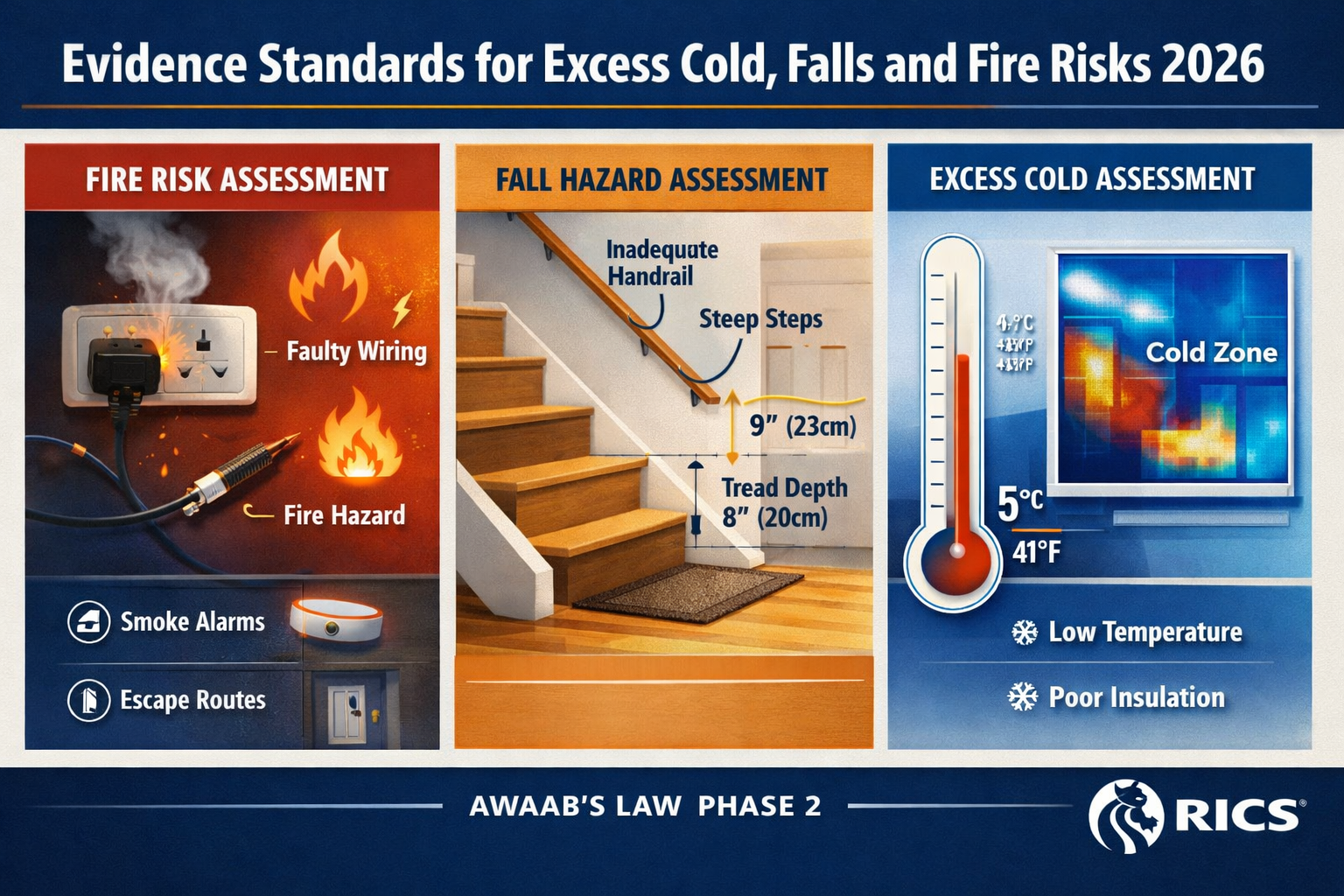
| Excess Cold | Inadequate heating, poor insulation, draughty windows |
| Excess Heat | Overheating in flats, lack of ventilation |
| Fire Risks | Faulty electrics, blocked escape routes, fire door defects |
| Explosion Risks | Gas leaks, unserviced boilers |
| Health and Hygiene | Sewage, pest infestation, inadequate sanitation |
Phase 3, planned for October 2027, will add asbestos, carbon monoxide, and falls protection to the statutory framework. [5]
A "significant hazard" is defined as one presenting a risk that a reasonable landlord would treat as requiring urgent action. [5] This apparently simple definition conceals enormous complexity when translated into expert evidence.
💬 "Policy weaknesses can lead to wrong processes — effective governance, robust data, and transparency are essential in complex multi-hazard cases." — Housing Ombudsman, March 2026 [3]
The Housing Ombudsman's March 2026 report specifically cautioned that Phase 1 compliance may have generated false confidence. Many landlords believe that having a damp and mould policy is sufficient preparation for Phase 2. It is not. [3] When multiple hazards exist in a single property — for example, excess cold combined with fire door defects — the assessment becomes far more complex, and the expert witness must be equipped to address each hazard independently and in combination.
Expert Witness Challenges in Awaab's Law 2026 Hazard Extensions: Evidence Standards for Excess Cold, Falls, and Fire Risks
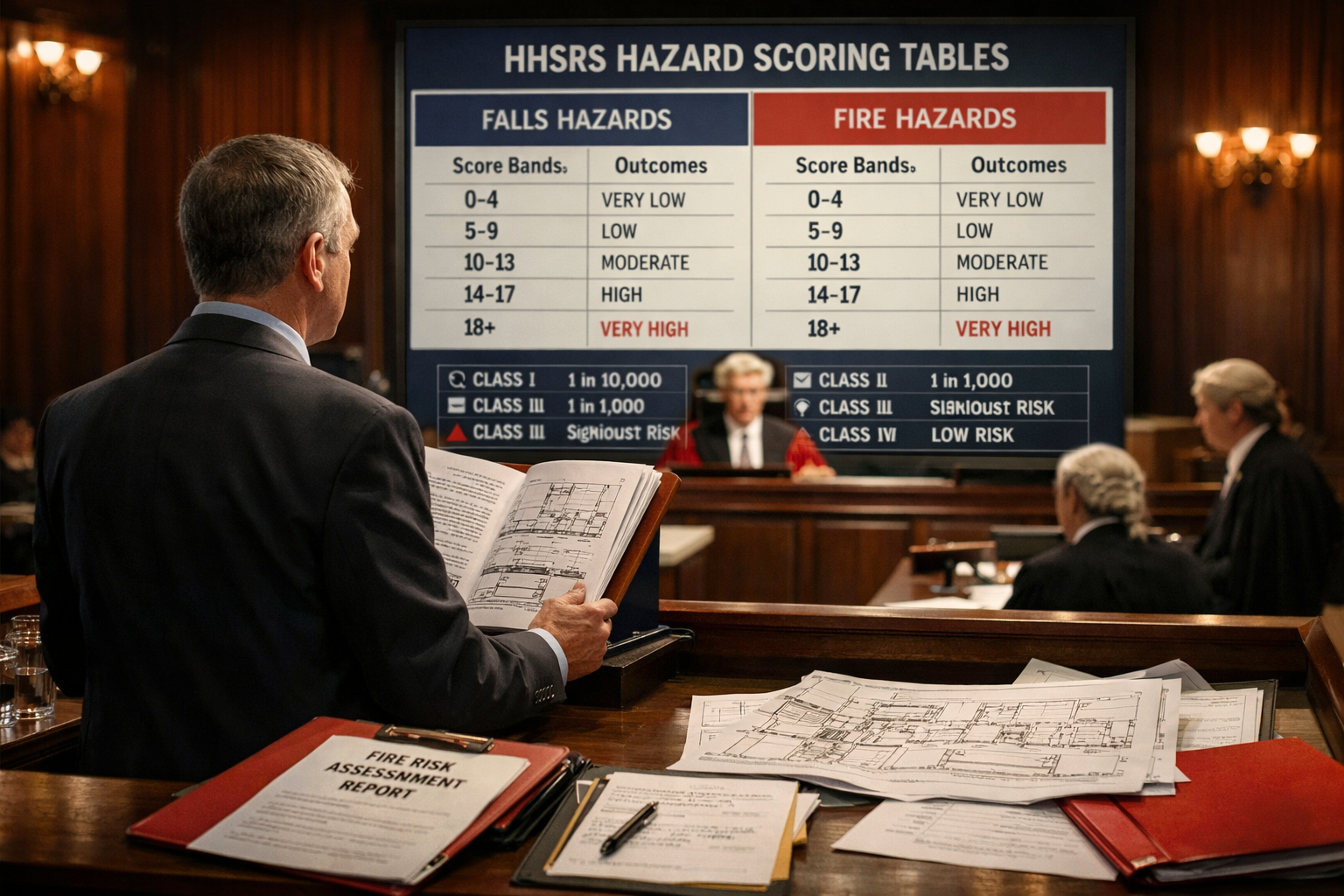
The core challenge facing expert witnesses in 2026 is producing reports that can withstand cross-examination in the First-tier Tribunal (Property Chamber), County Court, and Housing Ombudsman investigations. The evidentiary bar is high — and the forensic review of Phase 1 evidence has demonstrated exactly what happens when it is not met. [1]
The 250+ Errors Problem: A Cautionary Baseline
Jeff Charlton of Building Forensics (UK) published a review identifying more than 250 errors, omissions, and contradictions in the evidence base used to justify Awaab's Law Phase 1. These included failures in:
- 🔬 Environmental assessment methodology
- 🧪 Pathology and toxicology reasoning
- 📋 Investigative logic and chain of causation
- 📊 Data interpretation and statistical analysis
This is not merely an academic concern. Courts and tribunals increasingly scrutinise expert reports for methodological rigour. An expert witness who cannot defend their sampling methodology, calibration records, or interpretation of HHSRS hazard scores is vulnerable to having their opinion dismissed entirely. [1]
For those working on condition survey reports or specific defect surveys, the lessons from Phase 1 apply directly: documentation must be thorough, methodology must be transparent, and conclusions must follow logically from the evidence gathered.
Evidence Standards for Excess Cold Hazards
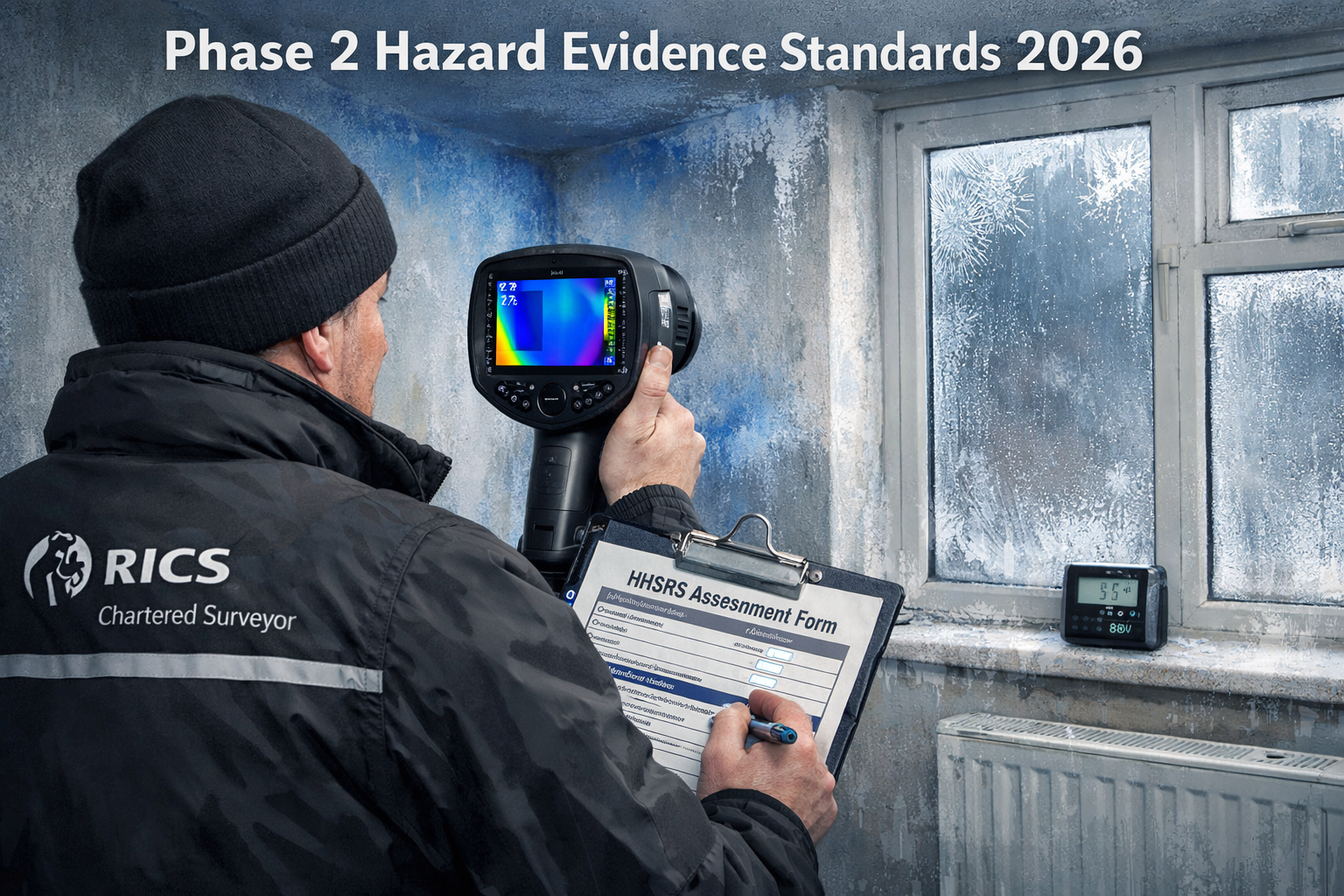
Excess cold is one of the most technically demanding hazards to assess. The HHSRS assigns a hazard score based on the likelihood of harm and the range of outcomes — from discomfort to death. For elderly or vulnerable tenants, inadequate heating can be life-threatening. Expert witnesses must demonstrate:
1. Quantified Temperature Data
- Continuous data logging over a minimum representative period (typically 48–72 hours minimum, longer for seasonal assessments)
- Calibrated instruments with traceable certification
- Measurements at multiple points including living areas, bedrooms, and bathrooms
2. Fabric Assessment
- U-value calculations for walls, roofs, and floors
- Window and door draught testing
- Thermal imaging evidence with calibrated cameras
3. Heating System Capacity
- Boiler output versus calculated heat loss
- Radiator sizing and distribution
- Evidence of system failures or inadequacy
4. HHSRS Scoring Methodology
The expert must demonstrate how the gathered data translates into an HHSRS hazard score. Vague assertions that a property "felt cold" will not survive challenge. Numerical evidence, referenced to HHSRS guidance and current building regulations, is essential.
Understanding structural defects is also relevant here — cold bridges, inadequate insulation at junctions, and thermal bypasses are structural issues that contribute directly to excess cold hazards and must be identified and documented.
Evidence Standards for Falls Hazards
Falls on stairs, steps, and ramps represent one of the most common causes of serious injury in residential properties. For Phase 3 (October 2027), falls protection will become a statutory investigation requirement — but expert witnesses should begin preparing now, as falls evidence is already being challenged in enforcement cases. [5]
Key evidence requirements include:
- Stair geometry: Rise, going, pitch angle — measured against Approved Document K
- Handrail and balustrade assessment: Height, continuity, structural integrity
- Surface condition: Slip resistance testing (pendulum test or surface roughness measurement)
- Lighting levels: Lux measurements at stair treads and landings
- Headroom: Measured clearances versus regulatory minimums
A common expert witness error is relying on visual inspection alone. Tribunals increasingly expect quantified measurements, photographic evidence with scale references, and explicit cross-referencing to the relevant regulatory standard.
Evidence Standards for Fire Risks
Fire risk evidence is particularly complex because it intersects with fire safety legislation (the Regulatory Reform (Fire Safety) Order 2005 and the Building Safety Act 2022) as well as HHSRS. Expert witnesses must be careful to distinguish between:
- HHSRS fire hazard assessment (relevant to Awaab's Law enforcement)
- Fire Risk Assessment under fire safety legislation (a separate but related document)
Key evidence elements for fire hazard expert reports:
| Evidence Type | What to Document |
|---|---|
| Fire detection | Alarm type, location, test records, battery status |
| Means of escape | Door widths, corridor lengths, escape route obstructions |
| Fire door compliance | Gap measurements, self-closer function, intumescent strips |
| Electrical installation | EICR date, fault categories, remediation records |
| Combustible materials | Storage in escape routes, cladding type if applicable |
⚠️ Critical point: An expert witness who conflates an HHSRS fire hazard score with a Fire Risk Assessment will face immediate challenge. These are distinct legal instruments with different methodologies.
Preparing Defensible Expert Reports: RICS Protocols and Best Practice
Expert witnesses operating under Awaab's Law 2026 hazard extensions must anchor their reports in recognised professional frameworks. The two most important are:
- RICS Professional Standards — particularly the Surveying Safely guidance and the RICS Guidance Note on Expert Witness Services
- HHSRS Operating Guidance (2006, as applied in 2026 enforcement context)
The Structure of a Defensible Report
A report that will withstand cross-examination in tribunal proceedings should follow this structure:
- Expert's declaration — confirming independence, qualifications, and overriding duty to the court
- Instructions received — verbatim or closely paraphrased
- Documents reviewed — complete list with dates
- Inspection methodology — instruments used, calibration records, inspection duration
- Findings — factual, numbered, referenced to evidence
- HHSRS assessment — hazard scoring with full workings shown
- Opinion — clearly distinguished from fact
- Limitations — what could not be assessed and why
Understanding what a surveyor does in professional practice is foundational — but acting as an expert witness adds a layer of legal obligation that goes beyond standard survey practice. The expert's primary duty is to the court, not to the instructing party.
Common Challenges Under Cross-Examination
Based on the pattern of errors identified in Phase 1 evidence [1] and the legal commentary emerging in early 2026 [4], expert witnesses in Awaab's Law cases face predictable lines of challenge:
- "What instruments did you use, and when were they last calibrated?" — Lack of calibration records is a frequent weakness.
- "How did you arrive at this HHSRS score?" — Unexplained scores suggest guesswork rather than methodology.
- "Did you consider alternative causes?" — Failure to address differential causation undermines credibility.
- "Is your opinion based on a single visit?" — Seasonal hazards like excess cold may require multiple visits.
- "Are you qualified in this specific hazard category?" — Surveyors must ensure their CPD covers Phase 2 hazard types. [2]
For those involved in legal disputes relating to property condition, the quality of expert evidence often determines the outcome. A poorly constructed report does not just lose a case — it can result in a wasted costs order and damage to professional reputation.
Training, Governance, and the Multi-Hazard Problem
The Housing Ombudsman's March 2026 report identified a systemic problem: many social landlords have invested heavily in damp and mould training but have not extended that investment to the Phase 2 hazard categories. [3] This creates a governance gap that expert witnesses will encounter repeatedly.
What Training Must Cover
According to compliance guidance for 2026, frontline staff, surveyors, and contractors must be trained to: [2]
- ✅ Recognise HHSRS hazard categories beyond damp and mould
- ✅ Understand the statutory investigation timelines for each hazard type
- ✅ Document hazards in a format that supports legal proceedings
- ✅ Escalate complex or multi-hazard cases to appropriately qualified professionals
- ✅ Understand when an expert witness report is required
The Multi-Hazard Assessment Challenge
When a property presents with excess cold and fire risks and a falls hazard, the assessment becomes exponentially more complex. Each hazard must be:
- Assessed independently using HHSRS methodology
- Documented with its own evidence base
- Scored separately (the highest Category 1 hazard triggers enforcement priority)
- Considered in combination where hazards interact (e.g., inadequate heating leading to use of portable heaters, increasing fire risk)
The Housing Ombudsman specifically flagged this interaction effect as an area where current landlord processes are weakest. [3] Expert witnesses who can demonstrate awareness of hazard interactions — and document them clearly — will produce significantly more persuasive reports.
For landlords and surveyors seeking to understand their legal requirements under the expanded framework, early engagement with qualified professionals is strongly advisable. Similarly, those dealing with dilapidations claims in the private rented sector should note that Awaab's Law enforcement can intersect with dilapidations proceedings in complex ways.
Governance Recommendations for Landlords
| Governance Area | Action Required |
|---|---|
| Policy review | Update hazard response policies to cover all Phase 2 categories |
| Data systems | Ensure repairs data captures hazard type, not just defect type |
| Contractor briefing | Brief contractors on HHSRS hazard recognition and reporting |
| Expert witness panel | Establish relationships with qualified expert witnesses before enforcement action |
| Transparency | Document decision-making processes to demonstrate reasonable landlord behaviour |
Conclusion: Actionable Steps for Expert Witnesses and Landlords in 2026
The expansion of Awaab's Law in October 2026 creates both risk and opportunity. For expert witnesses, the opportunity is to establish a reputation for rigorous, defensible reporting in a rapidly growing area of housing law. For landlords, the opportunity is to get ahead of enforcement by investing in proper assessment, training, and governance now.
Actionable next steps:
-
📐 Audit your methodology — Review your current inspection protocols against HHSRS guidance for excess cold, fire, and falls hazards. Ensure instruments are calibrated and records are maintained.
-
📚 Update your CPD — Ensure your continuing professional development covers Phase 2 hazard categories. Tribunals will ask about your qualifications in specific hazard types. [2]
-
📋 Strengthen your report structure — Adopt the structured report format outlined above. Every opinion must be traceable to a specific piece of evidence.
-
🔍 Address multi-hazard cases explicitly — Where multiple hazards exist, assess and document each independently, then consider interaction effects.
-
⚖️ Know your duty — As an expert witness, your overriding duty is to the court. Ensure your report reflects this, and be prepared to defend every conclusion under cross-examination.
-
🏢 Engage early — Landlords facing potential enforcement should instruct qualified surveyors and expert witnesses before proceedings commence, not after. For those in London, property surveyors across multiple locations can provide early-stage assessments that support proactive compliance.
The 250+ errors identified in Phase 1 evidence are a wake-up call. [1] Expert Witness Challenges in Awaab's Law 2026 Hazard Extensions: Evidence Standards for Excess Cold, Falls, and Fire Risks will only intensify as Phase 2 enforcement begins and tribunals develop their expectations. Those who invest in rigorous methodology, proper training, and defensible reporting now will be best placed to serve the justice system — and their clients — effectively.
References
[1] Awaabs Law Must Be Repealed And Re Written Claims Expert – https://housingdigital.co.uk/awaabs-law-must-be-repealed-and-re-written-claims-expert/
[2] Awaabs Law Phase 2 Is Coming What Social Landlords Need To Know About Additional Hazard Compliance In 2026 – https://www.mobysoft.com/resources/blogs/awaabs-law-phase-2-is-coming-what-social-landlords-need-to-know-about-additional-hazard-compliance-in-2026/
[3] Call For Focus On Early Warning Signs In Hazards Report – https://www.housing-ombudsman.org.uk/2026/03/26/call-for-focus-on-early-warning-signs-in-hazards-report/
[4] Awaabs Law Oddities And Observations – https://thelegalposition.co.uk/2026/01/27/awaabs-law-oddities-and-observations/
[5] How Awaabs Law Will Be Stress Tested In 2026 – https://theintermediary.co.uk/2026/02/how-awaabs-law-will-be-stress-tested-in-2026/
[6] Awaabs Law Deadlines Explained – https://awaabs-law.com/awaabs-law-deadlines-explained