
Buyer demand in the UK residential property market collapsed to a net balance of -26% in February 2026, marking one of the sharpest monthly contractions on record—then plummeted further to -39% in March 2026[1]. For expert witnesses defending property valuations in litigation, arbitration, or dispute resolution proceedings, this unprecedented volatility presents a critical challenge: how to construct defensible testimony when the market itself is experiencing seismic shifts driven by geopolitical events. The Expert Witness Challenges in Geopolitical Market Volatility: Using RICS February 2026 Data for Robust Valuations have become central to maintaining credibility in courtroom settings where opposing counsel will scrutinize every assumption, comparable sale, and market trend analysis.
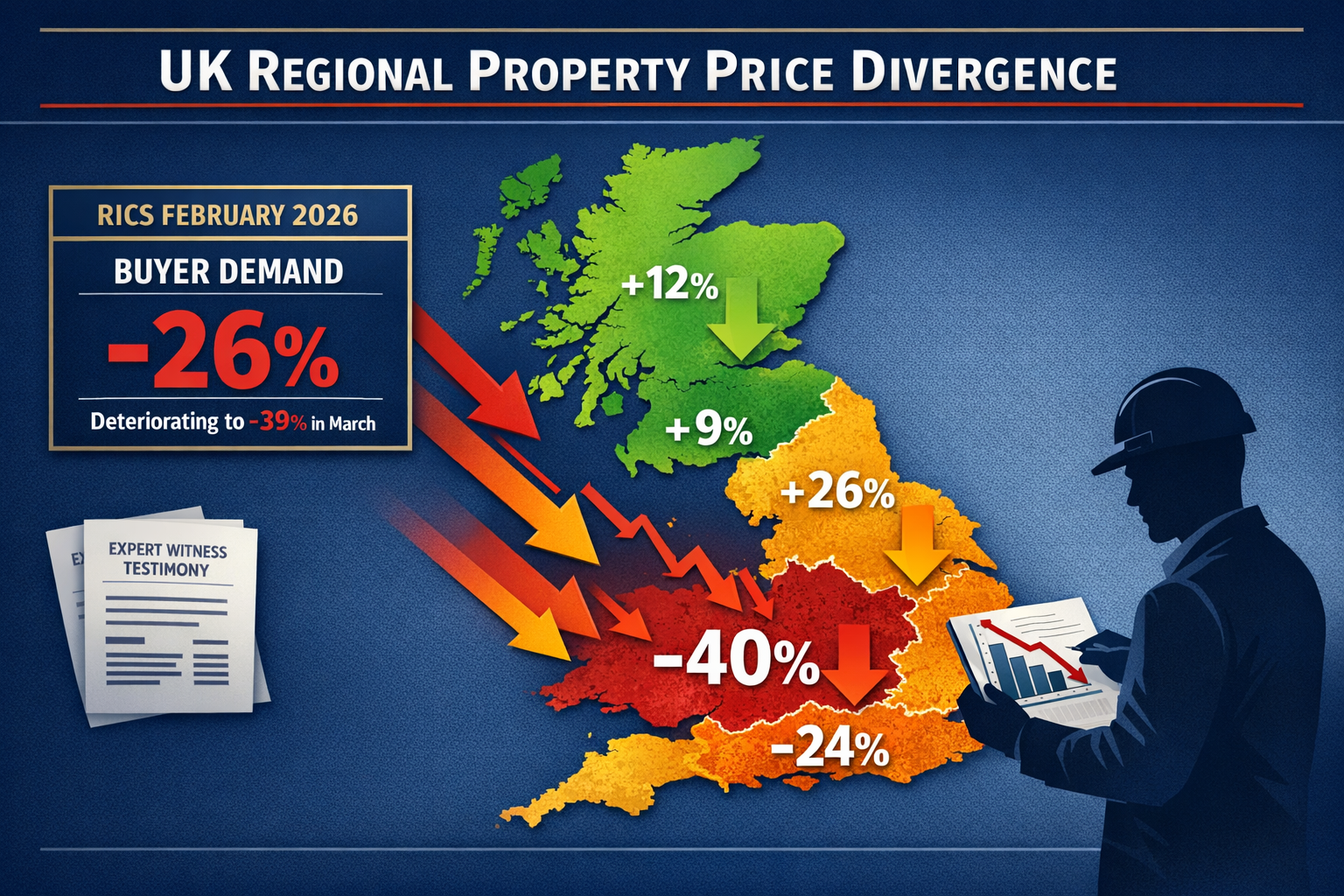
The Iran conflict that escalated in early 2026 created a documented causal link between geopolitical events and UK property market performance. RICS explicitly noted "downward momentum in confidence since the Iran conflict began with several respondents naming it directly"[1]. This creates both an opportunity and a burden for expert witnesses: while the data provides clear evidence of external market disruption, it also demands sophisticated methodological adjustments to account for volatility that traditional valuation approaches may not adequately capture.
Key Takeaways
- Regional price divergence reached extreme levels in February 2026, with London down 40% while Northern Ireland and Scotland showed resilience—requiring experts to defend region-specific valuation methodologies
- Oil price volatility surged to $119.5 per barrel during March 2026 conflict escalation, directly impacting mortgage rate expectations and discount rate assumptions in valuation models
- RICS survey data provides documented evidence of the Iran conflict's impact on buyer confidence, creating a defensible foundation for expert testimony about market disruption
- Short-term price expectations reversed sharply from -6% to -18% between January and February 2026, demonstrating the speed at which expert opinion formation must adapt
- Robust valuation methodology requires reconciling near-term pessimism (-39% demand collapse) with longer-term structural optimism (17% expecting sales increases over 12 months)
Understanding the February 2026 Market Context for Expert Witness Testimony
The Expert Witness Challenges in Geopolitical Market Volatility: Using RICS February 2026 Data for Robust Valuations begin with establishing the market context that existed during the valuation date. Expert witnesses must demonstrate comprehensive understanding of the specific conditions that prevailed in February 2026, distinguishing between temporary disruption and structural market shifts.
The Geopolitical Shock and Its Documented Impact
The Middle East conflict that intensified in early 2026 created measurable impacts across multiple market indicators. Brent crude oil surged to $119.5 per barrel on March 9, 2026 before retreating below $90[4], creating significant uncertainty about inflation trajectories and central bank policy responses. This volatility directly influenced mortgage rate expectations—a critical input for residential property valuations.
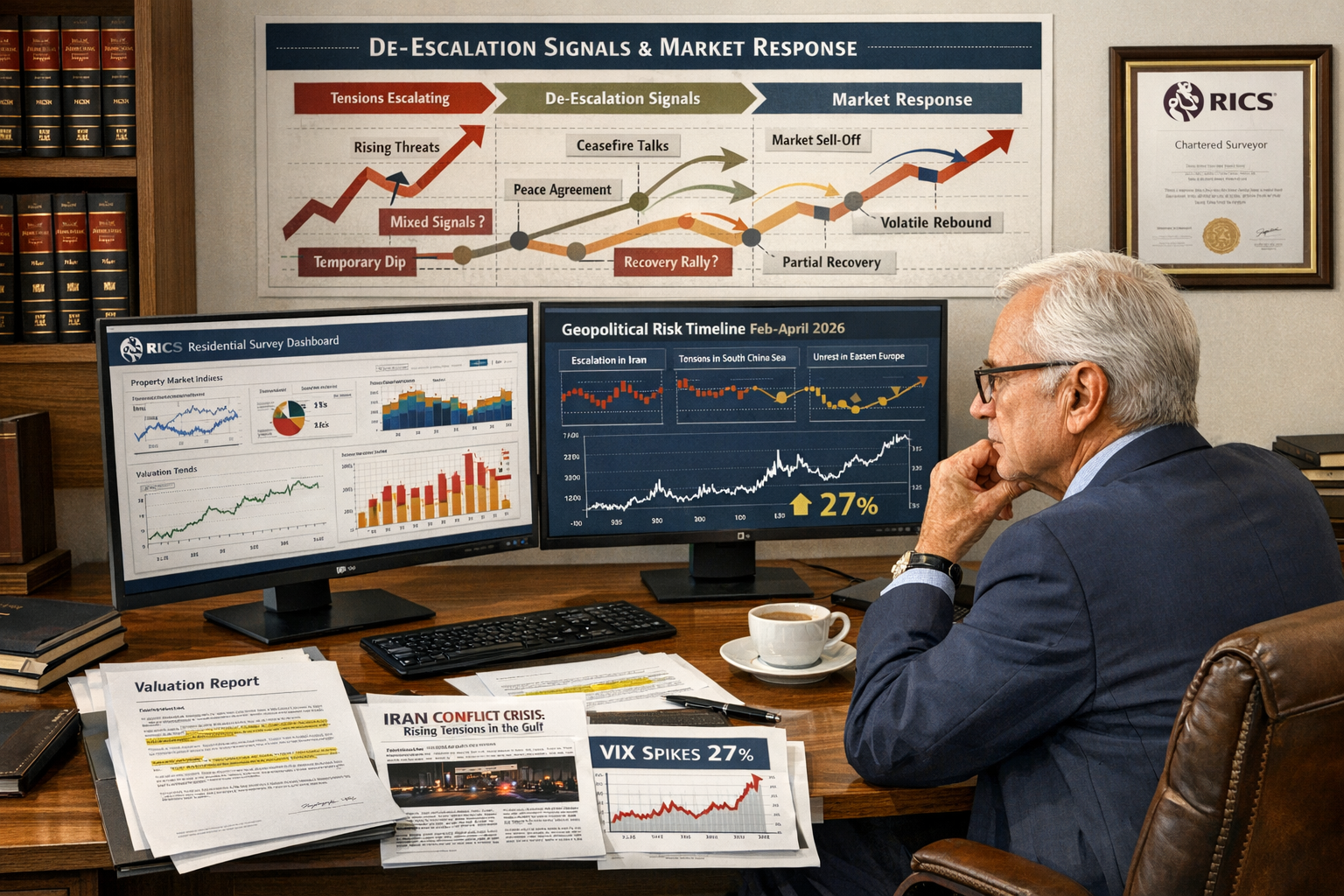
The VIX volatility index increased 27% since the beginning of the Middle East conflict[4], providing quantifiable evidence of elevated systemic risk. For expert witnesses, this creates an opportunity to defend higher discount rates in discounted cash flow valuations or to justify more conservative comparable selection criteria.
Regional Divergence Creates Valuation Complexity
One of the most significant Expert Witness Challenges in Geopolitical Market Volatility: Using RICS February 2026 Data for Robust Valuations involves addressing the pronounced regional price divergence documented in the RICS survey:
| Region | Price Change | Implications for Expert Testimony |
|---|---|---|
| London | -40% | Requires explanation of capital flight, international buyer withdrawal |
| South East | -24% | Moderate decline suggests commuter belt resilience |
| East Anglia | -26% | Similar to South East, regional economic factors |
| Northern Ireland | Positive trend | Demonstrates UK market is not monolithic |
| Scotland | Positive trend | Regional economic divergence from London-centric narrative |
| North West | Firmer trends | Industrial base and affordability factors |
This divergence means that expert witnesses cannot rely on national-level statistics when defending valuations in specific regions. A valuation conducted in London during February 2026 requires fundamentally different market context analysis than one conducted in Manchester or Edinburgh. RICS property valuations during this period demanded heightened attention to regional market dynamics.
The Buyer Demand Collapse and Comparable Sales Methodology
The collapse in buyer demand from -26% in February to -39% in March 2026[1] creates significant challenges for comparable sales methodology—the foundation of most residential property valuations. Expert witnesses must address:
- Transaction volume decline: Fewer sales mean fewer comparables, reducing statistical confidence
- Distressed sale risk: Declining demand may force some sales at below-market prices
- Time adjustment factors: Rapid market deterioration requires sophisticated time adjustments for older comparables
- Buyer motivation analysis: Distinguishing between strategic buyers and distressed purchasers
Professional data analysis becomes essential when comparable sales databases are compromised by market volatility.
Methodological Approaches to Address Expert Witness Challenges in Geopolitical Market Volatility

Constructing defensible expert testimony during periods of geopolitical market volatility requires methodological rigor that goes beyond standard valuation practice. The Expert Witness Challenges in Geopolitical Market Volatility: Using RICS February 2026 Data for Robust Valuations demand specific technical approaches that can withstand cross-examination.
Scenario Analysis and Sensitivity Testing
Given the documented uncertainty in February 2026 market conditions, expert witnesses should employ scenario analysis as a core component of their valuation methodology. This involves constructing multiple valuation scenarios based on different geopolitical and economic outcomes:
Base Case Scenario 📊
- Assumes gradual conflict de-escalation over 6-12 months
- Mortgage rates remain elevated but stable
- Buyer demand recovers to -10% net balance by Q4 2026
- Regional divergence persists but moderates
Pessimistic Scenario 📉
- Prolonged conflict extends beyond 12 months (consistent with State Street's April 2026 base case)[4]
- Oil prices remain volatile, averaging $100+ per barrel
- Buyer demand remains below -30% through year-end
- London and South East experience further 10-15% declines
Optimistic Scenario 📈
- Rapid conflict resolution within 3-6 months
- Oil prices stabilize below $85 per barrel
- Buyer demand recovers to positive territory by Q3 2026
- Pent-up demand creates recovery in transaction volumes
This scenario framework allows expert witnesses to demonstrate that their valuation conclusion is robust across multiple potential futures, rather than dependent on a single market trajectory that may prove incorrect.
Adjusting Discount Rates for Geopolitical Risk Premium
The 27% increase in the VIX volatility index[4] provides quantifiable justification for incorporating a geopolitical risk premium into discount rate calculations. Expert witnesses can defend higher discount rates by:
- Documenting the baseline risk-free rate prevailing in February 2026
- Calculating the equity risk premium based on historical UK market data
- Adding a geopolitical risk premium of 1.5-3.0% based on VIX increase and comparable historical conflict periods
- Applying property-specific risk adjustments for location, tenant quality, or lease structure
This approach transforms abstract geopolitical uncertainty into quantifiable valuation inputs that can be defended under cross-examination. Expert building evaluation during volatile periods requires this level of methodological sophistication.
Reconciling Short-Term Pessimism with Long-Term Optimism
One of the most significant Expert Witness Challenges in Geopolitical Market Volatility: Using RICS February 2026 Data for Robust Valuations involves reconciling contradictory market signals. The RICS data shows:
- Near-term pessimism: Price expectations fell from -6% to -18% between January and February 2026[1]
- Longer-term optimism: 17% of respondents expect sales activity to rise over the next 12 months[1]
Expert witnesses must explain this apparent contradiction in their testimony. The reconciliation typically involves:
Temporal Segmentation ⏰
- Acknowledging that short-term disruption (3-6 months) differs from structural trends (12-24 months)
- Explaining that rational market participants distinguish between temporary geopolitical shocks and fundamental property market drivers
- Demonstrating that UK residential property has historically recovered from external shocks within 12-18 months
Market Cycle Positioning 🔄
- Contextualizing February 2026 within the broader UK property cycle
- Identifying whether the market was already at peak, mid-cycle, or trough before the geopolitical shock
- Explaining how the conflict accelerated or decelerated existing market trends rather than creating entirely new dynamics
Using RICS Survey Balances as Evidentiary Support
The RICS survey data provides expert witnesses with credible, independent, third-party evidence that can be cited in testimony and reports. Key advantages include:
✅ Professional surveyor consensus: Data reflects opinions of qualified RICS members actively working in the market
✅ Documented causation: RICS explicitly linked confidence decline to Iran conflict[1]
✅ Regional granularity: Survey provides region-specific data supporting localized valuation adjustments
✅ Temporal precision: Monthly survey cadence allows precise dating of market sentiment shifts
✅ Forward-looking indicators: Price expectations and sales forecasts provide insight into market trajectory
When citing RICS data in expert reports, witnesses should:
- Quote specific net balance figures with source attribution
- Explain the survey methodology and sample size
- Acknowledge limitations (e.g., sentiment vs. transaction data)
- Cross-reference with transaction-based data sources where available
Professional chartered surveyors recognize that RICS survey data carries significant weight in dispute resolution proceedings.
Practical Strategies for Defending Valuations Under Cross-Examination
The ultimate test of Expert Witness Challenges in Geopolitical Market Volatility: Using RICS February 2026 Data for Robust Valuations comes during cross-examination. Opposing counsel will probe every assumption, challenge every comparable sale, and question every adjustment factor. Preparation is essential.
Anticipating Common Cross-Examination Challenges
Expert witnesses should prepare for these predictable lines of attack:
Challenge 1: "Your valuation relies on market conditions that were temporary and have since normalized"
Robust Response Strategy:
- Acknowledge that valuation reflects conditions at the specific valuation date (February 2026), not current conditions
- Cite legal precedent establishing that retrospective valuations must reflect information available at the valuation date
- Present RICS data showing that market participants in February 2026 could not have known the conflict duration or resolution timeline
- Explain that State Street's April 2026 analysis shifted toward "a more prolonged phase" of conflict[4], validating the uncertainty that existed in February
Challenge 2: "You've cherry-picked comparable sales that support your conclusion"
Robust Response Strategy:
- Document comprehensive comparable search methodology, including all properties considered
- Explain specific, objective criteria for including or excluding each comparable
- Present statistical analysis showing the selected comparables are representative of the broader market
- Acknowledge outliers and explain their treatment
- Provide sensitivity analysis showing valuation conclusion remains robust with alternative comparable selections
Challenge 3: "Regional price data contradicts your London-focused valuation"
Robust Response Strategy:
- Present RICS regional breakdown showing London's -40% divergence from national trends[1]
- Explain London-specific factors: international buyer withdrawal, currency effects, higher price point sensitivity
- Cite precedent establishing that regional data supersedes national data for location-specific valuations
- Demonstrate awareness of positive trends in Northern Ireland and Scotland while explaining their irrelevance to London property valuation
Documenting Assumptions and Limitations
Credible expert testimony requires transparent disclosure of all assumptions and limitations. The Expert Witness Challenges in Geopolitical Market Volatility: Using RICS February 2026 Data for Robust Valuations demand that witnesses explicitly state:
Market Assumptions 🏘️
- Buyer demand trends based on RICS net balance of -26% in February 2026
- Mortgage rate expectations incorporating oil price volatility impacts
- Transaction volume assumptions and their impact on comparable sales availability
- Regional price trend assumptions specific to the subject property location
Geopolitical Assumptions 🌍
- Conflict duration assumptions (with acknowledgment of uncertainty)
- Oil price trajectory assumptions and sensitivity analysis
- Central bank policy response assumptions
- Currency and international investment flow assumptions
Methodology Limitations ⚠️
- Comparable sales data quality issues during volatile periods
- Reduced transaction volumes limiting statistical confidence
- Potential for distressed sales contaminating comparable databases
- Time lag between RICS survey data collection and publication
Professional building surveyor services recognize that transparent limitation disclosure enhances rather than undermines expert credibility.
Leveraging RICS Data for Price Expectation Arguments
The RICS February 2026 survey provides specific data points that expert witnesses can leverage to support price expectation arguments:
Short-Term Price Expectations 📉
- Professional surveyors' expectations fell from -6% (January) to -18% (February)[1]
- This 12-percentage-point deterioration in one month demonstrates rapid sentiment shift
- Expert witnesses can cite this as evidence that market participants expected further price declines
- Supports conservative valuation approaches and higher discount rates
Rental Market Divergence 🏢
- 20% of surveyors expected rents to rise over the coming three months[1]
- Creates divergent implications for buy-to-let investment valuations
- Supports arguments about yield compression and investment value vs. market value distinctions
- Relevant for income-producing property valuations using capitalization rate methodology
Sales Activity Forecasts 📊
- 17% net balance expecting sales activity to rise over 12 months[1]
- Provides evidence of longer-term market optimism despite near-term weakness
- Supports arguments against applying excessive long-term pessimism adjustments
- Relevant for defending valuation conclusions that incorporate market recovery assumptions
Addressing Mortgage Rate and Affordability Impacts
RICS Head of Market Research noted that "the recent rise in oil and energy prices has also increased the likelihood that mortgage rates will remain higher for longer"[1]. This creates structural challenges for experts defending valuations that incorporate lower mortgage rate assumptions.
Expert witnesses should:
- Document prevailing mortgage rates at the February 2026 valuation date across multiple lenders and product types
- Explain the transmission mechanism from oil prices to inflation expectations to central bank policy to mortgage rates
- Quantify affordability impacts using mortgage payment calculations at different rate scenarios
- Adjust comparable sales for differences in financing conditions if transactions occurred during different rate environments
- Consider buyer pool contraction as higher rates eliminate marginal buyers from the market
Construction law and property dispute cases increasingly involve detailed analysis of financing condition impacts on property values.
Integrating RICS Data with Other Market Intelligence Sources
While RICS February 2026 data provides crucial evidence for expert witnesses, robust valuations require integration with multiple data sources to create a comprehensive market picture.
Cross-Referencing Transaction Data
Expert witnesses should cross-reference RICS sentiment data with actual transaction data from:
- Land Registry price paid data: Provides actual sale prices for completed transactions
- Rightmove and Zoopla asking price indices: Shows listing price trends and time-on-market changes
- Mortgage approval data: Bank of England statistics on mortgage lending volumes
- Auction results: Provides insight into distressed sale pricing and investor demand
Discrepancies between RICS sentiment data and transaction data should be acknowledged and explained. For example, if RICS shows -26% buyer demand but transaction volumes remain relatively stable, expert witnesses must explain this apparent contradiction (e.g., pent-up demand from earlier periods, completion lag effects, regional variation).
Incorporating Geopolitical Risk Analysis
S&P Global's Geopolitical Risk Brief for February 2026[3] provides complementary analysis that expert witnesses can cite alongside RICS data. Integration strategies include:
Risk Scenario Mapping 🗺️
- Align S&P geopolitical scenarios with RICS market sentiment data
- Demonstrate how specific geopolitical developments (conflict escalation, de-escalation signals) correlate with RICS survey responses
- Create timeline showing geopolitical events alongside RICS monthly data points
Quantitative Risk Metrics 📈
- Cite VIX volatility increase of 27%[4] as quantifiable risk measure
- Reference oil price movements ($119.5 peak, subsequent retreat below $90)[4]
- Calculate correlation between geopolitical risk indicators and RICS net balance changes
Expert Credibility Enhancement ✅
- Demonstrate comprehensive market knowledge beyond single data source
- Show awareness of broader economic and geopolitical context
- Establish that valuation methodology accounts for multiple risk factors
Professional survey research principles emphasize the importance of triangulating multiple data sources.
Addressing the De-Escalation Signal Problem
One of the most challenging aspects of Expert Witness Challenges in Geopolitical Market Volatility: Using RICS February 2026 Data for Robust Valuations involves the inconsistent market response to de-escalation signals. State Street noted that markets "repeatedly triggered sharp but short-lived risk-on moves, often reversing when those signals failed to translate into lasting outcomes"[4].
This creates a dilemma for expert witnesses:
Problem: If markets responded positively to de-escalation signals that subsequently failed, how should valuations account for this pattern?
Solution Framework:
- Acknowledge the pattern: Demonstrate awareness that markets exhibited false starts during the conflict period
- Explain market learning: Show that market participants became increasingly skeptical of de-escalation signals over time
- Justify conservative assumptions: Use the pattern of failed de-escalation as justification for not incorporating optimistic assumptions
- Apply probability weighting: Rather than binary assumptions (conflict continues vs. resolves), apply probability weights to multiple scenarios
This nuanced approach demonstrates sophisticated market understanding that enhances expert credibility.
Building a Defensible Valuation Report Structure
The written expert report is the foundation of testimony. The Expert Witness Challenges in Geopolitical Market Volatility: Using RICS February 2026 Data for Robust Valuations require a report structure that clearly communicates methodology, assumptions, and conclusions.
Essential Report Components
Executive Summary 📋
- Valuation conclusion with range (if appropriate)
- Key assumptions explicitly stated
- Major limiting conditions
- Certification of independence and compliance with RICS standards
Market Context Section 🌐
- Comprehensive analysis of February 2026 market conditions
- RICS survey data with specific net balance figures cited[1]
- Geopolitical context including Iran conflict timeline
- Regional market analysis with divergence data
- Mortgage rate and affordability analysis
Methodology Section 🔧
- Detailed explanation of valuation approach (comparable sales, income capitalization, etc.)
- Comparable selection criteria and search methodology
- Adjustment factors and their derivation
- Scenario analysis framework
- Sensitivity testing results
Valuation Analysis Section 💰
- Comparable sales grid with detailed adjustments
- Discount rate or capitalization rate derivation
- Reconciliation of multiple valuation approaches
- Explanation of weight given to each approach
Assumptions and Limitations Section ⚠️
- Market assumptions based on RICS data
- Geopolitical assumptions and uncertainty acknowledgment
- Data quality limitations
- Scope limitations
Appendices 📎
- RICS survey data excerpts with source attribution
- Comparable sales details and photographs
- Market data sources and references
- Expert qualifications and CV
Professional commercial property inspections and valuations during volatile periods require this level of documentation rigor.
Visual Data Presentation Strategies
Expert reports should incorporate visual elements that make complex data accessible:
RICS Data Visualizations 📊
- Line graphs showing buyer demand trend from positive territory through -26% (February) to -39% (March)[1]
- Regional heat maps showing price divergence across UK regions
- Bar charts comparing short-term vs. long-term price expectations
Comparable Sales Maps 🗺️
- Geographic distribution of comparable sales
- Visual representation of regional price variation
- Distance circles showing comparable proximity to subject property
Sensitivity Analysis Tables 📈
- Matrix showing valuation conclusion under different discount rate assumptions
- Scenario comparison table showing base/pessimistic/optimistic outcomes
- Adjustment factor sensitivity showing impact of different adjustment magnitudes
Visual presentation enhances comprehension during testimony and makes reports more persuasive to judges, arbitrators, or juries who may lack technical valuation expertise.
Conclusion
The Expert Witness Challenges in Geopolitical Market Volatility: Using RICS February 2026 Data for Robust Valuations represent a critical inflection point for property valuation professionals. The unprecedented buyer demand collapse to -26% in February 2026, deteriorating further to -39% in March[1], combined with extreme regional divergence (London -40%, Northern Ireland positive)[1], creates a complex evidentiary landscape that demands methodological sophistication and transparent disclosure.
Expert witnesses who successfully navigate these challenges share common characteristics:
✅ Comprehensive market knowledge: Deep understanding of RICS data, geopolitical context, and regional market dynamics
✅ Methodological rigor: Scenario analysis, sensitivity testing, and multiple valuation approach reconciliation
✅ Transparent assumption disclosure: Clear statement of all assumptions, limitations, and uncertainty
✅ Cross-examination preparedness: Anticipation of challenges and development of robust response strategies
✅ Multi-source data integration: Triangulation of RICS sentiment data with transaction data and geopolitical analysis
Actionable Next Steps for Expert Witnesses
For valuation professionals preparing expert testimony involving February-March 2026 valuations:
-
Obtain complete RICS survey data for February and March 2026, including regional breakdowns and all net balance figures[1]
-
Document the geopolitical timeline with specific dates for conflict escalation, oil price movements, and de-escalation signals[4]
-
Develop scenario analysis framework incorporating base/pessimistic/optimistic cases with probability weights
-
Conduct comprehensive comparable sales analysis with explicit documentation of selection criteria and time adjustments
-
Prepare detailed cross-examination responses for predictable challenges regarding market normalization, comparable selection, and regional data
-
Engage with professional surveyor services to ensure methodology aligns with current RICS standards and best practices
-
Consider peer review of valuation methodology and conclusions before finalizing expert report
The February 2026 market conditions created by geopolitical volatility will likely feature in property disputes, litigation, and arbitration proceedings for years to come. Expert witnesses who master the integration of RICS survey data with robust valuation methodology will provide the most credible and defensible testimony, ultimately serving the interests of justice and accurate property valuation.
For property professionals seeking guidance on navigating these complex valuation challenges, consultation with experienced building surveyor specialists who understand both technical methodology and expert witness requirements is essential. The stakes are high, but the RICS February 2026 data provides a solid evidentiary foundation for those who know how to use it effectively.
References
[1] Uk Residential Survey February 2026 – https://www.rics.org/news-insights/uk-residential-survey-february-2026
[2] Valuation Challenges In Uncertain Markets Using Rics February 2026 Data To Adjust Valuations Amid Geopolitical Volatility And Interest Rate Concerns – https://nottinghillsurveyors.com/blog/valuation-challenges-in-uncertain-markets-using-rics-february-2026-data-to-adjust-valuations-amid-geopolitical-volatility-and-interest-rate-concerns
[3] Geopolitical Risk Brief February 2026 – https://www.spglobal.com/market-intelligence/en/news-insights/research/2026/02/geopolitical-risk-brief-february-2026
[4] Mind On The Market 06 April 2026 – https://www.ssga.com/us/en/institutional/insights/mind-on-the-market-06-april-2026