
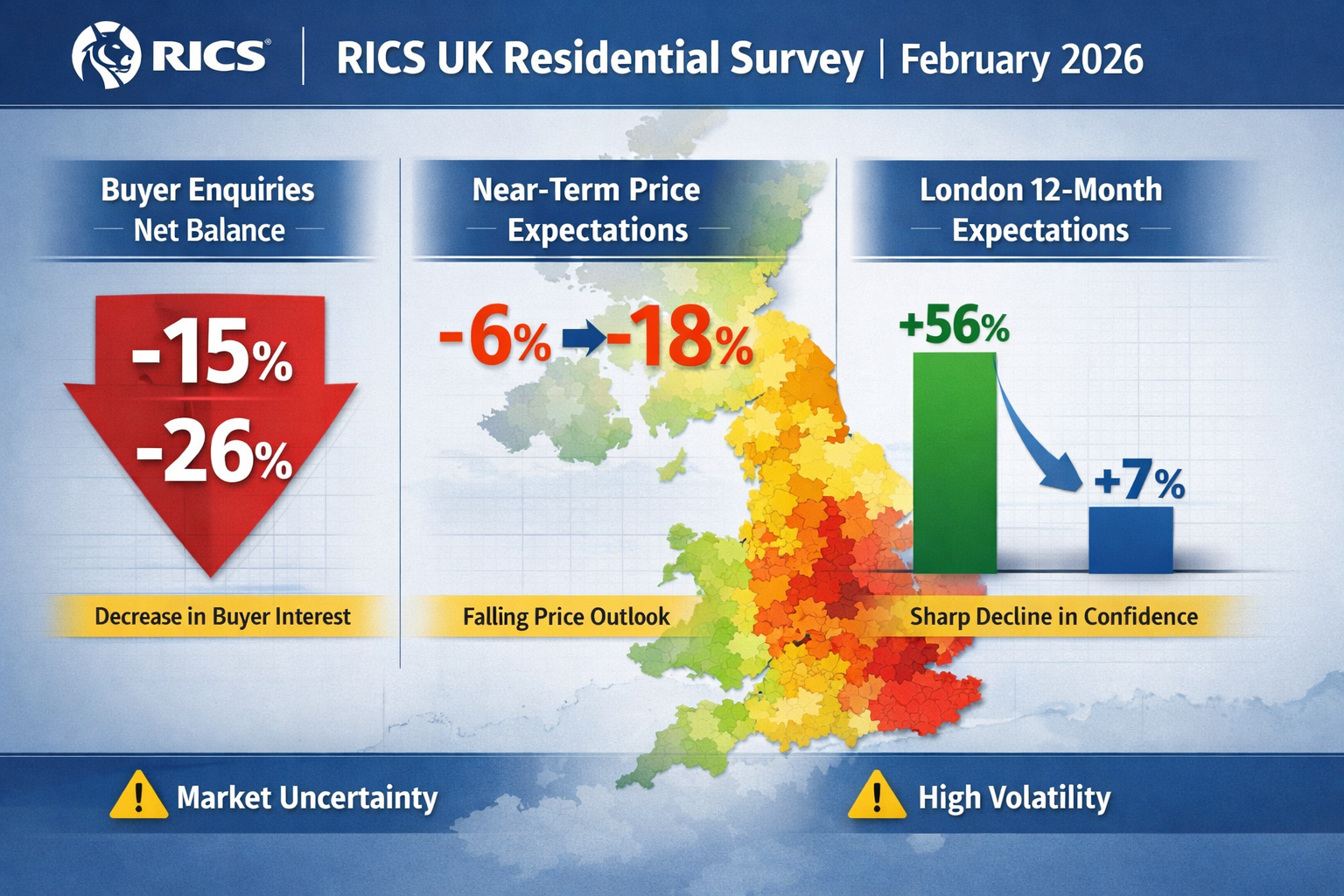
New buyer enquiries plummeted to a net balance of -26% in February 2026—the sharpest decline since early 2024—while near-term price expectations collapsed from -6% to -18% in just one month.[3] These dramatic shifts in the RICS UK Residential Survey reveal a housing market gripped by uncertainty, creating a perfect storm where automated valuation models (AVMs) struggle to capture the nuanced reality that professional surveyors navigate daily. As transaction volumes decline and regional markets diverge dramatically, the debate over Defending Surveyor Valuations Against AVMs in Cautious Q2 2026 Markets: RICS Insights from February Residential Survey has never been more critical for property professionals, lenders, and buyers alike.
The February 2026 RICS data exposes fundamental weaknesses in algorithm-driven valuations during periods of market volatility. When London's 12-month price expectations crashed from +56% to just +7%,[3] it highlighted how rapidly sentiment can shift—changes that AVMs, relying on historical data patterns, simply cannot anticipate or contextualize with the sophistication of RICS-qualified surveyors.
Key Takeaways
- Buyer demand weakness: New buyer enquiries fell to -26% in February 2026, creating data scarcity issues that undermine AVM reliability and comparable sales methodologies
- Regional divergence challenges: London's price expectations collapsed from +56% to +7%, demonstrating dramatic regional variations that AVMs struggle to capture accurately
- Professional judgment remains essential: RICS standards require mandatory human oversight for all AVM usage, with written disclosure to clients before deployment[4]
- Data quality determines accuracy: AVMs are only as reliable as their training data—outdated or biased datasets produce flawed valuations, particularly dangerous in volatile Q2 2026 markets[1]
- Complex properties need human expertise: AVMs work best for standard, homogeneous properties but fail to account for property condition, unique features, and context-specific factors that qualified valuers identify[1]
Understanding the Q2 2026 Market Context for Defending Surveyor Valuations Against AVMs
The housing market entering Q2 2026 presents unprecedented challenges for valuation professionals. The RICS UK Residential Survey for February 2026 reveals a market characterized by weakened buyer demand, declining transaction volumes, and significant regional price divergence—conditions that expose the fundamental limitations of automated valuation models.[3]
Declining Buyer Demand and Transaction Volumes
The net balance of new buyer enquiries dropped sharply to -26% in February 2026, down from -15% in January.[3] This decline creates a cascading effect on valuation reliability:
- Fewer comparable sales: Lower transaction volumes mean less recent data for valuers to reference
- Outdated pricing signals: AVMs relying on historical transactions become increasingly disconnected from current market sentiment
- Data scarcity issues: Thin markets make it harder to identify truly comparable properties[6]
When transaction volumes decline, the foundation upon which AVMs operate—large datasets of recent, comparable sales—begins to crumble. Professional surveyors, however, can incorporate market intelligence, buyer sentiment, and forward-looking indicators that algorithms cannot process effectively.
Near-Term Price Pessimism
Near-term price expectations deteriorated significantly, falling to -18% from -6% in just one month.[3] This rapid sentiment shift illustrates a critical weakness in AVM methodology: algorithms trained on historical patterns cannot anticipate or adjust to sudden changes in market psychology.
A qualified building surveyor conducting a valuation in Q2 2026 incorporates:
✅ Current market sentiment and buyer confidence levels
✅ Economic indicators affecting purchasing power
✅ Local market dynamics and upcoming supply changes
✅ Property-specific features that may appeal differently in cautious markets
AVMs, by contrast, rely primarily on backward-looking data, making them inherently reactive rather than responsive to emerging market conditions.
Regional Price Divergence
Perhaps the most striking finding from the February 2026 RICS survey is the dramatic regional divergence in price expectations. London's 12-month price expectations collapsed from +56% to just +7%,[3] while other regions showed different trajectories entirely.
| Region | Previous Expectation | February 2026 | Change |
|---|---|---|---|
| London | +56% | +7% | -49 points |
| Regional variations | Varied | Varied | Significant divergence |
This regional divergence creates a valuation minefield for AVMs, which typically apply broad algorithmic models across different geographies without the nuanced understanding of local market dynamics that experienced property surveyors bring to each assessment.[6]
The Fundamental Limitations of AVMs in Defending Surveyor Valuations Against AVMs in Cautious Q2 2026 Markets
Automated valuation models have gained traction in recent years due to their speed and cost-effectiveness, but the RICS guidance and February 2026 market conditions expose critical weaknesses that make them unsuitable as standalone valuation tools—particularly in complex or volatile markets.
Data Quality Dependency
AVMs are only as good as their training data. This fundamental principle becomes particularly problematic in Q2 2026 markets characterized by rapid change and data scarcity.[1]
RICS guidance on responsible AI use in valuation emphasizes that if foundational data is:
- Outdated: The model reflects past market conditions, not current reality
- Incomplete: Missing data points create blind spots in valuation accuracy
- Biased: Training data skewed toward certain property types or regions produces systematically flawed outputs[1]
In the cautious Q2 2026 market, with declining transaction volumes, the data refresh rate for AVMs slows significantly. Meanwhile, market sentiment shifts rapidly—creating a dangerous disconnect between AVM outputs and actual market values.
"The output of an AVM is only as good as the data that has been used to train the model. If the data is outdated, incomplete, or biased, the model's output will have significant weaknesses."[1]
Inability to Assess Property Condition and Unique Features
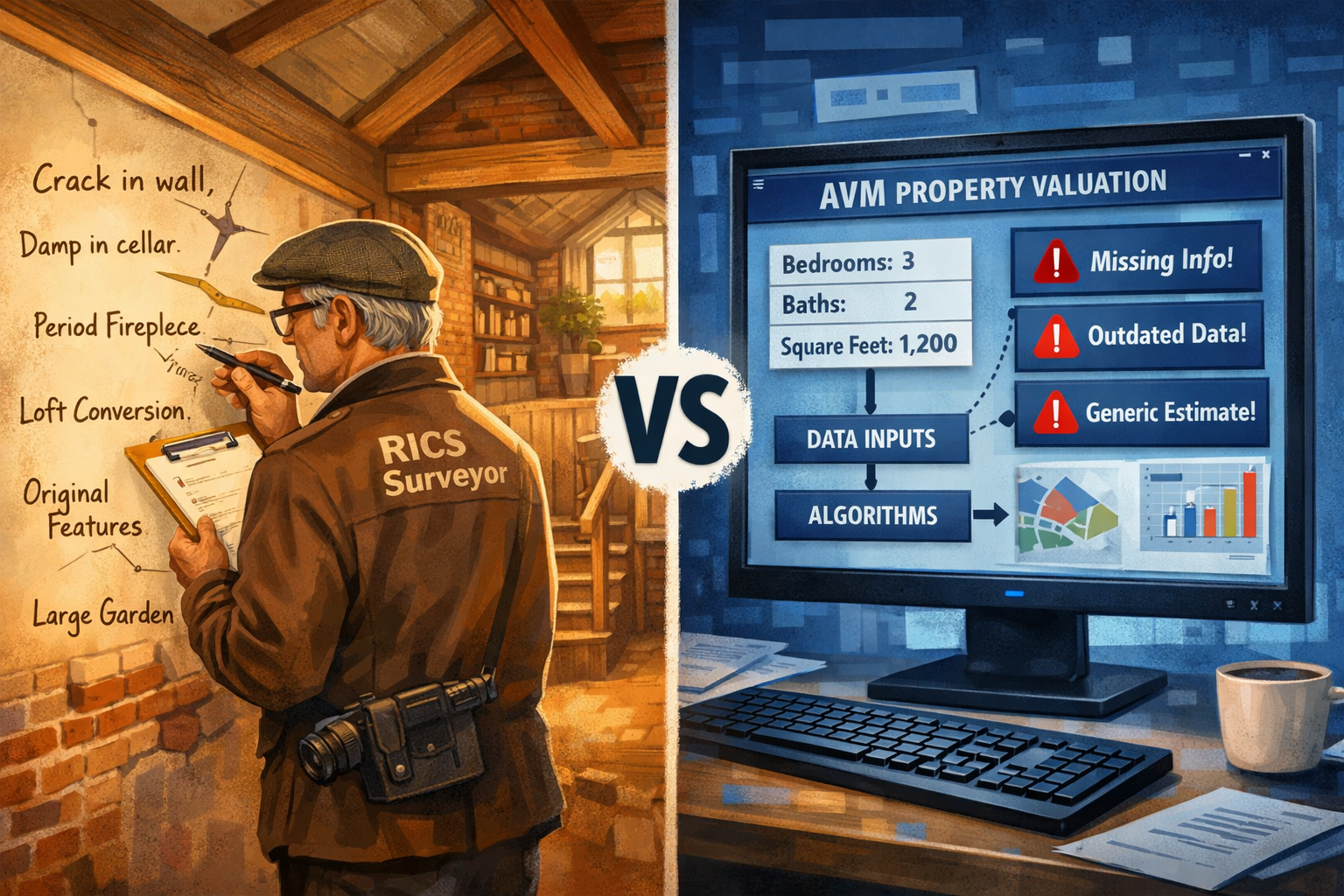
RICS research confirms that AVMs are more reliable only for standard, homogeneous properties and typically do not account for property condition or specific features at scale.[1] This limitation becomes critical when defending surveyor valuations against AVM-generated figures.
Consider a Victorian terrace in Notting Hill versus Bromley. An AVM might identify similar square footage, bedroom count, and general location characteristics. However, a qualified surveyor would identify:
🏚️ Structural condition differences: subsidence, damp, roof condition
🎨 Period features: original cornicing, fireplaces, architectural details
🔧 Modernization quality: kitchen and bathroom standards, heating systems
📍 Micro-location factors: proximity to transport, schools, amenities
🏗️ Potential for development: loft conversion feasibility, extension possibilities
These factors can create valuation differences of 15-30% or more—differences that AVMs systematically fail to capture.[1]
Inherent Bias Risks
RICS 2026 guidance identifies that valuation models trained on biased data may generate inaccurate outputs, potentially skewing results to generate higher or lower property valuations.[4] This bias can manifest in several ways:
- Geographic bias: Over-representation of certain regions in training data
- Property type bias: More data for common property types, less for unique properties
- Historical bias: Training data reflecting past market conditions that no longer apply
- Socioeconomic bias: Data patterns that inadvertently reflect discriminatory historical practices
In the diverse London property market—from Knightsbridge to Lewisham—these biases can produce systematically inaccurate valuations that disadvantage certain properties or areas.
Regional Market Complexity
The February 2026 RICS data showing London's dramatic price expectation collapse from +56% to +7%[3] illustrates how regional markets can diverge significantly from national trends. AVMs typically struggle with this complexity because:
- National models lack local granularity: Broad algorithms cannot capture neighborhood-specific dynamics
- Regional models require substantial local data: Thin markets don't provide enough transactions for reliable regional AVMs
- Micro-markets shift rapidly: Local factors (new transport links, school catchment changes, regeneration projects) affect values in ways algorithms cannot anticipate
A professional surveyor in Camberwell understands how the local market differs from Kingston or Redbridge—knowledge that no algorithm can replicate without extensive, continuously updated local data.
RICS Standards for Defending Surveyor Valuations Against AVMs in Cautious Q2 2026 Markets
The Royal Institution of Chartered Surveyors has established clear professional standards governing the use of AVMs and the role of qualified valuers, particularly relevant when defending professional valuations against automated outputs in uncertain markets.
Mandatory Human Oversight Requirement
All AVM usage requires mandatory human input and oversight from a chartered surveyor and registered valuer.[2] This is not merely a recommendation—it is a professional requirement that recognizes the limitations of algorithmic approaches.
RICS guidance specifies that valuers must be:
✔️ Sufficiently skilled and competent in AVM use and interpretation
✔️ Able to critically assess AVM outputs against professional judgment
✔️ Responsible for the final valuation, regardless of AVM input
✔️ Compliant with Red Book standards for all regulated valuations
This human oversight requirement acknowledges that AVMs are tools to support professional judgment, not replacements for it—especially in complex, high-value, or contentious valuations.[1]
Written Disclosure Requirements
Before using AI or AVM tools, RICS members must disclose in writing, in advance, their use of these technologies to clients.[4] This transparency requirement serves several purposes:
- Informed consent: Clients understand how their valuation is being produced
- Professional accountability: Valuers remain responsible for outputs despite technological assistance
- Quality assurance: Clients can request fully manual valuations if concerned about AVM limitations
- Risk management: Clear documentation protects both client and valuer
In the cautious Q2 2026 market, where valuation accuracy carries heightened importance for lending decisions and purchase negotiations, this disclosure requirement becomes particularly significant.
The RICS Red Book Standard
The RICS Red Book (RICS Valuation – Global Standards) remains the established benchmark for competent valuation practice.[1] For complex, high-value, or contentious valuations, the Red Book standards require:
- Fully qualified valuation professionals: Not AVMs or automated processes
- Comprehensive property inspection: Physical assessment of condition and features
- Market analysis: Consideration of current market conditions and trends
- Professional judgment: Interpretation of data within market context
- Transparent methodology: Clear explanation of valuation approach and reasoning
When defending surveyor valuations against AVM outputs, reference to Red Book compliance provides a robust professional foundation. A homebuyers survey or building survey conducted to Red Book standards carries professional weight that no AVM output can match.
AVMs as Support Tools, Not Replacements
RICS guidance is explicit: for valuations informing lending decisions, legal disputes, or investment decisions, AVMs should only be used to support the valuation process.[1] The expertise of qualified professionals remains critical for:
🔍 Interpreting data within current market context
🏛️ Identifying context-specific factors affecting value
⚖️ Ensuring compliance with professional standards
📊 Providing defensible valuations that withstand scrutiny
In Q2 2026's uncertain market, where buyer sentiment has shifted dramatically and regional divergence is pronounced, this supporting role for AVMs becomes even more appropriate. The technology can provide data points and preliminary estimates, but professional judgment must interpret and validate these outputs.

Practical Strategies for Defending Surveyor Valuations Against AVMs
When faced with AVM-generated valuations that differ from professional surveyor assessments, property professionals need clear strategies to defend their expert opinions while acknowledging the role technology can play in the valuation process.
Document Property-Specific Factors
The most effective defense against AVM challenges is comprehensive documentation of property-specific factors that algorithms cannot capture:
Structural and Condition Factors:
- Detailed condition assessment of major elements (roof, walls, foundations)
- Evidence of defects, repairs, or maintenance issues
- Quality of construction and materials used
- Age-related deterioration or modernization
Unique Property Features:
- Period features and architectural significance
- Quality of finishes and fixtures
- Layout optimization and space utilization
- Natural light, views, and aspect
Micro-Location Considerations:
- Proximity to transport links, schools, and amenities
- Street characteristics and neighborhood quality
- Noise, pollution, or other environmental factors
- Future development plans affecting the area
A comprehensive Level 3 survey provides the detailed documentation needed to justify valuation differences from AVM outputs, particularly for older or non-standard properties.
Leverage Comparable Sales Analysis
While AVMs use comparable sales data, professional valuers apply this methodology with greater sophistication:
- Select truly comparable properties: Not just similar on paper, but genuinely comparable in condition, features, and micro-location
- Adjust for differences: Apply professional judgment to adjust comparable sales for differences in size, condition, features, and timing
- Weight recent transactions appropriately: Give greater weight to recent sales while recognizing market direction
- Consider off-market intelligence: Include knowledge of offers, withdrawn sales, and market sentiment not captured in public data
In markets like Fulham or Marylebone, where property values can vary significantly within small geographic areas, this nuanced comparable analysis becomes essential.
Incorporate Current Market Intelligence
The February 2026 RICS survey data provides powerful evidence of rapid market changes that AVMs cannot capture in real-time.[3] When defending valuations, reference:
📉 Buyer demand trends: Net balance of new buyer enquiries at -26%
📊 Price expectation shifts: Near-term expectations declining to -18%
🗺️ Regional divergence: London expectations collapsing from +56% to +7%
💼 Transaction volume changes: Lower activity creating data scarcity
This current market intelligence, combined with local knowledge from practicing in areas like Croydon or Harrow, provides context that no algorithm can replicate.
Reference Professional Standards and Qualifications
When defending professional valuations, explicitly reference:
✅ RICS membership and qualifications: Demonstrate professional competence
✅ Red Book compliance: Show adherence to established standards
✅ Professional indemnity insurance: Evidence of accountability
✅ Continuing professional development: Demonstrate current knowledge
✅ Local market expertise: Highlight specific geographic experience
These professional credentials carry weight with lenders, solicitors, and clients that AVM outputs—however sophisticated—cannot match.
Explain AVM Limitations Transparently
Rather than dismissing AVMs entirely, acknowledge their role while explaining their limitations:
"AVMs provide useful preliminary estimates for standard properties in active markets. However, they have significant limitations:
- They cannot assess property condition or unique features
- They rely on historical data that may not reflect current market sentiment
- They struggle with regional and micro-location variations
- They cannot incorporate property-specific factors affecting value
- They are less reliable in volatile markets with declining transaction volumes
For these reasons, RICS standards require professional oversight of all AVM usage, and Red Book valuations rely on qualified surveyor assessment rather than automated outputs alone."
This balanced approach demonstrates professional understanding of technology while clearly articulating why human expertise remains essential.
Use AVMs as Supporting Evidence
When appropriate, incorporate AVM data as supporting evidence for your professional valuation:
- "AVM estimates range from £X to £Y, which supports our professional valuation of £Z"
- "While AVM outputs suggest £X, our detailed property inspection identified [specific factors] that justify our valuation of £Y"
- "AVM data provides useful market context, but our valuation incorporates property-specific factors including [list factors] that algorithms cannot assess"
This approach demonstrates that you understand and consider available technology while maintaining professional judgment as the primary basis for valuation.
Document Market Volatility and Data Scarcity
In Q2 2026's cautious market, explicitly reference the limitations that declining transaction volumes create for AVM reliability:
"The RICS UK Residential Survey for February 2026 reports declining transaction volumes and significant buyer demand weakness (net balance of -26%). These conditions create data scarcity issues that particularly affect AVM reliability, as algorithms require substantial recent transaction data to produce accurate outputs. Our professional valuation incorporates current market intelligence and buyer sentiment that AVMs cannot capture during periods of market volatility."[3]
This explanation helps clients, lenders, and other stakeholders understand why professional valuations may differ from AVM outputs during uncertain market periods.
The Future of Valuation: Integration Rather Than Replacement
The debate over Defending Surveyor Valuations Against AVMs in Cautious Q2 2026 Markets: RICS Insights from February Residential Survey is not about choosing between human expertise and technology—it's about understanding how each contributes to accurate, reliable property valuations.
The Appropriate Role for AVMs
AVMs have legitimate applications in property valuation:
✔️ Preliminary estimates for standard properties in active markets
✔️ Portfolio valuation where individual property precision is less critical
✔️ Market trend analysis across large datasets
✔️ Initial screening before detailed professional valuation
✔️ Supporting data for professional valuers
However, RICS guidance is clear that for high-stakes valuations—those informing lending decisions, legal disputes, investment decisions, or property purchases—professional surveyor expertise remains essential.[1]
The Irreplaceable Value of Professional Surveyors
Professional surveyors provide capabilities that technology cannot replicate:
🏠 Physical property inspection: Identifying condition issues, defects, and unique features
🧠 Professional judgment: Interpreting data within market and property context
📍 Local market knowledge: Understanding micro-location factors and regional dynamics
⚖️ Regulatory compliance: Ensuring valuations meet professional standards
🤝 Client communication: Explaining valuations and addressing concerns
🔍 Detailed reporting: Providing comprehensive documentation and reasoning
In areas across London—from Brent to Hillingdon, from Barking to Woodford—this local expertise combined with professional standards creates valuations that withstand scrutiny.
Best Practice: Integrated Approach
The most effective approach combines technological tools with professional expertise:
- Use AVMs for initial estimates and market context
- Conduct professional property inspection to assess condition and features
- Apply professional judgment to interpret data and AVM outputs
- Document property-specific factors that affect value
- Provide transparent reporting explaining methodology and reasoning
- Maintain Red Book compliance for regulated valuations
- Disclose technology use to clients in advance
This integrated approach leverages the speed and data processing capabilities of AVMs while ensuring the accuracy, accountability, and professional standards that only qualified surveyors can provide.
Conclusion
The February 2026 RICS UK Residential Survey data reveals a housing market characterized by declining buyer demand, deteriorating price expectations, and dramatic regional divergence—conditions that expose fundamental limitations in automated valuation models. With new buyer enquiries at -26%, near-term price expectations at -18%, and London's 12-month outlook collapsing from +56% to +7%,[3] the case for Defending Surveyor Valuations Against AVMs in Cautious Q2 2026 Markets: RICS Insights from February Residential Survey has never been stronger.
AVMs provide valuable preliminary estimates and market data, but RICS standards are explicit: professional surveyor oversight is mandatory for all AVM usage, and qualified human expertise remains essential for complex, high-value, or contentious valuations.[1][2] AVMs cannot assess property condition, cannot capture unique features, cannot interpret rapid market sentiment shifts, and cannot apply the professional judgment that distinguishes accurate valuations from algorithmic estimates.
Actionable Next Steps
For Property Buyers:
- Commission a comprehensive property survey from RICS-qualified professionals
- Request detailed documentation of property-specific factors affecting value
- Ask surveyors to explain any differences between their valuation and AVM estimates
- Ensure your valuation complies with Red Book standards for lending purposes
For Property Professionals:
- Document property-specific factors comprehensively in all valuation reports
- Reference current RICS survey data when explaining market conditions
- Disclose AVM usage to clients in writing before deployment
- Maintain CPD on both traditional valuation methods and emerging technologies
- Use AVMs as supporting tools, never as replacements for professional judgment
For Lenders and Stakeholders:
- Require Red Book compliant valuations for lending decisions
- Understand the limitations of AVM outputs in volatile markets
- Value the accountability and professional indemnity that qualified surveyors provide
- Recognize that cost savings from AVMs may create risk exposure in complex valuations
The Q2 2026 market demonstrates that professional surveyor expertise is not a legacy service being replaced by technology—it is an essential safeguard ensuring accurate, reliable, and defensible property valuations during periods of market uncertainty. As transaction volumes decline and regional markets diverge, the value of qualified professional surveyors who can interpret complex market signals and assess property-specific factors becomes increasingly apparent.
In defending surveyor valuations against AVMs, the evidence is clear: technology supports professional practice, but cannot replace the judgment, accountability, and comprehensive assessment that only qualified human experts can provide.
References
[1] Ruai Case Studies 02 – https://www.rics.org/profession-standards/rics-standards-and-guidance/conduct-competence/responsible-use-of-ai/ruai-case-studies-02
[2] Watch – https://www.youtube.com/watch?v=eHYtqY6A9L8
[3] Uk Residential Survey February 2026 – https://www.rics.org/news-insights/uk-residential-survey-february-2026
[4] Rics Apc Hot Topics 2026 Qa Practice – https://resources.apcguide.com/rics-apc-hot-topics-2026-qa-practice/
[6] Valuation Impacts Of February 2026 Rics Survey Strategies For Regional Price Divergence In Uk Markets – https://nottinghillsurveyors.com/blog/valuation-impacts-of-february-2026-rics-survey-strategies-for-regional-price-divergence-in-uk-markets