


On February 23, 2026, the updated ALTA/NSPS survey standards took effect across the United States, fundamentally reshaping how property transactions establish certainty in an increasingly complex real estate market[2][5]. Meanwhile, across the Atlantic, 78% of UK law firms now deploy artificial intelligence to streamline conveyancing work—double the rate from just two years ago[6]. These parallel developments signal a decisive shift: building survey certainty in uncertain 2026 transactions now depends on landmark data tools for risk reduction that combine regulatory precision with technological innovation.
The convergence of stricter standards, advanced data analytics, and comprehensive property intelligence platforms has created unprecedented opportunities for buyers, developers, and lenders to minimize transaction risks. Yet many property professionals remain unaware of how these tools can dramatically reduce delays, expose hidden liabilities, and strengthen negotiating positions before contracts are signed.

Key Takeaways
- New 2026 ALTA/NSPS standards mandate enhanced transparency in survey documentation, requiring detailed explanatory notes when discrepancies arise between recorded information and measured data[2]
- Comprehensive property data platforms reduce transaction uncertainty by integrating environmental searches, boundary verification, and title documentation into unified risk assessments
- Early coordination between surveyors, title insurers, and clients prevents costly delays and ensures all parties understand encumbrances before financing milestones[3]
- AI-powered conveyancing tools now support 78% of UK law firms, accelerating due diligence while improving accuracy in identifying potential survey issues[6]
- Proactive survey specification and documentation review enables buyers to renegotiate terms or withdraw from problematic transactions before significant capital commitment
Understanding the 2026 Survey Standards Revolution
What Changed in February 2026?
The 2026 ALTA/NSPS Land Title Survey standards represent the most significant update to professional surveying requirements in five years. All new surveys contracted on or after February 23, 2026, must comply with these enhanced minimum requirements, which prioritize transparency, documentation, and coordination[2][5].
The standards do not materially expand survey scope, cost, or timing for most transactions. Instead, they strengthen the quality and clarity of information clients receive, particularly regarding:
Enhanced Easement Documentation 📋
Surveyors must now explicitly state whether easements are shown on the survey, cannot be located, represent blanket easements, are illegible, or do not affect the property. When recorded easements appear in title documents but were not previously listed, surveyors must notify title insurers directly[2].
Refined Relative Positional Precision (RPP) Reporting 📐
The updated standards clarify how measurement accuracy and boundary location results should be reported, offering clients clearer expectations about precision levels in their survey deliverables[5].
Expanded Records Research Obligations 🔍
Surveyor responsibilities now explicitly include researching "non-public or quasi-public documents" such as railroad plans, highway department records, and utility easements—not just relying on title company-provided information[2].
Mandatory Discrepancy Explanations ⚠️
When differences arise between recorded distances and measured distances, or when observations affect survey conclusions, surveyors must provide comprehensive explanatory notes detailing the discrepancy and its implications[2].
Why These Changes Matter for Transaction Certainty
For property buyers, developers, and lenders, these enhanced standards directly address the most common sources of transaction delays and post-closing disputes. Understanding the differences between survey types becomes even more critical when standards demand greater precision.
Boundary Discrepancies in Multi-Parcel Properties
Complex developments assembled over time—such as hospital campuses or commercial estates—frequently contain legacy legal descriptions with phased adjustments. The 2026 standards make it far more likely these discrepancies will be identified and documented before acquisition[3].
Easement Conflicts Affecting Development Plans
Unrecorded utility easements or blanket easements with ambiguous language have derailed countless development projects. Enhanced documentation requirements ensure these issues surface during due diligence rather than during construction[2].
Title Insurance Underwriting Efficiency
Closer coordination between surveyors and title insurers reduces exceptions, speeds policy issuance, and minimizes premium costs by resolving ambiguities before underwriting decisions[3].
Building Survey Certainty in Uncertain 2026 Transactions Through Landmark Data Integration
The UK's Comprehensive Property Data Advantage
While the ALTA/NSPS standards govern American land title surveys, UK property transactions benefit from a different but equally powerful framework: integrated property data platforms that consolidate multiple risk assessment layers into unified reports.
Landmark Information Group, the UK's largest property data provider, exemplifies this approach by offering surveyors, conveyancers, and lenders access to:
- Environmental and contamination searches
- Flood risk assessments with climate projections
- Ground stability and subsidence data
- Legal boundary verification
- Planning constraints and building regulation history
- Energy performance certificates and sustainability metrics
This integration delivers building survey certainty in uncertain 2026 transactions by eliminating information gaps that traditionally required weeks of separate inquiries from multiple agencies.
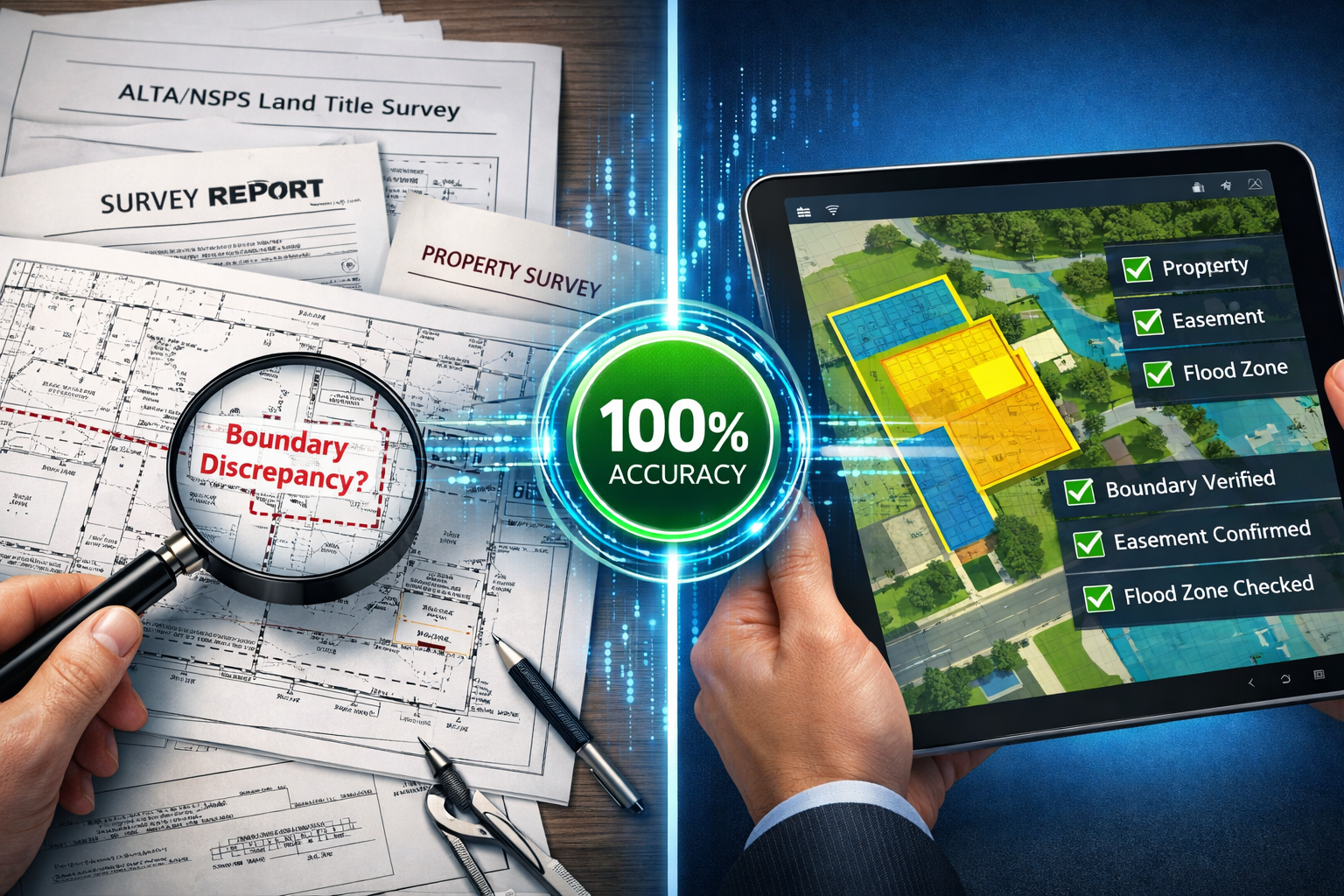
How Data Tools Reduce Transaction Risk
1. Early Identification of Deal-Breaking Issues 🚨
Comprehensive data searches conducted before formal survey commissioning can reveal fundamental problems that make properties unsuitable for intended use. A building survey for new builds might uncover ground stability issues that require costly remediation, while environmental searches might expose contamination liabilities that exceed property value.
2. Negotiation Leverage Through Documentation 💪
When surveys reveal defects or encumbrances, buyers gain powerful negotiation tools. The ability to renegotiate after a poor building survey result depends entirely on having comprehensive, defensible documentation that quantifies repair costs and liability exposure.
3. Accelerated Due Diligence Timelines ⚡
Traditional property searches requiring manual requests to local authorities, utility companies, and environmental agencies can take 4-6 weeks. Integrated data platforms reduce this to 48-72 hours, preventing transaction delays that cause financing approvals to lapse or market conditions to shift unfavorably.
4. Reduced Professional Liability Exposure 🛡️
Surveyors who leverage comprehensive data platforms demonstrate higher standards of care by cross-referencing multiple authoritative sources. This documentation protects against negligence claims when latent defects emerge post-transaction.
Implementing Data-Driven Survey Protocols
Property professionals seeking to harness landmark data tools for risk reduction should adopt systematic protocols:
| Transaction Stage | Data Integration Action | Risk Reduction Benefit |
|---|---|---|
| Pre-Offer | Commission preliminary environmental and flood searches | Avoid wasted survey costs on fundamentally flawed properties |
| Survey Specification | Request "2026 ALTA/NSPS LAND TITLE SURVEY" (US) or Level 3 Building Survey with data integration (UK) | Ensure comprehensive scope covering all material risks |
| Document Review | Provide surveyors with current title commitments and all available property documents | Enable accurate boundary determination and easement identification |
| Table A Discussion | Proactively discuss optional survey items before fieldwork begins | Prevent scope gaps requiring expensive re-surveys |
| Report Analysis | Cross-reference survey findings with independent data sources | Validate conclusions and identify overlooked issues |
| Negotiation | Quantify remediation costs using contractor estimates and regulatory requirements | Support price reductions with objective evidence |
Common myths about property surveys often prevent buyers from requesting appropriate scope. Understanding what surveys actually reveal helps clients specify the right level of investigation for their transaction risk profile.
Practical Applications: Building Survey Certainty in Uncertain 2026 Transactions Across Property Types
Residential Transactions
For homebuyers, building survey certainty means understanding not just the property's current condition but its future risk exposure. Climate change has made flood risk assessments and ground stability data essential components of residential due diligence.
Case Example: Victorian Terrace Purchase
A buyer commissioning a homebuyers report on a Victorian terrace might discover subsidence indicators. Integrated data tools can immediately cross-reference historical subsidence claims in the postcode, geological surveys showing clay soil composition, and drainage infrastructure records—providing context that transforms a concerning observation into either a manageable maintenance issue or a deal-breaker requiring structural engineering intervention.
Understanding which home survey is right for your situation prevents both over-spending on unnecessary investigation and under-investing in essential due diligence.
Commercial Development Projects
Developers face exponentially greater complexity when assembling multi-parcel sites or converting existing structures. The 2026 ALTA/NSPS standards specifically address challenges common in these transactions[3].
Enhanced Coordination Requirements
The updated standards emphasize early communication between surveyors, title insurers, and clients to prevent delays affecting construction schedules, regulatory approvals, or financing milestones[3]. For hospital campus expansions or mixed-use developments, this coordination ensures all parties understand boundary discrepancies and easement conflicts before architectural plans are finalized.
Boundary Discrepancy Documentation
Properties assembled over decades frequently contain overlapping legal descriptions, vacated rights-of-way, and easements that no longer serve their original purpose. The 2026 standards' requirement for comprehensive explanatory notes means these issues receive proper documentation rather than being glossed over in survey certifications[2].
Party Wall and Boundary Dispute Prevention
Party wall surveyors rely heavily on accurate boundary determination to establish rights and obligations when adjacent owners undertake building work. The 2026 standards' enhanced RPP reporting and mandatory discrepancy explanations provide the precision necessary to prevent disputes before construction begins[5].
A schedule of condition prepared before building work commences becomes far more defensible when supported by survey data meeting the latest professional standards.
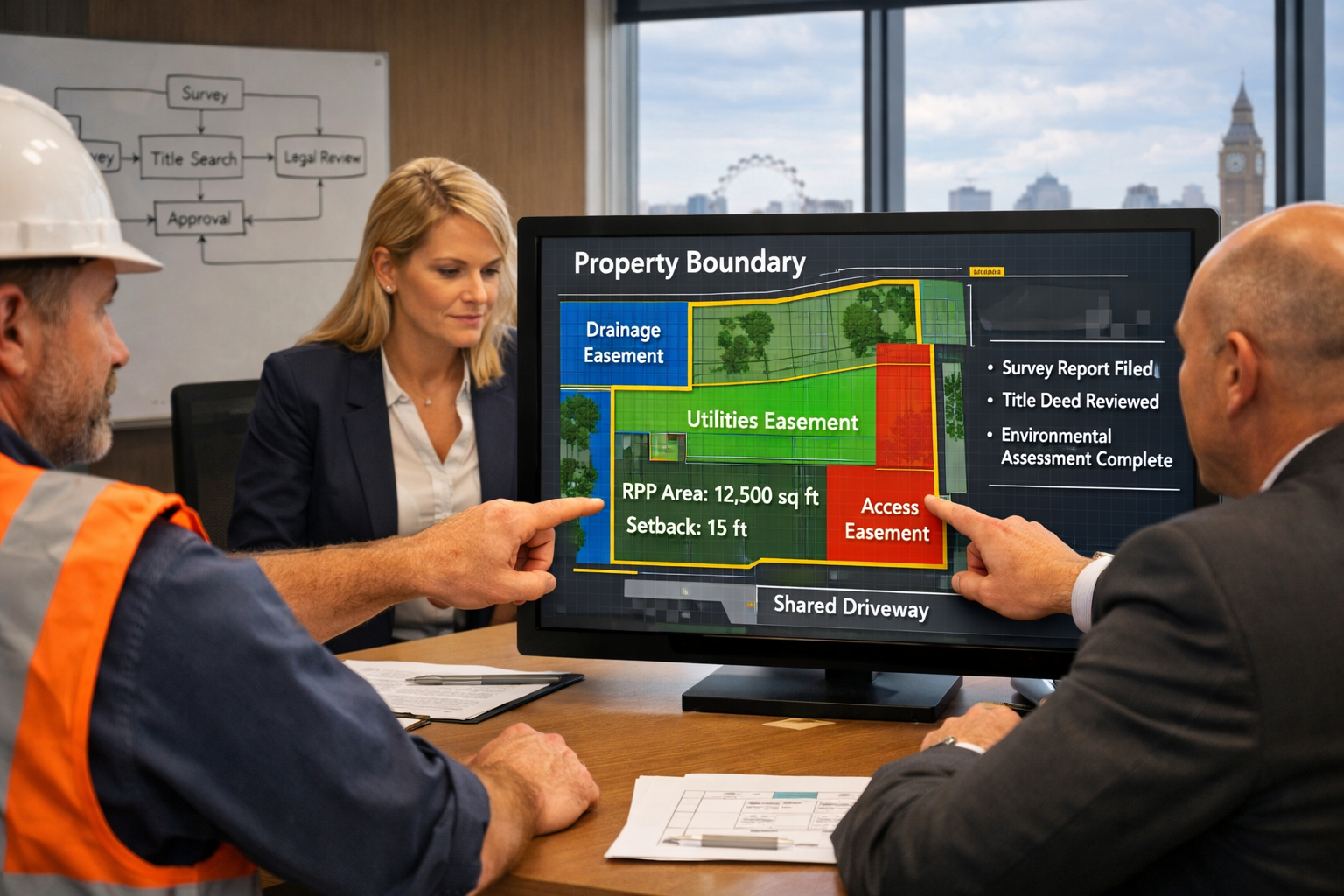
The Technology Transformation: AI and Automation in 2026 Conveyancing
The 78% AI Adoption Rate
Research from Landmark Information Group reveals that 78% of UK law firms now use artificial intelligence to assist with conveyancing work—a dramatic increase from 39% in 2024[6]. This transformation reflects broader recognition that traditional manual processes cannot keep pace with market demands for speed and accuracy.
AI Applications in Survey-Related Due Diligence:
✅ Automated document analysis extracting key terms from title deeds, easement agreements, and planning permissions
✅ Risk flagging algorithms identifying potential conflicts between survey findings and legal documentation
✅ Precedent comparison matching current survey results against historical patterns to highlight anomalies
✅ Cost estimation tools calculating remediation expenses based on defect descriptions and local contractor rates
✅ Timeline optimization scheduling survey appointments, report reviews, and follow-up inquiries to minimize transaction duration
Balancing Automation with Professional Judgment
While AI tools accelerate routine tasks, building survey certainty in uncertain 2026 transactions still requires experienced professional judgment. The most effective approach combines:
Human Expertise: Interpreting ambiguous findings, assessing materiality of defects, negotiating remediation responsibilities
Machine Efficiency: Processing vast data sets, cross-referencing multiple sources, flagging potential issues for human review
Surveyors who master this balance deliver superior value by focusing their expertise on complex interpretive questions while delegating data gathering and preliminary analysis to automated systems.
Client Responsibilities in the 2026 Standards Framework
Specifying Survey Requirements Correctly
The 2026 ALTA/NSPS standards place new obligations on clients to ensure surveys meet their actual needs. Clients must now:
Request "2026 ALTA/NSPS LAND TITLE SURVEY" Explicitly
Generic requests for "boundary surveys" or "site surveys" may not trigger compliance with the updated standards. Explicit specification ensures surveyors understand the required scope[4].
Provide Current Title Commitments Early
Surveyors need title commitments and all available property documents at project initiation—not midway through fieldwork. Early provision enables accurate boundary determination and complete easement identification[4].
Discuss Table A Optional Items Proactively
The ALTA/NSPS standards include optional Table A items covering specialized investigations. Clients should discuss which options apply to their transaction before fieldwork begins, preventing expensive re-surveys when gaps are discovered[4].
Understanding Survey Limitations
Even comprehensive surveys have inherent limitations that clients must understand:
🔸 Surveys document observable conditions at the time of inspection—they cannot predict future defects or guarantee absence of concealed problems
🔸 Boundary determinations reflect professional judgment based on available evidence—they are not infallible legal determinations
🔸 Easement locations may be approximate when recorded descriptions are ambiguous or physical evidence is absent
🔸 Environmental conditions change—flood risks, contamination migration, and ground stability evolve over time
Clients who understand these limitations make better-informed decisions about when additional investigation (geotechnical testing, environmental sampling, structural engineering assessment) is warranted.
Regional Considerations: Adapting Standards to Local Markets
London and Southeast England
Property professionals working in London and surrounding areas face unique challenges that make comprehensive data integration particularly valuable:
- Complex ownership histories with centuries of easements, covenants, and rights-of-way
- High property values making thorough due diligence economically justified
- Dense development where party wall issues and boundary disputes are common
- Diverse building stock ranging from listed Georgian townhouses to modern high-rises
Surveyors serving areas like Marylebone, Chelsea, Islington, and Paddington must navigate conservation area restrictions, listed building constraints, and archaeological considerations alongside standard survey requirements.
Outer London and Home Counties
Suburban and semi-rural areas present different risk profiles requiring adapted approaches:
Properties in Brentwood, Chelmsford, Epping, and Ingatestone often feature larger plots with more complex boundary determinations, agricultural easements, and private drainage systems requiring specialized investigation.
Areas like Croydon, Ealing, Newham, and Wembley combine urban density with diverse building ages and types, requiring flexible survey approaches that balance thoroughness with cost-effectiveness.
Cost-Benefit Analysis: Investing in Comprehensive Surveys
The True Cost of Survey Shortcuts
Clients sometimes view comprehensive surveys as discretionary expenses that can be minimized to reduce transaction costs. This perspective ignores the substantial risks of inadequate due diligence:
Hidden Defect Discovery Post-Purchase
Structural issues, contamination, or boundary encroachments discovered after completion typically cost 3-10 times more to remediate than the survey investment that would have revealed them pre-purchase.
Transaction Collapse Expenses
When fundamental problems emerge late in the transaction process, buyers lose survey fees, legal costs, mortgage arrangement fees, and search expenses—often totaling £3,000-£8,000 for residential transactions and significantly more for commercial deals.
Litigation Costs
Boundary disputes, party wall disagreements, and defect-related conflicts generate legal expenses that dwarf survey costs. Professional negligence claims against surveyors who missed material defects create additional complexity and expense.
Quantifying Survey Investment Returns
Comprehensive surveys deliver measurable financial benefits:
| Survey Investment | Typical Benefit | ROI Multiple |
|---|---|---|
| £800-£1,500 (residential Level 3) | Identify £15,000-£40,000 in repair needs before purchase | 10-50x |
| £2,500-£5,000 (commercial ALTA survey) | Prevent £50,000-£200,000 in post-closing disputes | 10-40x |
| £500-£1,200 (environmental searches) | Avoid contaminated land liability of £100,000+ | 80-200x |
| £300-£800 (flood risk assessment) | Prevent insurance denial or unaffordable premiums | 20-100x |
These multiples explain why experienced property investors and developers view comprehensive surveys as essential risk management rather than optional expenses.
Future-Proofing Transactions: Climate and Regulatory Trends
Climate Risk Integration
The 2026 property market operates in a fundamentally different climate risk environment than previous decades. Landmark data tools now incorporate:
Forward-Looking Flood Models 🌊
Historical flood data no longer adequately predicts future risk. Modern assessments model climate change scenarios through 2050 and beyond, showing how risk profiles will evolve over typical ownership periods.
Heat Risk and Energy Efficiency 🌡️
Properties with poor thermal performance face both regulatory pressure (EPC requirements) and market devaluation as energy costs rise. Integrated data platforms flag energy efficiency issues alongside traditional structural concerns.
Ground Movement and Extreme Weather ⛈️
Increased frequency of drought-swell cycles in clay soils and extreme precipitation events affecting drainage systems require enhanced ground stability assessments.
Regulatory Evolution
Building survey certainty in uncertain 2026 transactions must account for regulatory trends likely to affect property values and usability:
Retrofit Requirements
Anticipated regulations mandating energy efficiency improvements for rental properties and properties at sale will create significant capital obligations. Surveys that quantify retrofit costs provide essential planning data.
Biodiversity Net Gain
Development projects increasingly face requirements to demonstrate biodiversity improvements. Site surveys documenting existing ecological value inform compliance strategies.
Fire Safety Standards
Post-Grenfell regulatory changes continue evolving, particularly for multi-occupancy buildings. Surveys must identify potential fire safety deficiencies requiring costly remediation.
Actionable Steps for Property Professionals
For Buyers and Investors
- Commission preliminary data searches before formal offers to eliminate fundamentally flawed properties early
- Specify comprehensive survey scope appropriate to property age, type, and intended use
- Provide surveyors with all available documentation including title deeds, planning permissions, and previous surveys
- Review survey reports thoroughly with professional advisors before proceeding to exchange
- Use survey findings proactively in negotiations to adjust price or require seller remediation
- Maintain survey documentation for future reference during ownership and eventual resale
For Surveyors and Conveyancers
- Update standard specifications to reference 2026 ALTA/NSPS standards or equivalent UK best practices
- Integrate comprehensive data platforms into standard workflow to enhance report quality
- Implement AI-assisted document review for efficiency while maintaining professional oversight
- Establish clear communication protocols with title insurers and other transaction parties
- Provide detailed explanatory notes when discrepancies or ambiguities arise
- Invest in continuing education on evolving standards, technology tools, and climate risk assessment
For Lenders and Title Insurers
- Require 2026-compliant surveys for all commercial transactions and high-value residential lending
- Collaborate with surveyors early to identify potential issues before underwriting decisions
- Leverage integrated data platforms to validate survey findings and assess risk comprehensively
- Adjust underwriting criteria to account for climate risks and regulatory trends
- Communicate exceptions clearly so borrowers understand coverage limitations
Conclusion
Building survey certainty in uncertain 2026 transactions through landmark data tools for risk reduction has evolved from optional best practice to essential due diligence. The convergence of enhanced ALTA/NSPS standards, comprehensive property data integration, and AI-powered conveyancing tools creates unprecedented opportunities to minimize transaction risks, prevent costly disputes, and make informed property decisions.
The 2026 standards' emphasis on transparency, documentation, and coordination addresses the most common sources of transaction delays and post-closing conflicts. Meanwhile, UK property professionals benefit from integrated data platforms that consolidate environmental, legal, and structural risk assessments into unified reports delivered in days rather than weeks.
Success in 2026's property market requires embracing these tools while maintaining the professional judgment that transforms raw data into actionable insights. Whether purchasing a residential property, developing a commercial site, or underwriting a complex transaction, comprehensive survey investigation supported by landmark data resources delivers measurable returns through avoided costs, stronger negotiating positions, and reduced liability exposure.
Next Steps:
✅ Review your current survey specifications to ensure they meet 2026 standards
✅ Evaluate comprehensive property data platforms for integration into your workflow
✅ Establish coordination protocols with surveyors, title insurers, and other transaction parties
✅ Invest in professional development covering evolving standards and technology tools
✅ Commission appropriate survey scope for your next transaction based on property type and risk profile
The property professionals who master building survey certainty in uncertain 2026 transactions will deliver superior client outcomes while minimizing their own professional liability exposure—transforming regulatory requirements and technological capabilities into competitive advantages.
References
[1] Survey Reveals Demand Uncertainty Is Changing 2026 Homebuilding Strategy – https://www.housingwire.com/articles/survey-reveals-demand-uncertainty-is-changing-2026-homebuilding-strategy/
[2] 2026 Alta Survey Standards Updates – https://www.hklaw.com/en/insights/publications/2026/03/2026-alta-survey-standards-updates
[3] New 2026 Alta Nsps Survey Standards What Developers And Counsel Should Know – https://hallrender.com/2026/02/23/new-2026-alta-nsps-survey-standards-what-developers-and-counsel-should-know/
[4] Alta Nsps Key Changes And Updates In The 2026 Standards – https://www.beneschlaw.com/insight/alta-nsps-key-changes-and-updates-in-the-2026-standards/
[5] Updated 2026 Alta Nsps Land Title Surveys – https://www.vika.com/news/updated-2026-alta-nsps-land-title-surveys
[6] Paving The Way For Smarter Residential Conveyancing In 2026 – https://www.landmark.co.uk/news-insights/industry-reports/paving-the-way-for-smarter-residential-conveyancing-in-2026/