The built environment sector faces a stark reality: 46% of construction professionals do not measure carbon emissions across their projects—a figure that has actually increased from 34% in 2024.[1] This alarming deterioration in measurement practices arrives precisely as the RICS Sustainability Report 2025 establishes new expectations for how surveyors must integrate environmental, social, and governance (ESG) factors into every aspect of their work. For party wall surveyors and valuation professionals working on 2026 projects, the RICS Sustainability Report 2025 Implications for Party Wall and Valuation Surveyors in 2026 Projects represent a fundamental shift in professional practice—one that demands immediate attention and adaptation.
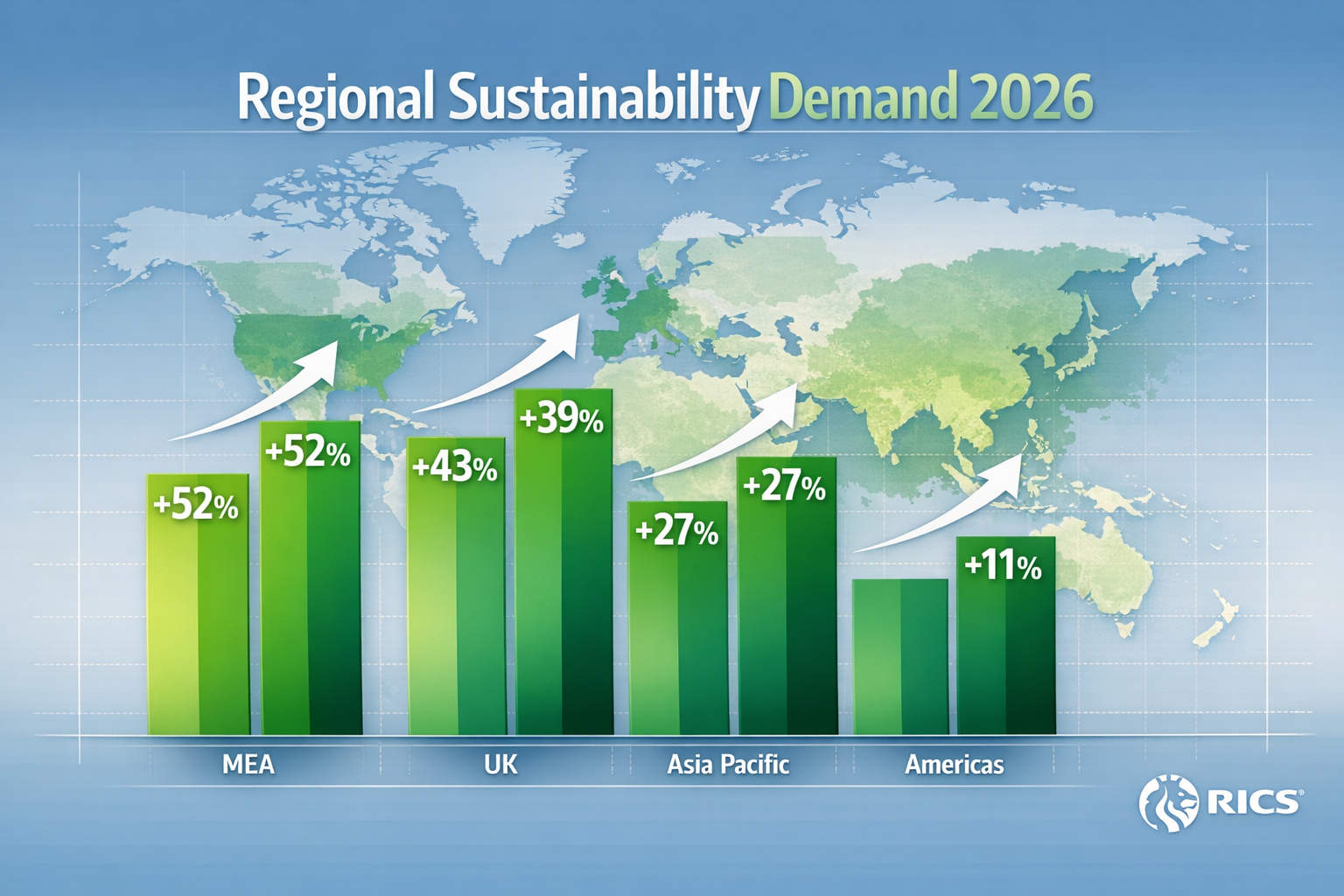
The report reveals that while demand for green buildings in the UK has surged by 43%, significant barriers remain: initial costs, lack of return-on-investment evidence, and insufficient knowledge among professionals.[1] These findings directly impact how surveyors approach party wall agreements and property valuations in an era where sustainability credentials increasingly determine market value and regulatory compliance.
Key Takeaways
- 46% of construction professionals fail to measure carbon emissions, representing a worsening trend that directly affects party wall and valuation survey accuracy and compliance[1]
- UK green building demand has increased by 43%, creating new valuation considerations and party wall agreement complexities for sustainable renovation projects[1]
- 30% of professionals cite insufficient knowledge as their primary barrier to reducing embodied carbon, highlighting urgent training needs for surveyors[1]
- ESG factors must now be reflected in valuation advice worldwide, establishing mandatory integration of sustainability metrics into professional surveying practice[3]
- Whole-life carbon assessment and climate resilience are becoming essential components of property assessments, fundamentally changing how surveyors evaluate adjoining properties[2]
Understanding the RICS Sustainability Report 2025 Framework
The RICS Sustainability Report 2025 represents more than another industry publication—it establishes a comprehensive framework that directly influences how surveyors must conduct their work in 2026 and beyond. The report synthesizes global data from construction and property professionals, revealing critical trends that shape professional obligations.
Core Findings Affecting Surveying Practice
The report identifies three primary barriers preventing widespread sustainable investment: initial costs, lack of ROI evidence, and insufficient investor awareness or client demand.[1] For surveyors, these barriers translate into practical challenges when assessing properties undergoing sustainable modifications or when valuing green building features.
Regional variations in sustainability priorities add another layer of complexity. The Middle East and Africa (MEA) region leads with a remarkable 52% growth in green building demand, while the UK follows at 43%.[1] These regional differences mean that surveyors working on international portfolios or advising clients with diverse property holdings must understand varying sustainability standards and market expectations.
The report also highlights a concerning knowledge gap: 60% of professionals conduct carbon calculations and climate resilience assessments in less than half of their projects or not at all.[1] This statistic directly challenges the competency of surveyors who must now integrate these assessments into routine practice.
Key Sustainability Metrics for 2026 Projects
Three features emerge as most critical for sustainable buildings across all surveyed regions:
🌿 Green building certification (BREEAM, LEED, etc.)
🔄 High adaptability for future use changes
🛡️ Climate resilience against environmental risks
For party wall surveyor responsibilities, these metrics become particularly relevant when adjoining owners pursue different sustainability strategies. The report emphasizes that MEA and Asia-Pacific regions prioritize climate adaptation and resilience more strongly than other regions, reflecting heightened exposure to drought, heatwaves, and water scarcity.[1]
RICS Sustainability Report 2025 Implications for Party Wall Surveyors in 2026
Party wall surveyors face unique challenges as the RICS Sustainability Report 2025 Implications for Party Wall and Valuation Surveyors in 2026 Projects reshape traditional practice. The intersection of sustainability requirements and party wall legislation creates new considerations for every stage of the surveying process.
Sustainable Modifications and Party Wall Agreements
When building owners pursue sustainable renovations—such as external wall insulation, green roofs, or solar panel installations—these improvements often trigger Party Wall Act requirements. The RICS consultation on the draft 8th edition of party wall guidance, launched in April 2026, specifically addresses how surveyors should handle sustainability-related works.[3]
Common sustainable modifications affecting party walls include:
- External wall insulation systems extending onto or affecting party walls
- Green roof installations requiring structural modifications to shared walls
- Ground source heat pump installations affecting foundations near party walls
- Rainwater harvesting systems with drainage near party structures
- Solar panel mounting systems attached to party walls or roofs
Each of these improvements requires careful assessment of both structural impact and sustainability benefits. Understanding party wall surveyor fees becomes more complex when sustainable assessments add scope to traditional party wall surveys.
Carbon Assessment in Party Wall Surveys
The report's finding that 46% of professionals don't measure carbon emissions presents a critical challenge.[1] Party wall surveyors must now consider the embodied carbon implications of proposed works, particularly when advising on alternative construction methods or materials.
Practical carbon considerations include:
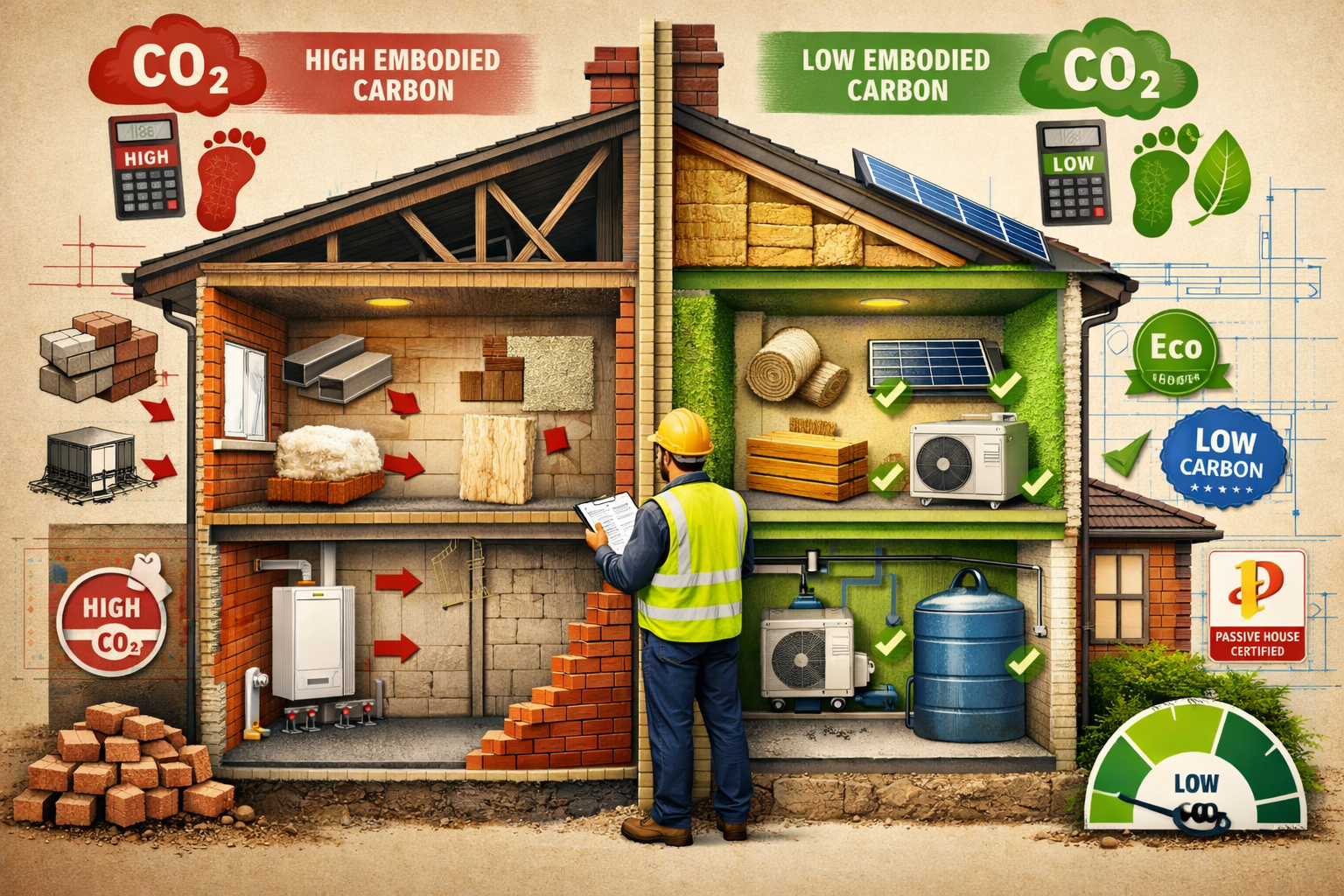
| Traditional Approach | Sustainable Alternative | Carbon Impact |
|---|---|---|
| Cement-based mortar | Lime-based mortar | 40-60% reduction |
| New brick | Reclaimed brick | 70-80% reduction |
| Standard insulation | Natural fiber insulation | 30-50% reduction |
| Concrete underpinning | Lime grouting | 50-70% reduction |
When preparing party wall awards, surveyors should document the carbon implications of proposed works and recommended alternatives. This practice aligns with RICS recommendations for mandatory whole-life carbon assessment alongside stronger building regulations.[2]
Climate Resilience and Adjoining Properties
The report emphasizes that climate resilience ranks among the top three features investors seek in sustainable buildings.[1] For party wall surveyors, this means assessing how proposed works affect both properties' resilience to climate-related risks such as flooding, overheating, or extreme weather events.
Expert party wall advice must now incorporate climate adaptation strategies. When one owner installs flood-resistant measures or improves thermal performance, surveyors should evaluate whether these improvements create disparities in climate resilience between adjoining properties—potentially affecting future valuations and insurance costs.
RICS Sustainability Report 2025 Implications for Valuation Surveyors in 2026
The RICS Sustainability Report 2025 Implications for Party Wall and Valuation Surveyors in 2026 Projects fundamentally alter how valuation surveyors assess property worth. The report establishes that ESG factors must be reflected in valuation advice worldwide, creating both mandatory requirements and market-driven imperatives.[3]
Integrating ESG Factors into Property Valuations
The RICS framework requires valuation surveyors to establish clear, practical methodologies for incorporating environmental, social, and governance factors into their assessments. This represents a significant departure from traditional valuation practice, which historically treated sustainability features as optional considerations.
Key ESG integration requirements:
✅ Environmental factors: Energy performance, carbon emissions, climate resilience, biodiversity impact
✅ Social factors: Community impact, accessibility, health and wellbeing features
✅ Governance factors: Building certification, regulatory compliance, maintenance standards
For RICS surveys, this means expanding assessment scope beyond structural condition and market comparables to include comprehensive sustainability metrics. The UK Residential Survey for March 2026 indicates declining market momentum due to rising borrowing costs and geopolitical uncertainty,[5] making accurate sustainability valuation even more critical as buyers seek long-term value.
Valuation Adjustments for Green Building Features
The report's finding that UK green building demand has increased by 43% directly impacts property valuations.[1] However, the lack of ROI evidence cited as a top barrier to sustainable investment creates challenges for valuation surveyors attempting to quantify green building premiums.
Evidence-based valuation adjustments should consider:
- Certification premiums: Properties with BREEAM or similar certifications typically command 5-10% premiums in the UK market
- Energy efficiency: Each EPC band improvement correlates with approximately 3-5% value increase
- Operational cost savings: Reduced energy and water costs improve investment yields
- Future-proofing value: Compliance with emerging regulations protects against obsolescence risk
- Insurance benefits: Climate-resilient features may reduce insurance premiums by 10-20%
When conducting property evaluation, surveyors must balance these potential premiums against the report's warning about initial cost barriers and uncertain ROI evidence.[1]
Whole-Life Carbon Assessment in Valuations
The RICS recommendation for mandatory whole-life carbon assessment[2] introduces a new dimension to property valuation. Whole-life carbon includes both embodied carbon (from construction materials and processes) and operational carbon (from building use over its lifetime).
Whole-life carbon assessment components:
- Embodied carbon: Materials, construction, maintenance, end-of-life disposal
- Operational carbon: Energy use, water heating, cooling systems
- Sequestered carbon: Green infrastructure, timber construction benefits
- Avoided carbon: Renewable energy generation, waste reduction measures
Valuation surveyors must develop competency in interpreting whole-life carbon assessments and translating these findings into market value adjustments. The report's revelation that 30% of professionals lack sufficient knowledge to reduce embodied carbon[1] suggests many surveyors require additional training in this area.
Climate Risk and Resilience Valuation
With 60% of professionals conducting climate resilience assessments in less than half their projects,[1] there's a significant gap between best practice and current implementation. Valuation surveyors working on 2026 projects must address this shortfall by systematically evaluating climate risks.
Climate risk factors affecting valuations:
🌊 Flood risk: Current and projected flood zones based on climate scenarios
🔥 Overheating risk: Summer temperature projections and cooling requirements
💧 Water scarcity: Drought resilience and water efficiency measures
🌪️ Extreme weather: Storm resistance and structural resilience
🏜️ Subsidence risk: Soil moisture changes and foundation stability
The report notes that MEA and Asia-Pacific regions prioritize climate adaptation more strongly than other regions,[1] but UK surveyors cannot afford complacency. Climate-related risks increasingly affect property insurability and mortgage availability, directly impacting market value.
Practical Implementation Strategies for 2026 Projects
Updating Survey Methodologies and Reporting
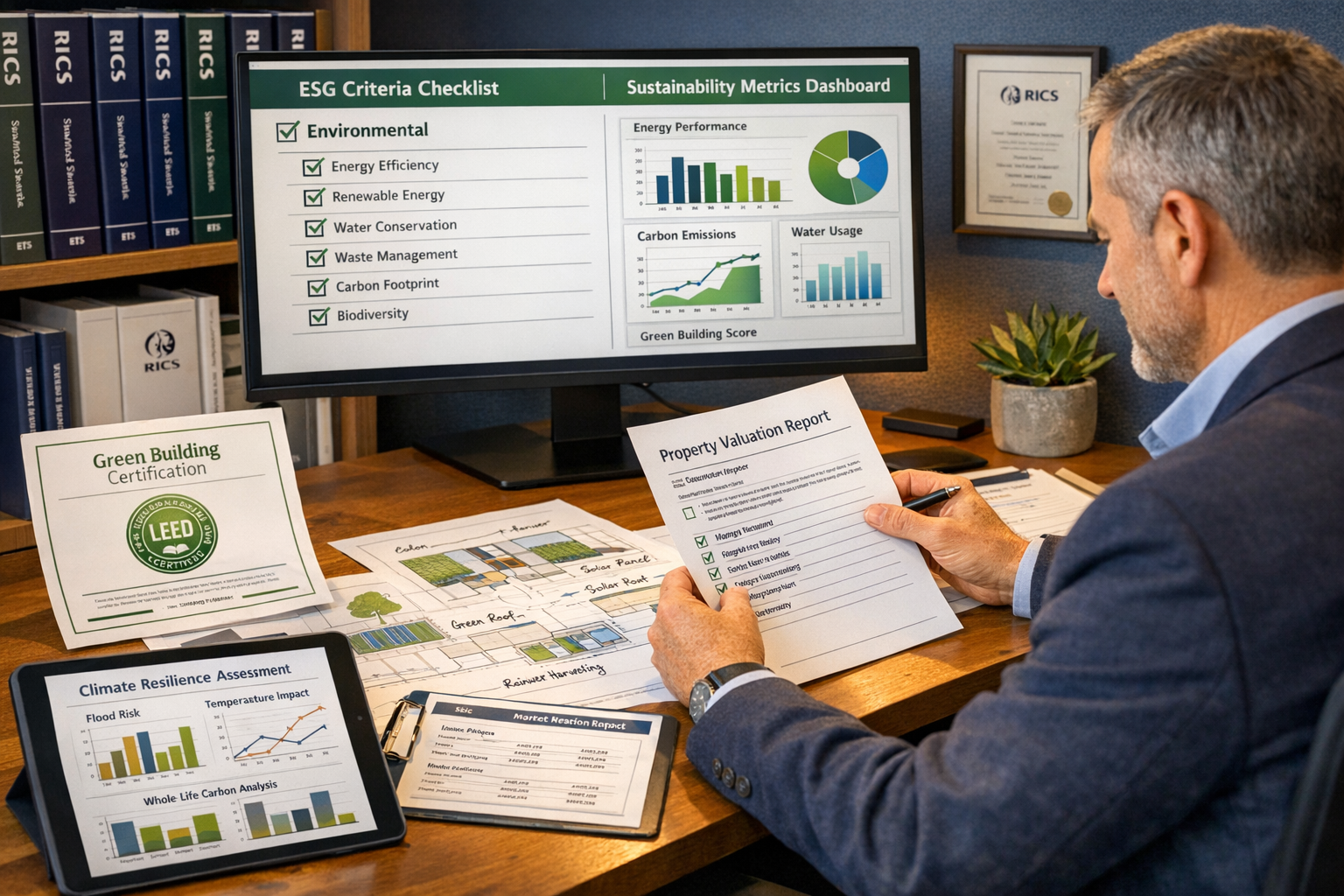
The RICS Sustainability Report 2025 Implications for Party Wall and Valuation Surveyors in 2026 Projects require immediate updates to survey methodologies and reporting templates. Surveyors must integrate sustainability assessments into standard practice rather than treating them as optional add-ons.
Essential methodology updates include:
- Carbon calculation protocols: Establish standard approaches for measuring embodied and operational carbon
- Climate resilience checklists: Develop systematic assessment frameworks for climate-related risks
- ESG scoring systems: Create consistent metrics for evaluating environmental, social, and governance factors
- Green certification verification: Implement procedures for confirming and valuing building certifications
- Sustainability reporting sections: Add dedicated sections to survey reports addressing sustainability factors
For those conducting building surveys, these additions represent significant scope expansion. However, the report's findings make clear that sustainability integration is no longer optional—it's a professional obligation.
Training and Professional Development Requirements
The report's finding that 30% of professionals cite insufficient knowledge as their barrier to reducing embodied carbon[1] highlights urgent training needs. RICS members must prioritize continuing professional development (CPD) in sustainability topics throughout 2026.
Priority training areas:
📚 Whole-life carbon assessment: Understanding calculation methodologies and interpretation
📚 Green building standards: Familiarity with BREEAM, LEED, and other certification systems
📚 Climate science fundamentals: Basic understanding of climate projections and adaptation strategies
📚 Sustainable construction materials: Knowledge of low-carbon alternatives and their properties
📚 ESG valuation methodologies: Techniques for quantifying sustainability factors in property values
RICS offers specialized CPD courses addressing these topics, and the consultation on the 8th edition of party wall guidance[3] provides opportunities for surveyors to engage with evolving standards.
Collaboration with Sustainability Consultants
Given the complexity of sustainability assessments, many surveyors benefit from collaborating with specialized sustainability consultants. This interdisciplinary approach ensures comprehensive evaluation while allowing surveyors to maintain focus on their core competencies.
Effective collaboration strategies:
- Early engagement: Involve sustainability consultants during initial project scoping
- Clear role definition: Establish which party handles specific assessment components
- Integrated reporting: Combine sustainability findings with traditional survey outputs
- Joint site visits: Conduct inspections together to ensure comprehensive evaluation
- Knowledge transfer: Use collaborations as learning opportunities to build internal expertise
For property assessment projects involving complex sustainability considerations, this collaborative approach delivers more robust results while supporting professional development.
Technology and Tools for Sustainability Assessment
Digital tools increasingly support sustainability integration in surveying practice. From carbon calculation software to climate risk mapping platforms, technology enables more efficient and accurate sustainability assessments.
Recommended technology solutions:
- Carbon calculation software: Tools like One Click LCA or eTool for embodied carbon assessment
- Energy modeling platforms: IES VE or DesignBuilder for operational energy analysis
- Climate risk databases: Climate Just or Climate UK for location-specific risk data
- Building certification trackers: Systems for verifying and monitoring green building certifications
- Digital survey platforms: Mobile apps incorporating sustainability assessment checklists
Investing in these technologies supports compliance with the RICS Sustainability Report 2025 Implications for Party Wall and Valuation Surveyors in 2026 Projects while improving efficiency and accuracy.
Regulatory Landscape and Future Compliance
Current UK Building Regulations and Sustainability
The UK regulatory environment continues evolving toward more stringent sustainability requirements. The RICS report recommends mandatory whole-life carbon assessment alongside stronger building regulations to limit energy use in both new and existing buildings.[2]
Current regulatory drivers include:
- Building Regulations Part L: Increasingly stringent energy efficiency standards
- Future Homes Standard: Targeting 75-80% carbon reduction for new homes by 2025
- Minimum Energy Efficiency Standards (MEES): Rental properties must achieve minimum EPC ratings
- Climate Change Act targets: Net zero by 2050 driving progressive policy tightening
- Local planning requirements: Many authorities now require sustainability statements
Surveyors must stay current with these evolving requirements, as non-compliance affects both property values and legal liabilities. Understanding building regulations becomes increasingly complex as sustainability requirements layer onto traditional structural and safety standards.
Anticipated Regulatory Changes Through 2026-2030
The RICS report advocates for government policy measures to define decarbonization pathways, drive green building investments, and scale biodiversity measures.[1] These recommendations signal likely regulatory developments that surveyors should anticipate.
Probable regulatory developments:
- Mandatory carbon reporting: Extension of carbon disclosure requirements to smaller projects
- Enhanced EPC standards: More comprehensive energy assessment including whole-life carbon
- Climate adaptation requirements: Mandatory resilience measures for new developments
- Biodiversity net gain: Strengthened requirements for ecological enhancement
- Circular economy standards: Regulations promoting material reuse and waste reduction
Surveyors who proactively develop expertise in these areas will be better positioned as regulations tighten. The deterioration in carbon measurement practices—from 34% not measuring in 2024 to 46% in 2025[1]—suggests many professionals are falling behind rather than preparing for stricter requirements.
Professional Liability Considerations
As sustainability factors become integral to surveying practice, professional liability implications evolve accordingly. Failure to adequately assess or report sustainability factors may constitute professional negligence, particularly as these factors increasingly affect property values and regulatory compliance.
Liability risk areas:
⚠️ Inadequate carbon assessment: Failing to identify high-carbon materials or construction methods
⚠️ Overlooked climate risks: Missing flood, overheating, or other climate-related vulnerabilities
⚠️ Incorrect ESG valuations: Materially misstating property values due to sustainability factors
⚠️ Certification errors: Failing to verify or properly value green building certifications
⚠️ Regulatory non-compliance: Missing building regulation or planning requirement violations
Professional indemnity insurance policies should be reviewed to ensure adequate coverage for sustainability-related claims. Insurers increasingly expect surveyors to demonstrate competency in sustainability assessment through appropriate training and methodology updates.
Case Studies: Sustainability in Practice
Case Study 1: Party Wall Agreement for External Wall Insulation
A terraced property owner in South London sought to install external wall insulation (EWI) to improve energy efficiency from EPC rating D to B. The proposed works would extend approximately 100mm onto the party wall boundary with the adjoining property.
Sustainability considerations:
- Proposed EWI system would reduce operational carbon by approximately 2.5 tonnes CO2 annually
- Materials specified included high-embodied-carbon foam insulation
- Alternative natural fiber insulation would reduce embodied carbon by 45% with similar thermal performance
- Installation would improve both properties' thermal performance at the party wall junction
Party wall surveyor actions:
The appointed party wall surveyor incorporated sustainability assessment into the traditional party wall process, recommending the lower-carbon alternative insulation material. The party wall award specified sustainable materials and included provisions for the adjoining owner to access similar benefits when undertaking future improvements.
Outcome:
Both owners benefited from improved thermal performance, embodied carbon was reduced by 1.8 tonnes CO2, and the approach established a precedent for future sustainable improvements along the terrace.
Case Study 2: Valuation of Retrofitted Period Property
A Victorian semi-detached property underwent comprehensive sustainable retrofit, including solar panels, heat pump installation, improved insulation, and rainwater harvesting. The owner commissioned a valuation for refinancing purposes.
Sustainability features valued:
- Solar PV system (4kW) generating approximately £600 annual savings
- Air source heat pump replacing gas boiler (£800 annual savings)
- Improved insulation raising EPC from E to B
- Rainwater harvesting reducing water bills by £200 annually
- Climate resilience improvements including flood-resistant measures
Valuation approach:
The valuation surveyor applied the RICS Sustainability Report 2025 Implications for Party Wall and Valuation Surveyors in 2026 Projects framework, conducting whole-life carbon assessment and climate resilience evaluation alongside traditional valuation methods.
Outcome:
The property achieved a 12% premium over comparable non-retrofitted properties, justified by operational cost savings, improved EPC rating, reduced climate risks, and future-proofing against regulatory changes. The valuation report included detailed sustainability metrics supporting the premium.
Case Study 3: New Development with Integrated Sustainability
A small residential development of four townhouses incorporated comprehensive sustainability features from the design stage, targeting BREEAM Excellent certification.
Integrated sustainability features:
- Timber frame construction reducing embodied carbon by 60% versus traditional masonry
- Passive house principles minimizing operational energy requirements
- Green roofs providing biodiversity net gain and surface water management
- Shared ground source heat pump system serving all units
- Electric vehicle charging infrastructure
Surveying challenges:
Multiple surveyors collaborated on the project, including party wall surveyors for the shared walls between units and valuation surveyors for pre-sale assessments. Coordination was essential to ensure consistent sustainability evaluation across disciplines.
Outcome:
The development achieved BREEAM Excellent certification and commanded 18% premiums over comparable new builds without sustainability features. The integrated approach from design stage through to completion demonstrated best practice for implementing the RICS Sustainability Report 2025 Implications for Party Wall and Valuation Surveyors in 2026 Projects.
Conclusion
The RICS Sustainability Report 2025 Implications for Party Wall and Valuation Surveyors in 2026 Projects represent a watershed moment for the surveying profession. With 46% of construction professionals failing to measure carbon emissions,[1] 30% citing insufficient knowledge as their primary barrier,[1] and 60% conducting sustainability assessments in less than half their projects,[1] the gap between current practice and required standards is substantial and urgent.
For party wall surveyors, sustainability integration means expanding traditional structural and legal assessments to include carbon implications, climate resilience, and green building standards. The consultation on the 8th edition of party wall guidance[3] provides an opportunity to shape how these considerations are formally incorporated into professional standards.
For valuation surveyors, the mandate to reflect ESG factors in valuation advice worldwide[3] fundamentally changes how property worth is determined. With UK green building demand increasing by 43%,[1] sustainability features increasingly drive market value—making competency in sustainability assessment essential rather than optional.
Actionable Next Steps for Surveyors
Immediate actions (next 30 days):
- Review current methodologies: Audit existing survey and valuation processes to identify sustainability gaps
- Engage with RICS consultation: Participate in the party wall guidance consultation to influence emerging standards[3]
- Assess training needs: Identify specific knowledge gaps in carbon assessment, climate resilience, and ESG valuation
- Update report templates: Add sustainability sections to standard survey and valuation reports
Short-term actions (next 3-6 months):
- Complete targeted CPD: Undertake RICS sustainability training courses addressing identified knowledge gaps
- Acquire assessment tools: Invest in carbon calculation software and climate risk databases
- Establish consultant networks: Build relationships with sustainability specialists for collaborative projects
- Pilot integrated assessments: Test enhanced methodologies on selected projects before full implementation
Long-term strategic actions (next 12 months):
- Develop firm-wide capabilities: Ensure all surveyors within practice achieve minimum sustainability competency
- Market sustainability expertise: Differentiate services based on comprehensive sustainability integration
- Monitor regulatory developments: Track emerging requirements and adjust practices proactively
- Contribute to professional development: Share learnings and case studies with the wider surveying community
The deterioration in carbon measurement practices from 2024 to 2025[1] demonstrates that passive approaches are insufficient. Surveyors must actively engage with sustainability requirements, develop necessary competencies, and integrate these considerations into every aspect of professional practice.
The built environment sector's journey toward net zero and climate resilience depends significantly on surveyors' ability to accurately assess, value, and advise on sustainability factors. The RICS Sustainability Report 2025 Implications for Party Wall and Valuation Surveyors in 2026 Projects provide the framework—now the profession must deliver the implementation.
For surveyors seeking guidance on integrating sustainability into their practice, contact qualified RICS surveyors who are already implementing these enhanced methodologies and can provide practical insights from real-world projects.
References
[1] Sustainability Report 2025 – https://www.rics.org/news-insights/current-topics-campaigns/sustainability/sustainability-report-2025
[2] Sustainability Report 2025 Royal Institution Chartered Surveyors – https://build-up.ec.europa.eu/en/resources-and-tools/publications/sustainability-report-2025-royal-institution-chartered-surveyors
[3] Rics Launches Consultation On Updated Party Wall Practice Guidance – https://www.rics.org/news-insights/rics-launches-consultation-on-updated-party-wall-practice-guidance
[5] rics – https://www.rics.org