

Buyer enquiries across UK property markets plummeted by 26% in the three weeks following the February 28, 2026 U.S.-Israeli strikes on Iran, according to preliminary RICS residential market survey data. This dramatic contraction reflects more than typical seasonal fluctuations—it signals a fundamental reassessment of risk premiums as oil prices surged past $119 per barrel and inflation expectations spiked to levels not seen since 2023. For property surveyors navigating these unprecedented conditions, understanding Valuation Adjustments for Iran Conflict Geopolitical Risks: RICS February 2026 Insights for UK Property Surveyors has become essential to maintaining professional standards and protecting client interests.
The Royal Institution of Chartered Surveyors has issued critical guidance for members conducting valuations amid this geopolitical turbulence, emphasising strict compliance with RICS Global Valuation Standards (Red Book), particularly VPS 6 (Valuation Investigations) and VPGA 10 (Material Uncertainty).[2] As the conflict extends beyond initial projections and disrupts approximately 20% of global oil supply through Strait of Hormuz closures,[1] UK property professionals must recalibrate their methodologies to account for cascading economic impacts ranging from energy cost inflation to delayed interest rate cuts.
Key Takeaways
- Material Uncertainty declarations are now mandatory for valuations with exposure to geopolitical risk factors stemming from the Iran conflict, per RICS guidance on Red Book compliance[2]
- Energy cost inflation is directly impacting discount rates with oil prices exceeding $119/barrel and core PPI reaching 3.9%, requiring immediate valuation methodology adjustments[3]
- Buyer enquiry volumes dropped 26% following the February 28 strikes, signalling market sentiment shifts that surveyors must incorporate into comparable analysis
- Central bank policy timelines have extended significantly, with Fed rate cuts now off the table and CME FedWatch pricing 99% probability of April holds[3]
- Supply chain disruptions are creating secondary valuation impacts including 30% fertiliser price spikes and elevated construction material costs affecting development feasibility[6]
Understanding the Iran Conflict Impact on UK Property Markets

The joint military operations that commenced on February 28, 2026, represent the most significant geopolitical escalation in the Middle East in recent years. The strikes killed Iran's Supreme Leader Ayatollah Ali Khamenei and targeted key military and nuclear facilities, prompting immediate and aggressive Iranian retaliation.[1][4] Unlike previous episodes of regional tension, this conflict has triggered sustained disruptions to global energy supplies and financial markets that directly affect UK property valuations.
The Strait of Hormuz Disruption Effect
Iran's retaliatory actions included attacks across GCC countries and deliberate disruptions to shipping through the Strait of Hormuz, a critical chokepoint for approximately 20% of global oil supply.[1] When markets reopened following the initial strikes, oil prices jumped approximately 7%, with Brent crude climbing from around $70 to over $80 per barrel within days.[5] By March 2026, both Brent and WTI crude reached highs above $119 per barrel as the strait remained effectively closed.[3]
For UK property surveyors, these energy market disruptions translate into several valuation considerations:
- Operational cost increases for commercial properties with high energy consumption
- Transportation and logistics cost inflation affecting retail and industrial asset viability
- Construction material price volatility impacting development appraisals
- Tenant covenant strength reassessment for businesses exposed to energy-intensive operations
Market Sentiment and Transaction Volume Impacts
The 26% decline in buyer enquiries represents one of the sharpest contractions outside of major financial crises. This sentiment shift affects valuation methodology in multiple ways:
✅ Comparable evidence becomes less reliable as transaction volumes thin
✅ Marketing period assumptions require extension to reflect reduced buyer pools
✅ Forced sale scenarios increase as some sellers face liquidity pressures
✅ Negotiation leverage shifts toward buyers demanding risk premiums
Chartered surveyors conducting valuations during this period must carefully document these market condition changes and adjust their assumptions accordingly. The RICS guidance emphasises that despite ongoing conflicts, markets across the Middle East region remain functional, though with "greater or lesser extent of normality depending on the jurisdiction and the asset class."[2] This principle applies equally to UK markets experiencing indirect effects.
RICS Red Book Compliance: Material Uncertainty and Valuation Investigations
The Royal Institution of Chartered Surveyors has been actively monitoring valuation impacts and has engaged directly with stakeholders to provide clear guidance on professional standards during this period of heightened uncertainty.[2] The focus centres on two critical components of the RICS Global Valuation Standards:
VPS 6: Valuation Investigations and Enhanced Due Diligence
VPS 6 requires valuers to undertake appropriate investigations before accepting instructions and throughout the valuation process. In the context of Valuation Adjustments for Iran Conflict Geopolitical Risks: RICS February 2026 Insights for UK Property Surveyors, this means:
Enhanced investigation requirements include:
- Energy exposure assessment – Determining the property's direct and indirect sensitivity to oil and gas price fluctuations
- Supply chain vulnerability analysis – Evaluating construction materials availability and cost stability for development projects
- Tenant sector risk profiling – Assessing covenant strength for tenants in energy-intensive industries
- Comparable transaction timing – Scrutinising whether comparable evidence predates or postdates the February 28 conflict escalation
- Financing condition review – Understanding how lender risk appetite and lending criteria have shifted
VPGA 10: Material Uncertainty Declarations
VPGA 10 provides guidance on including Material Uncertainty clauses in valuation reports when market conditions create exceptional uncertainty. The current geopolitical situation has elevated this from an optional consideration to a mandatory assessment for many valuations.[2]
"Surveyors must apply heightened scrutiny to material uncertainty clauses when valuing properties with exposure to geopolitical risk." – RICS Guidance, February 2026
When to declare Material Uncertainty:
- Significant market volatility affecting comparable evidence reliability
- Unprecedented external shocks like the Iran conflict disrupting normal market function
- Reduced transaction volumes limiting available market data
- Rapid changes in economic fundamentals such as the 7% oil price spike within days[4]
Material Uncertainty declarations do not invalidate a valuation but rather provide transparency about the confidence level and potential for value fluctuation. For UK property professionals, particularly those working on property inspection and valuation assignments, understanding when and how to apply these declarations protects both professional liability and client interests.
Quantifying Energy Cost Impacts in Property Valuations
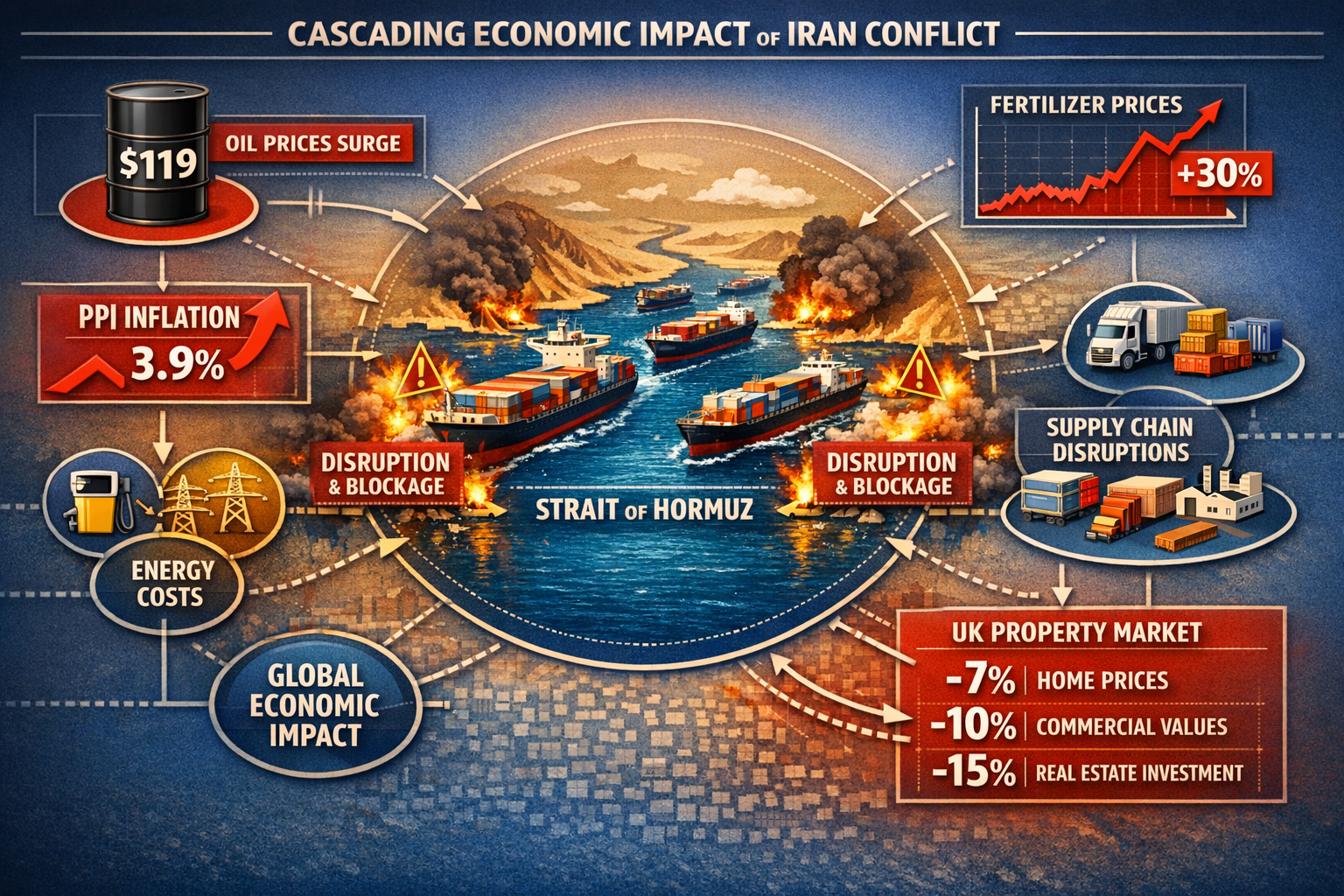
The surge in oil prices to over $119 per barrel creates direct and indirect valuation impacts that require quantitative adjustment. Understanding these mechanisms is central to implementing Valuation Adjustments for Iran Conflict Geopolitical Risks: RICS February 2026 Insights for UK Property Surveyors effectively.
Direct Energy Cost Adjustments for Commercial Properties
For income-producing properties where energy represents a significant operational expense, valuers must recalibrate net operating income projections:
Adjustment methodology:
| Property Type | Typical Energy % of NOI | Impact of +70% Energy Costs | Valuation Adjustment |
|---|---|---|---|
| Office (Grade A) | 8-12% | +5.6-8.4% operating costs | -3.2% to -4.8% value |
| Retail (Shopping Centre) | 6-9% | +4.2-6.3% operating costs | -2.4% to -3.6% value |
| Industrial (Warehouse) | 3-5% | +2.1-3.5% operating costs | -1.2% to -2.0% value |
| Logistics (Cold Storage) | 15-22% | +10.5-15.4% operating costs | -6.0% to -8.8% value |
These adjustments assume a 70% increase in energy costs from pre-conflict baselines (reflecting the oil price movement from approximately $70 to $119 per barrel) and typical capitalisation rates for each property type.
Inflation Impact on Discount Rates
The February employment report revealed concerning inflation pressures, with Nonfarm Payrolls declining by 92,000 versus expectations for gains, while PPI readings came in hotter than forecasted across the board.[3] Core PPI reached 3.9%, significantly above the Bank of England's target range.
This inflationary environment affects property valuations through multiple channels:
📊 Discount rate adjustments – Risk-free rates and equity risk premiums both increase
📊 Capitalisation rate expansion – Investors demand higher yields to compensate for inflation uncertainty
📊 Growth rate volatility – Rental growth assumptions become less predictable
📊 Financing cost increases – Mortgage rates rise as central banks maintain restrictive policy
Fed Chairman Jerome Powell stated "We see the current stance of policy as appropriately restrictive" amid ongoing Middle East developments, with the CME FedWatch Tool pricing in a 99% probability of another hold in April.[3] Rate cuts that were anticipated for early 2026 are now off the table, fundamentally altering the discount rate environment for property valuations.
Supply Chain and Construction Cost Inflation
Beyond energy, the Iran conflict has triggered cascading supply chain disruptions. Fertiliser prices spiked approximately 30% over one month by early March,[6] while soybean oil prices hit their highest level in more than two years.[6] These agricultural commodity impacts ripple through to construction materials, particularly:
- Steel production costs (energy-intensive manufacturing in Gulf region)
- Cement and concrete (fuel-dependent transportation and production)
- Plastics and synthetic materials (petroleum-derived inputs)
- Labour costs (inflation-driven wage pressure)
For building surveys and development appraisals, these cost increases require immediate adjustment to residual land valuations and development feasibility models. A 15-20% increase in construction costs can render marginal schemes unviable, directly impacting land values in development areas.
Practical Surveyor Tactics for Hedging Geopolitical Risk in Valuations

Implementing Valuation Adjustments for Iran Conflict Geopolitical Risks: RICS February 2026 Insights for UK Property Surveyors requires practical methodologies that balance professional standards with market realities. Here are evidence-based tactics for property professionals:
Scenario-Based Valuation Approaches
Rather than relying on single-point estimates during periods of exceptional uncertainty, surveyors should adopt scenario-based frameworks:
Three-scenario model:
- Base case – Conflict resolves within 8-12 weeks, oil prices normalise to $85-95/barrel range
- Adverse case – Conflict extends 6+ months, sustained oil prices above $110/barrel, recession risk
- Optimistic case – Rapid diplomatic resolution, oil prices return to $75-80/barrel within 8 weeks
Each scenario should include corresponding adjustments to:
- Discount rates (typically +50-150 basis points in adverse case)
- Rental growth assumptions
- Void period expectations
- Tenant default probability
- Exit capitalisation rates
This approach provides clients with a valuation range rather than false precision, aligning with RICS guidance on Material Uncertainty.[2]
Enhanced Comparable Analysis Protocols
The 26% drop in buyer enquiries means comparable evidence is both scarcer and potentially less reliable. Surveyors should implement enhanced protocols:
✔️ Time-weight adjustments – Apply explicit percentage adjustments to comparables predating February 28
✔️ Motivation screening – Distinguish between forced sales and arm's-length transactions
✔️ Energy profile matching – Prioritise comparables with similar energy exposure characteristics
✔️ Geographic risk zoning – Segment markets by exposure to energy-intensive industries
For professionals conducting residential property advice work, particular attention should be paid to properties with high heating costs or those in areas with significant employment concentration in affected sectors.
Tenant Covenant Stress Testing
Commercial valuations must incorporate enhanced tenant covenant analysis:
Risk factors to assess:
- Industry sector exposure to energy costs (manufacturing, logistics, hospitality)
- Financial leverage and liquidity ratios
- Supply chain dependencies on Middle East or affected regions
- Hedging strategies for energy cost exposure
- Lease structure (who bears operating cost increases)
For multi-let properties, consider portfolio-level concentration risk if multiple tenants operate in vulnerable sectors. This analysis directly informs income sustainability assumptions and appropriate capitalisation rates.
Documentation and Professional Liability Protection
The heightened uncertainty environment increases professional liability exposure. Robust documentation practices are essential:
📝 Assumptions register – Explicitly state all key assumptions with reference to conflict-related uncertainties
📝 Limitation of liability clauses – Ensure terms of engagement address extraordinary market conditions
📝 Material Uncertainty wording – Use RICS-recommended language when declaring Material Uncertainty[2]
📝 Market evidence appendices – Provide comprehensive comparable schedules with timing annotations
📝 Client communication records – Document discussions about risk factors and valuation limitations
When conducting property condition assessments or other survey work, ensure that any geopolitical risk factors affecting value or marketability are clearly communicated in plain language within the executive summary.
Regional Variations: UK Market Segmentation by Geopolitical Risk Exposure
Not all UK property markets face equal exposure to Iran conflict impacts. Surveyors should apply differentiated approaches based on regional characteristics:
High Exposure Markets
Characteristics:
- Significant employment in energy-intensive industries
- High proportion of commercial properties with elevated energy costs
- Logistics and distribution hub locations
- Ports and international trade infrastructure
Examples and considerations:
Areas like Ilford property markets near logistics hubs or Ealing property zones with industrial concentrations may experience more pronounced valuation impacts. These locations require:
- Larger discount rate adjustments (+75-150 basis points)
- Extended marketing period assumptions (+20-40%)
- Enhanced tenant covenant scrutiny
- Scenario analysis weighted toward adverse cases
Moderate Exposure Markets
Characteristics:
- Diversified economic base
- Mixed-use property portfolios
- Moderate energy cost sensitivity
- Balanced residential and commercial mix
Locations such as Bromley property markets or Islington property areas typically fall into this category. Valuation adjustments should be:
- Moderate discount rate increases (+25-75 basis points)
- Standard Material Uncertainty declarations where appropriate
- Balanced scenario weighting
- Sector-specific tenant analysis
Lower Exposure Markets
Characteristics:
- Prime residential focus
- Professional services employment base
- Lower energy intensity
- Strong underlying demand fundamentals
Areas like Wimbledon, Harrow, or Wembley property markets may experience minimal direct impacts, though indirect effects through broader economic uncertainty remain relevant. Approach should include:
- Modest discount rate adjustments (+0-50 basis points)
- Selective Material Uncertainty declarations
- Focus on transaction volume impacts rather than fundamental value shifts
- Monitoring of mortgage availability and buyer sentiment
Integrating RICS February 2026 Guidance into Daily Practice
For UK property surveyors, translating RICS guidance on Valuation Adjustments for Iran Conflict Geopolitical Risks into daily practice requires systematic process updates:
Pre-Instruction Screening
Before accepting valuation instructions, conduct preliminary risk assessment:
- Property type and use – Identify energy exposure level
- Client purpose – Understand whether lending, acquisition, or litigation valuation
- Timeframe sensitivity – Determine urgency and ability to monitor evolving conditions
- Comparable availability – Assess whether sufficient post-conflict evidence exists
- Professional competence – Ensure team has appropriate geopolitical risk analysis capabilities
This screening aligns with VPS 6 requirements and helps manage professional liability exposure.[2]
Terms of Engagement Modifications
Update standard terms of engagement templates to address:
- Assumptions about conflict duration and oil price trajectories
- Market conditions date and validity period for valuation
- Material Uncertainty inclusion criteria and client notification protocols
- Revaluation triggers if conditions change materially before completion
- Additional fee provisions for extended research or scenario analysis
Valuation Report Enhancements
Standard valuation reports should incorporate new sections:
Recommended additions:
- Geopolitical Risk Assessment – Brief summary of Iran conflict impacts on subject property
- Energy Cost Sensitivity Analysis – Quantified impact of energy price scenarios on value
- Market Conditions Commentary – Explicit discussion of transaction volume changes and sentiment
- Comparable Evidence Timing Analysis – Clear identification of pre- and post-conflict comparables
- Assumptions and Limitations Register – Comprehensive listing of conflict-related assumptions
These enhancements provide transparency and align with why choose RICS surveyors principles of professional standards and client protection.
Continuing Professional Development
The rapid evolution of geopolitical risk factors requires ongoing education:
- RICS webinars and guidance updates – Monitor official communications regularly
- Economic data tracking – Follow oil prices, inflation metrics, and central bank statements
- Market intelligence networks – Engage with peer surveyors on comparable evidence and market sentiment
- Geopolitical analysis sources – Develop familiarity with conflict analysis and energy market forecasting
Financial Market Implications for Property Valuations
The broader financial market response to the Iran conflict creates secondary effects that UK property surveyors must understand:
Bond Market Movements and Discount Rates
Most government bond yields increased sharply following the February 28 strikes,[4] reflecting both inflation concerns and safe-haven flows. This creates a complex environment for discount rate determination:
Competing forces:
- Upward pressure – Inflation expectations and term premium increases push yields higher
- Downward pressure – Flight-to-quality flows into government bonds during risk-off episodes
- Net effect – Generally higher discount rates for property valuations, but with significant volatility
Surveyors should reference current gilt yields plus appropriate risk premiums rather than relying on historical averages that may no longer reflect market conditions.
Credit Spreads and Financing Availability
CDS spreads rose particularly for lower credit quality instruments following the conflict escalation.[4] This translates into:
- Tighter lending standards – Banks become more selective about property loan approvals
- Higher mortgage rates – Spread widening increases borrowing costs beyond base rate changes
- Reduced loan-to-value ratios – Lenders demand larger equity cushions
- Sector discrimination – Properties in high-risk sectors face financing challenges
These financing condition changes affect property values through two channels: reduced buyer purchasing power and increased required returns for leveraged investors.
Equity Market Volatility and Investor Sentiment
Global financial markets experienced broad volatility across all sectors since late February,[4] with particular pressure on:
- Energy-intensive industrials
- Transportation and logistics companies
- Retail and consumer discretionary sectors
- Financial institutions with Middle East exposure
For commercial property valuations, this equity market performance provides insight into investor risk appetite and required returns across different property sectors and tenant profiles.
Looking Ahead: Duration Scenarios and Valuation Strategy
President Trump's Operation Epic Fury may extend well beyond the originally discussed 4-5 week window.[1] Markets initially responded with relative composure, but by early March, price action reflected growing concern that prolonged conflict could have more persistent macro and financial market implications.[1]
Short-Duration Scenario (8-12 Weeks)
Assumptions:
- Diplomatic resolution by May 2026
- Oil prices normalise to $85-95/barrel range
- Inflation pressures moderate
- Central banks resume rate cut trajectory in Q3 2026
Valuation implications:
- Temporary discount rate premium (+25-50 basis points)
- Limited long-term rental growth impact
- Transaction volume recovery by summer 2026
- Material Uncertainty declarations can be removed by Q3
Medium-Duration Scenario (6-9 Months)
Assumptions:
- Conflict continues through Q3 2026
- Sustained oil prices above $100/barrel
- Persistent inflation above 3%
- Delayed monetary policy easing until 2027
Valuation implications:
- Significant discount rate increases (+75-125 basis points)
- Rental growth downgrade across most sectors
- Extended marketing periods throughout 2026
- Material Uncertainty remains standard practice
Extended-Duration Scenario (12+ Months)
Assumptions:
- Conflict escalation or stalemate into 2027
- Oil prices sustained above $110/barrel
- Recession risk materialises
- Significant market dislocation
Valuation implications:
- Major discount rate adjustments (+150+ basis points)
- Negative rental growth in vulnerable sectors
- Market dysfunction requiring alternative valuation approaches
- Potential for RICS to issue additional emergency guidance
Surveyors should explicitly identify which scenario their valuation assumes and consider providing scenario-based valuation ranges for critical instructions. This approach was successfully employed during the COVID-19 pandemic and aligns with current RICS best practice recommendations.[2]
Conclusion
The Iran conflict that escalated on February 28, 2026, has fundamentally altered the risk landscape for UK property valuations. With buyer enquiries down 26%, oil prices exceeding $119 per barrel, and inflation pressures mounting to 3.9% core PPI, property surveyors face unprecedented challenges in maintaining valuation accuracy and professional standards. The Valuation Adjustments for Iran Conflict Geopolitical Risks: RICS February 2026 Insights for UK Property Surveyors framework provides essential guidance for navigating this complexity.
Key Implementation Steps for Property Surveyors
Immediate actions:
- Review all active instructions for geopolitical risk exposure and Material Uncertainty requirements
- Update terms of engagement templates to address conflict-related assumptions and limitations
- Establish energy cost sensitivity protocols for different property types and sectors
- Implement enhanced comparable analysis with explicit time-weighting for post-February 28 evidence
- Document scenario assumptions clearly in all valuation reports
Ongoing monitoring:
- Track oil prices, inflation metrics, and central bank policy statements weekly
- Participate in RICS continuing education on geopolitical risk valuation
- Maintain dialogue with clients about evolving market conditions
- Review and update Material Uncertainty declarations as conditions change
- Build professional networks for comparable evidence sharing during low-volume periods
Professional development:
- Deepen understanding of RICS standards particularly VPS 6 and VPGA 10
- Develop expertise in scenario-based valuation methodologies
- Enhance knowledge of energy markets and geopolitical risk analysis
- Strengthen documentation practices to protect professional liability
The conflict's duration remains uncertain, with President Trump's Operation Epic Fury potentially extending well beyond initial projections.[1] This uncertainty reinforces the importance of robust valuation methodologies that acknowledge limitations while providing clients with reliable guidance for decision-making.
For UK property professionals from Willesden to Bromley, the message is clear: geopolitical risk is no longer an abstract consideration but a concrete factor requiring quantitative adjustment in every valuation. By implementing the RICS February 2026 guidance systematically and maintaining rigorous professional standards, surveyors can navigate this challenging environment while protecting both client interests and professional reputation.
The property valuation profession has weathered financial crises, pandemics, and market dislocations before. The Iran conflict presents unique challenges, but with appropriate methodologies, enhanced due diligence, and transparent communication, UK surveyors can continue to provide the reliable, professional service that underpins property market confidence even during periods of exceptional uncertainty.
References
[1] 2026 03 03 Quick Take – https://www.tcw.com/insights/2026/2026-03-03-quick-take
[2] Valuation Issues Associated With The Conflict In The Middle East – https://www.rics.org/news-insights/valuation-issues-associated-with-the-conflict-in-the-middle-east
[3] Valuation Reset Amid Geopolitical Shock Uncertainty Persists But Opportunities Are Emerging – https://www.astoriaadvisors.com/single-post/valuation-reset-amid-geopolitical-shock-uncertainty-persists-but-opportunities-are-emerging
[4] Iran Conflict Markets Valuation Implications – https://kpmg.com/ie/en/insights/asset-management/iran-conflict-markets-valuation-implications.html
[5] February 2026 Markets Geopolitics And A War In Iran0 260318 – https://www.ig.com/en/news-and-trade-ideas/february-2026–markets–geopolitics–and-a-war-in-iran0-260318
[6] Conflict In Iran Investors Mute The Noise But Inflation Risk Grows – https://www.top1000funds.com/2026/03/conflict-in-iran-investors-mute-the-noise-but-inflation-risk-grows/