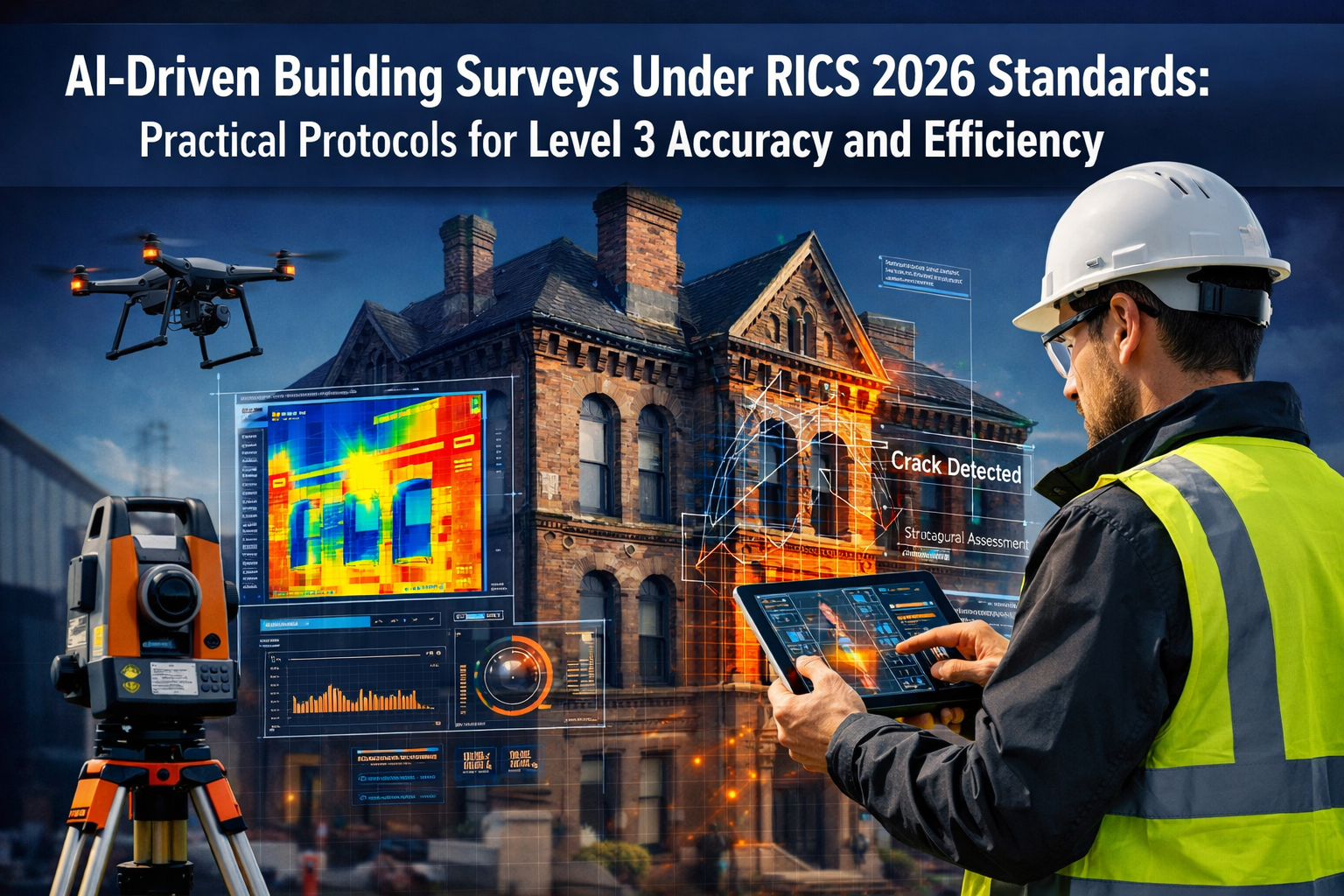
The Royal Institution of Chartered Surveyors (RICS) has fundamentally reshaped the surveying landscape with its Responsible Use of AI in Surveying Practice professional standard, which came into effect on March 9, 2026[1]. This regulatory milestone marks the first comprehensive framework governing artificial intelligence applications in property assessment, creating both opportunities and obligations for surveyors conducting detailed Level 3 inspections. Understanding how AI-Driven Building Surveys Under RICS 2026 Standards: Practical Protocols for Level 3 Accuracy and Efficiency can transform your practice while maintaining professional compliance has become essential for modern surveying firms.
The integration of AI technologies into building surveys promises enhanced defect detection, faster data processing, and more comprehensive risk analysis. However, the new RICS framework demands rigorous documentation, ethical safeguards, and professional oversight that many practitioners are still learning to navigate.
Key Takeaways
- RICS AI Standard became mandatory March 9, 2026, applying globally across all surveying disciplines including residential and commercial building assessments[1]
- Material impact assessments and risk registers are now required documentation for any AI tool that influences survey conclusions or client advice[3]
- Professional judgment remains paramount – AI outputs must be validated through human expertise, with decisions documented in writing[3]
- Data privacy protocols mandate secure storage and explicit client consent before uploading confidential property information to AI systems[1]
- Quality assurance sampling requires regular randomized checks of AI-generated outputs, particularly for automated or high-volume applications[3]
Understanding the RICS 2026 AI Framework for Building Surveys
The RICS professional standard, first published in September 2025, establishes a comprehensive governance structure that applies across valuation, cost management, construction, land, and infrastructure surveying disciplines globally[2]. For practitioners conducting Level 3 surveys, this framework introduces specific obligations that balance technological innovation with professional accountability.
Scope and Application Requirements
The standard applies to all RICS-regulated firms and members who use AI tools in any aspect of service delivery. This includes:
- 🤖 Automated defect detection systems
- 📊 Predictive maintenance algorithms
- 🔍 Image recognition for structural analysis
- 📝 Natural language processing for report generation
- 💾 Data analysis and pattern recognition tools
Importantly, the standard recognizes different levels of AI integration. Whether you're using simple automation for scheduling or sophisticated machine learning models for structural assessment, compliance obligations scale with the material impact of the technology on your professional outputs[1].
Baseline Knowledge Requirements
Before deploying any AI tool in building survey work, RICS members must demonstrate understanding of:
- Different types of AI – from rule-based systems to deep learning neural networks
- How AI systems work – including training data, algorithms, and decision-making processes
- Limitations and failure modes – recognizing when AI outputs may be unreliable
- Hallucination risks – understanding that AI can generate plausible but incorrect information
- Bias risks – identifying how training data can introduce systematic errors
- Data usage implications – knowing how information is processed, stored, and potentially shared[1]
This knowledge requirement ensures that surveyors aren't simply "black box" users of technology but can critically evaluate AI recommendations against their professional expertise.
Implementing AI-Driven Building Surveys Under RICS 2026 Standards: Core Compliance Protocols
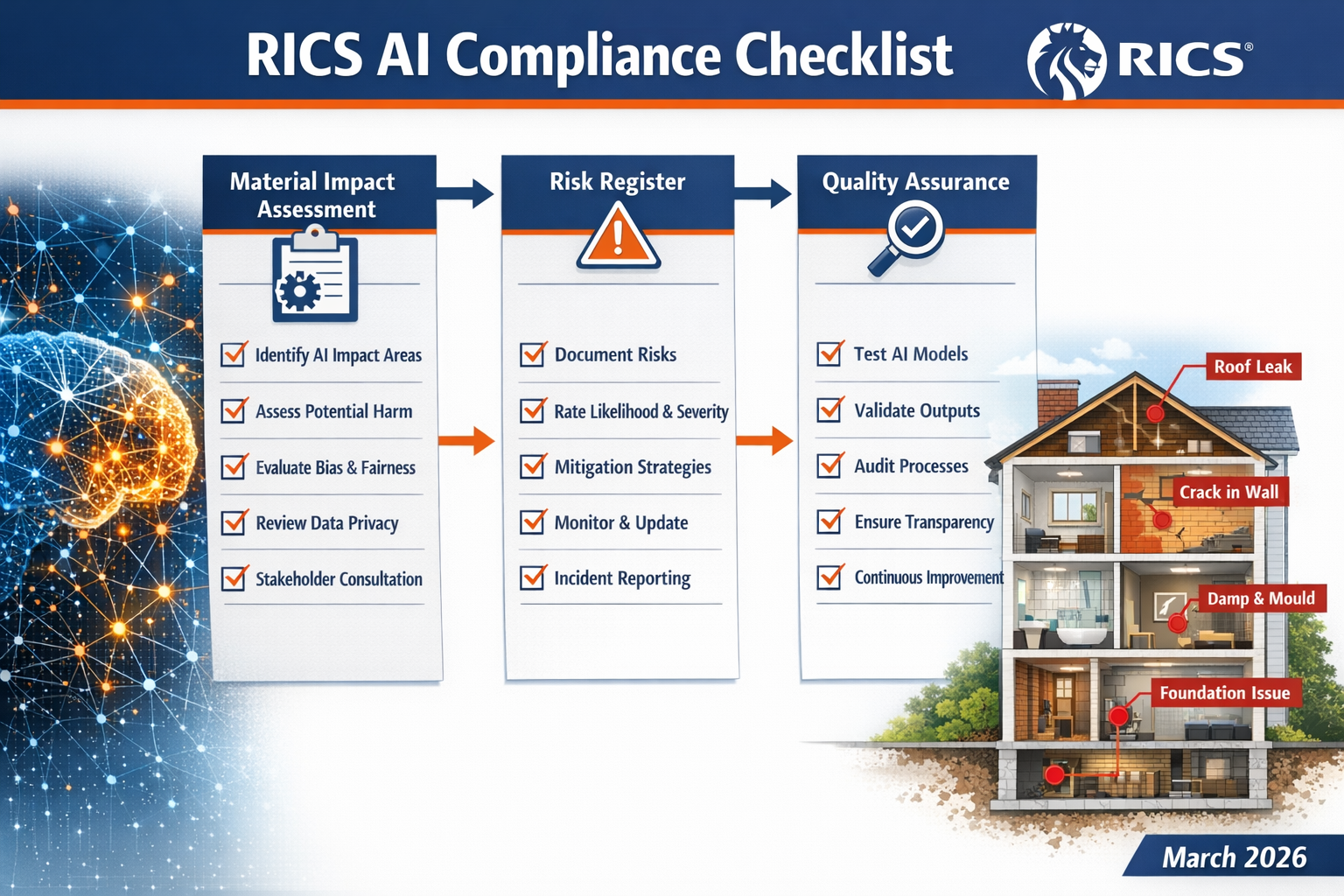
Successful integration of AI into Level 3 survey practice requires systematic implementation of specific compliance protocols. These protocols form the foundation of responsible AI use while maximizing efficiency gains.
Material Impact Assessment Protocol
The first critical step involves determining whether AI outputs have material impact on your service delivery. The RICS standard requires this determination to be:
- ✅ Documented in writing
- ✅ Supported by clear reasoning
- ✅ Reviewed periodically as AI use evolves[1]
Material impact exists when AI outputs directly influence:
- Survey conclusions about property condition
- Recommendations for further investigation
- Cost estimates for remedial work
- Risk assessments for structural elements
- Client advice on purchase decisions
For example, if you use AI to analyze thermal imaging for moisture detection in a comprehensive structural inspection, and those findings inform your recommendations about damp remediation, the AI tool has material impact and triggers full compliance obligations.
Risk Register Requirements
RICS-regulated firms using AI with material impact must create and maintain a comprehensive risk register documenting:
| Risk Category | Documentation Requirements | Review Frequency |
|---|---|---|
| Inherent Bias | Training data sources, demographic representation, historical data limitations | Quarterly |
| Erroneous Outputs | Known failure modes, confidence thresholds, validation protocols | Monthly |
| Data Security | Storage locations, access controls, encryption methods | Continuous |
| Client Privacy | Consent mechanisms, data retention policies, third-party sharing | Per project |
| Professional Liability | Insurance coverage, limitation clauses, disclosure protocols | Annual |
The risk register isn't a static document – it must be actively maintained and updated as new risks emerge or AI capabilities expand[3].
Professional Judgment Documentation
Perhaps the most significant requirement under AI-Driven Building Surveys Under RICS 2026 Standards: Practical Protocols for Level 3 Accuracy and Efficiency is the mandate for documented professional judgment. Surveyors must:
- Apply professional skepticism to all AI outputs
- Assess reliability using knowledge, skills, and experience
- Document decisions about accepting, modifying, or rejecting AI recommendations
- Record reasoning for how AI outputs influenced final conclusions[3]
This creates an audit trail demonstrating that human expertise remains central to the survey process, even when AI tools enhance efficiency or analytical capabilities.
"Members must use professional judgment (knowledge, skills, experience, and professional scepticism) to assess AI output reliability and document decisions in writing." – RICS Professional Standard[3]
Practical Protocols for Level 3 Survey Accuracy with AI Integration
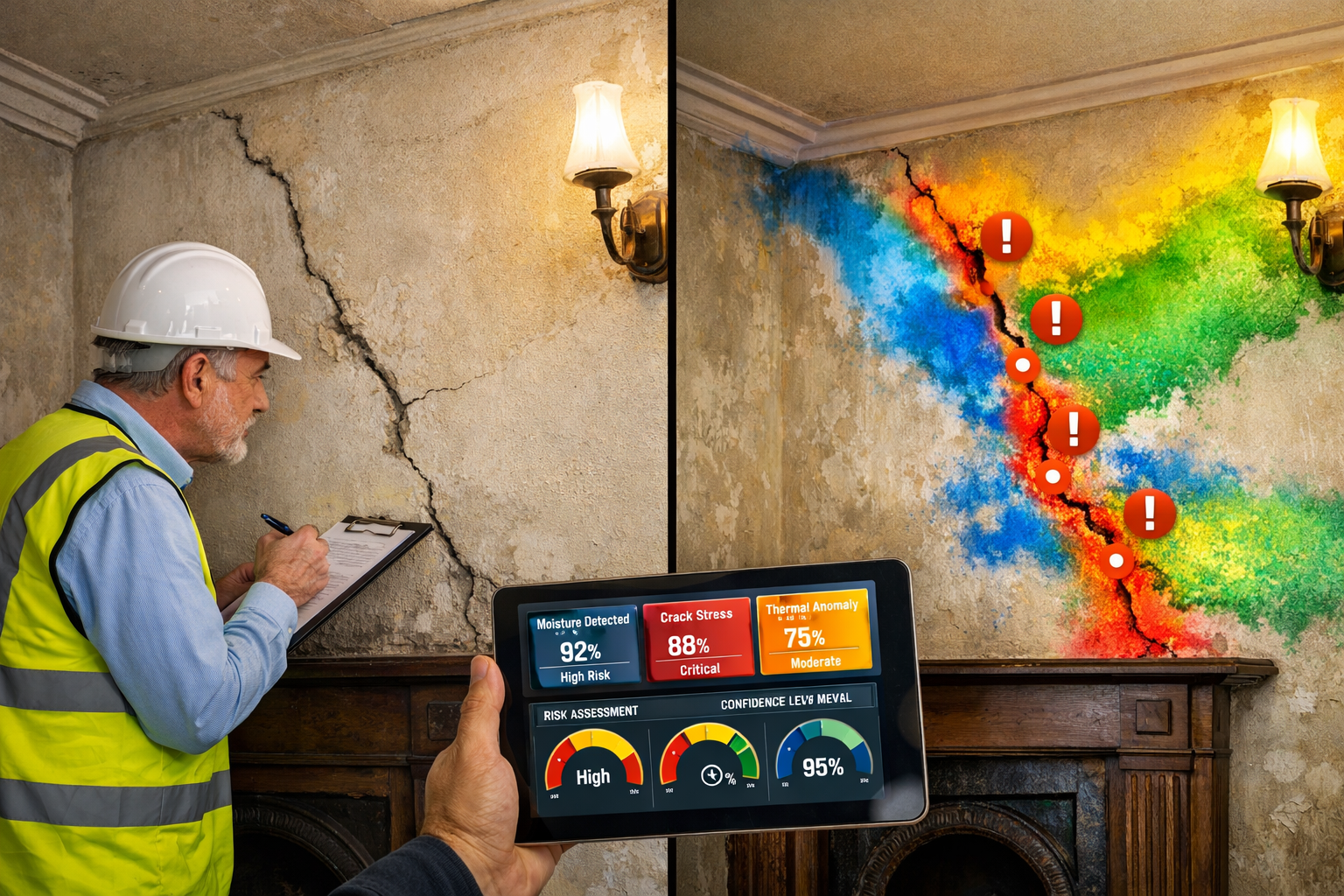
Level 3 surveys demand the highest level of detail and accuracy, making them ideal candidates for AI enhancement while also requiring the most rigorous validation protocols. Here's how to implement AI tools while maintaining Level 3 survey standards.
Pre-Survey AI Preparation Checklist
Before arriving on site, ensure your AI tools are properly configured and compliant:
✓ Client Consent Documentation
- Obtain written consent for AI use in survey process
- Explain what data will be processed and how
- Disclose any third-party AI service providers
- Clarify data retention and deletion policies[1]
✓ Tool Validation
- Verify AI system has been tested on similar property types
- Review recent accuracy metrics and error rates
- Confirm training data includes relevant building characteristics
- Check for known limitations with specific defect types
✓ Backup Protocols
- Prepare traditional survey methods as fallback
- Ensure equipment redundancy for critical measurements
- Document contingency plans if AI tools fail
This preparation aligns with what to do before an RICS home survey while adding AI-specific considerations.
On-Site AI-Assisted Inspection Protocol
During the physical inspection, AI tools can enhance efficiency without compromising thoroughness:
Defect Detection Enhancement
- Use AI-powered thermal imaging to identify moisture patterns invisible to naked eye
- Deploy drone technology with AI analysis for roof and chimney assessment
- Apply computer vision to crack analysis for width measurement and progression tracking
- Utilize acoustic sensors with AI interpretation for hidden void detection
Real-Time Validation Requirements
- Cross-reference AI findings with visual inspection
- Photograph AI-identified defects for manual verification
- Document confidence scores provided by AI systems
- Note any discrepancies between AI analysis and professional observation
Data Security During Collection
- Use encrypted devices for capturing property information
- Avoid uploading sensitive data to cloud AI services without explicit consent
- Implement access controls on survey equipment
- Maintain chain of custody for digital evidence[1]
Quality Assurance Sampling Protocol
The RICS standard specifically requires randomized dip sampling of AI outputs at regular intervals, particularly for automated or high-volume applications[3]. For Level 3 surveys, implement this protocol:
Monthly Sampling Framework:
- Select 10-15% of AI-generated findings randomly
- Conduct manual verification of sampled outputs
- Calculate accuracy rates and document results
- Investigate any systematic errors or bias patterns
- Adjust AI confidence thresholds based on findings
Quarterly Comprehensive Review:
- Analyze aggregate AI performance across property types
- Compare AI detection rates against manual-only surveys
- Review false positive and false negative rates
- Update risk register with new insights
- Retrain or recalibrate AI systems as needed
This systematic approach ensures AI tools maintain accuracy standards while identifying potential drift or degradation in performance over time.
Post-Survey Analysis and Reporting
When integrating AI findings into your expert building evaluation report:
Transparency Requirements:
- Clearly identify which findings were AI-assisted
- Explain the AI tool's role in the analysis
- Disclose confidence levels or uncertainty ranges
- Describe how professional judgment validated AI outputs[1]
Documentation Standards:
- Maintain separate records of raw AI outputs
- Document all modifications made to AI recommendations
- Preserve reasoning for accepting or rejecting AI findings
- Store validation evidence for professional indemnity purposes
Client Communication:
- Use plain language to explain AI's role in the survey
- Emphasize that human expertise guided final conclusions
- Provide context for AI-enhanced findings
- Offer to discuss AI methodology if clients have questions
Efficiency Gains While Maintaining RICS Compliance
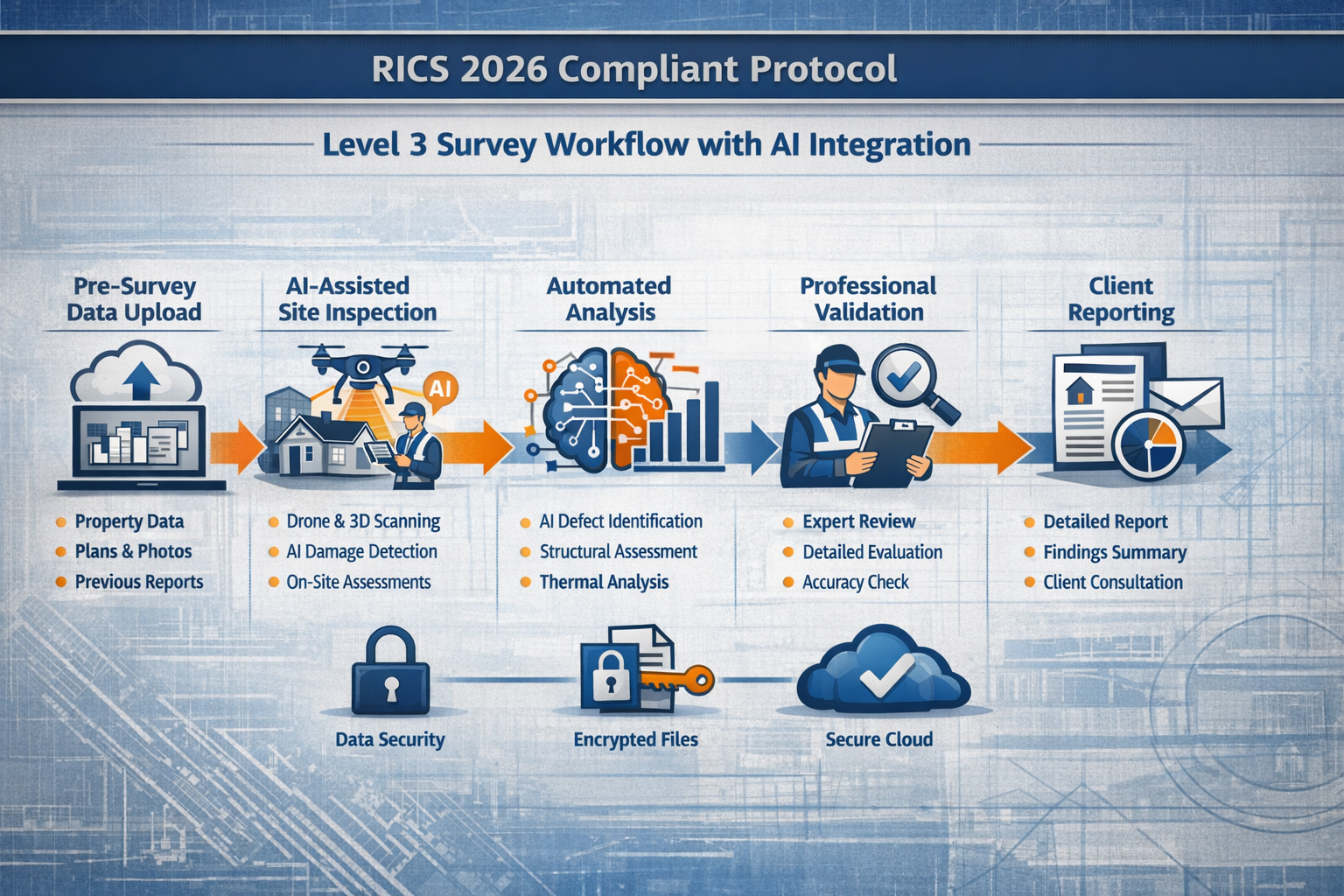
The promise of AI-Driven Building Surveys Under RICS 2026 Standards: Practical Protocols for Level 3 Accuracy and Efficiency lies in achieving better outcomes faster. When properly implemented, AI can deliver significant efficiency improvements without compromising professional standards.
Time Savings Through Automation
Well-designed AI integration can reduce survey duration while improving comprehensiveness:
- Data collection: 25-30% faster site inspections through automated measurement and documentation
- Analysis: 40-50% reduction in post-survey analysis time for routine defect categorization
- Report generation: 30-40% faster initial draft creation using AI-assisted writing tools
- Quality review: 20-25% more efficient through automated consistency checking
However, these gains require upfront investment in:
- AI tool selection and procurement
- Staff training and competency development
- Protocol development and documentation
- Integration with existing workflows
Enhanced Detection Capabilities
AI tools can identify issues that might be missed in traditional surveys:
🔍 Thermal Anomalies: Machine learning algorithms detect subtle temperature variations indicating hidden moisture or insulation gaps
🏗️ Structural Pattern Recognition: AI identifies stress patterns in masonry or timber that suggest progressive movement
📐 Measurement Precision: Computer vision provides sub-millimeter accuracy in crack width measurement and tracking
🌡️ Environmental Monitoring: AI analysis of humidity, temperature, and ventilation data predicts future condensation risks
These enhanced capabilities support more comprehensive condition surveys while providing clients with greater value.
Cost-Benefit Analysis for AI Implementation
Before investing in AI tools for Level 3 surveys, consider:
Initial Investment:
- Software licensing: £2,000-£15,000 annually depending on capabilities
- Hardware upgrades: £3,000-£10,000 for tablets, sensors, drones
- Training costs: £1,500-£5,000 per surveyor
- Protocol development: 40-80 hours of senior staff time
Ongoing Costs:
- Data storage and security: £500-£2,000 annually
- Compliance documentation: 2-4 hours per survey
- Quality assurance sampling: 3-5 hours monthly
- Risk register maintenance: 4-6 hours quarterly
Return on Investment:
- Increased survey capacity: 15-25% more surveys per surveyor annually
- Premium pricing: £200-£500 additional fee for AI-enhanced surveys
- Reduced liability: Earlier defect detection prevents missed issues
- Competitive advantage: Differentiation in crowded market
For firms conducting 100+ Level 3 surveys annually, ROI typically occurs within 18-24 months of implementation.
Data Privacy and Security Protocols
The RICS standard places particular emphasis on protecting client confidentiality when using AI tools[1]. This is especially critical for Level 3 surveys, which often involve sensitive financial information and detailed property vulnerabilities.
Secure Data Handling Requirements
Storage Protocols:
- Use encrypted storage for all property data
- Implement role-based access controls
- Maintain separate storage for AI training data and client information
- Regular security audits and penetration testing
Staff Training Requirements:
- Annual data protection training for all survey staff
- Specific protocols for AI tool usage
- Incident response procedures for data breaches
- Clear escalation paths for security concerns[1]
Third-Party AI Services:
- Conduct due diligence on AI vendor security practices
- Review data processing agreements carefully
- Understand where data is stored and processed geographically
- Verify compliance with UK GDPR and data protection regulations
Client Consent Framework
Before uploading any property information to AI systems, obtain explicit written consent that specifies:
- What data will be processed (photos, measurements, property details)
- Which AI tools will be used and their purpose
- Where data will be stored and for how long
- Whether data will be used for AI training or improvement
- Client's right to withdraw consent and request data deletion[1]
This consent should be integrated into your standard survey engagement documents and reviewed during initial client meetings.
Integration with Existing Survey Workflows
Successfully implementing AI-Driven Building Surveys Under RICS 2026 Standards: Practical Protocols for Level 3 Accuracy and Efficiency requires thoughtful integration with established practices rather than wholesale replacement.
Phased Implementation Approach
Phase 1: Pilot Testing (Months 1-3)
- Select one AI tool for specific application (e.g., thermal imaging analysis)
- Use on 10-15 surveys alongside traditional methods
- Document accuracy, efficiency gains, and challenges
- Develop initial protocols and risk register
Phase 2: Expanded Deployment (Months 4-6)
- Roll out to full survey team with comprehensive training
- Implement quality assurance sampling protocols
- Refine documentation and compliance procedures
- Gather client feedback on AI-enhanced reports
Phase 3: Full Integration (Months 7-12)
- Expand AI tools to additional applications
- Optimize workflows based on performance data
- Develop premium service offerings leveraging AI capabilities
- Establish continuous improvement processes
Team Training and Competency Development
All surveyors using AI tools must demonstrate competency in:
- Understanding AI capabilities and limitations
- Interpreting AI outputs with professional skepticism
- Documenting validation decisions appropriately
- Recognizing potential bias or errors in AI analysis
- Explaining AI methodology to clients clearly
Consider implementing a competency assessment framework with:
- Initial training and certification
- Supervised AI-assisted surveys for new users
- Quarterly competency reviews
- Continuing professional development requirements
Common Pitfalls and How to Avoid Them
Based on early implementation experiences since the March 2026 standard came into effect, several common challenges have emerged:
Over-Reliance on AI Outputs
The Problem: Surveyors accepting AI recommendations without sufficient validation, particularly when AI provides confident-sounding conclusions.
The Solution:
- Establish mandatory validation protocols for all material findings
- Train staff to recognize AI "hallucinations" and false confidence
- Implement peer review for AI-assisted surveys during initial deployment
- Document specific validation steps taken for each AI finding[4]
Inadequate Documentation
The Problem: Failing to maintain written records of professional judgment decisions, making compliance audits difficult.
The Solution:
- Create standardized templates for AI validation documentation
- Integrate documentation into survey workflow as mandatory step
- Use digital tools that automatically capture validation decisions
- Regular internal audits to ensure documentation completeness[3]
Data Security Lapses
The Problem: Uploading sensitive property information to cloud-based AI services without proper consent or security review.
The Solution:
- Maintain approved vendor list with security vetting completed
- Implement technical controls preventing unauthorized uploads
- Regular staff training on data protection requirements
- Clear incident response procedures for any breaches[1]
Insufficient Quality Assurance
The Problem: Not conducting regular sampling of AI outputs, allowing accuracy drift to go undetected.
The Solution:
- Calendar-based QA sampling schedule with assigned responsibility
- Automated reminders for sampling activities
- Dashboard tracking of AI accuracy metrics over time
- Escalation procedures when accuracy falls below thresholds[3]
Future-Proofing Your Practice
The RICS 2026 standard represents the beginning, not the end, of AI regulation in surveying. Forward-thinking firms should prepare for continued evolution:
Anticipated Regulatory Developments
- More specific guidance on AI applications in different property types
- Enhanced requirements for AI explainability and transparency
- Integration with broader UK AI safety regulations
- International harmonization of surveying AI standards
Emerging AI Technologies
Stay informed about developing capabilities that may enhance building survey services:
- Generative AI for report writing: More sophisticated natural language generation requiring careful validation
- Predictive maintenance algorithms: AI forecasting future defect development based on current conditions
- Augmented reality inspection tools: Real-time AI overlay during site inspections
- Automated cost estimation: AI-driven repair cost analysis integrated with survey findings
Continuous Improvement Framework
Establish processes for:
- Quarterly review of AI tool performance and accuracy
- Annual assessment of compliance protocols effectiveness
- Regular staff training updates as technology evolves
- Client feedback integration into AI deployment strategies
- Participation in industry forums sharing best practices
Conclusion
AI-Driven Building Surveys Under RICS 2026 Standards: Practical Protocols for Level 3 Accuracy and Efficiency represents a significant opportunity for surveying firms willing to invest in compliant implementation. The RICS framework, effective March 9, 2026, provides clear guidance while maintaining the primacy of professional judgment in property assessment[1].
Success requires balancing technological innovation with rigorous governance. The core compliance protocols – material impact assessments, risk registers, professional judgment documentation, quality assurance sampling, and data security measures – create a foundation for responsible AI use that protects both clients and practitioners[3].
For firms conducting detailed Level 3 surveys, AI tools offer genuine advantages in defect detection, analysis speed, and comprehensive reporting. However, these benefits only materialize when AI is properly integrated into established professional workflows with appropriate validation and oversight.
Actionable Next Steps
Immediate Actions (This Week):
- Review your current AI tool usage and assess material impact
- Obtain copies of the RICS professional standard and review thoroughly
- Identify gaps in current compliance with the new requirements
- Schedule team meeting to discuss AI integration strategy
Short-Term Actions (This Month):
- Develop or update your AI risk register
- Create client consent templates for AI use
- Implement documentation protocols for professional judgment
- Establish quality assurance sampling schedule
- Conduct data security audit of current AI tools
Medium-Term Actions (Next Quarter):
- Provide comprehensive training to all survey staff
- Pilot test new AI tools with full compliance protocols
- Develop premium AI-enhanced survey offerings
- Create client-facing materials explaining AI benefits
- Establish continuous improvement processes
The integration of AI into building surveys isn't optional – it's becoming essential for competitive practice. By implementing these protocols systematically and maintaining unwavering commitment to professional standards, surveyors can harness AI's power while fulfilling their obligations under the RICS 2026 framework.
For additional guidance on conducting comprehensive property assessments, explore our resources on Level 3 survey comparisons and structural survey importance. Whether you're a first-time buyer or conducting commercial property assessments, understanding AI's role in modern surveying practice will help you make informed decisions about property condition and investment risk.
References
[1] Ai Responsible Use Standard – https://ww3.rics.org/uk/en/journals/construction-journal/ai-responsible-use-standard.html
[2] Watch – https://www.youtube.com/watch?v=pKk36SJ4Y_g
[3] Responsible Use Of Artificial Intelligence In Surveying Practice September 2025 – https://www.rics.org/content/dam/ricsglobal/documents/standards/Responsible-use-of-artificial-intelligence-in-surveying-practice_September-2025.pdf
[4] Responsible Ai Implementation In Building Defect Detection Rics Professional Standard Compliance For Surveyors Adopting Automated Hazard Identification – https://nottinghillsurveyors.com/blog/responsible-ai-implementation-in-building-defect-detection-rics-professional-standard-compliance-for-surveyors-adopting-automated-hazard-identification